

Methods for the thematic synthesis of qualitative research in systematic reviews
Open accessThe DOI matches its Crossref record; 60 of the 64 references it cites were found in a registry or an index; 3 of the 48 sources its claims cite were checked for support.
Abstract
BACKGROUND: There is a growing recognition of the value of synthesising qualitative research in the evidence base in order to facilitate effective and appropriate health care. In response to this, methods for undertaking these syntheses are currently being developed. Thematic analysis is a method that is often used to analyse data in primary qualitative research. This paper reports on the use of this type of analysis in systematic reviews to bring together and integrate the findings of multiple qualitative studies. METHODS: We describe thematic synthesis, outline several steps for its conduct and illustrate the process and outcome of this approach using a completed review of health promotion research. Thematic synthesis has three stages: the coding of text 'line-by-line'; the development of 'descriptive themes'; and the generation of 'analytical themes'. While the development of descriptive themes remains 'close' to the primary studies, the analytical themes represent a stage of interpretation whereby the reviewers 'go beyond' the primary studies and generate new interpretive constructs, explanations or hypotheses. The use of computer software can facilitate this method of synthesis; detailed guidance is given on how this can be achieved. RESULTS: We used thematic synthesis to combine the studies of children's views and identified key themes to explore in the intervention studies. Most interventions were based in school and often combined learning about health benefits with 'hands-on' experience. The studies of children's views suggested that fruit and vegetables should be treated in different ways, and that messages should not focus on health warnings. Interventions that were in line with these suggestions tended to be more effective. Thematic synthesis enabled us to stay 'close' to the results of the primary studies, synthesising them in a transparent way, and facilitating the explicit production of new concepts and hypotheses. CONCLUSION: We compare thematic synthesis to other methods for the synthesis of qualitative research, discussing issues of context and rigour. Thematic synthesis is presented as a tried and tested method that preserves an explicit and transparent link between conclusions and the text of primary studies; as such it preserves principles that have traditionally been important to systematic reviewing.
Overview
CoChat Summary
TL;DR
This paper describes thematic synthesis, a three-stage method for integrating qualitative findings in systematic reviews: line-by-line coding, descriptive themes, and analytical themes. It illustrates the method with a review of children’s views on healthy eating and argues it preserves transparency while enabling new interpretive constructs.
Key findings
- Thematic synthesis has three overlapping stages: free line-by-line coding, development of descriptive themes, and generation of analytical themes; descriptive themes remain close to primary studies, while analytical themes go beyond them.
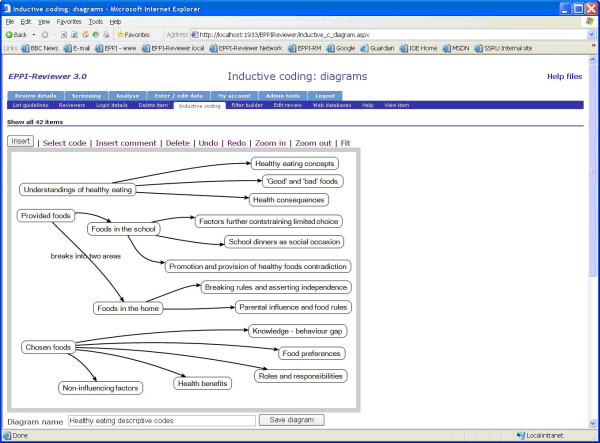
- In the example review, eight relevant qualitative studies yielded 36 initial codes, 12 descriptive themes, six analytical themes, and ten intervention recommendations.
- Six main issues emerged from children’s views: children do not see it as their role to be interested in health; future-health messages are not personally relevant or credible; fruit, vegetables and confectionery have different meanings; children seek food choices; eating is valued as a social occasion; and children see contradictions between promoted theory and adult practice.
- Most interventions were school-based and combined health-benefit learning with hands-on experience; interventions aligned with children’s views tended to be more effective, while multi-component physical activity plus healthy eating interventions worked less well than healthy-eating-only ones.
Methods
- Methodological paper describing thematic synthesis, illustrated with a completed systematic review of barriers to and facilitators of healthy eating among children aged four to 10 years.
- Searching involved extensive grey literature, author contact, and manual journal screening; quality was assessed using 12 criteria covering reporting, validity/reliability strategies, and appropriateness for children’s perspectives.
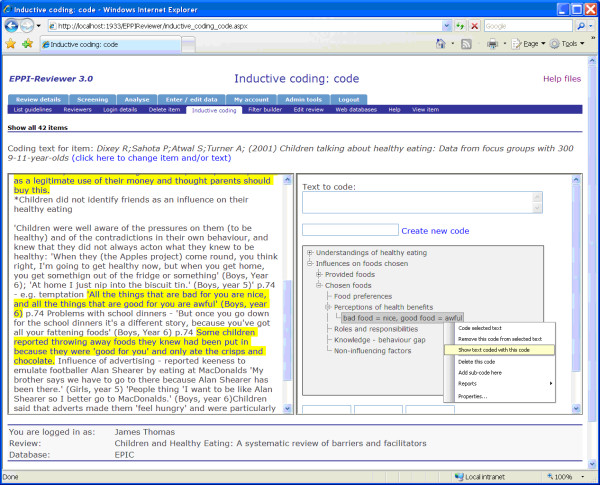
- Findings text labelled results/findings was entered verbatim into NVivo/EPPI-Reviewer; three reviewers independently coded line-by-line, grouped codes into descriptive themes, then generated analytical themes through group discussion and review questions.
Limitations
- Stated: contextual information in primary reports was very restricted, making it difficult to use context fully; there is little consensus on assessing qualitative quality and no accepted or empirically tested methods for excluding studies on quality, so all studies were included regardless of quality.
- Stated: the analytical-theme stage depends on reviewers’ judgement and insights and is potentially controversial; sensitivity analysis was done after synthesis by examining relative contributions of studies, finding poorer-quality studies contributed comparatively little and contained few unique themes.
- Evident: the method is illustrated with a single example review rather than compared empirically with other synthesis methods; the paper does not report a formal validation or inter-rater reliability for the synthesis.
Model-written summary. Check it against the paper before relying on it.
Integrity signals
Registry
Cites
Statistics
Figures
Verification
Claims the paper makes
3 Valid · 1 Not valid · 20 Not checked · 63 Own results and interpretations
A result the paper reports from its own data — it cites no other source for it, so there is none to check. The quote shows it is in the paper.
In the paper
“we found that there was very little difference in the methods we had to use to find qualitative studies compared to the methods we use when searching for studies for inclusion in a meta-analysis.”
§ Methods for the thematic synthesis of qualitative research in systematic reviews > Methods > Searching
plain- Asserted: passes — The authors put it forward as true.
- Checkable: passes — It can be checked against evidence.
- Load-bearing: unclear — It is unclear whether the paper’s conclusions depend on it.
- Based: passes — The paper gives a reason why it holds.
A result the paper states — it cites no source for it, so there is none to check. The quote shows it is in the paper.
In the paper
“Interventions that were in line with these suggestions tended to be more effective.”
§ Methods for the thematic synthesis of qualitative research in systematic reviews > Abstract > Results
hedgedstates an association- Asserted: passes — The authors put it forward as true.
- Checkable: passes — It can be checked against evidence.
- Load-bearing: passes — The paper’s conclusions depend on it.
- Based: passes — The paper gives a reason why it holds.
A result the paper states — it cites no source for it, so there is none to check. The quote shows it is in the paper.
In the paper
“In our review, it was not possible to rely on simple electronic searches of databases.”
§ Methods for the thematic synthesis of qualitative research in systematic reviews > Methods > Searching
plain- Asserted: passes — The authors put it forward as true.
- Checkable: passes — It can be checked against evidence.
- Load-bearing: unclear — It is unclear whether the paper’s conclusions depend on it.
- Based: passes — The paper gives a reason why it holds.
A result the paper reports from its own data — it cites no other source for it, so there is none to check. The quote shows it is in the paper.
In the paper
“In the event, we did not find any themes that belonged to a specific group, but another outcome of this process was a realisation that the contextual information given in the reports of studies was very restricted indeed.”
§ Methods for the thematic synthesis of qualitative research in systematic reviews > Discussion > Context and rigour in thematic synthesis
plain- Asserted: passes — The authors put it forward as true.
- Checkable: passes — It can be checked against evidence.
- Load-bearing: unclear — It is unclear whether the paper’s conclusions depend on it.
- Based: passes — The paper gives a reason why it holds.
A result the paper states — it cites no source for it, so there is none to check. The quote shows it is in the paper.
In the paper
“Interventions targeted at people with particular risk factors worked better than others, and multi-component interventions that combined the promotion of physical activity with healthy eating did not work as well as those that only concentrated on healthy eating.”
§ Methods for the thematic synthesis of qualitative research in systematic reviews > Results
plainstates a cause- Asserted: passes — The authors put it forward as true.
- Checkable: passes — It can be checked against evidence.
- Load-bearing: passes — The paper’s conclusions depend on it.
- Based: passes — The paper gives a reason why it holds.
25 more claims
Create a free account to see all 87 claims and to verify the 9 references still open.
- It may state two separate claims as one. 26
- Probably not a substantial claim. 45
Claims other papers make about this one
Each is checked against this paper’s own text: does it say what the citing paper says it does?
The source backs part of the claim, not all of it — or backs it for a different population, condition or comparison.
In the citing paper
“A thematic synthesis approach was used to integrate findings from studies with diverse methodological designs, following three key stages (Thomas & Harden, 2008).”
From Mind the gap: a systematic review of barriers, facilitators, and experiences of care transitions for people living with dementia and their informal caregivers. (2026) · cites this paper as Thomas & Harden, 2008
Experimental — accuracy not yet measuredThe source backs part of the claim, not all of it — or backs it for a different population, condition or comparison.
In the citing paper
“The thematic coding frame in Table 2 was applied to all included studies and reviewed for consistency of interpretation. This process, known as “axial coding,” ensured coded themes remained connected to and understood within the context of the source studies [13].”
From Patient-Perceived Factors Influencing Physical Activity Sensor Use in Stroke Prevention and Rehabilitation: Systematic Review of Qualitative Studies Using Thematic Synthesis (2026) · cites this paper as [13]
Experimental — accuracy not yet measuredThe source backs part of the claim, not all of it — or backs it for a different population, condition or comparison.
In the citing paper
“These data will be analysed following a three-step process. First, study data will be coded line by line by the first reviewer and checked by a second reviewer with a coding frame developed from codes derived from the data.”
From Effectiveness and acceptability of cognitive-behavioural therapy based interventions for maternal peripartum depression: A systematic review, meta-analysis and thematic synthesis protocol (2019) · cites this paper as [104]
Experimental — accuracy not yet measuredThe cited source says what the claim attributes to it.
In the citing paper
“The data coding, extraction and synthesis process was an iterative process, aligned with the thematic synthesis process outlined by Thomas 2008.”
From Health workers' perceptions and experiences of using mHealth technologies to deliver primary healthcare services: a qualitative evidence synthesis (2020) · cites this paper as Thomas 2008
The cited source says what the claim attributes to it.
In the citing paper
“To ensure the scientific reliability and trustworthiness of the findings, the qualitative analysis followed a thematic synthesis approach [25].”
From Sustainable Value Creation in Nonprofit Organizations: Processes, Determinants, and Strategic Dimensions (2026) · cites this paper as [25]
31 more claims about this paper
Create a free account to see every claim other papers make about this one.
Citations
Cites
Using thematic analysis in psychology
Braun, V., & Clarke, V. (2006) · Qualitative Research in Psychology · doi:10.1191/1478088706qp063oa · Cited by 194,414
(1997) · Cited by 4,204
Systematic reviews in the social sciences: a practical guide
(2006) · Choice Reviews Online · doi:10.5860/choice.43-5664 · Cited by 4,089
The Handbook of Research Synthesis.
Howel, D., Cooper, H., & Hedges, L. V. (1995) · Biometrics · doi:10.2307/2533295 · Cited by 3,642
Systematic Reviews in the Social Sciences: A Practical Guide
Petticrew, M., & Roberts, H. (2006) · doi:10.1002/9780470754887 · Cited by 3,586
Assessing the quality of controlled clinical trials
Jüni, P., Altman, D. G., & Egger, M. (2001) · BMJ · doi:10.1136/bmj.323.7303.42 · Cited by 3,309
Noblit, G., & Hare, R. (1988) · doi:10.4135/9781412985000 · Cited by 2,723
Qualitative Research: Rigour and qualitative research
Mays, N., & Pope, C. (1995) · BMJ · doi:10.1136/bmj.311.6997.109 · Cited by 2,715
Systematic Reviews in Health Care : Meta-Analysis in Context
Egger, M., Smith, G. D., & Altman, D. G. (2000) · Cited by 2,417
Dixon-Woods, M., Cavers, D., Agarwal, S., Annandale, E., Arthur, A., Harvey, J., Hsu, R., Katbamna, S., Olsen, R., Smith, L., et al. (2006) · BMC Medical Research Methodology · doi:10.1186/1471-2288-6-35 · Cited by 2,289
Research works printed but not linked: 9
- EPPI-Centre EPPI-Centre Methods for Conducting Systematic Reviews 2006 London: EPPI-Centre, Social Science Research Unit, Institute of Education, University of London
- Higgins J Green S (Eds) Cochrane Handbook for Systematic Reviews of Interventions 426 2006 Updated September 2006. Accessed 24th January 2007
- Sandelowski M Barroso J Handbook for Synthesising Qualitative Research 2007 New York: Springer
- Oakley A Experiments in Knowing: Gender and methods in the social sciences 2000 Cambridge: Polity Press
- Shepherd J Harden A Rees R Brunton G Oliver S Oakley A Young People and Healthy Eating: A systematic review of barriers and facilitators 2001 London: EPPI-Centre, Social Science Research Unit, Institute of Education, University of London
- Popay J Moving Beyond Effectiveness in Evidence Synthesis 2006 London: National Institute for Health and Clinical Excellence
- Boyatzis RE Transforming Qualitative Information 1998 Sage: Cleveland
- Medical Sociology Group Criteria for the evaluation of qualitative research papers Med Sociol News 1996 22 68 71
- Thomas J Brunton J EPPI-Reviewer 30: Analysis and management of data for research synthesis EPPI-Centre software 2006 London: EPPI-Centre, Social Science Research Unit, Institute of Education
Cited by
Items 8,301–8,400 of 9,166
Ayob, M. B., Abdullah, N., Hroub, S., et al. (2026) · Archives of Computational Methods in Engineering · doi:10.1007/s11831-026-10595-7
Gillan, E., Byrne, G., & Watters, J. (2026) · Mindfulness · doi:10.1007/s12671-026-02846-2
Wong, C. M., Piersol, C. V., Chew, F. M., Lekovitch, C. A., Shier, V., Morris, M., Martínez, J., Britton, J., & Leland, N. E. (2026) · Journal of Evaluation in Clinical Practice · doi:10.1111/jep.70451
Advanced analytics in marketing: Driving customer centric strategies in the digital economy
Velala, S. K., Azhar, A., & Jeba, B. S. (2026) · Journal of Progress in Artificial Intelligence · doi:10.68152/1526
Influencia de los estilos de liderazgo en PYMES: revisión sistemática 2020–2025
Martinez, E. T. F., Cabrera-Gala, R., Sanchez, A. J. G., et al. (2026) · Revista Multidisciplinaria Voces de América y el Caribe · doi:10.69821/remuvac.v3i1.306
Vinitha, M., V (2026) · International Journal of Administration and Management Research Studies (IJAMRS) · doi:10.63090/ijamrs/3107.9695.0025
A scoping review of narrative analysis in studies of rural depopulation and land abandonment
Salvia, R., Saulle, M. M. M., & Quaranta, G. (2026) · Discover Sustainability · doi:10.1007/s43621-026-03328-0
Kurva, R. (2026) · SSRN Electronic Journal · doi:10.2139/ssrn.6661019
Enablers of incremental innovation in construction firms: a systematic literature review
Abidin, N. Z., & Teoh, A. Y. X. (2026) · Built Environment Project and Asset Management · doi:10.1108/bepam-07-2025-0209
Green Finance and Sustainable Investment Trends.Preprint
Chauhan, D. (2026) · SSRN Electronic Journal · doi:10.2139/ssrn.6659558
Yan, W., Frey, R., Raphael, D. L., & Gott, M. (2026) · Palliative Medicine · doi:10.1177/02692163261441427
Gendered volunteer pathways and governance in community sport: a systematic review
Zhu, Z. (2026) · International Journal of Sport Policy and Politics · doi:10.1080/19406940.2026.2662211
Moorhead, A., Lynch, L., Quigley, F., Miras, A. D., & Crotty, M. (2026) · Journal of Healthcare Leadership · doi:10.2147/jhl.s563803
Liu, J., Pan, X., Zhu, Z., et al. (2026) · Research Square · doi:10.21203/rs.3.rs-9393848/v1
Amoah-Oppong, D., & ACHEAMPONG, B. (2026) · Research Square · doi:10.21203/rs.3.rs-9544668/v1
Fiserova, A., Duchonova, S., Hafiz, H., Hagarova, M., Morton, B., Tessmann, H., Graham, C. D., & Rickardsson, N. (2026) · Clinical Rehabilitation · doi:10.1177/02692155261446313
Shirane, T., Okasawara, D. S., de Oliveira‐Cardoso, É. A., & Santos, M. A. R. I. A. N. (2026) · Cadernos de Saúde Pública · doi:10.1590/0102-311xen181525
The menopausal transition and women's workplace identity: A qualitative systematic review
van de Wall, S., Dempsey, M., Dockray, S., & Foley, S. (2026) · SSM - Qualitative Research in Health · doi:10.1016/j.ssmqr.2026.100774 · Cited by 1
Yohanes, Y., Tohirin, A., Wuysang, J. M., Cosella, M., & Cosella, N. (2026) · F1000Research · doi:10.12688/f1000research.180184.1
Mekonnen, G. T., Lin, L. S. F., Aslett, D., & Allan, D. M. C. (2026) · World · doi:10.3390/world7050075 · Cited by 2
Nauphoeta cinerea as a useful model organism in insecticide research
Oladepo, A. J., Nwawuba, S. U., Mohammed, K. A., Adeoye, A. A., Godswill, U.-A. S., Oyedele, G. T., Olaseni, A. A., Babalola, A. A., Aschner, M., da Rocha, J. B. T., et al. (2026) · Toxicology Research · doi:10.1093/toxres/tfag029
Polydoros, G., Vasileiou, I., Krokou, Z., & Antoniou, A.-S. (2026) · Encyclopedia · doi:10.3390/encyclopedia6050098
Minchin, E., Laidsaar‐Powell, R., Kirsten, L. T., Atwell, J., Dewar, E., Gilchrist, J., & Juraskova, I. (2026) · Maturitas · doi:10.1016/j.maturitas.2026.108971 · Cited by 1
Normalizing pre-exposure prophylaxis: a thematic synthesis of self-talk and communication work
Yeo, T. E. D. (2026) · Annals of the International Communication Association · doi:10.1093/anncom/wlag022
Hamzaoui, R., Essalmi, F., & Jemni, M. (2026) · Interactive Learning Environments · doi:10.1080/10494820.2026.2666607
Factors influencing anime-generated parasocial relationships: a systematic review
Archana, V., Arora, A., Saha, P. K. R., Pandey, V., & Jyothiswarup, G. (2026) · BMC Psychology · doi:10.1186/s40359-026-04471-z · Cited by 1
Young, H. M. L., Ancliffe, L., Curtis, F., Efuntoye, O., Graham-Brown, M. P., Lock, S., Parker, K., Rolfe, C., Smith, E., Udofia, A., et al. (2026) · PLoS ONE · doi:10.1371/journal.pone.0348585
Tan, H. W., Arifin, K., & Manaf, A. A. (2026) · Multidisciplinary Reviews · doi:10.31893/multirev.2026521
Kuchel, L. J., & Rowland, S. (2026) · Research in Science Education · doi:10.1007/s11165-026-10340-x · Cited by 1
Asghar, S. (2026) · Multidisciplinary Reviews · doi:10.31893/multirev.2026545
Nyamhanga, T. M., Gitagno, D., Mtei, R. J., Caputo, M., Kaaya, S., Hawkins, C., & Hirschhorn, L. R. (2026) · Journal of the International Association of Providers of AIDS Care (JIAPAC) · doi:10.1177/23259582261446450
Designing and Implementing COIL in Engineering Education: A Process Model and Continuum for Practice
Ukhova, N., Gabelaia, I., Khajedehi, M. H., Sukhodub, I. O., & Carli, M. D. (2026) · Lecture notes in networks and systems · doi:10.1007/978-3-032-18888-5_46
Trew, S., & Russell, D. H. (2026) · Child Psychiatry & Human Development · doi:10.1007/s10578-026-02023-5 · Cited by 1
Bilney, E. V. M., Tse, E. T. Y., Chan, M. M. L., Shi, Q., Ma, J., Parry, J. E., Wong, D. K.-K., Pulido, L., Wong, W. C. W., Chan, L., et al. (2026) · BMJ Open · doi:10.1136/bmjopen-2026-117588
Barabás, Á., Borgmann, K. M., & Noennig, J. R. (2026) · IntechOpen eBooks · doi:10.5772/intechopen.1014853
Zhang, S. (2026) · Frontiers in Psychiatry · doi:10.3389/fpsyt.2026.1799971 · Cited by 1
Rafiq, S., & Afzal, A. (2026) · Sexuality Research and Social Policy · doi:10.1007/s13178-026-01352-3
A systematic review of the social functioning of youth with JIA: Barriers, stigma, and resources
Jelinkova, K., Natasha, K., Twilt, M., Birnie, K. A., & Climie, E. A. (2026) · Journal of Pediatric Psychology · doi:10.1093/jpepsy/jsag032
Bridging the Gap: Embedding Ecosystem Services Into Urban Development Plans for Resilient Cities
Mostafavi, N. S., Asadolahi, Z., Chadegani, D. M., & Rabiei‐Dastjerdi, H. (2026) · Journal of Public Affairs · doi:10.1002/pa.70133
Palliative Extubation – zwischen Sterben und Leben
Hatschka, S., & Pöhner, J. (2026) · intensiv · doi:10.1055/a-2750-7564
Factors Influencing Job Satisfaction in Community Health Nursing: A Mixed Methods Review
Okullu, S., Kerr, L., Larkin, J., & Cithambaram, K. (2026) · Journal of Community Health Nursing · doi:10.1080/07370016.2026.2667174
Dubey, P., Watkins, S. L., Sivakami, M., Baker, K. K., Story, W. T., Fry, L., Ilavarasan, A., & Afifi, R. A. (2026) · Annals of LGBTQ Public and Population Health · doi:10.1891/lgbtq-2025-0010
Damani, A., Ghoshal, A., Gayatri, S., Clark, J., Varghese, C., V, Rao, S., Majumdar, P., & Salins, N. S. (2026) · BMJ Open · doi:10.1136/bmjopen-2026-117775
Asamoah, E. S., Doku, S. T. G., Koomson, S., Osae, E. M., & Mickson, M. K. (2026) · International Journal of Ethics and Systems · doi:10.1108/ijoes-04-2026-0246
Cohen, R., Gannot, R. N., & Sela, Y. (2026) · Human Resources for Health · doi:10.1186/s12960-026-01078-8
Xu, H., Möllerberg, M., Dalhammar, K., Bengtsson, M., & Forss, K. S. (2026) · Nursing and Health Sciences · doi:10.1111/nhs.70352
Kiazolu, J. (2026) · Research Square · doi:10.21203/rs.3.rs-9671286/v1
Hackett, F., O’Donnell, C., Galvin, R., et al. (2026) · European Journal of Oncology Nursing · doi:10.1016/j.ejon.2026.103206
Nyame, S. (2026) · Research Square · doi:10.21203/rs.3.rs-9659705/v1
COVID-19, climate change, and air pollution: a syndemic umbrella review
Jung, E., Lee, E.-Y., & Shin, H. H. (2026) · City and Environment Interactions · doi:10.1016/j.cacint.2026.100381 · Cited by 1
Liyanage, L. S., Naunton, M., Cox, L. S., Sudeshika, T., Peterson, G. M., & Kosari, S. (2026) · International Journal for Quality in Health Care · doi:10.1093/intqhc/mzag063
Northcott, S., Comer, A., Devane, N., Behn, N., Roper, A., Bohan, J. K., & Hilari, K. (2026) · Aphasiology · doi:10.1080/02687038.2026.2663794
Kostenius, C., Pettersson, A., Ivarsson, A., Ryk, C., & Mangrio, E. (2026) · Cogent Psychology · doi:10.1080/23311908.2026.2671532
Sacavém, A., Machado, A. D. B., dos Santos, J. R., et al. (2026) · Sustainability · doi:10.3390/su18104764
Retirement intentions of late-career female nurses: a phenomenological study
Aslan, Y., Zeybek, D. Ö., Zeybek, M. O., Atalay, H. N., & Güvensoy, T. (2026) · BMC Nursing · doi:10.1186/s12912-026-04746-1
Laila, E., Festiyed, Yerimadesi, Y., Yulkifli, & Diliarosta, S. (2026) · Jurnal Penelitian Pendidikan IPA · doi:10.29303/jppipa.v12i4.10145 · Cited by 1
Understanding internship experiences from students’ perspectives: a systematic review
Visser, S., & Grosemans, I. (2026) · Education + Training · doi:10.1108/et-08-2025-0605 · Cited by 2
Cui, C., Zhou, Y., Wang, D., Gong, N., Liang, F., Gao, W., He, Z., Wu, H., Zhang, Y., Tian, Q., et al. (2026) · BMC Psychiatry · doi:10.1186/s12888-026-08108-8
Eide, L. S. P., Jorem, G. T., & Titlestad, K. B. (2026) · Review Journal of Autism and Developmental Disorders · doi:10.1007/s40489-026-00563-z
Mohamed, E. A. S., Mallek, M., Alaawad, H. A., et al. (2026) · Frontiers in Communication · doi:10.3389/fcomm.2026.1823630
Nasrin, N., Haider, M. Z., & Ahsan, M. N. (2026) · Heliyon · doi:10.1016/j.heliyon.2026.e44995
Shankar, R., Lim, A., & Qian, X. (2026) · Discover Public Health · doi:10.1186/s12982-026-02067-x · Cited by 2
Fan, Y., Zhang, H., enyuan, Y., Tian, H., Yu, Y., & Lin, S. (2026) · PLoS ONE · doi:10.1371/journal.pone.0348367
Verma, S., Khetan, M., Dhankhar, R., et al. (2026) · Asian Pacific Journal of Reproduction · doi:10.4103/apjr.apjr_119_25
Experiences in rehabilitation for individuals with acquired amputation: A narrative review
Trent, L. A., & Lisk, C. (2026) · Prosthetics and Orthotics International · doi:10.1097/pxr.0000000000000536
Behn, N., Christensen, I., Cruice, M. N., Hilari, K., Kellar, I., & Togher, L. (2026) · PLoS ONE · doi:10.1371/journal.pone.0349220 · Cited by 1
What do tribes reveal about ecotourism, land, and livelihoods? A scoping review
Ramaprabha, N., & Balamurugan, J. (2026) · Frontiers in Ecology and Evolution · doi:10.3389/fevo.2026.1826086
Huang, Y., & Lee, Y. G. (2026) · Trauma Violence & Abuse · doi:10.1177/15248380261440273
Simpson, D., Miller-Lewis, L. R., & O’Reilly, M. (2026) · Educational Research Review · doi:10.1016/j.edurev.2026.100793
Christiansen, R., Nielsen, J. G., Maagaard, C. A., Wohlmann, A., & Nielsen, A. S. (2026) · Nordic Studies on Alcohol and Drugs · doi:10.1177/14550725261436985 · Cited by 1
Ergonomics in assistive technology design: scoping review
Umbelino, L. L., Ferreira, D. M. T. P., & Alonso, C. M. D. C. (2026) · Disability and Rehabilitation Assistive Technology · doi:10.1080/17483107.2026.2671838 · Cited by 1
(刘灿), C. L., Tian, C., 王向荣, & Wang, F. (2026) · Nurse Education in Practice · doi:10.1016/j.nepr.2026.104860
Laher, Z., Badat, A., Gathoo, A., Notoria, M. M., Cachalia, M., Sardiwalla, Z. M., Monethi, M., & Tlalajoe-Mokhatla, N. (2026) · Futurity Education · doi:10.57125/fed.2026.03.11 · Cited by 2
Digital Leverage for Climate Finance: Insights from Latvia’s Banking Sector
Rupeika-Apoga, R., Keksis, H. E., & Danovi, A. (2026) · World sustainability series · doi:10.1007/978-3-032-19076-5_21
Braddish, S., Houghton, S., Ruane‐McAteer, E., & Fortune, D. G. (2026) · Journal of Health Psychology · doi:10.1177/13591053261446886
CHIGUER, A., Sadik, M., Fail, A., & Youssef, B. (2026) · IEEE International Colloquium on Signal Processing & Its Applications (CSPA) · doi:10.1109/cspa68262.2026.11517664
Bloor, D., & Fayette, R. (2026) · Pastoral Care in Education · doi:10.1080/02643944.2026.2674103
Ashiagbor, J. C., Zeng, F., Zhang, P., et al. (2026) · Research Square · doi:10.21203/rs.3.rs-9616447/v1
Orsi, J. A., Marmirolli, F. A. D. P., de Aquino, P. R. P., de Oliveira, W. F., Slade, M., Andrade, M. C. R., & Gadelha, A. (2026) · Transcultural Psychiatry · doi:10.1177/13634615261445848 · Cited by 3
Ganesh, S., White, P. C. L., & Haque, A. N. (2026) · Frontiers in Environmental Science · doi:10.3389/fenvs.2026.1816386
Akhmadi, A., Zakaria, M. A., Anita, A., Siregar, E. H. H., Runesi, B. T. B., Annurrahman, A., & Novitasari, D. A. (2026) · F1000Research · doi:10.12688/f1000research.181964.1
He, J., Khalid, A., Zhang, R., & Zhang, T. (2026) · Sustainability · doi:10.3390/su18105191
Szabóová, V., Daďová, K., Větrovský, T., González‐Sánchez, M., Vacová, A., & Matoulek, M. (2026) · Obesity Surgery · doi:10.1007/s11695-026-08735-w
Applications of AI Chatbots in Marketing and Customers' Response
Pereira, M. C., & Bacalhau, L. M. (2026) · IGI Global eBooks · doi:10.4018/979-8-3373-7704-9.ch005
Bessone, M., & Nicholl, B. I. (2026) · Journal of Public Health · doi:10.1007/s10389-026-02779-z
Diamandis, S., Thornley, T., Benrimoj, S. I., & Dineen‐Griffin, S. (2026) · Journal of Pharmaceutical Policy and Practice · doi:10.1080/20523211.2026.2670703
Hu, Y. J., CHAN, E. Y., Sipio, M. D., Wang, J., & Yuan, J. (2026) · International Journal of Medical Informatics · doi:10.1016/j.ijmedinf.2026.106506
Vats, S., & Singari, R. M. (2026) · ShodhKosh Journal of Visual and Performing Arts · doi:10.29121/shodhkosh.v7.i11s.2026.8282
Computational Thinking and Career Identity Among Electrical Engineering Students
Ningrum, L. E. C., & Tuwoso, T. (2026) · Jurnal Teknologi Pendidikan · doi:10.47134/jtp.v3i3.2566
Cen, Y., Qiu, R., Liu, Y. C., Zheng, Y., Zhang, Z., Zhu, Y., & Lan, Z. (2026) · Frontiers in Cardiovascular Medicine · doi:10.3389/fcvm.2026.1806112
Islam, M. D. F., Le, B., Jiang, G., et al. (2026) · International Journal of Infectious Diseases · doi:10.1016/j.ijid.2026.108819
de Gans, S. T., Maessen, G. C., van de Pol, M. H. J., van der Zwaard, B. C., & Keijsers, C. J. P. W. (2026) · Journal of Interprofessional Education & Practice · doi:10.1016/j.xjep.2026.100825
Kalita, P., & Haye, A. (2026) · BMC Public Health · doi:10.1186/s12889-026-27808-0
Htay, M. N. N., Oo, M. M. T., Su, T. T., & Donnelly, M. (2026) · BMJ Open · doi:10.1136/bmjopen-2025-109989
Yohanes, Y., & Tohirin, A. (2026) · F1000Research · doi:10.12688/f1000research.182062.1 · Cited by 1
Lam, A. Y. K., Yau, M. K.-S., Franklin, R. C., & Wong, A. L. (2026) · Research Square · doi:10.21203/rs.3.rs-9673108/v1
The FAME Model: Conceptualizing End-of-Life Doulas’ Roles within Compassionate Communities
Donley, S. B., & Pilkington, S. (2026) · OMEGA - Journal of Death and Dying · doi:10.1177/00302228261453449
The GPS for Thinking: How AI Partners Are Reshaping Student MetacognitionPreprint
Amiri, S. M. H., Akter, N., Mithila, M., et al. (2026) · Research Square · doi:10.21203/rs.3.rs-9799303/v1
Metadata
- Authors
- Thomas, J., & Harden, A.
- Affiliations
- University of London (GB)
- Corresponding author
- Thomas, James
- Venue
- BMC Medical Research Methodology
- Published
- 2008-07-10
- Volume
- 8
- Issue
- 1
- Pages
- 45-45
- ISSN
- 1471-2288 (ISSN-L)
- PMC
- PMC2478656
- OpenAlex
- W2109305774
- Cited by
- 9,312
- References
- 64
- Citations by year
- 2026: 1606 · 2025: 1253 · 2024: 1082 · 2023: 899 · 2022: 903 · 2021: 852 · 2020: 606 · 2019: 472 · 2018: 404 · 2017: 318 · 2016: 275 · 2015: 179 · 2014: 141 · 2013: 122 · 2012: 91
- FWCI
- 38.28
- Type
- journal article
- Language
- en
- Open access
- gold
- doi.org
- Licence
- cc-by
- creativecommons.org/licenses/by/2.0 (tdm)
- Locations
- BMC Medical Research Methodology (publishedVersion, cc-by)
- PubMed Central (publishedVersion, cc-by)
- PubMed (publishedVersion)
- UEL Research Repository (University of East London) (acceptedVersion)
- City Research Online (City University London) (acceptedVersion)
- IOE EPrints (submittedVersion)
- UEL Research Repository (University of East London) (submittedVersion, cc-by-nd)
- DOAJ (DOAJ: Directory of Open Access Journals) (submittedVersion, cc-by-sa)
- UCL Discovery (University College London) (submittedVersion)
- Funders
- National Institute for Health and Care Research
- Economic and Social Research Council (RES-576-25-5008)
- Topics
- Social Sciences › Education › Qualitative Research Methods and Applications
- Social Sciences › Decision Sciences › Statistics, Probability and Uncertainty › Meta-analysis and systematic reviews
- Social Sciences › Sociology and Political Science › Delphi Technique in Research
- Keywords
- thematic synthesis, thematic analysis, health promotion interventions, children's perspectives, school-based intervention, fruit and vegetable intake, health messaging
- MeSH terms
- Humans, Methods, Review Literature as Topic, Statistics as Topic, Qualitative Research
About these checks
Registry, retraction, Cites and statistics results are computed, not judged, with one exception: a printed reference that no index lists is read once by a model before it counts as a citation error. Claims are extracted by a model and kept only when their quote appears verbatim in the text; each cited source is then checked, with a model’s help, for whether it says what the claim relies on. Those verdicts can be wrong — read the claim’s quote and the cited source before relying on one.
The claim verdicts this report counts are experimental: their accuracy is not yet measured.
A language model drew the claims from the paper on 2026-10-04, under version 3 of the claim definition (model deepseek-v4.1-flash, prompt extract-v3).
A second model labelled each claim on 2026-10-04 (model jev-1.13-20260917, definition revision gold-guideline-v0.2).
Statistics and arithmetic are recomputed, not judged.
Confidence bands are shown only for fields calibrated on our annotated test set. None is calibrated yet, so no band is shown.
What counts as a claim ›How we measure confidence ›How we check this ›
Are you an author, or do you see a problem with this page? Request a review
Data sources
Bibliographic data: Semantic Scholar, OpenAlex, Crossref.
Contains information from the Semantic Scholar Academic Graph Datasets, made available under the ODC Attribution License (ODC-BY 1.0).
Semantic Scholar’s data is described in: Kinney, R., et al. (2023). The Semantic Scholar Open Data Platform. arXiv:2301.10140.
