

Methods for the thematic synthesis of qualitative research in systematic reviews
Open accessThe DOI matches its Crossref record; 60 of the 64 references it cites were found in a registry or an index; 3 of the 48 sources its claims cite were checked for support.
Abstract
BACKGROUND: There is a growing recognition of the value of synthesising qualitative research in the evidence base in order to facilitate effective and appropriate health care. In response to this, methods for undertaking these syntheses are currently being developed. Thematic analysis is a method that is often used to analyse data in primary qualitative research. This paper reports on the use of this type of analysis in systematic reviews to bring together and integrate the findings of multiple qualitative studies. METHODS: We describe thematic synthesis, outline several steps for its conduct and illustrate the process and outcome of this approach using a completed review of health promotion research. Thematic synthesis has three stages: the coding of text 'line-by-line'; the development of 'descriptive themes'; and the generation of 'analytical themes'. While the development of descriptive themes remains 'close' to the primary studies, the analytical themes represent a stage of interpretation whereby the reviewers 'go beyond' the primary studies and generate new interpretive constructs, explanations or hypotheses. The use of computer software can facilitate this method of synthesis; detailed guidance is given on how this can be achieved. RESULTS: We used thematic synthesis to combine the studies of children's views and identified key themes to explore in the intervention studies. Most interventions were based in school and often combined learning about health benefits with 'hands-on' experience. The studies of children's views suggested that fruit and vegetables should be treated in different ways, and that messages should not focus on health warnings. Interventions that were in line with these suggestions tended to be more effective. Thematic synthesis enabled us to stay 'close' to the results of the primary studies, synthesising them in a transparent way, and facilitating the explicit production of new concepts and hypotheses. CONCLUSION: We compare thematic synthesis to other methods for the synthesis of qualitative research, discussing issues of context and rigour. Thematic synthesis is presented as a tried and tested method that preserves an explicit and transparent link between conclusions and the text of primary studies; as such it preserves principles that have traditionally been important to systematic reviewing.
Overview
CoChat Summary
TL;DR
This paper describes thematic synthesis, a three-stage method for integrating qualitative findings in systematic reviews: line-by-line coding, descriptive themes, and analytical themes. It illustrates the method with a review of children’s views on healthy eating and argues it preserves transparency while enabling new interpretive constructs.
Key findings
- Thematic synthesis has three overlapping stages: free line-by-line coding, development of descriptive themes, and generation of analytical themes; descriptive themes remain close to primary studies, while analytical themes go beyond them.
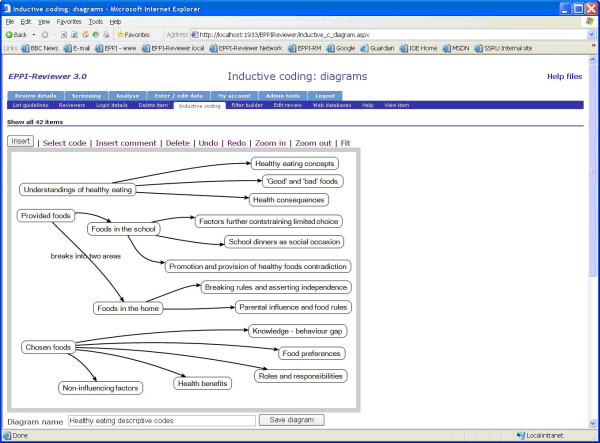
- In the example review, eight relevant qualitative studies yielded 36 initial codes, 12 descriptive themes, six analytical themes, and ten intervention recommendations.
- Six main issues emerged from children’s views: children do not see it as their role to be interested in health; future-health messages are not personally relevant or credible; fruit, vegetables and confectionery have different meanings; children seek food choices; eating is valued as a social occasion; and children see contradictions between promoted theory and adult practice.
- Most interventions were school-based and combined health-benefit learning with hands-on experience; interventions aligned with children’s views tended to be more effective, while multi-component physical activity plus healthy eating interventions worked less well than healthy-eating-only ones.
Methods
- Methodological paper describing thematic synthesis, illustrated with a completed systematic review of barriers to and facilitators of healthy eating among children aged four to 10 years.
- Searching involved extensive grey literature, author contact, and manual journal screening; quality was assessed using 12 criteria covering reporting, validity/reliability strategies, and appropriateness for children’s perspectives.
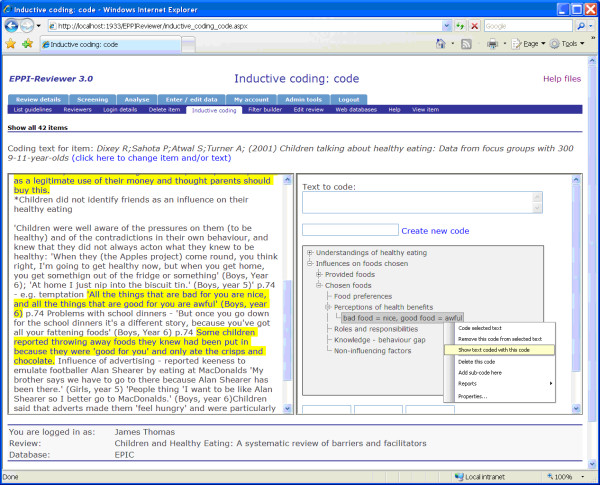
- Findings text labelled results/findings was entered verbatim into NVivo/EPPI-Reviewer; three reviewers independently coded line-by-line, grouped codes into descriptive themes, then generated analytical themes through group discussion and review questions.
Limitations
- Stated: contextual information in primary reports was very restricted, making it difficult to use context fully; there is little consensus on assessing qualitative quality and no accepted or empirically tested methods for excluding studies on quality, so all studies were included regardless of quality.
- Stated: the analytical-theme stage depends on reviewers’ judgement and insights and is potentially controversial; sensitivity analysis was done after synthesis by examining relative contributions of studies, finding poorer-quality studies contributed comparatively little and contained few unique themes.
- Evident: the method is illustrated with a single example review rather than compared empirically with other synthesis methods; the paper does not report a formal validation or inter-rater reliability for the synthesis.
Model-written summary. Check it against the paper before relying on it.
Integrity signals
Registry
Cites
Statistics
Figures
Verification
Claims the paper makes
3 Valid · 1 Not valid · 20 Not checked · 63 Own results and interpretations
A result the paper reports from its own data — it cites no other source for it, so there is none to check. The quote shows it is in the paper.
In the paper
“we found that there was very little difference in the methods we had to use to find qualitative studies compared to the methods we use when searching for studies for inclusion in a meta-analysis.”
§ Methods for the thematic synthesis of qualitative research in systematic reviews > Methods > Searching
plain- Asserted: passes — The authors put it forward as true.
- Checkable: passes — It can be checked against evidence.
- Load-bearing: unclear — It is unclear whether the paper’s conclusions depend on it.
- Based: passes — The paper gives a reason why it holds.
A result the paper states — it cites no source for it, so there is none to check. The quote shows it is in the paper.
In the paper
“Interventions that were in line with these suggestions tended to be more effective.”
§ Methods for the thematic synthesis of qualitative research in systematic reviews > Abstract > Results
hedgedstates an association- Asserted: passes — The authors put it forward as true.
- Checkable: passes — It can be checked against evidence.
- Load-bearing: passes — The paper’s conclusions depend on it.
- Based: passes — The paper gives a reason why it holds.
A result the paper states — it cites no source for it, so there is none to check. The quote shows it is in the paper.
In the paper
“In our review, it was not possible to rely on simple electronic searches of databases.”
§ Methods for the thematic synthesis of qualitative research in systematic reviews > Methods > Searching
plain- Asserted: passes — The authors put it forward as true.
- Checkable: passes — It can be checked against evidence.
- Load-bearing: unclear — It is unclear whether the paper’s conclusions depend on it.
- Based: passes — The paper gives a reason why it holds.
A result the paper reports from its own data — it cites no other source for it, so there is none to check. The quote shows it is in the paper.
In the paper
“In the event, we did not find any themes that belonged to a specific group, but another outcome of this process was a realisation that the contextual information given in the reports of studies was very restricted indeed.”
§ Methods for the thematic synthesis of qualitative research in systematic reviews > Discussion > Context and rigour in thematic synthesis
plain- Asserted: passes — The authors put it forward as true.
- Checkable: passes — It can be checked against evidence.
- Load-bearing: unclear — It is unclear whether the paper’s conclusions depend on it.
- Based: passes — The paper gives a reason why it holds.
A result the paper states — it cites no source for it, so there is none to check. The quote shows it is in the paper.
In the paper
“Interventions targeted at people with particular risk factors worked better than others, and multi-component interventions that combined the promotion of physical activity with healthy eating did not work as well as those that only concentrated on healthy eating.”
§ Methods for the thematic synthesis of qualitative research in systematic reviews > Results
plainstates a cause- Asserted: passes — The authors put it forward as true.
- Checkable: passes — It can be checked against evidence.
- Load-bearing: passes — The paper’s conclusions depend on it.
- Based: passes — The paper gives a reason why it holds.
25 more claims
Create a free account to see all 87 claims and to verify the 9 references still open.
- It may state two separate claims as one. 26
- Probably not a substantial claim. 45
Claims other papers make about this one
Each is checked against this paper’s own text: does it say what the citing paper says it does?
The source backs part of the claim, not all of it — or backs it for a different population, condition or comparison.
In the citing paper
“A thematic synthesis approach was used to integrate findings from studies with diverse methodological designs, following three key stages (Thomas & Harden, 2008).”
From Mind the gap: a systematic review of barriers, facilitators, and experiences of care transitions for people living with dementia and their informal caregivers. (2026) · cites this paper as Thomas & Harden, 2008
Experimental — accuracy not yet measuredThe source backs part of the claim, not all of it — or backs it for a different population, condition or comparison.
In the citing paper
“The thematic coding frame in Table 2 was applied to all included studies and reviewed for consistency of interpretation. This process, known as “axial coding,” ensured coded themes remained connected to and understood within the context of the source studies [13].”
From Patient-Perceived Factors Influencing Physical Activity Sensor Use in Stroke Prevention and Rehabilitation: Systematic Review of Qualitative Studies Using Thematic Synthesis (2026) · cites this paper as [13]
Experimental — accuracy not yet measuredThe source backs part of the claim, not all of it — or backs it for a different population, condition or comparison.
In the citing paper
“These data will be analysed following a three-step process. First, study data will be coded line by line by the first reviewer and checked by a second reviewer with a coding frame developed from codes derived from the data.”
From Effectiveness and acceptability of cognitive-behavioural therapy based interventions for maternal peripartum depression: A systematic review, meta-analysis and thematic synthesis protocol (2019) · cites this paper as [104]
Experimental — accuracy not yet measuredThe cited source says what the claim attributes to it.
In the citing paper
“The data coding, extraction and synthesis process was an iterative process, aligned with the thematic synthesis process outlined by Thomas 2008.”
From Health workers' perceptions and experiences of using mHealth technologies to deliver primary healthcare services: a qualitative evidence synthesis (2020) · cites this paper as Thomas 2008
The cited source says what the claim attributes to it.
In the citing paper
“To ensure the scientific reliability and trustworthiness of the findings, the qualitative analysis followed a thematic synthesis approach [25].”
From Sustainable Value Creation in Nonprofit Organizations: Processes, Determinants, and Strategic Dimensions (2026) · cites this paper as [25]
31 more claims about this paper
Create a free account to see every claim other papers make about this one.
Citations
Cites
Using thematic analysis in psychology
Braun, V., & Clarke, V. (2006) · Qualitative Research in Psychology · doi:10.1191/1478088706qp063oa · Cited by 194,414
(1997) · Cited by 4,204
Systematic reviews in the social sciences: a practical guide
(2006) · Choice Reviews Online · doi:10.5860/choice.43-5664 · Cited by 4,089
The Handbook of Research Synthesis.
Howel, D., Cooper, H., & Hedges, L. V. (1995) · Biometrics · doi:10.2307/2533295 · Cited by 3,642
Systematic Reviews in the Social Sciences: A Practical Guide
Petticrew, M., & Roberts, H. (2006) · doi:10.1002/9780470754887 · Cited by 3,586
Assessing the quality of controlled clinical trials
Jüni, P., Altman, D. G., & Egger, M. (2001) · BMJ · doi:10.1136/bmj.323.7303.42 · Cited by 3,309
Noblit, G., & Hare, R. (1988) · doi:10.4135/9781412985000 · Cited by 2,723
Qualitative Research: Rigour and qualitative research
Mays, N., & Pope, C. (1995) · BMJ · doi:10.1136/bmj.311.6997.109 · Cited by 2,715
Systematic Reviews in Health Care : Meta-Analysis in Context
Egger, M., Smith, G. D., & Altman, D. G. (2000) · Cited by 2,417
Dixon-Woods, M., Cavers, D., Agarwal, S., Annandale, E., Arthur, A., Harvey, J., Hsu, R., Katbamna, S., Olsen, R., Smith, L., et al. (2006) · BMC Medical Research Methodology · doi:10.1186/1471-2288-6-35 · Cited by 2,289
Research works printed but not linked: 9
- EPPI-Centre EPPI-Centre Methods for Conducting Systematic Reviews 2006 London: EPPI-Centre, Social Science Research Unit, Institute of Education, University of London
- Higgins J Green S (Eds) Cochrane Handbook for Systematic Reviews of Interventions 426 2006 Updated September 2006. Accessed 24th January 2007
- Sandelowski M Barroso J Handbook for Synthesising Qualitative Research 2007 New York: Springer
- Oakley A Experiments in Knowing: Gender and methods in the social sciences 2000 Cambridge: Polity Press
- Shepherd J Harden A Rees R Brunton G Oliver S Oakley A Young People and Healthy Eating: A systematic review of barriers and facilitators 2001 London: EPPI-Centre, Social Science Research Unit, Institute of Education, University of London
- Popay J Moving Beyond Effectiveness in Evidence Synthesis 2006 London: National Institute for Health and Clinical Excellence
- Boyatzis RE Transforming Qualitative Information 1998 Sage: Cleveland
- Medical Sociology Group Criteria for the evaluation of qualitative research papers Med Sociol News 1996 22 68 71
- Thomas J Brunton J EPPI-Reviewer 30: Analysis and management of data for research synthesis EPPI-Centre software 2006 London: EPPI-Centre, Social Science Research Unit, Institute of Education
Cited by
Items 8,501–8,600 of 9,166
Giammanco, A., Lawrence, E. G., Madigan, A., Basta, K., Tripoli, G., O’Neill, A., Moses, N., Farstad, H., Coventry, P. A., & Zahid, U. (2026) · Behavioral Sciences · doi:10.3390/bs16060974
Complications of Cochlear Implant Surgery in Low‐ and Middle‐Income Countries: A Systematic Review
Srinivasan, A., Prakash, A., Chou, W., Steiner, K., & Lakhoo, K. (2026) · Otolaryngology · doi:10.1002/ohn.70318
Maddigan, K., Davis, C., Ambrose, A., Kowalski, K. L., Noblet, T., & Rushton, A. (2026) · Musculoskeletal Science and Practice · doi:10.1016/j.msksp.2026.103596
“It's peanuts?”. Food allergies, gastronomic concerns and Palforzia: a narrative review
Paulo-Fernandes, J., & Cabral, Ó. (2026) · International Journal of Gastronomy and Food Science · doi:10.1016/j.ijgfs.2026.101576 · Cited by 1
Ardila, C. M., Pineda‐Vélez, E., Vivares‐Builes, A. M., & Díaz-Laclaustra, A. I. (2026) · Medical Sciences · doi:10.3390/medsci14020332
Perinatal bereavement in grandparents and siblings: A systematic review
Alves, E., Locatelli, M., & Fasse, L. (2026) · Death Studies · doi:10.1080/07481187.2026.2689183
Jacobsen, N. B., Nørgaard, B., & Marcussen, M. (2026) · Nordic Journal of Psychiatry · doi:10.1080/08039488.2026.2687768 · Cited by 2
Omar, I., Abosheisha, M., & Hafez, A. (2026) · Journal of Evaluation in Clinical Practice · doi:10.1111/jep.70504
Shah, R., Shinde, S., Akagwu, O., Juvekar, S. K., Fawzi, W. W., & Ahankari, A. S. (2026) · BMJ Open · doi:10.1136/bmjopen-2025-115187
Purcell, S., Robinson, K., O’Connor, M., Salsberg, J., Morrissey, A., & Hayes, S. (2026) · BMJ Open · doi:10.1136/bmjopen-2025-108366
Global Strategies in Digital Marketing for Public Dental Health Promotion
Bhuiyan, M. R. I. (2026) · IGI Global eBooks · doi:10.4018/979-8-3373-8894-6.ch010
Artificial Intelligence as a Security Mediation Layer in Enterprise Environments
Mikhailovich, U. V. (2026) · Journal of Computer and Communications · doi:10.4236/jcc.2026.146003
Turkar, A., Aggarwal, S., Purkayastha, K., Kumar, R. S., Agarwal, P., Dhiman, V., Naaz, F., Agnihotri, I., & Pati, S. (2026) · Environmental Research · doi:10.1016/j.envres.2026.125055
Canet, S. M., Roca, J., Nabal, M., Mira, M., Malas, O., Figuera, E., Liguerre, M. G., Cemeli, T., & Gimeno, E. B. (2026) · International Journal of Nursing Sciences · doi:10.1016/j.ijnss.2026.06.006
Mugonza, R., Ssembatya, R., & Basaza‐Ejiri, A. H. (2026) · Digital Medicine · doi:10.1097/dm-2026-00006
Shankar, R., Lim, A., & Xu, Q. (2026) · Journal of Emergency Nursing · doi:10.1016/j.jen.2026.05.010
Maulana, F., Farahsya, I., Qotrunnadya, F. S., Firmansyah, R. M., & Hanif, M. (2026) · Edutik Jurnal Pendidikan Teknologi Informasi dan Komunikasi · doi:10.67142/edutik.v6i3.381
Ali, Q. (2026) · Artificial Intelligence Review · doi:10.1007/s10462-026-11594-7
Can digital navigators help reduce inequities in healthcare? A systematic review
Ornellas, G., de Albuquerque, M. V., & Catapan, S. D. C. (2026) · Journal of Telemedicine and Telecare · doi:10.1177/1357633x261457758
Wiyono, A., Zuldian, P., Rozana, M., Saputro, B. A., Rahma, Q. Z., Nisfah, N., Gandidi, I. M., & Çelik, N. (2026) · Biomass and Bioenergy · doi:10.1016/j.biombioe.2026.109731
Nurses’ experiences and challenges related to assisted dying: a systematic review
McKinnon-Bowden, J. (2026) · Primary Health Care · doi:10.7748/phc.2026.e1882
Beer, N., Boos, D. D., & Gresswell, D. M. (2026) · BMC Women s Health · doi:10.1186/s12905-026-04561-5 · Cited by 1
Vogt, M., Bandodker, B., Neuhaus, T., Paredes, M. J. V., Waitoller, F. R., Ersan, O., Polenghi, S., & Debè, A. (2026) · Frontiers in Psychology · doi:10.3389/fpsyg.2026.1748297 · Cited by 2
Farzana, N., Guha, C., Jasim, N., Sluiter, A., Tong, A., & Manera, K. (2026) · BMJ Open · doi:10.1136/bmjopen-2025-112520
Young people’s sexual wellbeing: a systematic review of qualitative studies
Pérez, R. B., Littlejohn, J., Willis, M., Lewis, R., & Mitchell, K. R. (2026) · BMJ Sexual & Reproductive Health · doi:10.1136/bmjsrh-2025-203161 · Cited by 1
Haryadi, D., Yensy, N. A., Wahyuni, S. T., Nurhidayati, E., & Danim, S. (2026) · Learning in Context · doi:10.1016/j.lecon.2026.100029
Daniels-Donkor, S. S., Epstein, B., & Mitchell, E. M. (2026) · European Journal of Oncology Nursing · doi:10.1016/j.ejon.2026.103252
Thokwane, B. G., Elbardan, H., Kirkpatrick, A. K., & Vu, T. (2026) · SSRN Electronic Journal · doi:10.2139/ssrn.6988361
Conceptual Foundations of AI-Powered Learning Analytics in Education 4.0: A Theoretical Review
Arguello, I. M., Pierce, J., & Bolt, A. (2026) · IGI Global eBooks · doi:10.4018/979-8-2600-2606-9.ch010
Ullah, A., Hussain, A. K., & Chaudhry, T. (2026) · Cureus · doi:10.7759/cureus.111413 · Cited by 1
Değişim Sürecinde Öğretmenlerin Bilişsel Esnekliği: Kavramsal Bir Çerçeve
Efe, R. N. C., & Yavuz, Y. (2026) · Buca eğitim fakültesi dergisi (Online)/Buca Eğitim Fakültesi dergisi · doi:10.53444/deubefd.1854549
Rami, A. A. M., Habibi, A., Ibrahim, A., & Manaf, N. A. (2026) · SAGE Open · doi:10.1177/21582440261433473 · Cited by 3
Mebus, L., Pedrosa, D. J., & Carrasco, A. J. P. (2026) · BMC Palliative Care · doi:10.1186/s12904-026-02201-1
Psychology of Life Conduct of Private Sector Executives According to Buddhist Philosophy
Tantivivathaphand, S. (2026) · Journal of Applied Humanities Studies · doi:10.65680/jahs.v4i1.8760
Pastor-Cerezo, V., & Cuéllar, A. I. (2026) · Trauma Violence & Abuse · doi:10.1177/15248380261452176
Newborn and family-centered care: a scoping review on related newborn rights and principles
Togo, A., Lincetto, O., Bua, J., Mariani, I., & Lazzerini, M. (2026) · Journal of Global Health · doi:10.7189/jogh.16.04226
Maknia, K., O’Brien, S., Marsden, J., & Redmond, R. (2026) · Journal of Reproductive and Infant Psychology · doi:10.1080/02646838.2026.2694052 · Cited by 3
Jazib, M. J. (2026) · Environmental Development · doi:10.1016/j.envdev.2026.101523
Abbasnejad, B., Arbabi, A., Soltani, S., & Shooshtarian, S. (2026) · Construction Management and Economics · doi:10.1080/01446193.2026.2686981
Ün, R. (2026) · Roman Dili ve Kültürü Araştırmaları Enstitüsü Dergisi · doi:10.59250/raedergisi.1844133
Academic and institutional support for postgraduate students in sub-Saharan Africa: a scoping review
Lateef, A., & Makua, M. G. (2026) · Frontiers in Education · doi:10.3389/feduc.2026.1821614
Sutcliffe, K., Kneale, D., Dimitrova, V., Mathew, S., Stansfield, C., Bird, K. S., Rivas, C. A., Hunter, R. M., & O’Mara-Eves, A. (2026) · Cochrane Database of Systematic Reviews · doi:10.1002/14651858.cd016361
Women’s Collaborative Leadership in Technical and Vocational Education: A Systematic Review
Trisnaningsih, W., Rahman, B., Riswandi, Yunarti, T., & Sowiyah (2026) · Women Education and Social Welfare · doi:10.70211/wesw.v3i2.449
Israzhdinova, T. S. (2026) · Herald of Kazakh-British technical university · doi:10.55452/1998-6688-2026-23-2-534-550
The American immigration myth: the construction and reconstruction of educational possibilities
Oemig, P. A. (2026) · Cogent Education · doi:10.1080/2331186x.2026.2691463 · Cited by 1
Family dynamics and the grieving process: A systematic review and narrative synthesis
Levin, D., Quartermaine, M., Gavshon, A., Sealey, C., & Breen, L. J. (2026) · Death Studies · doi:10.1080/07481187.2026.2693950 · Cited by 1
Joseph, J. (2026) · International Journal of Commerce and Management Research Studies (IJCMRS) · doi:10.63090/ijcmrs/3049.1908.0039
Izadi, R., Zare, Z., Jalili, N., & Khosravi, M. (2026) · SAGE Open · doi:10.1177/21582440261463352
Yerushalmi, E., & Paladini, S. (2026) · Financial Innovation · doi:10.1186/s40854-026-00945-6 · Cited by 1
Life skills development through sport: a bibliometric and systematic literature review
Rahmatullah, N. A., Komarudin, & Mulyana, B. (2026) · Bravo’s Jurnal Program Studi Pendidikan Jasmani dan Kesehatan · doi:10.32682/bravos.v14i2/286
Teachers’ STEAM competencies for the 21st century: A systematic review
Jingwen, C., Hidayat, R., & bin Hassan, M. Z. (2026) · Eurasia Journal of Mathematics Science and Technology Education · doi:10.29333/ejmste/18868 · Cited by 1
Raphael, J., Eisner, E., & Wittkowski, A. (2026) · Frontiers in Psychology · doi:10.3389/fpsyg.2026.1840073
Kennard, A., Kılıç, A., Alsugeir, D. M., Hamada, Y., & Rangaka, M. X. (2026) · BMC Public Health · doi:10.1186/s12889-026-28299-9
Coping With Breathlessness in Individuals With Lung Diseases: A Systematic Review and Meta-Synthesis
CHENG, C., Takemura, N., Wang, Q., et al. (2026) · Journal of Pain and Symptom Management · doi:10.1016/j.jpainsymman.2026.06.022
Amir‐Behghadami, M., & Ghanbari-Homaie, S. (2026) · BMJ Open · doi:10.1136/bmjopen-2026-116434
Fahad, A. H. M., Chowdhury, N. M. R. A., & Urme, S. A. (2026) · BMJ Open · doi:10.1136/bmjopen-2026-119568
Ali, K., & Anagnostou, G. (2026) · Advances in Physical Education · doi:10.4236/ape.2026.163003
Leaviss, J., Booth, A., Coyle, D., Daly, G., Davis, S., Dawes, H., Deary, V., Dwivedi, K., Forsyth, J. E., Fryer, K., et al. (2026) · Health Technology Assessment · doi:10.3310/gjcb1006
Elghazaly, E., Weng, C., Wang, H.-C., & CHUNG, C. L. (2026) · International Journal of Developmental Disabilities · doi:10.1080/20473869.2026.2683487
Taylor, T., Steel, A., Foley, H., Debono, D. S., & Bishop, F. L. (2026) · Research Square · doi:10.21203/rs.3.rs-10186022/v1
Kovalenko, Y., Nikitin, A., & Kuzina, Y. (2026) · American Impact Review · doi:10.66308/air.e2026017
Parental sensory processing patterns and parenting: a systematic review
McClenaghan, M., Branjerdporn, G., Scott, C., Gillespie, K. M., & Meredith, P. J. (2026) · Frontiers in Developmental Psychology · doi:10.3389/fdpys.2026.1842441 · Cited by 1
Kurt, Y., Taylan, S., & Özkan, İ. (2026) · Irish Journal of Medical Science (1971 -) · doi:10.1007/s11845-026-04526-5
Lazdiņš, A., Bārdule, A., Vendiņa, V., et al. (2026) · Forests · doi:10.3390/f17070761
Beyond One-Size-Fits-All: A Critical Review of Frameworks for EFL Teacher Professional Development
Aydın, Y. T., & Geçkin, V. (2026) · Başkent University Journal of Education · doi:10.67306/bujoe.1755171
Shankar, R., Devi, F., Kee, K., Low, E., & Ali, J. (2026) · International Journal of Nursing Studies · doi:10.1016/j.ijnurstu.2026.105629
Malgir, B. Z., Tian, Y. J., Herger, E., Milford, S. R., Shaw, D., & Elger, B. S. (2026) · JMIR Research Protocols · doi:10.2196/92780
Hempenstall, P., Hayes, G., Woods, C. B., McDonough, S., Stephenson, A., & Toomey, C. (2026) · Rheumatology International · doi:10.1007/s00296-026-06230-0
Simbota, F., Kamoto, J. F. M., Fatch, P., et al. (2026) · Sustainability · doi:10.3390/su18136644
Himawan, F. D. (2026) · Jurnal Inovasi Daerah. · doi:10.66094/jid.v5i1.66 · Cited by 1
Yu, S., Xiao-yan, J., & Zhong, C. (2026) · Humanities and Social Sciences Communications · doi:10.1057/s41599-026-08156-1 · Cited by 1
Decoupling in Logistics: Unmasking the Greenwashing Paradox Through a Transparency Lens
Aḥmad, N., & YILMAZ, N. (2026) · IGI Global eBooks · doi:10.4018/979-8-3373-9913-3.ch007
Erlina, D., Mukminin, A., Marzulina, L., Fridiyanto, F., Fithriani, R., Yusuf, Y. Q., Fortunasari, F., & Mulyadi, D. (2026) · IGI Global eBooks · doi:10.4018/979-8-2600-2696-0.ch010
Zhao, J., Shah, S. S. A., & Hamid, S. H. A. (2026) · Frontiers in Education · doi:10.3389/feduc.2026.1759097
Ishfaq, H., Mushtaq, N., Arfaq, N., Nazir, I., Amin, W., Soleimani, A., Huang, Q., Pinnarelli, A., & Heidar, M. (2026) · Energy Conversion and Management X · doi:10.1016/j.ecmx.2026.102066
Harwood, J., Albury, C., de Beyer, J., Bian, Z., Duan, Y., Kirtley, S., Schlussel, M., Zhao, L., & Collins, G. S. (2026) · Research Integrity and Peer Review · doi:10.1186/s41073-026-00209-y · Cited by 3
Chigwenembe, P. (2026) · Cogent Education · doi:10.1080/2331186x.2026.2683212 · Cited by 5
Barboza, J. J., Rivera-Lozada, O., López-Leal, J., Chávez, A. M. C., Ayala-Jara, C., Vigo-Ayasta, E., Mucho, J. L. R., Falcón, A. W. C., Tirado, V. R. B., Mori, F. M. L. V., et al. (2026) · Frontiers in Human Dynamics · doi:10.3389/fhumd.2026.1828601
Menstrual Health Under Constraint: A Meta-Synthesis of Refugee Women’s Experiences
Marchetti, F., Staccioli, F., Smith, M., Rasi, F., Zambri, F., & Colaceci, S. (2026) · Healthcare · doi:10.3390/healthcare14131974
AI Multi-Agent Systems for Educational Content Generation: A Systematic Literature Review
Vargas, I., & Barros, J.-P. (2026) · International Conference on Information Technology Based Higher Education and Training (ITHET) · doi:10.1109/ithet69978.2026.11584977
Acevedo, A. M., & Zeigler, Z. (2026) · Military Medicine · doi:10.1093/milmed/usag303
Daumiller, M., Rinas, R., Schoon, I., & Lüftenegger, M. (2025) · Emerald Group Publishing Limited eBooks · doi:10.1108/979-8-88730-897-520251024
Villar-Campos, A. J. (2026) · Doxa Comunicación Revista interdisciplinar de estudios de comunicación y ciencias sociales · doi:10.31921/doxacom.3509
Hyldahl, K. K., & Gamlem, S. M. (2026) · Studies In Educational Evaluation · doi:10.1016/j.stueduc.2026.101646 · Cited by 2
Martínez-Redecillas, E., Loureiro, V., Loureiro, N., & Fernández, J. I. P. (2026) · Sustainability · doi:10.3390/su18136774
Sistem Nyakap Kurma terhadap Kesejahteraan Petani Lahan Kering Lombok Utara
Nasution, A. R., Mandalika, E. N. D., & Mulyawati, S. (2026) · Indonesian Journal of Multidisciplinary on Social and Technology · doi:10.69693/ijmst.v4i2.10760
Zaman, T. G. F., & Mannan, K. A. (2026) · Perception Motivation and Attitude Studies · doi:10.64907/xkmf.v5i3.pmas.13
Long, Y., Li, L., Xuemei, T., Dan, Y., & Huang, Y.-L. (2026) · Medicine · doi:10.1097/md.0000000000049592
Customer Experience in Online vs Physical Fashion Retail: A Meta-Analysis of Qualitative Research
Tanzin, B. B., Hossain, R. M., & Mannan, K. A. (2026) · SME Review and Analysis · doi:10.64907/xkmf.v6i3.sme-ra.12
Stigmergy and Self-Organizing Systems in Swarm Robotics: A Systematic Review
Ribeiro, L. M., Nedjah, N., & Mourelle, L. D. M. (2026) · Sensors · doi:10.3390/s26134227
Kement, Ü. (2026) · Worldwide Hospitality and Tourism Themes · doi:10.1108/whatt-05-2026-0168
Zohaib, M., Akbar, M. A., & Hyrynsalmi, S. (2026) · ACM/IEEE International Workshop on Software-intensive Business (IWSiB) · doi:10.1145/3786158.3788561
Κατσαρέα, Α. Τ., Velonaki, V. S., Sourtzi, P., & Pesiridis, T. (2026) · International Social Work · doi:10.1177/00208728261456556
廖慧慧, & Gao, Y. (2026) · Frontiers in Public Health · doi:10.3389/fpubh.2026.1852917
Nutritional Practices During the Transition to Motherhood: A Systematic Qualitative Review
Kokkinari, A., Dagla, M., Gourounti, K., et al. (2026) · Nursing Reports · doi:10.3390/nursrep16070234
Nurses’ Experiences with Spiritual Care in Paediatric Palliative Care: A Systematic Review
Kmetec, S., Veber, A., Maguša, I., Krel, C., & Reljić, N. M. (2026) · Healthcare · doi:10.3390/healthcare14131994 · Cited by 1
Understanding Postoperative Persistent Opioid Use: A Qualitative Meta-Synthesis
PARLAK, G., Taylan, S., & Aslan, F. E. (2026) · Pain Management Nursing · doi:10.1016/j.pmn.2026.06.003
Ali, S., Raza, S. M., & Dey, S. (2026) · International Conference on Computing, Mathematics and Engineering Technologies (iCoMET) · doi:10.1109/icomet69771.2026.11591638
Pan, J., & Moews, B. (2026) · Journal of Transport Geography · doi:10.1016/j.jtrangeo.2026.104757
Singh, P., Rohit, M. S., Maheshwari, N., & Singh, V. (2026) · Advances in computational intelligence and robotics book series · doi:10.4018/979-8-3373-7665-3.ch007
Metadata
- Authors
- Thomas, J., & Harden, A.
- Affiliations
- University of London (GB)
- Corresponding author
- Thomas, James
- Venue
- BMC Medical Research Methodology
- Published
- 2008-07-10
- Volume
- 8
- Issue
- 1
- Pages
- 45-45
- ISSN
- 1471-2288 (ISSN-L)
- PMC
- PMC2478656
- OpenAlex
- W2109305774
- Cited by
- 9,312
- References
- 64
- Citations by year
- 2026: 1606 · 2025: 1253 · 2024: 1082 · 2023: 899 · 2022: 903 · 2021: 852 · 2020: 606 · 2019: 472 · 2018: 404 · 2017: 318 · 2016: 275 · 2015: 179 · 2014: 141 · 2013: 122 · 2012: 91
- FWCI
- 38.28
- Type
- journal article
- Language
- en
- Open access
- gold
- doi.org
- Licence
- cc-by
- creativecommons.org/licenses/by/2.0 (tdm)
- Locations
- BMC Medical Research Methodology (publishedVersion, cc-by)
- PubMed Central (publishedVersion, cc-by)
- PubMed (publishedVersion)
- UEL Research Repository (University of East London) (acceptedVersion)
- City Research Online (City University London) (acceptedVersion)
- IOE EPrints (submittedVersion)
- UEL Research Repository (University of East London) (submittedVersion, cc-by-nd)
- DOAJ (DOAJ: Directory of Open Access Journals) (submittedVersion, cc-by-sa)
- UCL Discovery (University College London) (submittedVersion)
- Funders
- National Institute for Health and Care Research
- Economic and Social Research Council (RES-576-25-5008)
- Topics
- Social Sciences › Education › Qualitative Research Methods and Applications
- Social Sciences › Decision Sciences › Statistics, Probability and Uncertainty › Meta-analysis and systematic reviews
- Social Sciences › Sociology and Political Science › Delphi Technique in Research
- Keywords
- thematic synthesis, thematic analysis, health promotion interventions, children's perspectives, school-based intervention, fruit and vegetable intake, health messaging
- MeSH terms
- Humans, Methods, Review Literature as Topic, Statistics as Topic, Qualitative Research
About these checks
Registry, retraction, Cites and statistics results are computed, not judged, with one exception: a printed reference that no index lists is read once by a model before it counts as a citation error. Claims are extracted by a model and kept only when their quote appears verbatim in the text; each cited source is then checked, with a model’s help, for whether it says what the claim relies on. Those verdicts can be wrong — read the claim’s quote and the cited source before relying on one.
The claim verdicts this report counts are experimental: their accuracy is not yet measured.
A language model drew the claims from the paper on 2026-10-04, under version 3 of the claim definition (model deepseek-v4.1-flash, prompt extract-v3).
A second model labelled each claim on 2026-10-04 (model jev-1.13-20260917, definition revision gold-guideline-v0.2).
Statistics and arithmetic are recomputed, not judged.
Confidence bands are shown only for fields calibrated on our annotated test set. None is calibrated yet, so no band is shown.
What counts as a claim ›How we measure confidence ›How we check this ›
Are you an author, or do you see a problem with this page? Request a review
Data sources
Bibliographic data: Semantic Scholar, OpenAlex, Crossref.
Contains information from the Semantic Scholar Academic Graph Datasets, made available under the ODC Attribution License (ODC-BY 1.0).
Semantic Scholar’s data is described in: Kinney, R., et al. (2023). The Semantic Scholar Open Data Platform. arXiv:2301.10140.
