

Barriers to apply cardiovascular prediction rules in primary care: a postal survey
Open accessThe DOI matches its Crossref record; 26 of the 26 references it cites were found in a registry or an index.
Abstract
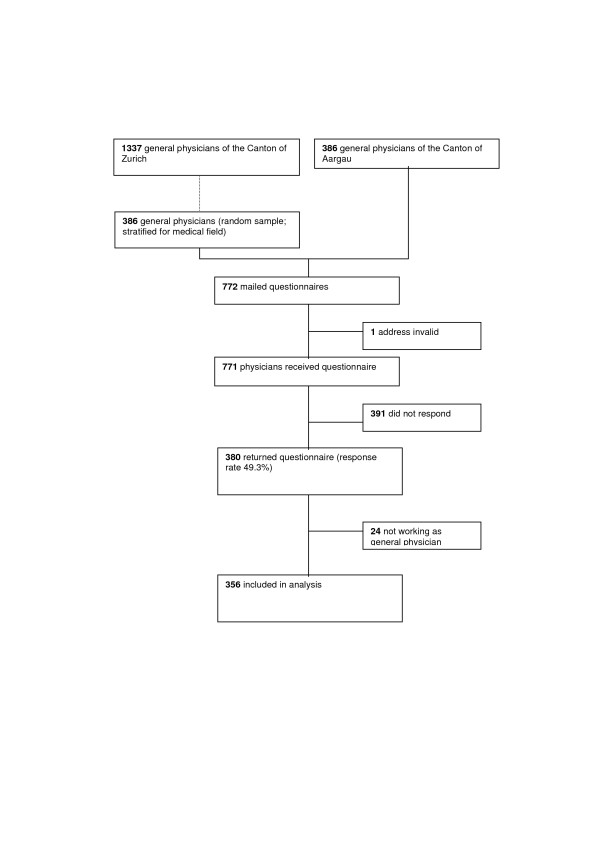
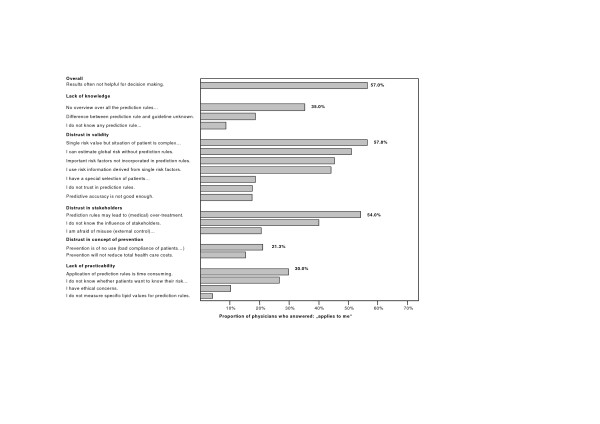
BACKGROUND: Although cardiovascular prediction rules are recommended by guidelines to evaluate global cardiovascular risk for primary prevention, they are rarely used in primary care. Little is known about barriers for application. The objective of this study was to evaluate barriers impeding the application of cardiovascular prediction rules in primary prevention. METHODS: We performed a postal survey among general physicians in two Swiss Cantons by a purpose designed questionnaire. RESULTS: 356 of 772 dispatched questionnaires were returned (response rate 49.3%). About three quarters (74%) of general physicians rarely or never use cardiovascular prediction rules. Most often stated barriers to apply prediction rules among rarely- or never-users are doubts concerning over-simplification of risk assessment using these instruments (58%) and potential risk of (medical) over-treatment (54%). 57% report that the numerical information resulting from prediction rules is often not helpful for decision-making in practice. CONCLUSION: If regular application of cardiovascular prediction rules in primary care is in demand additional interventions are needed to increase acceptance of these tools for patient management among general physicians.
Overview
The claims and statistics of this paper haven’t been checked yet.
Free: it reads the open-access text and checks the first 5 claims that cite a source we can check. Create a free account to check every claim.
Integrity signals
Registry
Cites
Statistics
Figures
Verification
Claims the paper makes
The claims and statistics of this paper haven’t been checked yet.
Free: it reads the open-access text and checks the first 5 claims that cite a source we can check. Create a free account to check every claim.
Claims other papers make about this one
Each is checked against this paper’s own text: does it say what the citing paper says it does?
The cited source says what the claim attributes to it.
In the citing paper
“A survey among general practitioners and internists working in clinical practice in two Swiss regions revealed that 74% rarely or never used CVD prediction rules, 544 due to fears of oversimplification of risk assessment (58%) or overuse of medical therapy (54%).”
From European Guidelines on cardiovascular disease prevention in clinical practice (version 2012) (2012) · cites this paper as [544]
In the citing paper
“More than half of the physicians (57%) believed that the numerical information resulting from prediction rules is frequently unhelpful for clinical decision-making.544”
From European Guidelines on cardiovascular disease prevention in clinical practice (version 2012) (2012) · cites this paper as [544]
Self-check
Percentages, sums and reported differences re-computed from the paper’s own numbers.
The self-check needs the paper’s full text.
Citations
Cites
Toprak, O., Kurt, H., Sarı, Y., Şarkış, C., Us, H., & Kırık, A. (2017) · Kidney and Blood Pressure Research · doi:10.1159/000468530 · Cited by 29,627
Grundy, S. M., Bilheimer, D. W., Chait, A., Clark, L. T., Denke, M. A., Havel, R. J., Hazzard, W. R., Hulley, S. B., Hunninghake, D. B., Kreisberg, R. A., et al. (1993) · JAMA · doi:10.1001/jama.269.23.3015 · Cited by 27,947
Expert Panel on Detection, E. (2001) · JAMA: The Journal of the American Medical Association · doi:10.1001/jama.285.19.2486 · Cited by 26,011
De Backer, G. (2003) · European Heart Journal · doi:10.1016/s0195-668x(03)00347-6 · Cited by 2,251
Forsetlund, L., Bjørndal, A., Rashidian, A., Jamtvedt, G., O'Brien, M. A., Wolf, F. M., Davis, D., Odgaard-Jensen, J., & Oxman, A. D. (2009) · Cochrane Database of Systematic Reviews · doi:10.1002/14651858.cd003030.pub2 · Cited by 1,849 · cited 1×
“A recent Cochrane review has favored interactive workshops rather than didactic presentations to influence professional practice [17].”
BackgroundEUROPEAN GUIDELINES ON CARDIOVASCULAR DISEASE PREVENTION IN CLINICAL PRACTICE
Backer, G. D., Ambrosioni, E., Borch-Johnsen, K., Brotons, C., Cifkova, R., Dallongeville, J., Ebrahim, S., Faergeman, O., Graham, I., Mancia, G., et al. (2005) · Rational Pharmacotherapy in Cardiology · doi:10.20996/1819-6446-2005-1-3-57-65 · Cited by 1,267
O'Brien, M. A., Freemantle, N., Oxman, A. D., Wolfe, F., Davis, D., & Herrin, J. (2001) · Cochrane Database of Systematic Reviews · doi:10.1002/14651858.cd003030 · Cited by 336
Hobbs, F. R. (2002) · Family Practice · doi:10.1093/fampra/19.6.596 · Cited by 253
O’Brien, M. A., Freemantle, N., Oxman, A., Wolf, F. M., Davis, D., & Herrin, J. S. (2001) · BMC News and views · doi:10.1186/2048-4623-1-s3-pc118 · Cited by 153
Cited by
Items 101–166 of 166
Effectiveness of LSTMs in Predicting Congestive Heart Failure OnsetPreprint
Mallya, S., Overhage, J. M., Srivastava, N., Arai, T. J., & Erdman, C. (2019) · arXiv (Cornell University) · doi:10.48550/arxiv.1902.02443 · Cited by 22
Muntner, P., Orroth, K. K., Mues, K. E., Exter, J., Shannon, E., Zaha, R. L., Rosenson, R. S., & Jackson, E. A. (2021) · Cardiovascular Drugs and Therapy · doi:10.1007/s10557-021-07167-1 · Cited by 13
Kakarmath, S. S., Golas, S. B., Felsted, J. A., Kvedar, J. C., Jethwani, K., & Agboola, S. O. (2018) · JMIR Research Protocols · doi:10.2196/resprot.9466 · Cited by 13
“However, the clinical adoption of risk prediction models remains quite low [21,22].”
BackgroundYe, C., Schousboe, J. T., Morin, S. N., Lix, L. M., McCloskey, E. V., Johansson, H., Harvey, N. C., Kanis, J. А., & Leslie, W. D. (2024) · Journal of Bone and Mineral Research · doi:10.1093/jbmr/zjad010 · Cited by 10
Wan, Q., Harris, M., Zwar, N. A., Vagholkar, S., & Campbell, T. (2010) · Journal of Evaluation in Clinical Practice · doi:10.1111/j.1365-2753.2009.01170.x · Cited by 14
Feasibility Evaluation of an Interpersonal and Social Rhythm Therapy Group Delivery Model
Hoberg, A. A., Vickers, K. S., Ericksen, J., Bauer, G., Kung, S., Stone, R., Williams, M., Moore, M. J., & Frye, M. A. (2013) · Archives of Psychiatric Nursing · doi:10.1016/j.apnu.2013.08.002 · Cited by 9
Štulc, T., Lánská, V., Šnejdrlová, M., Vrablík, M., Prusíková, M., & Češka, R. (2017) · Archives of Medical Science · doi:10.5114/aoms.2016.64865 · Cited by 9
Богачевская, С. А., & Николаевич, Б. А. (2017) · Social Aspects of Population Health · doi:10.21045/2071-5021-2017-53-1-1 · Cited by 10
van der Maas, J. C., Corbee, R. J., Kroese, F. M., de Ridder, D. T. D., Vos, R. C., Nielen, M., & Monninkhof, E. M. (2020) · BMC Family Practice · doi:10.1186/s12875-020-1088-3 · Cited by 9
Sarazin, M., Chiappe, S. G., Kasprzyk, Mismetti, & Lasserre, A. (2013) · International Journal of General Medicine · doi:10.2147/ijgm.s39022 · Cited by 9
“Prognostic scores CHADS2 74 (28) 13 (5) 27 (10) 6 (2) 28 (10) 194 (72) 61 (22) 133 (50) Diagnostic scores MMSE 251 (95) 39 (14) 149 (55) 30 (11) 33 (12) 17 (6) 17 (6) 0 Fagerström 240 (90) 50 (19) 121 (45) 28 (10) 41 (15) 28 (10) 23 (9) 5 (2) Hamilton 174 (65) 15 (6) 84 (31) 23 (9) 52 (19) 94 (65) 88 (32) 6 (2) McIsaa…”
Liu, X., YANG, K. Y., Guo, W., Ye, M., & Liu, S. (2022) · Frontiers in Surgery · doi:10.3389/fsurg.2022.890993 · Cited by 8
An exploratory statistical approach to depression pattern identification
Feng, Q., Griffiths, F. E., Parsons, N., & Gunn, J. M. (2012) · Physica A Statistical Mechanics and its Applications · doi:10.1016/j.physa.2012.10.025 · Cited by 8
Hussein, N. B., Ramli, R., Liew, S. M., Hanafi, N. S., Lee, P. Y., Cheong, A. T., Ghazali, S. S., Ahad, A. M., Patel, J., Schwarze, J., et al. (2023) · npj Primary Care Respiratory Medicine · doi:10.1038/s41533-023-00337-8 · Cited by 8
Goldstein, K. M., Fisher, D. A., Wu, R. R., Orlando, L. A., Coffman, C. J., Grubber, J. M., Rakhra-Burris, T. K., Wang, V., Scheuner, M. T., Sperber, N. R., et al. (2019) · Trials · doi:10.1186/s13063-019-3659-y · Cited by 9
GPs’ familiarity with and use of cardiovascular clinical prediction rules: a UK survey study
Ban, J.-W., Perera, R., & Stevens, R. (2020) · BJGP Open · doi:10.3399/bjgpopen20x101081 · Cited by 9
“On the other hand, studies conducted before 2010 often showed cardiovascular CPRs were infrequently used.(10,12,14,21,22,31) For example, a US national survey from 2006 found only 17% of family physicians used a coronary heart disease risk calculator.”
Are Cardiac Risk Scores Useful in Daily Clinical Practice?
Chrysohoou, C. A. (2015) · PubMed · Cited by 7
Ali, P. A., Allmark, P., Booth, A., McGarry, J., Woods, H. B., & Seedat, F. (2021) · Journal of Criminal Psychology · doi:10.1108/jcp-03-2021-0007 · Cited by 9
Redefining digital health interfaces with large language models
Imrie, F., Rauba, P., & van der Schaar, M. (2025) · Frontiers in Artificial Intelligence · doi:10.3389/frai.2025.1623339 · Cited by 12
“…being developed (Sutton et al., 2020; Dunn et al., 2018), clinical adoption of such methods faces significant hurdles (Eichler et al., 2007; Mathews et al., 2019), with some even calling their use “infeasible” (Müller-Riemenschneider et al., 2010) and “substantially conceptual” (Abernethy et al.,…”
InfluentialRosenthal, M., Morales, E., Levin, S. A., & Murphy, L. F. (2014) · Currents in Pharmacy Teaching and Learning · doi:10.1016/j.cptl.2014.04.012 · Cited by 5
Allan, G. M., Nouri, F., Korownyk, C. S., Kolber, M. R., Vandermeer, B., & McCormack, J. P. (2015) · BMC Research Notes · doi:10.1186/s13104-015-1401-8 · Cited by 5
“Although up to 74 % of primary care physicians who are specifically interested in cardiac disease may regularly use CVD risk calculators [1], most studies show only 22–48 % physicians regularly use risk calculators [2–4].”
BackgroundConflicts in adaptation: case studies from Nepal and the Maldives
Lama, P. D., & Becker, P. (2019) · Disaster Prevention and Management An International Journal · doi:10.1108/dpm-12-2018-0393 · Cited by 9
The impact of social media in orthopaedics
Goyal, D. K. C., Galetta, M. S., Fang, T., Mangan, J. J., Lendner, M., Vaccaro, A. R., Kepler, C. K., Schroeder, G. D., & Sharan, A. D. (2019) · Current Orthopaedic Practice · doi:10.1097/bco.0000000000000788 · Cited by 5
Communication about patients during ward rounds and verbal handovers: A gender perspective
Hedegaard, J. (2019) · Journal of Interprofessional Care · doi:10.1080/13561820.2019.1593116 · Cited by 6
Asril, N. M., & Yuniarti, K. W. (2012) · International Journal of Research Studies in Psychology · doi:10.5861/ijrsp.2012.v1i2.81 · Cited by 4
Vancheri, F., Strender, L., & Backlund, L. G. (2013) · Primary Health Care Research & Development · doi:10.1017/s146342361200059x · Cited by 4
“Risk assessment tools, such as charts or computer programs, have been developed and are recommended in the identification of high-risk subjects, but their use in clinical practice is limited, and clinicians are more likely to make their own assessment subjectively (Graham et al., 2006; Eichler et al., 2007).”
BackgroundPipilis, A. G., Kaliambakos, S., Xenodochidis, C., Tsakonas, G., Sourlas, N., & Mallios, K. (2007) · PubMed · Cited by 4
Osokogu, O. U., Pacurariu, A. C., Mosseveld, M., Rijnbeek, P. R., Weibel, D. M., Verhamme, K. M. C., & Sturkenboom, M. (2018) · Pharmacoepidemiology and Drug Safety · doi:10.1002/pds.4413 · Cited by 3
Fletcher, K., Mant, J., McManus, R. J., & Hobbs, R. F. (2016) · Programme Grants for Applied Research · doi:10.3310/pgfar04030 · Cited by 5
Evaluation of statin utilization in the Republic of Macedonia during 2013–2016
Naumovska, Z., Nestorovska, A. K., Grozdanova, A., Hristova, K., Dimovski, A. J., Šuturkova, L., & Sterjev, Z. (2018) · ClinicoEconomics and Outcomes Research · doi:10.2147/ceor.s157842 · Cited by 3
“24 Additional problems in the evaluation of the benefits of statins are associated with their use in the secondary prevention as the patients with hypertension and diabetes type 2 are considered as eligible for statin treatment.”
Smoking cessation dialogue and the complementary therapist: Reluctance to engage?
Tomlinson, L., & Mackereth, P. (2014) · Complementary Therapies in Clinical Practice · doi:10.1016/j.ctcp.2014.07.007 · Cited by 3
Peer support in patients with tipe 2 diabetes
Bahun, M., & Skela‐Savič, B. (2011) · Slovenian Journal of Public Health · doi:10.2478/v10152-010-0044-3 · Cited by 3
Vrints, C. J., Wood, D., Zamorano, J. L., Zannad, F. M., Karadeniz, Ş., Mezzani, A., Prescott, E., Ebrahim, S. B. J., Germanò, G., Hobbs, R. F., et al. (2013) · Cited by 3
Global cardiovascular risk evaluation: pattern of algorithm use and risk modification in ‘real life’
Filippi, A., Giampaoli, S., Lapi, F., Mazzaglia, G., Palmieri, L., Pecchioli, S., Brignoli, O., Cricelli, C. A., Simonetti, M., Sessa, E., et al. (2014) · Journal of Cardiovascular Medicine · doi:10.2459/jcm.0000000000000124 · Cited by 4
Rao, S. K., Li, Y., Mamouei, M., Salimi‐Khorshidi, G., Wamil, M., Nazarzadeh, M., Yau, C., Collins, G. S., Jackson, R., Vickers, A. J., et al. (2024) · medRxiv · doi:10.1101/2024.09.25.24314371 · Cited by 3
“27 In line with this, we found QRISK3 to classify over a quarter of the adult population as eligible for treatment in the general population 10 ; however, seven out of eight individuals predicted to have a preventable CVD event did not experience such an event.”
MethodPerk, J., Backer, G. D., Gohlke, H., Graham, I. M., Reiner, Ž., Verschuren, W. M. M., Albus, C., Benlian, P., Boysen, G., Cífková, R., et al. (2012) · Kardiologia Polska · Cited by 6
Nguyen, E., Coleman, C. I., Peacock, W. F., Wells, P. S., Weeda, E. R., Ashton, V., Crivera, C., Wildgoose, P., Schein, J. R., Bunz, T. J., et al. (2017) · BMC Pulmonary Medicine · doi:10.1186/s12890-017-0379-5 · Cited by 3
“Studies have reported common clinician barriers to using risk stratification tools including difficulties in implementation in routine practice [12, 13], lack of training in their use, regulatory constraints and the nature of the physicianpatient relationship [14].”
BackgroundWhat are medical students’ attitudes to clinical risk-scoring tools? An exploratory study
Tomlinson, F., & Willis, T. A. (2019) · Education for Primary Care · doi:10.1080/14739879.2019.1653227 · Cited by 2
McLaren, E., Baugh, V., Plugge, E., & O’Moore, É. (2012) · Journal of Immigrant and Minority Health · doi:10.1007/s10903-012-9636-0 · Cited by 2
Family narratives of lives with persistent physical symptom conditions
Friedner, K., Solomons, W., Flannery, H., & Harrington, J. (2021) · Clinical Child Psychology and Psychiatry · doi:10.1177/13591045211033188 · Cited by 1
Wan, Q., Harris, M., Zwar, N. A., Vagholkar, S., Kemp, L., & Campbell, T. (2010) · International Journal of Clinical Practice · doi:10.1111/j.1742-1241.2010.02403.x · Cited by 1
Smoke-free hospital site conversations: how nurses can initiate change
Mackereth, P., Finchett, C., & Holt, M. (2016) · British Journal of Nursing · doi:10.12968/bjon.2016.25.21.1176 · Cited by 1
Canivet, D., Peternelj, L., Delvaux, N., Reynaert, C., Razavi, D., & Libert, Y. (2016) · Psycho-Oncologie · doi:10.1007/s11839-016-0594-y · Cited by 1
Introduction: Evidence-Based Practice in Patient-Centered Care
Bartolo, C. A. D., & Braun, M. K. (2017) · Springer eBooks · doi:10.1007/978-3-319-49547-7_1 · Cited by 1
Medves, J., & Godfrey, C. M. (2008) · JBI Library of Systematic Reviews · doi:10.11124/01938924-200806041-00002 · Cited by 1
Einsatz von Risikoscores für den Typ-2-Diabetes in der Praxis
Kowall, B., Rathmann, W., & Landgraf, R. (2014) · Der Diabetologe · doi:10.1007/s11428-014-1212-x
Monitoring and treatment for cardiovascular risk
Rabinowitz, I., Hochman, O., Luzzati, R., Haifitz, Y., Shclar, Y., Kaykov, N., Khemlin, A., Kaffman, M., & Tamir, A. (2009) · Primary Health Care Research & Development · doi:10.1017/s1463423609990338
“A follow-up question revealed that approximately half the physicians made clinical decisions based on information about single risk factors (Eichler et al., 2007).”
BackgroundVanmeerbeek, M., Belche, J. L., & Vandoorne, C. (2009)
Nilsson, G. H. (2016) · DiVA at Umeå University (Umeå University)
Silva, É. R. (2010) · Americanae (AECID Library)
OBSOLETE: Behavior Modification and Cardiovascular Disease
Monti, J. (2017) · Elsevier eBooks · doi:10.1016/b978-0-12-801238-3.10939-0
Kim, P. (2017) · Scholarship@Western (Western University)
Giroux, C., & Smith, W. E. (2017) · Springer eBooks · doi:10.1007/978-3-319-67555-8_8
Timóteo, A. T. (2019) · Arquivos Brasileiros de Cardiologia · doi:10.5935/abc.20190122
Luque, M. J. F., Sánchez-Gómez, L. M., y Aldeguer, V. P., Súarez-Fernández, C., Sierra-García, B., Mayayo-Vicente, S., Ruiz-López, M., Gallego-Arenas, Á., Sánchez-Alcalde, R., Belinchón, P. L., et al. (2020) · World Journal of Cardiovascular Diseases · doi:10.4236/wjcd.2020.103013
“Further, it is known that although cardiovascular prediction rules are recommended by the guidelines to evaluate global CVR, some studies [20]-[25] have shown the scant use by physicians in PHC.”
BackgroundUltrasound-Guided Nerve Blocks for Chest
Crane, K., Ibrahim, I. N., Thompson, E., Harbell, M. W., Cornett, E. M., & Kaye, A. D. (2021) · Springer eBooks · doi:10.1007/978-3-030-46839-2_21
Cardiovascular risk prediction - a systems medicine approachPreprint
Gergei, I., Pfau, T., Krämer, B. K., Schneider, J. G., Nguyen, T. P., März, W., & Sauter, T. (2023) · medRxiv · doi:10.1101/2023.03.16.23287363
Ban, J.-W., Perera, R., & Williams, V. (2023) · BMC Family Practice · doi:10.1186/s12875-023-02155-w
“…knowledge about whether and how research evidence influences the use of CPRs. Previous studies described that the presence of research evidence about CPRs [32, 33], in particular for accuracy [33–36], generalizability [34, 37–39], and effectiveness [36], influenced the use of CPRs in practice.”
BackgroundResultYe, C., Hans, D. B., Schousboe, J. T., Binkley, N., & Leslie, W. D. (2025) · Osteoporosis International · doi:10.1007/s00198-025-07790-w
“Studies have shown that even with these minimal inputs, most primary care practitioners do not routinely use CVD risk scores [46, 47].”
Ban, J. W., Perera, R., & Williams, V. (2023) · Figshare · doi:10.6084/m9.figshare.24172075
Ban, J. W., Perera, R., & Williams, V. (2023) · Figshare · doi:10.6084/m9.figshare.24172078
Radhachandran, A., Garikipati, A., Zelin, N. S., Pellegrini, E., Ghandian, S., Calvert, J. S., Hoffman, J. L., Mao, Q., & Das, R. (2021) · Figshare · doi:10.6084/m9.figshare.14355343
Merz, C. N. B. (2026) · European Heart Journal · doi:10.1093/eurheartj/ehag605
Metadata
- Authors
- Eichler, K., Zoller, M., Tschudi, P., & Steurer, J.
- Affiliations
- University Hospital Zurich (CH)
- University of Basel (CH)
- Corresponding author
- Eichler, Klaus
- Venue
- BMC Family Practice
- Published
- 2007-01-03
- Volume
- 8
- Issue
- 1
- Pages
- 1-1
- ISSN
- 1471-2296 (ISSN-L)
- PMC
- PMC1766351
- OpenAlex
- W1552547472
- Cited by
- 167
- References
- 26
- Citations by year
- 2026: 1 · 2025: 3 · 2024: 2 · 2023: 5 · 2022: 2 · 2021: 16 · 2020: 10 · 2019: 12 · 2018: 7 · 2017: 16 · 2016: 12 · 2015: 15 · 2014: 12 · 2013: 10 · 2012: 13
- FWCI
- 7.15
- Type
- journal article
- Language
- en
- Open access
- gold
- doi.org
- Licence
- cc-by
- creativecommons.org/licenses/by/2.0 (tdm)
- Locations
- BMC Family Practice (publishedVersion, cc-by)
- PubMed Central (publishedVersion, cc-by)
- PubMed (publishedVersion)
- Zürcher Hochschule für Angewandte Wissenschaften digital collection (Zurich University of Applied Sciences) (submittedVersion, cc-by-nc-nd)
- DOAJ (DOAJ: Directory of Open Access Journals) (submittedVersion, cc-by-sa)
- ZHAW Digital Collection (cc-by)
- Funders
- Helmut Horten Stiftung
- Topics
- Health Sciences › Medicine › Public Health, Environmental and Occupational Health › Health Promotion and Cardiovascular Prevention
- Health Sciences › Medicine › Public Health, Environmental and Occupational Health › Clinical practice guidelines implementation
- Health Sciences › Health Professions › General Health Professions › Patient-Provider Communication in Healthcare
- Keywords
- primary prevention, cardiovascular risk assessment, barriers to use, general practitioners, risk stratification, clinical decision-making, guideline implementation
- MeSH terms
- Attitude of Health Personnel, Cardiovascular Diseases, Clinical Competence, Decision Making, Family Practice, Female, Humans, Male, Middle Aged, Practice Patterns, Physicians', Postal Service, Primary Health Care, Primary Prevention, Surveys and Questionnaires, Switzerland, Risk Assessment, Guideline Adherence
About these checks
Registry, retraction, Cites and statistics results are computed, not judged, with one exception: a printed reference that no index lists is read once by a model before it counts as a citation error. Claims are extracted by a model and kept only when their quote appears verbatim in the text; each cited source is then checked, with a model’s help, for whether it says what the claim relies on. Those verdicts can be wrong — read the claim’s quote and the cited source before relying on one.
Statistics and arithmetic are recomputed, not judged.
Confidence bands are shown only for fields calibrated on our annotated test set. None is calibrated yet, so no band is shown.
What counts as a claim ›How we measure confidence ›How we check this ›
Are you an author, or do you see a problem with this page? Request a review
Data sources
Bibliographic data: Semantic Scholar, OpenAlex, Crossref.
Contains information from the Semantic Scholar Academic Graph Datasets, made available under the ODC Attribution License (ODC-BY 1.0).
Semantic Scholar’s data is described in: Kinney, R., et al. (2023). The Semantic Scholar Open Data Platform. arXiv:2301.10140.
