

Barriers to apply cardiovascular prediction rules in primary care: a postal survey
Open accessThe DOI matches its Crossref record; 26 of the 26 references it cites were found in a registry or an index.
Abstract
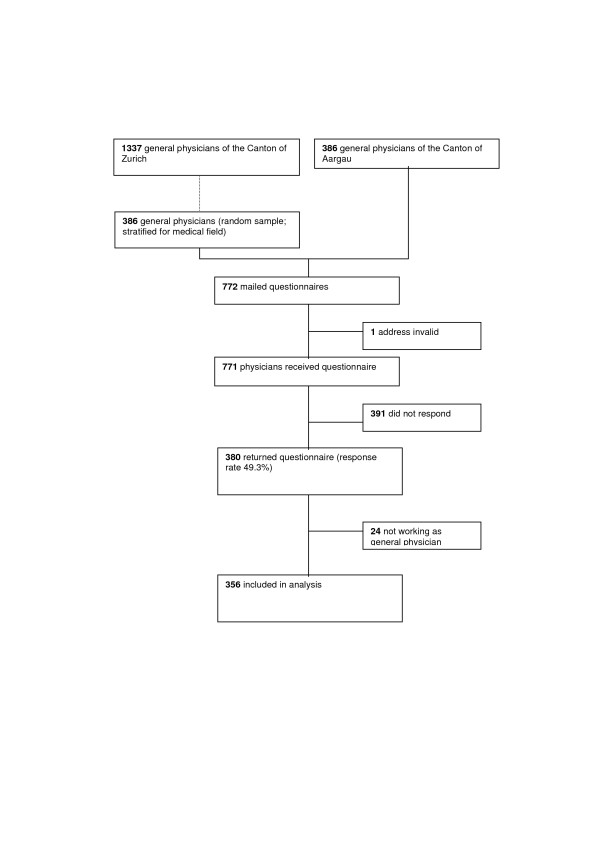
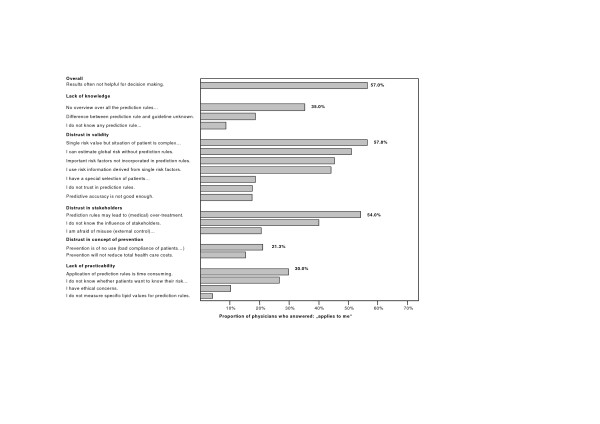
BACKGROUND: Although cardiovascular prediction rules are recommended by guidelines to evaluate global cardiovascular risk for primary prevention, they are rarely used in primary care. Little is known about barriers for application. The objective of this study was to evaluate barriers impeding the application of cardiovascular prediction rules in primary prevention. METHODS: We performed a postal survey among general physicians in two Swiss Cantons by a purpose designed questionnaire. RESULTS: 356 of 772 dispatched questionnaires were returned (response rate 49.3%). About three quarters (74%) of general physicians rarely or never use cardiovascular prediction rules. Most often stated barriers to apply prediction rules among rarely- or never-users are doubts concerning over-simplification of risk assessment using these instruments (58%) and potential risk of (medical) over-treatment (54%). 57% report that the numerical information resulting from prediction rules is often not helpful for decision-making in practice. CONCLUSION: If regular application of cardiovascular prediction rules in primary care is in demand additional interventions are needed to increase acceptance of these tools for patient management among general physicians.
Overview
The claims and statistics of this paper haven’t been checked yet.
Free: it reads the open-access text and checks the first 5 claims that cite a source we can check. Create a free account to check every claim.
Integrity signals
Registry
Cites
Statistics
Figures
Verification
Claims the paper makes
The claims and statistics of this paper haven’t been checked yet.
Free: it reads the open-access text and checks the first 5 claims that cite a source we can check. Create a free account to check every claim.
Claims other papers make about this one
Each is checked against this paper’s own text: does it say what the citing paper says it does?
The cited source says what the claim attributes to it.
In the citing paper
“A survey among general practitioners and internists working in clinical practice in two Swiss regions revealed that 74% rarely or never used CVD prediction rules, 544 due to fears of oversimplification of risk assessment (58%) or overuse of medical therapy (54%).”
From European Guidelines on cardiovascular disease prevention in clinical practice (version 2012) (2012) · cites this paper as [544]
In the citing paper
“More than half of the physicians (57%) believed that the numerical information resulting from prediction rules is frequently unhelpful for clinical decision-making.544”
From European Guidelines on cardiovascular disease prevention in clinical practice (version 2012) (2012) · cites this paper as [544]
Self-check
Percentages, sums and reported differences re-computed from the paper’s own numbers.
The self-check needs the paper’s full text.
Citations
Cites
Toprak, O., Kurt, H., Sarı, Y., Şarkış, C., Us, H., & Kırık, A. (2017) · Kidney and Blood Pressure Research · doi:10.1159/000468530 · Cited by 29,627
Grundy, S. M., Bilheimer, D. W., Chait, A., Clark, L. T., Denke, M. A., Havel, R. J., Hazzard, W. R., Hulley, S. B., Hunninghake, D. B., Kreisberg, R. A., et al. (1993) · JAMA · doi:10.1001/jama.269.23.3015 · Cited by 27,947
Expert Panel on Detection, E. (2001) · JAMA: The Journal of the American Medical Association · doi:10.1001/jama.285.19.2486 · Cited by 26,011
Audit and feedback: effects on professional practice and healthcare outcomes
Ivers, N., Jamtvedt, G., Flottorp, S., Young, J. M., Odgaard-Jensen, J., French, S. D., O'Brien, M. A., Johansen, M., Grimshaw, J., & Oxman, A. D. (2012) · Cochrane Database of Systematic Reviews · doi:10.1002/14651858.cd000259.pub3 · Cited by 5,485
De Backer, G. (2003) · European Heart Journal · doi:10.1016/s0195-668x(03)00347-6 · Cited by 2,251
Forsetlund, L., Bjørndal, A., Rashidian, A., Jamtvedt, G., O'Brien, M. A., Wolf, F. M., Davis, D., Odgaard-Jensen, J., & Oxman, A. D. (2009) · Cochrane Database of Systematic Reviews · doi:10.1002/14651858.cd003030.pub2 · Cited by 1,849 · cited 1×
“A recent Cochrane review has favored interactive workshops rather than didactic presentations to influence professional practice [17].”
BackgroundEUROPEAN GUIDELINES ON CARDIOVASCULAR DISEASE PREVENTION IN CLINICAL PRACTICE
Backer, G. D., Ambrosioni, E., Borch-Johnsen, K., Brotons, C., Cifkova, R., Dallongeville, J., Ebrahim, S., Faergeman, O., Graham, I., Mancia, G., et al. (2005) · Rational Pharmacotherapy in Cardiology · doi:10.20996/1819-6446-2005-1-3-57-65 · Cited by 1,267
O'Brien, M. A., Freemantle, N., Oxman, A. D., Wolfe, F., Davis, D., & Herrin, J. (2001) · Cochrane Database of Systematic Reviews · doi:10.1002/14651858.cd003030 · Cited by 336
Hobbs, F. R. (2002) · Family Practice · doi:10.1093/fampra/19.6.596 · Cited by 253
O’Brien, M. A., Freemantle, N., Oxman, A., Wolf, F. M., Davis, D., & Herrin, J. S. (2001) · BMC News and views · doi:10.1186/2048-4623-1-s3-pc118 · Cited by 153
Guidelines on preventing cardiovascular disease in clinical practice
Jackson, R. (2000) · BMJ · doi:10.1136/bmj.320.7236.659 · Cited by 147 · cited 1×
“baseline risk less precise than prediction rules despite the moderate accuracy of these tools [11-13].”
BackgroundJoint British recommendations on prevention of coronary heart disease in clinical practice
British Cardiac Society British Hyperlipidaemia Association British Hypertension Society endorsed by the British Diabetic Association (1998) · Heart · doi:10.1136/hrt.80.2008.1s · Cited by 128 · cited 2×
“Estimation of global cardiovascular risk is challenging and cardiovascular prediction rules have been developed as useful tools for risk estimation [1-3].”
Patients' ideas, fears and expectations of their coronary risk: barriers for primary prevention
van Steenkiste, B., van der Weijden, T., Timmermans, D., Vaes, J., Stoffers, J., & Grol, R. (2004) · Patient Education and Counseling · doi:10.1016/j.pec.2003.11.005 · Cited by 117 · cited 1×
“Given suitable communication measures (like communication training for physicians; educational material for patients; or graphical presentations of individual risk values with average risk estimates of the same age group) [14], cardiovascular risk estimates derived from prediction rules may strengthen motivation for l…”
BackgroundFriedmann, P. D., Brett, A. S., & Mayo-Smith, M. F. (1996) · Annals of Internal Medicine · doi:10.7326/0003-4819-124-4-199602150-00005 · Cited by 113 · cited 1×
“baseline risk less precise than prediction rules despite the moderate accuracy of these tools [11-13].”
BackgroundBarriers to implementing cardiovascular risk tables in routine general practice
Steenkiste, B. V., Weijden, T. V. D., Stoffers, H. E. J. H., & Grol, R. (2004) · Scandinavian Journal of Primary Health Care · doi:10.1080/02813430310004489 · Cited by 104 · cited 2×
“Little is known about barriers for application in daily practice [6,7].”
BackgroundResultRational prescribing in primary care (RaPP): a cluster randomized trial of a tailored intervention
Fretheim, A., Oxman, A. D., Håvelsrud, K., Treweek, S., Kristoffersen, D. T., & Bjørndal, A. (2006) · PLoS Medicine · doi:10.1371/journal.pmed.0030134 · Cited by 99 · cited 1×
“Specific tailored interventions to overcome barriers (like educational outreach visits with audit and feedback as well as computerised reminders linked to the medical record system) have been evaluated in a recent controlled trial [18].”
Controlled trial of effect of documented cardiovascular risk scores on prescribing
Hall, L. M. L., Jung, R. T., & Leese, G. P. (2003) · BMJ · doi:10.1136/bmj.326.7383.251 · Cited by 93 · cited 1×
“Controlled trials evaluating the impact of prediction rules on patient management have concentrated on technical aspects (like computerized calculation of global risk and standardized documentation) [15,16].”
BackgroundLowensteyn, I., Joseph, L., Levinton, C. M., Abrahamowicz, M., Steinert, Y., & Grover, S. A. (1998) · Preventive Medicine · doi:10.1006/pmed.1998.0351 · Cited by 84 · cited 1×
“Controlled trials evaluating the impact of prediction rules on patient management have concentrated on technical aspects (like computerized calculation of global risk and standardized documentation) [15,16].”
BackgroundEstimation of cardiovascular risk in hypertensive patients in primary care.
Montgomery, A. A., Fahey, T. P., MacKintosh, C., Sharp, D. J., & Peters, T. J. (2000) · Europe PMC (PubMed Central) · Cited by 79
In the Twilight: Life in the Margins Between Sick and Well
Anonymous (2001) · JAMA · doi:10.1001/jama.285.1.92-jms0103-4-1 · Cited by 29
Fretheim, A., Oxman, A. D., & Flottorp, S. (2004) · BMC Health Services Research · doi:10.1186/1472-6963-4-23 · Cited by 26 · cited 1×
“Our data fit well with recent qualitative research identifying obstacles to apply cardiovascular risk tables in routine general practice [7,9].”
ResultObstacles to cardiovascular prevention in general practice
MUYLDER, R. D., Lorant, V., Paulus, D., Nackers, F., Jeanjean, M., & Boland, B. B. (2004) · Acta Cardiologica · doi:10.2143/ac.59.2.2005165 · Cited by 23 · cited 3×
“Studies have shown, however, that general physicians rarely apply cardiovascular prediction rules [4,5].”
BackgroundResultThe role of guidelines and the patient's life-style in GPs' management of hypercholesterolaemia
Backlund, L. G., Skånér, Y., Montgomery, H., Bring, J., & Strender, L. (2004) · BMC Family Practice · doi:10.1186/1471-2296-5-3 · Cited by 12
[Do the fee-for-service and reimbursement influence medical practice?].
Fretheim, A., Håvelsrud, K., Flottorp, S. A., & Oxman, A. D. (2003) · PubMed · Cited by 7
Eichler, Biller‐Andorno, N., Traindl, Tschudi, Bachmann, & Steurer (2006) · Praxis · doi:10.1024/1661-8157.95.45.1751 · Cited by 1 · cited 1×
“Questionnaire development Based on a literature search and the results of a recent workshop with experts from the health care system including general physicians [8] we first gathered potential obstacles for application of cardiovascular prediction rule in daily routine.”
Cited by
European Guidelines on cardiovascular disease prevention in clinical practice (version 2012)
Authors/Task Force Members:, Perk, J., De Backer, G., Gohlke, H., Graham, I., Reiner, Ž., Verschuren, M., Albus, C., Benlian, P., Boysen, G., et al. (2012) · European Heart Journal · doi:10.1093/eurheartj/ehs092 · Cited by 8,490
Authors/Task Force Members, Graham, I., Atar, D., Borch-Johnsen, K., Boysen, G., Burell, G., Cifkova, R., Dallongeville, J., De Backer, G., Ebrahim, S., et al. (2007) · European Heart Journal · doi:10.1093/eurheartj/ehm316 · Cited by 3,753
Graham (2007) · doi:10.1097/01.hjr.0000277983.23934.c9 · Cited by 1,647
Authors/Task Force Members, Piepoli, M. F., Hoes, A. W., Agewall, S., Albus, C., Brotons, C., Catapano, A. L., Cooney, M.-T., Corrà, U., Cosyns, B., et al. (2016) · European Journal of Preventive Cardiology · doi:10.1177/2047487316653709 · Cited by 1,334
Authors/Task Force Members: Joep Perk (Chairperson) (Sweden)*, G. D. B. (. (2012) · European Journal of Preventive Cardiology · doi:10.1177/2047487312450228 · Cited by 863
Metadata
- Authors
- Eichler, K., Zoller, M., Tschudi, P., & Steurer, J.
- Affiliations
- University Hospital Zurich (CH)
- University of Basel (CH)
- Corresponding author
- Eichler, Klaus
- Venue
- BMC Family Practice
- Published
- 2007-01-03
- Volume
- 8
- Issue
- 1
- Pages
- 1-1
- ISSN
- 1471-2296 (ISSN-L)
- PMC
- PMC1766351
- OpenAlex
- W1552547472
- Cited by
- 167
- References
- 26
- Citations by year
- 2026: 1 · 2025: 3 · 2024: 2 · 2023: 5 · 2022: 2 · 2021: 16 · 2020: 10 · 2019: 12 · 2018: 7 · 2017: 16 · 2016: 12 · 2015: 15 · 2014: 12 · 2013: 10 · 2012: 13
- FWCI
- 7.15
- Type
- journal article
- Language
- en
- Open access
- gold
- doi.org
- Licence
- cc-by
- creativecommons.org/licenses/by/2.0 (tdm)
- Locations
- BMC Family Practice (publishedVersion, cc-by)
- PubMed Central (publishedVersion, cc-by)
- PubMed (publishedVersion)
- Zürcher Hochschule für Angewandte Wissenschaften digital collection (Zurich University of Applied Sciences) (submittedVersion, cc-by-nc-nd)
- DOAJ (DOAJ: Directory of Open Access Journals) (submittedVersion, cc-by-sa)
- ZHAW Digital Collection (cc-by)
- Funders
- Helmut Horten Stiftung
- Topics
- Health Sciences › Medicine › Public Health, Environmental and Occupational Health › Health Promotion and Cardiovascular Prevention
- Health Sciences › Medicine › Public Health, Environmental and Occupational Health › Clinical practice guidelines implementation
- Health Sciences › Health Professions › General Health Professions › Patient-Provider Communication in Healthcare
- Keywords
- primary prevention, cardiovascular risk assessment, barriers to use, general practitioners, risk stratification, clinical decision-making, guideline implementation
- MeSH terms
- Attitude of Health Personnel, Cardiovascular Diseases, Clinical Competence, Decision Making, Family Practice, Female, Humans, Male, Middle Aged, Practice Patterns, Physicians', Postal Service, Primary Health Care, Primary Prevention, Surveys and Questionnaires, Switzerland, Risk Assessment, Guideline Adherence
About these checks
Registry, retraction, Cites and statistics results are computed, not judged, with one exception: a printed reference that no index lists is read once by a model before it counts as a citation error. Claims are extracted by a model and kept only when their quote appears verbatim in the text; each cited source is then checked, with a model’s help, for whether it says what the claim relies on. Those verdicts can be wrong — read the claim’s quote and the cited source before relying on one.
Statistics and arithmetic are recomputed, not judged.
Confidence bands are shown only for fields calibrated on our annotated test set. None is calibrated yet, so no band is shown.
What counts as a claim ›How we measure confidence ›How we check this ›
Are you an author, or do you see a problem with this page? Request a review
Data sources
Bibliographic data: Semantic Scholar, OpenAlex, Crossref.
Contains information from the Semantic Scholar Academic Graph Datasets, made available under the ODC Attribution License (ODC-BY 1.0).
Semantic Scholar’s data is described in: Kinney, R., et al. (2023). The Semantic Scholar Open Data Platform. arXiv:2301.10140.
