

A systematic review and meta-analysis: probiotics in the treatment of irritable bowel syndrome
Open accessThe DOI matches its Crossref record; 36 of the 36 references it cites were found in a registry or an index.
Abstract
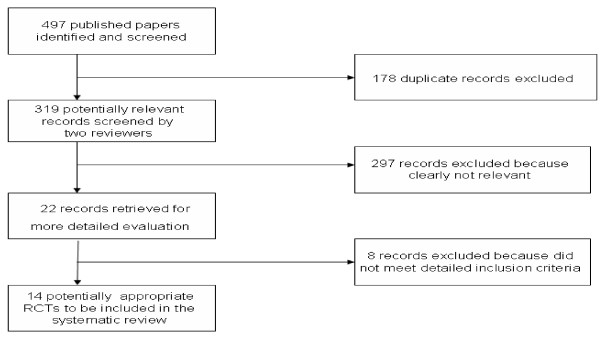
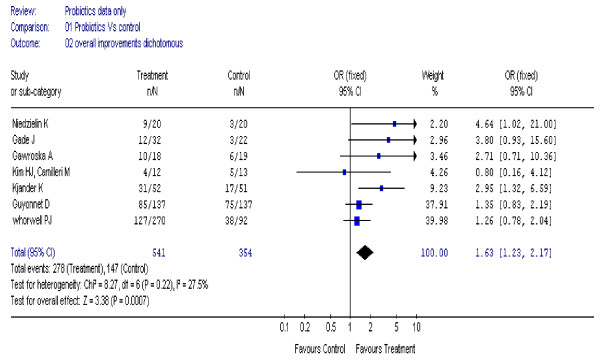
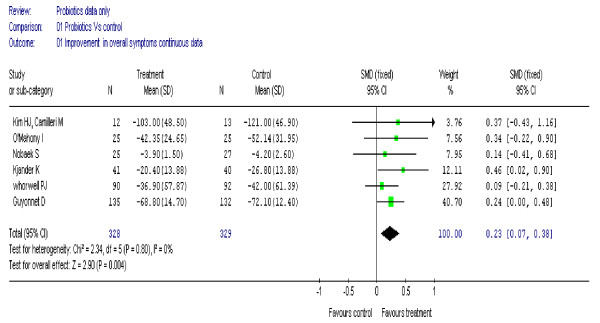
BACKGROUND: Irritable Bowel Syndrome (IBS) is a common chronic gastrointestinal disorder and the evidence for efficacy of most drug therapies in the treatment of IBS is weak. A popular alternative is probiotics, which have been used in several conditions. including IBS. Probiotics are live microbial food supplements.The aim of this systematic review and meta-analysis of randomized trials study was to evaluate the efficacy of probiotics in alleviating symptoms in patients with irritable bowel syndrome. We searched Ovid versions of MEDLINE (1950-2007), EMBASE (1980-2007), CINAHL (1982-2007), AMED (1985-2007), the Cochrane library and hand searched retrieved papers. RESULTS: We identified 14 randomized placebo controlled trials. Combined data suggested a modest improvement in overall symptoms after several weeks of treatment: for dichotomous data from seven trials the overall Odds Ratio (OR) was 1.6 (95% CI, 1.2 to 2.2); for continuous data from six trials the standardised mean difference (SMD) was 0.23 (95% CI, 0.07 to 0.38).For individual symptoms the results differed between the pooled dichotomous and pooled continuous data. Trials varied in relation to the length of treatment (4-26 weeks), dose, organisms and strengths of probiotics used. CONCLUSION: Probiotics may have a role in alleviating some of the symptoms of IBS, a condition for which currently evidence of efficacy of drug therapies is weak. However, as IBS is a condition that is chronic and usually intermittent longer term trials are recommended. Such research should focus on the type, optimal dose of probiotics and the subgroups of patients who are likely to benefit the most.
Overview
The claims and statistics of this paper haven’t been checked yet.
Free: it reads the open-access text and checks the first 5 claims that cite a source we can check. Create a free account to check every claim.
Integrity signals
Registry
Cites
Statistics
Figures
Verification
Claims the paper makes
The claims and statistics of this paper haven’t been checked yet.
Free: it reads the open-access text and checks the first 5 claims that cite a source we can check. Create a free account to check every claim.
Claims other papers make about this one
Each is checked against this paper’s own text: does it say what the citing paper says it does?
The cited source says what the claim attributes to it.
In the citing paper
“Based on the international consensus and existing evidence, probiotics are beneficial in improving overall symptoms in patients with IBS [29,30,31,32,33,34,35], but there are still contradictory reports on improvements in specific symptoms [36,37,38].”
In the citing paper
“Several systematic reviews and meta-analyses suggest that modulation of intestinal microbiota with probiotics may improve some of the symptoms of IBS (22, 79, 110, 147, 148).”
From Intestinal microbiota and immune function in the pathogenesis of irritable bowel syndrome (2013) · cites this paper as [79]
Self-check
Percentages, sums and reported differences re-computed from the paper’s own numbers.
The self-check needs the paper’s full text.
Citations
Cites
Moher, D., Cook, D. J., Eastwood, S., Olkin, I., Rennie, D., & Stroup, D. F. (1999) · The Lancet · doi:10.1016/s0140-6736(99)04149-5 · Cited by 4,826
The rand 36‐item health survey 1.0
Hays, R. D., Sherbourne, C. D., & Mazel, R. M. (1993) · Health Economics · doi:10.1002/hec.4730020305 · Cited by 2,884
O’Mahony, L., McCarthy, J., Kelly, P., Hurley, G., Luo, F., Chen, K., O’Sullivan, G. C., Kiely, B., Collins, J. K., Shanahan, F., et al. (2005) · Gastroenterology · doi:10.1053/j.gastro.2004.11.050 · Cited by 1,448
Whorwell, P. J., Altringer, L., Morel, J., Bond, Y., Charbonneau, D., O'Mahony, L., Kiely, B., Shanahan, F., & Quigley, E. M. M. (2006) · The American Journal of Gastroenterology · doi:10.1111/j.1572-0241.2006.00734.x · Cited by 799 · cited 10×
“Using continuous data in five studies [21-23,26,30] (388 participants), there was no statistically significant improvement in symptoms of flatulence, SMD 0.”
BackgroundMethodInfluentialProbiotics in prevention of antibiotic associated diarrhoea: meta-analysis
D'Souza, A. L., Rajkumar, C., Cooke, J., & Bulpitt, C. J. (2002) · BMJ · doi:10.1136/bmj.324.7350.1361 · Cited by 664 · cited 2×
“Probiotics have been used previously in different conditions [10,11].”
BackgroundNobaek, S., Johansson, M.-L., Molin, G., Ahrné, S., & Jeppsson, B. (2000) · American Journal of Gastroenterology · doi:10.1111/j.1572-0241.2000.02015.x · Cited by 653 · cited 8×
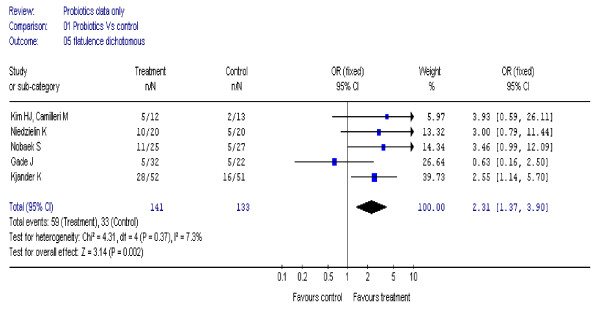
“Five studies [18,21,22,24,26] (274 participants) reported a significant improvement in symptoms of flatulence, OR 2.”
BackgroundInfluentialIrritable bowel syndrome: A technical review for practice guideline development
Drossman, D., Whitehead, W., & Camilleri, M. (1997) · Gastroenterology · doi:10.1053/gast.1997.v112.agast972120 · Cited by 566 · cited 1×
“In the West, about 15% of the population is affected at some time during their life, and it is more common in females [2].”
BackgroundNiedzielin, K., Kordecki, H., & Birkenfeld, B. (2001) · European Journal of Gastroenterology & Hepatology · doi:10.1097/00042737-200110000-00004 · Cited by 506 · cited 7×
“Five studies [18,21,22, 24 ,26] (274 participants) reported a significant improvement in symptoms of flatulence, OR 2.31 (95%CI, 1.37 to 3.9), I2 = 7% (figure 5). Using continuous data in five studies [21-23,26,30] (388 participants), there was no statistically significant improvement in symptoms of flatulence, SMD 0.…”
BackgroundInfluentialKim, H. J., Camilleri, M., Mckinzie, S., Lempke, M. B., Burton, D. D., Thomforde, G. M., & Zinsmeister, A. R. (2003) · Alimentary Pharmacology & Therapeutics · doi:10.1046/j.1365-2036.2003.01543.x · Cited by 468 · cited 10×
“There was also variation in the definition of overall symptoms in different studies: two studies included only subcategories of the IBS population (constipation – [20] or diarrhea-predominant participants [22].”
BackgroundResultInfluentialFurther validation of the IBS-QOL: a disease-specific quality-of-life questionnaire
Drossman, D. A., Patrick, D. L., Whitehead, W. E., Toner, B. B., Diamant, N. E., Hu, Y., Jia, H., & Bangdiwala, S. I. (2000) · The American Journal of Gastroenterology · doi:10.1111/j.1572-0241.2000.01941.x · Cited by 424 · cited 1×
“Whorwell [30] and O'Mahony [27] used IBS specific quality of life questionnaire [33].”
Method
Research works printed but not linked: 2
- Akehurst RL Burden of illness of irritable bowel syndrome. An interim report on behalf of Novartis Pharma AG, Basel, Switzerland 1999 Sheffield: ScHARR, University of Sheffield
- Chang L From Rome to Los Angeles – The Rome III Criteria for the Functional GI Disorders Medscape 2006 http://www.romecriteria.org/pdfs/RomeCritieraLaunch.pdf
Cited by
Hill (2014) · doi:10.1038/nrgastro.2014.66 · Cited by 9,592
“62 66 That the totality of evidence must be”
Intestinal permeability – a new target for disease prevention and therapy
Bischoff, S. C., Barbara, G., Buurman, W., Ockhuizen, T., Schulzke, J.-D., Serino, M., Tilg, H., Watson, A., & Wells, J. M. (2014) · BMC Gastroenterology · doi:10.1186/s12876-014-0189-7 · Cited by 1,755
“Possibly, the loss of particular TJ proteins such as occludin is a result of increased proteasome-mediated degradation observed in IBS triggered by low-grade inflammation and resulting in increased intestinal permeability [196].”
ResultInfluentialKelly, J. R., Kennedy, P. J., Cryan, J. F., Dinan, T. G., Clarke, G., & Hyland, N. P. (2015) · Frontiers in Cellular Neuroscience · doi:10.3389/fncel.2015.00392 · Cited by 1,110
“A number of probiotics and commensal organisms, primarily lactic acid bacteria, have been shown to ameliorate certain IBS symptoms (Hoveyda et al., 2009; Clarke et al., 2012; Ortiz-Lucas et al., 2013; Yoon et al., 2014; Didari et al., 2015).”
BackgroundIntestinal microbiota in functional bowel disorders: a Rome foundation report
Simrén, M., Barbara, G., Flint, H. J., Spiegel, B. M. R., Spiller, R. C., Vanner, S., Verdu, E. F., Whorwell, P. J., & Zoetendal, E. G. (2013) · Gut · doi:10.1136/gutjnl-2012-302167 · Cited by 939
Gastrointestinal microbiome signatures of pediatric patients with irritable bowel syndrome
Saulnier, D. M., Riehle, K., Mistretta, T., Diaz, M., Mandal, D., Raza, S., Weidler, E. M., Qin, X., Coarfa, C., Milosavljevic, A., et al. (2011) · Gastroenterology · doi:10.1053/j.gastro.2011.06.072 · Cited by 672
Metadata
- Authors
- Hoveyda, N., Heneghan, C., Mahtani, K. R., Perera, R., Roberts, N., & Glasziou, P.
- Affiliations
- University of Oxford (GB)
- Corresponding author
- Hoveyda, Nourieh
- Venue
- BMC Gastroenterology
- Published
- 2009-02-16
- Volume
- 9
- Issue
- 1
- Pages
- 15-15
- ISSN
- 1471-230X (ISSN-L)
- PMC
- PMC2656520
- OpenAlex
- W1984974981
- Cited by
- 297
- References
- 36
- Citations by year
- 2026: 6 · 2025: 8 · 2024: 3 · 2023: 6 · 2022: 7 · 2021: 4 · 2020: 6 · 2019: 15 · 2018: 9 · 2017: 17 · 2016: 24 · 2015: 23 · 2014: 36 · 2013: 31 · 2012: 39
- FWCI
- 5.11
- Type
- journal article
- Language
- en
- Open access
- gold
- doi.org
- Licence
- cc-by
- creativecommons.org/licenses/by/2.0 (tdm)
- Locations
- BMC Gastroenterology (publishedVersion, cc-by)
- PubMed Central (publishedVersion, cc-by)
- PubMed (publishedVersion)
- DOAJ (DOAJ: Directory of Open Access Journals) (submittedVersion)
- Funders
- Danone
- National Institute for Health and Care Research (ACF-2008-13-014)
- University College Cork
- Goddard Space Flight Center
- Topics
- Health Sciences › Medicine › Gastroenterology › Gastrointestinal motility and disorders
- Life Sciences › Agricultural and Biological Sciences › Food Science › Probiotics and Fermented Foods
- Life Sciences › Biochemistry, Genetics and Molecular Biology › Molecular Biology › Gut microbiota and health
- Keywords
- irritable bowel syndrome, probiotics, symptom relief, probiotic dosage, probiotic strains, complementary and alternative medicine
- MeSH terms
- Humans, Treatment Outcome, Probiotics, Irritable Bowel Syndrome
About these checks
Registry, retraction, Cites and statistics results are computed, not judged, with one exception: a printed reference that no index lists is read once by a model before it counts as a citation error. Claims are extracted by a model and kept only when their quote appears verbatim in the text; each cited source is then checked, with a model’s help, for whether it says what the claim relies on. Those verdicts can be wrong — read the claim’s quote and the cited source before relying on one.
Statistics and arithmetic are recomputed, not judged.
Confidence bands are shown only for fields calibrated on our annotated test set. None is calibrated yet, so no band is shown.
What counts as a claim ›How we measure confidence ›How we check this ›
Are you an author, or do you see a problem with this page? Request a review
How to cite
Cite CoChat for the checks on this page, and the paper for its own findings.
- This page
- CoChat. (2026). Citation check: A systematic review and meta-analysis: probiotics in the treatment of irritable bowel syndrome. https://app.cochat.ai/papers/10.1186/1471-230x-9-15
- The paper
- Hoveyda, N., Heneghan, C., Mahtani, K. R., Perera, R., Roberts, N., & Glasziou, P. (2009). A systematic review and meta-analysis: probiotics in the treatment of irritable bowel syndrome. BMC Gastroenterology. https://doi.org/10.1186/1471-230x-9-15
Data sources
Bibliographic data: Semantic Scholar, OpenAlex, Crossref.
Contains information from the Semantic Scholar Academic Graph Datasets, made available under the ODC Attribution License (ODC-BY 1.0).
Semantic Scholar’s data is described in: Kinney, R., et al. (2023). The Semantic Scholar Open Data Platform. arXiv:2301.10140.
