

Bacterial vaginosis is associated with uterine cervical human papillomavirus infection: a meta-analysis
Open accessThe DOI matches its Crossref record; 50 of the 51 references it cites were found in a registry or an index.
Abstract
Background: Bacterial vaginosis (BV), an alteration of vaginal flora involving a decrease in Lactobacilli and predominance of anaerobic bacteria, is among the most common cause of vaginal complaints for women of childbearing age. It is well known that BV has an influence in acquisition of certain genital infections. However, association between BV and cervical human papillomavirus (HPV) infection has been inconsistent among studies. The objective of this meta-analysis of published studies is to clarify and summarize published literature on the extent to which BV is associated with cervical HPV infection. Methods: Medline and Web of Science were systematically searched for eligible publications until December 2009. Articles were selected based on inclusion and exclusion criteria. After testing heterogeneity of studies, meta-analysis was performed using random effect model. Results: Twelve eligible studies were selected to review the association between BV and HPV, including a total of 6,372 women. The pooled prevalence of BV was 32%. The overall estimated odds ratio (OR) showed a positive association between BV and cervical HPV infection (OR, 1.43; 95% confidence interval, 1.11-1.84). Conclusion: This meta-analysis of available literature resulted in a positive association between BV and uterine cervical HPV infection.
Overview
The claims and statistics of this paper haven’t been checked yet.
Free: it reads the open-access text and checks the first 5 claims that cite a source we can check. Create a free account to check every claim.
Integrity signals
Registry
Cites
Statistics
Figures
Verification
Claims the paper makes
The claims and statistics of this paper haven’t been checked yet.
Free: it reads the open-access text and checks the first 5 claims that cite a source we can check. Create a free account to check every claim.
Claims other papers make about this one
Each is checked against this paper’s own text: does it say what the citing paper says it does?
The cited source says what the claim attributes to it.
In the citing paper
“As the normal vaginal microbiota is protective against the acquisition of STI,26–29 and HIV,30 31 menstrual cups may have the potential to reduce the incidence of such infections in vulnerable girls and the spread to their partners.”
In the citing paper
“A dysbiotic or high diversity vaginal microbiota coupled with chronic subclinical inflammation, hallmarks of BV, has been correlated with higher incidence, prevalence and persistence of HPV infection (Gillet et al., 2011; Guo et al., 2012).”
From Viral Infections, the Microbiome, and Probiotics (2021) · cites this paper as Gillet et al., 2011
Self-check
Percentages, sums and reported differences re-computed from the paper’s own numbers.
The self-check needs the paper’s full text.
Citations
Cites
Bias in meta-analysis detected by a simple, graphical test
Egger, M., Smith, G. D., Schneider, M., & Minder, C. (1997) · BMJ · doi:10.1136/bmj.315.7109.629 · Cited by 56,722 · cited 1×
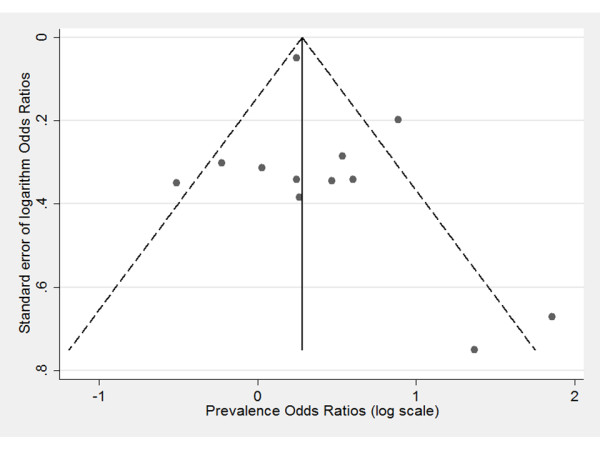
“Evidence of publication bias was ruled out by funnel plot [29] and statistically evaluated for asymmetry using the Begg rank correlation [30].”
MethodMeta-analysis in clinical trials
DerSimonian, R., & Laird, N. (1986) · Controlled Clinical Trials · doi:10.1016/0197-2456(86)90046-2 · Cited by 39,552 · cited 1×
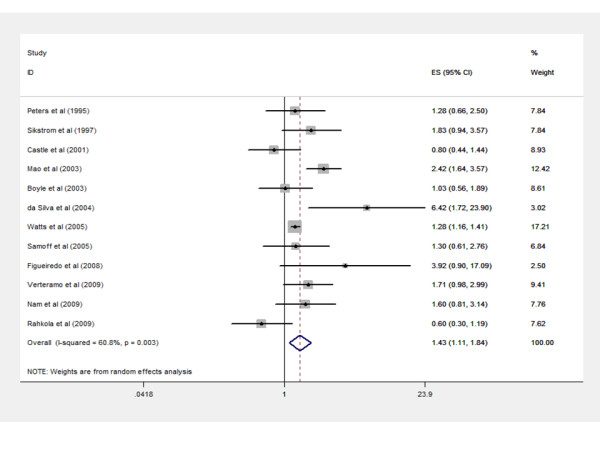
“The resulting set of odds ratios were combined into a summary estimate of the association between BV and HPV using the random effects model of DerSimonian and Laird [28] and results were visualised in a forest plot.”
Quantifying heterogeneity in a meta‐analysis
Higgins, J. P. T., & Thompson, S. G. (2002) · Statistics in Medicine · doi:10.1002/sim.1186 · Cited by 36,763 · cited 1×
“Homogeneity of effects across studies was assessed using Cochran’s Q test [31] and quantified by Higgins and Thompson’s I2 [32].”
MethodMeta-analysis of Observational Studies in Epidemiology<SUBTITLE>A Proposal for Reporting</SUBTITLE>
Stroup, D. F. (2000) · JAMA · doi:10.1001/jama.283.15.2008 · Cited by 20,623
Operating characteristics of a rank correlation test for publication bias
Begg, C. B., & Mazumdar, M. (1994) · Biometrics · doi:10.2307/2533446 · Cited by 16,955 · cited 1×
“Evidence of publication bias was ruled out by funnel plot [29] and statistically evaluated for asymmetry using the Begg rank correlation [30].”
MethodThe combination of estimates from different experiments
Cochran, W. G. (1954) · Biometrics · doi:10.2307/3001666 · Cited by 5,380 · cited 1×
“Homogeneity of effects across studies was assessed using Cochran’s Q test [31] and quantified by Higgins and Thompson’s I2 [32].”
MethodBacterial vaginosis and HIV acquisition: A meta-analysis of published studies
Atashili, J., Poole, C., Ndumbe, P. M., Adimora, A. A., & Smith, J. S. (2008) · AIDS · doi:10.1097/qad.0b013e3283021a37 · Cited by 706 · cited 7×
“Moreover, BV has been associated with many sexually transmitted infections (STIs), including infection with Chlamydia trachomatis , Neisseria gonorrhoeae , HSV-1 and 2, and an increased risk of HIV acquisition [4,8,9].”
InfluentialNatural history and epidemiology of HPV infection and cervical cancer
Castellsagué, X. (2008) · Gynecologic Oncology · doi:10.1016/j.ygyno.2008.07.045 · Cited by 590 · cited 2×
“However, few HPV infections persist and progress to cervical cancer [11].”
BackgroundWiesenfeld, H. C., Hillier, S. L., Krohn, M. A., Landers, D. V., & Sweet, R. L. (2003) · Clinical Infectious Diseases · doi:10.1086/367658 · Cited by 546 · cited 7×
“Moreover, BV has been associated with many sexually transmitted infections (STIs), including infection with Chlamydia trachomatis , Neisseria gonorrhoeae , HSV-1 and 2, and an increased risk of HIV acquisition [4,8,9].”
InfluentialKoshiol, J., Lindsay, L., Pimenta, J. M., Poole, C., Jenkins, D., & Smith, J. S. (2008) · American Journal of Epidemiology · doi:10.1093/aje/kwn036 · Cited by 428 · cited 1×
“Persistent HPV infection is a prerequisite for progression to highgrade lesions [10].”
BackgroundMeta-analysis in Stata : an updated collection from the Stata journal
Palmer, T., & Sterne, J. A. C. (2015) · Medical Entomology and Zoology · Cited by 388
Sexual Risk Factors and Bacterial Vaginosis: A Systematic Review and Meta‐Analysis
Fethers, K. A., Fairley, C. K., Hocking, J. S., Gurrin, L. C., & Bradshaw, C. S. (2008) · Clinical Infectious Diseases · doi:10.1086/592974 · Cited by 337 · cited 1×
“Some risk factors have been associated with BV, including cigarette smoking, use of intrauterine devices, frequent vaginal douches, multiple sexual partners, early age at first intercourse, and black ethnicity [4,5].”
BackgroundCherpes, T. L., Hillier, S. L., Meyn, L. A., Busch, J. L., & Krohn, M. A. (2008) · Sexually Transmitted Diseases · doi:10.1097/olq.0b013e318156a5d0 · Cited by 251 · cited 3×
“Some risk factors have been associated with BV, including cigarette smoking, use of intrauterine devices, frequent vaginal douches, multiple sexual partners, early age at first intercourse, and black ethnicity [4,5].”
BackgroundCastle, P. E., Hillier, S. L., Rabe, L. K., Hildesheim, A., Herrero, R., Bratti, M. C., Sherman, M. E., Burk, R. D., Rodriguez, A. C., Alfaro, M., et al. (2001) · PubMed · Cited by 249
Bacterial vaginosis: a public health review
Morris, M., Nicoll, A., Simms, I., Wilson, J., & Catchpole, M. (2001) · British Journal of Obstetrics and Gynaecology · doi:10.1016/s0306-5456(00)00124-8 · Cited by 227 · cited 5×
“5, presence of ‘clue cells’, and an amine odour after addition of 10% of potassium hydroxide [1,2].”
BackgroundInfluentialSialidases (neuraminidases) in bacterial vaginosis and bacterial vaginosis-associated microflora
Briselden, A. M., Moncla, B. J., Stevens, C. E., & Hillier, S. L. (1992) · Journal of Clinical Microbiology · doi:10.1128/jcm.30.3.663-666.1992 · Cited by 216 · cited 1×
“The team of Briselden demonstrated positivity for sialidases in 84% of BV-positive women [46].”
BackgroundCirino, F., Webley, W. C., West, C. A., Croteau, N. L., Andrzejewski, C., & Stuart, E. S. (2006) · ScholarWorks@UMassAmherst (University of Massachusetts Amherst) · Cited by 209
Watts, D. H., Fazarri, M., Minkoff, H., Hillier, S. L., Sha, B., Glesby, M., Levine, A. M., Burk, R., Palefsky, J. M., Moxley, M., et al. (2005) · The Journal of Infectious Diseases · doi:10.1086/427777 · Cited by 207 · cited 11×
“BV was diagnosed either using clinical Amsel or modified Amsel criteria in seven out of twelve studies [14,18,20,23,25,26,43], Nugent’s score in three out of twelve studies [17,21,24] and presence of clue cells in two out of twelve studies [13,15].”
BackgroundMethodInfluentialSamoff, E., Koumans, E. H., Markowitz, L. E., Sternberg, M., Sawyer, M. K., Swan, D., Papp, J. R., Black, C. M., & Unger, E. R. (2005) · American Journal of Epidemiology · doi:10.1093/aje/kwi262 · Cited by 198 · cited 9×
“BV was diagnosed either using clinical Amsel or modified Amsel criteria in seven out of twelve studies [14,18,20,23,25,26,43], Nugent’s score in three out of twelve studies [17,21,24] and presence of clue cells in two out of twelve studies [13,15].”
BackgroundMethodInfluentialBacterial vaginosis: an overview for 2009.
Livengood, C. H. (2009) · PubMed Central · Cited by 177
Secretory leukocyte protease inhibitor (SLPI) in mucosal fluids inhibits HIV‐1
Wahl, S. M., McNeely, T. B., Janoff, E. N., Shugars, D. C., Worley, P., Tucker, C., & Orenstein, J. (1997) · Oral Diseases · doi:10.1111/j.1601-0825.1997.tb00377.x · Cited by 155 · cited 1×
“Moreover, BV has been associated with a reduction in vaginal fluid levels of secretory leukocyte protease inhibitor (SLPI), able to block HIV infection in vitro [44].”
BackgroundBacterial vaginosis: an update on diagnosis and treatment
Verstraelen, H., & Verhelst, R. (2009) · Expert Review of Anti-infective Therapy · doi:10.1586/eri.09.87 · Cited by 148 · cited 3×
“At least 50% of patients have no symptoms [3].”
BackgroundSelf-citationHuman Papillomaviruses and genital co-infections in gynaecological outpatients
Verteramo, R., Pierangeli, A., Mancini, E., Calzolari, E., Bucci, M., Osborn, J. F., Nicosia, R., Chiarini, F., Antonelli, G., & Degener, A. M. (2009) · BMC Infectious Diseases · doi:10.1186/1471-2334-9-16 · Cited by 148
Cherpes, T. L., Melan, M. A., Kant, J. A., Cosentino, L. A., Meyn, L. A., & Hillier, S. L. (2005) · Clinical Infectious Diseases · doi:10.1086/429622 · Cited by 144 · cited 9×
“Although not considered an STI in its usual sense (e.g. treatment of the sexual partner has no effect on frequency or relapses), the epidemiological profile of BV mirrors an STI [49].”
InfluentialMoi, H. (1990) · International Journal of STD & AIDS · doi:10.1177/095646249000100203 · Cited by 124 · cited 1×
“Reasons for exclusion in the last step of our search strategy included: studies using koilocytosis as criterion for HPV detection [33-36], studies not describing their methodology of diagnosis [37,38], and studies using presence of Gardnerella vaginalis [39,40] or Grade II vaginal flora (according to Schröder et al.”
MethodGynecologic conditions and bacterial vaginosis: Implications for the non-pregnant patient
Sweet, R. L. (2000) · Infectious Diseases in Obstetrics and Gynecology · doi:10.1002/1098-0997(2000)8:3/4<184::aid-idog16>3.0.co;2-p · Cited by 124
Clinical findings among young women with genital human papillomavirus infection
Mao, C., Hughes, J. P., Kiviat, N. B., Kuypers, J. M., Lee, S.-K., Adam, D. E., & Koutsky, L. A. (2003) · American Journal of Obstetrics and Gynecology · doi:10.1067/mob.2003.164 · Cited by 97 · cited 10×
“BV was diagnosed either using clinical Amsel or modified Amsel criteria in seven out of twelve studies [14,18,20,23,25,26,43], Nugent’s score in three out of twelve studies [17,21,24] and presence of clue cells in two out of twelve studies [13,15].”
BackgroundMethodResultInfluentialAllsworth, J. E., Lewis, V. A., & Peipert, J. F. (2008) · Sexually Transmitted Diseases · doi:10.1097/olq.0b013e3181788301 · Cited by 93 · cited 7×
“Moreover, BV has been associated with many sexually transmitted infections (STIs), including infection with Chlamydia trachomatis , Neisseria gonorrhoeae , HSV-1 and 2, and an increased risk of HIV acquisition [4,8,9].”
InfluentialVaginal immunity in bacterial vaginosis
Cauci, S. (2004) · Current Infectious Disease Reports · doi:10.1007/s11908-004-0064-8 · Cited by 90 · cited 2×
“It is also possible that BV is a cofactor involved in acquisition or reactivation of HPV infection by affecting immunological balance within the cervical tissue as a result of changes in production of factors, such as cytokines (interleukin-1ß, interleukin-10) [47].”
BackgroundBacterial Vaginosis in Lesbians and Bisexual Women
Bailey, J. V., Farquhar, C., & Owen, C. (2004) · Sexually Transmitted Diseases · doi:10.1097/01.olq.0000143093.70899.68 · Cited by 82 · cited 1×
“highlighted by data in lesbians, who have a high prevalence of BV [48].”
BackgroundIncidence of Gardnerella vaginalis, Candida sp and human papilloma virus in cytological smears
Murta, E. F. C., de Souza, M. A. H., Júnior, E. A., & Adad, S. J. (2000) · Sao Paulo Medical Journal · doi:10.1590/s1516-31802000000400006 · Cited by 61 · cited 1×
“Reasons for exclusion in the last step of our search strategy included: studies using koilocytosis as criterion for HPV detection [33-36], studies not describing their methodology of diagnosis [37,38], and studies using presence of Gardnerella vaginalis [39,40] or Grade II vaginal flora (according to Schröder et al.”
MethodBacterial vaginosis in pregnancy
Ugwumadu, A. H. N. (2002) · Current Opinion in Obstetrics & Gynecology · doi:10.1097/00001703-200204000-00003 · Cited by 61 · cited 1×
“BV has been shown to increase the risk of obstetric and gynaecologic complications such as preterm labour and delivery, chorioamnionitis, post-caesarean endometritis, postabortion pelvic inflammatory disease, and cervicitis [6,7].”
BackgroundAssociation between bacterial vaginosis and cervical intraepithelial neoplasia
Nam, K. H., Kim, Y. T., Kim, S. R., Kim, S. W., Kim, J. W., Lee, M. K., Nam, E. J., & Jung, Y. W. (2009) · Journal of Gynecologic Oncology · doi:10.3802/jgo.2009.20.1.39 · Cited by 57 · cited 6×
“BV was diagnosed either using clinical Amsel or modified Amsel criteria in seven out of twelve studies [14,18,20,23,25,26,43], Nugent’s score in three out of twelve studies [17,21,24] and presence of clue cells in two out of twelve studies [13,15].”
BackgroundMethodInfluentialBacterial Vaginosis is Not Important in the Etiology of Cervical Neoplasia
PETERS, N., LEEUWEN, A. M. V., Pieters, W. J. L. M., Hollema, H., Quint, W. G. V., & Burger, M. P. M. (1995) · Sexually Transmitted Diseases · doi:10.1097/00007435-199509000-00005 · Cited by 50 · cited 8×
“BV was diagnosed either using clinical Amsel or modified Amsel criteria in seven out of twelve studies [14,18,20,23,25,26,43], Nugent’s score in three out of twelve studies [17,21,24] and presence of clue cells in two out of twelve studies [13,15].”
BackgroundMethodInfluentialHuman Papillomavirus Infection: A Concise Review of Natural History
Huh, W. K. (2009) · Obstetrics & Gynecology · doi:10.1097/aog.0b013e3181ab6878 · Cited by 46
Is bacterial vaginosis associated with cervical intraepithelial neoplasia?
Boyle, D. C. M., Barton, S. E., Uthayakumar, S., Hay, P., Pollock, J. W., Steer, P. J., & Smith, J. R. (2003) · International Journal of Gynecological Cancer · doi:10.1046/j.1525-1438.2003.13007.x · Cited by 44
Inflammatory events as detected in cervical smears and squamous intraepithelial lesions
Roeters, A. M. E., Boon, M. E., van Haaften, M., Vernooij, F., Bontekoe, T. R., & Heintz, A. P. M. (2009) · Diagnostic Cytopathology · doi:10.1002/dc.21169 · Cited by 43 · cited 1×
“Reasons for exclusion in the last step of our search strategy included: studies using koilocytosis as criterion for HPV detection [33-36], studies not describing their methodology of diagnosis [37,38], and studies using presence of Gardnerella vaginalis [39,40] or Grade II vaginal flora (according to Schröder et al.”
MethodInfection and cervical intraepithelial neoplasia
Boyle, & Smith (1999) · International Journal of Gynecological Cancer · doi:10.1046/j.1525-1438.1999.99007.x · Cited by 39 · cited 2×
“BV was diagnosed either using clinical Amsel or modified Amsel criteria in seven out of twelve studies [14,18,20,23,25,26,43], Nugent’s score in three out of twelve studies [17,21,24] and presence of clue cells in two out of twelve studies [13,15].”
BackgroundMethodMcNicol, P. J., Paraskevas, M., & Guijon, F. B. (1994) · Journal of Medical Virology · doi:10.1002/jmv.1890430218 · Cited by 39 · cited 1×
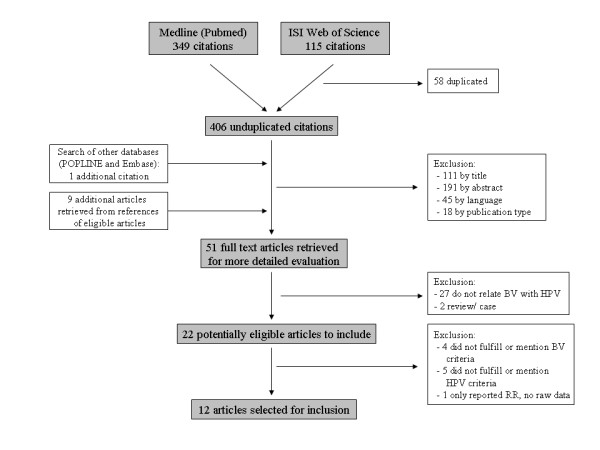
“[41] to diagnose BV. Twelve eligible articles were identified, including a total of 6,372 women.”
Discacciati, M. G., Simoes, J. A., Amaral, R. G., Brolazo, E. M., Rabelo‐Santos, S. H., Westin, M. C. D. A., & Montemor, E. B. L. (2006) · Diagnostic Cytopathology · doi:10.1002/dc.20418 · Cited by 37 · cited 1×
“Diagnosing BV only through presence of clue cells on wet smear or more than 20% clue cells on Papanicolaou smear was also considered an inclusion criteria, since this is confirmed by previous studies to be an accurate method and good predictor for BV [19].”
Methodda Silva, C. S., Adad, S. J., de Souza, M. A. H., Barcelos, A. C. M., Terra, A. P. S., & Murta, E. F. C. (2004) · Gynecologic and Obstetric Investigation · doi:10.1159/000079822 · Cited by 37
Engberts, M. K., Verbruggen, B. S. M., Boon, M. E., van Haaften, M., & Heintz, A. P. M. (2007) · Cancer · doi:10.1002/cncr.22947 · Cited by 37 · cited 1×
“Reasons for exclusion in the last step of our search strategy included: studies using koilocytosis as criterion for HPV detection [33-36], studies not describing their methodology of diagnosis [37,38], and studies using presence of Gardnerella vaginalis [39,40] or Grade II vaginal flora (according to Schröder et al.”
MethodRahkola‐Soisalo, P., Mikkola, T. S., Ylikorkala, O., & Väisänen‐Tommiska, M. (2009) · Gynecologic Oncology · doi:10.1016/j.ygyno.2009.05.003 · Cited by 35 · cited 7×
“BV was diagnosed either using clinical Amsel or modified Amsel criteria in seven out of twelve studies [14,18,20,23,25,26,43], Nugent’s score in three out of twelve studies [17,21,24] and presence of clue cells in two out of twelve studies [13,15].”
BackgroundMethodInfluentialHigh-risk and multiple human papillomavirus (HPV) infections in cancer-free Jamaican women
Watt, A., Garwood, D., Jackson, M. D., Younger, N. O. M., Ragin, C. C. R., Smikle, M., Fletcher, H. M., & McFarlane‐Anderson, N. (2009) · Infectious Agents and Cancer · doi:10.1186/1750-9378-4-s1-s11 · Cited by 33 · cited 1×
“Reasons for exclusion in the last step of our search strategy included: studies using koilocytosis as criterion for HPV detection [33-36], studies not describing their methodology of diagnosis [37,38], and studies using presence of Gardnerella vaginalis [39,40] or Grade II vaginal flora (according to Schröder et al.”
MethodKlomp, J. M., Boon, M. E., van Haaften, M., & Heintz, A. P. M. (2008) · American Journal of Obstetrics and Gynecology · doi:10.1016/j.ajog.2008.04.036 · Cited by 26 · cited 1×
“Reasons for exclusion in the last step of our search strategy included: studies using koilocytosis as criterion for HPV detection [33-36], studies not describing their methodology of diagnosis [37,38], and studies using presence of Gardnerella vaginalis [39,40] or Grade II vaginal flora (according to Schröder et al.”
MethodVerbruggen, B. M., Boon, M. E., & Boon, L. M. (2006) · Diagnostic Cytopathology · doi:10.1002/dc.20374 · Cited by 26 · cited 1×
“Reasons for exclusion in the last step of our search strategy included: studies using koilocytosis as criterion for HPV detection [33-36], studies not describing their methodology of diagnosis [37,38], and studies using presence of Gardnerella vaginalis [39,40] or Grade II vaginal flora (according to Schröder et al.”
MethodBacterial vaginosis: a sexually enhanced disease
Verstraelen, H. (2008) · International Journal of STD & AIDS · doi:10.1258/ijsa.2008.008189 · Cited by 18 · cited 10×
“Although not considered an STI in its usual sense (e.g. treatment of the sexual partner has no effect on frequency or relapses), the epidemiological profile of BV mirrors an STI [49].”
InfluentialSelf-citationPrevalence of vulvovaginitis and bacterial vaginosis in patients with koilocytosis
Campos, A. C. C., Freitas‐Júnior, R., Ribeiro, L. F. J., Paulinelli, R. R., & Reis, C. (2008) · Sao Paulo Medical Journal · doi:10.1590/s1516-31802008000600008 · Cited by 17 · cited 1×
“Reasons for exclusion in the last step of our search strategy included: studies using koilocytosis as criterion for HPV detection [33-36], studies not describing their methodology of diagnosis [37,38], and studies using presence of Gardnerella vaginalis [39,40] or Grade II vaginal flora (according to Schröder et al.”
MethodSikström, B., Hellberg, D., Nilsson, S., Kallings, I., & Mårdh, P. (2010) · Gynecologic and Obstetric Investigation · doi:10.1159/000291818 · Cited by 12 · cited 6×
“BV was diagnosed either using clinical Amsel or modified Amsel criteria in seven out of twelve studies [14,18,20,23,25,26,43], Nugent’s score in three out of twelve studies [17,21,24] and presence of clue cells in two out of twelve studies [13,15].”
BackgroundMethodInfluentialFigueirêdo, P. G., Sarian, L. O., Tambascia, J., Simões, J. A., Rabelo‐Santos, S. H., Discacciati, M. G., & Derchain, S. (2008) · Diagnostic Cytopathology · doi:10.1002/dc.20900 · Cited by 11 · cited 10×
“2008 Figueiredo et al[15] Brazil CS 228 referred PCR 84.”
BackgroundMethodInfluential
Cited by
Kombe Kombe, A. J., Li, B., Zahid, A., Mengist, H. M., Bounda, G.-A., Zhou, Y., & Jin, T. (2021) · Frontiers in Public Health · doi:10.3389/fpubh.2020.552028 · Cited by 646
Lactobacillus species as biomarkers and agents that can promote various aspects of vaginal health
Petrova, M. I., Lievens, E., Malik, S., Imholz, N., & Lebeer, S. (2015) · Frontiers in Physiology · doi:10.3389/fphys.2015.00081 · Cited by 523
“Multiple studies have identified a positive association between BV and cervical HPV infection, supported by the overall estimated odds ratio of ameta-analysis including 12 eligible studies investigating the BV-HPV association (Gillet et al., 2011).”
BackgroundInfluentialA systematic review of the health and social effects of menstrual hygiene management
Sumpter, C., & Torondel, B. (2013) · PLoS ONE · doi:10.1371/journal.pone.0062004 · Cited by 518
“BV has been associated with an increase risk of HIV infection [12,13]; human papillomavirus infection [14] and with adverse pregnancy outcomes [15] amongst others.”
BackgroundMitra, A., MacIntyre, D. A., Lee, Y. S., Smith, A., Marchesi, J. R., Lehne, B., Bhatia, R., Lyons, D., Paraskevaidis, E., Li, J. V., et al. (2015) · Scientific Reports · doi:10.1038/srep16865 · Cited by 498
“BV, a condition diagnosed using traditional culture techniques, in part by Lactobacillus spp. depletion and increased diversity of potentially pathogenic gram negative bacteria, is associated with significantly higher rates of HPV infection and CIN 19,20 .”
BackgroundMitra, A., MacIntyre, D. A., Marchesi, J. R., Lee, Y. S., Bennett, P. R., & Kyrgiou, M. (2016) · Microbiome · doi:10.1186/s40168-016-0203-0 · Cited by 484
Metadata
- Authors
- Gillet, E., Meys, J. F., Verstraelen, H., Bosire, C., De Sutter, P., Temmerman, M., & Broeck, D. V.
- Affiliations
- Vrije Universiteit Brussel (BE)
- Ghent University (BE)
- Ghent University Hospital (BE)
- Corresponding author
- Broeck, Davy Vanden
- Venue
- BMC Infectious Diseases
- Published
- 2011-01-11
- Volume
- 11
- Issue
- 1
- Pages
- 10-10
- ISSN
- 1471-2334 (ISSN-L)
- PMC
- PMC3023697
- OpenAlex
- W2065342949
- Cited by
- 354
- References
- 51
- Citations by year
- 2026: 21 · 2025: 27 · 2024: 34 · 2023: 32 · 2022: 42 · 2021: 28 · 2020: 29 · 2019: 19 · 2018: 22 · 2017: 17 · 2016: 21 · 2015: 19 · 2014: 12 · 2013: 16 · 2012: 13
- FWCI
- 1.62
- Type
- journal article
- Language
- en
- Open access
- gold
- doi.org
- Licence
- Locations
- BMC Infectious Diseases (publishedVersion, cc-by)
- PubMed Central (publishedVersion, cc-by)
- PubMed (publishedVersion)
- Ghent University Academic Bibliography (Ghent University) (submittedVersion, other-oa)
- eCommons - AKU (Aga Khan University) (submittedVersion)
- DOAJ (DOAJ: Directory of Open Access Journals) (submittedVersion, cc-by-sa)
- VUBIR (Vrije Universiteit Brussel) (submittedVersion)
- Funders
- Fonds Wetenschappelijk Onderzoek
- Vlaamse regering
- Topics
- Life Sciences › Immunology and Microbiology › Microbiology › Reproductive tract infections research
- Health Sciences › Medicine › Epidemiology › Cervical Cancer and HPV Research
- Health Sciences › Medicine › Obstetrics and Gynecology › Gynecological conditions and treatments
- Keywords
- bacterial vaginosis, human papillomavirus, cervical HPV infection, vaginal microbiota, lactobacilli, anaerobic bacteria, HPV acquisition, women of reproductive age
- MeSH terms
- Adolescent, Adult, Aged, Female, Humans, Middle Aged, Odds Ratio, Vaginosis, Bacterial, Papillomaviridae, Papillomavirus Infections, Young Adult
About these checks
Registry, retraction, Cites and statistics results are computed, not judged, with one exception: a printed reference that no index lists is read once by a model before it counts as a citation error. Claims are extracted by a model and kept only when their quote appears verbatim in the text; each cited source is then checked, with a model’s help, for whether it says what the claim relies on. Those verdicts can be wrong — read the claim’s quote and the cited source before relying on one.
Statistics and arithmetic are recomputed, not judged.
Confidence bands are shown only for fields calibrated on our annotated test set. None is calibrated yet, so no band is shown.
What counts as a claim ›How we measure confidence ›How we check this ›
Are you an author, or do you see a problem with this page? Request a review
Data sources
Bibliographic data: Semantic Scholar, OpenAlex, Crossref.
Contains information from the Semantic Scholar Academic Graph Datasets, made available under the ODC Attribution License (ODC-BY 1.0).
Semantic Scholar’s data is described in: Kinney, R., et al. (2023). The Semantic Scholar Open Data Platform. arXiv:2301.10140.
