

Differences in fungi present in induced sputum samples from asthma patients and non-atopic controls: a community based case control study
Open accessThe DOI matches its Crossref record; 20 of the 21 references it cites were found in a registry or an index.
Abstract
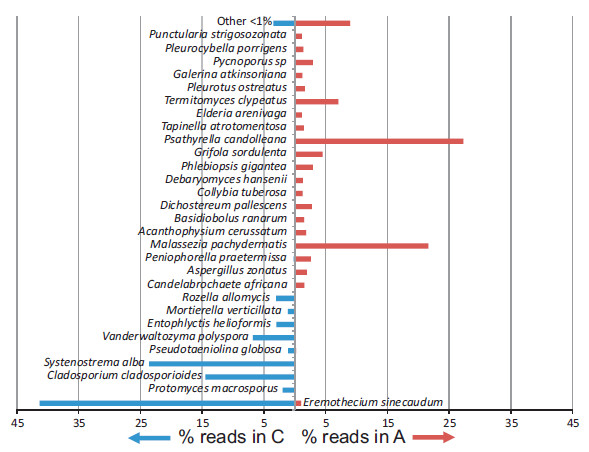
BACKGROUND: There is emerging evidence for the presence of an extensive microbiota in human lungs. It is not known whether variations in the prevalence of species of microbiota in the lungs may have aetiological significance in respiratory conditions such as asthma. The aim of the study was to undertake semi-quantitative analysis of the differences in fungal species in pooled sputum samples from asthma patients and controls. METHODS: Induced sputum samples were collected in a case control study of asthma patients and control subjects drawn from the community in Wandsworth, London. Samples from both groups were pooled and then tested for eukaryotes. DNA was amplified using standard PCR techniques, followed by pyrosequencing and comparison of reads to databases of known sequences to determine in a semi-quantitative way the percentage of DNA from known species in each of the two pooled samples. RESULTS: A total of 136 fungal species were identified in the induced sputum samples, with 90 species more common in asthma patients and 46 species more common in control subjects. Psathyrella candolleana, Malassezia pachydermatis, Termitomyces clypeatus and Grifola sordulenta showed a higher percentage of reads in the sputum of asthma patients and Eremothecium sinecaudum, Systenostrema alba, Cladosporium cladosporioides and Vanderwaltozyma polyspora showed a higher percentage of reads in the sputum of control subjects. A statistically significant difference in the pattern of fungi that were present in the respective samples was demonstrated using the Phylogenetic (P) test (P < 0.0001). CONCLUSION: This study is novel in providing evidence for the widespread nature of fungi in the sputum of healthy and asthmatic individuals. Differences in the pattern of fungi present in asthma patients and controls merit further investigation. Of particular interest was the presence of Malassezia pachydermatis, which is known to be associated with atopic dermatitis.
Overview
The claims and statistics of this paper haven’t been checked yet.
Free: it reads the open-access text and checks the first 5 claims that cite a source we can check. Create a free account to check every claim.
Integrity signals
Registry
Cites
Statistics
Figures
Verification
Claims the paper makes
The claims and statistics of this paper haven’t been checked yet.
Free: it reads the open-access text and checks the first 5 claims that cite a source we can check. Create a free account to check every claim.
Claims other papers make about this one
Each is checked against this paper’s own text: does it say what the citing paper says it does?
The source backs part of the claim, not all of it — or backs it for a different population, condition or comparison.
In the citing paper
“Furthermore, the healthy lung mycobiome was found to be predominantly composed of members of the Eremothecium, Systenostrema and Malassezia genera, and the Davidiellaceae family, with common fungi in the URT detected only in low abundance57,84,85.”
From The microbiota of the respiratory tract: gatekeeper to respiratory health (2017) · cites this paper as [84]
Experimental — accuracy not yet measured
Self-check
Percentages, sums and reported differences re-computed from the paper’s own numbers.
The self-check needs the paper’s full text.
Citations
Cites
The SILVA ribosomal RNA gene database project: improved data processing and web-based tools
Quast, C., Pruesse, E., Yilmaz, P., Gerken, J., Schweer, T., Yarza, P., Peplies, J., & Glöckner, F. O. (2012) · Nucleic Acids Research · doi:10.1093/nar/gks1219 · Cited by 33,055 · cited 1×
“The PCR primers were chosen after considerable deliberation and a probeCheck test showed that they were universal and matched Homo sapiens’ 18S rRNA gene 100% [21].”
MethodAmann, R. I., Krumholz, L., & Stahl, D. A. (1990) · Journal of Bacteriology · doi:10.1128/jb.172.2.762-770.1990 · Cited by 2,208
Disordered Microbial Communities in Asthmatic Airways
Hilty, M., Burke, C., Pedro, H., Cardenas, P., Bush, A., Bossley, C., Davies, J., Ervine, A., Poulter, L., Pachter, L., et al. (2010) · PLoS ONE · doi:10.1371/journal.pone.0008578 · Cited by 1,824
UniFrac – An online tool for comparing microbial community diversity in a phylogenetic context
Lozupone, C., Hamady, M., & Knight, R. (2006) · BMC Bioinformatics · doi:10.1186/1471-2105-7-371 · Cited by 1,453
The Malassezia Genus in Skin and Systemic Diseases
Gaitanis, G., Magiatis, P., Hantschke, M., Bassukas, I. D., & Velegraki, A. (2012) · Clinical Microbiology Reviews · doi:10.1128/cmr.00021-11 · Cited by 642 · cited 1×
“This organism has a known association with atopic conditions including atopic dermatitis [17].”
BackgroundPhylogenetic Approaches for Describing and Comparing the Diversity of Microbial Communities
Martin, A. P. (2002) · Applied and Environmental Microbiology · doi:10.1128/aem.68.8.3673-3682.2002 · Cited by 518
Detection of Anaerobic Bacteria in High Numbers in Sputum from Patients with Cystic Fibrosis
Tunney, M. M., Field, T. R., Moriarty, T. F., Patrick, S., Doering, G., Muhlebach, M. S., Wolfgang, M. C., Boucher, R., Gilpin, D. F., McDowell, A., et al. (2008) · American Journal of Respiratory and Critical Care Medicine · doi:10.1164/rccm.200708-1151oc · Cited by 468
Pitkäranta, M., Meklin, T., Hyvärinen, A., Paulin, L., Auvinen, P., Nevalainen, A., & Rintala, H. (2008) · Applied and Environmental Microbiology · doi:10.1128/aem.00692-07 · Cited by 216
Structural Diversity of Eukaryotic Small Subunit Ribosomal RNAsa: Evolutionary Implications
SOGIN, M. L., & GUNDERSON, J. H. (1987) · Annals of the New York Academy of Sciences · doi:10.1111/j.1749-6632.1987.tb40603.x · Cited by 160
Pirhonen, I., Nevalainen, A., Husman, T., & Pekkanen, J. (1996) · European Respiratory Journal · doi:10.1183/09031936.96.09122618 · Cited by 157
Research works printed but not linked: 3
- Bunnell J Editorial Epidemio-Ecology News 2002 1 2 1
- Griffin DW Kellogg CA Garrison VH Holmes C Shinn EA The movement of soil and sediment in Earth's atmosphere: microbiology and ecosystem health Epidemio-Ecology News 2002 1 2 1 6
- World Health Organisation Hazard prevention and control in the work environment: airborne dust 1999 Geneva: WHO
Cited by
Microbiota in health and diseases
Hou, K., Wu, Z.-X., Chen, X.-Y., Wang, J.-Q., Zhang, D., Xiao, C., Zhu, D., Koya, J. B., Wei, L., Li, J., et al. (2022) · Signal Transduction and Targeted Therapy · doi:10.1038/s41392-022-00974-4 · Cited by 3,171
“However, the research on fungi is limited and remains inconclusive.(194) Other studies identified altered abundance of Pseudomonas, Moraxella, Lactobacillus, and Haemophilus during COPD exacerbations.”
BackgroundThe microbiota of the respiratory tract: gatekeeper to respiratory health
Man, W. H., de Steenhuijsen Piters, W. A. A., & Bogaert, D. (2017) · Nature Reviews Microbiology · doi:10.1038/nrmicro.2017.14 · Cited by 1,384
Enaud, R., Prevel, R., Ciarlo, E., Beaufils, F., Wieërs, G., Guery, B., & Delhaes, L. (2020) · Frontiers in Cellular and Infection Microbiology · doi:10.3389/fcimb.2020.00009 · Cited by 738
The mycobiota: interactions between commensal fungi and the host immune system
Underhill, D. M., & Iliev, I. D. (2014) · Nature Reviews Immunology · doi:10.1038/nri3684 · Cited by 695
The Role of Lung and Gut Microbiota in the Pathology of Asthma
Barcik, W., Boutin, R. C. T., Sokolowska, M., & Finlay, B. B. (2020) · Immunity · doi:10.1016/j.immuni.2020.01.007 · Cited by 613
Metadata
- Authors
- van Woerden, H. C., Gregory, C., Brown, R., Marchesi, J. R., Hoogendoorn, B., & Matthews, I. P.
- Affiliations
- Cardiff University (GB)
- Corresponding author
- Gregory, Clive
- Venue
- BMC Infectious Diseases
- Published
- 2013-02-05
- Volume
- 13
- Issue
- 1
- Pages
- 69-69
- ISSN
- 1471-2334 (ISSN-L)
- PMC
- PMC3570489
- OpenAlex
- W2013956321
- Cited by
- 177
- References
- 21
- Citations by year
- 2026: 6 · 2025: 11 · 2024: 16 · 2023: 8 · 2022: 16 · 2021: 19 · 2020: 21 · 2019: 19 · 2018: 6 · 2017: 21 · 2016: 8 · 2015: 12 · 2014: 10 · 2013: 3
- FWCI
- 7.64
- Type
- journal article
- Language
- en
- Open access
- gold
- doi.org
- Licence
- cc-by
- creativecommons.org/licenses/by/2.0 (tdm)
- Locations
- BMC Infectious Diseases (publishedVersion, cc-by)
- Europe PMC (PubMed Central) (publishedVersion, cc-by)
- PubMed Central (publishedVersion, cc-by)
- PubMed (publishedVersion)
- ORCA Online Research @Cardiff (Cardiff University) (acceptedVersion)
- DOAJ (DOAJ: Directory of Open Access Journals) (submittedVersion)
- Clinical Infectious Diseases
- Funders
- Cardiff University
- Topics
- Health Sciences › Medicine › Pulmonary and Respiratory Medicine › Asthma and respiratory diseases
- Physical Sciences › Environmental Science › Health, Toxicology and Mutagenesis › Indoor Air Quality and Microbial Exposure
- Health Sciences › Medicine › Infectious Diseases › Antifungal resistance and susceptibility
- Keywords
- asthma, lung microbiome, fungal species, induced sputum, Malassezia pachydermatis, atopy, Psathyrella candolleana, Cladosporium cladosporioides, fungal diversity, atopic dermatitis
- MeSH terms
- Adolescent, Adult, Aged, Asthma, DNA, Fungal, Female, Fungi, Humans, Male, Middle Aged, Sputum, Case-Control Studies, Sequence Analysis, DNA, Young Adult
About these checks
Registry, retraction, Cites and statistics results are computed, not judged, with one exception: a printed reference that no index lists is read once by a model before it counts as a citation error. Claims are extracted by a model and kept only when their quote appears verbatim in the text; each cited source is then checked, with a model’s help, for whether it says what the claim relies on. Those verdicts can be wrong — read the claim’s quote and the cited source before relying on one.
Statistics and arithmetic are recomputed, not judged.
Confidence bands are shown only for fields calibrated on our annotated test set. None is calibrated yet, so no band is shown.
What counts as a claim ›How we measure confidence ›How we check this ›
Are you an author, or do you see a problem with this page? Request a review
How to cite
Cite CoChat for the checks on this page, and the paper for its own findings.
- This page
- CoChat. (2026). Citation check: Differences in fungi present in induced sputum samples from asthma patients and non-atopic controls: a community based case control study. https://app.cochat.ai/papers/10.1186/1471-2334-13-69
- The paper
- van Woerden, H. C., Gregory, C., Brown, R., Marchesi, J. R., Hoogendoorn, B., & Matthews, I. P. (2013). Differences in fungi present in induced sputum samples from asthma patients and non-atopic controls: a community based case control study. BMC Infectious Diseases. https://doi.org/10.1186/1471-2334-13-69
Data sources
Bibliographic data: Semantic Scholar, OpenAlex, Crossref.
Contains information from the Semantic Scholar Academic Graph Datasets, made available under the ODC Attribution License (ODC-BY 1.0).
Semantic Scholar’s data is described in: Kinney, R., et al. (2023). The Semantic Scholar Open Data Platform. arXiv:2301.10140.
