

The DOI matches its Crossref record; 223 of the 223 references it cites were found in a registry or an index.
A systematic review and meta-analysis of the effects of antibiotic consumption on antibiotic resistance
Open accessAbstract
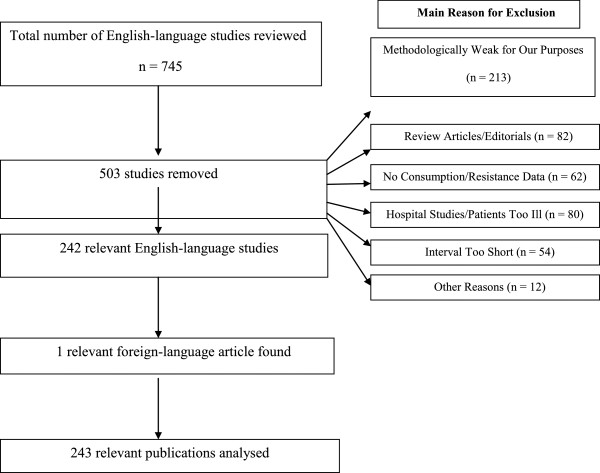
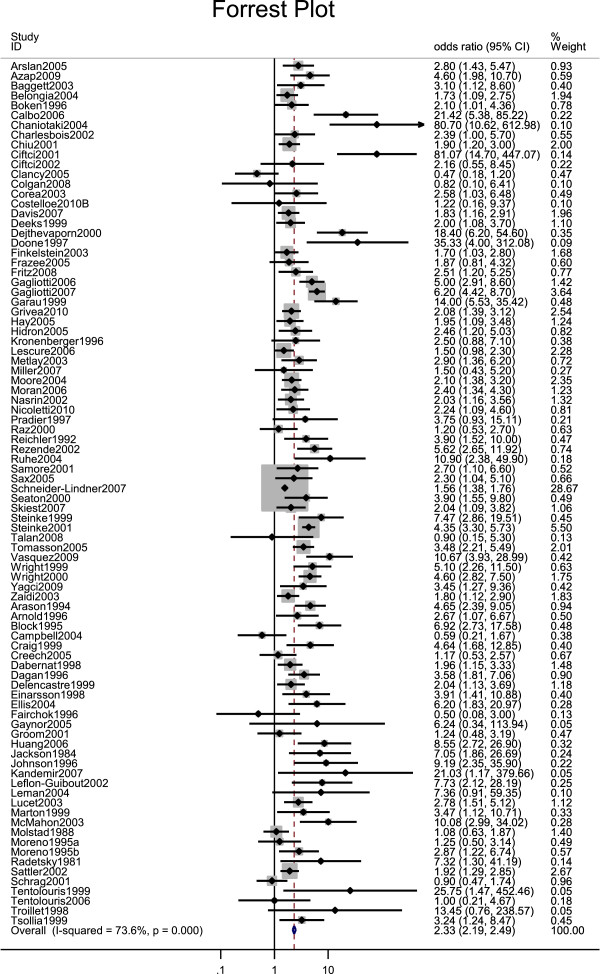
BACKGROUND: Greater use of antibiotics during the past 50 years has exerted selective pressure on susceptible bacteria and may have favoured the survival of resistant strains. Existing information on antibiotic resistance patterns from pathogens circulating among community-based patients is substantially less than from hospitalized patients on whom guidelines are often based. We therefore chose to assess the relationship between the antibiotic resistance pattern of bacteria circulating in the community and the consumption of antibiotics in the community. METHODS: Both gray literature and published scientific literature in English and other European languages was examined. Multiple regression analysis was used to analyse whether studies found a positive relationship between antibiotic consumption and resistance. A subsequent meta-analysis and meta-regression was conducted for studies for which a common effect size measure (odds ratio) could be calculated. RESULTS: Electronic searches identified 974 studies but only 243 studies were considered eligible for inclusion by the two independent reviewers who extracted the data. A binomial test revealed a positive relationship between antibiotic consumption and resistance (p < .001) but multiple regression modelling did not produce any significant predictors of study outcome. The meta-analysis generated a significant pooled odds ratio of 2.3 (95% confidence interval 2.2 to 2.5) with a meta-regression producing several significant predictors (F(10,77) = 5.82, p < .01). Countries in southern Europe produced a stronger link between consumption and resistance than other regions. CONCLUSIONS: Using a large set of studies we found that antibiotic consumption is associated with the development of antibiotic resistance. A subsequent meta-analysis, with a subsample of the studies, generated several significant predictors. Countries in southern Europe produced a stronger link between consumption and resistance than other regions so efforts at reducing antibiotic consumption may need to be strengthened in this area. Increased consumption of antibiotics may not only produce greater resistance at the individual patient level but may also produce greater resistance at the community, country, and regional levels, which can harm individual patients.
Overview
The claims and statistics of this paper haven’t been checked yet.
Run the check — free, no account needed. It reads the open-access text and checks the sources it cites.
Integrity signals
Registry
Cites
Statistics
Figures
Verification
Claims the paper makes
The claims and statistics of this paper haven’t been checked yet.
Run the check — free, no account needed. It reads the open-access text and checks the sources it cites.
Claims other papers make about this one
Each is checked against this paper’s own text: does it say what the citing paper says it does?
The source backs part of the claim, not all of it — or backs it for a different population, condition or comparison.
In the citing paper
“and a fast de-escalation was shown to be associated with a decreased risk [26, 27].”
From Lab efficiency and improvements in the management of bloodstream infections: a before and after study (2025) · cites this paper as [26]
Experimental — accuracy not yet measuredThe cited source says what the claim attributes to it.
In the citing paper
“Antibiotic resistance being correlated with antibiotic use, in terms of antimicrobial stewardship, it is crucial that antibiotics are only used when indicated”
From Lab efficiency and improvements in the management of bloodstream infections: a before and after study (2025) · cites this paper as [26]
Self-check
Percentages, sums and reported differences re-computed from the paper’s own numbers.
The self-check needs the paper’s full text.
Citations
Cites
(2000) · Cited by 9,198
Outpatient antibiotic use in Europe and association with resistance: a cross-national database study
Goossens, H., Ferech, M., Vander Stichele, R., & Elseviers, M. (2005) · The Lancet · doi:10.1016/s0140-6736(05)17907-0 · Cited by 3,359
Self-citationMethicillin-Resistant S. aureus Infections among Patients in the Emergency Department
Moran, G. J., Krishnadasan, A., Gorwitz, R. J., Fosheim, G. E., McDougal, L. K., Carey, R. B., & Talan, D. A. (2006) · New England Journal of Medicine · doi:10.1056/nejmoa055356 · Cited by 2,285
Costelloe, C., Metcalfe, C., Lovering, A., Mant, D., & Hay, A. D. (2010) · BMJ · doi:10.1136/bmj.c2096 · Cited by 1,981
The Relationship between Antimicrobial Use and Antimicrobial Resistance in Europe
Bronzwaer, S. L. A. M., Cars, O., Buchholz, U., Mölstad, S., Goettsch, W., Veldhuijzen, I. K., Kool, J. L., Sprenger, M. J. W., Degener, J. E., & System, P. I. T. E. A. R. S. (2002) · Emerging infectious diseases · doi:10.3201/eid0803.010192 · Cited by 691
Bacterial Resistance: Origins, Epidemiology, and Impact
Livermore, D. M. (2003) · Clinical Infectious Diseases · doi:10.1086/344654 · Cited by 589
Low Dosage and Long Treatment Duration of β-Lactam
Guillemot, D., Carbon, C., Balkau, B., Geslin, P., Lecoeur, H., Vauzelle-Kervroedan, F., Bouvenot, G., & Eschwège, É. (1998) · JAMA · doi:10.1001/jama.279.5.365 · Cited by 545
Malhotra‐Kumar, S., Lammens, C., Coenen, S., Herck, K. V., & Goossens, H. (2007) · The Lancet · doi:10.1016/s0140-6736(07)60235-9 · Cited by 541
Self-citationArason, V. A., Kristinsson, K. G., Sigurdsson, J. A., Stefansdottir, G., Mölstad, S., & Gudmundsson, S. (1996) · BMJ · doi:10.1136/bmj.313.7054.387 · Cited by 493
Antimicrobial Drug Use and Resistance in Europe
van de Sande-Bruinsma, N., Grundmann, H., Verloo, D., Tiemersma, E. W., Monen, J., Goossens, H., Ferech, M., & the European Antimicrobial Resistance Surveillance System and European Surveillance of Antimicrobial Consumption Project Groups (2008) · Emerging infectious diseases · doi:10.3201/eid1411.070467 · Cited by 481
Self-citation
Cited by
Sorted by citations
Understanding the mechanisms and drivers of antimicrobial resistance
Holmes, A. H., Moore, L. S. P., Sundsfjord, A., Steinbakk, M., Regmi, S., Karkey, A., Guerin, P. J., & Piddock, L. J. V. (2015) · The Lancet · doi:10.1016/s0140-6736(15)00473-0 · Cited by 2,877
Association of adverse events with antibiotic use in hospitalized patients.
Tamma, P. D., Avdic, E., Li, D. X., Dzintars, K., & Cosgrove, S. E. (2017) · JAMA Internal Medicine · doi:10.1001/jamainternmed.2017.1938 · Cited by 800
Schuts, E. C., Hulscher, M., Mouton, J. W., Verduin, C. M., Stuart, J. W. T. C., Overdiek, H. W. P. M., van der Linden, P. D., Natsch, S., Hertogh, C. M. P. M., Wolfs, T. F. W., et al. (2016) · The Lancet Infectious Diseases · doi:10.1016/s1473-3099(16)00065-7 · Cited by 772
Collignon, P., Beggs, J. J., Walsh, T. R., Gandra, S., & Laxminarayan, R. (2018) · The Lancet Planetary Health · doi:10.1016/s2542-5196(18)30186-4 · Cited by 750
Global trends in antibiotic consumption during 2016–2023 and future projections through 2030
Klein, E. Y., Impalli, I., Poleon, S., Denoël, P., Cipriano, M., Boeckel, T. P. V., Pecetta, S., Bloom, D. E., & Nandi, A. (2024) · Proceedings of the National Academy of Sciences · doi:10.1073/pnas.2411919121 · Cited by 481
Metadata
- Authors
- Bell, B. G., Schellevis, F., Stobberingh, E., Goossens, H., & Pringle, M.
- Affiliations
- University of Nottingham (GB)
- Maastricht University (NL)
- University of Antwerp (BE)
- Corresponding author
- Bell, Brian G
- Venue
- BMC Infectious Diseases
- Published
- 2014-01-09
- Volume
- 14
- Issue
- 1
- Pages
- 13-13
- ISSN
- 1471-2334 (ISSN-L)
- PMC
- PMC3897982
- OpenAlex
- W2064618548
- Cited by
- 1,262
- References
- 223
- Citations by year
- 2026: 56 · 2025: 91 · 2024: 151 · 2023: 151 · 2022: 149 · 2021: 156 · 2020: 158 · 2019: 105 · 2018: 93 · 2017: 60 · 2016: 50 · 2015: 27 · 2014: 13
- FWCI
- 7.04
- Type
- journal article
- Language
- en
- Open access
- gold
- doi.org
- Licence
- Locations
- BMC Infectious Diseases (publishedVersion, cc-by)
- Europe PMC (PubMed Central) (publishedVersion, cc-by)
- PubMed Central (publishedVersion, cc-by)
- PubMed (publishedVersion)
- Research Publications (Maastricht University) (publishedVersion, cc-by)
- Pure Amsterdam UMC (publishedVersion)
- Amsterdam UMC (VU Amsterdam) - Institutional Repository (publishedVersion)
- Data Archiving and Networked Services (DANS) (submittedVersion, other-oa)
- Research Publications (Maastricht University) (submittedVersion, other-oa)
- Data Archiving and Networked Services (DANS) (submittedVersion)
- Funders
- European Commission (223083)
- Topics
- Health Sciences › Medicine › Infectious Diseases › Antibiotic Use and Resistance
- Health Sciences › Medicine › Microbiology (medical) › Antibiotic Resistance in Bacteria
- Physical Sciences › Environmental Science › Pollution › Pharmaceutical and Antibiotic Environmental Impacts
- Keywords
- antibiotic use, antibiotic resistance, community-acquired infections, antimicrobial resistance patterns, selection pressure, Southern Europe, regional variation in resistance
- MeSH terms
- Anti-Bacterial Agents, Drug Resistance, Microbial, Europe, Humans, Odds Ratio
About these checks
Registry, retraction, Cites and statistics results are computed, not judged, with one exception: a printed reference that no index lists is read once by a model before it counts as a citation error. Claims are extracted by a model and kept only when their quote appears verbatim in the text; each cited source is then checked, with a model’s help, for whether it says what the claim relies on. Those verdicts can be wrong — read the claim’s quote and the cited source before relying on one.
Statistics and arithmetic are recomputed, not judged.
Confidence bands are shown only for fields calibrated on our annotated test set. None is calibrated yet, so no band is shown.
What counts as a claim ›How we measure confidence ›How we check this ›
Are you an author, or do you see a problem with this page? Request a review
