

Uniform distribution of three Candida albicans microsatellite markers in two French ICU populations supports a lack of nosocomial cross-contamination
Open accessThe DOI matches its Crossref record; 22 of the 22 references it cites were found in a registry or an index.
Abstract
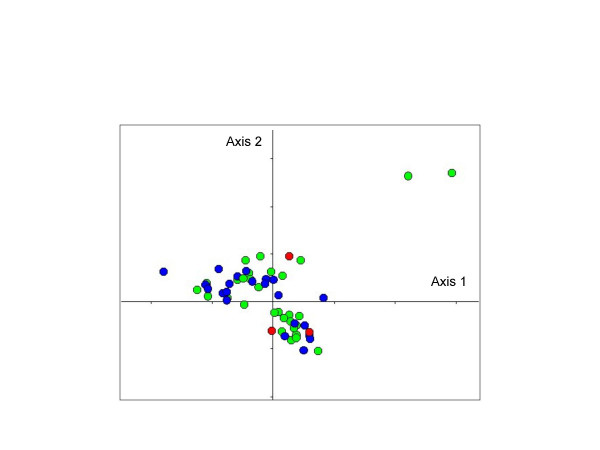
Background: The nosocomial acquisition of Candida albicans is a growing concern in intensive care units (ICUs) and understanding the route of contamination is relevant for infection control guidelines. Methods: To analyze whether there is a specific ecology for any given hospital, we genotyped C. albicans isolates of the ICU of Versailles hospital (Hospital A) and compared the results with those previously obtained in another ICU in Henri Mondor hospital (Hospital B) using three polymorphic microsatellite markers (PMM). Results: Among 36 patients with at least one positive culture for C. albicans, 26 had a specific multilocus genotype, two shared a common multilocus genotype, and 8 had the most common multilocus genotype found in the general population. The time interval between periods of hospitalization between patients with common genotypes differed by 13 to 78 days, thus supporting a lack of direct contamination. To confirm this hypothesis, the multilocus genotypic distributions of the three PMM were compared between the two hospitals. No statistically significant difference was observed. Multiple correspondences analysis did not indicate the association of a multilocus genotypic distribution with any given hospital. Conclusion: The present epidemiological study supports the conclusions that each patient harbours his/her own isolate, and that nosocomial transmission is not common in any given ICU. This study also supports the usefulness and practicability of PMM for studying the epidemiology of C. albicans.
Overview
The claims and statistics of this paper haven’t been checked yet.
Free: it reads the open-access text and checks the first 5 claims that cite a source we can check. Create a free account to check every claim.
Integrity signals
Registry
Cites
Statistics
Figures
Verification
Claims the paper makes
The claims and statistics of this paper haven’t been checked yet.
Free: it reads the open-access text and checks the first 5 claims that cite a source we can check. Create a free account to check every claim.
Claims other papers make about this one
Each is checked against this paper’s own text: does it say what the citing paper says it does?
In the citing paper
“More recent studies using microsatellite markers have confirmed that, in most cases, the fungal acquisition was mainly endogenous [44,45].”
From Management of invasive candidiasis and candidemia in adult non-neutropenic intensive care unit patients: part I. Epidemiology and diagnosis (2009) · cites this paper as [45]
Self-check
Percentages, sums and reported differences re-computed from the paper’s own numbers.
The self-check needs the paper’s full text.
Citations
Cites
GENEPOP (Version 1.2): Population Genetics Software for Exact Tests and Ecumenicism
Raymond, M., & Rousset, F. (1995) · Journal of Heredity · doi:10.1093/oxfordjournals.jhered.a111573 · Cited by 15,397
Le Gall, J.-R. (1993) · JAMA: The Journal of the American Medical Association · doi:10.1001/jama.270.24.2957 · Cited by 7,773 · cited 1×
“The following information was recorded for each patient: age, sex, new Simplified Acute Physiology Score (SAPS II) [8], presence of diabetes, immunodepression, wide-spectrum antibiotic therapy, orally administered amphotericin B, presence of arterial or central venous catheter, transfusion requirement, total parentera…”
MethodTesting Differentiation in Diploid Populations
Goudet, J., Raymond, M., de Meeüs, T., & Rousset, F. (1996) · Genetics · doi:10.1093/genetics/144.4.1933 · Cited by 1,296
Epidemiology of Candida species infections in critically ill non-immunosuppressed patients
Eggimann, P., Garbino, J., & Pittet, D. (2003) · The Lancet Infectious Diseases · doi:10.1016/s1473-3099(03)00801-6 · Cited by 900 · cited 2×
“Background Candida infections are a growing concern in patients hospitalized in intensive care units (ICUs) [1].”
BackgroundTortorano, A. M., Peman, J., Bernhardt, H., Klingspor, L., Kibbler, C. C., Faure, O., Biraghi, E., Canton, E., Zimmermann, K., Seaton, S., et al. (2004) · European Journal of Clinical Microbiology & Infectious Diseases · doi:10.1007/s10096-004-1103-y · Cited by 509 · cited 1×
“albicans is still predominant in ICUs, accounting for 55% of yeast bloodstream infections [2,3].”
BackgroundThe Ins and Outs of DNA Fingerprinting the Infectious Fungi
Soll, D. R. (2000) · Clinical Microbiology Reviews · doi:10.1128/cmr.13.2.332 · Cited by 346 · cited 1×
“Several genotyping techniques have been reported [4].”
Pfaller, M. A., & Diekema, D. J. (2002) · Journal of Clinical Microbiology · doi:10.1128/jcm.40.10.3551-3557.2002 · Cited by 269 · cited 1×
“albicans is still predominant in ICUs, accounting for 55% of yeast bloodstream infections [2,3].”
BackgroundOptimization and Validation of Multilocus Sequence Typing for Candida albicans
Tavanti, A., Gow, N. A. R., Senesi, S., Maiden, M. C. J., & Odds, F. C. (2003) · Journal of Clinical Microbiology · doi:10.1128/jcm.41.8.3765-3776.2003 · Cited by 140 · cited 2×
“This may be due to the 0.97 discriminatory power of the present PMM and can be solved by using other PMM [6] to increase the discriminatory power or by using another typing method such as MLST [17].”
MethodInfluentialSampaio, P., Gusmão, L., Correia, A., Alves, C., Rodrigues, A. G., Pina-Vaz, C., Amorim, A., & Pais, C. (2005) · Journal of Clinical Microbiology · doi:10.1128/jcm.43.8.3869-3876.2005 · Cited by 134 · cited 3×
“albicans by other authors using PMM [6,14-16].”
MethodHigh-Precision Genotyping by Denaturing Capillary Electrophoresis
Wenz, H.-M., Robertson, J. M., Menchen, S., Oaks, F., Demorest, D. M., Scheibler, D., Rosenblum, B. B., Wike, C., Gilbert, D. A., & Efcavitch, J. W. (1998) · Genome Research · doi:10.1101/gr.8.1.69 · Cited by 130 · cited 1×
“The lengths of the PCR fragments and their secondary structures probably interfered with the migration [22].”
BackgroundAnalysis of Microsatellite Markers of Candida albicans Used for Rapid Typing
Botterel, F., Desterke, C., Costa, C., & Bretagne, S. (2001) · Journal of Clinical Microbiology · doi:10.1128/jcm.39.11.4076-4081.2001 · Cited by 120 · cited 8×
“However, the most common shared multilocus genotype also belongs to the most common genotype in the general population, which accounted for 17% of 100 unrelated C albicans isolates [5].”
BackgroundMethodSelf-citationMicrosatellite Marker Analysis as a Typing System for Candida glabrata
Foulet, F., Nicolas, N., Eloy, O., Botterel, F., Gantier, J.-C., Costa, J.-M., & Bretagne, S. (2005) · Journal of Clinical Microbiology · doi:10.1128/jcm.43.9.4574-4579.2005 · Cited by 68 · cited 1×
“glabrata [23] which is the second leading species encountered in ICUs.”
BackgroundSelf-citationStéphan, F., Sialou Bah, M., Desterke, C., Rézaiguia‐Delclaux, S., Foulet, F., Duvaldestin, P., & Bretagne, S. (2002) · Clinical Infectious Diseases · doi:10.1086/344648 · Cited by 56 · cited 4×
“In a previous study on an ICU [7], we used genotyping to show that cross-contamination with C.”
BackgroundMethodSelf-citationEvidence for nosocomial transmission of Candida albicans obtained by Ca3 fingerprinting
Schmid, J., Tay, Y. P., Wan, L., Carr, M., Parr, D., & McKinney, W. (1995) · Journal of Clinical Microbiology · doi:10.1128/jcm.33.5.1223-1230.1995 · Cited by 52 · cited 2×
“Using the moderately repetitive sequence Ca3 to fingerprint C. albicans isolates in two distant hospitals in New Zealand [20], the authors have provided indirect evidence of nosocoMultiple correspondences analysis for the 37 Hospital A mul-tilocus genotypes and th 30 Hospital B multilocus genotypesFigure 1 Multiple co…”
BackgroundDalle, F., Dumont, L., Franco, N., Mesmacque, D., Caillot, D., Bonnin, P., Moiroux, C., Vagner, O., Cuisenier, B., Lizard, S., et al. (2003) · Journal of Clinical Microbiology · doi:10.1128/jcm.41.5.2203-2205.2003 · Cited by 41 · cited 1×
“albicans by other authors using PMM [6,14-16].”
Fundyga, R. E., Lott, T. J., & Arnold, J. (2002) · Infection Genetics and Evolution · doi:10.1016/s1567-1348(02)00088-6 · Cited by 40 · cited 1×
“albicans by other authors using PMM [6,14-16].”
Yeast Colonization in Surgical Patients with Intra-Abdominal Perforations
Sandven, P., & Giercksky, K. E. (2001) · European Journal of Clinical Microbiology and Infections Diseases · doi:10.1007/s100960100531 · Cited by 36 · cited 1×
“Other studies have reported similar differences in yeast colonization between 50% [1] and 90% [19].”
BackgroundLott, T. J., Fundyga, R. E., Brandt, M. E., Harrison, L. H., Sofair, A. N., Hajjeh, R. A., & Warnock, D. W. (2003) · Journal of Clinical Microbiology · doi:10.1128/jcm.41.3.1316-1321.2003 · Cited by 32 · cited 1×
“albicans by other authors using PMM [6,14-16].”
Viviani, M. A., Cogliati, M., Esposto, M. C., Prigitano, A., & Tortorano, A. M. (2006) · Journal of Clinical Microbiology · doi:10.1128/jcm.44.1.218-221.2006 · Cited by 32 · cited 1×
“albicans isolates can demonstrate the exogenous acquisition and should lead to preventive measures [21].”
BackgroundEvidence for a more recently evolved clade within a Candida albicans North American population
Lott, T. J., & Effat, M. M. (2001) · Microbiology · doi:10.1099/00221287-147-6-1687 · Cited by 31 · cited 1×
“albicans and the expansion of some clones [18].”
BackgroundTaylor, B. N., Harrer, T., Pscheidl, E., Schweizer, A., Röllinghoff, M., & Schröppel, K. (2003) · Journal of Hospital Infection · doi:10.1016/s0195-6701(03)00295-0 · Cited by 20
Use of Microsatellite Markers and Gene Dosage To Quantify Gene Copy Numbers in Candida albicans
Costa, J., Eloy, O., Botterel, F., Janbon, G., & Bretagne, S. (2005) · Journal of Clinical Microbiology · doi:10.1128/jcm.43.3.1387-1389.2005 · Cited by 19 · cited 1×
“When we observed electromorphs with one signal for a given locus, we considered that the isolates were homozygous for this locus [9].”
BackgroundSelf-citation
Cited by
Zaborin, A., Smith, D., Garfield, K., Quensen, J., Shakhsheer, B., Kade, M., Tirrell, M., Tiedje, J., Gilbert, J. A., Zaborina, O., et al. (2014) · mBio · doi:10.1128/mbio.01361-14 · Cited by 367
“Infections due to C. albicans are known to originate from the gut during critical illness and are a major cause of late-onset sepsis and mortality in the ICU (26–28).”
Guery, B. P., Arendrup, M. C., Auzinger, G., Azoulay, É., Borges Sá, M., Johnson, E. M., Müller, E., Putensen, C., Rotstein, C., Sganga, G., et al. (2009) · Intensive Care Medicine · doi:10.1007/s00134-008-1338-7 · Cited by 173
“More recent studies using microsatellite markers have confirmed that, in most cases, the fungal acquisition was mainly endogenous [44, 45].”
BackgroundMolecular Phylogenetics and Epidemiology of Candida Albicans
Odds, F. C. (2010) · Future Microbiology · doi:10.2217/fmb.09.113 · Cited by 125
Albano, L., Bretagne, S., Mamzer, M., Kacso, I., Desnos‐Ollivier, M., Guerrini, P., Luong, T. L., Cassuto, É., Dromer, F., Lortholary, O., et al. (2008) · Clinical Infectious Diseases · doi:10.1086/595688 · Cited by 125
Self-citationMolecular Approaches in the Diagnosis of Dermatophytosis
Kanbe, T. (2008) · Mycopathologia · doi:10.1007/s11046-008-9107-2 · Cited by 97
“This system is used for strain delineation in Candida species, targeting repeating units in microsatellites, rather than for species identification [29].”
Method
Metadata
- Authors
- Eloy, O., Marque, S., Botterel, F., Stephan, F., Costa, J.-M., Lasserre, V., & Bretagne, S.
- Affiliations
- Hôpital André Mignot (FR)
- Centre Hospitalier Universitaire Henri-Mondor (FR)
- Hôpital américain de paris (FR)
- Université Paris Descartes (FR)
- Institut Pasteur (FR)
- Corresponding author
- Bretagne, Stéphane
- Venue
- BMC Infectious Diseases
- Published
- 2006-11-13
- Volume
- 6
- Issue
- 1
- Pages
- 162-162
- ISSN
- 1471-2334 (ISSN-L)
- PMC
- PMC1660576
- OpenAlex
- W1846288566
- Cited by
- 35
- References
- 22
- Citations by year
- 2023: 1 · 2021: 1 · 2019: 1 · 2018: 2 · 2017: 1 · 2016: 1 · 2015: 3 · 2014: 1 · 2013: 7 · 2012: 3
- FWCI
- 1.86
- Type
- journal article
- Language
- en
- Open access
- gold
- doi.org
- Licence
- Locations
- BMC Infectious Diseases (publishedVersion, cc-by)
- PubMed (publishedVersion)
- DOAJ (DOAJ: Directory of Open Access Journals) (submittedVersion, cc-by-sa)
- Topics
- Health Sciences › Medicine › Infectious Diseases › Antifungal resistance and susceptibility
- Health Sciences › Medicine › Infectious Diseases › Infection Control in Healthcare
- Life Sciences › Immunology and Microbiology › Microbiology › Yeasts and Rust Fungi Studies
- Keywords
- Candida albicans, nosocomial transmission, intensive care unit, microsatellite markers, multilocus genotyping, infection control, fungal epidemiology
- MeSH terms
- Aged, Aged, 80 and over, Candida albicans, Candidiasis, Cross Infection, Female, France, Humans, Intensive Care Units, Male, Middle Aged, Polymorphism, Genetic, Microsatellite Repeats
About these checks
Registry, retraction, Cites and statistics results are computed, not judged, with one exception: a printed reference that no index lists is read once by a model before it counts as a citation error. Claims are extracted by a model and kept only when their quote appears verbatim in the text; each cited source is then checked, with a model’s help, for whether it says what the claim relies on. Those verdicts can be wrong — read the claim’s quote and the cited source before relying on one.
Statistics and arithmetic are recomputed, not judged.
Confidence bands are shown only for fields calibrated on our annotated test set. None is calibrated yet, so no band is shown.
What counts as a claim ›How we measure confidence ›How we check this ›
Are you an author, or do you see a problem with this page? Request a review
Data sources
Bibliographic data: Semantic Scholar, OpenAlex, Crossref.
Contains information from the Semantic Scholar Academic Graph Datasets, made available under the ODC Attribution License (ODC-BY 1.0).
Semantic Scholar’s data is described in: Kinney, R., et al. (2023). The Semantic Scholar Open Data Platform. arXiv:2301.10140.
