

The DOI matches its Crossref record; 33 of the 33 references it cites were found in a registry or an index.
Expanding the clinical spectrum associated with defects in CNTNAP2 and NRXN1
Open accessAbstract
Background: Heterozygous copy-number and missense variants in CNTNAP2 and NRXN1 have repeatedly been associated with a wide spectrum of neuropsychiatric disorders such as developmental language and autism spectrum disorders, epilepsy and schizophrenia. Recently, homozygous or compound heterozygous defects in either gene were reported as causative for severe intellectual disability. Methods: 99 patients with severe intellectual disability and resemblance to Pitt-Hopkins syndrome and/or suspected recessive inheritance were screened for mutations in CNTNAP2 and NRXN1. Molecular karyotyping was performed in 45 patients. In 8 further patients with variable intellectual disability and heterozygous deletions in either CNTNAP2 or NRXN1, the remaining allele was sequenced. Results: By molecular karyotyping and mutational screening of CNTNAP2 and NRXN1 in a group of severely intellectually disabled patients we identified a heterozygous deletion in NRXN1 in one patient and heterozygous splice-site, frameshift and stop mutations in CNTNAP2 in four patients, respectively. Neither in these patients nor in eight further patients with heterozygous deletions within NRXN1 or CNTNAP2 we could identify a defect on the second allele. One deletion in NRXN1 and one deletion in CNTNAP2 occurred de novo, in another family the deletion was also identified in the mother who had learning difficulties, and in all other tested families one parent was shown to be healthy carrier of the respective deletion or mutation. Conclusions: We report on patients with heterozygous defects in CNTNAP2 or NRXN1 associated with severe intellectual disability, which has only been reported for recessive defects before. These results expand the spectrum of phenotypic severity in patients with heterozygous defects in either gene. The large variability between severely affected patients and mildly affected or asymptomatic carrier parents might suggest the presence of a second hit, not necessarily located in the same gene.
Overview
The claims and statistics of this paper haven’t been checked yet.
Run the check — free, no account needed. It reads the open-access text and checks the sources it cites.
Integrity signals
Registry
Cites
Statistics
Figures
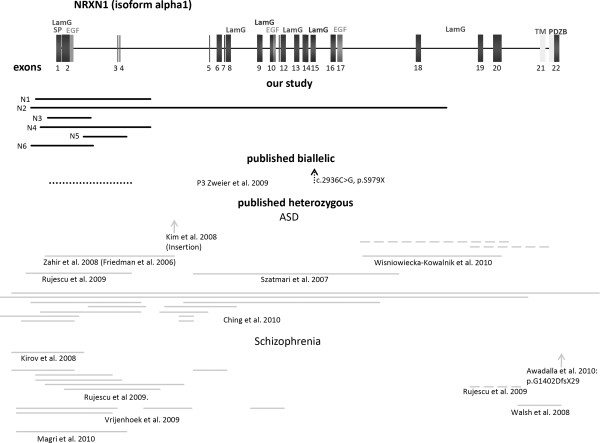
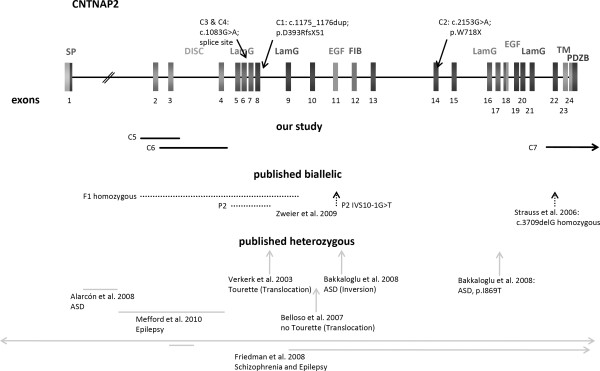
Verification
Claims the paper makes
The claims and statistics of this paper haven’t been checked yet.
Run the check — free, no account needed. It reads the open-access text and checks the sources it cites.
Claims other papers make about this one
Each is checked against this paper’s own text: does it say what the citing paper says it does?
The cited source says what the claim attributes to it.
In the citing paper
“More directly, rare variation in CNTNAP2, including CNVs, other structural disruptions and deleterious sequence variation, has been identified in subjects with autism, epilepsy, intellectual disability, Pitt-Hopkins-like syndrome, schizophrenia and Tourette syndrome (42–48), albeit with differing degrees of evidence for effect on these traits.”
From Individual common variants exert weak effects on the risk for autism spectrum disorders (2012) · cites this paper as [43]
Self-check
Percentages, sums and reported differences re-computed from the paper’s own numbers.
The self-check needs the paper’s full text.
Citations
Cites
Structural Variation of Chromosomes in Autism Spectrum Disorder
Marshall, C. R., Noor, A., Vincent, J. B., Lionel, A. C., Feuk, L., Skaug, J., Shago, M., Moessner, R., Pinto, D., Ren, Y., et al. (2008) · The American Journal of Human Genetics · doi:10.1016/j.ajhg.2007.12.009 · Cited by 1,815 · cited 1×
“epilepsy, schizophrenia or autism spectrum disorder (ASD) with reduced penetrance and no or rather mild intellectual impairment [1-23].”
BackgroundAutism genome-wide copy number variation reveals ubiquitin and neuronal genes
Glessner, J. T., Wang, K., Cai, G., Korvatska, O., Kim, C. E., Wood, S., Zhang, H., Estes, A., Brune, C. W., Bradfield, J. P., et al. (2009) · Nature · doi:10.1038/nature07953 · Cited by 1,421
Mapping autism risk loci using genetic linkage and chromosomal rearrangements
The Autism Genome Project Consortium (2007) · Nature Genetics · doi:10.1038/ng1985 · Cited by 1,402
Linkage, association, and gene-expression analyses identify CNTNAP2 as an autism-susceptibility gene
Alarcón, M., Abrahams, B. S., Stone, J. L., Duvall, J. A., Perederiy, J. V., Bomar, J. M., Sebat, J., Wigler, M., Martin, C. L., Ledbetter, D. H., et al. (2008) · The American Journal of Human Genetics · doi:10.1016/j.ajhg.2007.09.005 · Cited by 818
A functional genetic link between distinct developmental language disorders
Vernes, S. C., Newbury, D. F., Abrahams, B. S., Winchester, L., Nicod, J., Groszer, M., Alarcón, M., Oliver, P. L., Davies, K. E., Geschwind, D. H., et al. (2008) · New England Journal of Medicine · doi:10.1056/nejmoa0802828 · Cited by 676
A recurrent 16p12.1 microdeletion supports a two-hit model for severe developmental delay
Girirajan, S., Rosenfeld, J. A., Cooper, G. M., Antonacci, F., Siswara, P., Itsara, A., Vives, L., Walsh, T., McCarthy, S. E., Baker, C., et al. (2010) · Nature Genetics · doi:10.1038/ng.534 · Cited by 667
Recessive symptomatic focal epilepsy and mutant contactin-associated protein-like 2
Strauss, K. A., Puffenberger, E. G., Huentelman, M. J., Gottlieb, S., Dobrin, S. E., Parod, J. M., Stephan, D. A., & Morton, D. H. (2006) · New England Journal of Medicine · doi:10.1056/nejmoa052773 · Cited by 630
Arking, D. E., Cutler, D. J., Brune, C. W., Teslovich, T. M., West, K., Ikeda, M., Rea, A., Guy, M., Lin, S., Cook, E. H., et al. (2008) · The American Journal of Human Genetics · doi:10.1016/j.ajhg.2007.09.015 · Cited by 590
Disruption of neurexin 1 associated with autism spectrum disorder
Kim, H.-G., Kishikawa, S., Higgins, A. W., Seong, I.-S., Donovan, D. J., Shen, Y., Lally, E., Weiss, L. A., Najm, J., Kutsche, K., et al. (2008) · The American Journal of Human Genetics · doi:10.1016/j.ajhg.2007.09.011 · Cited by 578
Bakkaloglu, B., O'Roak, B. J., Louvi, A., Gupta, A. R., Abelson, J. F., Morgan, T. M., Chawarska, K., Klin, A., Ercan-Sencicek, A. G., Stillman, A. A., et al. (2008) · The American Journal of Human Genetics · doi:10.1016/j.ajhg.2007.09.017 · Cited by 537
Poliak, S., Gollan, L., Martinez, R., Custer, A., Einheber, S., Salzer, J., Trimmer, J., Shrager, P., & Peles, E. (1999) · Neuron · doi:10.1016/s0896-6273(00)81049-1 · Cited by 530
Mefford, H. C., Muhle, H., Ostertag, P., von Spiczak, S., Buysse, K., Baker, C., Franke, A., Malafosse, A., Genton, P., Thomas, P., et al. (2010) · PLoS Genetics · doi:10.1371/journal.pgen.1000962 · Cited by 474
Disruption of the neurexin 1 gene is associated with schizophrenia
Rujescu, D., Ingason, A., Cichon, S., Pietiläinen, O. P. H., Barnes, M. R., Toulopoulou, T., Picchioni, M., Vassos, E., Ettinger, U., Bramon, E., et al. (2009) · Human Molecular Genetics · doi:10.1093/hmg/ddn351 · Cited by 471
Bucan, M., Abrahams, B. S., Wang, K., Glessner, J. T., Herman, E. I., Sonnenblick, L. I., Alvarez Retuerto, A. I., Imielinski, M., Hadley, D., Bradfield, J. P., et al. (2009) · PLoS Genetics · doi:10.1371/journal.pgen.1000536 · Cited by 424
Comparative genome hybridization suggests a role for NRXN1 and APBA2 in schizophrenia
Kirov, G., Gumus, D., Chen, W., Norton, N., Georgieva, L., Sari, M., O'Donovan, M. C., Erdogan, F., Owen, M. J., Ropers, H.-H., et al. (2007) · Human Molecular Genetics · doi:10.1093/hmg/ddm323 · Cited by 377
Self-citationZweier, C., de Jong, E. K., Zweier, M., Orrico, A., Ousager, L. B., Collins, A. L., Bijlsma, E. K., Oortveld, M. A. W., Ekici, A. B., Reis, A., et al. (2009) · The American Journal of Human Genetics · doi:10.1016/j.ajhg.2009.10.004 · Cited by 345
Self-citationDeletions of NRXN1 (neurexin‐1) predispose to a wide spectrum of developmental disorders
Ching, M. S. L., Shen, Y., Tan, W., Jeste, S., Morrow, E. M., Chen, X., Mukaddes, N. M., Yoo, S.-Y., Hanson, E. M., Hundley, R. J., et al. (2010) · American Journal of Medical Genetics Part B Neuropsychiatric Genetics · doi:10.1002/ajmg.b.31063 · Cited by 306
CNTNAP2 gene dosage variation is associated with schizophrenia and epilepsy
Friedman, J. I., Vrijenhoek, T., Markx, S., Janssen, I. M., van der Vliet, W. A., Faas, B. H. W., Knoers, N. V. A. M., Cahn, W., Kahn, R. S., Edelmann, L. J., et al. (2007) · Molecular Psychiatry · doi:10.1038/sj.mp.4002049 · Cited by 297
High frequency of neurexin 1β signal peptide structural variants in patients with autism
Feng, J., Schroer, R. J., Jin, Y., Song, W., Yang, C., Bockholt, A., Cook, E. H., Skinner, C. D., Schwartz, C. E., & Sommer, S. S. (2006) · Neuroscience Letters · doi:10.1016/j.neulet.2006.08.017 · Cited by 285
Recurrent CNVs Disrupt Three Candidate Genes in Schizophrenia Patients
Vrijenhoek, T., Buizer‐Voskamp, J. E., van der Stelt, I., Strengman, E., Sabatti, C., van Kessel, A. G., Brunner, H. G., Ophoff, R. A., & Veltman, J. A. (2008) · The American Journal of Human Genetics · doi:10.1016/j.ajhg.2008.09.011 · Cited by 275
Direct Measure of the De Novo Mutation Rate in Autism and Schizophrenia Cohorts
Awadalla, P., Gauthier, J., Myers, R. A., Casals, F., Hamdan, F. F., Griffing, A. R., Côté, M., Henrion, É., Spiegelman, D., Tarabeux, J., et al. (2010) · The American Journal of Human Genetics · doi:10.1016/j.ajhg.2010.07.019 · Cited by 243
Verkerk, A., Mathews, C., Joosse, M., Eussen, B., Heutink, P., & Oostra, B. (2003) · Genomics · doi:10.1016/s0888-7543(03)00097-1 · Cited by 237
The oligogenic properties of Bardet-Biedl syndrome
Katsanis, N. (2004) · Human Molecular Genetics · doi:10.1093/hmg/ddh092 · Cited by 235
Zweier, M., Gregor, A., Zweier, C., Engels, H., Sticht, H., Wohlleber, E., Bijlsma, E. K., Holder, S., Zenker, M., Rossier, E., et al. (2010) · Human Mutation · doi:10.1002/humu.21253 · Cited by 181
Self-citationNeurexin 1α structural variants associated with autism
Jin, Y., Noltner, K., Feng, J., Li, W., Schroer, R. J., Skinner, C. D., Zeng, W., Schwartz, C. E., & Sommer, S. S. (2008) · Neuroscience Letters · doi:10.1016/j.neulet.2008.04.074 · Cited by 158
A patient with vertebral, cognitive and behavioural abnormalities and a de novo deletion of NRXN1α
Zahir, F., Baross, Á., Delaney, A. D., Eydoux, P., Fernandes, N., Pugh, T. J., Marra, M. A., & Friedman, J. M. (2007) · Journal of Medical Genetics · doi:10.1136/jmg.2007.054437 · Cited by 138
Engels, H., Wohlleber, E., Zink, A. M., Hoyer, J., Ludwig, K. U., Brockschmidt, F. F., Wieczorek, D., Moog, U., Hellmann-Mersch, B., Weber, R. G., et al. (2009) · European Journal of Human Genetics · doi:10.1038/ejhg.2009.90 · Cited by 110
Self-citationBorozdin, W., Böhm, D., Leipoldt, M., Wilhelm, C., Reardon, W., Clayton‐Smith, J., Becker, K., Mühlendyck, H., Winter, R. M., Giray, Ö., et al. (2004) · Journal of Medical Genetics · doi:10.1136/jmg.2004.019901 · Cited by 92
Self-citationNew Copy Number Variations in Schizophrenia
Magri, C., Sacchetti, E., Traversa, M., Valsecchi, P., Gardella, R., Bonvicini, C., Minelli, A., Gennarelli, M., & Barlati, S. (2010) · PLoS ONE · doi:10.1371/journal.pone.0013422 · Cited by 86
Wiśniowiecka‐Kowalnik, B., Nesteruk, M., Peters, S. U., Xia, Z., Cooper, M. L., Savage, S., Amato, R. S., Bader, P., Browning, M. F., Haun, C. L., et al. (2010) · American Journal of Medical Genetics Part B: Neuropsychiatric Genetics · doi:10.1002/ajmg.b.31064 · Cited by 82
Belloso, J. M., Bache, I., Guitart, M., Caballín, M. R., Halgren, C., Kirchhoff, M., Ropers, H., Tommerup, N., & Tümer, Z. (2007) · European Journal of Human Genetics · doi:10.1038/sj.ejhg.5201824 · Cited by 77
Hotspots of Large Rare Deletions in the Human Genome
Bradley, W. E. C., Raelson, J., Dubois, D. Y., Godin, É., Fournier, H., Privé, C., Allard, R., Pinchuk, V., Lapalme, M., Paulussen, R. J. A., et al. (2010) · PLoS ONE · doi:10.1371/journal.pone.0009401 · Cited by 57
Gene associated with seizures, autism, and hepatomegaly in an Amish girl
Jackman, C., Horn, N. D., Molleston, J. P., & Sokol, D. K. (2009) · Pediatric Neurology · doi:10.1016/j.pediatrneurol.2008.10.013 · Cited by 50
Cited by
Sorted by citations
Neuronal autoantigens—pathogenesis, associated disorders and antibody testing
Lancaster, E., & Dalmau, J. (2012) · Nature Reviews Neurology · doi:10.1038/nrneurol.2012.99 · Cited by 512
GABA system dysfunction in autism and related disorders: From synapse to symptoms
Coghlan, S., Horder, J., Inkster, B., Méndez, M. A., Murphy, D., & Nutt, D. (2012) · Neuroscience & Biobehavioral Reviews · doi:10.1016/j.neubiorev.2012.07.005 · Cited by 459
Individual common variants exert weak effects on the risk for autism spectrum disorders
Anney, R., Klei, L., Pinto, D., Almeida, J., Bacchelli, E., Baird, G., Bolshakova, N., Bölte, S., Bolton, P. F., Bourgeron, T., et al. (2012) · Human Molecular Genetics · doi:10.1093/hmg/dds301 · Cited by 375
Shining a light on CNTNAP2: Complex functions to complex disorders
Rodenas-Cuadrado, P., Ho, J., & Vernes, S. C. (2014) · European Journal of Human Genetics · doi:10.1038/ejhg.2013.100 · Cited by 272
Current Enlightenment About Etiology and Pharmacological Treatment of Autism Spectrum Disorder
Eissa, N., Al‐Houqani, M., Sadeq, A. S., Ojha, S. K., Sasse, A., & Sadek, B. S. (2018) · Frontiers in Neuroscience · doi:10.3389/fnins.2018.00304 · Cited by 276
Metadata
- Authors
- Gregor, A., Albrecht, B., Bader, I., Bijlsma, E. K., Ekici, A. B., Engels, H., Hackmann, K., Horn, D., Hoyer, J., Klapecki, J., Kohlhase, J., Maystadt, I., Nagl, S., Prott, E., Tinschert, S., Ullmann, R., Wohlleber, E., Woods, G., Reis, A., Rauch, A., & Zweier, C.
- Affiliations
- Friedrich-Alexander-Universität Erlangen-Nürnberg (DE)
- University of Duisburg-Essen (DE)
- Leiden University (NL)
- University of Bonn (DE)
- Technische Universität Dresden (DE)
- Charité – Universitätsmedizin Berlin (DE)
- Instytut Matki i Dziecka (PL)
- Institute of Pathology and Genetics (BE)
- Max Planck Institute for Molecular Genetics (DE)
- Addenbrooke's Hospital (GB)
- University of Zurich (CH)
- Corresponding author
- Zweier, Christiane
- ORCID
- Venue
- BMC Medical Genetics
- Published
- 2011-08-09
- Volume
- 12
- Issue
- 1
- Pages
- 106-106
- ISSN
- 1471-2350 (ISSN-L)
- PMC
- PMC3162517
- OpenAlex
- W2121619206
- Cited by
- 121
- References
- 33
- Citations by year
- 2026: 1 · 2025: 2 · 2024: 3 · 2023: 4 · 2022: 7 · 2021: 7 · 2020: 6 · 2019: 7 · 2018: 12 · 2017: 5 · 2016: 9 · 2015: 11 · 2014: 15 · 2013: 20 · 2012: 12
- FWCI
- 9.38
- Type
- journal article
- Language
- en
- Open access
- gold
- doi.org
- Licence
- Locations
- BMC Medical Genetics (publishedVersion, cc-by)
- Europe PMC (PubMed Central) (publishedVersion, cc-by)
- PubMed Central (publishedVersion, cc-by)
- PubMed (publishedVersion)
- Zurich Open Repository and Archive (University of Zurich) (acceptedVersion, cc-by)
- DuEPublico (University of Duisburg-Essen) (submittedVersion, cc-by)
- Data Archiving and Networked Services (DANS) (submittedVersion)
- Leiden Repository (Leiden University) (submittedVersion)
- Universitätsbibliographie, Universität Duisburg-Essen (submittedVersion)
- DOAJ (DOAJ: Directory of Open Access Journals) (submittedVersion)
- MPG.PuRe (Max Planck Society) (submittedVersion)
- OPUS FAU (Kooperativer Bibliotheksverbund Berlin-Brandenburg (KOBV), on behalf of the Universitätsbibliothek Erlangen-Nürnberg) (submittedVersion, other-oa)
- Apollo (University of Cambridge) (submittedVersion, cc-by)
- Zurich Open Repository and Archive (University of Zurich)
- Funders
- Deutsche Forschungsgemeinschaft
- Bundesministerium für Bildung und Forschung
- Topics
- Life Sciences › Biochemistry, Genetics and Molecular Biology › Genetics › Genetics and Neurodevelopmental Disorders
- Life Sciences › Biochemistry, Genetics and Molecular Biology › Genetics › Genomic variations and chromosomal abnormalities
- Life Sciences › Biochemistry, Genetics and Molecular Biology › Genetics › Genomics and Rare Diseases
- Keywords
- CNTNAP2, NRXN1, severe intellectual disability, heterozygous deletion, recessive inheritance, Pitt-Hopkins syndrome, splice site mutation, frameshift mutation, de novo mutations, second hit, carrier parents, phenotypic variability, neuropsychiatric disorders
- MeSH terms
- Adolescent, Alleles, Calcium-Binding Proteins, Child, Child Development Disorders, Pervasive, Child, Preschool, Female, Heterozygote, Humans, Hyperventilation, Karyotyping, Male, Membrane Proteins, Intellectual Disability, Nerve Tissue Proteins, Cell Adhesion Molecules, Neuronal, Frameshift Mutation, Gene Deletion, Codon, Terminator, Neural Cell Adhesion Molecules, Facies, RNA Splice Sites, Young Adult
About these checks
Registry, retraction, Cites and statistics results are computed, not judged, with one exception: a printed reference that no index lists is read once by a model before it counts as a citation error. Claims are extracted by a model and kept only when their quote appears verbatim in the text; each cited source is then checked, with a model’s help, for whether it says what the claim relies on. Those verdicts can be wrong — read the claim’s quote and the cited source before relying on one.
Statistics and arithmetic are recomputed, not judged.
Confidence bands are shown only for fields calibrated on our annotated test set. None is calibrated yet, so no band is shown.
What counts as a claim ›How we measure confidence ›How we check this ›
Are you an author, or do you see a problem with this page? Request a review
