

Promotion of the mind through exercise (PROMoTE): a proof-of-concept randomized controlled trial of aerobic exercise training in older adults with vascular cognitive impairment
Open accessThe DOI matches its Crossref record; 66 of the 67 references it cites were found in a registry or an index.
Abstract
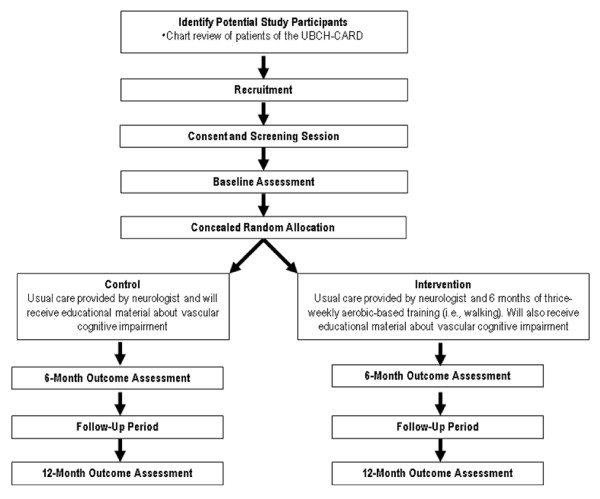
BACKGROUND: Sub-cortical vascular ischaemia is the second most common etiology contributing to cognitive impairment in older adults, and is frequently under-diagnosed and under-treated. Although evidence is mounting that exercise has benefits for cognitive function among seniors, very few randomized controlled trials of exercise have been conducted in populations at high-risk for progression to dementia. Aerobic-based exercise training may be of specific benefit in delaying the progression of cognitive decline among seniors with vascular cognitive impairment by reducing key vascular risk factors associated with metabolic syndrome. Thus, we aim to carry out a proof-of-concept single-blinded randomized controlled trial primarily designed to provide preliminary evidence of efficacy aerobic-based exercise training program on cognitive and everyday function among older adults with mild sub-cortical ischaemic vascular cognitive impairment. METHODS/DESIGN: A proof-of-concept single-blinded randomized trial comparing a six-month, thrice-weekly, aerobic-based exercise training group with usual care on cognitive and everyday function. Seventy older adults who meet the diagnostic criteria for sub-cortical ischaemic vascular cognitive impairment as outlined by Erkinjuntti and colleagues will be recruited from a memory clinic of a metropolitan hospital. The aerobic-based exercise training will last for 6 months. Participants will be followed for an additional six months after the cessation of exercise training. DISCUSSION: This research will be an important first step in quantifying the effect of an exercise intervention on cognitive and daily function among seniors with sub-cortical ischaemic vascular cognitive impairment, a recognized risk state for progression to dementia. Exercise has the potential to be an effective, inexpensive, and accessible intervention strategy with minimal adverse effects. Reducing the rate of cognitive decline among seniors with sub-cortical ischaemic vascular cognitive impairment could preserve independent functioning and health related quality of life in this population. This, in turn, could lead to reduced health care resource utilization costs and avoidance of early institutional care.
Overview
The claims and statistics of this paper haven’t been checked yet.
Free: it reads the open-access text and checks the first 5 claims that cite a source we can check. Create a free account to check every claim.
Integrity signals
Registry
Cites
Statistics
Figures
Verification
Claims the paper makes
The claims and statistics of this paper haven’t been checked yet.
Free: it reads the open-access text and checks the first 5 claims that cite a source we can check. Create a free account to check every claim.
Claims other papers make about this one
Each is checked against this paper’s own text: does it say what the citing paper says it does?
The cited source says what the claim attributes to it.
In the citing paper
“Physical activity has been identified as having potential protective benefits in brain health and plasticity and in VCI and related conditions.308–314”
From Vascular Contributions to Cognitive Impairment and Dementia: A Statement for Healthcare Professionals From the American Heart Association/American Stroke Association (2011) · cites this paper as [310]
Experimental — accuracy not yet measured
Self-check
Percentages, sums and reported differences re-computed from the paper’s own numbers.
The self-check needs the paper’s full text.
Citations
Cites
Folstein, M. F., Folstein, S. E., & McHugh, P. R. (1975) · Journal of Psychiatric Research · doi:10.1016/0022-3956(75)90026-6 · Cited by 88,282
The Montreal Cognitive Assessment, MoCA: a brief screening tool for mild cognitive impairment
Nasreddine, Z. S., Phillips, N. A., Bédirian, V., Charbonneau, S., Whitehead, V., Collin, I., Cummings, J. L., & Chertkow, H. (2005) · Journal of the American Geriatrics Society · doi:10.1111/j.1532-5415.2005.53221.x · Cited by 25,553 · cited 4×
“Nasreddine ZS, Phillips NA, Bedirian V, Charbonneau S, Whitehead V, Collin I, Cummings JL, Chertkow H: The Montreal Cognitive Assessment, MoCA: a brief screening tool for mild cognitive impairment.”
BackgroundMethodInfluentialThe Neuropsychiatric Inventory: Comprehensive assessment of psychopathology in dementia
Cummings, J. L., Mega, M., Gray, K., Rosenberg-Thompson, S., Carusi, D. A., & Gornbein, J. (1994) · Neurology · doi:10.1212/wnl.44.12.2308 · Cited by 7,568
A new rating scale for Alzheimer's disease
(1984) · American Journal of Psychiatry · doi:10.1176/ajp.141.11.1356 · Cited by 4,175
Lower-extremity function in persons over the age of 70 years as a predictor of subsequent disability
Guralnik, J. M., Ferrucci, L., Simonsick, E. M., Salive, M. E., & Wallace, R. B. (1995) · New England Journal of Medicine · doi:10.1056/nejm199503023320902 · Cited by 4,083 · cited 2×
“Poor performance on this scale predicts subsequent disability [ 44 ].”
BackgroundThe Cardiovascular Health Study: design and rationale.
Fried, L. P., Borhani, N. O., Enright, P., Furberg, C. D., Gardin, J. M., Kronmal, R. A., Kuller, L. H., Manolio, T. A., Mittelmark, M. B., Newman, A., et al. (1991) · Annals of Epidemiology · doi:10.1016/1047-2797(91)90005-w · Cited by 3,652
Forecasting the global burden of Alzheimer's disease
Brookmeyer, R., Johnson, E., Ziegler‐Graham, K., & Arrighi, H. M. (2007) · Alzheimer's & Dementia · doi:10.1016/j.jalz.2007.04.381 · Cited by 3,370 · cited 1×
“2 million by 2050 in the US alone [54].”
BackgroundThe physical activity scale for the elderly (PASE): Development and evaluation
Washburn, R. A., Smith, K. W., Jette, A. M., & Janney, C. A. (1993) · Journal of Clinical Epidemiology · doi:10.1016/0895-4356(93)90053-4 · Cited by 3,177 · cited 1×
“Physical activity, not including the study-assigned exercise classes, will be determined by the valid and reliable Physical Activities Scale for the Elderly (PASE) questionnaire [33,34].”
MethodExercise: a behavioral intervention to enhance brain health and plasticity
Cotman, C. (2002) · Trends in Neurosciences · doi:10.1016/s0166-2236(02)02143-4 · Cited by 2,739 · cited 1×
“Aerobic exercise may also act specifically on disease pathophysiology [13], for example, by improving capillarization or modulating brain neurotrophic factors [14-16], and may even decrease brain amyloid load in the brain [17].”
BackgroundLautenschlager, N. T., Cox, K. L., Flicker, L., Foster, J. K., van Bockxmeer, F. M., Xiao, J., Greenop, K. R., & Almeida, O. P. (2008) · JAMA · doi:10.1001/jama.300.9.1027 · Cited by 1,637 · cited 2×
“Although exercise therapy holds promise for delaying the onset and slowing down the progression of both cognitive and functional decline, very few randomized controlled trials of exercise have been conducted in populations at high-risk for dementia [ 30 ].”
BackgroundInfluential
Research works printed but not linked: 2
- Kovar M Lawton M Functional disability: Activities and instrumental activities of daily living Annu Rev Gerontol Geriatr 1994 14 57 75
- Canadian Society for Exercise Physiology Par-Q and You 1994 Gloucester, Ontario, Canada: Canadian Society of Exercise Physiology 1 2
Cited by
Gorelick, P. B., Scuteri, A., Black, S. E., DeCarli, C., Greenberg, S. M., Iadecola, C., Launer, L. J., Laurent, S., Lopez, O. L., Nyenhuis, D., et al. (2011) · Stroke · doi:10.1161/str.0b013e3182299496 · Cited by 3,811
Advances in the prevention of Alzheimer's disease and dementia
Solomon, A., Mangialasche, F., Richard, E., Andrieu, S., Bennett, D. A., Breteler, M., Fratiglioni, L., Hooshmand, B., Khachaturian, A. S., Schneider, L. S., et al. (2014) · Journal of Internal Medicine · doi:10.1111/joim.12178 · Cited by 319
Combinatorial bZIP dimers display complex DNA-binding specificity landscapes
Rodríguez-Martínez, J. A., Reinke, A. W., Bhimsaria, D., Keating, A. E., & Ansari, A. Z. (2017) · eLife · doi:10.7554/elife.19272 · Cited by 182
Aerobic exercise and vascular cognitive impairment: A randomized controlled trial
Liu-Ambrose, T., Best, J. R., Davis, J. C., Eng, J. J., Lee, P. E., Jacova, C., Boyd, L. A., Brasher, P. M., Munkacsy, M., Cheung, W., et al. (2016) · Neurology · doi:10.1212/wnl.0000000000003332 · Cited by 146
“The trial protocol has been published previously.(9) Participants provided written informed consent.”
BackgroundMethodSelf-citationHsu, C. L., Best, J. R., Davis, J. C., Nagamatsu, L. S., Wang, S., Boyd, L. A., Hsiung, G. R., Voss, M. W., Eng, J. J., & Liu-Ambrose, T. (2018) · British Journal of Sports Medicine · doi:10.1136/bjsports-2016-096846 · Cited by 139
Self-citationPhysical exercise alleviates debilities of normal aging and Alzheimer’s disease
Archer, T. (2011) · Acta Neurologica Scandinavica · doi:10.1111/j.1600-0404.2010.01412.x · Cited by 111
Barha, C. K., Hsiung, G. R., Best, J. R., Davis, J. C., Eng, J. J., Jacova, C., Lee, P. E., Munkacsy, M., Cheung, W., & Liu-Ambrose, T. Y. L. (2017) · Journal of Alzheimer s Disease · doi:10.3233/jad-170221 · Cited by 96
Self-citationZhu, H.-Y., Hong, F.-F., & Yang, S.-L. (2021) · International Journal of Molecular Sciences · doi:10.3390/ijms22094540 · Cited by 84
González-Palau, F., Franco, M., Bamidis, P., Losada, R., Parra, E., Papageorgiou, S. G., & Vivas, A. B. (2014) · Aging & Mental Health · doi:10.1080/13607863.2014.899972 · Cited by 79
“…evidence of the possible influence of exercise in the improvement of cognitive functions in MCI and age-related cognitive decline (Brown, Liu-Ambrose, Tate, & Lord, 2009; Geda et al., 2010; Lau-tenschlager et al., 2008; Liu-Ambrose et al., 2010; Scherder et al., 2005; Williamson et al., 2009).”
BackgroundLuca, M., & Luca, A. (2019) · Oxidative Medicine and Cellular Longevity · doi:10.1155/2019/8067045 · Cited by 78
“Interestingly, randomized controlled trials have confirmed that physical exercise may delay the cognitive decline characterizing AD [77] and VCI [78, 79].”
BackgroundGallucci, M., Mazzuco, S., Ongaro, F., Di Giorgi, E., Mecocci, P., Cesari, M., Albani, D., Forloni, G. L., Durante, E., Gajo, G. B., et al. (2013) · The Journal of nutrition, health and aging · doi:10.1007/s12603-012-0397-1 · Cited by 63
“On the contrary many studies have demonstrated that baseline physical performance predicts declines in cognitive function and/or incident cognitive impairment or dementia (13-16, 87-98).”
Very early-initiated physical rehabilitation protects against ischemic brain injury
Hu, Y. (2012) · Frontiers in Bioscience · doi:10.2741/e559 · Cited by 57
“2477 Physical exercise after stroke is an effective approach of clinic rehabilitation, as it has been shown to reduce the rate of cognitive decline (8), enhance sensorimotor control (9), promote walking speed and capacity (10, 11), and improve life quality of stroke patients (12,13).”
Cyarto, E. V., Lautenschlager, N. T., Desmond, P. M., Ames, D., Szoeke, C., Salvado, O., Sharman, M. J., Ellis, K. A., Phal, P. M., Masters, C. L., et al. (2012) · BMC Psychiatry · doi:10.1186/1471-244x-12-167 · Cited by 46
Hsu, C. L., Best, J. R., Wang, S. V., Voss, M. W., Hsiung, G. R., Munkacsy, M., Cheung, W., Handy, T. C., & Liu-Ambrose, T. Y. L. (2017) · Frontiers in Human Neuroscience · doi:10.3389/fnhum.2017.00344 · Cited by 41
“This is a secondary analysis of neuroimaging data acquired from a 6-month proof-of-concept RCT (NCT01027858) of aerobic exercise in older adults with mild SIVCI (Liu-Ambrose et al., 2010, 2016).”
MethodSelf-citationWinker, R., Lukas, I., Perkmann, T., Haslacher, H., Ponocny, E., Lehrner, J. P., Tscholakoff, D., & Dal‐Bianco, P. (2010) · Wiener klinische Wochenschrift · doi:10.1007/s00508-010-1485-z · Cited by 40
Cerebral Amyloid-β Deposition Is Associated with Impaired Gait Speed and Lower Extremity Function
Dao, E. A., Hsiung, G. R., Sossi, V., Tam, R. C., Shahinfard, E., Nicklin, E., Alkeridy, W. A., & Liu-Ambrose, T. Y. L. (2019) · Journal of Alzheimer s Disease · doi:10.3233/jad-180848 · Cited by 34
Self-citationHsu, C. L., Best, J. R., Wang, S. V., Voss, M. W., Hsiung, G. R., Munkacsy, M., Cheung, W., Handy, T. C., & Liu-Ambrose, T. Y. L. (2017) · Frontiers in Human Neuroscience · doi:10.3389/fnhum.2017.00449 · Cited by 26
Self-citationDavis, J. C., Hsiung, G. R., Bryan, S., Jacova, C., Jacova, P., Munkacsy, M., Cheung, W., Lee, P., & Liu-Ambrose, T. Y. L. (2016) · PLoS ONE · doi:10.1371/journal.pone.0153878 · Cited by 27
“The inclusion/exclusion criteria were previously defined in the published study protocol [26].”
Self-citationSilva, M. J., Cashman, S. B., Kunte, P., & Candib, L. M. (2012) · American Journal of Public Health · doi:10.2105/ajph.2012.300958 · Cited by 23
The Effect of Aerobic Exercise on White Matter Hyperintensity Progression May Vary by Sex
Dao, E. A., Barha, C. K., Best, J. R., Hsiung, G. R., Tam, R. C., & Liu-Ambrose, T. Y. L. (2019) · Canadian Journal on Aging / La Revue canadienne du vieillissement · doi:10.1017/s0714980818000582 · Cited by 28
“The design and primary results of the Promotion of the Mind Through Exercise (PROMoTE) study have been published previously (Liu-Ambrose et al., 2010, 2016).”
BackgroundSelf-citationPrevention of post‐stroke cognitive decline: a review focusing on lifestyle interventions
Teuschl, Y., Matz, K., & Brainin, M. (2012) · European Journal of Neurology · doi:10.1111/j.1468-1331.2012.03757.x · Cited by 27
“The fourth study is a small proof-of-concept study and will test whether 6 months of aerobic exercise can improve cognition in people with both cognitive syndrome and small vessel ischaemic disease [17].”
BackgroundBest, J. R., Eng, J. J., Davis, J. C., Hsiung, G. R., Hall, P. A., Middleton, L. E., Graf, P., Goldsmith, C. H., & Liu-Ambrose, T. Y. L. (2018) · BMJ Open · doi:10.1136/bmjopen-2018-021490 · Cited by 21
Self-citationBarha, C. K., Starkey, S. Y., Hsiung, G. R., Tam, R. C., & Liu-Ambrose, T. Y. L. (2023) · Biology of Sex Differences · doi:10.1186/s13293-023-00499-7 · Cited by 19
Self-citationGonzález-Palau, F., Franco, M., Toribio, J. M., Losada, R., Parra-Mora, E., & Bamidis, P. D. (2013) · Psychnology · Cited by 37
Middleton, L. E., Black, S. E., Herrmann, N., OH, P. I., Regan, K., & Lanctôt, K. L. (2018) · BMC Geriatrics · doi:10.1186/s12877-017-0684-0 · Cited by 20
“[34, 35] Costs will then be assigned to health-resource utilization data (using a Canadian healthcare system perspective) and combined with the costs for each intervention group to generate a cost per min/week of exercise.”
Methodten Brinke, L. F., Hsu, C. L., Best, J. R., Barha, C. K., & Liu-Ambrose, T. Y. L. (2018) · Journal of Cognitive Enhancement · doi:10.1007/s41465-018-0077-0 · Cited by 20
Self-citationLiu-Ambrose, T. Y. L., Dao, E. A., Crockett, R. A., Barha, C. K., Falck, R. S., Best, J. R., Hsiung, G. R., Field, T. S., Madden, K. M., Alkeridy, W. A., et al. (2021) · Trials · doi:10.1186/s13063-021-05156-1 · Cited by 18
“Current research efforts in SIVCI and exercise focus primarily on aerobic training [25, 26] despite evidence that suggests resistance training has important benefits for cardiometabolic health [27–30], cognitive function [31–34], and notably, WMH progression [35, 36].”
BackgroundSelf-citationBarha, C. K., Hsiung, G. R., & Liu-Ambrose, T. Y. L. (2019) · Neuroscience · doi:10.1016/j.neuroscience.2019.04.052 · Cited by 14
Self-citationRusso, M. J., Kañevsky, A. L., Leis, A., Iturry, M., Roncoroni, M., Serrano, C. M., Cristalli, D. O., Ure, J. A., & Zuin, D. R. (2020) · Neurología Argentina · doi:10.1016/j.neuarg.2020.01.003 · Cited by 41
Davis, J. C., Hsiung, G. R., Bryan, S., Best, J. R., Eng, J. J., Munkacsy, M., Cheung, W., Chiu, B. K., Jacova, C., Lee, P., et al. (2017) · BMJ Open · doi:10.1136/bmjopen-2016-014387 · Cited by 14
“Promotion Of the Mind Through Exercise (PROMoTE) trial.(21) Our primary objective was to determine the incremental cost–utility ratio (incremental cost per incremental quality-adjusted life year (QALY) gained) of thrice”
BackgroundMethodInfluentialSelf-citationfor the DERIVA Group, Rodríguez‐Sánchez, E., Criado, J. M., Mora‐Simón, S., Muriel-Diez, M. P., Gómez-Marcos, M. Á., Recio-Rodriguez, J. I., Patino-Alonso, M. C., Juan, L. F. V., Maderuelo-Fernández, J. Á., et al. (2014) · BMC Neurology · doi:10.1186/1471-2377-14-63 · Cited by 13
Barha, C. K., Dao, E. A., Marcotte, L., Hsiung, G. R., Tam, R. C., & Liu-Ambrose, T. Y. L. (2021) · Scientific Reports · doi:10.1038/s41598-021-99249-1 · Cited by 12
Self-citationExploring the effects of coexisting amyloid in subcortical vascular cognitive impairment
Dao, E. A., Hsiung, G. R., Sossi, V., Jacova, C., Tam, R. C., Dinelle, K., Best, J. R., & Liu-Ambrose, T. Y. L. (2015) · BMC Neurology · doi:10.1186/s12883-015-0459-1 · Cited by 13
“, NCT01027858) [25].”
Self-citationPillai, J. A., & Bonner‐Jackson, A. (2015) · Journal of Healthcare Engineering · doi:10.1260/2040-2295.6.1.71 · Cited by 11
“The use of heart rate monitor, activity monitors, and pedometers are gaining more popularity in standardization of compliance in the PROMoTE trial in elderly subjects with cognitive impairment [35], and in a trial for caregivers of AD [36].”
BackgroundLindholm, H. J., Punakallio, A., Lusa, S., Sainio, M. A., Ponocny, E., & Winker, R. (2011) · International Archives of Occupational and Environmental Health · doi:10.1007/s00420-011-0681-0 · Cited by 12
“1999), increasing the circulation and an indirect effect by reducing key vascular risk factors associated with the metabolic syndrome (Lange-Asschenfeldt and Kojda 2008; Liu-Ambrose et al. 2010).”
BackgroundBrucki, S. M. D., Ferraz, A. C., de Freitas, G. R., Massaro, A. R., Radanovic, M., & Schultz, R. R. (2011) · Dementia & Neuropsychologia · doi:10.1590/s1980-57642011dn05040005 · Cited by 15
“*In exceptional cases, one convincing Class I study may suffice for an “A” recommendation if 1) all criteria are met, 2) the magnitude of effect is large (relative rate improved outcome > 5 and the lower limit of the confidence interval is > 2). seem to be weaker in VD than AD.8 Studies investigating cognitive perform…”
InfluentialDao, E. A., Best, J. R., Hsiung, G. R., Sossi, V., Jacova, C., Tam, R. C., & Liu-Ambrose, T. Y. L. (2017) · BMC Geriatrics · doi:10.1186/s12877-017-0522-4 · Cited by 13
“Study Inclusion Criteria: Both inclusion and exclusion criteria have been published previously [24].”
BackgroundMethodInfluentialSelf-citationAlvarado, A. J. M., Brito, C. C., Román, G. C., Gareri, P., Aguilar-Navarro, S. G., Sandoval, J. L. R., Calleja-Castillo, J. M., Velázquez, C., Ardila, G. P., Merino, M. S. C., et al. (2017) · Journal of Neurology and Neuroscience · doi:10.21767/2171-6625.1000224 · Cited by 6
Gallucci, M., Mazzetto, M., Spagnolo, P., Aricò, M., Bergamelli, C., Oddo, M. G., Gallo, G., Astolfo, P., Giorgi, E. D., & Vanacore, N. (2016) · Annali dell Istituto Superiore di Sanità · doi:10.4415/ann_16_02_16 · Cited by 6
Lenstra, N., & Oguz, F. J. (2020) · Proceedings of the Association for Information Science and Technology · doi:10.1002/pra2.211 · Cited by 4
Motor Control, Motor Learning, and Neural Plasticity in Orthotic and Prosthetic Rehabilitation
Bowers, D. M., Oberlander, A., Chui, K. K., Malin, K. L., & Lusardi, M. M. (2020) · Elsevier eBooks · doi:10.1016/b978-0-323-60913-5.00003-9 · Cited by 6
Petsani, D., Konstantinidis, E. I., Díaz-Orueta, U., Hopper, L., & Bamidis, P. D. (2019) · Communications in computer and information science · doi:10.1007/978-3-030-15736-4_6 · Cited by 5
Physical Activity and Cognition in Older Adults With Mild Cognitive Impairment and Dementia
Lautenschlager, N. T. (2013) · Neurodegenerative Disease Management · doi:10.2217/nmt.13.26 · Cited by 4
Vascular Dementia and Cognitive Impairment
Seshadri, S. S., Economos, A., & Wright, C. B. (2015) · Elsevier eBooks · doi:10.1016/b978-0-323-29544-4.00017-7 · Cited by 4
Treatment of vascular dementia
Brucki, S. M. D., Ferraz, A. C., de Freitas, G. R., Massaro, A. R., Radanovic, M., & Schultz, R. R. (2011) · Cited by 4
Vascular Dementia and Cognitive Impairment
Seshadri, S. S., Caunca, M. R., & Rundek, T. (2021) · Elsevier eBooks · doi:10.1016/b978-0-323-69424-7.00018-1 · Cited by 3
A Software Solution for Preventing Alzheimer's Disease Based on MapReduce Framework
Zettam, M., Laassiri, J., & Enneya, N. (2017) · IEEE International Conference on Information Reuse and Integration (IRI) · doi:10.1109/iri.2017.77 · Cited by 2
“Other works in literature highlight the importance of physical exercises and diet to prevent Alzheimer’s disease [8] [9] [10] [11].”
BackgroundA MapReduce-based Adjoint method for preventing brain disease
Zettam, M., Laassiri, J., & Enneya, N. (2018) · Journal Of Big Data · doi:10.1186/s40537-018-0136-5 · Cited by 2
Motor Control, Motor Learning, and Neural Plasticity in Orthotic and Prosthetic Rehabilitation
Lusardi, M. M., & Bowers, D. M. (2013) · Elsevier eBooks · doi:10.1016/b978-1-4377-1936-9.00003-5 · Cited by 4
Exercise and Cognitive Functions
Nanda, B., & Manjunatha, S. (2015) · Wiley eBooks · doi:10.1002/9781118840634.ch19 · Cited by 3
Secondary prevention in cognitive frailty: the Treviso Dementia Registry
Gallucci, M. (2016) · Geriatric Care · doi:10.4081/gc.2016.6056 · Cited by 1
Windon, C., & Elahi, F. M. (2024) · Springer eBooks · doi:10.1007/978-3-031-49963-0_30 · Cited by 1
Vascular Dementia and Vascular Cognitive Decline
Seshadri, S. S. (2011) · Elsevier eBooks · doi:10.1016/b978-1-4160-5478-8.10017-x · Cited by 1
Neuroprotection in Miscellaneous Neurological Disorders
Jain, K. K. (2019) · Springer protocols handbooks/Springer protocols · doi:10.1007/978-1-4939-9465-6_11 · Cited by 2
Glenn, M. B., & Herman, S. D. (2020) · Elsevier eBooks · doi:10.1016/b978-0-323-54947-9.00148-6 · Cited by 2
Nilsson, P. M., Román, G. C., Sellke, F. W., Seshadri, S. S., Arnett, K., Bennett, D. A., Chui, H. C., Higashida, R. T., Lindquist, R. D., Nyenhuis, D. L., et al. (2011)
Chui, H. C., Higashida, R. T., Lindquist, R. D., Nilsson, P. M., Petersen, C., Schneider, J. A., Tzourio, C., Arnett, D. K., Launer, L. J., Laurent, S., et al. (2013)
López, N., Burgos, A. V., Allegri, R., Soto‐Añari, M., Chesta, S. A., & Coronado, J. C. S. (2015) · DOAJ (DOAJ: Directory of Open Access Journals) · Cited by 1
Arai, H., Takahashi, M., & Yutani, M. (2012) · Kitasato medical journal
Gomes, F. R. H., de OLIVEIRA, V., & Vagetti, G. C. (2023) · Editora ZH4 eBooks · doi:10.51360/zh4.236-04
Neuroprotection in Miscellaneous Neurological Disorders
Jain, K. K. (2011) · Humana Press eBooks · doi:10.1007/978-1-61779-049-2_11
Moncion, K., Rodrigues, L., Bon, A., Sutoski, A., Sikorska, K., Allison, E. Y., Abreu, J., Golchi, S., Arbour, N., Gauthier, C. J., et al. (2026) · BMJ Open · doi:10.1136/bmjopen-2026-123336
Prevention of Cognitive Decline in Later Life
Lam, L. C. W., & Chan, W. C. (2014) · Springer eBooks · doi:10.1007/978-94-017-9331-5_16
Metadata
- Authors
- Liu-Ambrose, T., Eng, J. J., Boyd, L. A., Jacova, C., Davis, J. C., Bryan, S., Lee, P., Brasher, P., & Hsiung, G.-Y. R.
- Affiliations
- University of British Columbia (CA)
- Vancouver Coastal Health Research Institute (CA)
- Corresponding author
- Liu-Ambrose, Teresa
- ORCID
- Venue
- BMC Neurology
- Published
- 2010-02-17
- Volume
- 10
- Issue
- 1
- Pages
- 14-14
- ISSN
- 1471-2377 (ISSN-L)
- PMC
- PMC2830197
- OpenAlex
- W1971923794
- Cited by
- 64
- References
- 67
- Citations by year
- 2026: 1 · 2024: 1 · 2023: 2 · 2021: 4 · 2020: 4 · 2019: 6 · 2018: 4 · 2017: 9 · 2016: 4 · 2015: 5 · 2014: 4 · 2013: 4 · 2012: 6
- Type
- conference abstract
- Language
- en
- Open access
- gold
- doi.org
- Licence
- Locations
- BMC Neurology (publishedVersion, cc-by)
- PubMed Central (publishedVersion, cc-by)
- PubMed (publishedVersion)
- cIRcle (University of British Columbia) (submittedVersion, cc-by)
- DOAJ (DOAJ: Directory of Open Access Journals) (submittedVersion)
- Open Collections
- Funders
- Heart and Stroke Foundation of Canada
- Canadian Stroke Network
- Michael Smith Health Research BC
- Topics
- Health Sciences › Medicine › Psychiatry and Mental health › Dementia and Cognitive Impairment Research
- Health Sciences › Medicine › Public Health, Environmental and Occupational Health › Physical Activity and Health
- Life Sciences › Neuroscience › Neurology › Neurological Disease Mechanisms and Treatments
- Keywords
- aerobic exercise training, vascular cognitive impairment, older adults, cognitive decline, dementia risk, daily functioning, metabolic syndrome, vascular risk factors, exercise intervention
- MeSH terms
- Brain Ischemia, Clinical Protocols, Cognition, Cognition Disorders, Exercise Therapy, Follow-Up Studies, Humans, Neuropsychological Tests, Research Design, Severity of Illness Index, Time Factors, Single-Blind Method, Treatment Outcome
About these checks
Registry, retraction, Cites and statistics results are computed, not judged, with one exception: a printed reference that no index lists is read once by a model before it counts as a citation error. Claims are extracted by a model and kept only when their quote appears verbatim in the text; each cited source is then checked, with a model’s help, for whether it says what the claim relies on. Those verdicts can be wrong — read the claim’s quote and the cited source before relying on one.
Statistics and arithmetic are recomputed, not judged.
Confidence bands are shown only for fields calibrated on our annotated test set. None is calibrated yet, so no band is shown.
What counts as a claim ›How we measure confidence ›How we check this ›
Are you an author, or do you see a problem with this page? Request a review
Data sources
Bibliographic data: Semantic Scholar, OpenAlex, Crossref.
Contains information from the Semantic Scholar Academic Graph Datasets, made available under the ODC Attribution License (ODC-BY 1.0).
Semantic Scholar’s data is described in: Kinney, R., et al. (2023). The Semantic Scholar Open Data Platform. arXiv:2301.10140.
