

Promotion of the mind through exercise (PROMoTE): a proof-of-concept randomized controlled trial of aerobic exercise training in older adults with vascular cognitive impairment
Open accessThe DOI matches its Crossref record; 66 of the 67 references it cites were found in a registry or an index.
Abstract
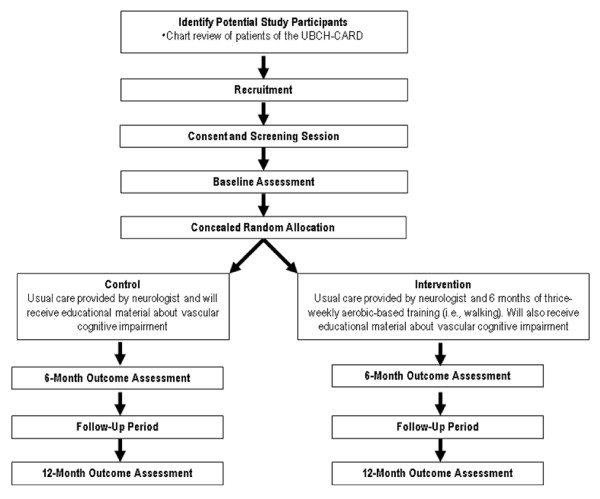
BACKGROUND: Sub-cortical vascular ischaemia is the second most common etiology contributing to cognitive impairment in older adults, and is frequently under-diagnosed and under-treated. Although evidence is mounting that exercise has benefits for cognitive function among seniors, very few randomized controlled trials of exercise have been conducted in populations at high-risk for progression to dementia. Aerobic-based exercise training may be of specific benefit in delaying the progression of cognitive decline among seniors with vascular cognitive impairment by reducing key vascular risk factors associated with metabolic syndrome. Thus, we aim to carry out a proof-of-concept single-blinded randomized controlled trial primarily designed to provide preliminary evidence of efficacy aerobic-based exercise training program on cognitive and everyday function among older adults with mild sub-cortical ischaemic vascular cognitive impairment. METHODS/DESIGN: A proof-of-concept single-blinded randomized trial comparing a six-month, thrice-weekly, aerobic-based exercise training group with usual care on cognitive and everyday function. Seventy older adults who meet the diagnostic criteria for sub-cortical ischaemic vascular cognitive impairment as outlined by Erkinjuntti and colleagues will be recruited from a memory clinic of a metropolitan hospital. The aerobic-based exercise training will last for 6 months. Participants will be followed for an additional six months after the cessation of exercise training. DISCUSSION: This research will be an important first step in quantifying the effect of an exercise intervention on cognitive and daily function among seniors with sub-cortical ischaemic vascular cognitive impairment, a recognized risk state for progression to dementia. Exercise has the potential to be an effective, inexpensive, and accessible intervention strategy with minimal adverse effects. Reducing the rate of cognitive decline among seniors with sub-cortical ischaemic vascular cognitive impairment could preserve independent functioning and health related quality of life in this population. This, in turn, could lead to reduced health care resource utilization costs and avoidance of early institutional care.
Overview
The claims and statistics of this paper haven’t been checked yet.
Free: it reads the open-access text and checks the first 5 claims that cite a source we can check. Create a free account to check every claim.
Integrity signals
Registry
Cites
Statistics
Figures
Verification
Claims the paper makes
The claims and statistics of this paper haven’t been checked yet.
Free: it reads the open-access text and checks the first 5 claims that cite a source we can check. Create a free account to check every claim.
Claims other papers make about this one
Each is checked against this paper’s own text: does it say what the citing paper says it does?
The cited source says what the claim attributes to it.
In the citing paper
“Physical activity has been identified as having potential protective benefits in brain health and plasticity and in VCI and related conditions.308–314”
From Vascular Contributions to Cognitive Impairment and Dementia: A Statement for Healthcare Professionals From the American Heart Association/American Stroke Association (2011) · cites this paper as [310]
Experimental — accuracy not yet measured
Self-check
Percentages, sums and reported differences re-computed from the paper’s own numbers.
The self-check needs the paper’s full text.
Citations
Cites
Folstein, M. F., Folstein, S. E., & McHugh, P. R. (1975) · Journal of Psychiatric Research · doi:10.1016/0022-3956(75)90026-6 · Cited by 88,282
The Montreal Cognitive Assessment, MoCA: a brief screening tool for mild cognitive impairment
Nasreddine, Z. S., Phillips, N. A., Bédirian, V., Charbonneau, S., Whitehead, V., Collin, I., Cummings, J. L., & Chertkow, H. (2005) · Journal of the American Geriatrics Society · doi:10.1111/j.1532-5415.2005.53221.x · Cited by 25,553 · cited 4×
“Nasreddine ZS, Phillips NA, Bedirian V, Charbonneau S, Whitehead V, Collin I, Cummings JL, Chertkow H: The Montreal Cognitive Assessment, MoCA: a brief screening tool for mild cognitive impairment.”
BackgroundMethodInfluentialThe Neuropsychiatric Inventory: Comprehensive assessment of psychopathology in dementia
Cummings, J. L., Mega, M., Gray, K., Rosenberg-Thompson, S., Carusi, D. A., & Gornbein, J. (1994) · Neurology · doi:10.1212/wnl.44.12.2308 · Cited by 7,568
A new rating scale for Alzheimer's disease
(1984) · American Journal of Psychiatry · doi:10.1176/ajp.141.11.1356 · Cited by 4,175
Lower-extremity function in persons over the age of 70 years as a predictor of subsequent disability
Guralnik, J. M., Ferrucci, L., Simonsick, E. M., Salive, M. E., & Wallace, R. B. (1995) · New England Journal of Medicine · doi:10.1056/nejm199503023320902 · Cited by 4,083 · cited 2×
“Poor performance on this scale predicts subsequent disability [ 44 ].”
BackgroundThe Cardiovascular Health Study: design and rationale.
Fried, L. P., Borhani, N. O., Enright, P., Furberg, C. D., Gardin, J. M., Kronmal, R. A., Kuller, L. H., Manolio, T. A., Mittelmark, M. B., Newman, A., et al. (1991) · Annals of Epidemiology · doi:10.1016/1047-2797(91)90005-w · Cited by 3,652
Forecasting the global burden of Alzheimer's disease
Brookmeyer, R., Johnson, E., Ziegler‐Graham, K., & Arrighi, H. M. (2007) · Alzheimer's & Dementia · doi:10.1016/j.jalz.2007.04.381 · Cited by 3,370 · cited 1×
“2 million by 2050 in the US alone [54].”
BackgroundThe physical activity scale for the elderly (PASE): Development and evaluation
Washburn, R. A., Smith, K. W., Jette, A. M., & Janney, C. A. (1993) · Journal of Clinical Epidemiology · doi:10.1016/0895-4356(93)90053-4 · Cited by 3,177 · cited 1×
“Physical activity, not including the study-assigned exercise classes, will be determined by the valid and reliable Physical Activities Scale for the Elderly (PASE) questionnaire [33,34].”
MethodExercise: a behavioral intervention to enhance brain health and plasticity
Cotman, C. (2002) · Trends in Neurosciences · doi:10.1016/s0166-2236(02)02143-4 · Cited by 2,739 · cited 1×
“Aerobic exercise may also act specifically on disease pathophysiology [13], for example, by improving capillarization or modulating brain neurotrophic factors [14-16], and may even decrease brain amyloid load in the brain [17].”
BackgroundLautenschlager, N. T., Cox, K. L., Flicker, L., Foster, J. K., van Bockxmeer, F. M., Xiao, J., Greenop, K. R., & Almeida, O. P. (2008) · JAMA · doi:10.1001/jama.300.9.1027 · Cited by 1,637 · cited 2×
“Although exercise therapy holds promise for delaying the onset and slowing down the progression of both cognitive and functional decline, very few randomized controlled trials of exercise have been conducted in populations at high-risk for dementia [ 30 ].”
BackgroundInfluentialMedicine and Science in Sports and Exercise-1980
Tipton, C. M. (1980) · Medicine & Science in Sports & Exercise · doi:10.1249/00005768-198021000-00001 · Cited by 1,631
Longstreth, W. T., Manolio, T. A., Arnold, A., Burke, G. L., Bryan, N., Jungreis, C. A., Enright, P. L., O'Leary, D., & Fried, L. (1996) · Stroke · doi:10.1161/01.str.27.8.1274 · Cited by 1,464 · cited 3×
“matter grading scale greater than 3 from the Cardiovascular Health Study) [23,24]; and ii.”
BackgroundAn Inventory to Assess Activities of Daily Living for Clinical Trials in Alzheimerʼs Disease
Galasko, D., Bennett, D., Sano, M., Ernesto, C., Thomas, R., Grundman, M., & Ferris, S. (1997) · Alzheimer Disease & Associated Disorders · doi:10.1097/00002093-199700112-00005 · Cited by 1,194 · cited 1×
“Everyday FunctionBecause executive dysfunction is associated with impaired everyday function [7], we will use the ADCS-ADL to assess the ability to perform everyday activities of daily living [ 41 ].”
Method(2014) · International Journal of Stroke · doi:10.1111/ijs.12374_18 · Cited by 1,166
O'Brien, J. T., Erkinjuntti, T., Reisberg, B., Roman, G., Sawada, T., Pantoni, L., Bowler, J. V., Ballard, C., DeCarli, C., Gorelick, P. B., et al. (2003) · The Lancet Neurology · doi:10.1016/s1474-4422(03)00305-3 · Cited by 1,139
The Physical Activity Scale for the Elderly (PASE)
Washburn, R. A., McAuley, E., Katula, J., Mihalko, S. L., & Boileau, R. A. (1999) · Journal of Clinical Epidemiology · doi:10.1016/s0895-4356(99)00049-9 · Cited by 997 · cited 1×
“Physical activity, not including the study-assigned exercise classes, will be determined by the valid and reliable Physical Activities Scale for the Elderly (PASE) questionnaire [33,34].”
Method(2003) · Archives of Internal Medicine · doi:10.1001/archinte.163.9.1069 · Cited by 988 · cited 1×
“A number of epidemiological studies suggest that modification of vascular risk factors, such as hypertension, diabetes mellitus, and hypercholesterolemia may be helpful in slowing down the progression of vascular cognitive impairment [9-12].”
BackgroundDishman, R. K., Berthoud, H., Booth, F. W., Cotman, C. W., Edgerton, V. R., Fleshner, M. R., Gandevia, S. C., Gomez‐Pinilla, F., Greenwood, B. N., Hillman, C. H., et al. (2006) · Obesity · doi:10.1038/oby.2006.46 · Cited by 958
A Physiological Profile Approach to Falls Risk Assessment and Prevention
Lord, S. R., Menz, H. B., & Tiedemann, A. (2003) · Physical Therapy · doi:10.1093/ptj/83.3.237 · Cited by 916 · cited 1×
“A PPA z-score of 0-1 indicates mild risk, 12 indicates moderate risk, 2-3 indicates high risk, and 3 and above indicates marked risk [46].”
BackgroundA physiological profile approach to falls risk assessment and prevention
(2007) · Falls in Older People · doi:10.1017/cbo9780511722233.018 · Cited by 886
Cardiovascular risk factors and cognitive decline in middle-aged adults
Knopman, D., Boland, L. L., Mosley, T., Howard, G., Liao, D., Szklo, M., McGovern, P., & Folsom, A. R. (2001) · Neurology · doi:10.1212/wnl.56.1.42 · Cited by 883
Voluntary Exercise Decreases Amyloid Load in a Transgenic Model of Alzheimer's Disease
Adlard, P. A., Perreau, V. M., Pop, V., & Cotman, C. W. (2005) · The Journal of Neuroscience · doi:10.1523/jneurosci.0496-05.2005 · Cited by 804 · cited 1×
“Aerobic exercise may also act specifically on disease pathophysiology [13], for example, by improving capillarization or modulating brain neurotrophic factors [14-16], and may even decrease brain amyloid load in the brain [17].”
BackgroundEnright, P. L., McBurnie, M. A., Bittner, V., Tracy, R. P., McNamara, R., Arnold, A., & Newman, A. B. (2003) · Chest · doi:10.1378/chest.123.2.387 · Cited by 788
Galasko, D. R., Bennett, D., Sano, M., Ernesto, C., Thomas, R., Grundman, M., & Ferris, S. H. (1997) · PubMed · Cited by 767
Erkinjuntti, T., Kurz, A., Gauthier, S., Bullock, R., Lilienfeld, S., & Damaraju, C. V. (2002) · The Lancet · doi:10.1016/s0140-6736(02)08267-3 · Cited by 752 · cited 1×
“The ADAS-Cog has been a significant outcome measure in numerous trials with AD [27,36,37] but also with vascular dementia [29,38].”
BackgroundResearch criteria for subcortical vascular dementia in clinical trials
Erkinjuntti, T., Inzitari, D., Pantoni, L., Wallin, A., Scheltens, P., Rockwood, K., Roman, G. C., Chui, H., & Desmond, D. W. (2000) · Advances in Dementia Research · doi:10.1007/978-3-7091-6781-6_4 · Cited by 631 · cited 1×
“We will recruit individuals who fulfill the diagnostic criteria for SIVCI as outlined by Erkinjuntti and colleagues [22], which requires the presence of both cognitive syndrome (as defined in Section A below) and small vessel ischaemic disease (as defined in Section B below).”
MethodBedside Assessment of Executive Cognitive Impairment: The Executive Interview
Royall, D. R., Mahurin, R. K., & Gray, K. F. (1992) · Journal of the American Geriatrics Society · doi:10.1111/j.1532-5415.1992.tb03646.x · Cited by 600 · cited 3×
“For each of the three primary endpoints (i.e., ADAS-Cog, EXIT-25, ADCS-ADL), the change from baseline to six months and 12 months will be assessed using an analysis of covariance model incorporating the baseline measurement.”
BackgroundMethodOrgogozo, J.-M., Rigaud, A.-S., Stöffler, A., Möbius, H.-J., & Forette, F. (2002) · Stroke · doi:10.1161/01.str.0000020094.08790.49 · Cited by 539 · cited 2×
“Studies have suggested a standard deviation of change of 6 to 7 [ 27-29 ] in Alzheimer Disease Assessment Scale Cognitive (ADAS-Cog) scores among individuals with vascular cognitive impairment.”
BackgroundMethodBorg, G. (1982) · International Journal of Sports Medicine · doi:10.1055/s-2008-1026080 · Cited by 486
Alzheimer Disease and Associated Disorders: Integrative, International, Interdisciplinary
Post, S. G., & Whitehouse, P. J. (1992) · Alzheimer Disease & Associated Disorders · doi:10.1097/00002093-199205000-00001 · Cited by 460
Manolio, T. A., Kronmal, R. A., Burke, G. L., Poirier, V, O'Leary, D. H., Gardin, J. M., Fried, L. P., Steinberg, E. P., & Bryan, R. N. (1994) · Stroke · doi:10.1161/01.str.25.2.318 · Cited by 458 · cited 3×
“matter grading scale greater than 3 from the Cardiovascular Health Study) [23,24]; and ii.”
BackgroundAnstey, K. J., Lipnicki, D. M., & Low, L.-F. (2008) · The American Journal of Geriatric Psychiatry · doi:10.1097/01.jgp.0000310778.20870.ae · Cited by 437
Donepezil in vascular dementia: A randomized, placebo-controlled study
Wilkinson, D., Doody, R., Helme, R., Taubman, K., Mintzer, J., Kertesz, A., Pratt, R. D., & the Donepezil 308 Study Group* (2003) · Neurology · doi:10.1212/01.wnl.0000078943.50032.fc · Cited by 392
Prevalence and outcomes of vascular cognitive impairment
Rockwood, K., Wentzel, C., Hachinski, V., Hogan, D. B., MacKnight, C., McDowell, I., & for the Vascular Cognitive Impairment Investigators of the Canadian Study of Health and Aging (2000) · Neurology · doi:10.1212/wnl.54.2.447 · Cited by 389
Falls in Older People: Risk Factors and Strategies for Prevention
Lord, S. R., Sherrington, C., & Menz, H. B. (2000) · Cited by 369
Vascular cognitive impairment: current concepts and clinical developments
Moorhouse, P., & Rockwood, K. (2008) · The Lancet Neurology · doi:10.1016/s1474-4422(08)70040-1 · Cited by 358 · cited 3×
“The growing consensus is that small vessel diseases have an important role in vascular cognitive impairment [18,19].”
BackgroundJournal of Neural Transmission
(2013) · Journal of Neural Transmission · doi:10.1007/702.1435-1463 · Cited by 352
Allhoff, P., Laaser, U., & Heinrich, J. (1991) · Kompendium der Lipid-Studien · doi:10.1007/978-3-642-95642-3_32 · Cited by 333
Preference-Based Measures in Economic Evaluation in Health Care
Neumann, P. J., Goldie, S. J., & Weinstein, M. C. (2000) · Annual Review of Public Health · doi:10.1146/annurev.publhealth.21.1.587 · Cited by 295
Maetzel, A., Li, L. C., Pencharz, J., Tomlinson, G., & Bombardier, C. (2004) · Annals of the Rheumatic Diseases · doi:10.1136/ard.2003.006031 · Cited by 274 · cited 1×
“The health resource utilization questionnaire has been previously described and supported in previous studies [48].”
ResultConsistency of the talk test for exercise prescription.
Persinger, R., Foster, C., Gibson, M. H., Fater, D. C., & Porcari, J. P. (2004) · PubMed · Cited by 271
Adlard, P. A., & Cotman, C. W. (2004) · Neuroscience · doi:10.1016/j.neuroscience.2003.12.039 · Cited by 265 · cited 1×
“Aerobic exercise may also act specifically on disease pathophysiology [13], for example, by improving capillarization or modulating brain neurotrophic factors [ 14-16 ], and may even decrease brain amyloid load in the brain [17].”
BackgroundDichgans, M., Markus, H. S., Salloway, S., Verkkoniemi, A., Moline, M., Wang, Q., Posner, H., & Chabriat, H. S. (2008) · The Lancet Neurology · doi:10.1016/s1474-4422(08)70046-2 · Cited by 264 · cited 1×
“Studies have suggested a standard deviation of change of 6 to 7 [27-29] in Alzheimer Disease Assessment Scale Cognitive (ADAS-Cog) scores among individuals with vascular cognitive impairment.”
BackgroundDrummond, M., Manca, A., & Sculpher, M. (2005) · International Journal of Technology Assessment in Health Care · doi:10.1017/s0266462305050221 · Cited by 251 · cited 1×
“By definition, an ICER is the difference between the mean costs of providing the competing interventions divided by the difference in effectiveness, where ICER = Δ Cost/Δ Effect [53].”
BackgroundProgression of impairment in patients with vascular cognitive impairment without dementia
Wentzel, C., Rockwood, K., MacKnight, C., Hachinski, V., Hogan, D. B., Feldman, H., Østbye, T., Wolfson, C., Gauthier, S., Verreault, R., et al. (2001) · Neurology · doi:10.1212/wnl.57.4.714 · Cited by 243 · cited 1×
“While mild Sub-cortical Ischaemic Vascular Cognitive Impairment (SIVCI) describes those individuals whose symptoms are not associated with substantial functional impairment [18], persons with mild SIVCI have a high risk of progression to dementia [18,21].”
BackgroundVascular dementia may be the most common form of dementia in the elderly
Román, G. C. (2002) · Journal of the Neurological Sciences · doi:10.1016/s0022-510x(02)00252-6 · Cited by 230 · cited 1×
“Background Cerebrovascular disease is the second most common etiology contributing to dementia in older adults [1-4] and may be the most under-diagnosed and yet most treatable form of cognitive dysfunction in older adults [5].”
BackgroundMedicine and Science in Sports and Exercise: The Name Says It All
Wathen, D. (2003) · Strength and Conditioning Journal · doi:10.1519/00126548-200306000-00017 · Cited by 218
Diabetes and the Risk of Stroke: The Honolulu Heart Program
Abbott, R. D. (1987) · JAMA · doi:10.1001/jama.1987.03390070069025 · Cited by 214
Falls in older people: risk factors and strategies for prevention.
Evans, J. G. (2001) · Family Practice · doi:10.1093/fampra/18.4.470 · Cited by 195
Galantamine treatment of vascular dementia: A randomized trial
Auchus, A. P., Brashear, H. R., Salloway, S., Korczyn, A. D., De Deyn, P. P., & Gassmann-Mayer, C. (2007) · Neurology · doi:10.1212/01.wnl.0000266625.31615.f6 · Cited by 189
Diabetes and the risk of stroke
Chukwuma, C., & Tuomilehto, J. O. (1993) · Journal of Diabetes and its Complications · doi:10.1016/s0002-9610(05)80253-3 · Cited by 138
Statistical considerations for pilot studies
Schoenfeld, D. (1980) · International Journal of Radiation Oncology*Biology*Physics · doi:10.1016/0360-3016(80)90153-4 · Cited by 127 · cited 1×
“In addition, no adjustment for multiple endpoints will be made since in a proof-of-concept study a Type II error is of more concern than a Type I error [ 52 ].”
BackgroundThe Talk Test as a Marker of Exercise Training Intensity
Foster, C., Porcari, J. P., Anderson, J., Paulson, M., Smaczny, D., Webber, H., Doberstein, S. T., & Udermann, B. (2008) · Journal of Cardiopulmonary Rehabilitation and Prevention · doi:10.1097/01.hcr.0000311504.41775.78 · Cited by 120
Gotsman, I., Stabholz, A., Planer, D., Pugatsch, T., Lapidus, L., Novikov, Y., Masrawa, S., Soskolne, A. W., & Lotan, C. (2008) · PubMed · Cited by 109
Prevention of CIND by physical activity: Different impact on VCI-ND compared with MCI
Middleton, L. E., Kirkland, S., & Rockwood, K. J. (2008) · Journal of the Neurological Sciences · doi:10.1016/j.jns.2007.04.054 · Cited by 96 · cited 1×
“Aerobic exercise may also act specifically on disease pathophysiology [13], for example, by improving capillarization or modulating brain neurotrophic factors [14-16], and may even decrease brain amyloid load in the brain [17].”
BackgroundExecutive Impairments Predict Functional Declines in Vascular Dementia
Boyle, P. A., Paul, R. H., Moser, D. J., & Cohen, R. A. (2004) · The Clinical Neuropsychologist · doi:10.1080/13854040490507172 · Cited by 95 · cited 3×
“, ability to perform instrumental activities of daily living [ADLs]) [7].”
BackgroundMethodRomán, G. C. (2002) · Acta Neurologica Scandinavica · doi:10.1034/j.1600-0404.106.s178.2.x · Cited by 84 · cited 14×
“The impact of our proposed work may be significant for seniors with mild SIVCI.”
BackgroundMethodInfluentialRole of White Matter Lesions in Cognitive Impairment of Vascular Origin
Pantoni, L., Leys, D., Fazekas, F., Longstreth, W. T., Inzitari, D., Wallin, A., Filippi, M., Scheltens, P., Erkinjuntti, T., & Hachinski, V. (1999) · Alzheimer Disease & Associated Disorders · doi:10.1097/00002093-199912001-00008 · Cited by 80
The Cognitive Syndrome of Vascular Dementia: Implications for Clinical Trials
Desmond, D. W., Erkinjuntti, T., Sano, M., Cummings, J. L., Bowler, J. V., Pasquier, F., Moroney, J. T., Ferris, S. H., Stern, Y., Sachdev, P. S., et al. (1999) · Alzheimer Disease & Associated Disorders · doi:10.1097/00002093-199912003-00005 · Cited by 78
The cognitive syndrome of vascular dementia: implications for clinical trials
Desmond, D. W., Erkinjuntti, T., Sano, M., et al. (2022) · PubMed · doi:10.7916/037w-mc41 · Cited by 74
Imaging of Static Brain Lesions in Vascular Dementia: Implications for Clinical Trials
Erkinjuntti, T., Bowler, J. V., DeCarli, C. S., Fazekas, F., Inzitari, D., O??Brien, J. T., Pantoni, L., Rockwood, K., Scheltens, P., Wahlund, L.-O., et al. (1999) · Alzheimer Disease & Associated Disorders · doi:10.1097/00002093-199912003-00013 · Cited by 62 · cited 2×
“This research will be an important first step in quantifying the effect of an exercise intervention on cognitive and daily function among seniors with SIVCI, as vascular cognitive impairment is the second most common cause of dementia in older adults [ 1-4 ].”
BackgroundYlikoski, R., Jokinen, H., Andersen, P., Salonen, O., Madureira, S., Ferro, J., Barkhof, F., van der Flier, W., Schmidt, R., Fazekas, F., et al. (2007) · Dementia and Geriatric Cognitive Disorders · doi:10.1159/000103865 · Cited by 53 · cited 1×
“The ADAS-Cog has marked advantages as an outcome measure, based on its substantial data confirming both reliability and validity and its use in measuring longitudinal change together with sensitivity to treatment effects [39].”
BackgroundSubcortical Ischemic Vascular Disease and Dementia
Erkinjuntti, T. (2003) · International Psychogeriatrics · doi:10.1017/s1041610203008925 · Cited by 40
Kemp, P. M. (2003) · Journal of Neurology, Neurosurgery & Psychiatry · doi:10.1136/jnnp.74.11.1567 · Cited by 38 · cited 1×
“The ADAS-Cog has been a significant outcome measure in numerous trials with AD [27,36,37] but also with vascular dementia [29,38].”
BackgroundBowler, J. (2008) · Cognitive NeurologyA clinical textbook · doi:10.1093/acprof:oso/9780198569275.003.0014 · Cited by 37
Dishman, R. K., Berthoud, H. R., Booth, F. W., Cotman, C. W., Edgerton, V. R., Fleshner, M., Gandevia, S. C., Gómez‐Pinilla, F., Greenwood, B. N., Hillman, C. H., et al. (2006) · Scandinavian Journal of Medicine and Science in Sports · doi:10.1111/j.1600-0838.2006.00610_1.x · Cited by 24 · cited 1×
“Aerobic exercise may also act specifically on disease pathophysiology [13], for example, by improving capillarization or modulating brain neurotrophic factors [14-16], and may even decrease brain amyloid load in the brain [17].”
Background
Research works printed but not linked: 2
- Kovar M Lawton M Functional disability: Activities and instrumental activities of daily living Annu Rev Gerontol Geriatr 1994 14 57 75
- Canadian Society for Exercise Physiology Par-Q and You 1994 Gloucester, Ontario, Canada: Canadian Society of Exercise Physiology 1 2
Cited by
Gorelick, P. B., Scuteri, A., Black, S. E., DeCarli, C., Greenberg, S. M., Iadecola, C., Launer, L. J., Laurent, S., Lopez, O. L., Nyenhuis, D., et al. (2011) · Stroke · doi:10.1161/str.0b013e3182299496 · Cited by 3,811
Advances in the prevention of Alzheimer's disease and dementia
Solomon, A., Mangialasche, F., Richard, E., Andrieu, S., Bennett, D. A., Breteler, M., Fratiglioni, L., Hooshmand, B., Khachaturian, A. S., Schneider, L. S., et al. (2014) · Journal of Internal Medicine · doi:10.1111/joim.12178 · Cited by 319
Combinatorial bZIP dimers display complex DNA-binding specificity landscapes
Rodríguez-Martínez, J. A., Reinke, A. W., Bhimsaria, D., Keating, A. E., & Ansari, A. Z. (2017) · eLife · doi:10.7554/elife.19272 · Cited by 182
Aerobic exercise and vascular cognitive impairment: A randomized controlled trial
Liu-Ambrose, T., Best, J. R., Davis, J. C., Eng, J. J., Lee, P. E., Jacova, C., Boyd, L. A., Brasher, P. M., Munkacsy, M., Cheung, W., et al. (2016) · Neurology · doi:10.1212/wnl.0000000000003332 · Cited by 146
“The trial protocol has been published previously.(9) Participants provided written informed consent.”
BackgroundMethodSelf-citationHsu, C. L., Best, J. R., Davis, J. C., Nagamatsu, L. S., Wang, S., Boyd, L. A., Hsiung, G. R., Voss, M. W., Eng, J. J., & Liu-Ambrose, T. (2018) · British Journal of Sports Medicine · doi:10.1136/bjsports-2016-096846 · Cited by 139
Self-citation
Metadata
- Authors
- Liu-Ambrose, T., Eng, J. J., Boyd, L. A., Jacova, C., Davis, J. C., Bryan, S., Lee, P., Brasher, P., & Hsiung, G.-Y. R.
- Affiliations
- University of British Columbia (CA)
- Vancouver Coastal Health Research Institute (CA)
- Corresponding author
- Liu-Ambrose, Teresa
- ORCID
- Venue
- BMC Neurology
- Published
- 2010-02-17
- Volume
- 10
- Issue
- 1
- Pages
- 14-14
- ISSN
- 1471-2377 (ISSN-L)
- PMC
- PMC2830197
- OpenAlex
- W1971923794
- Cited by
- 64
- References
- 67
- Citations by year
- 2026: 1 · 2024: 1 · 2023: 2 · 2021: 4 · 2020: 4 · 2019: 6 · 2018: 4 · 2017: 9 · 2016: 4 · 2015: 5 · 2014: 4 · 2013: 4 · 2012: 6
- Type
- conference abstract
- Language
- en
- Open access
- gold
- doi.org
- Licence
- Locations
- BMC Neurology (publishedVersion, cc-by)
- PubMed Central (publishedVersion, cc-by)
- PubMed (publishedVersion)
- cIRcle (University of British Columbia) (submittedVersion, cc-by)
- DOAJ (DOAJ: Directory of Open Access Journals) (submittedVersion)
- Open Collections
- Funders
- Heart and Stroke Foundation of Canada
- Canadian Stroke Network
- Michael Smith Health Research BC
- Topics
- Health Sciences › Medicine › Psychiatry and Mental health › Dementia and Cognitive Impairment Research
- Health Sciences › Medicine › Public Health, Environmental and Occupational Health › Physical Activity and Health
- Life Sciences › Neuroscience › Neurology › Neurological Disease Mechanisms and Treatments
- Keywords
- aerobic exercise training, vascular cognitive impairment, older adults, cognitive decline, dementia risk, daily functioning, metabolic syndrome, vascular risk factors, exercise intervention
- MeSH terms
- Brain Ischemia, Clinical Protocols, Cognition, Cognition Disorders, Exercise Therapy, Follow-Up Studies, Humans, Neuropsychological Tests, Research Design, Severity of Illness Index, Time Factors, Single-Blind Method, Treatment Outcome
About these checks
Registry, retraction, Cites and statistics results are computed, not judged, with one exception: a printed reference that no index lists is read once by a model before it counts as a citation error. Claims are extracted by a model and kept only when their quote appears verbatim in the text; each cited source is then checked, with a model’s help, for whether it says what the claim relies on. Those verdicts can be wrong — read the claim’s quote and the cited source before relying on one.
Statistics and arithmetic are recomputed, not judged.
Confidence bands are shown only for fields calibrated on our annotated test set. None is calibrated yet, so no band is shown.
What counts as a claim ›How we measure confidence ›How we check this ›
Are you an author, or do you see a problem with this page? Request a review
Data sources
Bibliographic data: Semantic Scholar, OpenAlex, Crossref.
Contains information from the Semantic Scholar Academic Graph Datasets, made available under the ODC Attribution License (ODC-BY 1.0).
Semantic Scholar’s data is described in: Kinney, R., et al. (2023). The Semantic Scholar Open Data Platform. arXiv:2301.10140.
