

Improved pregnancy outcome in refugees and migrants despite low literacy on the Thai-Burmese border: results of three cross-sectional surveys
Open accessThe DOI matches its Crossref record; 47 of the 47 references it cites were found in a registry or an index.
Abstract
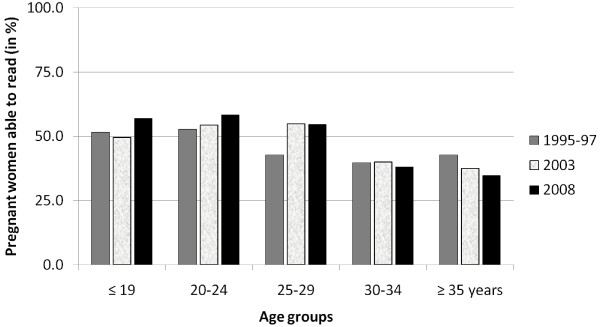
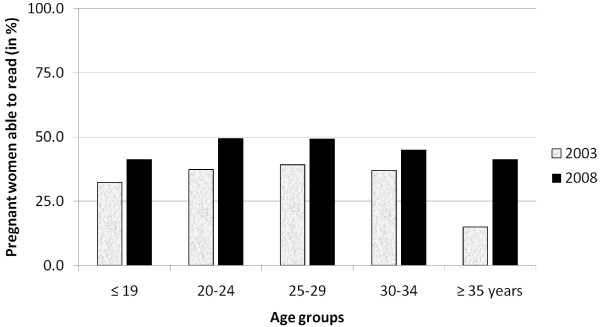
BACKGROUND: Maternal and infant health has been associated with maternal education level, which is highly associated with literacy. We aimed at estimating literacy rates among reproductive age women attending antenatal clinics in camps for refugees and in migrant clinics in Tak province, north-western Thailand, to determine whether illiteracy had an impact on birth outcomes. METHODS: Three reading assessments were conducted using an identical method each time, in 1995-97, 2003 and 2008. Midwives chose at random one of four pre-set sentences. Each woman was asked to read aloud and scoring was based on a "pass/fail" system. Pregnancy outcomes were compared with maternal literacy rate. RESULTS: Overall, 47% (1149/2424) of women were able to read. A significant improvement was observed among migrant (34% in 2003 vs. 46% in 2008, p = 0.01), but not refugee (47% in 1995-97, 49% in 2003, and 51% in 2008) women. Literate women were significantly more likely to be of non-Karen ethnicity, primigravidae, non-smokers, to remain free from malaria during pregnancy and to deliver in a health clinic. Significant improvements in pregnancy outcome (reductions in premature births, low birth weight newborns and neonatal death) between 1995-97 and 2003 were unrelated to literacy. CONCLUSIONS: Significant reductions in poor pregnancy outcome over time have not been driven by changes in literacy rates, which have remained low. Access to early diagnosis and treatment of malaria in this population, and delivery with skilled birth attendants, despite ongoing low literacy, appears to have played a significant role.
Overview
The claims and statistics of this paper haven’t been checked yet.
Free: it reads the open-access text and checks the first 5 claims that cite a source we can check. Create a free account to check every claim.
Integrity signals
Registry
Cites
Statistics
Figures
Verification
Claims the paper makes
The claims and statistics of this paper haven’t been checked yet.
Free: it reads the open-access text and checks the first 5 claims that cite a source we can check. Create a free account to check every claim.
Claims other papers make about this one
Each is checked against this paper’s own text: does it say what the citing paper says it does?
The source backs part of the claim, not all of it — or backs it for a different population, condition or comparison.
In the citing paper
“Antenatal care (ANC) coverage is high with more than 90% of pregnant women living in Mae La camp attending at least once [17], while more than 75% of women in Mae La camp give birth in the SMRU birth centre with SBAs [18].”
From Quality of intrapartum care by skilled birth attendants in a refugee clinic on the Thai-Myanmar border: a survey using WHO Safe Motherhood Needs Assessment (2015) · cites this paper as [18]
Experimental — accuracy not yet measuredThe source backs part of the claim, not all of it — or backs it for a different population, condition or comparison.
In the citing paper
“Low levels of literacy accompanied by a maximum level of 10th standard education are factors that limit availability of suitable applicants for the SBA program [46].”
From Accelerated Training of Skilled Birth Attendants in a Marginalized Population on the Thai-Myanmar Border: A Multiple Methods Program Evaluation (2016) · cites this paper as [46]
Experimental — accuracy not yet measuredThe source backs part of the claim, not all of it — or backs it for a different population, condition or comparison.
In the citing paper
“Maternal education is not routinely asked and while literacy is, it overestimates true health literacy [39].”
From COVID-19 pandemic, pregnancy care, perinatal outcomes in Eastern Myanmar and North-Western Thailand: a retrospective marginalised population cohort (2024) · doi:10.1186/s12884-024-06841-0 · cites this paper as [39]
Experimental — accuracy not yet measuredThe source backs part of the claim, not all of it — or backs it for a different population, condition or comparison.
In the citing paper
“Low literacy amongst the female population [46] required resources to be channeled toward training staff who speak local languages (S’gaw Karen, Pwo Karen and Burmese) in order to provide verbal or pictorial information and counseling to women.”
From Empirical lessons regarding contraception in a protracted refugee setting: A descriptive study from Maela camp on the Thai-Myanmar border 1996 – 2015 (2017) · cites this paper as [46]
Experimental — accuracy not yet measuredThe source backs part of the claim, not all of it — or backs it for a different population, condition or comparison.
In the citing paper
“However, the outcome of each pregnancy is obtained during the obstetric history of each woman, reducing the risk for incorrect reporting of gravidity, and literacy rates remain in agreement with a previous survey on literacy in the population 45.”
From Trends and birth outcomes in adolescent refugees and migrants on the Thailand-Myanmar border, 1986-2016: an observational study (2018) · cites this paper as [45]
Experimental — accuracy not yet measured
4 more claims about this paper
Create a free account to see every claim other papers make about this one.
Self-check
Percentages, sums and reported differences re-computed from the paper’s own numbers.
The self-check needs the paper’s full text.
Citations
Cites
Ethnologue. Languages of the World
(2014) · African Studies Companion Online · doi:10.1163/_afco_asc_441 · Cited by 2,162
Parker, R. M., Baker, D. W., Williams, M. V., & Nurss, J. R. (1995) · Journal of General Internal Medicine · doi:10.1007/bf02640361 · Cited by 2,023
The Links Between Education and Health
Ross, C. E., & Wu, C.-L. (1995) · American Sociological Review · doi:10.2307/2096319 · Cited by 1,943 · cited 1×
“Maternal and infant health has been associated with parental education levels, which can in part be measured by female literacy [3-5].”
BackgroundThe meaning and the measure of health literacy
Baker, D. W. (2006) · Journal of General Internal Medicine · doi:10.1111/j.1525-1497.2006.00540.x · Cited by 1,331 · cited 1×
“Reading fluency is part of conceptual models developed to assess an individual’s ability to comprehend messages or printed information [28].”
BackgroundManandhar, D. S., Osrin, D., Shrestha, B. P., Mesko, N., Morrison, J., Tumbahangphe, K. M., Tamang, S., Thapa, S., Shrestha, D., Thapa, B., et al. (2004) · The Lancet · doi:10.1016/s0140-6736(04)17021-9 · Cited by 847 · cited 4×
“Adhikari R: Demographic, socio-economic, and cultural factors affecting fertility differentials in Nepal.”
BackgroundInfluentialMaternal education and child survival in developing countries: The search for pathways of influence
Cleland, J. G., & van Ginneken, J. K. (1988) · Social Science & Medicine · doi:10.1016/0277-9536(88)90201-8 · Cited by 781 · cited 2×
“This study does not question the benefits of maternal literacy on pregnancy outcomes [10-15].”
BackgroundThe role of health literacy in patient-physician communication.
Williams, M. V., Davis, T. C., Parker, R. M., & Weiss, B. D. (2002) · PubMed · Cited by 677
Literacy and misunderstanding prescription drug labels
Davis, T. C., Wolf, M. S., Bass, P. F., Thompson, J. A., Tilson, H. H., Neuberger, M., & Parker, R. M. (2006) · Annals of Internal Medicine · doi:10.7326/0003-4819-145-12-200612190-00144 · Cited by 628 · cited 1×
“Background Low literacy skills have implications for health, whether in comprehending written instructions for taking medicines [1] or ability to understand one’s medical condition [2].”
BackgroundRapid assessment of literacy levels of adult primary care patients.
Tc, D., Crouch, M. A., Sw, L., Rh, J., Bates, P. T., Rb, G., & Bairnsfather, L. E. (1991) · PubMed · Cited by 580
Nosten, F., van Vugt, M., Price, R., Luxemburger, C., Thway, K., Brockman, A., McGready, R., ter Kuile, F., Looareesuwan, S., & White, N. (2000) · The Lancet · doi:10.1016/s0140-6736(00)02505-8 · Cited by 500 · cited 1×
“Access to early diagnosis and treatment of malaria in this population [37,38] and delivery with skilled birth attendants, despite ongoing low literacy, appears to have played a significant role.”
BackgroundSelf-citationFertility and Education. What Do We Really Know?
T., A. M. T., & Cochrane, S. H. (1980) · Population (French Edition) · doi:10.2307/1532377 · Cited by 464
Effects of Plasmodium vivax malaria in pregnancy.
Nosten, F., McGready, R., Simpson, J., Thwai, K., Balkan, S., Cho, T., Hkirijaroen, L., Looareesuwan, S., & White, N. (1999) · The Lancet · doi:10.1016/s0140-6736(98)09247-2 · Cited by 381 · cited 1×
“These three factors were associated with literacy in this population and all of them have been associated with birth outcomes previously [34-36].”
BackgroundSelf-citationMalaria during pregnancy in an area of unstable endemicity.
Nosten, F., ter Kuile, F., Maelankirri, L., Decludt, B., & White, N. J. (1991) · Transactions of the Royal Society of Tropical Medicine and Hygiene · doi:10.1016/0035-9203(91)90205-d · Cited by 294 · cited 1×
“Active antenatal screening for malaria and anaemia at antenatal clinics has been routine since 1986, because in this area transmission of malaria is low and seasonal but deleterious to pregnant women [26].”
BackgroundSelf-citationPractical Assessment of Adult Literacy in Health Care
Davis, T. C., Michielutte, R., Askov, E. N., Williams, M. V., & Weiss, B. D. (1998) · Health Education & Behavior · doi:10.1177/109019819802500508 · Cited by 241 · cited 1×
“Self-reported information on reading ability is subjective and often unreliable; education level attained does not always correlate with literacy skills and there are no standardized tests for assessing adult literacy in this multi-lingual setting [29].”
BackgroundEthnologue: languages of the world
(2004) · Choice Reviews Online · doi:10.5860/choice.41sup-0084 · Cited by 240
Influence of maternal education on infant and child mortality: Levels and causes
Caldwell, J., & McDonald, P. (1982) · Health Policy and Education · doi:10.1016/0165-2281(82)90012-1 · Cited by 218 · cited 2×
“This study does not question the benefits of maternal literacy on pregnancy outcomes [10-15].”
BackgroundDemographic, socio-economic, and cultural factors affecting fertility differentials in Nepal.
Adhikari, R. (2010) · BMC Pregnancy and Childbirth · doi:10.1186/1471-2393-10-19 · Cited by 216
Safety of the insect repellent N,N-diethyl-M-toluamide (DEET) in pregnancy.
McGready, R., Hamilton, K. A., Simpson, J. A., Cho, T., Luxemburger, C., Edwards, R., Looareesuwan, S., White, N. J., Nosten, F., & Lindsay, S. W. (2001) · The American journal of tropical medicine and hygiene · doi:10.4269/ajtmh.2001.65.285 · Cited by 195 · cited 3×
“The first literacy assessment was part of a “malaria in pregnancy prevention” trial and was conducted at enrolment (April 1995September 1997) [27].”
BackgroundMethodSelf-citationEffects of Malaria during Pregnancy on Infant Mortality in an Area of Low Malaria Transmission
Luxemburger, C. (2001) · American Journal of Epidemiology · doi:10.1093/aje/154.5.459 · Cited by 178 · cited 1×
“These three factors were associated with literacy in this population and all of them have been associated with birth outcomes previously [34-36].”
BackgroundThe health effects of education: a meta-analysis
Furnee, C. A., Groot, W. N. J., & van den Brink, H. M. (2008) · European Journal of Public Health · doi:10.1093/eurpub/ckn028 · Cited by 172 · cited 1×
“Maternal and infant health has been associated with parental education levels, which can in part be measured by female literacy [3-5].”
BackgroundFertility and Education: What Do We Really Know?
T., M. P., & Cochrane, S. H. (1979) · Population and Development Review · doi:10.2307/1972087 · Cited by 147
Carrara, V. I., Sirilak, S., Thonglairuam, J., Rojanawatsirivet, C., Proux, S., Gilbos, V., Brockman, A., Ashley, E. A., McGready, R., Krudsood, S., et al. (2006) · PLoS Medicine · doi:10.1371/journal.pmed.0030183 · Cited by 146 · cited 1×
“Access to early diagnosis and treatment of malaria in this population [37,38] and delivery with skilled birth attendants, despite ongoing low literacy, appears to have played a significant role.”
BackgroundSelf-citationObstetric ultrasound scanning by local health workers in a refugee camp on the Thai-Burmese border.
Rijken, M. J., Lee, S. J., Boel, M. E., Papageorghiou, A. T., Visser, G. H. A., Dwell, S. L. M., Kennedy, S. H., Singhasivanon, P., White, N. J., Nosten, F., et al. (2009) · Ultrasound in Obstetrics & Gynecology · doi:10.1002/uog.7350 · Cited by 108 · cited 1×
“Gestational age was estimated by ultrasound at first consultation [30], by last menstrual period if known, or by Dubowitz gestational assessment scored between 6 and 72 hours after birth [31].”
MethodSelf-citationMaterials and strategies that work in low literacy health communication.
Plimpton, S. H., & Root, J. (1994) · PubMed · Cited by 106
Boel, M., Carrara, V. I., Rijken, M., Proux, S., Nacher, M., Pimanpanarak, M., Paw, M. K., Moo, O., Gay, H., Bailey, W., et al. (2010) · PLoS Neglected Tropical Diseases · doi:10.1371/journal.pntd.0000887 · Cited by 93 · cited 1×
“Environment and living conditions have hardly changed over the years [25]; both refugee and migrant worker populations are from similarly deprived socio-economic backgrounds, although the population living in camps receives food and free access to medical care.”
BackgroundSelf-citationMullany, L. C., Lee, T. J., Yone, L., Lee, C. I., Teela, K. C., Paw, P., Shwe Oo, E. K., Maung, C., Kuiper, H., Masenior, N. F., et al. (2010) · PLoS Medicine · doi:10.1371/journal.pmed.1000317 · Cited by 92 · cited 3×
“These reported literacy rates are very similar to self-reported literacy in pregnant women in Eastern Burma [33].”
ResultCommunity engagement on the Thai-Burmese border: rationale, experience and lessons learnt.
Cheah, P. Y., Lwin, K. M., Phaiphun, L., Maelankiri, L., Parker, M., Day, N. P., White, N. J., & Nosten, F. (2010) · International Health · doi:10.1016/j.inhe.2010.02.001 · Cited by 80 · cited 1×
“This has serious implications for any community-based interventions aimed at improving maternal and child health, the development and use of IEC health materials, explaining instructions on vitamins and medication and for obtaining informed consent [44].”
BackgroundSelf-citationPhung, H. N., Bauman, A. E., Nguyen, T. V., Young, L., Tran, M., & Hillman, K. (2003) · European Journal of Epidemiology · doi:10.1023/a:1023384213536 · Cited by 77 · cited 1×
“These three factors were associated with literacy in this population and all of them have been associated with birth outcomes previously [34-36].”
BackgroundReproductive health in rural Malawi: a population-based survey
VANDENBROEK, N., WHITE, S., NTONYA, C., NGWALE, M., CULLINAN, T., MOLYNEUX, M., & NEILSON, J. (2003) · BJOG: An International Journal of Obstetrics and Gynaecology · doi:10.1016/s1470-0328(03)02902-1 · Cited by 77
Labor Market Outcomes of Immigrant Women in the United States: 1970 to 1990
Schoeni, R. F. (1998) · International Migration Review · doi:10.1177/019791839803200103 · Cited by 71 · cited 1×
“Furthermore, many refugee women and their families will eventually resettle in foreign countries and their poor literacy skills may have consequences for their physical health and overall well being [45-47].”
Influence of formal maternal education on the use of maternityservices in Enugu, Nigeria
Ikeako, L. C., Onah, H. E., & Iloabachie, G. C. (2006) · Journal of Obstetrics and Gynaecology · doi:10.1080/01443610500364004 · Cited by 69 · cited 1×
“Maternal education level influences use of health services in Africa [6,7], Latin America [8], and Asia [9].”
BackgroundDoes intelligence account for the link between maternal literacy and child survival?
Sandiford, P., Cassel, J., Sánchez, G., & Coldham, C. (1997) · Social Science & Medicine · doi:10.1016/s0277-9536(97)00042-7 · Cited by 58 · cited 1×
“Adult literacy programs have also demonstrated a reduction in infant mortality [17], and improvement in health-related knowledge [18].”
BackgroundHan, H., Kim, J., Kim, M. T., & Kim, K. B. (2010) · Journal of Immigrant and Minority Health · doi:10.1007/s10903-010-9366-0 · Cited by 56 · cited 1×
“Few attempts have been made to develop simple instruments for literacy screening in Asian countries [42].”
BackgroundInfant mortality in India: use of maternal and child health services in relation to literacy status.
Gokhale, M. K., Rao, S., & Garole, V. (2002) · PubMed · Cited by 45
Immigrant Unemployment: The Australian Experience
Miller, P. W., & Neo, L. M. (1997) · International Migration · doi:10.1111/1468-2435.00009 · Cited by 43 · cited 1×
“Furthermore, many refugee women and their families will eventually resettle in foreign countries and their poor literacy skills may have consequences for their physical health and overall well being [45-47].”
BackgroundImpact of maternal education and health services on child mortality in Uttar Pradesh, India
Rajna, P. N., Mishra, A. K., & Krishnamoorthy, S. V. (1998) · Asia-Pacific population journal · doi:10.18356/e198aade-en · Cited by 30 · cited 2×
“This study does not question the benefits of maternal literacy on pregnancy outcomes [10-15].”
BackgroundLabor Market Outcomes of Immigrant Women in the United States: 1970 to 1990
Schoeni, R. F. (1998) · International Migration Review · doi:10.2307/2547560 · Cited by 29
Moore, D. M., Castillo, E., Richardson, C. G., & Reid, R. J. (2003) · The International Journal of Health Planning and Management · doi:10.1002/hpm.731 · Cited by 28 · cited 2×
“Moore D, Castillo E, Richardson C, Reid RJ: Determinants of health status and the influence of primary health care services in Latin America, 1990-98.”
BackgroundAvailability and use of services for maternal and child health care in rural Nigeria
Okafor, C. B. (1991) · International Journal of Gynecology & Obstetrics · doi:10.1016/0020-7292(91)90602-2 · Cited by 23 · cited 1×
“Maternal education level influences use of health services in Africa [6,7], Latin America [8], and Asia [9].”
BackgroundGestational age of the newborn: A clinical manual
Dubowitz, L. M. S., & Dubowitz, V. (1977) · Cited by 18
Education and infant survival in rural Bangladesh
Chowdhury, A. K. M. A. (1982) · Health Policy and Education · doi:10.1016/0165-2281(82)90017-0 · Cited by 16 · cited 2×
“This study does not question the benefits of maternal literacy on pregnancy outcomes [10-15].”
BackgroundPrenatal Care Disparities and the Migrant Farm Worker Community
Bircher, H. (2009) · MCN The American Journal of Maternal/Child Nursing · doi:10.1097/01.nmc.0000360423.14110.96 · Cited by 15 · cited 1×
“Furthermore, many refugee women and their families will eventually resettle in foreign countries and their poor literacy skills may have consequences for their physical health and overall well being [45-47].”
BackgroundGender equity is the key to maternal and child health
Lancet, T. (2010) · The Lancet · doi:10.1016/s0140-6736(10)60905-1 · Cited by 12
Sirivong, A., Silphong, B., Simphaly, N., Phayasane, T., Bonouvong, V., & Schelp, F. P. (2003) · PubMed · Cited by 11
Gestational Age of the Newborn: A Clinical Manual
Eidelman, A. I. (1978) · Archives of Pediatrics and Adolescent Medicine · doi:10.1001/archpedi.1978.02120300095025 · Cited by 9 · cited 1×
“Gestational age was estimated by ultrasound at first consultation [30], by last menstrual period if known, or by Dubowitz gestational assessment scored between 6 and 72 hours after birth [31].”
MethodSmith, C. A. (1997) · ScholarWorks@UMassAmherst (University of Massachusetts Amherst) · doi:10.7275/11868 · Cited by 4
The Southern Appalachian Region: A Survey.
Graham, S., Ford, T. R., & Weatherford, W. D. (1962) · American Sociological Review · doi:10.2307/2089659 · Cited by 2
Research works printed but not linked: 4
- 23. IOM: Situation Report on International Migration in East and South-East Asia. Situation Report on International Migration in East and South-East Asia Bangkok; 2008.
- 24. Oh SA, Ochalumthan O, Pla-Law-La S, Htoo J: Education Survey Report 2005. Thailand: ZOA Refugee Care; 2006, 168.
- 32. Oh SA, Ochalumthan O, Pla-Law-La S, Htoo J: Education Survey Report 2005. ZOA Refugee Care Thailand; 2006.
- 48. Pre-publication history The pre-publication history for this paper can be accessed here: http://www.biomedcentral.com/1471-2393/11/45/prepub doi:10.1186/1471-2393-11-45 Cite this article as: Carrara et al.: Improved pregnancy outcome in refugees and migrants despite low literacy on the Thai-Burmese border: results of three cross-sectional surveys. BMC Pregnancy and Childbirth 2011 11:45.
Cited by
Resolving the cause of recurrent Plasmodium vivax malaria probabilistically
Taylor, A. R., Watson, J. A., Chu, C. S., Puaprasert, K., Duanguppama, J., Day, N. P. J., Nosten, F., Neafsey, D. E., Buckee, C. O., Imwong, M., et al. (2019) · Nature Communications · doi:10.1038/s41467-019-13412-x · Cited by 118
Self-citationMcGready, R., Boel, M., Rijken, M. J., Ashley, E. A., Cho, T., Moo, O., Paw, M. K., Pimanpanarak, M., Hkirijareon, L., Carrara, V. I., et al. (2012) · PLoS ONE · doi:10.1371/journal.pone.0040244 · Cited by 101
Self-citationDelivering maternal and neonatal health interventions in conflict settings: a systematic review
Munyuzangabo, M., Gaffey, M. F., Khalifa, D. S., Als, D., Ataullahjan, A., Kamali, M., Jain, R. P., Meteke, S., Radhakrishnan, A., Shah, S., et al. (2021) · BMJ Global Health · doi:10.1136/bmjgh-2020-003750 · Cited by 91
International migration to Canada: The post-birth health of mothers and infants by immigration class
Gagnon, A. J., Dougherty, G., Wahoush, O., Saucier, J.-F., Dennis, C.-L., Stanger, E., Palmer, B., Merry, L., & Stewart, D. E. (2013) · Social Science & Medicine · doi:10.1016/j.socscimed.2012.11.001 · Cited by 91
Ultrasound Evidence of Early Fetal Growth Restriction after Maternal Malaria Infection
Rijken, M. J., Papageorghiou, A. T., Thiptharakun, S., Kiricharoen, S., Dwell, S. L. M., Wiladphaingern, J., Pimanpanarak, M., Kennedy, S. H., Nosten, F., & McGready, R. (2012) · PLoS ONE · doi:10.1371/journal.pone.0031411 · Cited by 80
Self-citation
Metadata
- Authors
- Carrara, V. I., Hogan, C., De Pree, C., Nosten, F., & McGready, R.
- Affiliations
- Shoklo Malaria Research Unit (TH)
- Mahidol University (TH)
- Corresponding author
- Carrara, Verena I
- Venue
- BMC Pregnancy and Childbirth
- Published
- 2011-06-17
- Volume
- 11
- Issue
- 1
- Pages
- 45-45
- ISSN
- 1471-2393 (ISSN-L)
- PMC
- PMC3142536
- OpenAlex
- W1963856278
- Semantic Scholar
- 77e955f68bb71c1479b8a9a8b497221542736122
- Cited by
- 53
- References
- 46
- Citations by year
- 2026: 2 · 2025: 1 · 2024: 3 · 2023: 3 · 2022: 1 · 2021: 3 · 2019: 8 · 2018: 7 · 2017: 6 · 2016: 4 · 2015: 5 · 2014: 3 · 2012: 7
- FWCI
- 2.96
- Type
- journal article
- Language
- en
- Open access
- gold
- doi.org
- Licence
- cc-by
- creativecommons.org/licenses/by/2.0 (tdm)
- Locations
- BMC Pregnancy and Childbirth (publishedVersion, cc-by)
- Europe PMC (PubMed Central) (publishedVersion, cc-by)
- PubMed Central (publishedVersion, cc-by)
- PubMed (publishedVersion)
- DOAJ (DOAJ: Directory of Open Access Journals) (submittedVersion)
- Greater South Information System
- Topics
- Health Sciences › Medicine › Pediatrics, Perinatology and Child Health › Global Maternal and Child Health
- Health Sciences › Medicine › Pediatrics, Perinatology and Child Health › Maternal and Neonatal Healthcare
- Social Sciences › Psychology › Clinical Psychology › Migration, Health and Trauma
- Keywords
- maternal literacy, pregnancy outcomes, refugees, migrants, Karen people, Thai-Myanmar border, prenatal care, malaria in pregnancy, preterm birth, low birth weight, neonatal death, skilled birth attendance, maternal education
- MeSH terms
- Abortion, Spontaneous, Adolescent, Adult, Myanmar, Cross-Sectional Studies, Female, Health Services Accessibility, Home Childbirth, Humans, Infant Mortality, Infant, Low Birth Weight, Infant, Newborn, Interviews as Topic, Middle Aged, Pregnancy, Reading, Refugees, Thailand, Transients and Migrants, Logistic Models, Premature Birth, Stillbirth, Young Adult, Health Literacy
About these checks
Registry, retraction, Cites and statistics results are computed, not judged, with one exception: a printed reference that no index lists is read once by a model before it counts as a citation error. Claims are extracted by a model and kept only when their quote appears verbatim in the text; each cited source is then checked, with a model’s help, for whether it says what the claim relies on. Those verdicts can be wrong — read the claim’s quote and the cited source before relying on one.
Statistics and arithmetic are recomputed, not judged.
Confidence bands are shown only for fields calibrated on our annotated test set. None is calibrated yet, so no band is shown.
What counts as a claim ›How we measure confidence ›How we check this ›
Are you an author, or do you see a problem with this page? Request a review
Data sources
Bibliographic data: Semantic Scholar, OpenAlex, Crossref.
Contains information from the Semantic Scholar Academic Graph Datasets, made available under the ODC Attribution License (ODC-BY 1.0).
Semantic Scholar’s data is described in: Kinney, R., et al. (2023). The Semantic Scholar Open Data Platform. arXiv:2301.10140.
