

Oxidative stress and counteracting mechanisms in hormone receptor positive, triple-negative and basal-like breast carcinomas
Open accessThe DOI matches its Crossref record; 29 of the 29 references it cites were found in a registry or an index.
Abstract
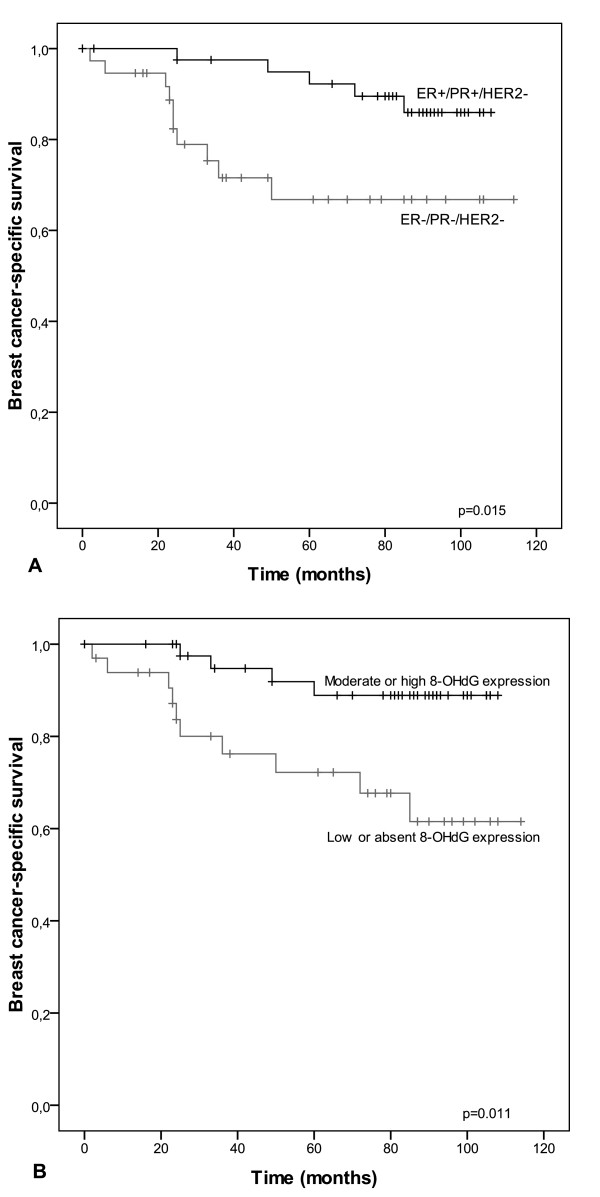
BACKGROUND: Triple-negative breast cancer (TNBC) and basal-like breast cancer (BLBC) are breast cancer subtypes with an especially poor prognosis. 8-Hydroxydeoxyguanosine (8-OHdG) is a widely used marker of oxidative stress and the redox-state-regulating enzymes peroxiredoxins (PRDXs) are efficient at depressing excessive reactive oxygen species. NF-E2-related factor 2 (Nrf2) and Kelch-like ECH-associated protein 1 (Keap1) are redox-sensitive transcription factors that regulate PRDX expression. This is the first study to assess oxidative stress and or cell redox state-regulating enzymes in TNBC and BLBC. METHODS: We assessed immunohistochemical expression of 8-OHdG, Nrf2, Keap1, PRDX III and PRDX IV in 79 women with invasive ductal breast carcinomas. Of these tumors, 37 represented TNBC (grade II-III tumors with total lack of ER, PR and human epidermal growth factor receptor 2 [HER2] expression). Control cases (n = 42) were ER-positive, PR-positive and HER2-negative. Of the 37 TNBCs, 31 had BLBC phenotype (TNBC with expression of cytokeratin 5/6 or epidermal growth factor receptor 1). RESULTS: Patients with TNBC had worse breast cancer-specific survival (BCSS) than the control group (p = 0.015). Expression of 8-OHdG was significantly lower in TNBC than in the non-TNBC group (p < 0.005). 8-OHdG immunostaining was associated with better BCSS (p = 0.01), small tumor size (p < 0.0001) and low grade (p < 0.0005). Keap1 overexpression was observed in the TNBC cohort (p = 0.001) and Keap1-positive patients had worse BCSS than Keap1-negative women (p = 0.014). PRDX IV was overexpressed in the TNBC vs. the non-TNBC group (p = 0.022). CONCLUSIONS: Cellular redox state markers may be promising targets when elucidating the pathogenesis of TNBC.
Overview
The claims and statistics of this paper haven’t been checked yet.
Free: it reads the open-access text and checks the first 5 claims that cite a source we can check. Create a free account to check every claim.
Integrity signals
Registry
Cites
Statistics
Figures
Verification
Claims the paper makes
The claims and statistics of this paper haven’t been checked yet.
Free: it reads the open-access text and checks the first 5 claims that cite a source we can check. Create a free account to check every claim.
Claims other papers make about this one
Each is checked against this paper’s own text: does it say what the citing paper says it does?
In the citing paper
“Because ER+ breast tumors are known to have increased oxidative stress compared with ER− tumors (57)”
From The human tumor microbiome is composed of tumor type–specific intracellular bacteria (2020) · cites this paper as [57]
Self-check
Percentages, sums and reported differences re-computed from the paper’s own numbers.
The self-check needs the paper’s full text.
Citations
Cites
Foulkes, W. D., Smith, I. E., & Reis-Filho, J. S. (2010) · New England Journal of Medicine · doi:10.1056/nejmra1001389 · Cited by 4,157
Pathology and Genetics of Tumours of the Breast and Female Genital Organs
Tavassoli, F. A., & Devilee, P. (2003) · International Agency for Research on Cancer eBooks · Cited by 2,800
Estrogen Carcinogenesis in Breast Cancer
Yager, J. D., & Davidson, N. E. (2006) · New England Journal of Medicine · doi:10.1056/nejmra050776 · Cited by 1,862 · cited 11×
“One of the most important estrogen-related carcinogenic mechanisms is oxidative metabolism of estrogen and subsequent formation of ROS [17,18].”
BackgroundInfluentialCheang, M. C. U., Voduc, D., Bajdik, C., Leung, S., McKinney, S., Chia, S. K., Perou, C. M., & Nielsen, T. O. (2008) · Clinical Cancer Research · doi:10.1158/1078-0432.ccr-07-1658 · Cited by 1,195 · cited 2×
“%) exhibited the BLBC phenotype, as they expressed either CK5/6 or EGFR-1.”
BackgroundWalker, R. A. (2005) · Histopathology · doi:10.1111/j.1365-2559.2004.02026.x · Cited by 839
Molyneux, G., Geyer, F. C., Magnay, F.-A., McCarthy, A., Kendrick, H., Natrajan, R., MacKay, A., Grigoriadis, A., Tutt, A., Ashworth, A., et al. (2010) · Cell Stem Cell · doi:10.1016/j.stem.2010.07.010 · Cited by 794 · cited 2×
“TNBC and BLBC tumors are usually larger and of higher grade compared with receptor-positive breast cancer tumors and some reports suggest that cases of BLBC are more often node-negative [3,14-16].”
BackgroundTriple-negative breast cancer—current status and future directions
Gluz, O., Liedtke, C., Gottschalk, N., Pusztai, L., Nitz, U., & Harbeck, N. (2009) · Annals of Oncology · doi:10.1093/annonc/mdp492 · Cited by 687 · cited 1×
“TNBC has a poor prognosis in terms of disease-free survival and overall survival and it tends to be associated with aggressive and early recurrence [ 1 ].”
BackgroundLAU, A., VILLENEUVE, N., SUN, Z., WONG, P., & ZHANG, D. (2008) · Pharmacological Research · doi:10.1016/j.phrs.2008.09.003 · Cited by 645
Expression of luminal and basal cytokeratins in human breast carcinoma
Abd El‐Rehim, D. M., Pinder, S. E., Paish, C. E., Bell, J., Blamey, R., Robertson, J. F., Nicholson, R. I., & Ellis, I. O. (2004) · The Journal of Pathology · doi:10.1002/path.1559 · Cited by 594 · cited 1×
“TNBC and BLBC tumors are usually larger and of higher grade compared with receptor-positive breast cancer tumors and some reports suggest that cases of BLBC are more often node-negative [3, 14-16 ].”
BackgroundThe role of oxidative stress in chemical carcinogenesis.
Klaunig, J. E., Xu, Y., Isenberg, J. S., Bachowski, S., Kolaja, K. L., Jiang, J., Stevenson, D. E., & Walborg, E. F. (1998) · Environmental Health Perspectives · doi:10.1289/ehp.98106s1289 · Cited by 511 · cited 1×
“Oxidative stress is a potent cause of damage in all cellular macromolecules and it may also lead to carcinogenesis [4].”
BackgroundProteomics Analysis of Cellular Response to Oxidative Stress
Rabilloud, T., Heller, M., Gasnier, F., Luche, S., Rey, C., Aebersold, R., Benahmed, M., Louisot, P., & Lunardi, J. (2002) · Journal of Biological Chemistry · doi:10.1074/jbc.m106585200 · Cited by 393
Use of immunohistochemical markers can refine prognosis in triple negative breast cancer
Tischkowitz, M., Brunet, J.-S., Bégin, L. R., Huntsman, D. G., Cheang, M. C., Akslen, L. A., Nielsen, T. O., & Foulkes, W. D. (2007) · BMC Cancer · doi:10.1186/1471-2407-7-134 · Cited by 365 · cited 1×
“TNBC and BLBC tumors are usually larger and of higher grade compared with receptor-positive breast cancer tumors and some reports suggest that cases of BLBC are more often node-negative [3, 14-16 ].”
BackgroundKARIHTALA, P., & SOINI, Y. (2007) · APMIS · doi:10.1111/j.1600-0463.2007.apm_514.x · Cited by 339 · cited 2×
“Peroxiredoxin IV is found in lysosomes, peroxisomes and the endoplasmic reticulum, where oxidative stress is also a potent threat [5].”
BackgroundSelf-citationPeroxiredoxins in breast carcinoma.
Karihtala, P., Mäntyniemi, A., Kang, S. W., Kinnula, V. L., & Soini, Y. (2003) · PubMed · Cited by 261
Self-citationPrognostic and aetiological relevance of 8-hydroxyguanosine in human breast carcinogenesis
Musarrat, J., Arezina-wilson, J., & Wani, A. A. (1996) · European Journal of Cancer · doi:10.1016/0959-8049(96)00031-7 · Cited by 229 · cited 2×
“Other studies have provided evidence that 8-OHdG levels in the ERpositive MCF-7 breast cancer cell line are over 9-fold higher than in triple-negative MDA-MB-231 cells [9] and inhibition of estrogen receptor alpha expression significantly reduces estrogen-induced 8-OHdG formation in MCF-7 cells [21].”
BackgroundEstrogen-Induced Mitochondrial Reactive Oxygen Species as Signal-Transducing Messengers
Felty, Q., Xiong, W.-C., Sun, D., Sarkar, S., Singh, K. P., Parkash, J., & Roy, D. (2005) · Biochemistry · doi:10.1021/bi047629p · Cited by 199 · cited 1×
“Published data from several laboratories suggest that in vitro, physiological estrogen concentrations induce significant oxidative stress and that estrogen-induced ROS formation takes place in mitochondria in particular [19,20].”
BackgroundEstrogen-induced reactive oxygen species-mediated signalings contribute to breast cancer
Okoh, V., Deoraj, A., & Roy, D. (2011) · Biochimica et Biophysica Acta (BBA) - Reviews on Cancer · doi:10.1016/j.bbcan.2010.10.005 · Cited by 185 · cited 1×
“One of the most important estrogen-related carcinogenic mechanisms is oxidative metabolism of estrogen and subsequent formation of ROS [17, 18 ].”
BackgroundIsola, J., Tanner, M., Forsyth, A., Cooke, T. G., Watters, A. D., & Bartlett, J. M. S. (2004) · Clinical Cancer Research · doi:10.1158/1078-0432.ccr-0428-03 · Cited by 181 · cited 2×
“Membranous HER2 expression was also studied by means of immunohistochemistry (IHC) and if a specimen exhibited a HER2-positive result (1+ to 3+ on a scale of 0 to 3+) in IHC, Her2 gene amplification status was determined by means of chromogenic in situ hybridization (CISH).”
Background8-Hydroxydeoxyguanosine: a new potential independent prognostic factor in breast cancer
Sova, H., Jukkola-Vuorinen, A., Puistola, U., Kauppila, S., & Karihtala, P. (2010) · British Journal of Cancer · doi:10.1038/sj.bjc.6605565 · Cited by 139
Self-citationEstrogen down-regulates uncoupling proteins and increases oxidative stress in breast cancer
Sastre‐Serra, J., Valle, A., Garau, I., Oliver, J., & Roca, P. (2009) · Free Radical Biology and Medicine · doi:10.1016/j.freeradbiomed.2009.11.025 · Cited by 116 · cited 1×
“Published data from several laboratories suggest that in vitro, physiological estrogen concentrations induce significant oxidative stress and that estrogen-induced ROS formation takes place in mitochondria in particular [19, 20 ].”
BackgroundInhibition of estrogen signaling activates the NRF2 pathway in breast cancer
Yao, Y., Brodie, A. M. H., Davidson, N. E., Kensler, T. W., & Zhou, Q. (2010) · Breast Cancer Research and Treatment · doi:10.1007/s10549-010-1023-8 · Cited by 89 · cited 1×
“Other studies have provided evidence that 8-OHdG levels in the ERpositive MCF-7 breast cancer cell line are over 9-fold higher than in triple-negative MDA-MB-231 cells [9] and inhibition of estrogen receptor alpha expression significantly reduces estrogen-induced 8-OHdG formation in MCF-7 cells [21].”
BackgroundThe Phenotypic Spectrum of Basal-like Breast Cancers: A Critical Appraisal
Fadare, O., & Tavassoli, F. A. (2007) · Advances in Anatomic Pathology · doi:10.1097/pap.0b013e31814b26fe · Cited by 88 · cited 1×
“The prevalence of TNBC has ranged from 17.1% to 30.5% and that of BLBC from 8.0% to 55.7% [ 13 ].”
BackgroundInfluentialKarihtala, P., Kauppila, S., Puistola, U., & Jukkola-Vuorinen, A. (2011) · Histopathology · doi:10.1111/j.1365-2559.2011.03835.x · Cited by 82
Self-citationKarihtala, P., Soini, Y., Laatio, L., Bloigu, R., & Puistola, U. (2009) · International Journal of Gynecological Cancer · doi:10.1111/igc.0b013e3181ad0f0d · Cited by 81
Self-citationIshii, T., & Yanagawa, T. (2007) · Sub-cellular biochemistry/Subcellular biochemistry · doi:10.1007/978-1-4020-6051-9_18 · Cited by 57 · cited 2×
“Previous studies carried out in vitro have demonstrated induction of PRDXs via the Nrf2/Keap1 pathway [28], but there are no reports on Nrf2 or Keap1 in clinical breast cancer material.”
BackgroundNuclear oxidative damage correlates with poor survival in colorectal cancer
Sheridan, J., Wang, L.-M., Tosetto, M., Sheahan, K., Hyland, J., Fennelly, D., O'Donoghue, D., Mulcahy, H., & O'Sullivan, J. (2009) · British Journal of Cancer · doi:10.1038/sj.bjc.6604821 · Cited by 52 · cited 1×
“A negative prognostic value of immunohistochemical 8-OHdG expression has been reported in connection with at least colorectal carcinoma [23], ovarian cancer [24] and malignant melanoma [25].”
BackgroundNuclear 8-hydroxy-2'-deoxyguanosine as survival biomarker in patients with cutaneous melanoma
Sirigu (2009) · Oncology Reports · doi:10.3892/or_00000640 · Cited by 39 · cited 1×
“A negative prognostic value of immunohistochemical 8-OHdG expression has been reported in connection with at least colorectal carcinoma [23], ovarian cancer [24] and malignant melanoma [25].”
BackgroundDrafta, D., Prişcu, A., Neacşu, E., Gangură, M., Schindler, A. E., Stroe, E., Anghel, C., & Panaitescu, G. (1983) · Journal of Steroid Biochemistry · doi:10.1016/0022-4731(83)90066-3 · Cited by 21 · cited 1×
“tumors are higher than in ER-negative ones [22], our finding that 8-OHdG (as a marker of ROS-derived DNA damage) was highly overexpressed in the ER+/PR +/HER2- group (73.”
BackgroundKarihtala, P., & Puistola, U. (2011) · Current Cancer Therapy Reviews · doi:10.2174/157339411794474128 · Cited by 14 · cited 1×
“This induction is largely mediated by redox-sensitive NF-E2-related factor 2 (Nrf2), which under oxidative stress translocates to the nucleus and attaches to antioxidant response elements (AREs) of antioxidant genes, thus stimulating synthesis of respective proteins [6-8].”
BackgroundSelf-citation
Cited by
The human tumor microbiome is composed of tumor type–specific intracellular bacteria
Nejman, D., Livyatan, I., Fuks, G., Gavert, N., Zwang, Y., Geller, L. T., Rotter-Maskowitz, A., Weiser, R., Mallel, G., Gigi, E., et al. (2020) · Science · doi:10.1126/science.aay9189 · Cited by 2,464
The role of peroxiredoxins in cancer
Nicolussi, A., D'Inzeo, S., Capalbo, C., Giannini, G., & Coppa, A. (2017) · Molecular and Clinical Oncology · doi:10.3892/mco.2017.1129 · Cited by 200
“In other types of epithelial cancers, such as oral cavity squamous cell carcinoma (116), breast cancer (117), ovarian cancer (118), CRC (119) or lung cancer (70), overexpression of PRDX4 correlates with the metastatic potential.”
Triple negative breast cancer: the kiss of death
Jitariu, A.-A., Cîmpean, A. M., Ribatti, D., & Raica, M. (2017) · Oncotarget · doi:10.18632/oncotarget.16938 · Cited by 173
“For a long period of time, TNBCs and basallike breast carcinomas (BLBCs) have been regarded as overlapping molecular entities, associated with poor prognosis and aggressive behavior [28-30].”
BackgroundKarihtala, P., Auvinen, P., Kauppila, S., Haapasaari, K., Jukkola‐Vuorinen, A., & Soini, Y. (2013) · Breast Cancer Research and Treatment · doi:10.1007/s10549-013-2442-0 · Cited by 131
Self-citationLee, J. D., Cai, Q., Shu, X. O., & Nechuta, S. (2017) · Journal of Women s Health · doi:10.1089/jwh.2016.5973 · Cited by 140
“016) Timing: both before and after chemotherapy Multivariable results: NR Sample type: blood Karihtala et al.(50) 8-OxodG in tumor tissues using IHC 8-OxodG-positive immunostaining was associated with higher BCSS in univariate analysis ( p = 0.”
BackgroundMethodInfluential
Metadata
- Authors
- Karihtala, P., Kauppila, S., Soini, Y., & Arja-Jukkola-Vuorinen
- Affiliations
- Oulu University Hospital (FI)
- University of Eastern Finland (FI)
- Corresponding author
- Karihtala, Peeter
- Venue
- BMC Cancer
- Published
- 2011-06-21
- Volume
- 11
- Issue
- 1
- Pages
- 262-262
- ISSN
- 1471-2407 (ISSN-L)
- PMC
- PMC3141776
- OpenAlex
- W2066549335
- Cited by
- 87
- References
- 29
- Citations by year
- 2026: 5 · 2025: 3 · 2024: 3 · 2023: 5 · 2022: 5 · 2021: 4 · 2020: 7 · 2019: 11 · 2018: 7 · 2017: 6 · 2016: 6 · 2015: 8 · 2014: 8 · 2013: 4 · 2012: 3
- FWCI
- 2.21
- Type
- journal article
- Language
- en
- Open access
- gold
- doi.org
- Licence
- Locations
- BMC Cancer (publishedVersion, cc-by)
- PubMed Central (publishedVersion, cc-by)
- PubMed (publishedVersion)
- DOAJ (DOAJ: Directory of Open Access Journals) (submittedVersion)
- Funders
- Suomen Lääketieteen Säätiö
- Filha
- Topics
- Life Sciences › Biochemistry, Genetics and Molecular Biology › Molecular Biology › Genomics, phytochemicals, and oxidative stress
- Life Sciences › Biochemistry, Genetics and Molecular Biology › Molecular Biology › Redox biology and oxidative stress
- Life Sciences › Biochemistry, Genetics and Molecular Biology › Cancer Research › Breast Cancer Treatment Studies
- Keywords
- triple-negative breast cancer, basal-like breast cancer, oxidative stress, 8-hydroxy-2'-deoxyguanosine, Nrf2, Keap1, peroxiredoxin III, redox state, breast cancer-specific survival, hormone receptor-positive breast cancer, invasive ductal carcinoma, prognostic factors
- MeSH terms
- Kelch-Like ECH-Associated Protein 1, 8-Hydroxy-2'-Deoxyguanosine, Breast Neoplasms, Basal Cell Carcinoma, Deoxyguanosine, Female, Follow-Up Studies, Humans, Immunohistochemistry, Oxidation-Reduction, Prognosis, Receptors, Estrogen, Receptors, Progesterone, Cohort Studies, Carcinoma, Ductal, Breast, Oxidative Stress, Erb-b2 Receptor Tyrosine Kinases, Intracellular Signaling Peptides and Proteins, NF-E2-Related Factor 2, Kaplan-Meier Estimate, Peroxiredoxins, Peroxiredoxin III
About these checks
Registry, retraction, Cites and statistics results are computed, not judged, with one exception: a printed reference that no index lists is read once by a model before it counts as a citation error. Claims are extracted by a model and kept only when their quote appears verbatim in the text; each cited source is then checked, with a model’s help, for whether it says what the claim relies on. Those verdicts can be wrong — read the claim’s quote and the cited source before relying on one.
Statistics and arithmetic are recomputed, not judged.
Confidence bands are shown only for fields calibrated on our annotated test set. None is calibrated yet, so no band is shown.
What counts as a claim ›How we measure confidence ›How we check this ›
Are you an author, or do you see a problem with this page? Request a review
Data sources
Bibliographic data: Semantic Scholar, OpenAlex, Crossref.
Contains information from the Semantic Scholar Academic Graph Datasets, made available under the ODC Attribution License (ODC-BY 1.0).
Semantic Scholar’s data is described in: Kinney, R., et al. (2023). The Semantic Scholar Open Data Platform. arXiv:2301.10140.
