

Oxidative stress and counteracting mechanisms in hormone receptor positive, triple-negative and basal-like breast carcinomas
Open accessThe DOI matches its Crossref record; 29 of the 29 references it cites were found in a registry or an index.
Abstract
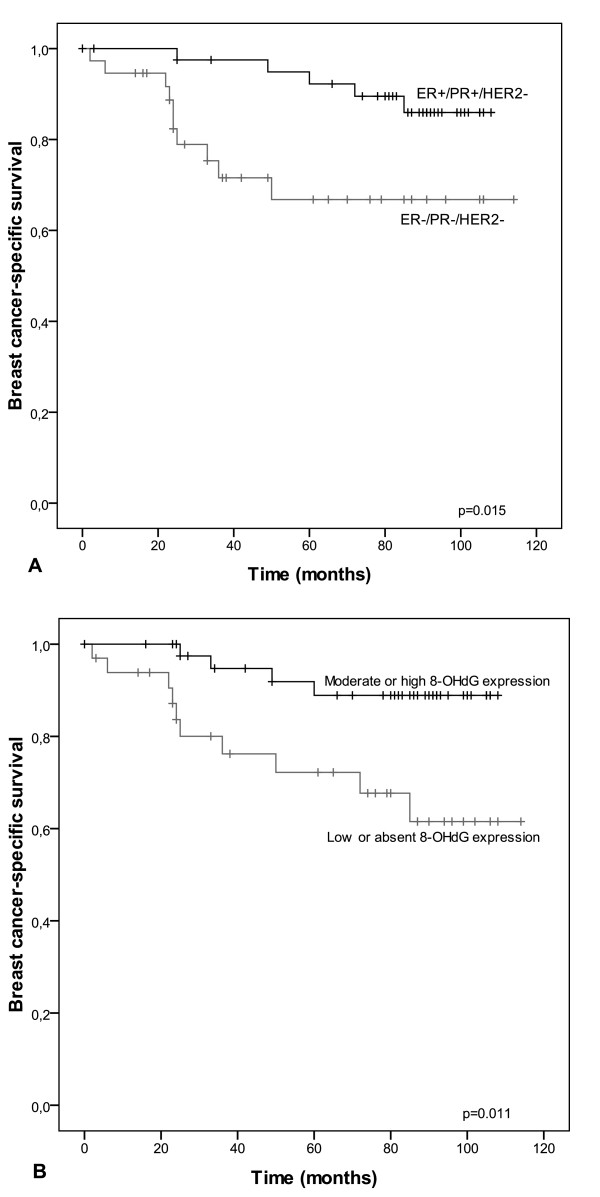
BACKGROUND: Triple-negative breast cancer (TNBC) and basal-like breast cancer (BLBC) are breast cancer subtypes with an especially poor prognosis. 8-Hydroxydeoxyguanosine (8-OHdG) is a widely used marker of oxidative stress and the redox-state-regulating enzymes peroxiredoxins (PRDXs) are efficient at depressing excessive reactive oxygen species. NF-E2-related factor 2 (Nrf2) and Kelch-like ECH-associated protein 1 (Keap1) are redox-sensitive transcription factors that regulate PRDX expression. This is the first study to assess oxidative stress and or cell redox state-regulating enzymes in TNBC and BLBC. METHODS: We assessed immunohistochemical expression of 8-OHdG, Nrf2, Keap1, PRDX III and PRDX IV in 79 women with invasive ductal breast carcinomas. Of these tumors, 37 represented TNBC (grade II-III tumors with total lack of ER, PR and human epidermal growth factor receptor 2 [HER2] expression). Control cases (n = 42) were ER-positive, PR-positive and HER2-negative. Of the 37 TNBCs, 31 had BLBC phenotype (TNBC with expression of cytokeratin 5/6 or epidermal growth factor receptor 1). RESULTS: Patients with TNBC had worse breast cancer-specific survival (BCSS) than the control group (p = 0.015). Expression of 8-OHdG was significantly lower in TNBC than in the non-TNBC group (p < 0.005). 8-OHdG immunostaining was associated with better BCSS (p = 0.01), small tumor size (p < 0.0001) and low grade (p < 0.0005). Keap1 overexpression was observed in the TNBC cohort (p = 0.001) and Keap1-positive patients had worse BCSS than Keap1-negative women (p = 0.014). PRDX IV was overexpressed in the TNBC vs. the non-TNBC group (p = 0.022). CONCLUSIONS: Cellular redox state markers may be promising targets when elucidating the pathogenesis of TNBC.
Overview
The claims and statistics of this paper haven’t been checked yet.
Free: it reads the open-access text and checks the first 5 claims that cite a source we can check. Create a free account to check every claim.
Integrity signals
Registry
Cites
Statistics
Figures
Verification
Claims the paper makes
The claims and statistics of this paper haven’t been checked yet.
Free: it reads the open-access text and checks the first 5 claims that cite a source we can check. Create a free account to check every claim.
Claims other papers make about this one
Each is checked against this paper’s own text: does it say what the citing paper says it does?
In the citing paper
“Because ER+ breast tumors are known to have increased oxidative stress compared with ER− tumors (57)”
From The human tumor microbiome is composed of tumor type–specific intracellular bacteria (2020) · cites this paper as [57]
Self-check
Percentages, sums and reported differences re-computed from the paper’s own numbers.
The self-check needs the paper’s full text.
Citations
Cites
Foulkes, W. D., Smith, I. E., & Reis-Filho, J. S. (2010) · New England Journal of Medicine · doi:10.1056/nejmra1001389 · Cited by 4,157
Pathology and Genetics of Tumours of the Breast and Female Genital Organs
Tavassoli, F. A., & Devilee, P. (2003) · International Agency for Research on Cancer eBooks · Cited by 2,800
Estrogen Carcinogenesis in Breast Cancer
Yager, J. D., & Davidson, N. E. (2006) · New England Journal of Medicine · doi:10.1056/nejmra050776 · Cited by 1,862 · cited 11×
“One of the most important estrogen-related carcinogenic mechanisms is oxidative metabolism of estrogen and subsequent formation of ROS [17,18].”
BackgroundInfluentialCheang, M. C. U., Voduc, D., Bajdik, C., Leung, S., McKinney, S., Chia, S. K., Perou, C. M., & Nielsen, T. O. (2008) · Clinical Cancer Research · doi:10.1158/1078-0432.ccr-07-1658 · Cited by 1,195 · cited 2×
“%) exhibited the BLBC phenotype, as they expressed either CK5/6 or EGFR-1.”
BackgroundWalker, R. A. (2005) · Histopathology · doi:10.1111/j.1365-2559.2004.02026.x · Cited by 839
Molyneux, G., Geyer, F. C., Magnay, F.-A., McCarthy, A., Kendrick, H., Natrajan, R., MacKay, A., Grigoriadis, A., Tutt, A., Ashworth, A., et al. (2010) · Cell Stem Cell · doi:10.1016/j.stem.2010.07.010 · Cited by 794 · cited 2×
“TNBC and BLBC tumors are usually larger and of higher grade compared with receptor-positive breast cancer tumors and some reports suggest that cases of BLBC are more often node-negative [3,14-16].”
BackgroundTriple-negative breast cancer—current status and future directions
Gluz, O., Liedtke, C., Gottschalk, N., Pusztai, L., Nitz, U., & Harbeck, N. (2009) · Annals of Oncology · doi:10.1093/annonc/mdp492 · Cited by 687 · cited 1×
“TNBC has a poor prognosis in terms of disease-free survival and overall survival and it tends to be associated with aggressive and early recurrence [ 1 ].”
BackgroundLAU, A., VILLENEUVE, N., SUN, Z., WONG, P., & ZHANG, D. (2008) · Pharmacological Research · doi:10.1016/j.phrs.2008.09.003 · Cited by 645
Expression of luminal and basal cytokeratins in human breast carcinoma
Abd El‐Rehim, D. M., Pinder, S. E., Paish, C. E., Bell, J., Blamey, R., Robertson, J. F., Nicholson, R. I., & Ellis, I. O. (2004) · The Journal of Pathology · doi:10.1002/path.1559 · Cited by 594 · cited 1×
“TNBC and BLBC tumors are usually larger and of higher grade compared with receptor-positive breast cancer tumors and some reports suggest that cases of BLBC are more often node-negative [3, 14-16 ].”
BackgroundThe role of oxidative stress in chemical carcinogenesis.
Klaunig, J. E., Xu, Y., Isenberg, J. S., Bachowski, S., Kolaja, K. L., Jiang, J., Stevenson, D. E., & Walborg, E. F. (1998) · Environmental Health Perspectives · doi:10.1289/ehp.98106s1289 · Cited by 511 · cited 1×
“Oxidative stress is a potent cause of damage in all cellular macromolecules and it may also lead to carcinogenesis [4].”
Background
Cited by
The human tumor microbiome is composed of tumor type–specific intracellular bacteria
Nejman, D., Livyatan, I., Fuks, G., Gavert, N., Zwang, Y., Geller, L. T., Rotter-Maskowitz, A., Weiser, R., Mallel, G., Gigi, E., et al. (2020) · Science · doi:10.1126/science.aay9189 · Cited by 2,464
The role of peroxiredoxins in cancer
Nicolussi, A., D'Inzeo, S., Capalbo, C., Giannini, G., & Coppa, A. (2017) · Molecular and Clinical Oncology · doi:10.3892/mco.2017.1129 · Cited by 200
“In other types of epithelial cancers, such as oral cavity squamous cell carcinoma (116), breast cancer (117), ovarian cancer (118), CRC (119) or lung cancer (70), overexpression of PRDX4 correlates with the metastatic potential.”
Triple negative breast cancer: the kiss of death
Jitariu, A.-A., Cîmpean, A. M., Ribatti, D., & Raica, M. (2017) · Oncotarget · doi:10.18632/oncotarget.16938 · Cited by 173
“For a long period of time, TNBCs and basallike breast carcinomas (BLBCs) have been regarded as overlapping molecular entities, associated with poor prognosis and aggressive behavior [28-30].”
BackgroundKarihtala, P., Auvinen, P., Kauppila, S., Haapasaari, K., Jukkola‐Vuorinen, A., & Soini, Y. (2013) · Breast Cancer Research and Treatment · doi:10.1007/s10549-013-2442-0 · Cited by 131
Self-citationLee, J. D., Cai, Q., Shu, X. O., & Nechuta, S. (2017) · Journal of Women s Health · doi:10.1089/jwh.2016.5973 · Cited by 140
“016) Timing: both before and after chemotherapy Multivariable results: NR Sample type: blood Karihtala et al.(50) 8-OxodG in tumor tissues using IHC 8-OxodG-positive immunostaining was associated with higher BCSS in univariate analysis ( p = 0.”
BackgroundMethodInfluentialPolicastro, L. L., Ibañez, I. L., Notcovich, C., Duran, H. A., & Podhajcer, O. L. (2013) · Antioxidants & Redox Signaling · doi:10.1089/ars.2011.4367 · Cited by 120
“Indeed, activation of ROSscavenging systems, for instance, through Nrf2, and hence a reduction of ROS levels has been shown to be associated with tumor cell aggressiveness in breast cancer (154).”
InfluentialWhitaker, H. C., Patel, D., Howat, W., Warren, A. Y., Kay, J. D., Sangan, T., Marioni, J. C., Mitchell, J., Aldridge, S., Luxton, H. J., et al. (2013) · British Journal of Cancer · doi:10.1038/bjc.2013.396 · Cited by 115
“Peroxiredoxin-3 is overexpressed in prostate cancer and promotes cancer cell survival by protecting cells from oxidative stress”
BackgroundAberrant Keap1 methylation in breast cancer and association with clinicopathological features
Barbano, R., Muscarella, L. A., Pasculli, B., Valori, V. M., Fontana, A., Coco, M., la Torre, A., Balsamo, T., Poeta, M. L., Marangi, G. F., et al. (2013) · Epigenetics · doi:10.4161/epi.23319 · Cited by 92
Prognostic significance of 8-hydroxy-2′-deoxyguanosine in solid tumors: a meta-analysis
Qing, X., Shi, D., Lv, X., Wang, B., Chen, S., & Shao, Z. (2019) · BMC Cancer · doi:10.1186/s12885-019-6189-9 · Cited by 97
NRF2 immunolocalization in human breast cancer patients as a prognostic factor
Onodera, Y., Motohashi, H., Takagi, K., Miki, Y., Shibahara, Y., Watanabe, M., Ishida, T., Hirakawa, H., Sasano, H., Yamamoto, M., et al. (2014) · Endocrine-Related Cancer · doi:10.1530/erc-13-0234 · Cited by 81
“NRF2 immunolocalization has been reported in breast carcinoma (Loignon et al. 2009, Karihtala et al. 2011, Hartikainen et al. 2012), but its clinical significance remains largely unclear, including the association with NQO1 and p62 status and whether it can represent a prognostic factor in breast…”
BackgroundO’Leary, P. C., Terrile, M., Bajor, M., Gaj, P., Hennessy, B. T., Mills, G. B., Zagozdzon, A., O’Connor, D. P., Brennan, D. J., Connor, K., et al. (2014) · Breast Cancer Research · doi:10.1186/bcr3691 · Cited by 79
“It has been suggested that the role of oxidative stress in ER-positive breast cancer may be different than in other tumor types [39].”
Role of Nrf2 Signaling Cascade in Breast Cancer: Strategies and Treatment
Kumar, H., Kumar, R. M., Bhattacharjee, D., Somanna, P., & Jain, V. K. (2022) · Frontiers in Pharmacology · doi:10.3389/fphar.2022.720076 · Cited by 87
PRDX4 and Its Roles in Various Cancers
Jia, W., Chen, P., & Cheng, Y. (2019) · Technology in Cancer Research & Treatment · doi:10.1177/1533033819864313 · Cited by 68
“ł High oxidative stress is associated with better BCSS, small tumor size and low tumor grade.(52) ł”
BackgroundKim, T. H., Song, J., Kim, S.-H., Parikh, A. K., Mo, X. M., Palanichamy, K., Kaur, B., Yu, J., Yoon, S. O., Nakano, I., et al. (2014) · Neuro-Oncology · doi:10.1093/neuonc/nou088 · Cited by 72
Phytochemicals potently inhibit migration of metastatic breast cancer cells
Ham, S. L., Nasrollahi, S., Shah, K. N., Soltisz, A. M., Paruchuri, S. M., Yun, Y., Luker, G. D., Bishayee, A., & Tavana, H. (2015) · Integrative Biology · doi:10.1039/c5ib00121h · Cited by 56
Hintsala, H., Jokinen, E., Haapasaari, K., Moza, M., Ristimaki, A. P., Soini, Y., Koivunen, J. P., & Karihtala, P. (2016) · PubMed · Cited by 54
Self-citationKovàcs, T., Mikó, E., Ujlaki, G., Yousef, H., Csontos, V., Uray, K., & Bai, P. (2021) · Cancer and Metastasis Reviews · doi:10.1007/s10555-021-10013-3 · Cited by 57
“The low level of oxidative and nitrosative stress is a key feature of successful tumor growth [98, 99].”
BackgroundKim, S., Kwon, C., & Nakano, I. (2014) · Journal of Neuroscience Research · doi:10.1002/jnr.23431 · Cited by 50
“PRDX4 is also overexpressed in other cancer types, such as prostate, lung, and triple-negative breast cancers (Li et al., 2004; Park et al., 2008; Liu et al., 2009; Pritchard et al., 2009; Chang et al., 2011; Karihtala et al., 2011).”
BackgroundBur, H., Haapasaari, K., Turpeenniemi-Hujanen, T. M., Kuittinen, O. M., Auvinen, P., Marin, K., Koivunen, P. T., Sormunen, R. T., Soini, Y., & Karihtala, P. (2014) · Histopathology · doi:10.1111/his.12389 · Cited by 48
Self-citationOshi, M., Angarita, F. A., Tokumaru, Y., Yan, L., Matsuyama, R., Endo, I., & Takabe, K. (2020) · Cancers · doi:10.3390/cancers12123856 · Cited by 46
“High NRF2 Tumors Are Significantly Associated with High Expression of Immune Checkpoint Molecules in ER-Positive/HER2-Negative Breast Cancer Immunotherapy using immune checkpoint inhibito s is drawing attention as a new m dality t treat can er, however, it is only approved for TNBC.”
InfluentialYang, H., Jenni, S., Čolović, M., Merkens, H., Poleschuk, C., Rodrigo, I., Miao, Q., Johnson, B. F., Rishel, M. J., Sossi, V., et al. (2016) · Journal of Nuclear Medicine · doi:10.2967/jnumed.116.180661 · Cited by 40
“interested in triple-negative breast cancer, which maintains low expression levels of estrogen receptor, progesterone receptor, and human epidermal growth factor receptor 2 and is typically associated with poor patient outcomes, including lower overall survival rates as well as aggressive and early recurrence (18).”
BackgroundPeroxiredoxin 4: a multifunctional biomarker worthy of further exploration
Schulte, J. (2011) · BMC Medicine · doi:10.1186/1741-7015-9-137 · Cited by 43
“In addition, several studies have shown that the expression or oxidation state of Prx4 changes under pathological conditions such as cancer [14-20], diabetes [21-23] and infection [4,6,24-27].”
BackgroundPeroxiredoxin 4: A novel secreted mediator of cancer induced osteoclastogenesis
Rafiei, S., Tiedemann, K., Tabariès, S., Siegel, P. M., & Komarova, S. V. (2015) · Cancer Letters · doi:10.1016/j.canlet.2015.03.012 · Cited by 42
Peroja, P., Pasanen, A. K., Haapasaari, K., Jantunen, E., Soini, Y., Turpeenniemi-Hujanen, T. M., Bloigu, R., Lilja, L., Kuittinen, O. M., & Karihtala, P. (2012) · Experimental Hematology and Oncology · doi:10.1186/2162-3619-1-2 · Cited by 39
“We have previously characterized the expression of the used antibodies in several malignant and pre-malignant tissues [18,19,22,35,36].”
BackgroundSelf-citationRole of Reactive Oxygen Species in Estrogen Dependant Breast Cancer Complication
Johar, R., Sharma, R., Kaur, A., & Mukherjee, T. K. (2015) · Anti-Cancer Agents in Medicinal Chemistry · doi:10.2174/1871520615666150518092315 · Cited by 39
Golubnitschaja, O., Filep, N., Yeghiazaryan, K., Blom, H. J., Hofmann‐Apitius, M., & Kuhn, W. C. (2017) · Amino Acids · doi:10.1007/s00726-017-2524-0 · Cited by 37
Pereira, E. J., Burns, J. S., Lee, C. Y., Marohl, T., Calderon, D., Wang, L., Atkins, K. A., Wang, C., & Janes, K. A. (2020) · Science Signaling · doi:10.1126/scisignal.aba4200 · Cited by 40
Jääskeläinen, A., Soini, Y., Jukkola‐Vuorinen, A., Auvinen, P., Haapasaari, K., & Karihtala, P. (2018) · BMC Cancer · doi:10.1186/s12885-018-4141-z · Cited by 36
“The specimen fixation, storing and staging was performed as previously described [23].”
MethodSelf-citationBouchmaa, N., Mrid, R. B., Boukharsa, Y., Nhiri, M., Mouse, H. A., Taoufik, J., Ansar, M., & Zyad, A. (2018) · Archiv der Pharmazie · doi:10.1002/ardp.201800128 · Cited by 36
The Prognosis Of Peroxiredoxin Family In Breast Cancer
Wang, G., Zhong, W.-C., Bi, Y., Tao, S., Zhu, H. H., Zhu, H., & Xu, A. (2019) · Cancer Management and Research · doi:10.2147/cmar.s229389 · Cited by 40
“However, PRDX3 was not independent of the conventional prognostic factor in multivariate analysis.(65) Moreover, the silencing of the PRDX3 gene inhibits cell proliferation in breast cancer.”
BackgroundKim, S., Saeidi, S., Cho, N., Kim, S. H., Lee, H., Han, W., Noh, D., & Surh, Y. (2020) · Cancer Letters · doi:10.1016/j.canlet.2020.11.047 · Cited by 37
Yi, N., XIAO, M. B., NI, W. K., Jiang, F., Lu, C., & Ni, R. (2014) · Molecular and Clinical Oncology · doi:10.3892/mco.2014.317 · Cited by 31
“Several studies reported that the Prx4 protein is overexpressed in breast (19), ovarian (20), prostate (21) and other types of cancer (22) and Prx4 has been associated with invasion, recurrence, prognosis and other characteristics of cancer (23,24).”
Oxidant stress as a major determinant of platelet activation in invasive breast cancer
Ferroni, P., Santilli, F., Cavaliere, F., Simeone, P., Costarelli, L., Liani, R., Tripaldi, R., Riondino, S., Roselli, M., Davì, G., et al. (2016) · International Journal of Cancer · doi:10.1002/ijc.30488 · Cited by 30
Kallergi, G., Tsintari, V., Sfakianakis, S. G., Bei, E. S., Lagoudaki, E. D., Koutsopoulos, A. V., Zacharopoulou, N., Alkahtani, S. H., Alarifi, S. A., Stournaras, C., et al. (2019) · Breast Cancer Research · doi:10.1186/s13058-019-1166-4 · Cited by 31
Karihtala, P., Kauppila, S., Puistola, U., & Jukkola‐Vuorinen, A. (2011) · British Journal of Cancer · doi:10.1038/bjc.2011.518 · Cited by 37
“We have previously demonstrated that 8-oxodG is paradoxically substantially present in breast carcinomas in patients with good prognosis, and serum 8-oxodG levels are also higher in patients with biologically less aggressive breast cancer (Sova et al, 2010; Karihtala et al, 2011a).”
BackgroundResultInfluentialSelf-citationBensimon, J., Biard, D. S. F., Paget, V., Goislard, M., Altmeyer‐Morel, S., Konge, J. C., Chevillard, S., & Lebeau, J. (2015) · Molecular Carcinogenesis · doi:10.1002/mc.22273 · Cited by 34
“It has been proposed that PRDX4 is a marker of poor prognosis in triple-negative breast cancers [47].”
BackgroundByun, J., Kim, S. Y., Kim, K., Kang, M. Y., Jeong, D., Lee, D. W., Jung, E., Kim, Y., Han, J., Song, I., et al. (2018) · Oncology Letters · doi:10.3892/ol.2018.7909 · Cited by 30
Integrative analysis the characterization of peroxiredoxins in pan-cancer
Gao, L., Meng, J., Yue, C., Wu, X., Su, Q., Wu, H., Zhang, Z., Yu, Q., Gao, S., Fan, S., et al. (2021) · Cancer Cell International · doi:10.1186/s12935-021-02064-x · Cited by 34
Reduced mRNA expression levels of NFE2L2 are associated with poor outcome in breast cancer patients
Wolf, B., Goebel, G., Hackl, H., & Fiegl, H. (2016) · BMC Cancer · doi:10.1186/s12885-016-2840-x · Cited by 27
“Interestingly, another study describes a correlation between a more active NFE2L2 pathway and a more favourable outcome in ER/PR positive breast cancer compared to triple negative breast cancer [29], similar to our results found in the ER positive subgroup of breast cancer patients.”
Gamma-tocotrienol treatment increased peroxiredoxin-4 expression in HepG2 liver cancer cell line
Sazli, F. A. R., Jubri, Z., Rahman, M. A., Karsani, S. A., Top, A. G. M., & Ngah, W. Z. W. (2015) · BMC Complementary and Alternative Medicine · doi:10.1186/s12906-015-0590-y · Cited by 25
“In bladder and triple-negative breast (a subtype of breast cancer with very poor prognosis) cancer [32], Prx4 was associated with a poor survival and its selective inhibition may serve as additional option for treatment of bladder cancer [33].”
BackgroundKeap1 expression has independent prognostic value in pancreatic adenocarcinomas
Isohookana, J., Haapasaari, K., Soini, Y., & Karihtala, P. (2015) · Diagnostic Pathology · doi:10.1186/s13000-015-0258-4 · Cited by 23
“In contrast, we and others have previously shown that there is aberrant Keap1 methylation in triple-negative breast cancer (TNBC) and Keap1 overexpression is associated with poor prognosis in TNBC [30,31].”
BackgroundSelf-citationBazmandegan, G., Zamanian, M. Y., Giménez‐Llort, L., Nikbakhtzadeh, M., Kamiab, Z., & Heidari, M. (2022) · Current Molecular Pharmacology · doi:10.2174/1874467215666220620143655 · Cited by 25
Cruz‐Gregorio, A. (2026) · Metabolites · doi:10.3390/metabo16010060 · Cited by 25
“In contrast, in TNBC cells, 8-OhdG levels reached only 37.1%, supporting the evidence that estrogens promote ROS production [16].”
InfluentialAllegra, A. G., Mannino, F., Innao, V., Musolino, C., & Allegra, A. (2020) · Antioxidants · doi:10.3390/antiox9111116 · Cited by 23
Essential Roles of Peroxiredoxin IV in Inflammation and Cancer
Thapa, P., Ding, N., Hao, Y., Alshahrani, A., Jiang, H., & Wei, Q. (2022) · Molecules · doi:10.3390/molecules27196513 · Cited by 27
“Immunohistochemical staining revealed that Prx4 is overexpressed in triple negative breast cancer (TNBC) cases compared to the non-TNBC cases [106].”
BackgroundMai, K. T., Hakim, S. W., Ball, C. G., Flood, T. A., & Belanger, E. C. (2014) · Pathology International · doi:10.1111/pin.12187 · Cited by 20
Bouchmaa, N., Mrid, R. B., Boukharsa, Y., Bouargalne, Y., Nhiri, M., Idir, A., Taoufik, J., Ansar, M., & Zyad, A. (2019) · Drug Research · doi:10.1055/a-0762-3775 · Cited by 19
Significance of 8-OHdG Expression as a Predictor of Survival in Colorectal Cancer
Kang, M., Jeong, S., Park, S., Nam, S., Chung, J., Kim, K. O., An, J., & Kim, J. H. (2023) · Cancers · doi:10.3390/cancers15184613 · Cited by 23
Metformin diminishes the unfavourable impact of Nrf2 in breast cancer patients with type 2 diabetes
Urpilainen, E., Kangaskokko, J., Puistola, U., & Karihtala, P. (2019) · Tumor Biology · doi:10.1177/1010428318815413 · Cited by 19
“On the other hand, Keap1 expression correlated with worse BCSS in our previous material enriched with triple-negative breast cancers, but only in univariate analysis.(18) Barbano et al.”
MethodSelf-citationThonusin, C., Osataphan, N., Leemasawat, K., Nawara, W., Sriwichaiin, S., Supakham, S., Gunaparn, S., Apaijai, N., Somwangprasert, A., Phrommintikul, A., et al. (2024) · Journal of Translational Medicine · doi:10.1186/s12967-024-05088-9 · Cited by 28
“This result also supported the fact that HER2 expression has been shown to protect against systemic oxidative stress [20–22].”
BackgroundResultBreast Cancer Molecular Subtypes and Oxidative DNA Damage
Jakovčević, D., Plavetić, N. D., Vrbanec, D., Jakovčević, A., & Jakić‐Razumović, J. (2015) · Applied immunohistochemistry & molecular morphology · doi:10.1097/pai.0000000000000135 · Cited by 21
Cytoplasmic Keap1 Expression Is Associated With Poor Prognosis in Endometrial Cancer
Ahtikoski, A. M., Kangas, J., Salonen, R. J., Puistola, U., & Karihtala, P. (2019) · Anticancer Research · doi:10.21873/anticanres.13151 · Cited by 18
Self-citationLuthra, S., Chandran, U. R., Diergaarde, B. B., Becich, M. J., Lee, A. V., & Neumann, C. A. (2018) · Free Radical Biology and Medicine · doi:10.1016/j.freeradbiomed.2018.03.011 · Cited by 16
Buijs, M., Wijlemans, J. W., Kwak, B. K., Ota, S., & Geschwind, J.-F. H. (2013) · Journal of Vascular and Interventional Radiology · doi:10.1016/j.jvir.2013.01.013 · Cited by 15
Peroxiredoxin-5 is a negative survival predictor in ovarian cancer
Sieńko, J., Gaj, P., Czajkowski, K., & Nowis, D. (2019) · Ginekologia Polska · doi:10.5603/gp.2019.0001 · Cited by 15
Integrated analysis of patients with KEAP1/NFE2L2/CUL3 mutations in lung adenocarcinomas
Jin, X., Zheng, Y., Chen, Z., Wang, F., Bi, G., Li, M., Liang, J., Sui, Q., Bian, Y., Hu, Z., et al. (2021) · Cancer Medicine · doi:10.1002/cam4.4338 · Cited by 14
A High-Quality Biobank Supports Breast Cancer Research in Harbin, China
Zhang, G., Xia, B., Liu, T., Zhang, J., Niu, M., Xu, S., Bai, X., You, Z., Xu, Q., Zhang, Y., et al. (2016) · Biopreservation and Biobanking · doi:10.1089/bio.2015.0010 · Cited by 16
Ndagi, U., Abdullahi, M., Hamza, A. N., & Soliman, M. E. S. (2020) · RSC Advances · doi:10.1039/c9ra07204g · Cited by 13
NF-kappaB Regulates Redox Status in Breast Cancer Subtypes
Pires, B. R. B., Binato, R., Ferreira, G. M., Cecchini, R., Panis, C., & Abdelhay, E. S. F. W. (2018) · Genes · doi:10.3390/genes9070320 · Cited by 19
“Overexpression of ROS scavenger enzymes in TNBC has been associated with a good prognosis [57].”
BackgroundResultInfluentialRedox and metabolic reprogramming in breast cancer and cancer‐associated adipose tissue
Zakić, T., Pekovic‐Vaughan, V., Čvoro, A., Korać, A., Janković, A., & Korać, B. (2023) · FEBS Letters · doi:10.1002/1873-3468.14794 · Cited by 15
“Several studies have shown that Nrf2 pathway is more activated in ER, PR, and HER-positive breast cancers than in TNBC [161].”
Yugawa, K., Itoh, S., Yoshizumi, T., Yoshiya, S., Takeishi, K., Toshima, T., Harada, N., Ikegami, T., Kohashi, K., Oda, Y., et al. (2020) · Pathology International · doi:10.1111/pin.12952 · Cited by 11
Kumar, M. A., Naushad, S. M., Narasimgu, N., Naik, S. N., Kadali, S., Shanker, U., & Narasu, M. L. (2018) · Molecular Biology Reports · doi:10.1007/s11033-018-4307-4 · Cited by 11
Metalloproteomics analysis in human mammary cell lines treated with inorganic mercury
Maniero, M. Á., Wuilloud, R. G., Callegari, E. A., Smichowski, P., & Fanelli, M. A. (2019) · Journal of Trace Elements in Medicine and Biology · doi:10.1016/j.jtemb.2019.126441 · Cited by 9
Radiotracers for Nuclear Imaging of Reactive Oxygen Species: Advances Made So Far
Huang, L., Li, Z., & Zhang, X. (2022) · Bioconjugate Chemistry · doi:10.1021/acs.bioconjchem.2c00050 · Cited by 10
Oxidative stress in breast and gynaecological carcinogenesis
Sova, H. (2014) · Cited by 10
Soghli, N., Yousefi, H., Naderi, T., Fallah, A., Moshksar, A., Darbeheshti, F., Vittori, C., Delavar, M. R., Zare, A. G., Sadeghirad, H., et al. (2023) · Pathology - Research and Practice · doi:10.1016/j.prp.2023.154341 · Cited by 9
Roininen, N., Haapasaari, K., & Karihtala, P. (2017) · Oxidative Medicine and Cellular Longevity · doi:10.1155/2017/2908039 · Cited by 5
“We have earlier reported that stronger immunohistochemical Keap1 expression is a poor prognostic factor for BCSS [39].”
BackgroundSelf-citationSiqueira, R., Colombo, R., Conzatti, A., de Castro, A. L., Carraro, C. C., Tavares, Â. M. V., Fernandes, T. R. G., Araújo, A. S. D. R., & Belló‐Klein, A. (2017) · Canadian Journal of Physiology and Pharmacology · doi:10.1139/cjpp-2016-0445 · Cited by 5
Sridhar, S., Bhalla, P., Kullu, J., Veerapaneni, S., Sahoo, S., Bhatt, N., & Suraishkumar, G. K. (2023) · Metabolic Engineering · doi:10.1016/j.ymben.2023.08.006 · Cited by 8
Han, J., Itoh, T., Shioya, A., Sakurai, M., Oyama, T., Kumagai, M., Takamura, H., Okuro, M., Mukai, T., Kitakata, H., et al. (2023) · PubMed · doi:10.14670/hh-18-666 · Cited by 5
The Participation of Oxidative Stress in Breast Cancer Cells Progression and Treatment Resistance
Marinello, P. C., Machado, K. L., Cecchini, R., & Cecchini, A. L. (2014) · American Journal of Immunology · doi:10.3844/ajisp.2014.207.214 · Cited by 4
Oxidative stress in the pathogenesis and prognosis of ovarian cancer
Pylväs-Eerola, M. (2015) · Cited by 3
Kakehashi, A., Suzuki, S., Nishidoi, Y., Hagihara, A., Ikenaga, H., Shiota, M., Qiu, G., Noura, I., Kuwae, Y., Vachiraarunwong, A., et al. (2025) · Cancers · doi:10.3390/cancers17132212 · Cited by 2
Peroxiredoxins: regulatory roles and potential clinical significances in breast cancer
Qi, Y., Li, Z., & Qun, Z. (2025) · Free Radical Research · doi:10.1080/10715762.2025.2592016 · Cited by 2
“…of Prdxs demonstrates notable subtype dependence. tNBc is one of the most aggressive subtypes of Bc, characterized by the worst prognosis [81]. elevated expression of Prdx1 protein in tNBc tissues has been identified as a potential biomarker for a favorable prognosis [25]. in eR + Bc,…”
Verde, S. M. M. L. (2016) · Digital Library of Theses and Dissertations (Universidade de São Paulo) · doi:10.11606/t.6.2016.tde-14122015-145005
Borçari, N. R. (2018) · Digital Library of Theses and Dissertations (Universidade de São Paulo) · doi:10.11606/d.100.2018.tde-21052018-223214
de Araújo, B. A. D. (2019) · Digital Library of Theses and Dissertations (Universidade de São Paulo) · doi:10.11606/d.89.2019.tde-02102019-162057
Yang, J., & Xu, H. (2020) · Faculty Opinions – Post-Publication Peer Review of the Biomedical Literature · doi:10.3410/f.738032617.793577444
Novelli, I. R. (2022) · Digital Library of Theses and Dissertations (Universidade de São Paulo) · doi:10.11606/t.6.2022.tde-10032023-144402 · Cited by 1
The Dual Role of NRF2 Transcription Factor in Female Cancer
Martins, D. B. G., de Aguiar, A. C., Barbosa, F. M. D. A., & Leitão, G. M. (2024) · IntechOpen eBooks · doi:10.5772/intechopen.1005041
Scandare: A Successful, Flexible, Prospective, and Longitudinal Biobank FrameworkPreprint
Tourneau, C. L., Lamy, C., Lecompte, L., Dupain, C., Nicolas, P.-A., Chanas, L., Nguyen, V., Berger, F., Kadi, A., Caputo, S. M., et al. (2025) · Research Square · doi:10.21203/rs.3.rs-7354298/v1
Additional file 1 of Integrative analysis the characterization of peroxiredoxins in pan-cancer
Gao, L., Meng, J., Yue, C., Wu, X., Su, Q., Wu, H., Zhang, Z., Yu, Q., Gao, S., Fan, S., et al. (2021) · Figshare · doi:10.6084/m9.figshare.14954552
Thonusin, C., Osataphan, N., Leemasawat, K., Nawara, W., Sriwichaiin, S., Supakham, S., Gunaparn, S., Apaijai, N., Somwangprasert, A., Phrommintikul, A., et al. (2024) · Figshare · doi:10.6084/m9.figshare.25720101
Wang, L., Yan, Z., Zhang, X., Gao, Y., Tao, S., Peng, B., & Ai, Y. (2026) · Psychology Health & Medicine · doi:10.1080/13548506.2026.2634903
Mal, S., Singh, T., Bishoyi, A. K., Pakeeraiah, K., Panda, P. K., Mahapatra, M., Das, S., Kumar, R., Paidesetty, S. K., & Roy, P. (2026) · Journal of Drug Delivery Science and Technology · doi:10.1016/j.jddst.2026.108444
Reactive Oxygen Species in Breast Cancer: From Redox Dysregulation to ROS‐Responsive Therapeutics
Nikolovska, M., Stojchevski, R., Eftimov, A., Mladenov, M. I., Avtanski, D. B., & Hadzi‐Petrushev, N. (2026) · Cell Biochemistry and Function · doi:10.1002/cbf.70301
Intratumoral Microbiota in Fueling Cancer and Steering Treatment Response
Xu, M., Yu, J., Chen, Y., Ge, S., Ye, L., Wang, Y., 周一雄, & Jia, R. (2026) · MedComm · doi:10.1002/mco2.71052
Metadata
- Authors
- Karihtala, P., Kauppila, S., Soini, Y., & Arja-Jukkola-Vuorinen
- Affiliations
- Oulu University Hospital (FI)
- University of Eastern Finland (FI)
- Corresponding author
- Karihtala, Peeter
- Venue
- BMC Cancer
- Published
- 2011-06-21
- Volume
- 11
- Issue
- 1
- Pages
- 262-262
- ISSN
- 1471-2407 (ISSN-L)
- PMC
- PMC3141776
- OpenAlex
- W2066549335
- Cited by
- 87
- References
- 29
- Citations by year
- 2026: 5 · 2025: 3 · 2024: 3 · 2023: 5 · 2022: 5 · 2021: 4 · 2020: 7 · 2019: 11 · 2018: 7 · 2017: 6 · 2016: 6 · 2015: 8 · 2014: 8 · 2013: 4 · 2012: 3
- FWCI
- 2.21
- Type
- journal article
- Language
- en
- Open access
- gold
- doi.org
- Licence
- Locations
- BMC Cancer (publishedVersion, cc-by)
- PubMed Central (publishedVersion, cc-by)
- PubMed (publishedVersion)
- DOAJ (DOAJ: Directory of Open Access Journals) (submittedVersion)
- Funders
- Suomen Lääketieteen Säätiö
- Filha
- Topics
- Life Sciences › Biochemistry, Genetics and Molecular Biology › Molecular Biology › Genomics, phytochemicals, and oxidative stress
- Life Sciences › Biochemistry, Genetics and Molecular Biology › Molecular Biology › Redox biology and oxidative stress
- Life Sciences › Biochemistry, Genetics and Molecular Biology › Cancer Research › Breast Cancer Treatment Studies
- Keywords
- triple-negative breast cancer, basal-like breast cancer, oxidative stress, 8-hydroxy-2'-deoxyguanosine, Nrf2, Keap1, peroxiredoxin III, redox state, breast cancer-specific survival, hormone receptor-positive breast cancer, invasive ductal carcinoma, prognostic factors
- MeSH terms
- Kelch-Like ECH-Associated Protein 1, 8-Hydroxy-2'-Deoxyguanosine, Breast Neoplasms, Basal Cell Carcinoma, Deoxyguanosine, Female, Follow-Up Studies, Humans, Immunohistochemistry, Oxidation-Reduction, Prognosis, Receptors, Estrogen, Receptors, Progesterone, Cohort Studies, Carcinoma, Ductal, Breast, Oxidative Stress, Erb-b2 Receptor Tyrosine Kinases, Intracellular Signaling Peptides and Proteins, NF-E2-Related Factor 2, Kaplan-Meier Estimate, Peroxiredoxins, Peroxiredoxin III
About these checks
Registry, retraction, Cites and statistics results are computed, not judged, with one exception: a printed reference that no index lists is read once by a model before it counts as a citation error. Claims are extracted by a model and kept only when their quote appears verbatim in the text; each cited source is then checked, with a model’s help, for whether it says what the claim relies on. Those verdicts can be wrong — read the claim’s quote and the cited source before relying on one.
Statistics and arithmetic are recomputed, not judged.
Confidence bands are shown only for fields calibrated on our annotated test set. None is calibrated yet, so no band is shown.
What counts as a claim ›How we measure confidence ›How we check this ›
Are you an author, or do you see a problem with this page? Request a review
Data sources
Bibliographic data: Semantic Scholar, OpenAlex, Crossref.
Contains information from the Semantic Scholar Academic Graph Datasets, made available under the ODC Attribution License (ODC-BY 1.0).
Semantic Scholar’s data is described in: Kinney, R., et al. (2023). The Semantic Scholar Open Data Platform. arXiv:2301.10140.
