

The DOI matches its Crossref record; 69 of the 69 references it cites were found in a registry or an index.
Targeting hypoxic tumour cells to overcome metastasis
Open accessAbstract
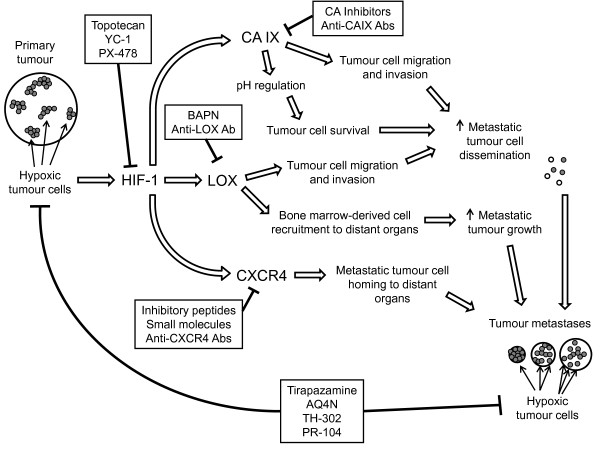
The microenvironment within solid tumours can influence the metastatic dissemination of tumour cells, and recent evidence suggests that poorly oxygenated (hypoxic) cells in primary tumours can also affect the survival and proliferation of metastatic tumour cells in distant organs. Hypoxic tumour cells have been historically targeted during radiation therapy in attempts to improve loco-regional control rates of primary tumours since hypoxic cells are known to be resistant to ionizing radiation-induced DNA damage. There are, therefore, a number of therapeutic strategies to directly target hypoxic cells in primary (and metastatic) tumours, and several compounds are becoming available to functionally inhibit hypoxia-induced proteins that are known to promote metastasis. This mini-review summarizes several established and emerging experimental strategies to target hypoxic cells in primary tumours with potential clinical application to the treatment of patients with tumour metastases or patients at high risk of developing metastatic disease. Targeting hypoxic tumour cells to reduce metastatic disease represents an important advance in the way scientists and clinicians view the influence of tumour hypoxia on therapeutic outcome.
Overview
The claims and statistics of this paper haven’t been checked yet.
Run the check — free, no account needed. It reads the open-access text and checks the sources it cites.
Integrity signals
Registry
Cites
Statistics
Figures
Verification
Claims the paper makes
The claims and statistics of this paper haven’t been checked yet.
Run the check — free, no account needed. It reads the open-access text and checks the sources it cites.
Claims other papers make about this one
Each is checked against this paper’s own text: does it say what the citing paper says it does?
In the citing paper
“Hypoxia occurs in the majority of solid tumors due to a poor vascular oxygen supply that is not sufficient to meet the needs of rapidly proliferating cancer cells.”
From Hypoxia signaling in cancer: Implications for therapeutic interventions (2023) · cites this paper as [3]
Self-check
Percentages, sums and reported differences re-computed from the paper’s own numbers.
The self-check needs the paper’s full text.
Citations
Cites
1 retracted
Lysyl oxidase is essential for hypoxia-induced metastasis
Erler, J. T., Bennewith, K. L., Nicolau, M., Dornhöfer, N., Kong, C., Le, Q.-T., Chi, J.-T. A., Jeffrey, S. S., & Giaccia, A. J. (2006) · Nature · doi:10.1038/nature04695 · Cited by 1,309
Self-citationRetractedTargeting HIF-1 for cancer therapy
Semenza, G. L. (2003) · Nature Reviews Cancer · doi:10.1038/nrc1187 · Cited by 6,717 · cited 1×
“Indeed, hypoxia up-regulates over 80 genes associated with tumour progression, glycolysis, angiogenesis, and metastasis [9-12] through the transcriptional activity of the heterodimeric transcription factors hypoxia-inducible factor-1 (HIF-1) and HIF-2.”
Involvement of chemokine receptors in breast cancer metastasis
Müller, A., Homey, B., Soto, H., Ge, N., Catron, D., Buchanan, M. E., McClanahan, T., Murphy, E., Yuan, W., Wagner, S. N., et al. (2001) · Nature · doi:10.1038/35065016 · Cited by 5,340
Cancer Metastasis: Building a Framework
Gupta, G. P., & Massagué, J. (2006) · Cell · doi:10.1016/j.cell.2006.11.001 · Cited by 4,333
VEGFR1-positive haematopoietic bone marrow progenitors initiate the pre-metastatic niche
Kaplan, R. N., Riba, R. D., Zacharoulis, S., Bramley, A. H., Vincent, L., Costa, C., MacDonald, D. D., Jin, D. K., Shido, K., Kerns, S. A., et al. (2005) · Nature · doi:10.1038/nature04186 · Cited by 3,288
Exploiting tumour hypoxia in cancer treatment
Brown, J. M., & Wilson, W. R. (2004) · Nature Reviews Cancer · doi:10.1038/nrc1367 · Cited by 2,828
Semenza, G. L., & Wang, G. L. (1992) · Molecular and Cellular Biology · doi:10.1128/mcb.12.12.5447 · Cited by 2,617
Tumor metastasis: mechanistic insights and clinical challenges
Steeg, P. S. (2006) · Nature Medicine · doi:10.1038/nm1469 · Cited by 2,165
Höckel, M., Schlenger, K., Aral, B., Mitze, M., Schäffer, U., & Vaupel, P. W. (1996) · PubMed · Cited by 1,727
The unique physiology of solid tumors: opportunities (and problems) for cancer therapy.
Brown, J. M., & Giaccia, A. J. (1998) · PubMed · Cited by 1,499
Cited by
Sorted by citations
Items 101–109 of 109
Targeting CAIX with small molecules
Parvathaneni (2017) · theses.fr (ABES) · doi:10.26481/dis.20171212nkp
Philip, B. (2014) · Griffith Research Online · doi:10.25904/1912/1367
Amini, M. A. (2019) · TSpace (University of Toronto)
Targeting Carbonic Anhydrase IX in Tumor Imaging and Theranostic Cancer Therapy
Lau, J., Lin, K., & Bénard, F. (2021) · Progress in drug research · doi:10.1007/978-3-030-79511-5_12
Optimizing the treatment of oesophageal cancer
Lien, V. D. V. (2020) · doi:10.26481/dis.20200506lv
Nanomaterial-Mediated Cancer Photodynamic Therapy
Liu, J., Gao, R., & Shen, X. (2026) · Springer eBooks · doi:10.1007/978-981-95-6849-9_1
Tumor Microenvironment-Responsive Smart Nanodrug Delivery Systems for Cancer Theranostics
Wen, X., Jiang, Y., Yang, H., & Sun, Q. (2026) · Journal of Nanotheranostics · doi:10.3390/jnt7040023
Metadata
- Authors
- Bennewith, K. L., & Dedhar, S.
- Affiliations
- BC Cancer Agency (CA)
- Corresponding author
- Dedhar, Shoukat
- Venue
- BMC Cancer
- Published
- 2011-11-30
- Volume
- 11
- Issue
- 1
- Pages
- 504-504
- ISSN
- 1471-2407 (ISSN-L)
- PMC
- PMC3247198
- OpenAlex
- W2046325076
- Cited by
- 109
- References
- 69
- Citations by year
- 2026: 2 · 2023: 7 · 2022: 4 · 2021: 4 · 2020: 11 · 2019: 10 · 2018: 10 · 2017: 6 · 2016: 8 · 2015: 8 · 2014: 14 · 2013: 16 · 2012: 8
- FWCI
- 0.90
- Type
- journal article
- Language
- en
- Open access
- gold
- doi.org
- Licence
- Locations
- BMC Cancer (publishedVersion, cc-by)
- Europe PMC (PubMed Central) (publishedVersion, cc-by)
- PubMed Central (publishedVersion, cc-by)
- PubMed (publishedVersion)
- DOAJ (DOAJ: Directory of Open Access Journals) (submittedVersion, cc-by-sa)
- Funders
- Michael Smith Health Research BC
- Terry Fox Foundation (020395)
- Canadian Institutes of Health Research
- Canadian Cancer Society Research Institute
- Topics
- Life Sciences › Biochemistry, Genetics and Molecular Biology › Cancer Research › Cancer, Hypoxia, and Metabolism
- Health Sciences › Medicine › Oncology › Cancer Cells and Metastasis
- Life Sciences › Biochemistry, Genetics and Molecular Biology › Molecular Biology › Mechanisms of cancer metastasis
- Keywords
- tumor hypoxia, metastasis, hypoxic tumor cells, hypoxia-targeted therapy, hypoxia-inducible factor, radioresistance (biology), ionizing radiation, tumor microenvironment
- MeSH terms
- Humans, Neoplasm Metastasis, Cell Hypoxia, Patient Selection
About these checks
Registry, retraction, Cites and statistics results are computed, not judged, with one exception: a printed reference that no index lists is read once by a model before it counts as a citation error. Claims are extracted by a model and kept only when their quote appears verbatim in the text; each cited source is then checked, with a model’s help, for whether it says what the claim relies on. Those verdicts can be wrong — read the claim’s quote and the cited source before relying on one.
Statistics and arithmetic are recomputed, not judged.
Confidence bands are shown only for fields calibrated on our annotated test set. None is calibrated yet, so no band is shown.
What counts as a claim ›How we measure confidence ›How we check this ›
Are you an author, or do you see a problem with this page? Request a review
