

The DOI matches its Crossref record; 69 of the 69 references it cites were found in a registry or an index.
Targeting hypoxic tumour cells to overcome metastasis
Open accessAbstract
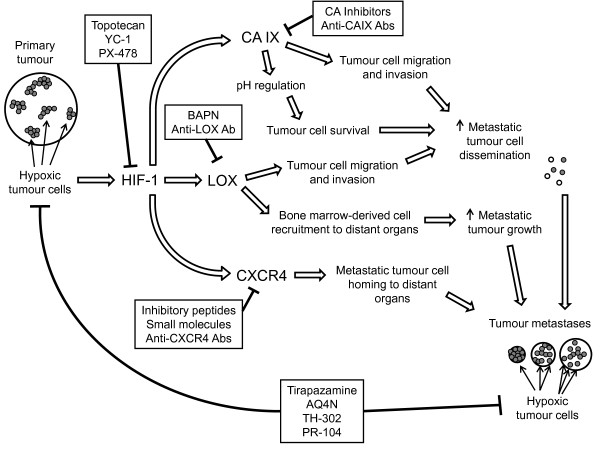
The microenvironment within solid tumours can influence the metastatic dissemination of tumour cells, and recent evidence suggests that poorly oxygenated (hypoxic) cells in primary tumours can also affect the survival and proliferation of metastatic tumour cells in distant organs. Hypoxic tumour cells have been historically targeted during radiation therapy in attempts to improve loco-regional control rates of primary tumours since hypoxic cells are known to be resistant to ionizing radiation-induced DNA damage. There are, therefore, a number of therapeutic strategies to directly target hypoxic cells in primary (and metastatic) tumours, and several compounds are becoming available to functionally inhibit hypoxia-induced proteins that are known to promote metastasis. This mini-review summarizes several established and emerging experimental strategies to target hypoxic cells in primary tumours with potential clinical application to the treatment of patients with tumour metastases or patients at high risk of developing metastatic disease. Targeting hypoxic tumour cells to reduce metastatic disease represents an important advance in the way scientists and clinicians view the influence of tumour hypoxia on therapeutic outcome.
Overview
The claims and statistics of this paper haven’t been checked yet.
Run the check — free, no account needed. It reads the open-access text and checks the sources it cites.
Integrity signals
Registry
Cites
Statistics
Figures
Verification
Claims the paper makes
The claims and statistics of this paper haven’t been checked yet.
Run the check — free, no account needed. It reads the open-access text and checks the sources it cites.
Claims other papers make about this one
Each is checked against this paper’s own text: does it say what the citing paper says it does?
In the citing paper
“Hypoxia occurs in the majority of solid tumors due to a poor vascular oxygen supply that is not sufficient to meet the needs of rapidly proliferating cancer cells.”
From Hypoxia signaling in cancer: Implications for therapeutic interventions (2023) · cites this paper as [3]
Self-check
Percentages, sums and reported differences re-computed from the paper’s own numbers.
The self-check needs the paper’s full text.
Citations
Cites
1 retracted
Lysyl oxidase is essential for hypoxia-induced metastasis
Erler, J. T., Bennewith, K. L., Nicolau, M., Dornhöfer, N., Kong, C., Le, Q.-T., Chi, J.-T. A., Jeffrey, S. S., & Giaccia, A. J. (2006) · Nature · doi:10.1038/nature04695 · Cited by 1,309
Self-citationRetractedTargeting HIF-1 for cancer therapy
Semenza, G. L. (2003) · Nature Reviews Cancer · doi:10.1038/nrc1187 · Cited by 6,717 · cited 1×
“Indeed, hypoxia up-regulates over 80 genes associated with tumour progression, glycolysis, angiogenesis, and metastasis [9-12] through the transcriptional activity of the heterodimeric transcription factors hypoxia-inducible factor-1 (HIF-1) and HIF-2.”
Involvement of chemokine receptors in breast cancer metastasis
Müller, A., Homey, B., Soto, H., Ge, N., Catron, D., Buchanan, M. E., McClanahan, T., Murphy, E., Yuan, W., Wagner, S. N., et al. (2001) · Nature · doi:10.1038/35065016 · Cited by 5,340
Cancer Metastasis: Building a Framework
Gupta, G. P., & Massagué, J. (2006) · Cell · doi:10.1016/j.cell.2006.11.001 · Cited by 4,333
VEGFR1-positive haematopoietic bone marrow progenitors initiate the pre-metastatic niche
Kaplan, R. N., Riba, R. D., Zacharoulis, S., Bramley, A. H., Vincent, L., Costa, C., MacDonald, D. D., Jin, D. K., Shido, K., Kerns, S. A., et al. (2005) · Nature · doi:10.1038/nature04186 · Cited by 3,288
Exploiting tumour hypoxia in cancer treatment
Brown, J. M., & Wilson, W. R. (2004) · Nature Reviews Cancer · doi:10.1038/nrc1367 · Cited by 2,828
Semenza, G. L., & Wang, G. L. (1992) · Molecular and Cellular Biology · doi:10.1128/mcb.12.12.5447 · Cited by 2,617
Tumor metastasis: mechanistic insights and clinical challenges
Steeg, P. S. (2006) · Nature Medicine · doi:10.1038/nm1469 · Cited by 2,165
Höckel, M., Schlenger, K., Aral, B., Mitze, M., Schäffer, U., & Vaupel, P. W. (1996) · PubMed · Cited by 1,727
The unique physiology of solid tumors: opportunities (and problems) for cancer therapy.
Brown, J. M., & Giaccia, A. J. (1998) · PubMed · Cited by 1,499
Cited by
Sorted by citations
Defining normoxia, physoxia and hypoxia in tumours—implications for treatment response
McKeown, S. R. (2014) · The British Journal of Radiology · doi:10.1259/bjr.20130676 · Cited by 1,050
The rationale for targeting the LOX family in cancer
Barker, H. E., Cox, T. R., & Erler, J. T. (2012) · Nature reviews. Cancer · doi:10.1038/nrc3319 · Cited by 611
A Nanozyme with Photo‐Enhanced Dual Enzyme‐Like Activities for Deep Pancreatic Cancer Therapy
Li, S., Shang, L., Xu, B., Wang, S., Gu, K. X., Wu, Q., Sun, Y., Zhang, Q., Yang, H., Zhang, F., et al. (2019) · Angewandte Chemie International Edition · doi:10.1002/anie.201904751 · Cited by 465
Walsh, J. C., Lebedev, A. Y., Aten, E., Madsen, K. S., Marciano, L., & Kolb, H. C. (2014) · Antioxidants and Redox Signaling · doi:10.1089/ars.2013.5378 · Cited by 432
Molecular aspects of cancer cell resistance to chemotherapy
Rebucci, M., & Michiels, C. (2013) · Biochemical Pharmacology · doi:10.1016/j.bcp.2013.02.017 · Cited by 424
Song, G., Chen, Y., Liang, C., Yi, X., Liu, J., Sun, X., Shen, S., Yang, K., & Liu, Z. (2016) · Advanced Materials · doi:10.1002/adma.201602111 · Cited by 394
Photodynamic nanomedicine in the treatment of solid tumors: Perspectives and challenges
Master, А. M., Livingston, M. K., & Gupta, A. S. (2013) · Journal of Controlled Release · doi:10.1016/j.jconrel.2013.02.020 · Cited by 373
Exosomes Derived from Hypoxic Leukemia Cells Enhance Tube Formation in Endothelial Cells
Tadokoro, H., Umezu, T., Ohyashiki, K., Hirano, T., & Ohyashiki, J. H. (2013) · Journal of Biological Chemistry · doi:10.1074/jbc.m113.480822 · Cited by 371
Tumor microenvironment targeted nanotherapeutics for cancer therapy and diagnosis: A review
Thakkar, S., Sharma, D., Kalia, K., & Tekade, R. K. (2019) · Acta Biomaterialia · doi:10.1016/j.actbio.2019.09.009 · Cited by 321
Hypoxia-responsive nanoparticle based drug delivery systems in cancer therapy: An up-to-date review
KUMARI, R. R., Sunil, D., & Ningthoujam, R. S. (2019) · Journal of Controlled Release · doi:10.1016/j.jconrel.2019.12.041 · Cited by 273
Sun, Y., Zhao, D., Wang, G., Wang, Y., Cao, L., Sun, J., Jiang, Q., & He, Z. (2020) · Acta Pharmaceutica Sinica B · doi:10.1016/j.apsb.2020.01.004 · Cited by 250
Recent advances in active targeting of nanomaterials for anticancer drug delivery
Dutta, B., Barick, K. C., & Hassan, P. A. (2021) · Advances in Colloid and Interface Science · doi:10.1016/j.cis.2021.102509 · Cited by 236
Improving cancer therapy through the nanomaterials-assisted alleviation of hypoxia
Sahu, A., Kwon, I., & Tae, G. (2019) · Biomaterials · doi:10.1016/j.biomaterials.2019.119578 · Cited by 219
Modulating tumor hypoxia by nanomedicine for effective cancer therapy
Jahanban‐Esfahlan, R., de la Guardia, M., Ahmadi, D., & Yousefi, B. (2018) · Journal of Cellular Physiology · doi:10.1002/jcp.25859 · Cited by 201
Tumor Microenvironment Targeted Nanotherapy
Fernandes, C., Suares, D., & Yergeri, M. C. (2018) · Frontiers in Pharmacology · doi:10.3389/fphar.2018.01230 · Cited by 164
Philip, B., Ito, K., Moreno‐Sánchez, R., & Ralph, S. J. (2013) · Carcinogenesis · doi:10.1093/carcin/bgt209 · Cited by 166
Chawla, S. P., Cranmer, L. D., Van Tine, B. A., Reed, D. R., Okuno, S. H., Butrynski, J. E., Adkins, D. R., Hendifar, A. E., Kroll, S., & Ganjoo, K. N. (2014) · Journal of Clinical Oncology · doi:10.1200/jco.2013.54.3660 · Cited by 155
Hypoxia as a biomarker for radioresistant cancer stem cells
Peitzsch, C., Perrin, R. L., Hill, R. P., Dubrovska, A., & Kurth, I. (2014) · International Journal of Radiation Biology · doi:10.3109/09553002.2014.916841 · Cited by 143
Chemokines, cytokines and exosomes help tumors to shape inflammatory microenvironment
Атретханы, К.-С. Н., Drutskaya, M. S., Nedospasov, S. A., Grivennikov, S. I., & Kuprash, D. V. (2016) · Pharmacology & Therapeutics · doi:10.1016/j.pharmthera.2016.09.011 · Cited by 131
Matsuura, Y., Wada, H., Eguchi, H., Gotoh, K., Kobayashi, S., Kinoshita, M., Kubo, M., Hayashi, K., Iwagami, Y., Yamada, D., et al. (2018) · Digestive Diseases and Sciences · doi:10.1007/s10620-018-5380-1 · Cited by 130
Hybrid Manganese Dioxide Nanoparticles Potentiate Radiation Therapy by Modulating Tumor Hypoxia
Abbasi, A. Z., Gordijo, C. R., Amini, M. A., Maeda, A., Rauth, A. M., DaCosta, R. S., & Wu, X. Y. (2016) · Cancer Research · doi:10.1158/0008-5472.can-15-3475 · Cited by 121
Hypoxia signaling in cancer: Implications for therapeutic interventions
Zhuang, Y., Liu, K., He, Q., Gu, X., Jiang, C., & Wu, J. (2023) · MedComm · doi:10.1002/mco2.203 · Cited by 119
Advances in nanomaterials for treatment of hypoxic tumor
Zou, M., Liu, W., Chen, H., Bai, X., Gao, F., Ye, J., Cheng, H. L., & Zhang, X. (2020) · National Science Review · doi:10.1093/nsr/nwaa160 · Cited by 118
Prodrug Applications for Targeted Cancer Therapy
Giang, I., Boland, E. L., & Poon, G. M. K. (2014) · The AAPS Journal · doi:10.1208/s12248-014-9638-z · Cited by 113
A Nanozyme with Photo‐Enhanced Dual Enzyme‐Like Activities for Deep Pancreatic Cancer Therapy
Li, S., Shang, L., Xu, B., Wang, S., Gu, K. X., Wu, Q., Sun, Y., Zhang, Q., Yang, H., Zhang, F., et al. (2019) · Angewandte Chemie · doi:10.1002/ange.201904751 · Cited by 100
Poff, A. M., Ward, N. P., Seyfried, T. N., Arnold, P., & D’Agostino, D. P. (2015) · PLoS ONE · doi:10.1371/journal.pone.0127407 · Cited by 98
Zeng, L., Chen, Y., Huang, H., Wang, J., Zhao, D., Ji, L., & Chao, H. (2015) · Chemistry - A European Journal · doi:10.1002/chem.201502154 · Cited by 94
Rami, M., Dubois, L. J., Parvathaneni, N.-K., Alterio, V., van Kuijk, S. J. A., Monti, S. M., Lambin, P., Simone, G. D., Supuran, C. T., & Winum, J. (2013) · Journal of Medicinal Chemistry · doi:10.1021/jm4009532 · Cited by 93
Novel Aspects of the Liver Microenvironment in Hepatocellular Carcinoma Pathogenesis and Development
Tu, T., Budzinska, M. A., Maczurek, A. E., Cheng, R., Bartolomeo, A. D., Warner, F. J., McCaughan, G. W., McLennan, S. V., & Shackel, N. A. (2014) · International Journal of Molecular Sciences · doi:10.3390/ijms15069422 · Cited by 90
Neurotrophin receptor TrkB promotes lung adenocarcinoma metastasis
Sinkevicius, K. W., Kriegel, C., Bellaria, K. J., Lee, J. J., Lau, A. N., Leeman, K. T., Zhou, P., Beede, A. M., Brainson, C. F., Caswell, D. R., et al. (2014) · Proceedings of the National Academy of Sciences · doi:10.1073/pnas.1404399111 · Cited by 88
Liu, H., Cheng, R., Dong, X., Zhu, S., Zhou, R., Yan, L., Zhang, C., Wang, Q., Gu, Z., & Zhao, Y. (2020) · Inorganic Chemistry · doi:10.1021/acs.inorgchem.9b03280 · Cited by 83
Huang, W.-C., Chen, S., Chiang, W., Huang, C.-W., Lo, C.-L., Chern, C., & Chiu, H. (2016) · Biomacromolecules · doi:10.1021/acs.biomac.6b00956 · Cited by 74
Hu, J., Valckenborgh, E. V., Menu, E., Bruyne, E. D., & Vanderkerken, K. (2012) · Disease Models & Mechanisms · doi:10.1242/dmm.008961 · Cited by 69
Enhancing the efficacy of immunotherapy using radiotherapy
Keam, S., Gill, S., Ebert, M. A., Nowak, A. K., & Cook, A. (2020) · Clinical & Translational Immunology · doi:10.1002/cti2.1169 · Cited by 69
Geng, B., Yan, L., Zhu, Y., Shi, W., Wang, H., Mao, J., Ren, L., Zhang, J., Tian, Y., Gao, F., et al. (2022) · Advanced Healthcare Materials · doi:10.1002/adhm.202202154 · Cited by 64
Fatima, H., Jin, Z. Y., Shao, Z., & Chen, X. J. (2022) · Journal of Colloid and Interface Science · doi:10.1016/j.jcis.2022.04.087 · Cited by 60
Gu, Q., He, Y., Ji, J., Yao, Y., Shen, W., Luo, J., Zhu, W., Cao, H., Geng, Y., Xu, J., et al. (2015) · Oncotarget · doi:10.18632/oncotarget.3535 · Cited by 61
Tumor oxygenation and cancer therapy—then and now
Hughes, V. S., Wiggins, J. M., & Siemann, D. W. (2018) · British Journal of Radiology · doi:10.1259/bjr.20170955 · Cited by 63
The Hypoxic Tumor Microenvironment: Driving the Tumorigenesis of Non-Small-Cell Lung Cancer
Foster, J. G., Wong, S. C. K., & Sharp, T. V. (2014) · Future Oncology · doi:10.2217/fon.14.201 · Cited by 61
Oxygen Sensing with Perfluorocarbon-Loaded Ultraporous Mesostructured Silica Nanoparticles
Lee, A. L., Gee, C. T., Weegman, B. P., Einstein, S. A., Joules, A., Ring, H. L., Hurley, K. R., Egger, S. M., Swindlehurst, G. R., Garwood, M., et al. (2017) · ACS Nano · doi:10.1021/acsnano.7b01006 · Cited by 60
New ways to image and target tumour hypoxia and its molecular responses
Dubois, L. J., Niemans, R., van Kuijk, S. J. A., Panth, K. M., Parvathaneni, N.-K., Peeters, S. G. J. A., Zegers, C. M. L., Rekers, N. H., van Gisbergen, M. W., Biemans, R., et al. (2015) · Radiotherapy and Oncology · doi:10.1016/j.radonc.2015.08.022 · Cited by 56
Liposomal Formulations to Modulate the Tumour Microenvironment and Antitumour Immune Response
Gilabert‐Oriol, R., Ryan, G. M., Leung, A. W. Y., Firmino, N. S., Bennewith, K. L., & Bally, M. B. (2018) · International Journal of Molecular Sciences · doi:10.3390/ijms19102922 · Cited by 53
Self-citationScaringi, R., Piccoli, M., Papini, N., Cirillo, F., Conforti, E., Bergante, S., Tringali, C., Garatti, A., Gelfi, C., Venerando, B., et al. (2012) · Journal of Biological Chemistry · doi:10.1074/jbc.m112.404327 · Cited by 48
The potential of clostridial spores as therapeutic delivery vehicles in tumour therapy
Kubiak, A. M., & Minton, N. P. (2015) · Research in Microbiology · doi:10.1016/j.resmic.2014.12.006 · Cited by 48
Brachytherapy Application With In Situ Dose Painting Administered by Gold Nanoparticle Eluters
Sinha, N., Cifter, G., Sajo, E., Kumar, R., Sridhar, S., Nguyen, P. L., Cormack, R. A., Makrigiorgos, G. M., & Ngwa, W. F. (2014) · International Journal of Radiation Oncology*Biology*Physics · doi:10.1016/j.ijrobp.2014.10.001 · Cited by 48
Mitochondria-targeting cyclometalated iridium( iii ) complexes for tumor hypoxic imaging and therapy
Li, J., Chen, H., Zeng, L., Rees, T. W., Xiong, K., Chen, Y., Ji, L., & Chao, H. (2019) · Inorganic Chemistry Frontiers · doi:10.1039/c9qi00081j · Cited by 48
The influence of pH and hypoxia on tumor metastasis
Abaza, M., & Luqmani, Y. A. (2013) · Expert Review of Anticancer Therapy · doi:10.1586/14737140.2013.843455 · Cited by 46
HDAC6 Deacetylase Activity Is Required for Hypoxia-Induced Invadopodia Formation and Cell Invasion
Arsenault, D., Brochu‐Gaudreau, K., Charbonneau, M., & Dubois, C. M. (2013) · PLoS ONE · doi:10.1371/journal.pone.0055529 · Cited by 47
Arginine deprivation as a new treatment strategy for head and neck cancer
Huang, C., Tsai, S., Kuo, C., Chang, J. S.-M., Jin, Y., Chang, J., & Hsiao, J. (2012) · Oral Oncology · doi:10.1016/j.oraloncology.2012.06.004 · Cited by 41
Spatio-Temporal Dynamics of Hypoxia during Radiotherapy
Kempf, H., Bleicher, M., & Meyer‐Hermann, M. (2015) · PLoS ONE · doi:10.1371/journal.pone.0133357 · Cited by 40
A traceable nanoplatform for enhanced chemo-photodynamic therapy by reducing oxygen consumption
Yao, H., Zhang, S., Guo, X., Li, Y., Ren, J., Zhou, H., Du, B., & Zhou, J. (2019) · Nanomedicine Nanotechnology Biology and Medicine · doi:10.1016/j.nano.2019.03.001 · Cited by 35
Li, Y., Feng, L., Tao, D., Tao, H., Zhong, X., Liang, C., Zhu, Y., Hu, B., Liu, Z., & Zheng, Y. (2020) · Nanoscale · doi:10.1039/d0nr01476a · Cited by 33
Nanotechnological strategies to increase the oxygen content of the tumor
Zhang, J., Tang, K., Fang, R., Liu, J., Liu, M., Ma, J., Wang, H., Ding, M., Wang, X., Song, Y., et al. (2023) · Frontiers in Pharmacology · doi:10.3389/fphar.2023.1140362 · Cited by 33
Huang, R., Hammelef, E., Sabitsky, M., Ream, C., Khalilieh, S., Zohar, N., Lavu, H., Bowne, W. B., Yeo, C. J., & Nevler, A. (2023) · Biomedicines · doi:10.3390/biomedicines11061684 · Cited by 32
Engineering Targeting Materials for Therapeutic Cancer Vaccines
Briquez, P. S., Hauert, S., de Titta, A., Gray, L. T., Alpar, A. T., Swartz, M. A., & Hubbell, J. A. (2020) · Frontiers in Bioengineering and Biotechnology · doi:10.3389/fbioe.2020.00019 · Cited by 32
A Platelet-Mimetic Paradigm for Metastasis-Targeted Nanomedicine Platforms
Modery-Pawlowski, C. L., Master, А. M., Pan, V., Howard, G. P., & Gupta, A. S. (2013) · Biomacromolecules · doi:10.1021/bm301996p · Cited by 30
Larue, R. T. H. M., Voorde, L. V. D., Berbée, M., van Elmpt, W., Dubois, L. J., Panth, K. M., Peeters, S. G. J. A., Claessens, A., Schreurs, W. M. J., Nap, M., et al. (2016) · BMC Cancer · doi:10.1186/s12885-016-2709-z · Cited by 29
Villa, C., Campione, M., González, B. S., Alessandrini, F., Erratico, S., Zucca, I., Bruzzone, M. G., Forzenigo, L. V., Malatesta, P., Mauri, M., et al. (2018) · Advanced Functional Materials · doi:10.1002/adfm.201707582 · Cited by 27
Calpe, B., & Kovacs, W. J. (2020) · Expert Opinion on Drug Discovery · doi:10.1080/17460441.2020.1756769 · Cited by 27
Current challenges and opportunities in treating hypoxic prostate tumors
McKenna, D. J., Errington, R. J., & Pors, K. (2018) · Journal of Cancer Metastasis and Treatment · doi:10.20517/2394-4722.2017.54 · Cited by 25
Recent Advances in Bio‐Compatible Oxygen Singlet Generation and Its Tumor Treatment
Jin, Z. Y., Fatima, H., Zhang, Y., Shao, Z., & Chen, X. J. (2021) · Advanced Therapeutics · doi:10.1002/adtp.202100176 · Cited by 25
Terman, D. S., Viglianti, B. L., Zennadi, R., Fels, D. R., Boruta, R. J., Yuan, H., Dreher, M. R., Grant, G. A., Rabbani, Z. N., Moon, E., et al. (2013) · PLoS ONE · doi:10.1371/journal.pone.0052543 · Cited by 23
Zou, Y., Rong, Y., Tan, Y., Xiao, J. Y., Yu, Z., Chen, Y., Ke, J., Li, C., Chen, X., Wu, X., et al. (2019) · Cancer Cell International · doi:10.1186/s12935-019-0964-1 · Cited by 23
Lyon, P. C., Mannaris, C., Gray, M. D., Carlisle, R. C., Gleeson, F. V., Cranston, D., Wu, F., & Coussios, C. C. (2021) · Ultrasound in Medicine & Biology · doi:10.1016/j.ultrasmedbio.2020.12.008 · Cited by 22
Wu, Y., Mao, F., Zuo, X., Moussalli, M. J., Elias, E., Xu, W., & Shureiqi, I. (2014) · Cancer Medicine · doi:10.1002/cam4.222 · Cited by 21
Iovanna, J., Marks, D. L., Fernández-Zapico, M. E., & Urrutia, R. A. (2013) · American Journal Of Pathology · doi:10.1016/j.ajpath.2012.12.004 · Cited by 18
Tg737 signaling is required for hypoxia-enhanced invasion and migration of hepatoma cells
You, N., Liu, W., Tang, L., Zhong, X., Ji, R., Zhang, N., Wang, D., He, Y., Dou, K., & Tao, K. (2012) · Journal of Experimental & Clinical Cancer Research · doi:10.1186/1756-9966-31-75 · Cited by 18
Liu, X., Zhang, J., Guo, X., Huang, J., Lou, Z., Zhao, X., Lin, Q., Li, X., You, J., & Luo, L. (2023) · Journal of Controlled Release · doi:10.1016/j.jconrel.2023.10.037 · Cited by 16
Exploiting tumor hypoxia for cancer treatment
Niemans (2018) · Research Publications (Maastricht University) · doi:10.26481/dis.20180626rn · Cited by 14
Rath, S., Anand, A., Ghosh, N., Das, L., Kokate, S. B., Dixit, P., Majhi, S., Rout, N., Singh, S. P., & Bhattacharyya, A. (2016) · Biochemical and Biophysical Research Communications · doi:10.1016/j.bbrc.2016.01.140 · Cited by 12
Tunca, E., Bülbül, M., İlki̇men, H., Canlıdinç, R. S., & Yenikaya, C. (2020) · Chemical Papers · doi:10.1007/s11696-020-01078-5 · Cited by 12
Tsai, I.-T., Kuo, C., Liou, J., & Chang, J. (2018) · Journal of Biomedical Science · doi:10.1186/s12929-018-0432-6 · Cited by 11
Krstić, J., Jauković, A., Mojsilović, S. B., Djordjević, I. O., Trivanović, D. I., Ilić, V. L., Santibanez, J. F., & Bugarski, D. S. (2013) · Cell Biology International · doi:10.1002/cbin.10144 · Cited by 11
Prasad, P., Khan, I., Sasmal, P. K., Koley, D., Kondaiah, P., & Chakravarty, A. R. (2013) · Dalton Transactions · doi:10.1039/c2dt32810k · Cited by 11
Carving out its niche: A role for carbonic anhydrase IX in pre-metastatic niche development
Chafe, S. C., & Dedhar, S. (2015) · OncoImmunology · doi:10.1080/2162402x.2015.1048955 · Cited by 10
Self-citationZhang, R., Yang, A., Zhang, L., He, L., Gu, X., Yu, C., Lu, Z., Wang, C., Zhou, F., Li, F., et al. (2023) · Acta Physiologica · doi:10.1111/apha.14018 · Cited by 9
Transiently hypoxic tumour cell turnover and radiation sensitivity in human tumour xenografts
Wadsworth, B. J., Lee, C.-M., & Bennewith, K. L. (2022) · British Journal of Cancer · doi:10.1038/s41416-021-01691-5 · Cited by 9
Self-citationNanotechnology Applications in Diagnosis and Treatment of Metastasis
Gupta, A. S. (2014) · Nanomedicine · doi:10.2217/nnm.14.94 · Cited by 8
Wang, L., Zhang, M., Gao, X., Li, J., Wu, M., Zhang, X., & Ye, Z. (2022) · RSC Advances · doi:10.1039/d2ra04690c · Cited by 6
Understanding hypoxia microenvironment of micrometastases
Li, X., Ma, Y., & Jiang, H. (2012) · Journal of Solid Tumors · doi:10.5430/jst.v2n2p28 · Cited by 5
Optimized Carbohydrate-Based Nanogel Formulation to Sensitize Hypoxic Tumors
Diaz‐Dussan, D., Peng, Y., Rashed, F. B., Macdonald, D., Weinfeld, M., Kumar, P., & Narain, R. (2023) · Molecular Pharmaceutics · doi:10.1021/acs.molpharmaceut.3c00101 · Cited by 5
2-18F-Fluoroethanol Is a PET Reporter of Solid Tumor Perfusion
Wadsworth, B. J., Pan, J., Dude, I., Colpo, N., Bosiljcic, M., Lin, K., Bénard, F., & Bennewith, K. L. (2017) · Journal of Nuclear Medicine · doi:10.2967/jnumed.116.183624 · Cited by 5
Self-citationProtective effects of methanolic extract of Vicia cracca against hypoxia-induced lethality in mice
shahnazi, R., & Ebrahimzadeh, M. A. (2018) · Pharmaceutical and Biomedical Research · doi:10.18502/pbr.v3i4.85 · Cited by 5
de Mello, R. A., Luís, M., Araújo, A., Reis, R. M., & Hespanhol, V. P. (2013) · Springer eBooks · doi:10.1007/978-1-4614-5857-9_20 · Cited by 4
Drug Delivery Applications of Peptide Materials
Hamsici, S., Gunay, G., Kirit, H. A., Kamatar, A., Loving, K., & Acar, H. (2020) · Royal Society of Chemistry eBooks · doi:10.1039/9781839161148-00291 · Cited by 4
The role of HIF-1α, CBP and p300 in the regulation of Nav1.5 expression in breast cancer cells
Dewadas, H. D., Kamarulzaman, N. S., Yaacob, N. S., Has, A. T. C., & Mokhtar, N. F. (2019) · Gene Reports · doi:10.1016/j.genrep.2019.100405 · Cited by 4
The Role of Cydonia oblonga, Portulaca oleracea , and Artemisia dracunculus on Hypoxia
Hosseinzadeh, M. H., Eghbali, M., Hashemi, Z., Naserirad, N., Shirdel, M., Rafizadeh, M., Farzin, D., & Ebrahimzadeh, M. A. (2023) · Majallah-i dānishgāh-i ̒ulum-i pizishkī-i Kirmān. · doi:10.34172/jkmu.2023.40 · Cited by 3
Can We Negotiate with a Tumor?
Wolfrom, C. M., Laurent, M., & Deschatrette, J. (2014) · PLoS ONE · doi:10.1371/journal.pone.0103834 · Cited by 2
Radiation Therapy Towards Laser-Driven Particle Beams: An “OMICS” Approach in Radiobiology
Minafra, L., Bravatà, V., Cammarata, F. P., & Forte, G. I. (2016) · Biological and medical physics, biomedical engineering · doi:10.1007/978-3-319-31563-8_4 · Cited by 2
Modification of Hypoxic States in Photodynamic Therapy
Gapeyev, A. B., & Shcherbatyuk, T. G. (2020) · Biochemistry (Moscow) Supplement Series A Membrane and Cell Biology · doi:10.1134/s1990747820020051 · Cited by 2
Biomarkers Expression in Cervical Cancer and High Grade Squamous Intraepithelial Lesions
Ostojich, M., Liliana, G., Gianni, S., Ana, A., Marino, L., Diana, D. D., & Jasnis, M. A. (2012) · Journal of Cancer Therapy · doi:10.4236/jct.2012.36139 · Cited by 1
Zhang, M., Li, X., Suehiro, M., Zhao, Z., Gagne, D., Pizzonia, J. H., Zhang, Z., Li, G. C., Ling, C. C., & Humm, J. L. (2012) · International Journal of Medical Physics Clinical Engineering and Radiation Oncology · doi:10.4236/ijmpcero.2012.12005 · Cited by 1
Li, X., & Ma, Y. (2013) · Springer eBooks · doi:10.1007/978-1-4614-8498-1_20 · Cited by 1
Breast Cancer Stem Cells: From Theory to Therapy
Conley, S. J., & Wicha, M. S. (2013) · Springer eBooks · doi:10.1007/978-1-4614-7696-2_35 · Cited by 3
The Role of Angiogenesis in Non-small Cell Lung Cancer Tumor Behavior
de Mello, R. A., Luís, M., Araújo, A., Reis, R. M., & Hespanhol, V. P. (2017) · Springer eBooks · doi:10.1007/978-3-319-61115-0_10 · Cited by 1
Postovit, L.-M. M. (2015) · Springer eBooks · doi:10.1007/978-3-319-13611-0_5 · Cited by 1
A decade of progress in cancer research
Chap, C., & Patel, J. (2011) · BMC Cancer · doi:10.1186/1471-2407-11-498 · Cited by 1
Therapy Resistance in Prostate Cancer: A Stem Cell Perspective
Klein, S., Frame, F. M., & Maitland, N. J. (2013) · Stem cell biology and regenerative medicine · doi:10.1007/978-1-4614-8066-2_13
Expressão gênica da família das lisil oxidases e papel funcional de LOX em astrocitomas
da Silva, R. (2014) · Digital Library of Theses and Dissertations (Universidade de São Paulo) · doi:10.11606/t.5.2014.tde-12012015-091413
Targeting tumour microenvironment : development of carbonic anhydrase IX nuclear imaging agents
Lau, J. (2016) · cIRcle (University of British Columbia) · doi:10.14288/1.0308658
Metadata
- Authors
- Bennewith, K. L., & Dedhar, S.
- Affiliations
- BC Cancer Agency (CA)
- Corresponding author
- Dedhar, Shoukat
- Venue
- BMC Cancer
- Published
- 2011-11-30
- Volume
- 11
- Issue
- 1
- Pages
- 504-504
- ISSN
- 1471-2407 (ISSN-L)
- PMC
- PMC3247198
- OpenAlex
- W2046325076
- Cited by
- 109
- References
- 69
- Citations by year
- 2026: 2 · 2023: 7 · 2022: 4 · 2021: 4 · 2020: 11 · 2019: 10 · 2018: 10 · 2017: 6 · 2016: 8 · 2015: 8 · 2014: 14 · 2013: 16 · 2012: 8
- FWCI
- 0.90
- Type
- journal article
- Language
- en
- Open access
- gold
- doi.org
- Licence
- Locations
- BMC Cancer (publishedVersion, cc-by)
- Europe PMC (PubMed Central) (publishedVersion, cc-by)
- PubMed Central (publishedVersion, cc-by)
- PubMed (publishedVersion)
- DOAJ (DOAJ: Directory of Open Access Journals) (submittedVersion, cc-by-sa)
- Funders
- Michael Smith Health Research BC
- Terry Fox Foundation (020395)
- Canadian Institutes of Health Research
- Canadian Cancer Society Research Institute
- Topics
- Life Sciences › Biochemistry, Genetics and Molecular Biology › Cancer Research › Cancer, Hypoxia, and Metabolism
- Health Sciences › Medicine › Oncology › Cancer Cells and Metastasis
- Life Sciences › Biochemistry, Genetics and Molecular Biology › Molecular Biology › Mechanisms of cancer metastasis
- Keywords
- tumor hypoxia, metastasis, hypoxic tumor cells, hypoxia-targeted therapy, hypoxia-inducible factor, radioresistance (biology), ionizing radiation, tumor microenvironment
- MeSH terms
- Humans, Neoplasm Metastasis, Cell Hypoxia, Patient Selection
About these checks
Registry, retraction, Cites and statistics results are computed, not judged, with one exception: a printed reference that no index lists is read once by a model before it counts as a citation error. Claims are extracted by a model and kept only when their quote appears verbatim in the text; each cited source is then checked, with a model’s help, for whether it says what the claim relies on. Those verdicts can be wrong — read the claim’s quote and the cited source before relying on one.
Statistics and arithmetic are recomputed, not judged.
Confidence bands are shown only for fields calibrated on our annotated test set. None is calibrated yet, so no band is shown.
What counts as a claim ›How we measure confidence ›How we check this ›
Are you an author, or do you see a problem with this page? Request a review
