

The DOI matches its Crossref record; 69 of the 69 references it cites were found in a registry or an index.
Targeting hypoxic tumour cells to overcome metastasis
Open accessAbstract
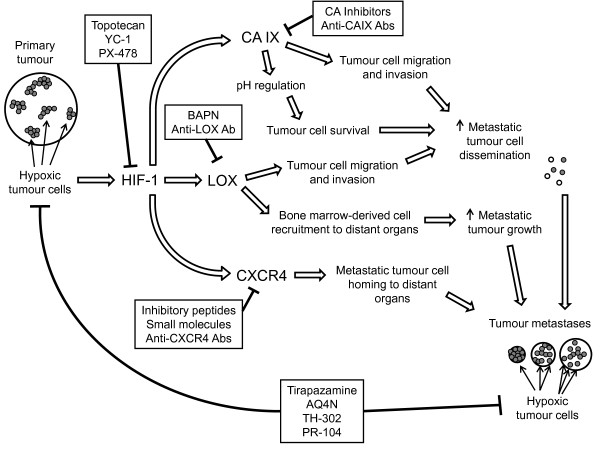
The microenvironment within solid tumours can influence the metastatic dissemination of tumour cells, and recent evidence suggests that poorly oxygenated (hypoxic) cells in primary tumours can also affect the survival and proliferation of metastatic tumour cells in distant organs. Hypoxic tumour cells have been historically targeted during radiation therapy in attempts to improve loco-regional control rates of primary tumours since hypoxic cells are known to be resistant to ionizing radiation-induced DNA damage. There are, therefore, a number of therapeutic strategies to directly target hypoxic cells in primary (and metastatic) tumours, and several compounds are becoming available to functionally inhibit hypoxia-induced proteins that are known to promote metastasis. This mini-review summarizes several established and emerging experimental strategies to target hypoxic cells in primary tumours with potential clinical application to the treatment of patients with tumour metastases or patients at high risk of developing metastatic disease. Targeting hypoxic tumour cells to reduce metastatic disease represents an important advance in the way scientists and clinicians view the influence of tumour hypoxia on therapeutic outcome.
Overview
The claims and statistics of this paper haven’t been checked yet.
Run the check — free, no account needed. It reads the open-access text and checks the sources it cites.
Integrity signals
Registry
Cites
Statistics
Figures
Verification
Claims the paper makes
The claims and statistics of this paper haven’t been checked yet.
Run the check — free, no account needed. It reads the open-access text and checks the sources it cites.
Claims other papers make about this one
Each is checked against this paper’s own text: does it say what the citing paper says it does?
In the citing paper
“Hypoxia occurs in the majority of solid tumors due to a poor vascular oxygen supply that is not sufficient to meet the needs of rapidly proliferating cancer cells.”
From Hypoxia signaling in cancer: Implications for therapeutic interventions (2023) · cites this paper as [3]
Self-check
Percentages, sums and reported differences re-computed from the paper’s own numbers.
The self-check needs the paper’s full text.
Citations
Cites
1 retracted
Lysyl oxidase is essential for hypoxia-induced metastasis
Erler, J. T., Bennewith, K. L., Nicolau, M., Dornhöfer, N., Kong, C., Le, Q.-T., Chi, J.-T. A., Jeffrey, S. S., & Giaccia, A. J. (2006) · Nature · doi:10.1038/nature04695 · Cited by 1,309
Self-citationRetractedTargeting HIF-1 for cancer therapy
Semenza, G. L. (2003) · Nature Reviews Cancer · doi:10.1038/nrc1187 · Cited by 6,717 · cited 1×
“Indeed, hypoxia up-regulates over 80 genes associated with tumour progression, glycolysis, angiogenesis, and metastasis [9-12] through the transcriptional activity of the heterodimeric transcription factors hypoxia-inducible factor-1 (HIF-1) and HIF-2.”
Involvement of chemokine receptors in breast cancer metastasis
Müller, A., Homey, B., Soto, H., Ge, N., Catron, D., Buchanan, M. E., McClanahan, T., Murphy, E., Yuan, W., Wagner, S. N., et al. (2001) · Nature · doi:10.1038/35065016 · Cited by 5,340
Cancer Metastasis: Building a Framework
Gupta, G. P., & Massagué, J. (2006) · Cell · doi:10.1016/j.cell.2006.11.001 · Cited by 4,333
VEGFR1-positive haematopoietic bone marrow progenitors initiate the pre-metastatic niche
Kaplan, R. N., Riba, R. D., Zacharoulis, S., Bramley, A. H., Vincent, L., Costa, C., MacDonald, D. D., Jin, D. K., Shido, K., Kerns, S. A., et al. (2005) · Nature · doi:10.1038/nature04186 · Cited by 3,288
Exploiting tumour hypoxia in cancer treatment
Brown, J. M., & Wilson, W. R. (2004) · Nature Reviews Cancer · doi:10.1038/nrc1367 · Cited by 2,828
Semenza, G. L., & Wang, G. L. (1992) · Molecular and Cellular Biology · doi:10.1128/mcb.12.12.5447 · Cited by 2,617
Tumor metastasis: mechanistic insights and clinical challenges
Steeg, P. S. (2006) · Nature Medicine · doi:10.1038/nm1469 · Cited by 2,165
Höckel, M., Schlenger, K., Aral, B., Mitze, M., Schäffer, U., & Vaupel, P. W. (1996) · PubMed · Cited by 1,727
The unique physiology of solid tumors: opportunities (and problems) for cancer therapy.
Brown, J. M., & Giaccia, A. J. (1998) · PubMed · Cited by 1,499
Erler, J. T., Bennewith, K. L., Cox, T. R., Lang, G., Bird, D., Koong, A., Le, Q.-T., & Giaccia, A. J. (2009) · Cancer Cell · doi:10.1016/j.ccr.2008.11.012 · Cited by 1,231
Self-citation(1996) · PubMed · Cited by 1,188
Hypoxia, DNA repair and genetic instability
Bristow, R. G., & Hill, R. P. (2008) · Nature Reviews Cancer · doi:10.1038/nrc2344 · Cited by 1,140
Integration of Oxygen Signaling at the Consensus HRE
Wenger, R. H., Stiehl, D. P., & Camenisch, G. (2005) · Science's STKE · doi:10.1126/stke.3062005re12 · Cited by 1,032
Lysyl oxidase: properties, specificity, and biological roles inside and outside of the cell
Kagan, H. M., & Li, W. (2003) · Journal of Cellular Biochemistry · doi:10.1002/jcb.10413 · Cited by 954
Chemokine receptor CXCR4 downregulated by von Hippel–Lindau tumour suppressor pVHL
Staller, P., Sulitkova, J., Lisztwan, J., Moch, H., Oakeley, E. J., & Krek, W. (2003) · Nature · doi:10.1038/nature01874 · Cited by 870
Peters, L. J., O’Sullivan, B., Giralt, J., FitzGerald, T. J., Trotti, A., Bernier, J., Bourhis, J., Yuen, K., Fisher, R., & Rischin, D. (2010) · Journal of Clinical Oncology · doi:10.1200/jco.2009.27.4498 · Cited by 814
The role of hypoxia-inducible factors in tumorigenesis
Rankin, E. B., & Giaccia, A. J. (2008) · Cell Death & Differentiation · doi:10.1038/cdd.2008.21 · Cited by 806 · cited 2×
“migration is well-established [12-17], and emerging evidence indicates that secreted hypoxia-induced proteins such as lysyl oxidase (LOX) [18] can modulate the microenvironment within distant metastatic target organs to promote metastatic tumour growth [19].”
Lou, Y., McDonald, P. C., Oloumi, A., Chia, S., Ostlund, C., Ahmadi, A., Kyle, A. H., Keller, U. A. D., Leung, S., Huntsman, D. D., et al. (2011) · Cancer Research · doi:10.1158/0008-5472.can-10-4261 · Cited by 761
Self-citationHIF-1 as a target for drug development
Giaccia, A., Siim, B. G., & Johnson, R. S. (2003) · Nature Reviews Drug Discovery · doi:10.1038/nrd1199 · Cited by 631
Rischin, D., Hicks, R. J., Fisher, R., Binns, D., Corry, J. F., Porceddu, S. V., & Peters, L. J. (2006) · Journal of Clinical Oncology · doi:10.1200/jco.2005.05.2878 · Cited by 540
Pacchiano, F., Carta, F., McDonald, P. C., Lou, Y., Vullo, D., Scozzafava, A., Dedhar, S., & Supuran, C. T. (2011) · Journal of Medicinal Chemistry · doi:10.1021/jm101541x · Cited by 530
Self-citationLysyl oxidases: A novel multifunctional amine oxidase family
Csiszar, K. (2001) · Progress in nucleic acid research and molecular biology · doi:10.1016/s0079-6603(01)70012-8 · Cited by 519
YC-1: A Potential Anticancer Drug Targeting Hypoxia-Inducible Factor 1
Yeo, E., Chun, Y., Cho, Y.-S., Kim, J., Lee, J.-C., Kim, M.-S., & Park, J.-W. (2003) · JNCI Journal of the National Cancer Institute · doi:10.1093/jnci/95.7.516 · Cited by 479
Hypoxia-driven selection of the metastatic phenotype
Sullivan, R., & Graham, C. H. (2007) · Cancer and Metastasis Reviews · doi:10.1007/s10555-007-9062-2 · Cited by 423
SR-4233: A new bioreductive agent with high selective toxicity for hypoxic mammalian cells
Zeman, E. M., Brown, J. M., Lemmon, M. J., Hirst, V. K., & Lee, W. W. (1986) · International Journal of Radiation Oncology*Biology*Physics · doi:10.1016/0360-3016(86)90267-1 · Cited by 402
Tumor Hypoxia Has Independent Predictor Impact Only in Patients With Node-Negative Cervix Cancer
Fyles, A., Milosevic, M., Hedley, D., Pintilie, M., Levin, W., Manchul, L., & Hill, R. P. (2002) · Journal of Clinical Oncology · doi:10.1200/jco.20.3.680 · Cited by 398
Rischin, D., Peters, L. J., O'Sullivan, B., Giralt, J., Fisher, R., Yuen, K., Trotti, A., Bernier, J., Bourhis, J., Ringash, J., et al. (2010) · Journal of Clinical Oncology · doi:10.1200/jco.2009.27.4449 · Cited by 380
A molecular role for lysyl oxidase in breast cancer invasion.
Kirschmann, D. A., Seftor, E. A., Fong, S. F. T., Nieva, D. R. C., Sullivan, C. M., Edwards, E. M., Sommer, P., Csiszar, K., & Hendrix, M. J. C. (2002) · PubMed · Cited by 332
Topoisomerase I-Mediated Inhibition of Hypoxia-Inducible Factor 1
Rapisarda, A., Uranchimeg, B., Sordet, O., Pommier, Y., Shoemaker, R. H., & Melillo, G. (2004) · Cancer Research · doi:10.1158/0008-5472.can-03-3139 · Cited by 301
Arteel, G. E., Thurman, R., Yates, J. M., & Raleigh, J. (1995) · British Journal of Cancer · doi:10.1038/bjc.1995.429 · Cited by 295
Raimondi, S. L., Fogelgren, B., Hess, A. R., Seftor, E. A., Wiley, E. L., Fong, S. F. T., Csiszár, K., Hendrix, M. J. C., & Kirschmann, D. A. (2005) · Cancer Research · doi:10.1158/0008-5472.can-05-1274 · Cited by 293
CXCR4: chemokine receptor extraordinaire
Murdoch, C. (2000) · Immunological Reviews · doi:10.1034/j.1600-065x.2000.17715.x · Cited by 284
Vergis, R., Corbishley, C. M., Norman, A. R., Bartlett, J., Jhavar, S., Borre, M., Heeboll, S., Horwich, A., Huddart, R., Khoo, V., et al. (2008) · The Lancet Oncology · doi:10.1016/s1470-2045(08)70076-7 · Cited by 282
Welsh, S. J., Williams, R. R., Kirkpatrick, L., Paine-Murrieta, G. D., & Powis, G. (2004) · PubMed · Cited by 280
Development of HIF‐1 inhibitors for cancer therapy
Onnis, B., Rapisarda, A., & Melillo, G. (2009) · Journal of Cellular and Molecular Medicine · doi:10.1111/j.1582-4934.2009.00876.x · Cited by 268
Molecular Mechanisms of Tumor Invasion and Metastasis: An Integrated View
Cairns, R., Khokha, R., & Hill, R. P. (2003) · Current Molecular Medicine · doi:10.2174/1566524033479447 · Cited by 254
Patterson, A. V., Ferry, D. M., Edmunds, S. J., Gu, Y., Singleton, R. S., Patel, K., Pullen, S. M., Hicks, K. O., Syddall, S. P., Atwell, G. J., et al. (2007) · Clinical Cancer Research · doi:10.1158/1078-0432.ccr-07-0478 · Cited by 253
Potent and Highly Selective Hypoxia-Activated Achiral Phosphoramidate Mustards as Anticancer Drugs
Duan, J.-X., Jiao, H., Kaizerman, J. A., Stanton, T. F., Evans, J., Lan, L., Lorente, G., Banica, M., Jung, D. T., Wang, J., et al. (2008) · Journal of Medicinal Chemistry · doi:10.1021/jm701028q · Cited by 239
Detection of hypoxic cells by monoclonal antibody recognizing 2-nitroimidazole adducts.
Lord, E. M., Harwell, L. W., & Koch, C. J. (1993) · PubMed · Cited by 223
CXCL12-CXCR4 Axis in Angiogenesis, Metastasis and Stem Cell Mobilization
Liekens, S., Schols, D., & Hatse, S. (2010) · Current Pharmaceutical Design · doi:10.2174/138161210794455003 · Cited by 217
18F-EF5: A New PET Tracer for Imaging Hypoxia in Head and Neck Cancer
Komar, G., Seppänen, M., Eskola, O., Lindholm, P., Grönroos, T. J., Forsback, S. J., Sipilä, H. T., Evans, S. M., Solin, O. H., & Minn, H. R. I. (2008) · Journal of Nuclear Medicine · doi:10.2967/jnumed.108.053785 · Cited by 181
Rofstad, E. K., Gaustad, J., Egeland, T. A. M., Mathiesen, B. S., & Galappathi, K. (2010) · International Journal of Cancer · doi:10.1002/ijc.25176 · Cited by 174
Bioreductive Drugs: from Concept to Clinic
McKeown, S. R., Cowen, R. L., & Williams, K. J. (2007) · Clinical Oncology · doi:10.1016/j.clon.2007.03.006 · Cited by 174
Tirapazamine: a novel agent targeting hypoxic tumor cells
Reddy, S. B., & Williamson, S. K. (2008) · Expert Opinion on Investigational Drugs · doi:10.1517/13543780802567250 · Cited by 161
Weiss, G. J., Infante, J. R., Chiorean, E. G., Borad, M. J., Bendell, J. C., Molina, J. R., Tibes, R., Ramanathan, R. K., Lewandowski, K., Jones, S. F., et al. (2011) · Clinical Cancer Research · doi:10.1158/1078-0432.ccr-10-3425 · Cited by 159
Patterson, L. H. (1993) · Cancer and Metastasis Reviews · doi:10.1007/bf00689805 · Cited by 145
Visualization of Hypoxia in Microscopic Tumors by Immunofluorescent Microscopy
Li, X., Carlin, S., Urano, M., Russell, J., Ling, C. C., & O’Donoghue, J. A. (2007) · Cancer Research · doi:10.1158/0008-5472.can-06-4353 · Cited by 131
Albertella, M. R., Loadman, P. M., Jones, P. H., Phillips, R. M., Rampling, R., Burnet, N. G., Alcock, C., Anthoney, A., Vjaters, E., Dunk, C. R., et al. (2008) · Clinical Cancer Research · doi:10.1158/1078-0432.ccr-07-4020 · Cited by 131
Glycobiology and Cancer: Meeting Summary and Future Directions
Hart, G. W., Lowe, J. B., & Sathyamoorthy, N. (2004) · Cancer Biology & Therapy · doi:10.4161/cbt.3.2.775 · Cited by 122
Influence of tumour size on hypoxic fraction and therapeutic sensitivity of Lewis lung tumour
Stanley, J. A., Shipley, W. U., & Steel, G. G. (1977) · British Journal of Cancer · doi:10.1038/bjc.1977.160 · Cited by 96
Jameson, M. B., Rischin, D., Pegram, M. D., Gutheil, J. C., Patterson, A. V., Denny, W. A., & Wilson, W. R. (2009) · Cancer Chemotherapy and Pharmacology · doi:10.1007/s00280-009-1188-1 · Cited by 92
McKeown, S., Hejmadi, M. V., McIntyre, I. A., McAleer, J. J., & Patterson, L. H. (1995) · British Journal of Cancer · doi:10.1038/bjc.1995.280 · Cited by 92
Singleton, R. S., Guise, C. P., Ferry, D. M., Pullen, S. M., Dorie, M. J., Brown, J. M., Patterson, A. V., & Wilson, W. R. (2009) · Cancer Research · doi:10.1158/0008-5472.can-08-4023 · Cited by 85
Pitson, G., Fyles, A., Milosevic, M., Wylie, J. P., Pintilie, M., & Hill, R. P. (2001) · International Journal of Radiation Oncology*Biology*Physics · doi:10.1016/s0360-3016(01)01662-5 · Cited by 75
Li, X., & O’Donoghue, J. A. (2008) · Cancer Letters · doi:10.1016/j.canlet.2008.02.037 · Cited by 72
Lalani, A. S., Alters, S. E., Wong, A., Albertella, M. R., Cleland, J. L., & Henner, W. D. (2007) · Clinical Cancer Research · doi:10.1158/1078-0432.ccr-06-2427 · Cited by 55
Papadopoulos, K. P., Goel, S., Beeram, M., Wong, A., Desai, K. K., Haigentz, M., Milián, M. L., Mani, S., Tolcher, A. W., Lalani, A. S., et al. (2008) · Clinical Cancer Research · doi:10.1158/1078-0432.ccr-08-0483 · Cited by 55
Steward, W. P., Middleton, M. R., Benghiat, A., Loadman, P. M., Hayward, C., Waller, S., Ford, S., Halbert, G., Patterson, L. H., & Talbot, D. C. (2007) · Annals of Oncology · doi:10.1093/annonc/mdm120 · Cited by 45
The CXCL12/CXCR4 Axis as a Therapeutic Target in Cancer and HIV-1 Infection
Patrussi, L., & Baldari, C. T. (2011) · Current Medicinal Chemistry · doi:10.2174/092986711794480159 · Cited by 41
High 18F-FDG Uptake in Microscopic Peritoneal Tumors Requires Physiologic Hypoxia
Li, X., Ma, Y., Sun, X., Humm, J. L., Ling, C., & O’Donoghue, J. A. (2010) · Journal of Nuclear Medicine · doi:10.2967/jnumed.109.071233 · Cited by 41
Chaudary, N., & Hill, R. P. (2009) · Laboratory Investigation · doi:10.1038/labinvest.2009.16 · Cited by 40
Lopez, M., Trajkovic, J., Bornaghi, L. F., Innocenti, A., Vullo, D., Supuran, C. T., & Poulsen, S. (2011) · Journal of Medicinal Chemistry · doi:10.1021/jm101525j · Cited by 37
More Lessons Learned From the Suffocation of Hypoxia
Ang, K. K. (2010) · Journal of Clinical Oncology · doi:10.1200/jco.2010.28.3085 · Cited by 25
Tirapazamine Administered as a Neoadjuvant to Radiotherapy Reduces Metastatic Dissemination
Lunt, S. J., Telfer, B. A., Fitzmaurice, R. J., Stratford, I. J., & Williams, K. J. (2005) · Clinical Cancer Research · doi:10.1158/1078-0432.ccr-04-2162 · Cited by 22
Li, X.-F., Sun, X., Ma, Y., Suehiro, M., Zhang, M., Russell, J., Humm, J. L., Ling, C. C., & O’Donoghue, J. A. (2009) · European Journal of Nuclear Medicine and Molecular Imaging · doi:10.1007/s00259-009-1310-y · Cited by 21
Lunt, S. J., Cawthorne, C., Ali, M., Telfer, B. A., Babur, M., Smigova, A., Julyan, P. J., Price, P., Stratford, I. J., Bloomer, W. D., et al. (2010) · British Journal of Cancer · doi:10.1038/sj.bjc.6605753 · Cited by 19
Development of Hypoxia in a Preclinical Model of Tumor Micrometastases
Simonsen, T. G., Gaustad, J., & Rofstad, E. K. (2010) · International Journal of Radiation Oncology*Biology*Physics · doi:10.1016/j.ijrobp.2009.09.045 · Cited by 12
Walser, T. C., Yanagawa, J., Garon, E. B., Lee, J. M., & Dubinett, S. M. (2010) · Humana Press eBooks · doi:10.1007/978-1-60761-524-8_2 · Cited by 9
Cited by
Sorted by citations
Defining normoxia, physoxia and hypoxia in tumours—implications for treatment response
McKeown, S. R. (2014) · The British Journal of Radiology · doi:10.1259/bjr.20130676 · Cited by 1,050
The rationale for targeting the LOX family in cancer
Barker, H. E., Cox, T. R., & Erler, J. T. (2012) · Nature reviews. Cancer · doi:10.1038/nrc3319 · Cited by 611
A Nanozyme with Photo‐Enhanced Dual Enzyme‐Like Activities for Deep Pancreatic Cancer Therapy
Li, S., Shang, L., Xu, B., Wang, S., Gu, K. X., Wu, Q., Sun, Y., Zhang, Q., Yang, H., Zhang, F., et al. (2019) · Angewandte Chemie International Edition · doi:10.1002/anie.201904751 · Cited by 465
Walsh, J. C., Lebedev, A. Y., Aten, E., Madsen, K. S., Marciano, L., & Kolb, H. C. (2014) · Antioxidants and Redox Signaling · doi:10.1089/ars.2013.5378 · Cited by 432
Molecular aspects of cancer cell resistance to chemotherapy
Rebucci, M., & Michiels, C. (2013) · Biochemical Pharmacology · doi:10.1016/j.bcp.2013.02.017 · Cited by 424
Metadata
- Authors
- Bennewith, K. L., & Dedhar, S.
- Affiliations
- BC Cancer Agency (CA)
- Corresponding author
- Dedhar, Shoukat
- Venue
- BMC Cancer
- Published
- 2011-11-30
- Volume
- 11
- Issue
- 1
- Pages
- 504-504
- ISSN
- 1471-2407 (ISSN-L)
- PMC
- PMC3247198
- OpenAlex
- W2046325076
- Cited by
- 109
- References
- 69
- Citations by year
- 2026: 2 · 2023: 7 · 2022: 4 · 2021: 4 · 2020: 11 · 2019: 10 · 2018: 10 · 2017: 6 · 2016: 8 · 2015: 8 · 2014: 14 · 2013: 16 · 2012: 8
- FWCI
- 0.90
- Type
- journal article
- Language
- en
- Open access
- gold
- doi.org
- Licence
- Locations
- BMC Cancer (publishedVersion, cc-by)
- Europe PMC (PubMed Central) (publishedVersion, cc-by)
- PubMed Central (publishedVersion, cc-by)
- PubMed (publishedVersion)
- DOAJ (DOAJ: Directory of Open Access Journals) (submittedVersion, cc-by-sa)
- Funders
- Michael Smith Health Research BC
- Terry Fox Foundation (020395)
- Canadian Institutes of Health Research
- Canadian Cancer Society Research Institute
- Topics
- Life Sciences › Biochemistry, Genetics and Molecular Biology › Cancer Research › Cancer, Hypoxia, and Metabolism
- Health Sciences › Medicine › Oncology › Cancer Cells and Metastasis
- Life Sciences › Biochemistry, Genetics and Molecular Biology › Molecular Biology › Mechanisms of cancer metastasis
- Keywords
- tumor hypoxia, metastasis, hypoxic tumor cells, hypoxia-targeted therapy, hypoxia-inducible factor, radioresistance (biology), ionizing radiation, tumor microenvironment
- MeSH terms
- Humans, Neoplasm Metastasis, Cell Hypoxia, Patient Selection
About these checks
Registry, retraction, Cites and statistics results are computed, not judged, with one exception: a printed reference that no index lists is read once by a model before it counts as a citation error. Claims are extracted by a model and kept only when their quote appears verbatim in the text; each cited source is then checked, with a model’s help, for whether it says what the claim relies on. Those verdicts can be wrong — read the claim’s quote and the cited source before relying on one.
Statistics and arithmetic are recomputed, not judged.
Confidence bands are shown only for fields calibrated on our annotated test set. None is calibrated yet, so no band is shown.
What counts as a claim ›How we measure confidence ›How we check this ›
Are you an author, or do you see a problem with this page? Request a review
