

The DOI matches its Crossref record; 65 of the 65 references it cites were found in a registry or an index.
Potentiality of a triple microRNA classifier: miR-193a-3p, miR-23a and miR-338-5p for early detection of colorectal cancer
Open accessAbstract
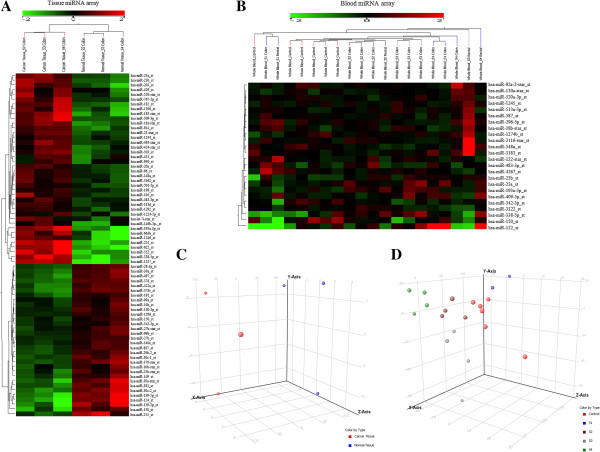
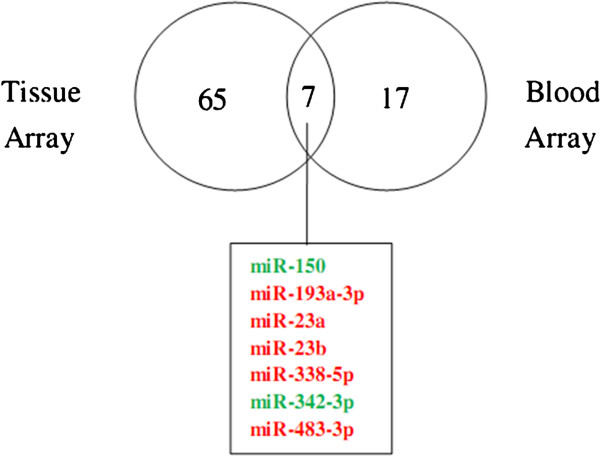
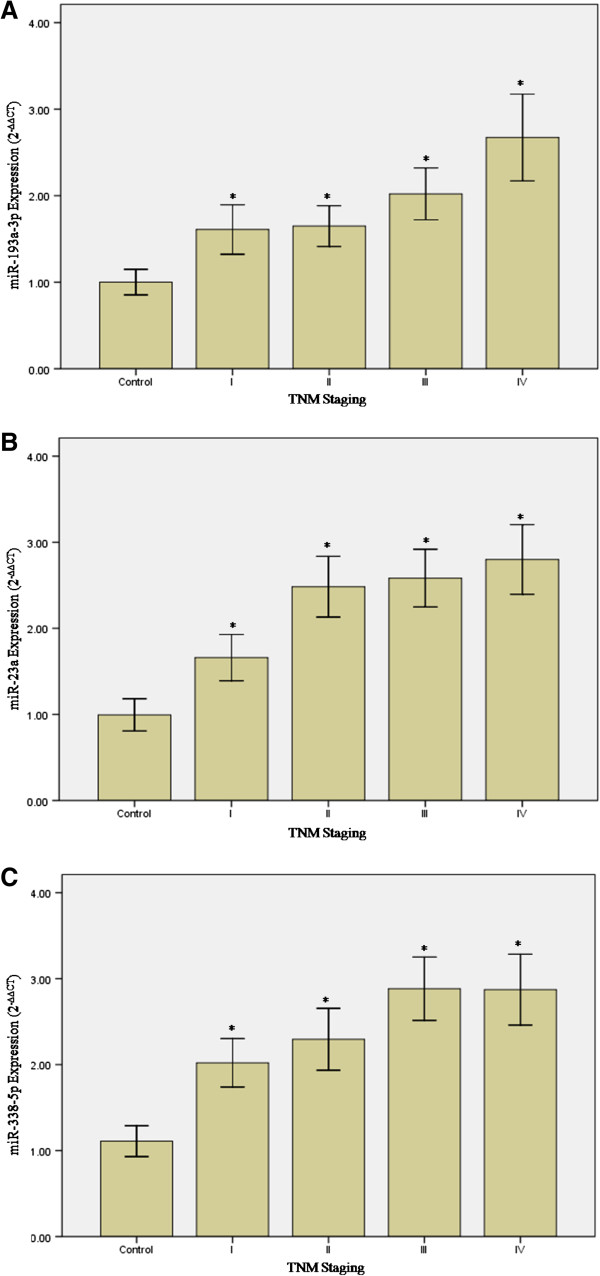
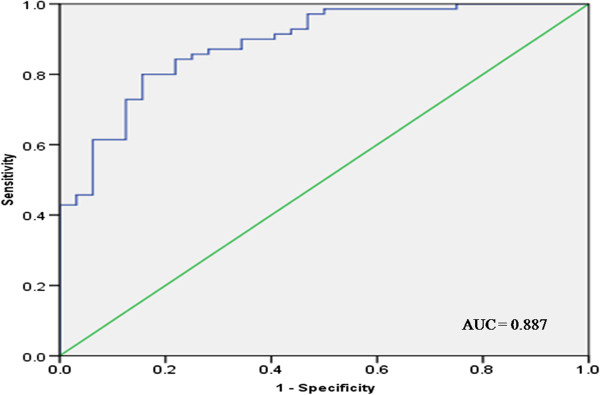
BACKGROUND: MicroRNAs (miRNAs) are short, non-coding RNA molecules that act as regulators of gene expression. Circulating blood miRNAs offer great potential as cancer biomarkers. The objective of this study was to correlate the differential expression of miRNAs in tissue and blood in the identification of biomarkers for early detection of colorectal cancer (CRC). METHODS: The study was divided into two phases: (I) Marker discovery by miRNA microarray using paired cancer tissues (n = 30) and blood samples (CRC, n = 42; control, n = 18). (II) Marker validation by stem-loop reverse transcription real time PCR using an independent set of paired cancer tissues (n = 30) and blood samples (CRC, n = 70; control, n = 32). Correlation analysis was determined by Pearson's test. Logistic regression and receiver operating characteristics curve analyses were applied to obtain diagnostic utility of the miRNAs. RESULTS: Seven miRNAs (miR-150, miR-193a-3p, miR-23a, miR-23b, miR-338-5p, miR-342-3p and miR-483-3p) have been found to be differentially expressed in both tissue and blood samples. Significant positive correlations were observed in the tissue and blood levels of miR-193a-3p, miR-23a and miR-338-5p. Moreover, increased expressions of these miRNAs were detected in the more advanced stages. MiR-193a-3p, miR-23a and miR-338-5p were demonstrated as a classifier for CRC detection, yielding a receiver operating characteristic curve area of 0.887 (80.0% sensitivity, 84.4% specificity and 83.3% accuracy). CONCLUSION: Dysregulations in circulating blood miRNAs are reflective of those in colorectal tissues. The triple miRNA classifier of miR-193a-3p, miR-23a and miR-338-5p appears to be a potential blood biomarker for early detection of CRC.
Overview
The claims and statistics of this paper haven’t been checked yet.
Run the check — free, no account needed. It reads the open-access text and checks the sources it cites.
Integrity signals
Registry
Cites
Statistics
Figures
Verification
Claims the paper makes
The claims and statistics of this paper haven’t been checked yet.
Run the check — free, no account needed. It reads the open-access text and checks the sources it cites.
Claims other papers make about this one
Each is checked against this paper’s own text: does it say what the citing paper says it does?
The source backs part of the claim, not all of it — or backs it for a different population, condition or comparison.
In the citing paper
“upregulation of miR-23 expression has been detected in both colorectal cancer and gastric cancer patients, such as in serum exosomes, blood tissues, and gastric cancer tissues [[78], [79], [80]].”
From Recent advances of miR-23 in human diseases and growth development (2025) · cites this paper as [79]
Experimental — accuracy not yet measured
Self-check
Percentages, sums and reported differences re-computed from the paper’s own numbers.
The self-check needs the paper’s full text.
Citations
Cites
Jemal, A., Bray, F., Ferlay, J., Ward, E., & Forman, D. (2011) · CA A Cancer Journal for Clinicians · doi:10.3322/caac.20107 · Cited by 55,077
Bartel (2004) · doi:10.1016/s0092-8674(04)00045-5 · Cited by 34,714
The C. elegans heterochronic gene lin-4 encodes small RNAs with antisense complementarity to lin-14
Lee, R. C., Feinbaum, R. L., & Ambros, V. (1993) · Cell · doi:10.1016/0092-8674(93)90529-y · Cited by 12,948
Valadi, H., Ekström, K., Bossios, A., Sjöstrand, M., Lee, J. J., & Lötvall, J. O. (2007) · Nature Cell Biology · doi:10.1038/ncb1596 · Cited by 12,834
Exploration, normalization, and summaries of high density oligonucleotide array probe level data
Irizarry, R. A. (2003) · Biostatistics · doi:10.1093/biostatistics/4.2.249 · Cited by 10,603
Oncomirs—MicroRNAs with a role in cancer
Esquela-Kerscher, A., & Slack, F. J. (2006) · Nature Reviews Cancer · doi:10.1038/nrc1840 · Cited by 5,884
A microRNA expression signature of human solid tumors defines cancer gene targets
Volinia, S., Calin, G. A., Liu, C.-G., Ambs, S., Cimmino, A., Petrocca, F., Visone, R., Iorio, M., Roldo, C., Ferracin, M., et al. (2006) · Proceedings of the National Academy of Sciences · doi:10.1073/pnas.0510565103 · Cited by 5,697
Chen, X., Ba, Y., Ma, L., Cai, X., Yin, Y., Wang, K., Guo, J., Zhang, Y., Chen, J., Guo, X., et al. (2008) · Cell Research · doi:10.1038/cr.2008.282 · Cited by 4,560
Human microRNA genes are frequently located at fragile sites and genomic regions involved in cancers
Calin, G. A., Sevignani, C., Dumitru, C. D., Hyslop, T., Noch, E., Yendamuri, S., Shimizu, M., Rattan, S., Bullrich, F., Negrini, M., et al. (2004) · Proceedings of the National Academy of Sciences · doi:10.1073/pnas.0307323101 · Cited by 4,096
miRBase: integrating microRNA annotation and deep-sequencing data
Kozomara, A., & Griffiths-Jones, S. (2011) · Nucleic Acids Research · doi:10.1093/nar/gkq1027 · Cited by 3,634
Research works printed but not linked: 2
- American Cancer Society: Cancer Facts & Figures 2012. 2012, Atlanta: American Cancer Society
- Zainal Ariffin O, Nor Saleha IT: National Cancer Registry Report 2007. 2011, Malaysia: Ministry of Healthy
Cited by
Sorted by citations
A microfluidics-based in vitro model of the gastrointestinal human–microbe interface
Shah, P., Fritz, J. V., Glaab, E., Desai, M. S., Greenhalgh, K., Frachet, A., Niegowska, M., Estes, M., Jäger, C., Seguin-Devaux, C., et al. (2016) · Nature Communications · doi:10.1038/ncomms11535 · Cited by 660
Circulating miRNAs: Roles in cancer diagnosis, prognosis and therapy
Cheng, G. (2014) · Advanced Drug Delivery Reviews · doi:10.1016/j.addr.2014.09.001 · Cited by 339
MicroRNAs as Potential Biomarkers in Cancer: Opportunities and Challenges
Lan, H., Lu, H., Wang, X., & Jin, H. (2015) · BioMed Research International · doi:10.1155/2015/125094 · Cited by 333
MicroRNAs as Peripheral Biomarkers in Aging and Age-Related Diseases
Kumar, S., Vijayan, M., Bhatti, J. S., & Reddy, P. H. (2017) · Progress in molecular biology and translational science · doi:10.1016/bs.pmbts.2016.12.013 · Cited by 226
Colorectal Cancer Biomarkers: Where Are We Now?
González‐Pons, M., & Cruz-Correa, M. R. (2015) · BioMed Research International · doi:10.1155/2015/149014 · Cited by 214
Metadata
- Authors
- Yong, F. L., Law, C. W., & Wang, C. W.
- Affiliations
- University of Malaya (MY)
- Mahsa University (MY)
- Corresponding author
- Yong, Fung Lin
- Venue
- BMC Cancer
- Published
- 2013-06-08
- Volume
- 13
- Issue
- 1
- Pages
- 280-280
- ISSN
- 1471-2407 (ISSN-L)
- PMC
- PMC3691634
- OpenAlex
- W2057318887
- Cited by
- 176
- References
- 65
- Citations by year
- 2026: 2 · 2025: 1 · 2024: 5 · 2023: 7 · 2022: 6 · 2021: 9 · 2020: 17 · 2019: 20 · 2018: 17 · 2017: 23 · 2016: 23 · 2015: 20 · 2014: 22 · 2013: 4
- FWCI
- 8.09
- Type
- journal article
- Language
- en
- Open access
- gold
- doi.org
- Licence
- Locations
- BMC Cancer (publishedVersion, cc-by)
- Europe PMC (PubMed Central) (publishedVersion, cc-by)
- PubMed Central (publishedVersion, cc-by)
- PubMed (publishedVersion)
- Funders
- Universiti Malaya (PV020-2011A, RG313-11HTM)
- Topics
- Life Sciences › Biochemistry, Genetics and Molecular Biology › Cancer Research › MicroRNA in disease regulation
- Life Sciences › Biochemistry, Genetics and Molecular Biology › Cancer Research › Cancer-related molecular mechanisms research
- Life Sciences › Biochemistry, Genetics and Molecular Biology › Molecular Biology › Extracellular vesicles in disease
- Keywords
- colorectal cancer, early cancer detection, circulating microRNAs, blood-based biomarkers, miR-193a-3p, miR-23a, miR-338-5p, miRNA expression profiling, tumor staging, diagnostic accuracy
- MeSH terms
- Aged, Colonic Neoplasms, Female, Humans, Male, Middle Aged, ROC Curve, Sensitivity and Specificity, Biomarkers, Tumor, Reverse Transcriptase Polymerase Chain Reaction, Oligonucleotide Array Sequence Analysis, MicroRNAs, Early Detection of Cancer, Real-Time Polymerase Chain Reaction
About these checks
Registry, retraction, Cites and statistics results are computed, not judged, with one exception: a printed reference that no index lists is read once by a model before it counts as a citation error. Claims are extracted by a model and kept only when their quote appears verbatim in the text; each cited source is then checked, with a model’s help, for whether it says what the claim relies on. Those verdicts can be wrong — read the claim’s quote and the cited source before relying on one.
Statistics and arithmetic are recomputed, not judged.
Confidence bands are shown only for fields calibrated on our annotated test set. None is calibrated yet, so no band is shown.
What counts as a claim ›How we measure confidence ›How we check this ›
Are you an author, or do you see a problem with this page? Request a review
