

The DOI matches its Crossref record; 43 of the 43 references it cites were found in a registry or an index.
Identification of the collagen type 1 alpha 1 gene (COL1A1) as a candidate survival-related factor associated with hepatocellular carcinoma
Open accessAbstract
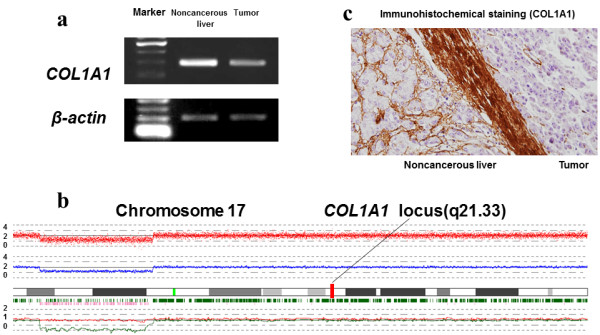
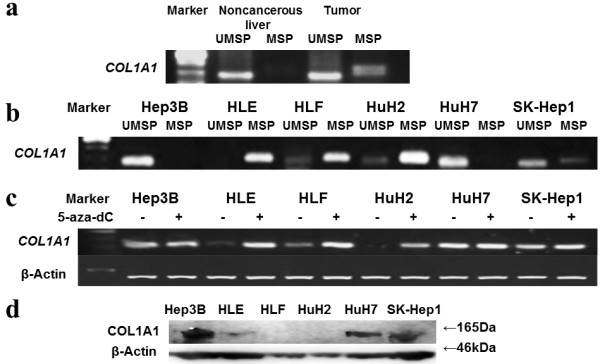
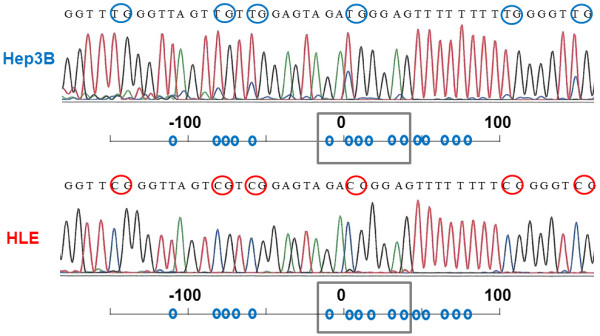
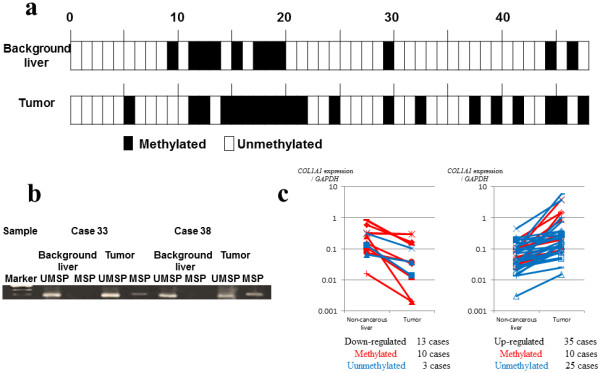
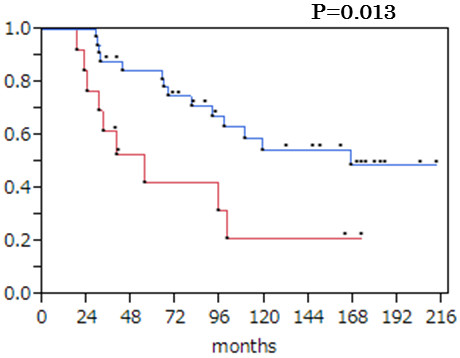
BACKGROUND: Hepatocellular carcinoma (HCC) is one of the major causes of cancer-related death especially among Asian and African populations. It is urgent that we identify carcinogenesis-related genes to establish an innovative treatment strategy for this disease. METHODS: Triple-combination array analysis was performed using one pair each of HCC and noncancerous liver samples from a 68-year-old woman. This analysis consists of expression array, single nucleotide polymorphism array and methylation array. The gene encoding collagen type 1 alpha 1 (COL1A1) was identified and verified using HCC cell lines and 48 tissues from patients with primary HCC. RESULTS: Expression array revealed that COL1A1 gene expression was markedly decreased in tumor tissues (log2 ratio -1.1). The single nucleotide polymorphism array showed no chromosomal deletion in the locus of COL1A1. Importantly, the methylation value in the tumor tissue was higher (0.557) than that of the adjacent liver tissue (0.008). We verified that expression of this gene was suppressed by promoter methylation. Reactivation of COL1A1 expression by 5-aza-2'-deoxycytidine treatment was seen in HCC cell lines, and sequence analysis identified methylated CpG sites in the COL1A1 promoter region. Among 48 pairs of surgical specimens, 13 (27.1%) showed decreased COL1A1 mRNA expression in tumor sites. Among these 13 cases, 10 had promoter methylation at the tumor site. The log-rank test indicated that mRNA down-regulated tumors were significantly correlated with a poor overall survival rate (P = 0.013). CONCLUSIONS: Triple-combination array analysis successfully identified COL1A1 as a candidate survival-related gene in HCCs. Epigenetic down-regulation of COL1A1 mRNA expression might have a role as a prognostic biomarker of HCC.
Overview
The claims and statistics of this paper haven’t been checked yet.
Run the check — free, no account needed. It reads the open-access text and checks the sources it cites.
Integrity signals
Registry
Cites
Statistics
Figures
Verification
Claims the paper makes
The claims and statistics of this paper haven’t been checked yet.
Run the check — free, no account needed. It reads the open-access text and checks the sources it cites.
Claims other papers make about this one
Each is checked against this paper’s own text: does it say what the citing paper says it does?
In the citing paper
“In three breast cancer tissues, H&E regions corresponding to tumor tissue showed high similarity with the bulk RNA-seq data from tumor biopsies, which include tumor-related markers such as COL1A1 (ref. 38) and ACTB39 (Fig. 3b and Supplementary Fig. 5).”
From A visual–omics foundation model to bridge histopathology with spatial transcriptomics (2025) · cites this paper as [38]
Self-check
Percentages, sums and reported differences re-computed from the paper’s own numbers.
The self-check needs the paper’s full text.
Citations
Cites
Jemal, A., Bray, F., Ferlay, J., Ward, E., & Forman, D. (2011) · CA A Cancer Journal for Clinicians · doi:10.3322/caac.20107 · Cited by 55,077
El-Serag, H. B. (2011) · New England Journal of Medicine · doi:10.1056/nejmra1001683 · Cited by 3,529
Decitabine improves patient outcomes in myelodysplastic syndromes
Kantarjian, H. M., Issa, J. J., Rosenfeld, C. S., Bennett, J. M., Albitar, M. X., DiPersio, J. F., Klimek, V. M., Slack, J. L., de Castro, C., Ravandi, F., et al. (2006) · Cancer · doi:10.1002/cncr.21792 · Cited by 1,539
Hotary, K. B., Allen, E. D., Brooks, P. C., Datta, N. S., Long, M. W., & Weiss, S. J. (2003) · Cell · doi:10.1016/s0092-8674(03)00513-0 · Cited by 674
Over- and under-expressed microRNAs in human colorectal cancer
Mori (2009) · International Journal of Oncology · doi:10.3892/ijo_00000233 · Cited by 349
Huang, J., Wang, Y., Guo, Y., & Sun, S. (2010) · Hepatology · doi:10.1002/hep.23660 · Cited by 345
Zeller, C., Dai, W., Steele, N. L., Siddiq, A., Walley, A. J., Wilhelm-Benartzi, C. S., Rizzo, S., van der Zee, A. G. J., Plumb, J. A., & Brown, R. E. (2012) · Oncogene · doi:10.1038/onc.2011.611 · Cited by 286
Genome-wide screen of promoter methylation identifies novel markers in melanomaPreprint
Koga, Y., Pelizzola, M., Cheng, E., Krauthammer, M. O., Sznol, M., Ariyan, S., Narayan, D., Molinaro, A. M., Halaban, R., & Weissman, S. M. (2009) · Genome Research · doi:10.1101/gr.091447.109 · Cited by 197
Ishigami, K., Yoshimitsu, K., Nishihara, Y., Irié, H., Asayama, Y., Tajima, T., Nishie, A., Hirakawa, M., Ushijima, Y., Okamoto, D., et al. (2008) · Radiology · doi:10.1148/radiol.2501071702 · Cited by 188
Identification of Novel Target Genes by an Epigenetic Reactivation Screen of Renal Cancer
de Cáceres, I. I., Dulaimi, E., Hoffman, A. M., Al‐Saleem, T., Uzzo, R. G., & Cairns, P. (2006) · Cancer Research · doi:10.1158/0008-5472.can-05-3365 · Cited by 154
Research works printed but not linked: 1
- Saito Y, Hibino S, Saito H: Alterations of epigenetics and microRNA in hepatocellular carcinoma. Hepatol Res. in press
Cited by
Sorted by citations
Ma, H., Chang, H., Bamodu, O. A., Yadav, V. K., Huang, T., Wu, A. T. H., Yeh, C., Tsai, S. H., & Lee, W. (2019) · Cancers · doi:10.3390/cancers11060786 · Cited by 212
Identification of COL1A1 and COL1A2 as candidate prognostic factors in gastric cancer
Li, J., Ding, Y., & Li, A. (2016) · World Journal of Surgical Oncology · doi:10.1186/s12957-016-1056-5 · Cited by 199
MiR-129-5p suppresses gastric cancer cell invasion and proliferation by inhibiting COL1A1
Wang, Q., & Yu, J. (2017) · Biochemistry and Cell Biology · doi:10.1139/bcb-2016-0254 · Cited by 127
A visual–omics foundation model to bridge histopathology with spatial transcriptomics
Chen, W., Zhang, P., Tran, T. N., Xiao, Y., Li, S., Shah, V. V., Cheng, H., Brannan, K. W., Youker, K., Lai, L., et al. (2025) · Nature Methods · doi:10.1038/s41592-025-02707-1 · Cited by 118
“38) and ACTB 39 (Fig.”
He, B., Lin, X., Tian, F., Yu, W., & Qiao, B. (2017) · Journal of Cellular Biochemistry · doi:10.1002/jcb.26182 · Cited by 116
Metadata
- Authors
- Hayashi, M., Nomoto, S., Hishida, M., Inokawa, Y., Kanda, M., Okamura, Y., Nishikawa, Y., Tanaka, C., Kobayashi, D., Yamada, S., Nakayama, G., Fujii, T., Sugimoto, H., Koike, M., Fujiwara, M., Takeda, S., & Kodera, Y.
- Affiliations
- Nagoya University (JP)
- Corresponding author
- Nomoto, Shuji
- ORCID
- Venue
- BMC Cancer
- Published
- 2014-02-19
- Volume
- 14
- Issue
- 1
- Pages
- 108-108
- ISSN
- 1471-2407 (ISSN-L)
- PMC
- PMC4015503
- OpenAlex
- W2152909439
- Cited by
- 101
- References
- 43
- Citations by year
- 2026: 2 · 2025: 6 · 2024: 4 · 2023: 7 · 2022: 17 · 2021: 16 · 2020: 14 · 2019: 10 · 2018: 5 · 2017: 7 · 2016: 7 · 2015: 4 · 2014: 1
- FWCI
- 2.60
- Type
- journal article
- Language
- en
- Open access
- gold
- doi.org
- Licence
- Locations
- BMC Cancer (publishedVersion, cc-by)
- Europe PMC (PubMed Central) (publishedVersion, cc-by)
- PubMed Central (publishedVersion, cc-by)
- PubMed (publishedVersion)
- Funders
- Japan Society for the Promotion of Science (22591427)
- Topics
- Life Sciences › Biochemistry, Genetics and Molecular Biology › Molecular Biology › Epigenetics and DNA Methylation
- Health Sciences › Medicine › Hepatology › Hepatocellular Carcinoma Treatment and Prognosis
- Life Sciences › Biochemistry, Genetics and Molecular Biology › Cancer Research › Cancer-related molecular mechanisms research
- Keywords
- hepatocellular carcinoma, COL1A1, promoter methylation, epigenetic silencing, gene downregulation, prognostic factors, overall survival, decitabine, single nucleotide polymorphism array, DNA methylation arrays
- MeSH terms
- Collagen Type I, alpha 1 Chain, Aged, Base Sequence, Female, Carcinoma, Hepatocellular, Humans, Liver Neoplasms, Molecular Sequence Data, Survival Rate, Collagen Type I, Cell Line, Tumor, Genetic Association Studies
About these checks
Registry, retraction, Cites and statistics results are computed, not judged, with one exception: a printed reference that no index lists is read once by a model before it counts as a citation error. Claims are extracted by a model and kept only when their quote appears verbatim in the text; each cited source is then checked, with a model’s help, for whether it says what the claim relies on. Those verdicts can be wrong — read the claim’s quote and the cited source before relying on one.
Statistics and arithmetic are recomputed, not judged.
Confidence bands are shown only for fields calibrated on our annotated test set. None is calibrated yet, so no band is shown.
What counts as a claim ›How we measure confidence ›How we check this ›
Are you an author, or do you see a problem with this page? Request a review
