

Young age: an independent risk factor for disease-free survival in women with operable breast cancer
Open accessThe DOI matches its Crossref record; 40 of the 42 references it cites were found in a registry or an index.
Abstract
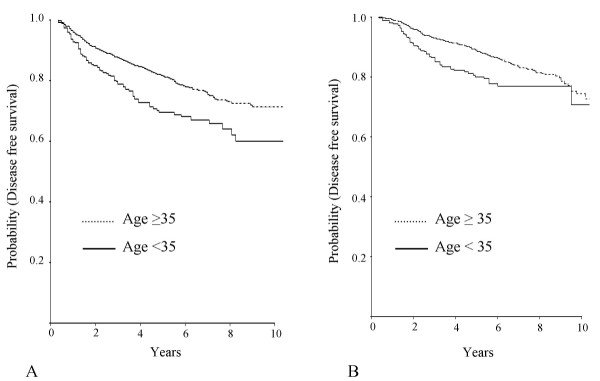
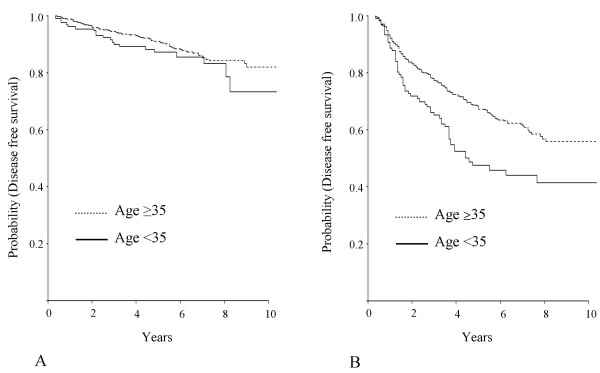
BACKGROUND: The incidence of breast cancer in young women (age < 35) is low. The biology of the disease in this age group is poorly understood, and there are conflicting data regarding the prognosis for these women compared to older patients. METHODS: We retrospectively analyzed 2040 consecutive primary invasive breast cancer patients who underwent surgical procedures at our institution between 1990 and 1999. The younger age group was defined as patients aged <35 years at the time of diagnosis. The clinicopathological characteristics and treatment outcomes were compared between younger and older age groups. RESULTS: A total of 256 (12.5%) patients were aged <35. There was a significantly higher incidence of nuclear grade 3 and medullary histological-type tumors in younger patients compared to older patients. Axillary lymph node status, T stage, histological grade, c-erbB2 expression and estrogen receptor status did not differ significantly between the two age groups. Younger patients had a greater probability of recurrence and death at all time periods. Although there was no significant difference in disease-free survival between the two age groups in lymph node-negative patients, the younger group showed worse prognosis among lymph node-positive patients (p < 0.001). In multivariate analysis, young age remained a significant predictor of recurrence (p = 0.010). CONCLUSION: Young age (<35) is an independent risk factor for relapse in operable breast cancer patients.
Overview
The claims and statistics of this paper haven’t been checked yet.
Free: it reads the open-access text and checks the first 5 claims that cite a source we can check. Create a free account to check every claim.
Integrity signals
Registry
Cites
Statistics
Figures
Verification
Claims the paper makes
The claims and statistics of this paper haven’t been checked yet.
Free: it reads the open-access text and checks the first 5 claims that cite a source we can check. Create a free account to check every claim.
Claims other papers make about this one
Each is checked against this paper’s own text: does it say what the citing paper says it does?
The source backs part of the claim, not all of it — or backs it for a different population, condition or comparison.
In the citing paper
“Young age (<35) is also a risk factor for relapse in operable breast cancer patients all subtypes confounded, 271 suggesting a completely different biology of the disease in young versus elderly individuals.”
From Meta-hallmarks of aging and cancer (2023) · cites this paper as [271]
Experimental — accuracy not yet measured
Self-check
Percentages, sums and reported differences re-computed from the paper’s own numbers.
The self-check needs the paper’s full text.
Citations
Cites
Regression Models and Life-Tables
Cox, D. R. (1972) · Journal of the Royal Statistical Society Series B: Statistical Methodology · doi:10.1111/j.2517-6161.1972.tb00899.x · Cited by 39,793
Nonparametric Estimation from Incomplete Observations
Kaplan, E. L., & Meier, P. (1958) · Journal of the American Statistical Association · doi:10.1080/01621459.1958.10501452 · Cited by 39,158
Regression Models and Life-Tables
Cox, D. R. (1992) · Springer Series in Statistics · doi:10.1007/978-1-4612-4380-9_37 · Cited by 26,297
Linkage of Early-Onset Familial Breast Cancer to Chromosome 17q21
Hall, J. M., Lee, M. K., Newman, B., Morrow, J. E., Anderson, L. A., Huey, B., & King, M.-C. (1990) · Science · doi:10.1126/science.2270482 · Cited by 2,550 · cited 1×
“It is known that young breast cancer patients are more likely to have an inherited form of the disease [37].”
BackgroundBeahrs, O. H., & Henson, D. E. (1992) · Medical Entomology and Zoology · Cited by 2,460
Statistical Models and Methods for Lifetime Data
Schafer, R. E. (1983) · Technometrics · doi:10.1080/00401706.1983.10487833 · Cited by 2,094
Prevalence of BRCA1 and BRCA2 Gene Mutations in Patients With Early-Onset Breast Cancer
Peto, J., Collins, N., Barfoot, R., Seal, S., Warren, W., Rahman, N., Easton, D. F., Evans, C., Deacon, J., & Stratton, M. R. (1999) · JNCI Journal of the National Cancer Institute · doi:10.1093/jnci/91.11.943 · Cited by 873 · cited 1×
“Up to 15–30% of women aged less than 35 years diagnosed with breast cancer are likely to have germ-line BRCA1 or BRCA2 mutations [35,36].”
BackgroundMeeting Highlights: International Consensus Panel on the Treatment of Primary Breast Cancer
Goldhirsch, A., Wood, W. C., Senn, H.-J., Glick, J. H., & Gelber, R. D. (1995) · JNCI: Journal of the National Cancer Institute · doi:10.1093/jnci/87.19.1441 · Cited by 689
Meeting Highlights: International Consensus Panel on the Treatment of Primary Breast Cancer
Goldhirsch, A., Glick, J. H., Gelber, R. D., Coates, A. S., & Senn, H.-J. (2001) · Journal of Clinical Oncology · doi:10.1200/jco.2001.19.18.3817 · Cited by 582
Nixon, A. J., Neuberg, D., Hayes, D. F., Gelman, R., Connolly, J. L., Schnitt, S., Abner, A., Recht, A., Vicini, F., & Harris, J. R. (1994) · Journal of Clinical Oncology · doi:10.1200/jco.1994.12.5.888 · Cited by 579 · cited 2×
“While some studies have found that younger patients have worse clinical outcomes than older patients [3-7], others report younger patients have a more favorable prognosis, or that there is no relationship between outcome and age [8-10].”
Result
Research works printed but not linked: 2
- Yoo KY Park SK Sung JH Kang D Kim YC Kang HS Suh JS Kim JS Yun IJ Han S Noh DY Choe KJ High risk groups for female breast cancer in Korea J Korean Cancer Ass 1998 30 435 439
- Korea Central Cancer Registry, Ministry of Health and Welfare, Republic of Korea 2002 Annual Report of the Korea Central Cancer Registry Seoul 2003
Cited by
Breast cancer in young women: an overview
Anastasiadi, Z., Lianos, G. D., Ignatiadou, E., Harissis, H. V., & Mitsis, M. (2017) · Updates in Surgery · doi:10.1007/s13304-017-0424-1 · Cited by 603
“Recent evidence suggests that young age at diagnosis of breast cancer represent an independent prognostic factor of survival [18].”
BackgroundMeta-hallmarks of aging and cancer
López-Otín, C., Pietrocola, F., Roiz-Valle, D., Galluzzi, L., & Kroemer, G. (2023) · Cell Metabolism · doi:10.1016/j.cmet.2022.11.001 · Cited by 529
Age, Breast Cancer Subtype Approximation, and Local Recurrence After Breast-Conserving Therapy
Arvold, N. D., Taghian, A. G., Niemierko, A., Abi Raad, R. F., Sreedhara, M., Nguyen, P. L., Bellon, J. R., Wong, J. S., Smith, B. L., & Harris, J. R. (2011) · Journal of Clinical Oncology · doi:10.1200/jco.2011.36.1105 · Cited by 452
“Young patient age has been reported to be a poor prognostic factor among women with breast cancer (BC).(1-4) Studies have variously defined young age as age at diagnosis younger than 35, 40, 45, or even 50 years, with reports demonstrating higher rates of local recurrence (LR) and lower survival when young women are c…”
BackgroundEffects of Age on the Detection and Management of Breast Cancer
McGuire, A., Brown, J., Malone, C., McLaughlin, R., & Kerin, M. (2015) · Cancers · doi:10.3390/cancers7020815 · Cited by 374
“Prognosis of patients varies with age, as younger women tend to have more aggressive tumours (such as triple negative) and a higher recurrence rate [136–141].”
BackgroundEpidemiology and prognosis of breast cancer in young women.
Assi, H., Khoury, K. E., Dbouk, H., Khalil, L. E., Mouhieddine, T. H., & Saghir, N. S. E. (2013) · PubMed · doi:10.3978/j.issn.2072-1439.2013.05.24 · Cited by 306
“Although the diagnosis of breast cancer is much less common in women under the age of 40 years, it can have a greater impact than in older counterparts, as it tends to present at a later stage, be more aggressive and have a poorer prognosis (8,9).”
BackgroundAhn, S. H., Son, B. H., Kim, S. W., Kim, S. I., Jeong, J., Ko, S.-S., & Han, W. (2007) · Journal of Clinical Oncology · doi:10.1200/jco.2006.10.3754 · Cited by 279
Self-citationCollins, L. C., Marotti, J. D., Gelber, S., Cole, K., Ruddy, K., Kereakoglow, S., Brachtel, E. F., Schapira, L., Come, S. E., Winer, E. P., et al. (2012) · Breast Cancer Research and Treatment · doi:10.1007/s10549-011-1872-9 · Cited by 271
“Young women diagnosed with breast cancer have been shown to have a poorer prognosis compared to older women [1, 3, 27].”
BackgroundAsian ethnicity and breast cancer subtypes: a study from the California Cancer Registry
Telli, M. L., Chang, E. T., Kurian, A. W., Keegan, T. H. M., McClure, L. A., Lichtensztajn, D., Ford, J. M., & Gomez, S. L. (2011) · Breast Cancer Research and Treatment · doi:10.1007/s10549-010-1173-8 · Cited by 174
“Breast cancer occurs at a younger age in Asia, and the postmenopausal rise in breast cancer incidence observed in Western populations is not seen in most Asian populations [14, 20, 42].”
The Korean Breast Cancer Society, Han, W., & Kang, S. Y. (2010) · Breast Cancer Research and Treatment · doi:10.1007/s10549-009-0388-z · Cited by 159
Self-citationAge at diagnosis in relation to survival following breast cancer: a cohort study
Brandt, J., Garne, J., Tengrup, I., & Manjer, J. (2015) · World Journal of Surgical Oncology · doi:10.1186/s12957-014-0429-x · Cited by 158
“Several previous studies have also found young women to have a higher BCSM than other age groups [6-10,13,24-29].”
Unique Features of Young Age Breast Cancer and Its Management
Lee, H., & Han, W. (2014) · Journal of Breast Cancer · doi:10.4048/jbc.2014.17.4.301 · Cited by 168
“YABC patients were found to have a poorer prognosis than older women with breast cancer, even after adjusting for the delay in diagnosis of younger patients [37-39].”
BackgroundSelf-citationBreast Cancer in Young Women in Latin America: An Unmet, Growing Burden
Villarreal-Garza, C. M., Águila, C., Magallanes-Hoyos, M. C., Mohar, A., Bargalló, E., Meneses, A., Cazap, E. L., Gómez, H., López‐Carrillo, L., Chávarri-Guerra, Y., et al. (2013) · The Oncologist · doi:10.1634/theoncologist.2013-0321 · Cited by 135
Ten-year survival in women with primary stage IV breast cancer
Eng, L. G., Dawood, S. S., Sopik, V., Haaland, B. A., Tan, P. S., Bhoo‐Pathy, N., Warner, E., Iqbal, J., Narod, S. A., & Dent, R. A. (2016) · Breast Cancer Research and Treatment · doi:10.1007/s10549-016-3974-x · Cited by 146
“Young women with breast cancer are more likely to have adverse prognostic features such as positive nodes, high tumour grade, negative oestrogen and progesterone receptor expression and overexpression of HER2; the adverse prognostic effect of young age persists even after controlling for these factors [7, 8].”
Trajectories of fear of cancer recurrence in young breast cancer survivors
Schapira, L., Zheng, Y., Gelber, S. I., Poorvu, P., Ruddy, K. J., Tamimi, R. M., Peppercorn, J., Come, S. E., Borges, V. F., Partridge, A. H., et al. (2022) · Cancer · doi:10.1002/cncr.33921 · Cited by 126
Underweight and Breast Cancer Recurrence and Death: A Report From the Korean Breast Cancer Society
Moon, H., Han, W., & Noh, D. (2009) · Journal of Clinical Oncology · doi:10.1200/jco.2009.22.4436 · Cited by 131
Self-citationModern surgical treatment of breast cancer
Riis, M. L. H. (2020) · Annals of Medicine and Surgery · doi:10.1016/j.amsu.2020.06.016 · Cited by 154
Partridge, A. H., Gelber, S. I., Piccart, M. J., Focant, F., Scullion, M. J., Holmes, E. M., Winer, E. P., & Gelber, R. D. (2013) · Journal of Clinical Oncology · doi:10.1200/jco.2012.44.1956 · Cited by 110
Elkum, N. B., Dermime, S., Ajarim, D. S., Alzahrani, A. S., Alsayed, A., Tulbah, A. M., Malik, O. A., Alshabanah, M., Ezzat, A. A., & Al‐Tweigeri, T. (2007) · BMC Cancer · doi:10.1186/1471-2407-7-222 · Cited by 108
Does iron have a role in breast cancer?
Huang, X. (2008) · The Lancet Oncology · doi:10.1016/s1470-2045(08)70200-6 · Cited by 108
Epidemiology of Breast Cancer in Young Women
Yankaskas, B. C. (2006) · Breast Disease · doi:10.3233/bd-2006-23102 · Cited by 104
“A few studies found no independent effect of age [6,28, 29]; others have reported that age remained as an independent risk factor [21,30,31].”
Breast Cancer in Young Women: Pathologic and Immunohistochemical Features
Erić, I. (2018) · Acta Clinica Croatica · doi:10.20471/acc.2018.57.03.13 · Cited by 94
Youness, R. A., Hafez, H. M., Khallaf, E., Assal, R. A., Motaal, A. A. A., & Gad, M. Z. (2019) · Journal of Cellular Physiology · doi:10.1002/jcp.28629 · Cited by 94
“Moreover, recent evidence suggests that young age at diagnosis of TNBC represent an independent demolishing prognostic factor of survival (Han et al., 2004).”
BackgroundColleoni, M. A., Rotmensz, N., Peruzzotti, G., Maisonneuve, P., Orlando, L., Ghisini, R., Viale, G., Pruneri, G., Veronesi, P., Luini, A., et al. (2006) · Annals of Oncology · doi:10.1093/annonc/mdl145 · Cited by 89
“Similar results, indicating an interaction between age and ER status in premenopausal women treated with chemotherapy alone, was observed in a retrospective analysis conducted by three major US cooperative groups and the International Breast Cancer Study Group (IBCSG) [7].”
BackgroundResultInfluentialTumor Biology of Breast Cancer in Young Women
Klauber‐DeMore, N. (2006) · Breast Disease · doi:10.3233/bd-2006-23103 · Cited by 90
Kim, E., Noh, W. C., Han, W., & Noh, D. (2011) · World Journal of Surgery · doi:10.1007/s00268-011-1071-1 · Cited by 82
“In Korea, the proportion of young (\35 years) patients is much higher and ranges from 12.5 to 14.6% [ 3 , 4]. The KBCS reported that breast cancer peaks in the fifth decade (40.0% of patients) and is relatively uncommon in women over 70 years old [21].”
BackgroundInfluentialSelf-citationAging impacts transcriptomes but not genomes of hormone-dependent breast cancers
Yau, C. S. F., Fedele, V., Roydasgupta, R., Fridlyand, J., Hubbard, A., Gray, J. W., Chew, K., Dairkee, S. H., Moore, D. H., Schittulli, F., et al. (2007) · Breast Cancer Research · doi:10.1186/bcr1765 · Cited by 89
Impact of lifestyle and psychological stress on the development of early onset breast cancer
Li, P., Huang, J., Wu, H., Fu, C., Li, Y., & Qiu, J. (2016) · Medicine · doi:10.1097/md.0000000000005529 · Cited by 82
“5% to 12% of all patients with breast cancer in Asia are within this young age range.([2]) Recently, the rate of breast cancer diagnosis has rapidly increased in young women in China, and the mortality rate among these young patients is higher than among those who are older.”
BackgroundPoorvu, P. D., Gelber, S. I., Rosenberg, S. M., Ruddy, K. J., Tamimi, R. M., Collins, L. C., Peppercorn, J. M., Schapira, L., Borges, V. F., Come, S. E., et al. (2019) · Journal of Clinical Oncology · doi:10.1200/jco.19.01959 · Cited by 73
Pregnancy and post-partum breast cancer: a prospective study.
Mathelin, C., Annane, K., Treisser, A., Chenard, M., Tomasetto, C., Bellocq, J., & Rio, M. (2008) · PubMed · Cited by 74
The work life and career development of young breast cancer survivors.
Raque‐Bogdan, T. L., Hoffman, M. A., Ginter, A. C., Piontkowski, S., Schexnayder, K., & White, R. (2015) · Journal of Counseling Psychology · doi:10.1037/cou0000068 · Cited by 87
“Young survivors have a poorer prognosis than do older survivors, including a higher risk for cancer recurrence and death (Han et al., 2004), greater decreases in cognitive functioning (Arndt et al.”
BackgroundBreast Cancer in Young Women in Latin America: An Unmet, Growing Burden
Villarreal-Garza, C. M., Águila, C., Magallanes-Hoyos, M. C., Mohar, A., Bargalló, E., Meneses, A., Cazap, E. L., Gómez, H., López‐Carrillo, L., Chávarri-Guerra, Y., et al. (2013) · The Oncologist · doi:10.1634/theoncologist.18-s2-26 · Cited by 75
Figueiredo, J. C., Ennis, M., Knight, J. A., McLaughlin, J. R., Hood, N., O’Malley, F. P., Andrulis, I. L., & Goodwin, P. J. (2006) · Breast Cancer Research and Treatment · doi:10.1007/s10549-006-9433-3 · Cited by 64
“While some studies suggest that diagnosis at a young age is an adverse independent prognostic factor [17, 19, 20, 22 , 25], other studies show no effect after accounting for tumor characteristics and/or treatment [18, 21, 26, 27].”
Lewis‐Smith, H., Diedrichs, P. C., Rumsey, N., & Harcourt, D. (2018) · Psycho-Oncology · doi:10.1002/pon.4870 · Cited by 63
“The sample had to be comprised of women with a mean age ≥ 35 to reflect the rarity of breast cancer in younger women.(17,18) Participants had to be currently undergoing, or had previously undergone, any form of treatment for breast cancer at any stage (including ductal carcinoma in situ or metastatic disease).”
BackgroundEckard, J., Dai, J., Wu, J., Jian, J., Yang, Q., Chen, H., Costa, M., Frenkel, K., & Huang, X. (2010) · Cancer Cell International · doi:10.1186/1475-2867-10-28 · Cited by 55
“TfR1 knockdown cells enhancing VEGF production and in vivo angiogenesis Considering the high prevalence of iron deficiency in young women and the high tumor recurrence in young breast cancer patients [7, 19 ], association of cellular iron deficiency with VEGF levels and angiogenesis were investigated.”
BackgroundThe Korean Breast Cancer Society, Lee, J. A., Kim, K., Bae, J. W., Jung, Y.-H., An, H., & Lee, E. S. (2010) · Breast Cancer Research and Treatment · doi:10.1007/s10549-010-0998-5 · Cited by 54
Chen, M. H.-S., Yip, G. W. C., Tse, G. M.-K., Moriya, T., Lui, P. C. W., Zin, M.-L., Bay, B., & Tan, P. (2008) · Modern Pathology · doi:10.1038/modpathol.2008.90 · Cited by 54
“14 The biology of invasive breast carcinoma in this cohort of women is poorly understood and the role of biologic markers not well defined”
BackgroundKaviani, A., Neishaboury, M., Mohammadzadeh, N., Damavandi, M. A., & Jamei, K. (2013) · Asian Pacific Journal of Cancer Prevention · doi:10.7314/apjcp.2013.14.4.2225 · Cited by 50
“Besides these predisposing risk factors, there some other factors such as obesity and age that can negatively affect the survival of patients with breast cancer (Chlebowski et al., 2002; Han et al., 2004).”
BackgroundWong, F. Y., Tham, W. Y., Nei, W. L., Lim, C., & Miao, H. (2018) · 癌症:英文版 · doi:10.1186/s40880-018-0310-3 · Cited by 46
Is the high proportion of young age at breast cancer onset a unique feature of Asian breast cancer?
Korean Breast Cancer Society, Lee, S. K., Kim, S. W., Yu, J., Lee, J. E., Kim, J. Y., Woo, J., Lee, S., Kim, E., Moon, H., et al. (2018) · Breast Cancer Research and Treatment · doi:10.1007/s10549-018-4947-z · Cited by 47
Self-citationLuminal B subtype: A key factor for the worse prognosis of young breast cancer patients in China
Tang, L.-C., Jin, X., Yang, H.-Y., He, M. Y., Chang, H. R., Shao, Z., & Di, G. (2015) · BMC Cancer · doi:10.1186/s12885-015-1207-z · Cited by 43
“Breast cancer, although rare in young women, in known to have more aggressive biological characteristics and is associated with a more unfavorable prognosis compared with older women [4-6].”
BackgroundBreast cancer in young women: Pathologic features and molecular phenotype
Sabiani, L., Houvenaeghel, G. F., Heinemann, M., Reyal, F., Classe, J., Cohen, M., Garbay, J.-R., Giard, S., Charitansky, H., Chopin, N., et al. (2016) · The Breast · doi:10.1016/j.breast.2016.07.007 · Cited by 43
Peng, R., Wang, S., Shi, Y., Liu, D., Teng, X., Qin, T., Zeng, Y., & Yuan, Z. (2011) · The Breast · doi:10.1016/j.breast.2011.07.012 · Cited by 42
Black, K. Z., Nichols, H. B., Eng, E., & Rowley, D. L. (2017) · Breast Cancer Research · doi:10.1186/s13058-017-0803-z · Cited by 45
Receipt of locoregional therapy among young women with breast cancer
Freedman, R. A., Virgo, K. S., Labadie, J., He, Y., Partridge, A. H., & Keating, N. L. (2012) · Breast Cancer Research and Treatment · doi:10.1007/s10549-012-2156-8 · Cited by 41
Expression of Lewis X Is Associated With Poor Prognosis in Triple-Negative Breast Cancer
Koh, Y. W., Lee, H. J., Ahn, J., Lee, J. W., & Gong, G. (2013) · American Journal of Clinical Pathology · doi:10.1309/ajcp2e6qndidpttc · Cited by 45
Fornetti, J., Jindal, S., Middleton, K. A., Borges, V. F., & Schedin, P. S. (2014) · American Journal Of Pathology · doi:10.1016/j.ajpath.2013.12.026 · Cited by 40
Locoregional Recurrence Patterns in Patients With Different Molecular Subtypes of Breast Cancer
Cheun, J.-H., Kim, H., Moon, H., Han, W., & Lee, H. (2023) · JAMA Surgery · doi:10.1001/jamasurg.2023.2150 · Cited by 46
Self-citationManaging breast cancer in younger women: challenges and solutions
Ademuyiwa, F. O., Cyr, A. E., Ivanovich, J. L., & Thomas, M. (2015) · Breast Cancer Targets and Therapy · doi:10.2147/bctt.s68848 · Cited by 51
Vazquez, F. D. L., Silva, T. B., Vieira, R. A. D. C., da Costa, A. M., Scapulatempo‐Neto, C., Fregnani, J. H. T. G., Mauad, E. C., Longatto‐Filho, A., & Syrjänen, K. J. (2016) · Oncology Letters · doi:10.3892/ol.2016.5360 · Cited by 41
“The equal survival rates between young and old women observed in the present study have been reported in previous studies (38,39), however, in general, the results have been highly variable among the published literature (40-43).”
Do Very Young Korean Breast Cancer Patients Have Worse Outcomes?
Kim, J. K., Kwak, B. S., Lee, J. S., Hong, S. J., Kim, H. J., Son, B. H., & Ahn, S. H. (2007) · Annals of Surgical Oncology · doi:10.1245/s10434-006-9345-9 · Cited by 37
Zhang, X., Yang, J., Cai, H., & Ye, Y. (2018) · Cancer Management and Research · doi:10.2147/cmar.s167363 · Cited by 35
“Some studies revealed that young age could influence prognosis negatively in lymph node negative breast cancer,(31,35) while others reported that young age was not related to prognosis.(15,17) In the present study, subgroup analysis was performed based on lymph node status, and patients younger than 35 years presented…”
An, Y. Y., Kim, S. H., Kang, B. J., Park, C. S., Jung, N. Y., & Kim, J. Y. (2015) · European Journal of Radiology · doi:10.1016/j.ejrad.2015.07.002 · Cited by 35
Self-citationKim, H. J., Han, W., Yi, O. V., Shin, H.-C., Ahn, S., Koh, B. S., Moon, H., You, J. H., Son, B. H., Ahn, S. H., et al. (2011) · Breast Cancer Research and Treatment · doi:10.1007/s10549-011-1736-3 · Cited by 33
“On the other hand, previous studies have shown that age is an independent risk factor for poor survival [ 2 , 18], mainly in ER-positive breast cancers [5].”
ResultSelf-citationLiu, P. J., Li, X., Mittendorf, E., Li, J., Du, X. L., He, J., Ren, Y., Yang, J., Hunt, K. K., & Yi, M. (2013) · British Journal of Cancer · doi:10.1038/bjc.2013.387 · Cited by 31
“…studies have demonstrated that breast tumours in younger women have a more aggressive biology, which correlates with poorer outcomes when compared with older women (Nixon et al, 1994; Chung et al, 1996; Dubsky et al, 2002; Han et al, 2004; Aebi and Castiglione, 2006).”
ResultLiu, Y., Jiang, Y., Yu, K., & Shao, Z. (2014) · Annals of Surgical Oncology · doi:10.1245/s10434-014-4108-5 · Cited by 34
“Although the results have been conflicting, many studies have shown that age at diagnosis is a prognostic factor in breast cancer.(3,5,8,17,18) However, to the best of our knowledge, few studies have investigated the association between age and disease-specific mortality in a wider age range.”
BackgroundResultThe effect of surgery type on survival and recurrence in very young women with breast cancer
Quan, M. L., Paszat, L. F., Fernandes, K. A., Sutradhar, R., McCready, D. R., Rakovitch, E., Warner, E., Wright, F. C., Hodgson, N., Brackstone, M., et al. (2017) · Journal of Surgical Oncology · doi:10.1002/jso.24489 · Cited by 31
Breast cancer genetics in young women: What do we know?
Gómez‐Flores‐Ramos, L., Álvarez-Gómez, R. M., Villarreal-Garza, C. M., Wegman-Ostrosky, T., & Mohar, A. (2017) · Mutation Research/Reviews in Mutation Research · doi:10.1016/j.mrrev.2017.08.001 · Cited by 43
Alabdulkareem, H., Pinchinat, T., Khan, S., Landers, A., Christos, P. J., Simmons, R. M., & Moo, T.-A. S. (2017) · The Breast Journal · doi:10.1111/tbj.12853 · Cited by 30
Treatment-related amenorrhea in a modern, prospective cohort study of young women with breast cancer
Poorvu, P. D., Hu, J., Zheng, Y. H., Gelber, S. I., Ruddy, K. J., Tamimi, R. M., Peppercorn, J. M., Schapira, L., Borges, V. F., Come, S. E., et al. (2021) · npj Breast Cancer · doi:10.1038/s41523-021-00307-8 · Cited by 31
`It usually happens in older women': Young women's perceptions about breast cancer
Johnson, N. E., & Dickson‐Swift, V. (2008) · Health Education Journal · doi:10.1177/0017896908097068 · Cited by 42
Clinical Features and Survival Analysis of Very Young (Age<35) Breast Cancer Patients
Wei, X.-Q., Li, X., Xin, X. J., Tong, Z., & Zhang, S. (2013) · Asian Pacific Journal of Cancer Prevention · doi:10.7314/apjcp.2013.14.10.5949 · Cited by 29
Kang, J. S., Jang, J., Kwon, W., Han, Y., & Kim, S. (2017) · Pancreatology · doi:10.1016/j.pan.2017.08.013 · Cited by 34
Self-citationPark, Y. H., Lee, S. J., Jung, H. A., Kim, S. M., Kim, M. J., Kil, W. H., Lee, J. E., Nam, S. J., Ahn, J. S., & Im, Y. (2015) · The Breast · doi:10.1016/j.breast.2015.01.012 · Cited by 30
Self-citationAge at diagnosis in women with non-metastatic breast cancer: Is it related to prognosis?
Alieldin, N., Abo-Elazm, O. M., Bilal, D., Salem, S., Gouda, E., El-Mongy, M., & Ibrahim, A. S. (2013) · Journal of the Egyptian National Cancer Institute · doi:10.1016/j.jnci.2013.08.005 · Cited by 29
“Previous studies have identified axillary lymph node status, hormone receptors and HER2 status, tumor size, histological grade, operative procedure, radiation therapy, adjuvant systemic therapy, and age, 35 years or 40 years as independent prognostic factors in patients with breast cancer [9– 10,14,24,25].”
BackgroundTransition metals in angiogenesis – A narrative review
Dürig, J., Calcagni, M., & Buschmann, J. (2023) · Materials Today Bio · doi:10.1016/j.mtbio.2023.100757 · Cited by 35
“Furthermore, iron deficiency is common in young woman [68].”
BackgroundSlaoui, M., Mouh, F. Z., Ghanname, I., Razıne, R., Mzibri, M. E., & Amrani, M. (2016) · PLoS ONE · doi:10.1371/journal.pone.0164841 · Cited by 28
Prognostic Factors in Young Japanese Women with Breast Cancer: Prognostic Value of Age at Diagnosis
Yoshida, M., Shimizu, C., Fukutomi, T., Tsuda, H., Kinoshita, T., Akashi‐Tanaka, S., Ando, M., Hojo, T., & Fujiwara, Y. (2010) · Japanese Journal of Clinical Oncology · doi:10.1093/jjco/hyq191 · Cited by 27
Kang, H. W., Seo, S. P., Kim, W. T., Yun, S. J., Lee, S., Kim, W., Hwang, E. C., Kang, S. H., Hong, S., Chung, J., et al. (2016) · Journal of Korean Medical Science · doi:10.3346/jkms.2016.31.12.1976 · Cited by 26
“Younger age is a significant prognostic factor for survival in numerous malignancies, such as breast cancer, thyroid carcinoma, and cervical and ovarian carcinoma (6-11).”
BackgroundAdult weight gain accelerates the onset of breast cancer
Azrad, M., Blair, C. K., Rock, C. L., Sedjo, R. L., Wolin, K. Y., & Demark‐Wahnefried, W. (2019) · Breast Cancer Research and Treatment · doi:10.1007/s10549-019-05268-y · Cited by 30
10-Year Breast Cancer Outcomes in Women ≤35 Years of Age
Billena, C., Wilgucki, M., Flynn, J. R., Modlin, L. A., Tadros, A. B., Razavi, P., Braunstein, L. Z., Gillespie, E. F., Cahlon, O., McCormick, B. L., et al. (2020) · International Journal of Radiation Oncology*Biology*Physics · doi:10.1016/j.ijrobp.2020.10.022 · Cited by 25
Dufour, O., Houvenaeghel, G. F., Classe, J., Cohen, M., Fauré, C., Mazouni, C., Chauvet, M., Jouve, E., Daraï, É., Azuar, A.-S., et al. (2023) · The Breast · doi:10.1016/j.breast.2023.02.004 · Cited by 24
“The association between young age and prognosis has been recognized for a long time [3–5] but its independent value is still debated [6].”
BackgroundTang, J., Wu, C.-C., Xie, Z., Luo, R., & Yang, M. (2011) · Breast Care · doi:10.1159/000332593 · Cited by 24
Prognosis in very young women with triple-negative breast cancer: retrospective study of 216 cases
Liu, Y., Xin, T., Huang, D., Shen, W., Li, L., Lv, Y., Jin, Y., Song, X., Teng, C., & Jiang, Q. (2014) · Medical Oncology · doi:10.1007/s12032-014-0222-2 · Cited by 24
“Breast cancer in young women is always thought to be less well differentiated, more vascular invasion, and they have poorer local relapse-free, distant metastasis-free survival than their older counterparts [1–5].”
BackgroundFu, F., Wang, C., Huang, M., Song, C., Lin, S., & Huang, H. (2012) · The Tohoku Journal of Experimental Medicine · doi:10.1620/tjem.226.221 · Cited by 23
“Only 2.4% of breast cancers are diagnosed in patients younger than 35 years old annually in the United States (Anders et al. 2009), whereas the incidence rate could reach 9.5-11% in Asia (Han et al. 2004).”
BackgroundInfluentialAkdeniz, D., van Barele, M., Heemskerk‐Gerritsen, B. A. M., Steyerberg, E. W., Hauptmann, M., van de Beek, I., van Engelen, K., Wevers, M. R., Gómez-García, E. B., Ausems, M. G. E. M., et al. (2021) · The Breast · doi:10.1016/j.breast.2021.12.007 · Cited by 24
Abulkhair, O. A. M., Moghraby, J. S., Badri, M., & Alkushi, A. O. (2012) · Hematology/Oncology and Stem Cell Therapy · doi:10.5144/1658-3876.2012.101 · Cited by 23
Risk factors and natural history of breast cancer in younger Chinese women
Yeo, W. (2014) · World Journal of Clinical Oncology · doi:10.5306/wjco.v5.i5.1097 · Cited by 23
Collins, L. C., Gelber, S. I., Marotti, J. D., White, S., Ruddy, K. J., Brachtel, E. F., Schapira, L., Come, S. E., Borges, V. F., Schedin, P. S., et al. (2015) · The Oncologist · doi:10.1634/theoncologist.2014-0412 · Cited by 23
Molecular Biology In Young Women With Breast Cancer: From Tumor Gene Expression To Dna Mutations
Gómez‐Flores‐Ramos, L., Castro‐Sánchez, A., Peña‐Curiel, O., & Mohar, A. (2017) · Revista de investigaci�n Cl�nica · doi:10.24875/ric.17002225 · Cited by 23
Breast cancer in women under 40.
Peppercorn, J. M. (2009) · PubMed · Cited by 23
Imaging Findings and Clinicopathological Correlation of Breast Cancer in Women under 40 Years Old
Durhan, G., Azizova, A., Önder, Ö., Kösemehmetoğlu, K., Karakaya, J., Akpınar, M. G., Demirkazık, F., & Üner, A. (2019) · European Journal of Breast Health · doi:10.5152/ejbh.2019.4606 · Cited by 30
Long-term observational follow-up study of breast cancer diagnosed in women ≤40 years old
Karihtala, P., Winqvist, R., Bloigu, R., & Jukkola‐Vuorinen, A. (2010) · The Breast · doi:10.1016/j.breast.2010.05.001 · Cited by 22
Chen, L., Fu, F., Huang, M., Lv, J., Zhang, W., & Wang, C. (2020) · Breast Cancer Research and Treatment · doi:10.1007/s10549-020-05573-x · Cited by 23
Clinical Features and Prognoses of Patients With Breast Cancer Who Underwent Surgery
Liu, G., Kong, X., Dai, Q., Cheng, H. W., Wang, J., Gao, J., & Wang, Y. (2023) · JAMA Network Open · doi:10.1001/jamanetworkopen.2023.31078 · Cited by 26
Wei, J.-T., Huang, W.-H., Du, C., Qiu, S.-Q., Wei, X., Liu, J., & Zhang, G. (2014) · Scientific Reports · doi:10.1038/srep05360 · Cited by 21
Rudat, V., El-Sweilmeen, H., Fadel, E., Brune-Erber, I., Nour, A. A., Bushnag, Z., Masri, N., & Altuwaijri, S. (2012) · Journal of Oncology · doi:10.1155/2012/370385 · Cited by 21
“Hindawi Publishing Corporation Journal of Oncology Volume 2012, Article ID 370385, 10 pages doi:10.1155/2012/370385”
BackgroundInfluentialMartínez, M. T., Oltra, S. S., Peña-Chilet, M., Alonso, E., Hernándo, C., Burgués, O., Chirivella, I., Bermejo, B., Lluch, A. M., & Ribas, G. (2019) · Breast Cancer Basic and Clinical Research · doi:10.1177/1178223419828766 · Cited by 27
Zhu, D., Zha, X., Hu, M., Tao, A.-D., Zhou, H., Zhou, X., & Sun, Y. (2012) · Medical Oncology · doi:10.1007/s12032-012-0239-3 · Cited by 20
HDAC5 Inhibitors as a Potential Treatment in Breast Cancer Affecting Very Young Women
Oltra, S. S., Cejalvo, J. M., Tormo, E., Albanell‐Fernández, M., Ferrer, A., Nacher, M., Bermejo, B., Hernándo, C., Chirivella, I., Alonso, E., et al. (2020) · Cancers · doi:10.3390/cancers12020412 · Cited by 20
“Scientific evidence suggests that age at breast cancer diagnosis represents an independent prognostic survival factor [6].”
BackgroundPrognostic effect analysis of molecular subtype on young breast cancer patients.
Chen, H., Ding, A., & Wang, F. (2015) · Europe PMC (PubMed Central) · doi:10.3978/j.issn.1000-9604.2015.08.02 · Cited by 20
“Multiple studies have indicated that young breast cancer patients are more likely to have a higher proportion of histological grade III (62-80%), negative ER and PR (3380%), HER-2 overexpression (29-44%) (17,18), TNBC subtype (19,20), lymph node invasion and lymphovascular invasion (6,9,10,21,22).”
BackgroundManagement of Early Invasive Breast Cancer in Very Young Women (<35 years)
Hartmann, S., Reimer, T., & Gerber, B. (2011) · Clinical Breast Cancer · doi:10.1016/j.clbc.2011.06.001 · Cited by 24
“Several studies have reported significantly worse outcomes in younger women with breast cancer than in older women.(2,3) An age of less than 35 years was found to be a reasonable cut-off point for defining young age-onset breast cancer.”
Wang, J., Chang, K., Kuo, W., Lee, H.-T., & Shih, T. T. (2007) · Journal of the Formosan Medical Association · doi:10.1016/s0929-6646(08)60035-2 · Cited by 19
Wang, J., Wang, J., Li, Q., Zhang, P., Yuan, P., Ma, F., Luo, Y., Cai, R., Fan, Y., Chen, S., et al. (2017) · Oncotarget · doi:10.18632/oncotarget.15268 · Cited by 19
“Tumors in young women present with higher grade, higher T or N stage, lower differentiation, higher proliferating fraction and more vascular invasion [5, 7-17].”
BackgroundInfluentialThe Korean Breast Cancer Society (2006) · Journal of Breast Cancer · doi:10.4048/jbc.2006.9.3.214 · Cited by 19
Wieder, R., Shafiq, B., & Adam, N. R. (2016) · Journal of Cancer · doi:10.7150/jca.16012 · Cited by 19
“Studies have demonstrated that younger age [5-12], later stage [13], higher grade [13-15], ER and/or PR negative tumor staining [16-19] and single marital status [20] are associated with an unfavorable prognosis to patients who present with localized breast cancer.”
BackgroundLocally advanced breast cancer in young women in Latin America
Villarreal-Garza, C. M., Lopez-Martinez, E. A., Muñoz-Lozano, J. F., & Unger‐Saldaña, K. (2019) · ecancermedicalscience · doi:10.3332/ecancer.2019.894 · Cited by 18
“The high proportion of advanced stages at presentation seen in younger patients may be in part due to more aggressive tumour behaviour when compared to their older counterparts, as previously reported by several groups [28, 29].”
BackgroundResultPrognostic Impact of Pregnancy in Korean Patients with Breast Cancer
Choi, M., Han, J., Yang, B. R., Jang, M., Kim, M., Kim, T., Im, S., Lee, H., Moon, H., Han, W., et al. (2019) · The Oncologist · doi:10.1634/theoncologist.2019-0167 · Cited by 18
“Breast cancer in Asia has several distinct features compared with that in Western countries: younger age of onset, increasing incidence and mortality [10], and a higher proportion of patients under 35 years of age [11].”
BackgroundSelf-citationOutcomes of Pregnancy after Breast Cancer in Korean Women: A Large Cohort Study
Lee, M. H., Kim, Y. A., Hong, J. H., Jung, S., Lee, S., Kong, S., Park, B., & Lee, E. S. (2019) · Cancer Research and Treatment · doi:10.4143/crt.2018.382 · Cited by 19
Quan, M. L., Osman, F., McCready, D. R., Fernandes, K., Sutradhar, R., & Paszat, L. F. (2013) · Annals of Surgical Oncology · doi:10.1245/s10434-013-3319-5 · Cited by 17
Disease-free survival in patients with non-metastatic breast cancer
Diniz, R. W., Guerra, M. R., Cintra, J. R. D., Fayer, V. A., & Bustamante-Teixeira, M. T. (2016) · Revista da Associação Médica Brasileira · doi:10.1590/1806-9282.62.05.407 · Cited by 16
“26 In our cohort, DFS for women under the age of 40 years was 58.7%, though only with marginal statistical significance (p=0.08).”
BackgroundInfluential
Metadata
- Authors
- Han, W., Kim, S. W., Ae Park, I., Kang, D., Kim, S.-W., Youn, Y.-K., Oh, S. K., Choe, K. J., & Noh, D.-Y.
- Affiliations
- Seoul National University (KR)
- Corresponding author
- Noh, Dong-Young
- Venue
- BMC Cancer
- Published
- 2004-11-17
- Volume
- 4
- Issue
- 1
- Pages
- 82-82
- ISSN
- 1471-2407 (ISSN-L)
- PMC
- PMC545947
- OpenAlex
- W1505543598
- Cited by
- 259
- References
- 42
- Citations by year
- 2026: 4 · 2025: 6 · 2024: 11 · 2023: 12 · 2022: 14 · 2021: 16 · 2020: 16 · 2019: 18 · 2018: 13 · 2017: 16 · 2016: 15 · 2015: 17 · 2014: 18 · 2013: 18 · 2012: 11
- FWCI
- 2.23
- Type
- journal article
- Language
- en
- Open access
- gold
- doi.org
- Licence
- cc-by
- creativecommons.org/licenses/by/2.0/ (tdm)
- creativecommons.org/licenses/by/2.0/ (vor)
- Locations
- BMC Cancer (publishedVersion, cc-by)
- Europe PMC (PubMed Central) (publishedVersion)
- PubMed Central (publishedVersion)
- PubMed (publishedVersion)
- DOAJ (DOAJ: Directory of Open Access Journals) (submittedVersion, cc-by-sa)
- Funders
- Seoul National University
- Topics
- Life Sciences › Biochemistry, Genetics and Molecular Biology › Cancer Research › Breast Cancer Treatment Studies
- Health Sciences › Medicine › Pathology and Forensic Medicine › Breast Lesions and Carcinomas
- Health Sciences › Medicine › Oncology › Cancer Risks and Factors
- Keywords
- young age, operable breast cancer, disease-free survival, prognosis, breast cancer recurrence, lymph node status, medullary carcinoma, nuclear grade, estrogen receptor, c-erbB-2, young women
- MeSH terms
- Adult, Age Factors, Breast Neoplasms, Female, Humans, Neoplasm Recurrence, Local, Retrospective Studies, Multivariate Analysis, Chi-Square Distribution, Disease-Free Survival
About these checks
Registry, retraction, Cites and statistics results are computed, not judged, with one exception: a printed reference that no index lists is read once by a model before it counts as a citation error. Claims are extracted by a model and kept only when their quote appears verbatim in the text; each cited source is then checked, with a model’s help, for whether it says what the claim relies on. Those verdicts can be wrong — read the claim’s quote and the cited source before relying on one.
Statistics and arithmetic are recomputed, not judged.
Confidence bands are shown only for fields calibrated on our annotated test set. None is calibrated yet, so no band is shown.
What counts as a claim ›How we measure confidence ›How we check this ›
Are you an author, or do you see a problem with this page? Request a review
Data sources
Bibliographic data: Semantic Scholar, OpenAlex, Crossref.
Contains information from the Semantic Scholar Academic Graph Datasets, made available under the ODC Attribution License (ODC-BY 1.0).
Semantic Scholar’s data is described in: Kinney, R., et al. (2023). The Semantic Scholar Open Data Platform. arXiv:2301.10140.
