

Young age: an independent risk factor for disease-free survival in women with operable breast cancer
Open accessThe DOI matches its Crossref record; 40 of the 42 references it cites were found in a registry or an index.
Abstract
BACKGROUND: The incidence of breast cancer in young women (age < 35) is low. The biology of the disease in this age group is poorly understood, and there are conflicting data regarding the prognosis for these women compared to older patients. METHODS: We retrospectively analyzed 2040 consecutive primary invasive breast cancer patients who underwent surgical procedures at our institution between 1990 and 1999. The younger age group was defined as patients aged <35 years at the time of diagnosis. The clinicopathological characteristics and treatment outcomes were compared between younger and older age groups. RESULTS: A total of 256 (12.5%) patients were aged <35. There was a significantly higher incidence of nuclear grade 3 and medullary histological-type tumors in younger patients compared to older patients. Axillary lymph node status, T stage, histological grade, c-erbB2 expression and estrogen receptor status did not differ significantly between the two age groups. Younger patients had a greater probability of recurrence and death at all time periods. Although there was no significant difference in disease-free survival between the two age groups in lymph node-negative patients, the younger group showed worse prognosis among lymph node-positive patients (p < 0.001). In multivariate analysis, young age remained a significant predictor of recurrence (p = 0.010). CONCLUSION: Young age (<35) is an independent risk factor for relapse in operable breast cancer patients.
Overview
The claims and statistics of this paper haven’t been checked yet.
Free: it reads the open-access text and checks the first 5 claims that cite a source we can check. Create a free account to check every claim.
Integrity signals
Registry
Cites
Statistics
Figures
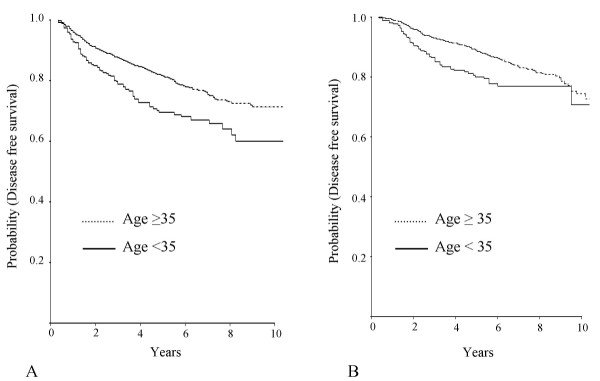
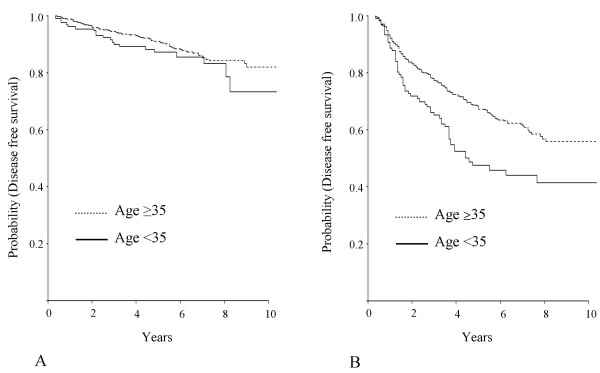
Verification
Claims the paper makes
The claims and statistics of this paper haven’t been checked yet.
Free: it reads the open-access text and checks the first 5 claims that cite a source we can check. Create a free account to check every claim.
Claims other papers make about this one
Each is checked against this paper’s own text: does it say what the citing paper says it does?
The source backs part of the claim, not all of it — or backs it for a different population, condition or comparison.
In the citing paper
“Young age (<35) is also a risk factor for relapse in operable breast cancer patients all subtypes confounded, 271 suggesting a completely different biology of the disease in young versus elderly individuals.”
From Meta-hallmarks of aging and cancer (2023) · cites this paper as [271]
Experimental — accuracy not yet measured
Self-check
Percentages, sums and reported differences re-computed from the paper’s own numbers.
The self-check needs the paper’s full text.
Citations
Cites
Regression Models and Life-Tables
Cox, D. R. (1972) · Journal of the Royal Statistical Society Series B: Statistical Methodology · doi:10.1111/j.2517-6161.1972.tb00899.x · Cited by 39,793
Nonparametric Estimation from Incomplete Observations
Kaplan, E. L., & Meier, P. (1958) · Journal of the American Statistical Association · doi:10.1080/01621459.1958.10501452 · Cited by 39,158
Regression Models and Life-Tables
Cox, D. R. (1992) · Springer Series in Statistics · doi:10.1007/978-1-4612-4380-9_37 · Cited by 26,297
Linkage of Early-Onset Familial Breast Cancer to Chromosome 17q21
Hall, J. M., Lee, M. K., Newman, B., Morrow, J. E., Anderson, L. A., Huey, B., & King, M.-C. (1990) · Science · doi:10.1126/science.2270482 · Cited by 2,550 · cited 1×
“It is known that young breast cancer patients are more likely to have an inherited form of the disease [37].”
BackgroundBeahrs, O. H., & Henson, D. E. (1992) · Medical Entomology and Zoology · Cited by 2,460
Statistical Models and Methods for Lifetime Data
Schafer, R. E. (1983) · Technometrics · doi:10.1080/00401706.1983.10487833 · Cited by 2,094
Prevalence of BRCA1 and BRCA2 Gene Mutations in Patients With Early-Onset Breast Cancer
Peto, J., Collins, N., Barfoot, R., Seal, S., Warren, W., Rahman, N., Easton, D. F., Evans, C., Deacon, J., & Stratton, M. R. (1999) · JNCI Journal of the National Cancer Institute · doi:10.1093/jnci/91.11.943 · Cited by 873 · cited 1×
“Up to 15–30% of women aged less than 35 years diagnosed with breast cancer are likely to have germ-line BRCA1 or BRCA2 mutations [35,36].”
BackgroundMeeting Highlights: International Consensus Panel on the Treatment of Primary Breast Cancer
Goldhirsch, A., Wood, W. C., Senn, H.-J., Glick, J. H., & Gelber, R. D. (1995) · JNCI: Journal of the National Cancer Institute · doi:10.1093/jnci/87.19.1441 · Cited by 689
Meeting Highlights: International Consensus Panel on the Treatment of Primary Breast Cancer
Goldhirsch, A., Glick, J. H., Gelber, R. D., Coates, A. S., & Senn, H.-J. (2001) · Journal of Clinical Oncology · doi:10.1200/jco.2001.19.18.3817 · Cited by 582
Nixon, A. J., Neuberg, D., Hayes, D. F., Gelman, R., Connolly, J. L., Schnitt, S., Abner, A., Recht, A., Vicini, F., & Harris, J. R. (1994) · Journal of Clinical Oncology · doi:10.1200/jco.1994.12.5.888 · Cited by 579 · cited 2×
“While some studies have found that younger patients have worse clinical outcomes than older patients [3-7], others report younger patients have a more favorable prognosis, or that there is no relationship between outcome and age [8-10].”
Result
Research works printed but not linked: 2
- Yoo KY Park SK Sung JH Kang D Kim YC Kang HS Suh JS Kim JS Yun IJ Han S Noh DY Choe KJ High risk groups for female breast cancer in Korea J Korean Cancer Ass 1998 30 435 439
- Korea Central Cancer Registry, Ministry of Health and Welfare, Republic of Korea 2002 Annual Report of the Korea Central Cancer Registry Seoul 2003
Cited by
Items 201–258 of 258
Factores relacionados con la supervivencia libre de enfermedad en el cáncer de mama
Dávila-Arias, C., Hernández, O. O., Fernández, M. F., Arrebola, J. P., Sánchez, M., Aneiros, J., Torné, P., & Olea, N. (2014) · Medicina Clínica · doi:10.1016/j.medcli.2013.09.041 · Cited by 2
Wang, J., Li, Q., Zhang, P., Yuan, P., Ma, F., Luo, Y., Cai, R., Fan, Y., Chen, S., Li, Q., et al. (2017) · Anti-Cancer Drugs · doi:10.1097/cad.0000000000000577 · Cited by 2
Zekri, J., Ibrahim, E., Al-Gahmi, A., Zeeneldin, A. A., Elkhodary, T. R., Gaballa, H. E., Fawzy, E. E., Elsayed, M., Bahadur, Y. A., Awadalla, S., et al. (2016) · ecancermedicalscience · doi:10.3332/ecancer.2010.167 · Cited by 2
Prise en charge thérapeutique des cancers du sein infiltrants localisés
Espié, M., Giacchetti, S., Bourstyn, E., Hennequin, C., Cuvier, C., Hamy, A., & Espié, N. (2013) · Cited by 4
Monaghan, P. P., Shrestha, A., Barrett, E., & Absar, M. S. (2024) · BJS Open · doi:10.1093/bjsopen/zrae138 · Cited by 2
“The 5-year survival rate was similar to that of analogous studies, which have quoted values for younger women from 79.6% to 87.0% 6,13,21,22,28,29 .”
InfluentialPrognosis of Breast Cancer in Women in Their 20s: Clinical and Radiological Insights
Youn, I., Ko, E. Y., Lee, J. E., Han, B., Ko, E. S., Choi, J. S., Kim, H., Kim, M. K., Lee, M. Y., Moon, S., et al. (2025) · Diagnostics · doi:10.3390/diagnostics15162072 · Cited by 1
“The absence of a standardized age definition for YBC poses a challenge, with studies employing various thresholds, such as 30 [1,9,18], 35 [5,7], and 40 years [2,6,8,10,17,19,20], as well as considering premenopausal status [21].”
Choi, D. H., Jin, S. Y., Lee, D. W., Kim, E. S., & Kim, Y. H. (2008) · Radiation Oncology Journal · doi:10.3857/jkstro.2008.26.1.65 · Cited by 1
Lee, S. H., Kang, B. J., & An, Y. Y. (2018) · Journal of the Korean Society of Radiology · doi:10.3348/jksr.2018.79.4.196 · Cited by 1
Temel, E., Elverici, E., Sarı, E., Özsoy, A., Doğan, M., & Kulaçoğlu, S. (2023) · Current Medical Imaging Formerly Current Medical Imaging Reviews · doi:10.2174/1573405620666230721124048 · Cited by 1
Drissi, H., Boutaina, A., Imad, F. E., Bendahhou, K., Benider, A., & Radallah, D. (2024) · Journal of Biomedical Research & Environmental Sciences · doi:10.37871/jbres1901
Durgekar, T. D., Ghosh, S., Savitha, B. A., Shrivastava, P., Krishnamoorthy, N., Sunder, M., Deepti, K. S., & Bakre, M. M. (2025) · Clinical Breast Cancer · doi:10.1016/j.clbc.2025.08.022 · Cited by 3
Preservación de la fertilidad femenina
Comtet, M., Bénard, J., & Grynberg, M. (2017) · EMC - Ginecología-Obstetricia · doi:10.1016/s1283-081x(16)82403-0 · Cited by 1
Adjuvant Chemotherapy for ER+ Breast Cancer: A Sea Change is Underway
Poorvu, P. D., & Winer, E. P. (2017) · JNCI Journal of the National Cancer Institute · doi:10.1093/jnci/djx264 · Cited by 1
Restrepo, M. E. M., Barcenas, C. H., Gómez-Wolff, R., Cock-Rada, A. M., Castaño, M. J., & García, H. I. G. (2020) · Revista Colombiana de Hematología y Oncología · doi:10.51643/22562915.78 · Cited by 1
Molecular Characterization of Male Breast Cancer
Johansson, I. (2013) · Lund University Publications (Lund University) · Cited by 1
Clinical significance of age for premenopausal women with primary breast cancer
Kang, B. M., Jung, J.-H., Lim, Y. S., Park, H.-Y., & Lee, Y.-H. (2006) · Journal of Breast Cancer · doi:10.4048/jbc.2006.9.4.323 · Cited by 1
Kim, E. S., Choi, D. H., Jin, S. Y., Lee, D. W., Park, H. S., Lee, M. H., Won, J.-H., Kim, Y. H., Lee, K. T., & Kim, S. Y. (2008) · Radiation Oncology Journal · doi:10.3857/jkstro.2008.26.1.45 · Cited by 1
Self-citationThe mid-long term outcome of breast-conserving patients with different ages
Zhang, H., Wang, X., & Zhang, B. (2009) · Clinical Oncology and Cancer Research · doi:10.1007/s11805-009-0250-4
“The result was consistent with the findings of Han et al. [ 10 ] The choice of breast-conserving surgery for the patients in this study had not been affected by the age factor at the beginning, and the main factors which affected the choice of breastconserving treatment were the tumor size, localization, lymph node st…”
ResultMeseguer, M. R. N., Lisbona, L. Y., Blázquez, B. S., Diez, M., Gutiérrez, S. M., Franco, R. C., Pérez, B. S., Álvarez, M. G., Ferrandez, M., & Urízar, J. L. M. (2013) · Progresos de Obstetricia y Ginecología · doi:10.1016/j.pog.2012.07.010
Cancer du sein des femmes jeunes : existe-t-il un profil biopathologique différent ?
Jacquemier, J. D., Charafe‐Jauffret, E., Houvenahegel, G., Extra, J.-M., Xerri, L., & mammaire, F. S. F. D. S. E. D. P. (2010) · HAL
Balabram, D., Araújo, F. B., Porto, S., Rodrigues, J. S., Sousa, A. S., Siqueira, A. L., & Gobbi, H. (2012) · DOAJ (DOAJ: Directory of Open Access Journals)
Impact of Age on Survival of Patients with Operable Breast Cancer
Neishaboury, M., Aboutorabi, A., Behboudi, B., Mirminachi, B., Jamei, K., Zanganeh, M., & Kaviani, A. (2015) · Archives of Breast Cancer · doi:10.19187/abc.201524109-113
Underweight and breast cancer recurrence and death
Moon, H., Han, W., Lee, J., Ko, E., KIM, E. A., KIM, E. A., Yu, J. H., & Noh, D. (2009) · Journal of Clinical Oncology · doi:10.1200/jco.2009.27.15_suppl.e22054
Self-citationPostpartum Breast Cancer in Hispanic Women: Epigenetics and microRNAs
Muñoz-Rodríguez, J. L. (2015) · UA Campus Repository (The University of Arizona)
Ovarian Suppression for Women Younger Than 35 Years: New Data to Support Informed Decision Making
Poorvu, P. D., & Partridge, A. H. (2017) · Journal of Clinical Oncology · doi:10.1200/jco.2017.73.5662
OBESITY: A CAUSATIVE RISK FACTOR OF BREAST CANCER
Roy, A. S., Basu, S., & Bandyopadhyay, A. (2019) · International Journal of Medicine and Medical Research · doi:10.11603/ijmmr.2413-6077.2018.2.9410
Duran, A. (2019) · Digital Library of Theses and Dissertations (Universidade de São Paulo) · doi:10.11606/d.5.2019.tde-06122019-113038 · Cited by 1
Bi-rads final assessment categories in breast cancer patients
Daniels, T. W. V. (2019)
Prognostic Factors for Premenopausal Women with Distant Metastatic Breast Cancer
Seung, J., Ryu, J. M., Nam, S. J., Lee, J. E., Yu, J., Lee, S. K., Chae, B. J., & Kim, S. W. (2020) · Journal of Breast Disease · doi:10.14449/jbd.2020.8.1.1
Self-citationEvaluation of Biochemical Markers Correlated with Breast Cancer Young Patients
Bacinschi, X. E., Şaptefraţi, O., Zgura, A. F., Iliescu, L. E., Hăineală, B., Brătilă, E., Mehedințu, C., Petca, R., Petca, A. T., Barac, R. I., et al. (2020) · Revista de Chimie · doi:10.37358/rc.20.8.8298
“[6-7] The aim of the study was to evaluate the impact of age in breast cancer patients in relation to histological and immunohistochemical parameters, the degree of histological differentiation G, estrogens receptor ER, progesterone receptor PR, HER 2 status, and the proliferation index KI-67 to increase the impact on…”
BackgroundBenlghazi, A., Belouad, M., Benali, S., Rachid, A., & Jawad, K. (2021) · Scholars International Journal of Obstetrics and Gynecology · doi:10.36348/sijog.2021.v04i04.008
“7%) than in older women in a study published in 2004 [7] and in the Italian series[8] , as in the study published by Azim in 2015[9].”
ResultPoorvu, P. D., & Partridge, A. H. (2020) · Springer eBooks · doi:10.1007/978-3-030-24762-1_1
Cala-Ayala, Á., Uribe-Castaño, A., Quintero, N. E. L., Trespalacios, E. M. V., & Gallón-Villegas, L. J. (2022) · Oncología (Ecuador) · doi:10.33821/594
Borrero, D. F. V., & Sierra, R. A. C. (2019) · Universidad Peruana de Ciencias Aplicadas (UPC) · doi:10.19083/tesis/648793
Cancer du sein infiltrant chez les femmes de moins de 25 ans
Paillocher, N., Lacourtoisie, S. A., Fondrinier, É., Catala, L., Morand, C., Boursier, J., Guerin, O., & Descamps, P. (2006) · La Presse Médicale · doi:10.1016/j.lpm.2006.09.012
Restrepo, M. E. M., Barcenas, C. H., Gómez-Wolff, R., Cock-Rada, A. M., Castaño, M. J., & García, H. I. G. (2020) · Revista Colombiana de Hematología y Oncología · doi:10.51643/22562915.v7.n1.2020.78
Chung, H., Chow, J., Lam, M., Ngan, R., & Wong, K. (2022) · Hong Kong Journal of Radiology · doi:10.12809/hkjr2217419
Vornicu, A. (2022) · The Medical-Surgical Journal · doi:10.22551/msj.2022.04.13
Özdemır, B. A., Kocaöz, S., Çomçalı, B., Yazıcıoğlu, M. Ö., Canlıkarakaya, F., Ceylan, C., & Körüklüoğlu, B. (2023) · SDÜ Tıp Fakültesi Dergisi · doi:10.17343/sdutfd.1182177
“In addition, the disease relapses more frequently in younger patients and has a worse prognosis in terms of survival (31, 32).”
BackgroundRassy, E., Filleron, T., Viansone, A. A., Lacroix‐Triki, M., Rivera, S., Desmoulins, I., Serin, D., Canon, J. L., Campone, M., Gonçalvès, A., et al. (2023) · Breast Cancer Research and Treatment · doi:10.1007/s10549-023-06912-4
Tratamiento quirúrgico del cáncer de mama en mujeres menores de 35 años
Uriburu, J. L. (2022) · Fronteras en Medicina · doi:10.31954/rfem/201804/0197-0202
Nogueira, G. M. (2023) · Digital Library of Theses and Dissertations (Universidade de São Paulo) · doi:10.11606/t.17.2023.tde-08052023-145403
Bah, M., Mamady, K., Ismael, T. A., Cissé, K., Bobo, S. M., Condé, I., & Bangaly, T. (2023) · Cancer Research Journal · doi:10.11648/j.crj.20231103.16
“The frequency of 30% found in our study is similar to that reported by GUEYE et al in Senegal [14] unlike in industrialized countries where it remains low [6, 9, 15, 16].”
ResultKim, J. H., Kim, Y. Y., Chung, J. H., Kim, W. Y., Lee, J. B., & Woo, S. U. (2024) · Annals of Surgical Treatment and Research · doi:10.4174/astr.2024.106.4.189
“The difference was more pronounced in patients aged ≤35 years [3], as their tumor characteristics were associated with poorer prognostic features.”
BackgroundBadran, O., Campisi‐Pinto, S., Amna, M. A., Turgeman, I., Yosef, S., & Bar‐Sela, G. (2024) · Frontiers in Oncology · doi:10.3389/fonc.2024.1337521
“Some studies have found that younger women have poorer outcomes, attributing this to more aggressive tumor types and hormonal differences (29, 30).”
BackgroundControl de la natalidad, esterilidad, infertilidad: preservación de la fertilidad femenina
Bajeux, J., & Grynberg, M. (2024) · EMC - Ginecología-Obstetricia · doi:10.1016/s1283-081x(24)49684-7 · Cited by 1
Durgekar, T. D., Ghosh, S., Savitha, B. A., Shrivastava, P., Krishnamoorthy, N., Sunder, M., Deepti, K. S., & Bakre, M. M. (2024) · SSRN Electronic Journal · doi:10.2139/ssrn.5002403
Sobrevida Livre de Doença em Mulheres com Câncer de Mama: Coorte de 36 e 60 Meses
Santos, B. M., & Schneider, I. J. C. (2025) · Revista Brasileira de Cancerologia · doi:10.32635/2176-9745.rbc.2024v70n4.4726 · Cited by 3
Risk Factors of Breast Cancer in Young Women and Construction of Risk Prediction Model
姜, 萌. (2025) · Advances in Clinical Medicine · doi:10.12677/acm.2025.1551631
The Role of Age in Breast Cancer Subtypes: A Comparative Study in Young and Older Women
Özışık, H., Erdoğan, A. P., Sürmeli, Z., Ekinci, F., Durusoy, R., & Karaca, B. (2021) · Asian journal of Current Research in Clinical Cancer · doi:10.51847/ieff4vkdkc
Molecular subtypes of breast cancer in women ≤35 years and >35 years: Does age matter?
Özışık, H., Erdoğan, A. P., Sürmeli, Z., Ekinci, F., Durusoy, R., & Karaca, B. (2021) · Clinical Cancer Investigation Journal · doi:10.51847/dqojd4gvn08900
Lima Vazquez, F. D., Silva, T. B., Vieira, R. A. C., da Costa, A. M., Scapulatempo-Neto, C., Fregnani, J. H. T. G., Mauad, E. C., Longatto Filho, A., & Syrjanen, K. (2015) · Portuguese National Funding Agency for Science, Research and Technology (RCAAP Project by FCT)
Park, W. K., Nam, S. J., Kim, S., Lee, J. E., Yu, J., Lee, S. K., Ryu, J. M., Ahn, J. S., Park, Y. H., Kim, J., et al. (2026) · JCO Precision Oncology · doi:10.1200/po-25-00445 · Cited by 1
Self-citationYang, Y., Xu, J., Liao, R., & Zhou, Y. (2026) · Frontiers in Surgery · doi:10.3389/fsurg.2026.1763803
Diagnosis, Treatment, and Outcomes of Breast Cancer in Young Women
Silva, J., Jacques, S., Moleiro, M. L., Pereira, A. D. S., & Polónia, J. (2026) · Journal of young women's breast cancer and health. · doi:10.4103/ywbc.ywbc_4_26
Atman, E. D., Uludag, S. B., Uzun, Ç., Agaran, G., & Eskalen, Z. (2026) · Diagnostics · doi:10.3390/diagnostics16162510
“…activity and vascular invasion, and shows lower expression of estrogen and progesterone receptors (ER, PR) compared with that in older women [3,6–8 , The present study was designed to directly compare imaging characteristics, pathological features, and survival outcomes between two age…”
Influential
Metadata
- Authors
- Han, W., Kim, S. W., Ae Park, I., Kang, D., Kim, S.-W., Youn, Y.-K., Oh, S. K., Choe, K. J., & Noh, D.-Y.
- Affiliations
- Seoul National University (KR)
- Corresponding author
- Noh, Dong-Young
- Venue
- BMC Cancer
- Published
- 2004-11-17
- Volume
- 4
- Issue
- 1
- Pages
- 82-82
- ISSN
- 1471-2407 (ISSN-L)
- PMC
- PMC545947
- OpenAlex
- W1505543598
- Cited by
- 259
- References
- 42
- Citations by year
- 2026: 4 · 2025: 6 · 2024: 11 · 2023: 12 · 2022: 14 · 2021: 16 · 2020: 16 · 2019: 18 · 2018: 13 · 2017: 16 · 2016: 15 · 2015: 17 · 2014: 18 · 2013: 18 · 2012: 11
- FWCI
- 2.23
- Type
- journal article
- Language
- en
- Open access
- gold
- doi.org
- Licence
- cc-by
- creativecommons.org/licenses/by/2.0/ (tdm)
- creativecommons.org/licenses/by/2.0/ (vor)
- Locations
- BMC Cancer (publishedVersion, cc-by)
- Europe PMC (PubMed Central) (publishedVersion)
- PubMed Central (publishedVersion)
- PubMed (publishedVersion)
- DOAJ (DOAJ: Directory of Open Access Journals) (submittedVersion, cc-by-sa)
- Funders
- Seoul National University
- Topics
- Life Sciences › Biochemistry, Genetics and Molecular Biology › Cancer Research › Breast Cancer Treatment Studies
- Health Sciences › Medicine › Pathology and Forensic Medicine › Breast Lesions and Carcinomas
- Health Sciences › Medicine › Oncology › Cancer Risks and Factors
- Keywords
- young age, operable breast cancer, disease-free survival, prognosis, breast cancer recurrence, lymph node status, medullary carcinoma, nuclear grade, estrogen receptor, c-erbB-2, young women
- MeSH terms
- Adult, Age Factors, Breast Neoplasms, Female, Humans, Neoplasm Recurrence, Local, Retrospective Studies, Multivariate Analysis, Chi-Square Distribution, Disease-Free Survival
About these checks
Registry, retraction, Cites and statistics results are computed, not judged, with one exception: a printed reference that no index lists is read once by a model before it counts as a citation error. Claims are extracted by a model and kept only when their quote appears verbatim in the text; each cited source is then checked, with a model’s help, for whether it says what the claim relies on. Those verdicts can be wrong — read the claim’s quote and the cited source before relying on one.
Statistics and arithmetic are recomputed, not judged.
Confidence bands are shown only for fields calibrated on our annotated test set. None is calibrated yet, so no band is shown.
What counts as a claim ›How we measure confidence ›How we check this ›
Are you an author, or do you see a problem with this page? Request a review
Data sources
Bibliographic data: Semantic Scholar, OpenAlex, Crossref.
Contains information from the Semantic Scholar Academic Graph Datasets, made available under the ODC Attribution License (ODC-BY 1.0).
Semantic Scholar’s data is described in: Kinney, R., et al. (2023). The Semantic Scholar Open Data Platform. arXiv:2301.10140.
