

Young age: an independent risk factor for disease-free survival in women with operable breast cancer
Open accessThe DOI matches its Crossref record; 40 of the 42 references it cites were found in a registry or an index.
Abstract
BACKGROUND: The incidence of breast cancer in young women (age < 35) is low. The biology of the disease in this age group is poorly understood, and there are conflicting data regarding the prognosis for these women compared to older patients. METHODS: We retrospectively analyzed 2040 consecutive primary invasive breast cancer patients who underwent surgical procedures at our institution between 1990 and 1999. The younger age group was defined as patients aged <35 years at the time of diagnosis. The clinicopathological characteristics and treatment outcomes were compared between younger and older age groups. RESULTS: A total of 256 (12.5%) patients were aged <35. There was a significantly higher incidence of nuclear grade 3 and medullary histological-type tumors in younger patients compared to older patients. Axillary lymph node status, T stage, histological grade, c-erbB2 expression and estrogen receptor status did not differ significantly between the two age groups. Younger patients had a greater probability of recurrence and death at all time periods. Although there was no significant difference in disease-free survival between the two age groups in lymph node-negative patients, the younger group showed worse prognosis among lymph node-positive patients (p < 0.001). In multivariate analysis, young age remained a significant predictor of recurrence (p = 0.010). CONCLUSION: Young age (<35) is an independent risk factor for relapse in operable breast cancer patients.
Overview
The claims and statistics of this paper haven’t been checked yet.
Free: it reads the open-access text and checks the first 5 claims that cite a source we can check. Create a free account to check every claim.
Integrity signals
Registry
Cites
Statistics
Figures
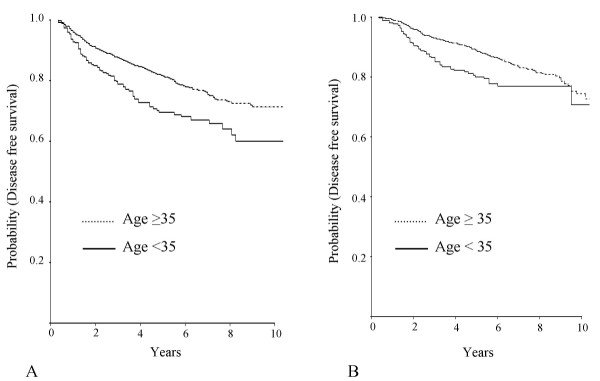
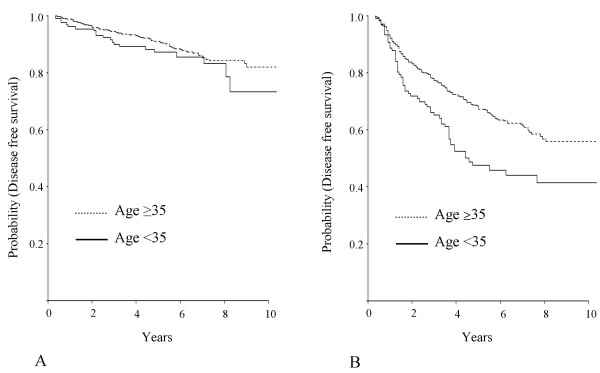
Verification
Claims the paper makes
The claims and statistics of this paper haven’t been checked yet.
Free: it reads the open-access text and checks the first 5 claims that cite a source we can check. Create a free account to check every claim.
Claims other papers make about this one
Each is checked against this paper’s own text: does it say what the citing paper says it does?
The source backs part of the claim, not all of it — or backs it for a different population, condition or comparison.
In the citing paper
“Young age (<35) is also a risk factor for relapse in operable breast cancer patients all subtypes confounded, 271 suggesting a completely different biology of the disease in young versus elderly individuals.”
From Meta-hallmarks of aging and cancer (2023) · cites this paper as [271]
Experimental — accuracy not yet measured
Self-check
Percentages, sums and reported differences re-computed from the paper’s own numbers.
The self-check needs the paper’s full text.
Citations
Cites
Regression Models and Life-Tables
Cox, D. R. (1972) · Journal of the Royal Statistical Society Series B: Statistical Methodology · doi:10.1111/j.2517-6161.1972.tb00899.x · Cited by 39,793
Nonparametric Estimation from Incomplete Observations
Kaplan, E. L., & Meier, P. (1958) · Journal of the American Statistical Association · doi:10.1080/01621459.1958.10501452 · Cited by 39,158
Regression Models and Life-Tables
Cox, D. R. (1992) · Springer Series in Statistics · doi:10.1007/978-1-4612-4380-9_37 · Cited by 26,297
Linkage of Early-Onset Familial Breast Cancer to Chromosome 17q21
Hall, J. M., Lee, M. K., Newman, B., Morrow, J. E., Anderson, L. A., Huey, B., & King, M.-C. (1990) · Science · doi:10.1126/science.2270482 · Cited by 2,550 · cited 1×
“It is known that young breast cancer patients are more likely to have an inherited form of the disease [37].”
BackgroundBeahrs, O. H., & Henson, D. E. (1992) · Medical Entomology and Zoology · Cited by 2,460
Statistical Models and Methods for Lifetime Data
Schafer, R. E. (1983) · Technometrics · doi:10.1080/00401706.1983.10487833 · Cited by 2,094
Prevalence of BRCA1 and BRCA2 Gene Mutations in Patients With Early-Onset Breast Cancer
Peto, J., Collins, N., Barfoot, R., Seal, S., Warren, W., Rahman, N., Easton, D. F., Evans, C., Deacon, J., & Stratton, M. R. (1999) · JNCI Journal of the National Cancer Institute · doi:10.1093/jnci/91.11.943 · Cited by 873 · cited 1×
“Up to 15–30% of women aged less than 35 years diagnosed with breast cancer are likely to have germ-line BRCA1 or BRCA2 mutations [35,36].”
BackgroundMeeting Highlights: International Consensus Panel on the Treatment of Primary Breast Cancer
Goldhirsch, A., Wood, W. C., Senn, H.-J., Glick, J. H., & Gelber, R. D. (1995) · JNCI: Journal of the National Cancer Institute · doi:10.1093/jnci/87.19.1441 · Cited by 689
Meeting Highlights: International Consensus Panel on the Treatment of Primary Breast Cancer
Goldhirsch, A., Glick, J. H., Gelber, R. D., Coates, A. S., & Senn, H.-J. (2001) · Journal of Clinical Oncology · doi:10.1200/jco.2001.19.18.3817 · Cited by 582
Nixon, A. J., Neuberg, D., Hayes, D. F., Gelman, R., Connolly, J. L., Schnitt, S., Abner, A., Recht, A., Vicini, F., & Harris, J. R. (1994) · Journal of Clinical Oncology · doi:10.1200/jco.1994.12.5.888 · Cited by 579 · cited 2×
“While some studies have found that younger patients have worse clinical outcomes than older patients [3-7], others report younger patients have a more favorable prognosis, or that there is no relationship between outcome and age [8-10].”
Result
Research works printed but not linked: 2
- Yoo KY Park SK Sung JH Kang D Kim YC Kang HS Suh JS Kim JS Yun IJ Han S Noh DY Choe KJ High risk groups for female breast cancer in Korea J Korean Cancer Ass 1998 30 435 439
- Korea Central Cancer Registry, Ministry of Health and Welfare, Republic of Korea 2002 Annual Report of the Korea Central Cancer Registry Seoul 2003
Cited by
Items 101–200 of 258
Ha, R. S., Mango, V. L., Al-Khalili, R., Mema, E., Friedlander, L., Desperito, E., & Wynn, R. T. (2018) · Clinical Imaging · doi:10.1016/j.clinimag.2018.05.008 · Cited by 17
Adjuvant therapies for very young women with early stage breast cancer
Freedman, R. A., & Partridge, A. H. (2011) · The Breast · doi:10.1016/s0960-9776(11)70313-7 · Cited by 16
Clinical Significance of Age at the Time of Diagnosis among Young Breast Cancer Patients
Kim, I.-K., Park, S., Hwang, H.-W., Lee, J. S., Ko, S. M., Kim, S. I., & Park, B. (2011) · Journal of Breast Cancer · doi:10.4048/jbc.2011.14.4.314 · Cited by 16
“However, in Korea, the peak age is in the 40s and the proportion of patients of this age is much higher than it is in the West [4,5].”
BackgroundResultInfluentialSelf-citationAnothaisintawee, T., Teerawattananon, Y., Wiratkapun, C., Srinakarin, J., Woodtichartpreecha, P., Hirunpat, S., Wongwaisayawan, S., Lertsithichai, P., Kasamesup, V., & Thakkinstian, A. (2014) · Asian Pacific Journal of Cancer Prevention · doi:10.7314/apjcp.2014.15.16.6811 · Cited by 16
“is more common in postmenopausal Caucasians (Han et al., 2004; Son et al., 2006; Yip, 2009; Keramatinia et al., 2014; Wu et al., 2014).”
BackgroundTang, L.-C., Yin, W., Di, G., Shen, Z., & Shao, Z. (2009) · Breast Cancer Research and Treatment · doi:10.1007/s10549-009-0537-4 · Cited by 15
“The predictive risk factor model of young BCPs is not yet practical, although it has been known for years that these women have high risks for recurrence/metastasis [ 22 , 23].”
BackgroundJeon, Y. W., Choi, J. E., Park, H. K., Kim, K. S., Lee, J. Y., & Suh, Y. J. (2013) · Breast Cancer Research and Treatment · doi:10.1007/s10549-013-2456-7 · Cited by 15
Zhang, Q., Ma, B., & Kang, M. (2015) · PubMed Central · Cited by 15
Park, J. H., Lee, S. K., Lee, J. E., Kim, S. W., Nam, S. J., Kim, J., Ahn, J., Park, W., Yu, J., & Park, Y. H. (2018) · Journal of Breast Cancer · doi:10.4048/jbc.2018.21.1.91 · Cited by 15
“, breast cancer occurring in patients less than 35 years of age) [5-10].”
BackgroundSelf-citationIdade como fator independente de prognóstico no câncer de mama
Clagnan, W. S., de Andrade, J. M., Carrara, H. H. A., Tiezzi, D. G., dos Reis, F. J. C., Marana, H. R. C., & Abrão, R. A. (2008) · Revista Brasileira Ginecologia e Obstetrícia · doi:10.1590/s0100-72032008000200004 · Cited by 25
Korean Breast Cancer Society, Park, S., Kim, K. S., Kim, J. S., Han, W., Park, B., Lee, S., Jeon, Y. W., Lee, S. K., Yu, J., et al. (2017) · Medical Oncology · doi:10.1007/s12032-017-0974-6 · Cited by 16
Self-citationZhang, W., Zhang, B., He, J., Fan, J., Li, J., Zhang, B., Yang, H., Xie, X., Tang, Z., Li, H., et al. (2021) · Gland Surgery · doi:10.21037/gs-20-574 · Cited by 14
“However, it is lower than other research reports from Asia, which report an incidence of 10% to 25% (8,31), and is lower than that reported in the Western world (4,10).”
BackgroundResultInfluentialKim, J., Hong, S., Lee, J., Won, Y., Lee, E. S., Kang, H., Lee, S., Han, J. H., Lee, E., Jo, H., et al. (2021) · Breast Cancer Research and Treatment · doi:10.1007/s10549-021-06107-9 · Cited by 16
Bågeman, E., Ingvar, C., Rose, C., & Jernström, H. (2007) · British Journal of Cancer · doi:10.1038/sj.bjc.6603632 · Cited by 14
“The prognosis is often poorer in younger than in older women (Sidoni et al, 2003) in terms of overall survival and relapse (Han et al, 2004), partly because young women do not benefit from breast cancer screening and early-onset breast cancers are usually detected clinically at a more advanced…”
BackgroundManuneethimaran, T., Navrathan, N., Mohanapriya, T., Kumar, A., & Singh, B. K. (2015) · International Surgery Journal · doi:10.18203/2349-2902.isj20151000 · Cited by 13
Lee, J., Kim, S. H., Kang, B. J., Lee, A., Park, W. C., & Hwang, J.-W. (2021) · Scientific Reports · doi:10.1038/s41598-021-99600-6 · Cited by 15
Self-citationLiu, J., Chen, K., Mao, K., Su, F., Liu, Q., & Jacobs, L. K. (2015) · Oncotarget · doi:10.18632/oncotarget.5844 · Cited by 13
“Besides the classic biologic predictors, age at diagnosis has been proved as an independent prognostic factor in several studies [1–9].”
BackgroundKim, S. W., Chun, M., Han, S., Jung, Y. S., Choi, J. H., Kang, S. Y., Yim, H., & Kang, S. H. (2016) · Cancer Research and Treatment · doi:10.4143/crt.2016.246 · Cited by 17
Self-citationAssociation of p53 polymorphisms with breast cancer: a case-control study in Slovak population.
Franekova, M., Žúbor, P., Štanclová, A., Ca, D., Bohušová, T., Galo, S., Dobrota, D., Kajo, K., M, P., & Račay, P. (2007) · PubMed · Cited by 18
Tahir, I. M., Rauf, A., Mehboob, H., Sadaf, S., Alam, M. S., Kalsoom, F., Bouyahya, A., Allam, A. E., Omari, N. E., Bakrim, S., et al. (2022) · Human Antibodies · doi:10.3233/hab-220001 · Cited by 13
“The risks will be increased if the cancer was bilateral [42].”
Li, S., Wang, X., Yang, J., Lv, M., Zhang, X., Li, C., Zhang, L., Shen, Y., Zhang, X., Chen, Z., et al. (2017) · Thoracic Cancer · doi:10.1111/1759-7714.12503 · Cited by 12
Banz‐Jansen, C., Heinrichs, A., Hedderich, M., Waldmann, A., Wedel, B., Mebes, I., Diedrich, K., Rody, A., & Fischer, D. (2013) · Archives of Gynecology and Obstetrics · doi:10.1007/s00404-013-2738-7 · Cited by 15
Influence of a family history of breast and/or ovarian cancer on breast cancer outcomes
Cao, A., He, M., Di, G., WU, J., Lu, J.-S., Liu, G., SHEN, Z.-Z., & Shao, Z. (2011) · Experimental and Therapeutic Medicine · doi:10.3892/etm.2011.275 · Cited by 12
Özemir, İ. A., Orhun, K., Eren, T., Baysal, H., Sağıroğlu, J., Leblebici, M., Ceyran, A. B., & Alımoğlu, O. (2016) · Bratislavské lekárske listy/Bratislava medical journal · doi:10.4149/bll_2016_085 · Cited by 12
“Morrison (18) et al revealed that young patients demonstrated more aggressive features and worse outcomes when compared to older patients, and Han (19) et al supported that young age was an independent risk factor for relapse.”
ResultAge and Late Recurrence in Young Patients With ER–Positive, ERBB2 -Negative Breast Cancer
Shin, D. S., Lee, J., Kang, E. K., Noh, D., Cheun, J.-H., Lee, J., Son, Y., Bae, S. J., Kim, S. W., Lee, J. E., et al. (2024) · JAMA Network Open · doi:10.1001/jamanetworkopen.2024.42663 · Cited by 15
Self-citationLee, J. S., Oh, M., Ahn, S. H., Bae, J. W., Bae, Y. T., Baek, J. W., Bong, J., Cha, K.-H., Chang, E., Chang, I. T., et al. (2014) · Clinical Breast Cancer · doi:10.1016/j.clbc.2014.05.003 · Cited by 11
Self-citationLee, S. B., Lee, J. W., Son, B. H., Eom, J. S., Kim, E. K., Lee, T. J., & Ahn, S. (2018) · Asian Journal of Surgery · doi:10.1016/j.asjsur.2018.04.004 · Cited by 11
Feng, Y., McGuire, N., Walton, A., Fox, S. B., Papa, A., Lakhani, S. R., & Reed, A. E. M. (2023) · Journal of Pathology Informatics · doi:10.1016/j.jpi.2023.100329 · Cited by 13
Kim, H. K., Ham, J. S., Byeon, S., Yoo, K. H., Jung, K. S., Song, H., Cho, J., Lee, J. Y., Lim, S. H., Kim, H. S., et al. (2016) · Cancer Research and Treatment · doi:10.4143/crt.2015.423 · Cited by 11
Self-citationWieder, R., Shafiq, B., & Adam, N. R. (2020) · Journal of Cancer · doi:10.7150/jca.39091 · Cited by 12
“Spectrums of well documented patient-associated and tumorassociated variables have contributed to this disparity (7-21).”
BackgroundThe prognosis of early-stage breast cancer in extremely young female patients
Chung, W., Lee, K., Chen, Y., Hsu, Y., Loh, Z.-J., Huang, C.-C., & Hsu, H. (2021) · Medicine · doi:10.1097/md.0000000000024076 · Cited by 11
Breast cancer in women younger than 25: clinicopathological features and prognostic factors
Yao, S.-D., Xu, B., Ma, F., Liao, Y., & Fan, Y. (2009) · Annals of Oncology · doi:10.1093/annonc/mdn711 · Cited by 10
He, J., Wang, H., Ma, F., Feng, F.-Y., Chen, L., & Qian, H. (2014) · Oncology Letters · doi:10.3892/ol.2014.2339 · Cited by 10
“The percentage of patients who are diagnosed with lymph node-negative breast cancer before the age of 35 has been reported to be 11.5% in the South Korean population (17), and 8.9% in the Chinese population (18).”
InfluentialKim, K., Chie, E. K., Han, W., Noh, D., Oh, D., Im, S., Kim, T., Bang, Y., & Ha, S. W. (2010) · The Breast Journal · doi:10.1111/j.1524-4741.2010.01021.x · Cited by 10
“geneous both in the ethnicity of study population and in the provided treatment (4,6).”
BackgroundSelf-citationXie, J., WU, R. T., Xu, H., Yao, M., & Xu, G. (2014) · PubMed Central · Cited by 10
Ordu, Ç., McGuire, K. P., Alço, G., Pilancı, K. N., Köksal, Ü. İ., Elbüken, F., Erdogan, Z., Ağaçayak, F., İlgün, S., Sarsenov, D., et al. (2016) · Cureus · doi:10.7759/cureus.633 · Cited by 10
Independent Factors for Poor Prognosis in Young Patients with Stage I-III Breast Cancer
Erić, I. (2020) · Acta Clinica Croatica · doi:10.20471/acc.2020.59.02.07 · Cited by 10
Cancer du sein infiltrant chez les femmes de moins de 25 ans
Paillocher, N., Lacourtoisie, S. A., Fondrinier, É., Catala, L., Morand, C., Boursier, J., Guerin, O., & Descamps, P. (2006) · La Presse Médicale · doi:10.1016/s0755-4982(06)74869-2 · Cited by 10
Effets paradoxaux de la grossesse sur le cancer du sein
Mathelin, C., Youssef, C., Brettes, J., & Rio, M. C. (2007) · Gynécologie Obstétrique & Fertilité · doi:10.1016/j.gyobfe.2007.02.026 · Cited by 10
Kim, J. Y., Lee, S. H., Lee, J. W., Kim, S., & Choo, K. S. (2014) · Acta Radiologica · doi:10.1177/0284185114542365 · Cited by 10
“8% of cancers diagnosed in Western countries (2,3) but for more than 10% of cancers diagnosed in Asian countries (4).”
BackgroundResultSelf-citationBouchard‐Fortier, A., Baxter, N. N., Sutradhar, R., Fernandes, K. A., Camacho, X., Graham, P., & Quan, M. L. (2018) · Current Oncology · doi:10.3747/co.25.4169 · Cited by 10
Cvetanović, A., POPOVIC, L. S., Filipovic, S., Trifunović, J., Živković, N., Matovina-Brko, G., Kostić, M. S., Vicko, F., Kocić, B., & Kolarov-Bjelobrk, I. (2015) · PubMed · Cited by 10
Rakhsha, A., Anvari, A., Razzaghdoust, A., & Kashi, A. S. Y. (2017) · International Journal of Cancer Management · doi:10.5812/ijcm.11772 · Cited by 9
Alshehri, B. (2023) · Saudi Journal of Biological Sciences · doi:10.1016/j.sjbs.2023.103896 · Cited by 10
“Since the early 1990 s, screening initiatives and adjuvant chemotherapy have considerably improved the survival, disease-free survival, and mortality rates of BC patients, improving their prognosis (Han et al., 2004, Qayoom et al., 2021).”
BackgroundRadiomics Nomogram: Prediction of 2-Year Disease-Free Survival in Young Age Breast Cancer
Lee, J., Kim, S. H., Kim, Y., Park, J.-W., Park, G. E., & Kang, B. J. (2022) · Cancers · doi:10.3390/cancers14184461 · Cited by 11
Self-citationWang, W., Wang, X., Liu, J., Gao, J., Wang, J., Wang, X., & Zhao, D. (2016) · Pathology - Research and Practice · doi:10.1016/j.prp.2016.08.010 · Cited by 9
Bae, S. Y., Lee, J., Lee, J. S., Yoon, J. S., Kim, K. S., Kim, Y. S., Kim, Z., Min, J. W., Shim, E., Lee, I., et al. (2022) · The Breast · doi:10.1016/j.breast.2022.03.005 · Cited by 10
Selecting local therapy in the young breast cancer patient
King, T. A. (2011) · Journal of Surgical Oncology · doi:10.1002/jso.21697 · Cited by 9
Xie, Z., Wang, X., Lin, H., Wei, W., Liu, P., Xiao, X., Xie, X., Guan, X., Yang, M., & Tang, J. (2014) · Annals of Surgical Oncology · doi:10.1245/s10434-014-3620-y · Cited by 9
“Although its definition is controversial, most studies define this subgroup as age at onset less than 35 years.(7,8,16) Generally, this type of breast cancer is thought to be less well differentiated, more triplenegative, and less luminal A subtype, with more vascular invasion, leading to more aggressive biological be…”
BackgroundHisto-Molecular Profile of Breast Cancer in Young Women in Togo
Djiwa, T., Koui, B. S., Simgban, P., Sama, B. M., Bombonne, M., Doukouré, B., & Darré, T. (2022) · Clinical Pathology · doi:10.1177/2632010x221112452 · Cited by 8
“Micropapillary carcinoma 1 (5) 0 (0) 1 (20) 0 (0) 2 (5.”
Arnould, L., Penault-Llorca, F. M., Dohollou, N., Caron, O., & Lévy, C. (2019) · Bulletin du Cancer · doi:10.1016/s0007-4551(20)30042-4 · Cited by 12
Jeffrey, S. S. (2010) · International Journal of Oncology · doi:10.3892/ijo_00000652 · Cited by 7
Actualización del cáncer de mama en Atención Primaria (II/V)
Brusint, B., Vich-Pérez, P., Álvarez-Hernández, C. F., Cuadrado-Rouco, C., Diaz-Garcia, N., & Redondo-Margüello, E. (2014) · Medicina de Familia SEMERGEN · doi:10.1016/j.semerg.2014.03.003 · Cited by 17
Sudhir, R., Sannapareddy, K., Potlapalli, A., & Penmetsa, V. (2021) · Indian journal of radiology and imaging - new series/Indian journal of radiology and imaging/Indian Journal of Radiology & Imaging · doi:10.1055/s-0041-1734342 · Cited by 7
Liu, K., Wang, P., Zhu, X., Bei, Y., Zheng, Z., & Yan, S. (2018) · Cancer Management and Research · doi:10.2147/cmar.s169192 · Cited by 7
Expression of Ki67 and p53 Proteins: Breast Cancer Aggressivity Markers in Brazilian Young Patients
Bocchi, M., Pereira, N. D. S., Furuya, R. K., Fernandes, C. Y. M., Guembarovski, R. L., Vitiello, G. A. F., Amarante, M. K., & Watanabe, M. A. E. (2020) · Journal of Adolescent and Young Adult Oncology · doi:10.1089/jayao.2020.0037 · Cited by 7
“9–11 Despite advances in molecular technologies, assessment of hormone receptors, namely estrogen (ER) and progesterone (PR) receptors, and HER2 through immunohistochemistry (IHC) remain the most important and widely used strategy to classify disease into molecular subtypes, predict disease…”
Song, Y., Sun, S., Li, D., Han, J., Niu, M., Luo, S., Xu, H., Huang, R., Zhang, S., Wu, Y., et al. (2021) · World Journal of Surgical Oncology · doi:10.1186/s12957-021-02450-9 · Cited by 8
The Impact of Stage and Molecular Subtypes on Survival Outcomes in Young Women with Breast Cancer
Hariharan, N., Rao, T. S., Naidu, C. C. K., Raju, K. V. V. N., Rajappa, S. J., Ayyagari, S., Krishnamohan, M. V. T., Murthy, S., Suryadevara, A., & Bollineni, N. (2019) · Journal of Adolescent and Young Adult Oncology · doi:10.1089/jayao.2019.0023 · Cited by 7
“2,3 However, it remains controversial as to whether young age is an independent adverse prognostic factor.”
BRCA1/2 mutations and outcomes among Middle Eastern patients with early-onset breast cancer in Oman
Amri, W. S. A., Amri, A. H. A., Abri, A. A., Hughes, T. A., & Lawati, F. A. (2024) · The Oncologist · doi:10.1093/oncolo/oyae214 · Cited by 6
“…have been reported in various populations, 30 some of which have had the statistical power to demonstrate in multi-variate analyses that EOBC itself was an predictor of poor prognosis independently of standard prognostic factors, 31,32 hinting at aggressive biology that differs in more subtle ways.”
Suleman, K., Mushtaq, A. H., Haque, E., Badran, A. A., Ajarim, D. S., Elashwah, A., Gad, A., Abdelsamad, A. S., Omar, A., Khan, K. A., et al. (2020) · Breast Care · doi:10.1159/000506824 · Cited by 6
Signaling pathways in early onset sporadic breast cancer of patients in Indonesia.
Sutandyo, N., Suzanna, E., Sj, H., & Ah, R. (2008) · PubMed · Cited by 6
Wu, J., Lv, M., Yuan, P., Ma, Y., Tian, P., Li, L., Wang, C., Lu, Z.-D., Yan, M., Chen, X., et al. (2022) · Gland Surgery · doi:10.21037/gs-22-409 · Cited by 5
“Younger patients with TNBC have a higher proportion of higher histologic grade, increased nodal involvement, and larger tumor size, which present as confounding factors when assessing the effect of age on survival (24,26-28).”
Kravchenko, D., Parokonnaya, A., Nechushkin, M. I., Nikitina, E. A., & Khakurinova, N. (2018) · Tumors of female reproductive system · doi:10.17650/1994-4098-2018-14-3-55-63 · Cited by 12
RISK FACTORS FOR BREAST CANCER IN SOUTH INDIA: A CASE CONTROL STUDY
Bhupathi, S., Taranikanti, M., Archana, R., & Sankar, R. B. (2016) · International Journal of Research in Ayurveda and Pharmacy · doi:10.7897/2277-4343.07285 · Cited by 5
Papalexis, P., Georgakopoulou, V., Keramydas, D., Vogiatzis, R., Taskou, C., Anthouli-Anagnostopoulou, F., Nonni, A., Lazaris, A. C., Zografos, G., Kavantzas, N., et al. (2024) · Cancer Diagnosis & Prognosis · doi:10.21873/cdp.10330 · Cited by 10
Madaras, L., Baranyák, Z., Kulka, J., Szász, A. M., Kovács, A. D., Lan, P. H., Székely, B., Dank, M., Nagy, T., Kiss, O., et al. (2013) · Pathology & Oncology Research · doi:10.1007/s12253-013-9635-z · Cited by 5
“According to literature data, younger patients affected by breast carcinoma have poor outcome [6, 20, 21].”
Surgical treatment of young women with breast cancer: Public vs private hospitals
Patel, A. S., Wang, W., Warnack, E., Joseph, K., Schnabel, F. R., Axelrod, D., & Dhage, S. (2019) · The Breast Journal · doi:10.1111/tbj.13294 · Cited by 5
Recurrent Breast Cancer Following Modified Radical Mastectomy and Risk Factors
Mutlak, N. S., Al-Mukhtar, R., Al-Dawoodi, N. S., & Sulaiman, T. I. (2012) · Journal of the Faculty of Medicine Baghdad · doi:10.32007/jfacmedbagdad.543717 · Cited by 5
Kim, J., Han, W., Moon, H., Ko, E., Lee, J. W., Kim, E., Park, I.-A., Ha, S. W., Chie, E. K., Oh, S. K., et al. (2009) · Journal of Breast Cancer · doi:10.4048/jbc.2009.12.4.324 · Cited by 5
“유방암 환자에서 예후를 분석함에 있어 연령의 경계를 정하는 데에는 논란이 있을 수 있지만 기존의 많은 연구들이 35세 혹은 40세를기준으로하고있으며, 최근의연구에서한국인유방암환 자에서35세를기준으로하는것이가장유의한분별값이된다는 보고에따라35세이하와이상으로환자군을구분하였다.(25,26)”
Self-citationKoca, B., Kuru, B., Karabıçak, İ., Yürüker, S., & Özen, N. (2014) · PubMed · Cited by 5
Actualización del cáncer de mama en atención primaria (V/V)
Diaz-Garcia, N., Rouco, C. C., Vich-Pérez, P., Álvarez-Hernández, C. F., Brusint, B., & Margüello, E. R. (2014) · Medicina de Familia SEMERGEN · doi:10.1016/j.semerg.2014.03.014 · Cited by 5
Relapse-free survival in Sudanese women with non-metastatic breast cancer
Muddather, H. F., Faggad, A., & Elhassan, M. M. A. (2022) · Global Epidemiology · doi:10.1016/j.gloepi.2022.100082 · Cited by 4
“Among the factors that considerably influence the occurrence of relapse are the patient age [10,16,17], tumor biological and molecular characteristics [18,19], lymph node involvement [10,20,21], tumor size [10,20], and stage of the disease [22–24].”
BackgroundCheun, J.-H., Kwak, Y., Kang, E. K., Jung, J.-J., Kim, H. K., Lee, H., Lee, K.-H., Moon, H., Hwang, K., Park, Y. H., et al. (2024) · The Breast · doi:10.1016/j.breast.2024.103828 · Cited by 4
Self-citationChoi, Y. J., Kook, S., Kwag, H. J., & Park, Y. L. (2009) · Journal of Breast Cancer · doi:10.4048/jbc.2009.12.2.79 · Cited by 4
“Also many reports suggested that in young age breast cancer is more aggressive and carries a higher mortality in younger women.(6-8) Whether a poorer prognosis is caused by a diagnostic delay or different characteristics of the tumor is still controversial.”
BackgroundClinical Features and Survival Analysis of T1mic, a, bN0M0 Breast Cancer
Li, J., Liu, X., & Tong, Z. (2012) · Japanese Journal of Clinical Oncology · doi:10.1093/jjco/hys046 · Cited by 4
Chen, J. Y. G. (2014) · Journal of Bioanalysis & Biomedicine · doi:10.4172/1948-593x.1000e126 · Cited by 4
“Although the diagnosis of breast cancer is much less common in women under the age of 40 years old, it can have a greater influence than in older counterparts, as it tends to be more aggressive and has a poorer prognosis [6-7].”
BackgroundCorter, A. L., Quan, M. L., Wright, F., Kennedy, E. D., Simunovic, M. R. I., Shao, J., & Baxter, N. N. (2018) · Journal of Multidisciplinary Healthcare · doi:10.2147/jmdh.s173735 · Cited by 4
“They are more likely to be diagnosed with aggressive forms of cancer,(1,2) have higher surgical re-excision rates(3) and have greater risk of cancer recurrence and mortality than older women.(4,5) Fertility concerns may also be an issue, as YWBC may be pregnant at the time of diagnosis or, may be looking forward to ha…”
Yu, J. (2021) · Advances in experimental medicine and biology · doi:10.1007/978-981-32-9620-6_20 · Cited by 5
Zingarello, A., Mazouni, C., Rivera, S., Mokdad-Adi, M., & Pistilli, B. (2017) · The Breast · doi:10.1016/j.breast.2017.07.013 · Cited by 4
Purnomosari, D., Raharjo, C. A., Kalim, A. S., Herviastuti, R., Yushan, M., Fajar, R., Harris, K. K., & Wahyono, A. (2019) · Asian Pacific Journal of Cancer Prevention · doi:10.31557/apjcp.2019.20.11.3305 · Cited by 4
“In the United States, only 6.8% of BC patients are below 40 years (Anders et al., 2009), whereas in Asia its incidence rate could reaches 9.5-11% (Han et al., 2004).”
BackgroundInfluentialRace and the Molecular Origins of Breast Cancer in Chinese Women
Chen, M., Xu, R., Turner, J. W., Warhol, M. J., August, P., & Lee, P. (2012) · Annals of Surgical Oncology · doi:10.1245/s10434-012-2452-x · Cited by 5
Matrix Metalloproteinase-9 as Prognostic Factor for the Treatment of HER-2 Enriched Breast Cancer
Khambri, D., Suyuthie, H. D., Hilbertina, N., Yetti, H., & Purwanto, D. J. (2022) · Asian Pacific Journal of Cancer Prevention · doi:10.31557/apjcp.2022.23.3.1013 · Cited by 4
Mark, C., Pujara, V., Srour, M. K., Yuan, Y., & Lee, J. S. (2025) · Breast Cancer Research and Treatment · doi:10.1007/s10549-024-07588-0 · Cited by 5
“In fact, studies have shown that young age at the time of diagnosis is an independent prognostic factor and is highly associated with increased risk of recurrence and death [12–14].”
Mutlu, H. (2013) · International Journal of Hematology and Oncology · doi:10.4999/uhod.11081 · Cited by 3
“Age is an important factor for the risk of recurrence independent of other features.(1) Tumoral features of young age with breast cancer tend to be receptor negative and high-grade.”
BackgroundVollbrecht, B., Sarquiz, M., Zerwes, F., Viegas, J. F., Arent, A., Badalotti, M., & Frasson, A. L. (2009) · DOAJ (DOAJ: Directory of Open Access Journals) · Cited by 3
Maglangit, S. A. C. A., Ramirez, A. D., Kho, M. R., & Dofitas, R. B. (2021) · Philippine Journal of Surgical Specialties · doi:10.61662/pcs_nrvx2103 · Cited by 3
Lisbona, L. Y., Meseguer, M. R. N., Pérez, B. S., Ferrández, C. S., Álvarez, M. G., & García, J. M. H. (2010) · Progresos de Obstetricia y Ginecología · doi:10.1016/j.pog.2010.07.003 · Cited by 3
Mammographic and Sonographic Features of Breast Cancer in Women Before 30 Years of Age
Park, J. S., Kim, Y. S., & Lee, S. E. (2019) · Current Medical Imaging Formerly Current Medical Imaging Reviews · doi:10.2174/1573405615666191018154704 · Cited by 3
Vohra, S., Reeder-Hayes, K. E., Nichols, H. B., Emerson, M. A., Love, M. I., Olshan, A. F., & Troester, M. A. (2022) · Breast Cancer Research and Treatment · doi:10.1007/s10549-022-06511-9 · Cited by 3
“Page 6 of 28 Background (Limit: 3500 words; current: 2072 words) Younger (<40 years of age) and recently postpartum (within 5 years of cancer diagnosis) women have been found to have worse breast cancer outcomes and higher mortality compared to other women with breast cancer [1-23].”
BackgroundAzman, N., Abdullah, M. F. I. L. B., Musa, K. I., Hassan, N., & Shariff, N. M. (2024) · Journal of Psychosocial Oncology · doi:10.1080/07347332.2024.2325498 · Cited by 3
Limbach, K. E., León, E. J., Pommier, R. F., & Pommier, S. J. (2020) · The Breast Journal · doi:10.1111/tbj.13783 · Cited by 3
Guideline Conformity Treatment in Young Women with Early-Onset Breast Cancer in Germany
Pursche, T., Hedderich, M., Heinrichs, A., Baumann, K., Banz‐Jansen, C., Rody, A., Waldmann, A., & Fischer, D. (2014) · Breast Care · doi:10.1159/000366435 · Cited by 3
Changes in mastectomy rates at a Brazilian public hospital over 20 years (1989 to 2008)
Balabram, D., Araújo, F. B., Porto, S., Rodrigues, J. S., Sousa, A. S., Siqueira, A. L., & Gobbi, H. (2012) · Sao Paulo Medical Journal · doi:10.1590/s1516-31802012000600002 · Cited by 3
“5) 163 (100) 2007 68 (45) 83 (55) 151 (100) 2008 85 (53.”
PROFILES AND PREDICTIVE FACTORS IN YOUNG AGE BREAST CANCER PATIENTS (RETROSPECTIVE STUDY)
Aksaz, E., Atasoy, G., Öncel, T., Yazici, T., Aydemir, A., Ipek, N., & Bitik, D. (2012) · DOAJ (DOAJ: Directory of Open Access Journals) · Cited by 3
Guo, S., Zhao, K., Hu, X., Xie, Y., Li, Q., Liang, J., Chen, S., Sun, J., Gao, Z., Zhu, L., et al. (2025) · Frontiers in Oncology · doi:10.3389/fonc.2025.1539748 · Cited by 2
Bcl-2 and Ki-67 Expression in Young Women with Breast Cancer
(2013) · The Annals of Clinical and Analytical Medicine · doi:10.4328/jcam.1110 · Cited by 2
“Histologic grade and lymph node involvement rate are found to be high and a lower hormone receptor expression is found in these patients at the time of diagnosis [5] .”
BackgroundExpression of lipoma preferred partner in mammary and extramammary Paget disease
Liu, Y., Wang, Y., Qi, R., Mao, X., & Jin, F. (2020) · Medicine · doi:10.1097/md.0000000000023443 · Cited by 3
“And findings from a recent study suggest that youth represents an independent prognostic factor for survival in the diagnosis of breast cancer.([54]) Here, we found that the expression intensity of LPP in the middle-aged group was greater than that in the senior group.”
BackgroundChoi, H.-S., Noh, H., Kim, K., Cho, I.-J., Lim, S., & Han, A. (2021) · Cancer Control · doi:10.1177/10732748211037914 · Cited by 2
Impact of modern personalized treatment of breast cancer on surgical attitude and outcomes
Tanasescu, C. A. H., Şerban, D., Moisin, A., Popa, C., Coca, R., Iancu, G., Tudosie, M. S., Costea, D. O., Socea, B., Tudor, C., et al. (2021) · Experimental and Therapeutic Medicine · doi:10.3892/etm.2021.10979 · Cited by 2
Zhao, Z., Liu, Q., Wu, C., Guo, W., & Li, J. (2019) · Europe PMC (PubMed Central) · doi:10.12122/j.issn.1673-4254.2019.04.15 · Cited by 2
Koshariya, M., Shukla, S., Ansari, F., & Khare, V. S. (2022) · Cureus · doi:10.7759/cureus.27237 · Cited by 2
“However, our observation correlates with many previous studies that failed to demonstrate any association of histological grade with age [13-15].”
Result
Metadata
- Authors
- Han, W., Kim, S. W., Ae Park, I., Kang, D., Kim, S.-W., Youn, Y.-K., Oh, S. K., Choe, K. J., & Noh, D.-Y.
- Affiliations
- Seoul National University (KR)
- Corresponding author
- Noh, Dong-Young
- Venue
- BMC Cancer
- Published
- 2004-11-17
- Volume
- 4
- Issue
- 1
- Pages
- 82-82
- ISSN
- 1471-2407 (ISSN-L)
- PMC
- PMC545947
- OpenAlex
- W1505543598
- Cited by
- 259
- References
- 42
- Citations by year
- 2026: 4 · 2025: 6 · 2024: 11 · 2023: 12 · 2022: 14 · 2021: 16 · 2020: 16 · 2019: 18 · 2018: 13 · 2017: 16 · 2016: 15 · 2015: 17 · 2014: 18 · 2013: 18 · 2012: 11
- FWCI
- 2.23
- Type
- journal article
- Language
- en
- Open access
- gold
- doi.org
- Licence
- cc-by
- creativecommons.org/licenses/by/2.0/ (tdm)
- creativecommons.org/licenses/by/2.0/ (vor)
- Locations
- BMC Cancer (publishedVersion, cc-by)
- Europe PMC (PubMed Central) (publishedVersion)
- PubMed Central (publishedVersion)
- PubMed (publishedVersion)
- DOAJ (DOAJ: Directory of Open Access Journals) (submittedVersion, cc-by-sa)
- Funders
- Seoul National University
- Topics
- Life Sciences › Biochemistry, Genetics and Molecular Biology › Cancer Research › Breast Cancer Treatment Studies
- Health Sciences › Medicine › Pathology and Forensic Medicine › Breast Lesions and Carcinomas
- Health Sciences › Medicine › Oncology › Cancer Risks and Factors
- Keywords
- young age, operable breast cancer, disease-free survival, prognosis, breast cancer recurrence, lymph node status, medullary carcinoma, nuclear grade, estrogen receptor, c-erbB-2, young women
- MeSH terms
- Adult, Age Factors, Breast Neoplasms, Female, Humans, Neoplasm Recurrence, Local, Retrospective Studies, Multivariate Analysis, Chi-Square Distribution, Disease-Free Survival
About these checks
Registry, retraction, Cites and statistics results are computed, not judged, with one exception: a printed reference that no index lists is read once by a model before it counts as a citation error. Claims are extracted by a model and kept only when their quote appears verbatim in the text; each cited source is then checked, with a model’s help, for whether it says what the claim relies on. Those verdicts can be wrong — read the claim’s quote and the cited source before relying on one.
Statistics and arithmetic are recomputed, not judged.
Confidence bands are shown only for fields calibrated on our annotated test set. None is calibrated yet, so no band is shown.
What counts as a claim ›How we measure confidence ›How we check this ›
Are you an author, or do you see a problem with this page? Request a review
Data sources
Bibliographic data: Semantic Scholar, OpenAlex, Crossref.
Contains information from the Semantic Scholar Academic Graph Datasets, made available under the ODC Attribution License (ODC-BY 1.0).
Semantic Scholar’s data is described in: Kinney, R., et al. (2023). The Semantic Scholar Open Data Platform. arXiv:2301.10140.
