

Fear of hypoglycaemia in parents of young children with type 1 diabetes: a systematic review
Open accessThe DOI matches its Crossref record; 37 of the 38 references it cites were found in a registry or an index.
Abstract
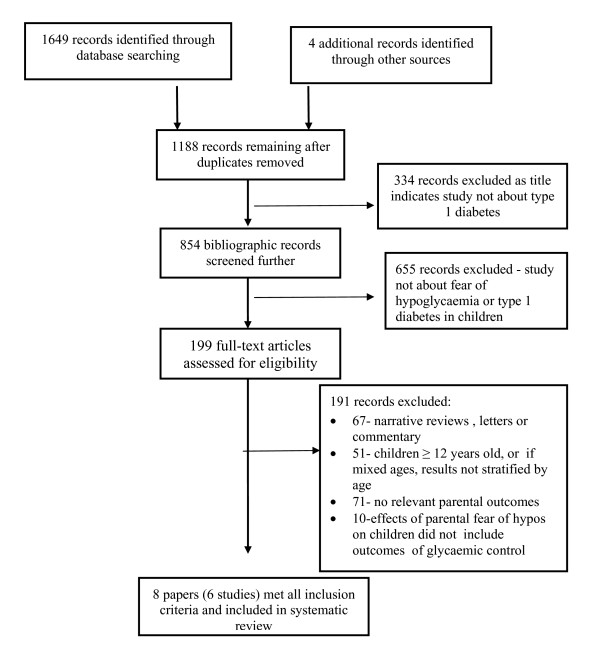
BACKGROUND: Many children with type 1 diabetes have poor glycaemic control. Since the Diabetes Control and Complications Trial (DCCT) showed that tighter control reduces complication rates, there has been more emphasis on intensified insulin therapy. We know that patients and families are afraid of hypoglycaemia. We hypothesised that fear of hypoglycaemia might take precedence over concern about long-term complications, and that behaviour to avoid hypoglycaemia might be at the cost of poorer control, and aimed to evaluate the effectiveness of any interventions designed to prevent that. The objective of this review was to systematically review studies concerning the extent and consequences of fear of hypoglycaemia in parents of children under 12 years of age with type 1 diabetes, and interventions to reduce it. DATA SOURCES: MEDLINE, EMBASE, PsycINFO, The Cochrane Library, Web of Science, meeting abstracts of EASD, ADA and Diabetes UK, Current Controlled Trials, ClinicalTrials.gov, UK CRN, scrutiny of bibliographies of retrieved papers and contact with experts in the field.Inclusions: Relevant studies of any design of parents of children under 12 years of age with Type 1 diabetes were included. The key outcomes were the extent and impact of fear, hypoglycaemia avoidance behaviour in parents due to parental fear of hypoglycaemia in their children, the effect on diabetes control, and the impact of interventions to reduce this fear and hypoglycaemia avoidance behaviour. RESULTS: Eight articles from six studies met the inclusion criteria. All were cross sectional studies and most were of good quality. Parental fear of hypoglycaemia, anxiety and depression were reported to be common. There was a paucity of evidence on behaviour to avoid hypoglycaemia, but there were some suggestions that higher than desirable blood glucose levels might be permitted in order to avoid hypoglycaemia. No studies reporting interventions to reduce parental fear of hypoglycaemia were found. CONCLUSIONS: The evidence base was limited. Parents of children with Type 1 diabetes reported considerable parental fear of hypoglycaemia, affecting both parental health and quality of life. There is some suggestion that hypoglycaemia avoidance behaviours by parents might adversely affect glycaemic control. Trials of interventions to reduce parental anxiety and hypoglycaemia avoidance behaviour are needed. We suggest that there should be a trial of structured education for parents of young children with Type 1 diabetes.
Overview
The claims and statistics of this paper haven’t been checked yet.
Free: it reads the open-access text and checks the first 5 claims that cite a source we can check. Create a free account to check every claim.
Integrity signals
Registry
Cites
Statistics
Figures
Verification
Claims the paper makes
The claims and statistics of this paper haven’t been checked yet.
Free: it reads the open-access text and checks the first 5 claims that cite a source we can check. Create a free account to check every claim.
Claims other papers make about this one
Each is checked against this paper’s own text: does it say what the citing paper says it does?
The source backs part of the claim, not all of it — or backs it for a different population, condition or comparison.
In the citing paper
“This fear is associated with reduced self-care and poor glucose control (4)(5)(6).”
From Hypoglycemia (2018) · cites this paper as [4]
Experimental — accuracy not yet measured
Self-check
Percentages, sums and reported differences re-computed from the paper’s own numbers.
The self-check needs the paper’s full text.
Citations
Cites
Systematic reviews in the social sciences: a practical guide
(2006) · Choice Reviews Online · doi:10.5860/choice.43-5664 · Cited by 4,089
Systematic Reviews in the Social Sciences: A Practical Guide
Petticrew, M., & Roberts, H. (2006) · doi:10.1002/9780470754887 · Cited by 3,586
Systematic reviews: CRD's guidance for undertaking reviews in health care
Tacconelli, E. (2010) · The Lancet Infectious Diseases · doi:10.1016/s1473-3099(10)70065-7 · Cited by 3,245
Good practice in the conduct and reporting of survey research
KELLEY, K. (2003) · International Journal for Quality in Health Care · doi:10.1093/intqhc/mzg031 · Cited by 2,157
Patterson, C. C., Dahlquist, G. G., Gyürüs, E., Green, A., & Soltész, G. (2009) · The Lancet · doi:10.1016/s0140-6736(09)60568-7 · Cited by 1,854 · cited 2×
“It is predicted that in European children under the age of 5 years, the incidence rate will double between 2005 and 2020, with prevalent cases younger than 15 years rising by 70% [2].”
BackgroundMortality from heart disease in a cohort of 23,000 patients with insulin-treated diabetes
Laing, S. P., Swerdlow, A. J., Slater, S. D., Burden, A. C., Morris, A., Waugh, N. R., Gatling, W., Bingley, P. J., & Patterson, C. C. (2003) · Diabetologia · doi:10.1007/s00125-003-1116-6 · Cited by 724 · cited 1×
“Heart disease is the main cause of death in type 1 diabetes in developed countries [4].”
BackgroundSelf-citationAmiel, S. A., Beveridge, S., Bradley, C., Gianfrancesco, C., Heller, S. R., James, P., McKeown, N., Newton, D. F., Newton, L. D., Oliver, L., et al. (2002) · Deakin Research Online (Deakin University) · Cited by 723
Cited by
Items 201–240 of 240
Fear of hypoglycaemia in paediatric diabetes: a literature review
Fernando, A., & Patel, V. (2021) · British Journal of Diabetes · doi:10.15277/bjd.2021.286 · Cited by 2
“/# 0(*# 89:Q#*(&4A(442?%?B#%3'# 6%)(3723S#*7)(**## 0(*# 0(*# 0(*## M(&(?7('#4)9>#%#&2>27('#'%7%I%*(## N(4&(?72O(#94#&9?%ᬵ&%7293## !--D#R)%32%3## # @9# K"#E2#T%772*7%## ####+,--G/# 0(*# U44(?7#94#89:#93#*9?2%&# %3L2(7BQ#%'<()(3?(#%3'#V9W# 0(*# 0(*# ;()<%6*## =2>(#?9>>27>(37## X!-#23?(372O(## N(6)(*(37%72O(#94#?&23…”
InfluentialGampelaere, C. V. (2020) · Ghent University Academic Bibliography (Ghent University) · Cited by 1
Haugstvedt, A. (2012) · NVA (Nasjonalt vitenarkiv) · Cited by 1
ElhassanAbdalla, M., Gaffar, A. M., Khalafalla, H. E., Haroun, H. M., & Elnaem, B. (2012) · Journal of Biology Agriculture and Healthcare
Lukács, A., & Barkai, L. (2013) · University of Debrecen Electronic Archive (University of Debrecen)
Evidence-Based Medicine in Pediatric Endocrinology
Kelnar, C. J. H., & Mitchell, R. T. (2013) · Yearbook of pediatric endocrinology · doi:10.1159/000353839
“Whereas all diabetes teams strive to achieve an optimal HbA1c for their patients, by delivering a full diabetes education package, they recognize the parental fear of hypoglycaemia [4].”
Backgroundvan Heiningen, J., Keij, F. M., & Roep, B. O. (2015) · Tijdschrift voor kindergeneeskunde · doi:10.1007/s12456-015-0004-6
New Methods in Exploring Old Topics: Case Studying Brittle Diabetes in the Family Context
Günther, M. P., Winker, P., Wudy, S. A., & Brosig, B. (2015) · Journal of Diabetes Research · doi:10.1155/2016/6437452
“Fears of hypoglycemia were somewhat irrational with all three familymembers, including the father, who, at first sight, seemed rather more distant to the matter (literature proposes parental hypoglycemia avoidance behaviours to adversely affect glycemic control [12]).”
BackgroundThe Importance of Managing Adolescent Mental Health
Hauge, L. (2015)
Educating Grandparents of Grandchildren with Type I Diabetes Using Simulation: A Dissertation
Maguire, L. L. (2015) · The Journal of the American Medical Association (JAMA) Network (American Medical Association) · doi:10.13028/epdc-dx22
The Hypoglycaemia-Hyperglycaemia Minimizer System in the Management of Type 1 Diabetes
Levy, B. L., McCann, T. W., & Finan, J. A. D. A. (2016) · touchREVIEWS in Endocrinology · doi:10.17925/ee.2016.12.01.18
Berntsen, N. L., & Eilertsen, E. (2012) · NORA - Norwegian Open Research Archives
Tauschmann, M., & Hovorka, R. (2016) · Springer eBooks · doi:10.1007/978-3-319-40242-0_14
The problem of diabetic hipoglycaemia
Derkacz, M., Chmiel-Perzyńska, I., & Nowakowski, A. M. (2012) · Current Problems of Psychiatry
Diabetes mellitus em crianças com menos de cinco anos
Pereira, A. L. F. D. C. (2012) · Portuguese National Funding Agency for Science, Research and Technology (RCAAP Project by FCT) · doi:10.34626/kxgh-5d94 · Cited by 1
Diabetes and Behavior in the 21st Century: Things That Make You Go “Hmmm . . . ”
Wysocki, T. (2019) · Diabetes Spectrum · doi:10.2337/dsi18-0001
Family Physician's Clinical Inertia in the Management of Hypoglycemia
Rebicki, M., & Caroline, C. (2019)
Shea, G. R. (2024) · Scholarworks (University of Massachusetts Amherst) · doi:10.7275/17362261
McCarthy, O. M., Deere, R., Eckstein, M. L., Pitt, J. P., Wellman, B., Bain, S. C., Moser, O., & Bracken, R. M. (2021) · Frontiers in Public Health · doi:10.3389/fpubh.2020.568832
Psychosoziale Aspekte in der Betreuung von Kindern und Jugendlichen mit Typ 1 Diabetes mellitus
Prchla, C., Berger, G., Berner-Marouschek, H., Culen, C., König, M., & Wagner, G. (2021) · Pädiatrie & Pädologie · doi:10.1007/s00608-021-00896-4
“Häufige elterlicheAngst vorHypoglykämien kann bei Kindern erhöhte emotionale Belastung und schlechtere Stoffwechseleinstellung bedingen [53, 54].”
BackgroundISPAD Clinical Practice Consensus Guidelines 2018. Managing diabetes in preschool children
Зелінська, П. Н. Б. (2021) · Ukrainian Journal of Pediatric Endocrinology · doi:10.30978/ujpe2021-2-35
Barat, P. (2018) · Elsevier eBooks · doi:10.1016/b978-2-294-74942-1.00005-7
Marker, A. M., Monzon, A. D., Nelson, E., Clements, M. A., & Patton, S. R. (2019) · doi:10.2196/preprints.13727
Clayton, D., Woo, V. C., & Yale, J. (2013) · Canadian Journal of Diabetes · doi:10.1016/j.jcjd.2013.07.007 · Cited by 5
Diagnostik, Therapie und Verlaufskontrolle des Diabetes mellitus im Kindes- und Jugendalter
Neu, A., Bürger-Büsing, J., Danne, T., Dost, A., Holder, M., Holl, R. W., Holterhus, P., Kapellen, T. M., Karges, B., Kordonouri, O., et al. (2022) · Die Diabetologie · doi:10.1007/s11428-022-00936-y
Chapter 28: Children with Diabetes
Schreiner, B., & Ponder, S. W. (2017) · American Diabetes Association eBooks · doi:10.2337/9781580405690.28
Önal, S., Uçar, A., Şıklar, Z., & Berberoğlu, M. (2024) · Turkish Journal of Diabetes and Obesity · doi:10.25048/tudod.1455685
Technologies for Diabetes, volume II
(2024) · Frontiers research topics · doi:10.3389/978-2-8325-5453-1
Chenoweth, D. J., Palmer, B. A., Norris, A. W., Tansey, M., & Pinnaro, C. T. (2024) · Pediatric Diabetes · doi:10.1155/2024/5218915
“FoH represents a potential barrier to glycemia in T1D [16].”
Social Experiences of Young Adults with Diabetes: A Qualitative Study on Living with Type 1 Diabetes
Üstün, A., & Dübüş, S. (2026) · TYB Akademi Dil Edebiyat ve Sosyal Bilimler Dergisi · doi:10.64985/tybakademi.1712249
Grazhdankina, A. A., & Владимировна, К. Е. (2025) · Pharmacoeconomics theory and practice · doi:10.30809/phe.2.2025.1
Gfi1 : a new target for diabetes therapy
Napolitano, T. (2017) · theses.fr (ABES) · doi:10.70675/aaf52a4az6ce1z446czae57z0d918d5706d5
Fear of Nighttime Hypoglycemia: Perspectives of Diabetes Providers and Caregivers
Monzon, A. D., McDonough, R., Cushing, C. C., Clements, M. A., & Patton, S. R. (2026) · Journal of Clinical Psychology in Medical Settings · doi:10.1007/s10880-026-10158-9
Lind, N., DeCosta, P., Lyngsøe, L., Hansen, N. H., & Svensson, J. (2026) · Journal of Diabetes Science and Technology · doi:10.1177/19322968261474527
“9,10 Such concerns may reflect prior experiences with hypoglycemia, perceived vulnerability, receiving glucose alarms, or differences in parental roles in diabetes management.”
Parental fear of progression in juvenile idiopathic arthritis and type 1 diabetes
Richmond, B., Sharpe, L., Colagiuri, R., & Todd, J. (2026) · BMJ Paediatrics Open · doi:10.1136/bmjpo-2026-005018
“The Depression Anxiety Stress Scales-21 (DASS-21) 40 was administered to parents to assess their depression, anxiety and stress symptoms.”
Functional and Psychosocial Ramifications of Type 1 Diabetes Mellitus in Pediatric Endocrinology
Pilek, N. L., & Starkman, H. S. (2014) · Springer eBooks · doi:10.1007/978-1-4899-8074-8_9 · Cited by 1
The Effects of Insulin-Induced Moderate Hypoglycemia on Hippocampal Plasticity
Frankel, J., Gunther, K. E., Matthews, L., Plakkot, S., Ser, E., Shapiro, M. R., Weng, P., Wilkin, D., & Xu, L. (2015) · University Libraries (University of Maryland) · doi:10.13016/m2k04f
“and depression resulting from fear of developing hypoglycemia (Barnard et al., 2010; Solli et al., 2010; Böhme et al., 2013).”
Untitled work
Diabetes Canada Clinical Practice Guidelines Expert Committee (n.d.) · Diabetes Canada
Metadata
- Authors
- Barnard, K., Thomas, S., Royle, P., Noyes, K., & Waugh, N.
- Affiliations
- University of Aberdeen (GB)
- Royal Hospital for Sick Children (GB)
- Venue
- BMC Pediatrics
- Published
- 2010-07-15
- Volume
- 10
- Issue
- 1
- Pages
- 50-50
- ISSN
- 1471-2431 (ISSN-L)
- PMC
- PMC2912881
- OpenAlex
- W2169169764
- Cited by
- 239
- References
- 38
- Citations by year
- 2026: 6 · 2025: 4 · 2024: 11 · 2023: 10 · 2022: 15 · 2021: 21 · 2020: 13 · 2019: 22 · 2018: 13 · 2017: 14 · 2016: 21 · 2015: 17 · 2014: 22 · 2013: 20 · 2012: 16
- FWCI
- 2.17
- Type
- journal article
- Language
- en
- Open access
- gold
- doi.org
- Licence
- cc-by
- creativecommons.org/licenses/by/2.0 (tdm)
- Locations
- BMC Pediatrics (publishedVersion, cc-by)
- PubMed Central (publishedVersion, cc-by)
- PubMed (publishedVersion)
- Warwick Research Archive Portal (University of Warwick) (acceptedVersion)
- Aberdeen University Research Archive (Aberdeen University) (submittedVersion)
- DOAJ (DOAJ: Directory of Open Access Journals) (submittedVersion, cc-by-sa)
- Topics
- Health Sciences › Medicine › Endocrinology, Diabetes and Metabolism › Diabetes Management and Research
- Health Sciences › Medicine › Endocrinology, Diabetes and Metabolism › Diabetes Management and Education
- Life Sciences › Biochemistry, Genetics and Molecular Biology › Genetics › Diabetes and associated disorders
- Keywords
- fear of hypoglycemia, type 1 diabetes, children, parents, glycemic control, parental anxiety, parental depression, quality of life, parent education
- MeSH terms
- Anxiety, Blood Glucose, Child, Child, Preschool, Diabetes Mellitus, Type 1, Fear, Humans, Hypoglycemia, Hypoglycemic Agents, Insulin, Parents, Socioeconomic Factors
About these checks
Registry, retraction, Cites and statistics results are computed, not judged, with one exception: a printed reference that no index lists is read once by a model before it counts as a citation error. Claims are extracted by a model and kept only when their quote appears verbatim in the text; each cited source is then checked, with a model’s help, for whether it says what the claim relies on. Those verdicts can be wrong — read the claim’s quote and the cited source before relying on one.
Statistics and arithmetic are recomputed, not judged.
Confidence bands are shown only for fields calibrated on our annotated test set. None is calibrated yet, so no band is shown.
What counts as a claim ›How we measure confidence ›How we check this ›
Are you an author, or do you see a problem with this page? Request a review
Data sources
Bibliographic data: Semantic Scholar, OpenAlex, Crossref.
Contains information from the Semantic Scholar Academic Graph Datasets, made available under the ODC Attribution License (ODC-BY 1.0).
Semantic Scholar’s data is described in: Kinney, R., et al. (2023). The Semantic Scholar Open Data Platform. arXiv:2301.10140.
