

Parents’ actions, challenges, and needs while enabling participation of children with a physical disability: a scoping review
Open accessThe DOI matches its Crossref record; 74 of the 76 references it cites were found in a registry or an index.
Abstract
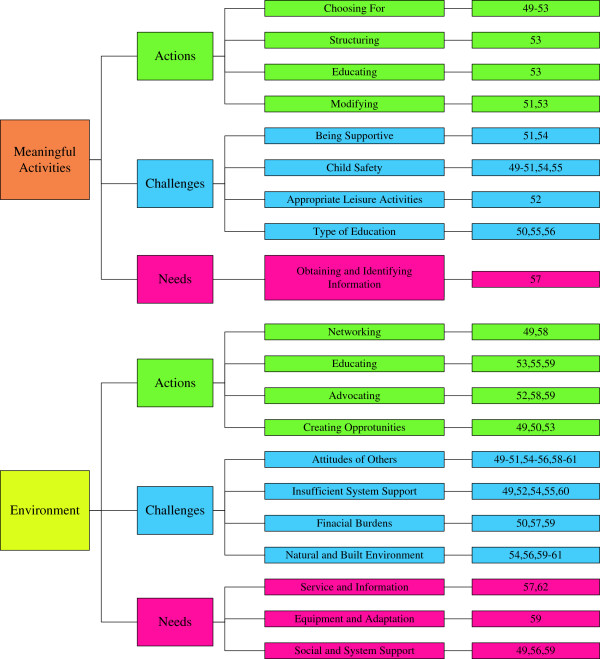
BACKGROUND: Pediatric rehabilitation considers Family-centered service (FCS) as a way to increase participation of children with a physical disability in daily life. An important principal is that parents greatly contribute to their child's participation at school, at home, and in the community. However, it is unclear what kind of information is available from literature about what parents actually do to support their child's participation and what problems and needs they experience? Hence, the aim of this study was to provide an overview of the actions, challenges, and needs of parents in enabling participation of their child with a physical disability that is neurological and non-progressive in nature. METHODS: Scoping review with extensive literature search (September 2011) and a thematic analysis to synthesize findings. RESULTS: Fourteen relevant articles revealed two major themes: 'parents enable and support performance of meaningful activities' and 'parents enable, change and use the environment'. Each theme holds a number of actions (e.g. choosing the right type of meaningful activities for facilitating social contacts) and challenges (e.g. negative attitudes of other people). Less information is available about the needs of parents. CONCLUSIONS: This study indicates that parents apply a broad range of strategies to support participation of their children. They experience many challenges, especially as a result of constraints in the social and physical environments. However, this review also shows that little is known about needs of parents in facilitating participation. As Family-centered service (FCS) philosophy is all about the needs of the child and the family, it is essential to further investigate the needs of the parents and to understand if and to what extent they wish to be supported in enabling their child's participation in daily life.
Overview
The claims and statistics of this paper haven’t been checked yet.
Free: it reads the open-access text and checks the first 5 claims that cite a source we can check. Create a free account to check every claim.
Integrity signals
Registry
Cites
Statistics
Figures
Verification
Claims the paper makes
The claims and statistics of this paper haven’t been checked yet.
Free: it reads the open-access text and checks the first 5 claims that cite a source we can check. Create a free account to check every claim.
Self-check
Percentages, sums and reported differences re-computed from the paper’s own numbers.
The self-check needs the paper’s full text.
Citations
Cites
Using thematic analysis in psychology
Braun, V., & Clarke, V. (2006) · Qualitative Research in Psychology · doi:10.1191/1478088706qp063oa · Cited by 194,414 · cited 1×
“Narrative synthesis was used to summarize evidence from 3 streams (quantitative descriptive, mixed methods, and qualitative studies) involving a qualitative, thematic analysis [46-49].”
MethodScoping studies: towards a methodological framework
Arksey, H., & O'Malley, L. (2005) · International Journal of Social Research Methodology · doi:10.1080/1364557032000119616 · Cited by 36,742 · cited 4×
“Data collation and summarization was done in two steps, as recommended methodological procedures found in the literature [38,40].”
MethodInfluentialScoping studies: advancing the methodology
Levac, D., Colquhoun, H., & O'Brien, K. K. (2010) · Implementation Science · doi:10.1186/1748-5908-5-69 · Cited by 15,268 · cited 2×
“Data collation and summarization was done in two steps, as recommended methodological procedures found in the literature [38,40].”
MethodStigma: Notes on the Management of Spoiled Identity
(1969) · Postgraduate Medical Journal · doi:10.1136/pgmj.45.527.642 · Cited by 14,231
(1998) · Cited by 13,501
Stigma: Notes on the Management of Spoiled Identity.
Seeman, M., & Goffman, E. (1964) · American Sociological Review · doi:10.2307/2091442 · Cited by 10,716
Methods for the thematic synthesis of qualitative research in systematic reviews
Thomas, J., & Harden, A. (2008) · BMC Medical Research Methodology · doi:10.1186/1471-2288-8-45 · Cited by 9,312
International Classification of Functioning, Disability and Health
World Health Organization (2021) · PsycTESTS Dataset · doi:10.1037/t76403-000 · Cited by 3,751
International Classification of Functioning, Disability and Health
Chard, G. (2004) · British Journal of Occupational Therapy · doi:10.1177/030802260406700101 · Cited by 3,688
Methods for the synthesis of qualitative research: a critical review
Barnett-Page, E., & Thomas, J. (2009) · BMC Medical Research Methodology · doi:10.1186/1471-2288-9-59 · Cited by 2,042
Surveillance of cerebral palsy in Europe: a collaboration of cerebral palsy surveys and registers
Cans, C. (2000) · Developmental Medicine & Child Neurology · doi:10.1111/j.1469-8749.2000.tb00695.x · Cited by 1,635
Mays, N., Pope, C., & Popay, J. (2005) · Journal of Health Services Research & Policy · doi:10.1258/1355819054308576 · Cited by 1,375
Exploring Disability: A Sociological Introduction
Barnes, C., & Mercer, G. (1999) · Cited by 960
Participation in the Occupations of Everyday Life
Law, M. (2002) · American Journal of Occupational Therapy · doi:10.5014/ajot.56.6.640 · Cited by 940 · cited 1×
“Through participation in different social contexts, children gather knowledge and skills needed to interact, play, work, and live with other people [14,15].”
BackgroundSurveillance of cerebral palsy in Europe: a collaboration of cerebral palsy surveys and registers
(SCPE), S. O. C. P. I. E. (2001) · Developmental Medicine and Child Neurology · doi:10.1017/s0012162200001511 · Cited by 908
Vollmar, H. C., Mayer, H., Ostermann, T., Butzlaff, M. E., Sandars, J. E., Wilm, S., & Rieger, M. A. (2010) · Implementation Science · doi:10.1186/1748-5908-5-1 · Cited by 693
Rosenbaum, P., King, S., Law, M., King, G., & Evans, J. (1998) · Physical & Occupational Therapy In Pediatrics · doi:10.1300/j006v18n01_01 · Cited by 516
King, S., Teplicky, R., King, G., & Rosenbaum, P. (2004) · Seminars in Pediatric Neurology · doi:10.1016/j.spen.2004.01.009 · Cited by 490 · cited 3×
“In FCS, the family is seen as an expert on the child’s abilities and needs, and professionals work in partnership with the family [34,35].”
BackgroundDiscrimination in health care against people with mental illness
Thornicroft, G., Rose, D., & Kassam, A. (2007) · International Review of Psychiatry · doi:10.1080/09540260701278937 · Cited by 446
King, G. A., Law, M., King, S., Hurley, P., Hanna, S., Kertoy, M., & Rosenbaum, P. (2007) · Child: Care, Health and Development · doi:10.1111/j.1365-2214.2006.00613.x · Cited by 414 · cited 1×
“The concept of participation is important in the field of childhood disability [1].”
BackgroundPERENBOOM, R. J. M., & CHORUS, A. M. J. (2003) · Disability and Rehabilitation · doi:10.1080/0963828031000137081 · Cited by 373 · cited 3×
“Perenboom & Chorus [67] stress the importance of fulfillment of personal goals and societal roles for participation, although their study found that several measurement instruments for participation only focused on the actual performance of activities.”
BackgroundInfluentialBamm, E. L., & Rosenbaum, P. (2008) · Archives of Physical Medicine and Rehabilitation · doi:10.1016/j.apmr.2007.12.034 · Cited by 346 · cited 1×
“Pediatric rehabilitation, aiming for optimal participation [33,34], could benefit from this understanding to improve Family-centered services (FCS).”
BackgroundChiao, C., Weng, L.-J., & Botticello, A. L. (2011) · BMC Public Health · doi:10.1186/1471-2458-11-292 · Cited by 345 · cited 2×
“Participation is an important outcome for the health of adults and children [4-7].”
BackgroundSynthesising research evidence.
Mays, N., Roberts, E., & Popay, J. (2001) · LSHTM Research Online (London School of Hygiene and Tropical Medicine) · doi:10.4324/9780203481981-16 · Cited by 327
Hemmingsson, H., & Jonsson, H. (2005) · The American Journal of Occupational Therapy · doi:10.5014/ajot.59.5.569 · Cited by 319
Self-citationSocial Participation of Students with Special Needs in Regular Primary Education in the Netherlands
Koster, M., Pijl, S. J., Nakken, H., & Van Houten, E. (2010) · International Journal of Disability, Development and Education · doi:10.1080/10349120903537905 · Cited by 294
The Reliability and Validity of the Quality of Upper Extremity Skills Test
DeMatteo, C., Law, M., Russell, D., Pollock, N., Rosenbaum, P., & Walter, S. (1993) · Physical & Occupational Therapy In Pediatrics · doi:10.1080/j006v13n02_01 · Cited by 286
Family and Peer Issues Among Adolescents With Spina Bifida and Cerebral Palsy
Blum, R. W., Resnick, M. D., Nelson, R., & Germaine, A. S. (1991) · PEDIATRICS · doi:10.1542/peds.88.2.280 · Cited by 281
Factors affecting family‐centred service delivery for children with disabilities
Law, M., Hanna, S., King, G., Hurley, P., King, S., Kertoy, M., & Rosenbaum, P. (2003) · Child: Care, Health and Development · doi:10.1046/j.1365-2214.2003.00351.x · Cited by 272
Badley, E. M. (2008) · Social Science & Medicine · doi:10.1016/j.socscimed.2008.01.026 · Cited by 257 · cited 1×
“There is a debate in the literature about the concept of participation [11,64].”
BackgroundParticipation of disabled children: how should it be characterised and measured?
McConachie, H., Colver, A. F., Forsyth, R. J., Jarvis, S. N., & Parkinson, K. N. (2006) · Disability and Rehabilitation · doi:10.1080/09638280500534507 · Cited by 251
Frostad, P., & Pijl, S. J. (2007) · European Journal of Special Needs Education · doi:10.1080/08856250601082224 · Cited by 248 · cited 1×
“As a result, they have decreased opportunities building relationships and often feel socially isolated [27-29].”
BackgroundOccupational therapy with children : understanding children's occupations and enabling participation
Rodger, S., & Ziviani, J. M. (2006) · Blackwell Publishing Ltd eBooks · Cited by 228
Missiuna, C. A., Moll, S. E., King, S., King, G. A., & Law, M. (2007) · Physical & Occupational Therapy In Pediatrics · doi:10.1080/j006v27n01_06 · Cited by 226
The Disabilities Convention: Human Rights of Persons with Disabilities or Disability Rights?
Mégret, F. (2008) · Human Rights Quarterly · doi:10.1353/hrq.0.0000 · Cited by 225
Bult, M. K., Verschuren, O., Jongmans, M. J., Lindeman, E., & Ketelaar, M. (2011) · Research in Developmental Disabilities · doi:10.1016/j.ridd.2011.01.045 · Cited by 222 · cited 1×
“The degree of participation of children with a physical disability is associated with several variables, such as gross motor function, communicative skills, and environments [24].”
BackgroundSelf-citationOliver, S., Harden, A., Rees, R., Shepherd, J., Brunton, G., Garcia, J., & Oakley, A. (2005) · Evaluation · doi:10.1177/1356389005059383 · Cited by 221 · cited 1×
“Similar steps used for mixed-method systematic reviews were followed [39]; typically in scoping reviews, the appraisal and inclusion of evidence is not limited by the methodological quality of that evidence [38,40].”
MethodLee, H. Y., Jang, S.-N., Lee, S., Cho, S.-I., & Park, E.-O. (2008) · International Journal of Nursing Studies · doi:10.1016/j.ijnurstu.2007.05.007 · Cited by 216 · cited 1×
“Furthermore, children’s participation at home, at school, and in the community relates to well-being, quality of life, and development [5,8-10].”
BackgroundDiversity of participation in children with cerebral palsy
Imms, C., Reilly, S., Carlin, J., & Dodd, K. (2008) · Developmental Medicine & Child Neurology · doi:10.1111/j.1469-8749.2008.02051.x · Cited by 201 · cited 1×
“They participate less frequently in almost all activities compared to children without physical disabilities [25,26].”
BackgroundSuccessful Participation: The Lived Experience among Children with Disabilities
Heah, T., Case, T., McGuire, B., & Law, M. (2007) · Canadian Journal of Occupational Therapy · doi:10.2182/cjot.06.10 · Cited by 195 · cited 5×
“[50] found that parents had strong convictions that their children should experience a variety of activities in order to choose those that are particularly meaningful.”
BackgroundInfluentialBedell, G. M., & Dumas, H. M. (2004) · Brain Injury · doi:10.1080/0269905031000110517 · Cited by 193 · cited 1×
“Through participation in different social contexts, children gather knowledge and skills needed to interact, play, work, and live with other people [14,15].”
BackgroundMeasures of social outcomes in disability research
Dijkers, M. P. J. M., Whiteneck, G., & El-Jaroudi, R. (2000) · Archives of Physical Medicine and Rehabilitation · doi:10.1053/apmr.2000.20627 · Cited by 174 · cited 1×
“Furthermore, children’s participation at home, at school, and in the community relates to well-being, quality of life, and development [5,8-10].”
BackgroundA Systematic Review of Instruments Assessing Participation: Challenges in Defining Participation
Eyssen, I. C., Steultjens, M. P., Dekker, J., & Terwee, C. B. (2011) · Archives of Physical Medicine and Rehabilitation · doi:10.1016/j.apmr.2011.01.006 · Cited by 170 · cited 1×
“Participation is an important outcome for the health of adults and children [4-7].”
BackgroundParent Perspectives to Inform Development of Measures of Children's Participation and Environment
Bedell, G. M., Khetani, M. A., Cousins, M. A., Coster, W. J., & Law, M. (2011) · Archives of Physical Medicine and Rehabilitation · doi:10.1016/j.apmr.2010.12.029 · Cited by 149 · cited 2×
“[72] gave examples of parents educating others and Reid et al.”
BackgroundMysteries and Mazes: Parents' Experiences of Children with Developmental Coordination Disorder
Missiuna, C. A., Moll, S. E., Law, M., King, S., & King, G. A. (2005) · Canadian Journal of Occupational Therapy · doi:10.2182/cjot.05.0010 · Cited by 149 · cited 2×
“[53] described parents’ struggles with physical leisure activities.”
BackgroundFamily needs of parents of children and youth with cerebral palsy
Palisano, R. J., Almarsi, N., Chiarello, L. A., Orlin, M. N., Bagley, A., & Maggs, J. (2010) · Child: Care, Health and Development · doi:10.1111/j.1365-2214.2009.01030.x · Cited by 147
Häggström, A., & Larsson-Lund, M. (2008) · Acta Dermato Venereologica · doi:10.2340/16501977-0138 · Cited by 132 · cited 1×
“participation used in this scoping review has been criticized in the literature [20,65,66] for not including a per-”
MethodNew wine in old bottles: the WHO ICF as an explanatory model of human behaviour
Wade, D. T., & Halligan, P. (2003) · Clinical Rehabilitation · doi:10.1191/0269215503cr619ed · Cited by 130 · cited 1×
“participation used in this scoping review has been criticized in the literature [20,65,66] for not including a per-”
MethodLawlor, K., Mihaylov, S. I., Welsh, B., Jarvis, S. N., & Colver, A. F. (2006) · Developmental Neurorehabilitation · doi:10.1080/13638490500235649 · Cited by 121 · cited 7×
“In several studies [50,57,60] parents also expressed the need for extra support from grandparents by bringing their child to leisure activities or to school, ensuring that parents would be able to continue to work.”
BackgroundMethodInfluentialBult, M. K., Verschuren, O. W., Gorter, J., Jongmans, M. J., Piškur, B., & Ketelaar, M. (2010) · Clinical Rehabilitation · doi:10.1177/0269215510367545 · Cited by 112 · cited 1×
“They participate less frequently in almost all activities compared to children without physical disabilities [25,26].”
BackgroundSelf-citationAntle, B. J., Mills, W., Steele, C., Kalnins, I., & Rossen, B. E. (2007) · Child Care Health and Development · doi:10.1111/j.1365-2214.2007.00782.x · Cited by 109
Missiuna, C. A., Moll, S. E., King, S., et al. (2007) · Physical & Occupational Therapy In Pediatrics · doi:10.1300/j006v27n01_06 · Cited by 104
The Role of Family in the Development of Social Skills in Children with Physical Disabilities
Bennett, K., & Hay, D. A. (2007) · International Journal of Disability Development and Education · doi:10.1080/10349120701654555 · Cited by 95 · cited 5×
“The more severe the child’s disability, the more alert and involved his or her parents were [56].”
BackgroundInfluentialBedell, G. M., Cohn, E. S., & Dumas, H. M. (2005) · American Journal of Occupational Therapy · doi:10.5014/ajot.59.3.273 · Cited by 93 · cited 7×
“[54] showed that parents purposefully selected certain peers to visit or play with their child after school in order to increase the chances for developing a solid friendship.”
BackgroundInfluentialConceptions of Participation in Students with Disabilities and Persons in Their Close Environment
Eriksson, L., & Granlund, M. (2004) · Journal of Developmental and Physical Disabilities · doi:10.1023/b:jodd.0000032299.31588.fd · Cited by 92 · cited 1×
“Some authors [68,69] assigned the importance of engagement and motivation to the definition of participation.”
BackgroundSocial Participation in the Elderly: What Does the Literature Tell Us?
Dahan-Oliel, N., Gelinas, I., & Mazer, B. (2008) · Critical Reviews in Physical and Rehabilitation Medicine · doi:10.1615/critrevphysrehabilmed.v20.i2.40 · Cited by 82
Segal, R., Mandich, A. D., Polatajko, H. J., & Cook, J. V. (2002) · American Journal of Occupational Therapy · doi:10.5014/ajot.56.4.422 · Cited by 77 · cited 2×
“In a study of parents’ perceptions of their children with developmental coordination disorder (DCD), Segal et al, [73] found that physical activity is an important facet of social life, as impaired performance could lead to participation restriction.”
BackgroundLewis, S. A., Noyes, J., & Mackereth, S. (2010) · BMC Pediatrics · doi:10.1186/1471-2431-10-103 · Cited by 72 · cited 1×
“parents of children with Down syndrome, young people with epilepsy, and young adults with physical disabilities [70-72].”
BackgroundLeven, N. V., & Jonsson, H. (2002) · Scandinavian Journal of Occupational Therapy · doi:10.1080/11038120260501172 · Cited by 69 · cited 1×
“example, several studies [22,23] show people might consider themselves to be engaged and participate in activities without actually performing them.”
BackgroundBeing concerned: caregiving for Taiwanese mothers of a child with cerebral palsy
Huang, Y., Kellett, U., & St John, W. (2012) · Journal of Clinical Nursing · doi:10.1111/j.1365-2702.2011.03741.x · Cited by 68 · cited 4×
“Also, schools, playgrounds, and leisure facilities in neighborhoods were often inaccessible to children with a physical disability [55,61].”
BackgroundInfluentialFamily Needs Assessment in Cerebral Palsy Clinic
Buran, C. F., Sawin, K. J., Grayson, P., & Criss, S. (2008) · Journal for Specialists in Pediatric Nursing · doi:10.1111/j.1744-6155.2008.00176.x · Cited by 64 · cited 3×
“[58,63] illustrated how parents require more written information than is generally available about ser-”
BackgroundInfluentialHow might districts identify local barriers to participation for children with cerebral palsy?
Welsh, B., Jarvis, S. N., Hammal, D. M., & Colver, A. F. (2005) · Public Health · doi:10.1016/j.puhe.2005.04.006 · Cited by 59
Social participation of relatives post-stroke: the role of rehabilitation and related ethical issues
Pellerin, C., Rochette, A., & Racine, É. (2011) · Disability and Rehabilitation · doi:10.3109/09638288.2010.524272 · Cited by 57
Perspectives on Understanding and Changing the Environments of Children with Disabilities
Law, M., & Dunn, W. (1994) · Physical & Occupational Therapy In Pediatrics · doi:10.1300/j006v13n03_01 · Cited by 54
The ups and downs of social participation: experiences of wheelchair users in Norway
Hjelle, K. M., & Vik, K. (2011) · Disability and Rehabilitation · doi:10.3109/09638288.2011.575525 · Cited by 53 · cited 2×
“Several authors use the term social participation for participation, emphasizing the importance of engagement in social situations [11-13].”
Background“If I Knew Then What I Know Now”: Parents’ Reflections on Raising a Child with Cerebral Palsy
Reid, A., Imrie, H., Brouwer, E., Clutton, S., Evans, J., Russell, D., & Bartlett, D. (2011) · Physical & Occupational Therapy In Pediatrics · doi:10.3109/01942638.2010.540311 · Cited by 50
Turnbull, A. P., Pereira, L., & Blue-Banning, M. J. (1999) · Research and Practice for Persons with Severe Disabilities · doi:10.2511/rpsd.24.2.85 · Cited by 46
Perspectives on Understanding and Changing the Environments of Children with Disabilities
Law, M., & Dunn, W. (1994) · Physical & Occupational Therapy In Pediatrics · doi:10.1080/j006v13n03_01 · Cited by 44 · cited 1×
“As a result, they have decreased opportunities building relationships and often feel socially isolated [27-29].”
BackgroundKolehmainen, N., Francis, J. J., Ramsay, C. R., Owen, C., McKee, L., Ketelaar, M., & Rosenbaum, P. (2011) · BMC Pediatrics · doi:10.1186/1471-2431-11-100 · Cited by 43 · cited 1×
“Some authors [68,69] assigned the importance of engagement and motivation to the definition of participation.”
BackgroundSelf-citationThe Participation Experience of Children with Disabilities in Portuguese Mainstream Schools
Pereira, E., la Cour, K., Jonsson, H., & Hemmingsson, H. (2010) · British Journal of Occupational Therapy · doi:10.4276/030802210x12918167234244 · Cited by 37 · cited 1×
“example, several studies [22,23] show people might consider themselves to be engaged and participate in activities”
BackgroundSelf-citationParent‐perceived barriers to participation in children and adolescents with cerebral palsy
Vogts, N., Mackey, A. H., Ameratunga, S. N., & Stott, N. S. (2010) · Journal of Paediatrics and Child Health · doi:10.1111/j.1440-1754.2010.01815.x · Cited by 34 · cited 3×
“Similar challenges were also experienced in parks, public transport, and parking facilities – all noted as not being user-friendly for children with a physical disabilities [57,60-62].”
BackgroundMaking Sense of What People Do: Historical Perspectives
Wilcock, A. A. (2003) · Journal of Occupational Science · doi:10.1080/14427591.2003.9686504 · Cited by 23 · cited 1×
“Others [20,21] stressed that in addition to performance,”
BackgroundParents’ views of their children who have complex health needs
Hewitt‐Taylor, J. (2008) · Nursing Children and Young People · doi:10.7748/paed.20.8.20.s22 · Cited by 20
Children with complex, continuing health needs and access to facilities
Hewitt‐Taylor, J. (2009) · Nursing Standard · doi:10.7748/ns2009.04.23.31.35.c6932 · Cited by 14
If I Knew Then What I Know Now
Kramer, M. (2014) · Rowman & Littlefield Publishers eBooks · doi:10.5040/9798216401919.ch-003 · Cited by 9
Mothering a 3- to 6-Year-Old Child with Hemiparesis
Meehan, D. R. (2005) · Journal of Neuroscience Nursing · doi:10.1097/01376517-200510000-00006 · Cited by 7 · cited 1×
“ing of belonging to a group with shared interests [59].”
Background
Research works printed but not linked: 3
- United Nations General comment on implementing rights in early childhood 2006 Geneva: UN CotRot, vol. CRC/C/GC/7/Rev 1
- Council of Europe Revised European social charter: 5th national report on the implementation of the revised European social charter submitted by the government of the Netherlands 2012 Strasbourg: Council of Europe
- Action 2011 http://www.Dictionary.cambridge.org
Cited by
PRISMA Extension for Scoping Reviews (PRISMA-ScR): Checklist and Explanation
Tricco, A. C., Lillie, E., Zarin, W., O'Brien, K. K., Colquhoun, H., Levac, D., Moher, D., Peters, M. D. J., Horsley, T., Weeks, L., et al. (2018) · Annals of Internal Medicine · doi:10.7326/m18-0850 · Cited by 43,565
Solution-Focused Coaching in Pediatric Rehabilitation: An Integrated Model for Practice
Baldwin, P. J., King, G. A., Evans, J., McDougall, S., Tucker, M. A., & Servais, M. (2013) · Physical & Occupational Therapy In Pediatrics · doi:10.3109/01942638.2013.784718 · Cited by 128
“…King, et al., 2002), and greater awareness that key adults in a child’s life play an important role in providing learning opportunities within natural environments and in developing environmental changes that support successful participation (Dirks & Hadders-Algra, 2011; Piskur et al., 2012).”
BackgroundAnaby, D., Khetani, M. A., Piškur, B., van der Holst, M., Bedell, G. M., Schakel, F., de Kloet, A. J., Simeonsson, R. J., & Imms, C. (2021) · Disability and Rehabilitation · doi:10.1080/09638288.2021.1903102 · Cited by 108
Self-citationShikako‐Thomas, K., Kolehmainen, N., Ketelaar, M., Bult, M. K., & Law, M. (2014) · Journal of Child Neurology · doi:10.1177/0883073814533422 · Cited by 89
“The scope of interventions and service delivery models should support the role of individuals with cerebral palsy and their families to make decisions, to pursue their preferences and to build skills and provide opportunities that may facilitate meaningful engagement in leisure.(96,101,102)”
BackgroundSelf-citationHealth challenges faced by parents of children with disabilities: a scoping review
Shahali, S., Tavousi, M., Sadighi, J., Kermani, R. M., & Rostami, R. (2024) · BMC Pediatrics · doi:10.1186/s12887-024-05104-3 · Cited by 97
Metadata
- Authors
- Piškur, B., Beurskens, A. J., Jongmans, M. J., Ketelaar, M., Norton, M., Frings, C. A., Hemmingsson, H., & Smeets, R. J.
- Affiliations
- Zuyd University of Applied Sciences (NL)
- Utrecht University (NL)
- University Medical Center Utrecht (NL)
- Linköping University (SE)
- Maastricht University (NL)
- Corresponding author
- Piškur, Barbara
- ORCID
- Venue
- BMC Pediatrics
- Published
- 2012-11-08
- Volume
- 12
- Issue
- 1
- Pages
- 177-177
- ISSN
- 1471-2431 (ISSN-L)
- PMC
- PMC3538071
- OpenAlex
- W2152062489
- Semantic Scholar
- 8d850ab4b36de0ccb99a9c9e1de2bcea3e7f2520
- Cited by
- 107
- References
- 73
- Citations by year
- 2026: 7 · 2025: 8 · 2024: 13 · 2023: 3 · 2022: 6 · 2021: 10 · 2020: 13 · 2019: 11 · 2018: 9 · 2017: 7 · 2016: 4 · 2015: 6 · 2014: 7 · 2013: 3
- FWCI
- 0.75
- Type
- journal article
- Language
- en
- Open access
- gold
- doi.org
- Licence
- cc-by
- creativecommons.org/licenses/by/2.0 (tdm)
- Locations
- BMC Pediatrics (publishedVersion, cc-by)
- Europe PMC (PubMed Central) (publishedVersion, cc-by)
- PubMed Central (publishedVersion, cc-by)
- PubMed (publishedVersion)
- Research Publications (Maastricht University) (publishedVersion, cc-by)
- DiVA (Linkoping University) (submittedVersion, other-oa)
- DOAJ (DOAJ: Directory of Open Access Journals) (submittedVersion, cc-by-sa)
- Radboud Repository (Radboud University) (submittedVersion)
- Radboud Repository (Radboud University) (submittedVersion, other-oa)
- Research Publications (Maastricht University) (submittedVersion, other-oa)
- Funders
- University of Toronto
- Zuyd Hogeschool
- Topics
- Social Sciences › Psychology › Clinical Psychology › Family and Disability Support Research
- Health Sciences › Medicine › Rehabilitation › Cerebral Palsy and Movement Disorders
- Social Sciences › Sociology and Political Science › Disability Rights and Representation
- Keywords
- parental involvement, participation, children with physical disabilities, pediatric rehabilitation, parental needs, meaningful activities, environmental modification, social environment
- MeSH terms
- Cerebral Palsy, Child, Humans, Parents, Social Support, Spinal Dysraphism, Parenting, Needs Assessment, Social Participation
About these checks
Registry, retraction, Cites and statistics results are computed, not judged, with one exception: a printed reference that no index lists is read once by a model before it counts as a citation error. Claims are extracted by a model and kept only when their quote appears verbatim in the text; each cited source is then checked, with a model’s help, for whether it says what the claim relies on. Those verdicts can be wrong — read the claim’s quote and the cited source before relying on one.
Statistics and arithmetic are recomputed, not judged.
Confidence bands are shown only for fields calibrated on our annotated test set. None is calibrated yet, so no band is shown.
What counts as a claim ›How we measure confidence ›How we check this ›
Are you an author, or do you see a problem with this page? Request a review
Data sources
Bibliographic data: Semantic Scholar, OpenAlex, Crossref.
Contains information from the Semantic Scholar Academic Graph Datasets, made available under the ODC Attribution License (ODC-BY 1.0).
Semantic Scholar’s data is described in: Kinney, R., et al. (2023). The Semantic Scholar Open Data Platform. arXiv:2301.10140.
