

Recovery from depressive symptoms, state anxiety and post-traumatic stress disorder in women exposed to physical and psychological, but not to psychological intimate partner violence alone: A longitudinal study
Open accessThe DOI matches its Crossref record; 78 of the 78 references it cites were found in a registry or an index.
Abstract
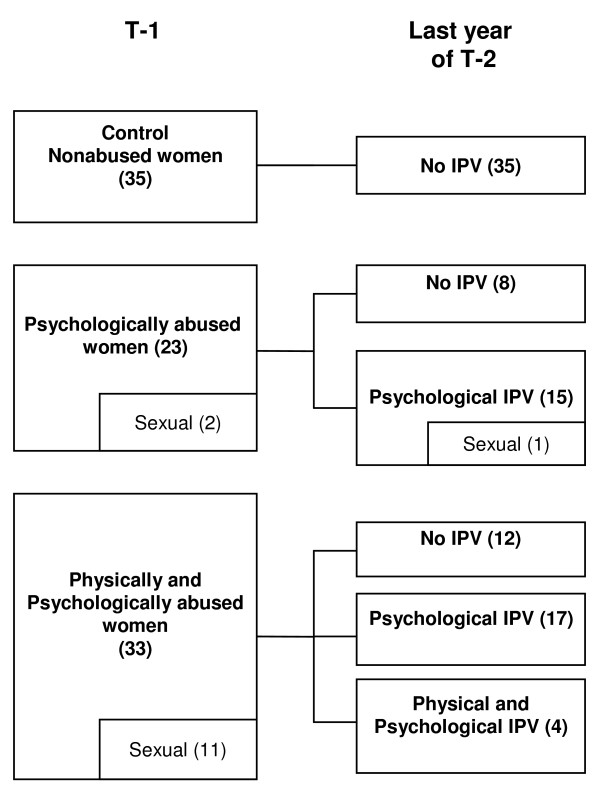
Background: It is well established that intimate male partner violence (IPV) has a high impact on women's mental health. It is necessary to further investigate this impact longitudinally to assess the factors that contribute to its recovery or deterioration. The objective of this study was to assess the course of depressive, anxiety and post-traumatic stress disorder (PTSD) symptoms and suicidal behavior over a three-year follow-up in female victims of IPV. Methods: Women (n = 91) who participated in our previous cross-sectional study, and who had been either physically/psychologically (n = 33) or psychologically abused (n = 23) by their male partners, were evaluated three years later. A nonabused control group of women (n = 35) was included for comparison. Information about mental health status and lifestyle variables was obtained through face-to-face structured interviews. Results: Results of the follow-up study indicated that while women exposed to physical/psychological IPV recovered their mental health status with a significant decrease in depressive, anxiety and PTSD symptoms, no recovery occurred in women exposed to psychological IPV alone. The evolution of IPV was also different: while it continued across both time points in 65.21% of psychologically abused women, it continued in only 12.12% of physically/psychologically abused women while it was reduced to psychological IPV in 51.5%. Hierarchical multiple regression analyses indicated that cessation of physical IPV and perceived social support contributed to mental health recovery, while a high perception of lifetime events predicted the continuation of PTSD symptoms. Conclusion: This study shows that the pattern of mental health recovery depends on the type of IPV that the women had been exposed to. While those experiencing physical/psychological IPV have a higher likelihood of undergoing a cessation or reduction of IPV over time and, therefore, could recover, women exposed to psychological IPV alone have a high probability of continued exposure to the same type of IPV with a low possibility of recovery. Thus, women exposed to psychological IPV alone need more help to escape from IPV and to recuperate their mental health. Longitudinal studies are needed to improve knowledge of factors promoting or impeding health recovery to guide the formulation of policy at individual, social and criminal justice levels.
Overview
The claims and statistics of this paper haven’t been checked yet.
Free: it reads the open-access text and checks the first 5 claims that cite a source we can check. Create a free account to check every claim.
Integrity signals
Registry
Cites
Statistics
Figures
Verification
Claims the paper makes
The claims and statistics of this paper haven’t been checked yet.
Free: it reads the open-access text and checks the first 5 claims that cite a source we can check. Create a free account to check every claim.
Claims other papers make about this one
Each is checked against this paper’s own text: does it say what the citing paper says it does?
The source backs part of the claim, not all of it — or backs it for a different population, condition or comparison.
In the citing paper
“All sixteen reviewed studies on anxiety reported finding a positive association between a history of intimate partner violence and increased levels of anxiety in women.”
From Mental and Physical Health and Intimate Partner Violence against Women: A Review of the Literature (2013) · cites this paper as [15]
Experimental — accuracy not yet measuredThe cited source says what the claim attributes to it.
In the citing paper
“IPV was associated with a range of mental health issues including depression, PTSD, anxiety, self-harm, and sleep disorders.”
From Mental and Physical Health and Intimate Partner Violence against Women: A Review of the Literature (2013) · cites this paper as [15]
The cited source says what the claim attributes to it.
In the citing paper
“All studies agreed on the fact that a history of intimate partner violence was positively associated with the increased incidence of PTSD symptoms and PTSD diagnoses.”
From Mental and Physical Health and Intimate Partner Violence against Women: A Review of the Literature (2013) · cites this paper as [15]
Self-check
Percentages, sums and reported differences re-computed from the paper’s own numbers.
The self-check needs the paper’s full text.
Citations
Cites
Diagnostic and Statistical Manual of Mental Disorders
Williams, J. B. W., & First, M. (2013) · Encyclopedia of Social Work · doi:10.1093/acrefore/9780199975839.013.104 · Cited by 109,519
An inventory for measuring depression
BECK, A. T. (1961) · Archives of General Psychiatry · doi:10.1001/archpsyc.1961.01710120031004 · Cited by 38,032 · cited 5×
“1)-Depressive symptoms The severity of depressive symptoms was measured with the Beck Depression Inventory (BDI) [59].”
MethodInfluential(1970) · Cited by 24,983
Diagnostic and Statistical Manual of Mental Disorders
(2012) · SpringerReference · doi:10.1007/springerreference_121117 · Cited by 20,570
Diagnostic and Statistical Manual of Mental Disorders, 5th Edition
(2013) · American Psychiatric Association Publishing eBooks · doi:10.1176/appi.books.9780890425596.893619 · Cited by 4,383
Health consequences of intimate partner violence
Campbell, J. C. (2002) · The Lancet · doi:10.1016/s0140-6736(02)08336-8 · Cited by 4,055
STAI manual for the State-trait anxiety inventory
Cd, S. (1970) · Medical Entomology and Zoology · Cited by 2,492
Physical and mental health effects of intimate partner violence for men and women
Coker, A. L., Davis, K. E., Arias, I., Desai, S., Sanderson, M., Brandt, H. M., & Smith, P. H. (2002) · American Journal of Preventive Medicine · doi:10.1016/s0749-3797(02)00514-7 · Cited by 2,258 · cited 1×
“The most prevalent sequelae include depression, anxiety and posttraumatic stress disorder (PTSD) [8-14].”
BackgroundEllsberg, M., Jansen, H. A., Heise, L., Watts, C. H., & Garcia-Moreno, C. (2008) · The Lancet · doi:10.1016/s0140-6736(08)60522-x · Cited by 1,820
Broadhead, W. E., Gehlbach, S. H., De Gruy, F. V., & Kaplan, B. H. (1988) · Medical Care · doi:10.1097/00005650-198807000-00006 · Cited by 1,314 · cited 1×
“The Duke-UNC scale (11 item version) was used to measure functional social support [ 57 ].”
Method
Research works printed but not linked: 2
- Conde V Useros E Adaptación castellana de la escala de evaluación conductual para la depresión de Beck Rev Psiquiatria Psicol Med Eur Am 1975 12 217 236
- Spielberger CD Gorsuch RL Lushene RE Manual STAI. Cuestionario de Ansiedad Estado Rasgo 1988 Adaptación española. Madrid: TEA Ediciones
Cited by
Items 101–133 of 133
Tramayne, S. R. (2012) · Loyola eCommons (Loyola University of Chicago) · Cited by 10
Romito, P., Feresin, M., Bastiani, F., & Saurel‐Cubizolles, M. (2022) · Health Care For Women International · doi:10.1080/07399332.2022.2039148 · Cited by 4
“Other researchers have found links between violence and PTSD (including nightmares and panic attacks) (Coker et al., 2002; Mechanic et al., 2008), with a dose–response effect (Basile et al., 2004; Chandra et al., Global indicator of IPV low 1 (reference) 1 1 1 1 Intermediate 2 6.54 [2.44–17.49] 2.55 [0.96–6.74] 1.34 […”
ResultInfluentialA client informed view of domestic violence counselling
Roddy, J. K. (2014) · White Rose eTheses Online (University of Leeds, The University of Sheffield, University of York) · Cited by 4
McCall, M. (2014) · UA Campus Repository (The University of Arizona) · Cited by 4
Yastıbaş, C., Çınar, P., Üzümçeker, E., & Karaman, İ. G. Y. (2023) · Journal of Interpersonal Violence · doi:10.1177/08862605231213401 · Cited by 1
“Blasco-Ros et al. (2010) claimed that due to the high probability of psychological IPV persisting over time, women exposed to psychological IPV had greater difficulties in recovering from depression compared to those exposed to physical IPV.”
BackgroundJeong, E., Lee, C., Kim, H., Yu, H., Lee, J., Ha, T. B. T., Won, H., Myung, W., Kang, H. S., & Park, J. (2026) · Journal of Mental Health · doi:10.1080/09638237.2026.2645539 · Cited by 1
“Similarly, a longitudinal study supports this, showing that while physical abuse often ceases over time, psychological abuse is harder to overcome due to sustained exposure to mistreatment (Blasco-Ros et al., 2010).”
Apoyo social y violencia de pareja en los países hispanoparlantes: una revisión sistemática
Hernández, R. R., Viveros, N. C., & Esquivel-Santoveña, E. E. (2024) · Cuadernos Hispanoamericanos de Psicología · doi:10.18270/chps.4815 · Cited by 1
Christina, D., & Irwanto, I. (2019) · Jurnal Muara Ilmu Sosial Humaniora dan Seni · doi:10.24912/jmishumsen.v3i1.4043
Pernebo, K., & Almqvist, K. (2023) · Violence and Victims · doi:10.1891/vv-2021-0056 · Cited by 1
Rodríguez, M. F. S., Blasco‐Ros, C., & Ortiz, M. M. (2017) · INFORMACIO PSICOLOGICA · doi:10.14635/ipsic.2017.114.3 · Cited by 4
Self-citationReactions to Violence Among African American Female Survivors of Intimate Partner Victimization
Cunningham, S. R., Schumacher, J. A., & Bell, T. P. (2018) · Journal of Black Studies · doi:10.1177/0021934718770825 · Cited by 2
Intimate Partner Violence and Sexual Trauma
Buranosky, R. A., & McCall‐Hosenfeld, J. S. (2020) · Springer eBooks · doi:10.1007/978-3-030-50695-7_35 · Cited by 3
Intimate Partner Violence and Victims
Gopalan, R. T. (2022) · Springer eBooks · doi:10.1007/978-3-031-12930-8_5 · Cited by 2
Effects of Interpersonal Crime on Victims
Hamilton-Giachritsis, C. E., & sleath, E. (2017) · Wiley eBooks · doi:10.1002/9781394259281.ch5 · Cited by 1
Violência na gestação e saúde mental de mulheres que são vítimas de seus parceiros
Fonseca‐Machado, M. D. O. (2014) · Digital Library of Theses and Dissertations (Universidade de São Paulo) · doi:10.11606/t.22.2014.tde-08012015-101617 · Cited by 8
Áhrif ofbeldis í nánum samböndum á lífsgæði ungra kvenna. Fræðileg samantekt
Stefánsdóttir, G. Ó., & Sigurðardóttir, S. H. (2013)
Carlos, J., Bermúdez, M. P., & Buela‐Casal, G. (2014)
Birungi, S. O. (2019) · Open University of Cape Town (University of Cape Town)
McLaughlin, J. (2013) · Stirling Online Research Repository (University of Stirling) · Cited by 2
Lamoreau, R., Obus, E., Koren‐Karie, N., & Gray, S. A. O. (2023) · Attachment & Human Development · doi:10.1080/14616734.2023.2272268 · Cited by 2
“In the adult literature, the trajectory of women’s mental health recovery may depend on the type and chronicity of IPV exposure (Blasco-Ros et al., 2010; Thompson et al., 2006).”
BackgroundEffects of Intimate Partner Violence Against Women
McCloskey, K., & Hussey, D. (2013) · Wiley eBooks · doi:10.1002/9781394260454.ch4
Domestic Violence, Psychosocial Stress, Socio-Economic Status and CVD Risk in Women
van Gelder, N. E., & Oertelt‐Prigione, S. (2024) · Springer eBooks · doi:10.1007/978-3-031-65952-2_16
Earle, E. A., Siegel, A. N., Tissera, T., Hernandez, K. M., Bartolomeo, A. A. D., Ip, J., & Fitzpatrick, S. (2025) · Journal of Trauma & Dissociation · doi:10.1080/15299732.2025.2503713 · Cited by 1
“…experiencing PTSS following these stressors frequently show limited response to standard treatments for depression (e.g., interpersonal psychotherapy, selective serotonin reuptake inhibitors) and anxiety, often requiring augmentation treatment (Blasco-Ros et al., 2010; Miniati et al., 2010).”
Lee, K. A., Priestley, S. R., & Hylton, K. K. (2025) · Journal of Family Violence · doi:10.1007/s10896-025-00886-1
Miller, L. E. (2013) · Deep Blue (University of Michigan)
Fredericksen, R. J., Nance, R. M., Whitney, B. M., Harding, B. N., Fitzsimmons, E., Del Rio, C., Eron, J., Feaster, D. J., Kalokhe, A. S., Mathews, W. C., et al. (2021) · Figshare · doi:10.6084/m9.figshare.16779681
Fredericksen, R. J., Nance, R. M., Whitney, B. M., Harding, B. N., Fitzsimmons, E., Del Rio, C., Eron, J., Feaster, D. J., Kalokhe, A. S., Mathews, W. C., et al. (2021) · Figshare · doi:10.6084/m9.figshare.16779678
Violence against women and its influence on menopausal symptoms and timing: A narrative review
Mendoza, N., Mendoza-Huertas, L., & Salas, E. (2026) · Maturitas · doi:10.1016/j.maturitas.2026.108949 · Cited by 1
Nowak, Y. E., Eriksson, J. A., Eikemo, R., Dahlström, K. M., Åhlund, D. S., Jonas, W., & Barimani, M. M. (2026) · Scandinavian Journal of Public Health · doi:10.1177/14034948261433286
Sharda, A., Satyen, L., & Toumbourou, J. W. (2026) · Journal of Family Violence · doi:10.1007/s10896-026-01154-6
Metadata
- Authors
- Blasco-Ros, C., Sánchez-Lorente, S., & Martinez, M.
- Affiliations
- Universitat de València (ES)
- Venue
- BMC Psychiatry
- Published
- 2010-11-25
- Volume
- 10
- Issue
- 1
- Pages
- 98-98
- ISSN
- 1471-244X (ISSN-L)
- PMC
- PMC3009625
- OpenAlex
- W2172080500
- Cited by
- 133
- References
- 76
- Citations by year
- 2026: 7 · 2025: 8 · 2024: 7 · 2023: 7 · 2022: 10 · 2021: 10 · 2020: 9 · 2019: 9 · 2018: 7 · 2017: 6 · 2016: 7 · 2015: 4 · 2014: 16 · 2013: 13 · 2012: 12
- FWCI
- 8.44
- Type
- journal article
- Language
- en
- Open access
- gold
- doi.org
- Licence
- cc-by
- creativecommons.org/licenses/by/2.0 (tdm)
- creativecommons.org/licenses/by/2.0 (vor)
- Locations
- BMC Psychiatry (publishedVersion, cc-by)
- PubMed Central (publishedVersion, cc-by)
- PubMed (publishedVersion)
- DOAJ (DOAJ: Directory of Open Access Journals) (submittedVersion, cc-by-sa)
- Repository of Digital Objects for Teaching Research and Culture (University of Valencia) (submittedVersion, cc-by-nc)
- Funders
- Generalitat Valenciana
- Ministerio de Ciencia e Innovación
- Topics
- Social Sciences › Health › Intimate Partner and Family Violence
- Social Sciences › Psychology › Clinical Psychology › Child Abuse and Trauma
- Social Sciences › Psychology › Clinical Psychology › Posttraumatic Stress Disorder Research
- Keywords
- intimate partner violence, physical abuse, psychological violence, depressive symptoms, state anxiety, post-traumatic stress disorder, suicidal behavior, mental health recovery, women, perceived social support
- MeSH terms
- Adult, Anxiety Disorders, Depression, Female, Follow-Up Studies, Health Status, Humans, Life Change Events, Longitudinal Studies, Male, Mental Health, Middle Aged, Surveys and Questionnaires, Sex Factors, Social Environment, Social Support, Spouse Abuse, Stress Disorders, Post-Traumatic, Comorbidity, Women's Health, Outcome Assessment, Health Care, Domestic Violence
About these checks
Registry, retraction, Cites and statistics results are computed, not judged, with one exception: a printed reference that no index lists is read once by a model before it counts as a citation error. Claims are extracted by a model and kept only when their quote appears verbatim in the text; each cited source is then checked, with a model’s help, for whether it says what the claim relies on. Those verdicts can be wrong — read the claim’s quote and the cited source before relying on one.
Statistics and arithmetic are recomputed, not judged.
Confidence bands are shown only for fields calibrated on our annotated test set. None is calibrated yet, so no band is shown.
What counts as a claim ›How we measure confidence ›How we check this ›
Are you an author, or do you see a problem with this page? Request a review
Data sources
Bibliographic data: Semantic Scholar, OpenAlex, Crossref.
Contains information from the Semantic Scholar Academic Graph Datasets, made available under the ODC Attribution License (ODC-BY 1.0).
Semantic Scholar’s data is described in: Kinney, R., et al. (2023). The Semantic Scholar Open Data Platform. arXiv:2301.10140.
