

Recovery from depressive symptoms, state anxiety and post-traumatic stress disorder in women exposed to physical and psychological, but not to psychological intimate partner violence alone: A longitudinal study
Open accessThe DOI matches its Crossref record; 78 of the 78 references it cites were found in a registry or an index.
Abstract
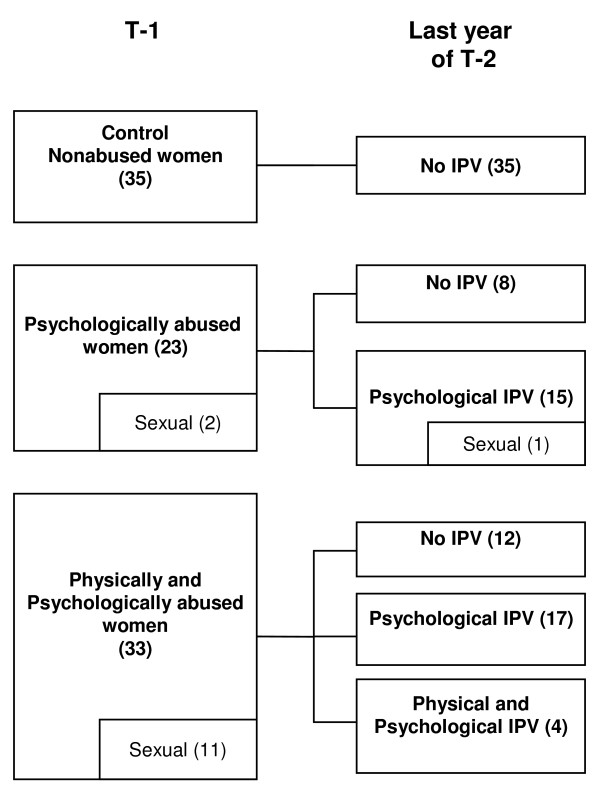
Background: It is well established that intimate male partner violence (IPV) has a high impact on women's mental health. It is necessary to further investigate this impact longitudinally to assess the factors that contribute to its recovery or deterioration. The objective of this study was to assess the course of depressive, anxiety and post-traumatic stress disorder (PTSD) symptoms and suicidal behavior over a three-year follow-up in female victims of IPV. Methods: Women (n = 91) who participated in our previous cross-sectional study, and who had been either physically/psychologically (n = 33) or psychologically abused (n = 23) by their male partners, were evaluated three years later. A nonabused control group of women (n = 35) was included for comparison. Information about mental health status and lifestyle variables was obtained through face-to-face structured interviews. Results: Results of the follow-up study indicated that while women exposed to physical/psychological IPV recovered their mental health status with a significant decrease in depressive, anxiety and PTSD symptoms, no recovery occurred in women exposed to psychological IPV alone. The evolution of IPV was also different: while it continued across both time points in 65.21% of psychologically abused women, it continued in only 12.12% of physically/psychologically abused women while it was reduced to psychological IPV in 51.5%. Hierarchical multiple regression analyses indicated that cessation of physical IPV and perceived social support contributed to mental health recovery, while a high perception of lifetime events predicted the continuation of PTSD symptoms. Conclusion: This study shows that the pattern of mental health recovery depends on the type of IPV that the women had been exposed to. While those experiencing physical/psychological IPV have a higher likelihood of undergoing a cessation or reduction of IPV over time and, therefore, could recover, women exposed to psychological IPV alone have a high probability of continued exposure to the same type of IPV with a low possibility of recovery. Thus, women exposed to psychological IPV alone need more help to escape from IPV and to recuperate their mental health. Longitudinal studies are needed to improve knowledge of factors promoting or impeding health recovery to guide the formulation of policy at individual, social and criminal justice levels.
Overview
The claims and statistics of this paper haven’t been checked yet.
Free: it reads the open-access text and checks the first 5 claims that cite a source we can check. Create a free account to check every claim.
Integrity signals
Registry
Cites
Statistics
Figures
Verification
Claims the paper makes
The claims and statistics of this paper haven’t been checked yet.
Free: it reads the open-access text and checks the first 5 claims that cite a source we can check. Create a free account to check every claim.
Claims other papers make about this one
Each is checked against this paper’s own text: does it say what the citing paper says it does?
The source backs part of the claim, not all of it — or backs it for a different population, condition or comparison.
In the citing paper
“All sixteen reviewed studies on anxiety reported finding a positive association between a history of intimate partner violence and increased levels of anxiety in women.”
From Mental and Physical Health and Intimate Partner Violence against Women: A Review of the Literature (2013) · cites this paper as [15]
Experimental — accuracy not yet measuredThe cited source says what the claim attributes to it.
In the citing paper
“IPV was associated with a range of mental health issues including depression, PTSD, anxiety, self-harm, and sleep disorders.”
From Mental and Physical Health and Intimate Partner Violence against Women: A Review of the Literature (2013) · cites this paper as [15]
The cited source says what the claim attributes to it.
In the citing paper
“All studies agreed on the fact that a history of intimate partner violence was positively associated with the increased incidence of PTSD symptoms and PTSD diagnoses.”
From Mental and Physical Health and Intimate Partner Violence against Women: A Review of the Literature (2013) · cites this paper as [15]
Self-check
Percentages, sums and reported differences re-computed from the paper’s own numbers.
The self-check needs the paper’s full text.
Citations
Cites
Diagnostic and Statistical Manual of Mental Disorders
Williams, J. B. W., & First, M. (2013) · Encyclopedia of Social Work · doi:10.1093/acrefore/9780199975839.013.104 · Cited by 109,519
An inventory for measuring depression
BECK, A. T. (1961) · Archives of General Psychiatry · doi:10.1001/archpsyc.1961.01710120031004 · Cited by 38,032 · cited 5×
“1)-Depressive symptoms The severity of depressive symptoms was measured with the Beck Depression Inventory (BDI) [59].”
MethodInfluential(1970) · Cited by 24,983
Diagnostic and Statistical Manual of Mental Disorders
(2012) · SpringerReference · doi:10.1007/springerreference_121117 · Cited by 20,570
Diagnostic and Statistical Manual of Mental Disorders, 5th Edition
(2013) · American Psychiatric Association Publishing eBooks · doi:10.1176/appi.books.9780890425596.893619 · Cited by 4,383
Health consequences of intimate partner violence
Campbell, J. C. (2002) · The Lancet · doi:10.1016/s0140-6736(02)08336-8 · Cited by 4,055
STAI manual for the State-trait anxiety inventory
Cd, S. (1970) · Medical Entomology and Zoology · Cited by 2,492
Physical and mental health effects of intimate partner violence for men and women
Coker, A. L., Davis, K. E., Arias, I., Desai, S., Sanderson, M., Brandt, H. M., & Smith, P. H. (2002) · American Journal of Preventive Medicine · doi:10.1016/s0749-3797(02)00514-7 · Cited by 2,258 · cited 1×
“The most prevalent sequelae include depression, anxiety and posttraumatic stress disorder (PTSD) [8-14].”
BackgroundEllsberg, M., Jansen, H. A., Heise, L., Watts, C. H., & Garcia-Moreno, C. (2008) · The Lancet · doi:10.1016/s0140-6736(08)60522-x · Cited by 1,820
Broadhead, W. E., Gehlbach, S. H., De Gruy, F. V., & Kaplan, B. H. (1988) · Medical Care · doi:10.1097/00005650-198807000-00006 · Cited by 1,314 · cited 1×
“The Duke-UNC scale (11 item version) was used to measure functional social support [ 57 ].”
MethodPico-Alfonso, M. A., Garcia-Linares, M. I., Celda-Navarro, N., Blasco-Ros, C., Echeburúa, E., & Martinez, M. (2006) · Journal of Women's Health · doi:10.1089/jwh.2006.15.599 · Cited by 831 · cited 7×
“There were no differences between women exposed to physical and psychological IPV and those exposed to psychological IPV alone [13].”
BackgroundResultSelf-citationSocial Support Protects against the Negative Effects of Partner Violence on Mental Health
Coker, A. L., Smith, P. H., Thompson, M. P., McKeown, R. E., Bethea, L., & Davis, K. E. (2002) · Journal of Women's Health & Gender-Based Medicine · doi:10.1089/15246090260137644 · Cited by 669 · cited 1×
“This finding agrees with the literature, which shows that social support protects against the effects of IPV on mental health and has a beneficial effect on women’s decision to take actions to eliminate IPV, thus providing a beneficial impact on their health [9,44,49,67,69-72].”
ResultPsychological Abuse: A Variable Deserving Critical Attention in Domestic Violence
O’Leary, K. D. (1999) · Violence and Victims · doi:10.1891/0886-6708.14.1.3 · Cited by 507
Anderson, D. K., & Saunders, D. G. (2003) · Trauma, Violence, & Abuse · doi:10.1177/1524838002250769 · Cited by 462 · cited 4×
“In general, previous studies reported an improvement in mental health status over time with a decrease in depressive and anxiety symptoms as well as PTSD incidence [ 43-47 ].”
BackgroundResultInfluentialZlotnick, C., Johnson, D. M., & Kohn, R. (2006) · Journal of Interpersonal Violence · doi:10.1177/0886260505282564 · Cited by 417 · cited 1×
“Furthermore, IPV is strongly associated with suicidality, sleep and eating disorders, low self-esteem, personality disorders, social dysfunction and an increased likelihood of substance abuse [15-26].”
BackgroundMechanic, M. B., Weaver, T. L., & Resick, P. A. (2008) · Violence Against Women · doi:10.1177/1077801208319283 · Cited by 377
Forced Sex and Intimate Partner Violence: Effects on Women's Risk and Women's Health
CAMPBELL, J. C., & SOEKEN, K. L. (1999) · Violence Against Women · doi:10.1177/1077801299005009003 · Cited by 371
Medical and Psychosocial Diagnoses in Women With a History of Intimate Partner Violence
Bonomi, A. E. (2009) · Archives of Internal Medicine · doi:10.1001/archinternmed.2009.292 · Cited by 364
The Impact of Different Forms of Psychological Abuse on Battered Women
Sackett, L. A., & Saunders (1999) · Violence and Victims · doi:10.1891/0886-6708.14.1.105 · Cited by 356
[Validity and reliability of the Duke-UNC-11 questionnaire of functional social support].
Saameño, J. A. B., Sánchez, A. D., del Castillo, J. L., & Claret, P. L. (1996) · PubMed · Cited by 340
Psychological Abuse: Implications for Adjustment and Commitment to Leave Violent Partners
Arias, I., & Pape, K. T. (1999) · Violence and Victims · doi:10.1891/0886-6708.14.1.55 · Cited by 335 · cited 3×
“These results indicate that psychological IPV both alone and concomitant with physical IPV have similar consequences on women’s mental health, as we and other researchers have previously reported [13,14,33-35].”
BackgroundResultBonomi, A. E., Anderson, M. L., Rivara, F. P., & Thompson, R. S. (2009) · Health Services Research · doi:10.1111/j.1475-6773.2009.00955.x · Cited by 331
Beeble, M. L., Bybee, D., Sullivan, C. M., & Adams, A. E. (2009) · Journal of Consulting and Clinical Psychology · doi:10.1037/a0016140 · Cited by 304 · cited 1×
“The personal and social factors that have been reported to have beneficial effects on women’s mental health recovery include the cessation of violence, the feelings of being safe and in control, the end of the relationship with the aggressive partner, the engagement of coping strategies and the existence of social sup…”
BackgroundDomestic violence and alcohol use: Trauma-related symptoms and motives for drinking
Kaysen, D., Dillworth, T. M., Simpson, T., Waldrop, A., Larimer, M. E., & Resick, P. A. (2007) · Addictive Behaviors · doi:10.1016/j.addbeh.2006.09.007 · Cited by 272 · cited 1×
“Furthermore, IPV is strongly associated with suicidality, sleep and eating disorders, low self-esteem, personality disorders, social dysfunction and an increased likelihood of substance abuse [15-26].”
BackgroundBasile, K. C., Arias, I., Desai, S., & Thompson, M. P. (2004) · Journal of Traumatic Stress · doi:10.1023/b:jots.0000048954.50232.d8 · Cited by 270 · cited 1×
“A high prevalence of all types of violence is associated with the highest prevalence of depression and PTSD [29,32].”
BackgroundTesta, M., Livingston, J. A., & Leonard, K. E. (2003) · Addictive Behaviors · doi:10.1016/j.addbeh.2003.08.040 · Cited by 266 · cited 2×
“On the other hand, the factors that have been found to be detrimental for recovery are a lack of social support, greater severity and maintenance of the IPV, and an avoidant coping strategy [ 23 ,47,50-52].”
BackgroundViolence and Women's Mental Health: The Impact of Physical, Sexual, and Psychological Aggression
Jordan, C. E., Campbell, R., & Follingstad, D. (2010) · Annual Review of Clinical Psychology · doi:10.1146/annurev-clinpsy-090209-151437 · Cited by 255 · cited 1×
“Background Intimate male partner violence (IPV) continues to be a major public health problem and has both short- and long-term mental health consequences for women, which result in a subsequent burden on the health care system and state [1-7].”
BackgroundStreet, A. E., & Arias, I. (2001) · Violence and Victims · doi:10.1891/0886-6708.16.1.65 · Cited by 252
Women Who Use Domestic Violence Shelters: Changes in Depression Over Time
Campbell, R., Sullivan, C. M., & Davidson, W. S. (1995) · Psychology of Women Quarterly · doi:10.1111/j.1471-6402.1995.tb00290.x · Cited by 248 · cited 4×
“This course of recovery agrees with previous studies in which a decrease in depression and anxiety as well as the incidence of PTSD was reported over time for women exposed to IPV [41,43,44,46,47,50].”
ResultInfluentialBybee, D. I., & Sullivan, C. M. (2002) · American Journal of Community Psychology · doi:10.1023/a:1014376202459 · Cited by 242 · cited 3×
“Furthermore, social support decreases the risk of revictimization by partners [49,73].”
BackgroundResultPredicting Re-Victimization of Battered Women 3 Years After Exiting a Shelter Program
Bybee, D., & Sullivan, C. M. (2005) · American Journal of Community Psychology · doi:10.1007/s10464-005-6234-5 · Cited by 223 · cited 1×
“Furthermore, social support decreases the risk of revictimization by partners [49,73].”
BackgroundBennice, J. A., Resick, P. A., Mechanic, M., & Astin, M. (2003) · Violence and Victims · doi:10.1891/vivi.2003.18.1.87 · Cited by 213 · cited 1×
“Although until recently, most research addressing the consequences of IPV on mental health focused on the impact of acts of physical violence, the concomitance with sexual violence has been reported to increase the negative effects [13,27,28], and the concomitance with psychological IPV per se is sufficient to predict…”
BackgroundAvoidant coping and PTSD symptoms related to domestic violence exposure: A longitudinal study
Krause, E. D., Kaltman, S., Goodman, L. A., & Dutton, M. A. (2008) · Journal of Traumatic Stress · doi:10.1002/jts.20288 · Cited by 213 · cited 2×
“On the other hand, the factors that have been found to be detrimental for recovery are a lack of social support, greater severity and maintenance of the IPV, and an avoidant coping strategy [23,47,50-52].”
BackgroundWomen's Responses to Battering Over Time: An Analysis of Change
CAMPBELL, J. C., & SOEKEN, K. L. (1999) · Journal of Interpersonal Violence · doi:10.1177/088626099014001002 · Cited by 210 · cited 3×
“This course of recovery agrees with previous studies in which a decrease in depression and anxiety as well as the incidence of PTSD was reported over time for women exposed to IPV [41,43,44,46,47,50].”
BackgroundResultPatterns of Intimate Partner Violence: Correlates and Outcomes
Dutton, M. A., Kaltman, S. I., Goodman, L. A., Weinfurt, K., & Vankos, N. (2005) · Violence and Victims · doi:10.1891/0886-6708.2005.20.5.483 · Cited by 198
A 5-year follow-up study of 117 battered women.
Bergman, B., & Brismar, B. (1991) · American Journal of Public Health · doi:10.2105/ajph.81.11.1486 · Cited by 197 · cited 1×
“For this reason, longitudinal studies have been recommended by researchers to identify the changes in women’s lives and the intervention programs that are beneficial or detrimental for recovery [37-42].”
BackgroundThe impact of specific battering experiences on the self-esteem of abused women
Aguilar, R. J., & Nightingale, N. N. (1994) · Journal of Family Violence · doi:10.1007/bf01531967 · Cited by 195 · cited 1×
“Furthermore, IPV is strongly associated with suicidality, sleep and eating disorders, low self-esteem, personality disorders, social dysfunction and an increased likelihood of substance abuse [15-26].”
BackgroundPico-Alfonso, M. A., Garcia-Linares, M. I., Celda-Navarro, N., Herbert, J., & Martinez, M. (2004) · Biological Psychiatry · doi:10.1016/j.biopsych.2004.06.001 · Cited by 187 · cited 1×
“The present study is part of a larger longitudinal research project in which women who had participated in a previous cross-sectional study conducted between 2000-2002 on the impact of IPV on health (T-1: baseline) [13,21,54-56] were evaluated again three years later (T-2).”
BackgroundChang, J. C., Dado, D., Hawker, L., Cluss, P. A., Buranosky, R., Slagel, L., McNeil, M., & Scholle, S. H. (2010) · Journal of Women's Health · doi:10.1089/jwh.2009.1568 · Cited by 176 · cited 2×
“Some studies have started to assess this issue [33,67,68], as it has an important impact on the pattern of recovery of women’s mental health.”
BackgroundResultThe impact of psychological abuse by an intimate partner on the mental health of pregnant women
Tiwari, A., Chan, K., Fong, D., Leung, W., Brownridge, D., Lam, H., Wong, B., Lam, C., Chau, F., Chan, A., et al. (2008) · BJOG: An International Journal of Obstetrics & Gynaecology · doi:10.1111/j.1471-0528.2007.01593.x · Cited by 173 · cited 1×
“On the other hand, the few studies that have assessed the influence of psychological IPV alone highlight the strong deterioration of mental health when compared to psychological IPV concomitant with physical IPV [13,14,33-36].”
BackgroundEscala de gravedad de síntomas del trastorno de estrés postraumático: Propiedades psicométricas
Echeburúa, E., del Corral, P., Amor, P. J., Zubizarreta, I., & Sarasua, B. (1997) · Análisis y Modificación de Conducta · Cited by 159
The long-term effects of battering on women's health.
Sutherland, C., Bybee, D. I., & Sullivan, C. F. (1998) · PubMed · Cited by 155
Forced Sex and Intimate Partner Violence: Effects on Women's Risk and Women's Health
Campbell, J. C., & Kl, S. (1999) · Violence Against Women · doi:10.1177/10778019922181608 · Cited by 148
Ehrensaft, M. K., Moffitt, T. E., & Caspi, A. (2006) · American Journal of Psychiatry · doi:10.1176/appi.ajp.163.5.885 · Cited by 127
Personality Disorder Symptoms in Women as a Result of Chronic Intimate Male Partner Violence
Pico-Alfonso, M. A., Echeburúa, E., & Martínez, M. (2008) · Journal of Family Violence · doi:10.1007/s10896-008-9180-9 · Cited by 120 · cited 2×
“Participants The present study is part of a larger longitudinal research project in which women who had participated in a previous cross-sectional study conducted between 2000-2002 on the impact of IPV on health (T-1: baseline) [13, 21 ,54-56] were evaluated again three years later (T-2).”
BackgroundMethodIntimate Partner Violence and Mental Health Consequences in Women Attending Family Practice in Spain
Ruiz-Pérez, I., & Plazaola-Castaño, J. (2005) · Psychosomatic Medicine · doi:10.1097/01.psy.0000181269.11979.cd · Cited by 112 · cited 3×
“The most prevalent sequelae include depression, anxiety and posttraumatic stress disorder (PTSD) [8-14].”
BackgroundResultPathways Linking Intimate Partner Violence and Posttraumatic Disorder
Dutton, M. A. (2009) · Trauma, Violence, & Abuse · doi:10.1177/1524838009334451 · Cited by 112 · cited 1×
“The most prevalent sequelae include depression, anxiety and posttraumatic stress disorder (PTSD) [8-14].”
BackgroundLeiner, A. S., Compton, M. T., Houry, D., & Kaslow, N. J. (2008) · Journal of Family Violence · doi:10.1007/s10896-008-9174-7 · Cited by 112 · cited 1×
“Furthermore, IPV is strongly associated with suicidality, sleep and eating disorders, low self-esteem, personality disorders, social dysfunction and an increased likelihood of substance abuse [15-26].”
BackgroundBogat, G. A., Levendosky, A. A., & Eye, A. V. (2005) · American Journal of Community Psychology · doi:10.1007/s10464-005-6232-7 · Cited by 110
Patterns of Intimate Partner Violence: Correlates and Outcomes
Dutton, M. A., Kaltman, S. I., Goodman, L. A., Weinfurt, K., & Vankos, N. (2005) · Violence and Victims · doi:10.1891/vivi.2005.20.5.483 · Cited by 107 · cited 1×
“A high prevalence of all types of violence is associated with the highest prevalence of depression and PTSD [29, 32 ].”
BackgroundBonilla, J., Bernal, G., Santos, A., & Santos, D. (2004) · Journal of Clinical Psychology · doi:10.1002/jclp.10195 · Cited by 105 · cited 1×
“Several studies support the internal consistency and construct validity of this Spanish version [61,62].”
ResultMburia-Mwalili, A., Clements-Nolle, K., Lee, W., Shadley, M., & Yang, W. (2010) · Journal of Interpersonal Violence · doi:10.1177/0886260509354879 · Cited by 105 · cited 1×
“This finding agrees with the literature, which shows that social support protects against the effects of IPV on mental health and has a beneficial effect on women’s decision to take actions to eliminate IPV, thus providing a beneficial impact on their health [9,44,49,67,69-72].”
ResultMertin, P. G., & Mohr, P. B. (2001) · PubMed · Cited by 101
Suicide attempts by battered wives
Bergman, B., & Brismar, B. (1991) · Acta Psychiatrica Scandinavica · doi:10.1111/j.1600-0447.1991.tb05560.x · Cited by 97 · cited 1×
“Furthermore, IPV is strongly associated with suicidality, sleep and eating disorders, low self-esteem, personality disorders, social dysfunction and an increased likelihood of substance abuse [15-26].”
BackgroundThompson, M. P., Kaslow, N. J., Short, L. M., & Wyckoff, S. (2002) · Journal of Consulting and Clinical Psychology · doi:10.1037//0022-006x.70.4.942 · Cited by 93
HOPE for battered women with PTSD in domestic violence shelters.
Johnson, D. M., & Zlotnick, C. (2009) · Professional Psychology: Research and Practice · doi:10.1037/a0012519 · Cited by 87 · cited 1×
“In general, previous studies reported an improvement in mental health status over time with a decrease in depressive and anxiety symptoms as well as PTSD incidence [43-47].”
ResultGarcia-Linares, M. I., Sanchez-Lorente, S., Coe, C. L., & Martinez, M. (2004) · Psychosomatic Medicine · doi:10.1097/01.psy.0000145820.90041.c0 · Cited by 76 · cited 1×
“The present study is part of a larger longitudinal research project in which women who had participated in a previous cross-sectional study conducted between 2000-2002 on the impact of IPV on health (T-1: baseline) [13,21,54-56] were evaluated again three years later (T-2).”
BackgroundSelf-citationPartner Violence and Psychological Well-Being: Buffer or Indirect Effect of Social Support
Escribà-Agüir, V., Ruiz-Pérez, I., Montero-Piñar, M. I., Vives-Cases, C., Plazaola-Castaño, J., & Martín-Baena, D. (2010) · Psychosomatic Medicine · doi:10.1097/psy.0b013e3181d2f0dd · Cited by 73
Katz, J., & Arias, I. (1999) · Journal of Family Violence · doi:10.1023/a:1022866400736 · Cited by 72 · cited 2×
“These results indicate that psychological IPV both alone and concomitant with physical IPV have similar consequences on women’s mental health, as we and other researchers have previously reported [13,14,33-35].”
BackgroundResultDeJonghe, E., Bogat, G., Levendosky, A., & Eye, A. (2008) · Journal of Postgraduate Medicine · doi:10.4103/0022-3859.41435 · Cited by 71 · cited 2×
“The most prevalent sequelae include depression, anxiety and posttraumatic stress disorder (PTSD) [8-14].”
BackgroundResultChanges in Health Care Costs over Time Following the Cessation of Intimate Partner Violence
Fishman, P. A., Bonomi, A. E., Anderson, M. L., Reid, R. J., & Rivara, F. P. (2010) · Journal of General Internal Medicine · doi:10.1007/s11606-010-1359-0 · Cited by 70 · cited 1×
“However, it has also been reported that mental health problems may persist long after the cessation of violence and that some women just out of the abusive relationship may have greater psychological difficulties than those who are still in it [43,46,53].”
BackgroundWeaver, T. L., & Etzel, J. C. (2003) · Addictive Behaviors · doi:10.1016/j.addbeh.2003.08.041 · Cited by 68 · cited 1×
“Furthermore, IPV is strongly associated with suicidality, sleep and eating disorders, low self-esteem, personality disorders, social dysfunction and an increased likelihood of substance abuse [15-26].”
BackgroundDomestic Violence and Abuse, Health Status, and Social Functioning
McCaw, B., Golding, J. M., Farley, M., & Minkoff, J. R. (2007) · Women & Health · doi:10.1300/j013v45n02_01 · Cited by 62 · cited 1×
“Furthermore, IPV is strongly associated with suicidality, sleep and eating disorders, low self-esteem, personality disorders, social dysfunction and an increased likelihood of substance abuse [15-26].”
BackgroundCoping Among Victims of Relationship Abuse: A Longitudinal Examination
Taft, C. T., Resick, P. A., Panuzio, J., Vogt, D. S., & Mechanic, M. B. (2007) · Violence and Victims · doi:10.1891/088667007781553946 · Cited by 58 · cited 2×
“On the other hand, the factors that have been found to be detrimental for recovery are a lack of social support, greater severity and maintenance of the IPV, and an avoidant coping strategy [23,47,50-52].”
BackgroundSleep Patterns of Sheltered Battered Women
Humphreys, J. C., Lee, K. A., Neylan, T. C., & Marmar, C. R. (1999) · Image: the Journal of Nursing Scholarship · doi:10.1111/j.1547-5069.1999.tb00452.x · Cited by 57
Women’s Response to Intimate Partner Violence
Ruiz-Pérez, I., Mata-Pariente, N., & Plazaola-Castaño, J. (2006) · Journal of Interpersonal Violence · doi:10.1177/0886260506290421 · Cited by 55 · cited 1×
“Some studies have started to assess this issue [33,67,68], as it has an important impact on the pattern of recovery of women’s mental health.”
BackgroundWoods, S. J., Kozachik, S. L., & Hall, R. J. (2010) · Journal of Traumatic Stress · doi:10.1002/jts.20495 · Cited by 46 · cited 1×
“Furthermore, IPV is strongly associated with suicidality, sleep and eating disorders, low self-esteem, personality disorders, social dysfunction and an increased likelihood of substance abuse [15-26].”
BackgroundKernic, M. A., Holt, V. L., Stoner, J. A., Wolf, M. E., & Rivara, F. P. (2003) · Violence and Victims · doi:10.1891/vivi.2003.18.2.115 · Cited by 43
Intimate partner violence and health outcomes in mid-life women: a population-based cohort study
Schei, B., Guthrie, J. R., Dennerstein, L., & Alford, S. (2006) · Archives of Women's Mental Health · doi:10.1007/s00737-006-0156-6 · Cited by 37 · cited 1×
“Background Intimate male partner violence (IPV) continues to be a major public health problem and has both short- and long-term mental health consequences for women, which result in a subsequent burden on the health care system and state [1-7].”
BackgroundGarcia-Linares, M. I., Pico-Alfonso, M. A., Sánchez-Lorente, S., Savall-Rodriguez, F., Celda-Navarro, N., Blasco‐Ros, C., & Martínez, M. (2005) · Violence and Victims · doi:10.1891/0886-6708.2005.20.1.99 · Cited by 34
Self-citationGender and psychotropic medication use: The role of intimate partner violence
Romans, S. E., Cohen, M. M., Forte, T., Mont, J. D., & Hyman, I. (2007) · Preventive Medicine · doi:10.1016/j.ypmed.2007.07.019 · Cited by 31 · cited 1×
“Previous studies and our own study demonstrate that female victims of IPV take more psychoactive drugs than nonabused women [13,74].”
ResultGarcia-Linares, M. I., Pico-Alfonso, M. A., Sánchez-Lorente, S., Savall-Rodriguez, F., Celda-Navarro, N., Blasco‐Ros, C., & Martı́nez, M. (2005) · Violence and Victims · doi:10.1891/vivi.2005.20.1.99 · Cited by 19
Self-citationHathaway, J. E., Zimmer, B., Willis, G., & Silverman, J. G. (2008) · Journal of Midwifery & Women's Health · doi:10.1016/j.jmwh.2008.07.008 · Cited by 17 · cited 1×
“For this reason, longitudinal studies have been recommended by researchers to identify the changes in women’s lives and the intervention programs that are beneficial or detrimental for recovery [37-42].”
BackgroundFactors Associated with Suicidal Ideation Among Women Abused in Intimate Partner Relationships
Renner, L. M., & Markward, M. J. (2009) · Smith College Studies in Social Work · doi:10.1080/00377310902830809 · Cited by 15 · cited 1×
“Furthermore, IPV is strongly associated with suicidality, sleep and eating disorders, low self-esteem, personality disorders, social dysfunction and an increased likelihood of substance abuse [15-26].”
Background[Critical study of reliability and validity of Beck's inventory measuring depression].
López, C., Esteban Chamorro, T., & Useros Serrano, E. (1976) · PubMed · Cited by 12
Conflict, Gender, and Violence
Klein, R. D., & Wallner, B. (2004) · DigitalCommons (California Polytechnic State University) · Cited by 11
Wozniak, D. F. (2009) · Global Public Health · doi:10.1080/17441690902815488 · Cited by 11 · cited 1×
“For this reason, longitudinal studies have been recommended by researchers to identify the changes in women’s lives and the intervention programs that are beneficial or detrimental for recovery [37-42].”
BackgroundViolencia contra las mujeres: descripción e intervención biopsicosocial
López‐Zafra, E. (2010) · Dialnet (Universidad de la Rioja) · Cited by 2
Research works printed but not linked: 2
- Conde V Useros E Adaptación castellana de la escala de evaluación conductual para la depresión de Beck Rev Psiquiatria Psicol Med Eur Am 1975 12 217 236
- Spielberger CD Gorsuch RL Lushene RE Manual STAI. Cuestionario de Ansiedad Estado Rasgo 1988 Adaptación española. Madrid: TEA Ediciones
Cited by
Mental and Physical Health and Intimate Partner Violence against Women: A Review of the Literature
Dillon, G., Hussain, R., Loxton, D., & Rahman, S. (2013) · International Journal of Family Medicine · doi:10.1155/2013/313909 · Cited by 992
“is appears to be the case in several other PTSD studies as well [15, 18, 23, 36].”
ResultA systematic review of the correlates of violence against sex workers
Deering, K. N., Amin, A., Shoveller, J., Nesbitt, A., Garcia-Moreno, C., Duff, P., Argento, E., & Shannon, K. (2014) · American Journal of Public Health · doi:10.2105/ajph.2014.301909 · Cited by 611
Intimate partner abuse and suicidality: a systematic review
McLaughlin, J., O'Carroll, R. E., & O'Connor, R. C. (2012) · Clinical Psychology Review · doi:10.1016/j.cpr.2012.08.002 · Cited by 248
“Blasco-Ros et al. (2010) used a follow up period of 3 years, comparing those with no experience of IPA, thosewith experienceof psychologicalabuse, and thosewith experience of both physical and psychological abuse.”
BackgroundMethodInfluentialDokkedahl, S. B., Kirubakaran, R., Bech-Hansen, D., Kristensen, T. R., & Elklit, A. (2022) · Systematic Reviews · doi:10.1186/s13643-022-02025-z · Cited by 172
Lövestad, S., Löve, J., Vaez, M., & Krantz, G. (2017) · BMC Public Health · doi:10.1186/s12889-017-4222-y · Cited by 151
“This supports the repeatedly confirmed findings in earlier literature that psychological abuse, including controlling behavior is as detrimental to women’s mental health as other forms of IPV [16, 57].”
BackgroundResult
Metadata
- Authors
- Blasco-Ros, C., Sánchez-Lorente, S., & Martinez, M.
- Affiliations
- Universitat de València (ES)
- Venue
- BMC Psychiatry
- Published
- 2010-11-25
- Volume
- 10
- Issue
- 1
- Pages
- 98-98
- ISSN
- 1471-244X (ISSN-L)
- PMC
- PMC3009625
- OpenAlex
- W2172080500
- Cited by
- 133
- References
- 76
- Citations by year
- 2026: 7 · 2025: 8 · 2024: 7 · 2023: 7 · 2022: 10 · 2021: 10 · 2020: 9 · 2019: 9 · 2018: 7 · 2017: 6 · 2016: 7 · 2015: 4 · 2014: 16 · 2013: 13 · 2012: 12
- FWCI
- 8.44
- Type
- journal article
- Language
- en
- Open access
- gold
- doi.org
- Licence
- cc-by
- creativecommons.org/licenses/by/2.0 (tdm)
- creativecommons.org/licenses/by/2.0 (vor)
- Locations
- BMC Psychiatry (publishedVersion, cc-by)
- PubMed Central (publishedVersion, cc-by)
- PubMed (publishedVersion)
- DOAJ (DOAJ: Directory of Open Access Journals) (submittedVersion, cc-by-sa)
- Repository of Digital Objects for Teaching Research and Culture (University of Valencia) (submittedVersion, cc-by-nc)
- Funders
- Generalitat Valenciana
- Ministerio de Ciencia e Innovación
- Topics
- Social Sciences › Health › Intimate Partner and Family Violence
- Social Sciences › Psychology › Clinical Psychology › Child Abuse and Trauma
- Social Sciences › Psychology › Clinical Psychology › Posttraumatic Stress Disorder Research
- Keywords
- intimate partner violence, physical abuse, psychological violence, depressive symptoms, state anxiety, post-traumatic stress disorder, suicidal behavior, mental health recovery, women, perceived social support
- MeSH terms
- Adult, Anxiety Disorders, Depression, Female, Follow-Up Studies, Health Status, Humans, Life Change Events, Longitudinal Studies, Male, Mental Health, Middle Aged, Surveys and Questionnaires, Sex Factors, Social Environment, Social Support, Spouse Abuse, Stress Disorders, Post-Traumatic, Comorbidity, Women's Health, Outcome Assessment, Health Care, Domestic Violence
About these checks
Registry, retraction, Cites and statistics results are computed, not judged, with one exception: a printed reference that no index lists is read once by a model before it counts as a citation error. Claims are extracted by a model and kept only when their quote appears verbatim in the text; each cited source is then checked, with a model’s help, for whether it says what the claim relies on. Those verdicts can be wrong — read the claim’s quote and the cited source before relying on one.
Statistics and arithmetic are recomputed, not judged.
Confidence bands are shown only for fields calibrated on our annotated test set. None is calibrated yet, so no band is shown.
What counts as a claim ›How we measure confidence ›How we check this ›
Are you an author, or do you see a problem with this page? Request a review
Data sources
Bibliographic data: Semantic Scholar, OpenAlex, Crossref.
Contains information from the Semantic Scholar Academic Graph Datasets, made available under the ODC Attribution License (ODC-BY 1.0).
Semantic Scholar’s data is described in: Kinney, R., et al. (2023). The Semantic Scholar Open Data Platform. arXiv:2301.10140.
