

The DOI matches its Crossref record; 42 of the 43 references it cites were found in a registry or an index.
Experiences of guided Internet-based cognitive-behavioural treatment for depression: A qualitative study
Open accessAbstract
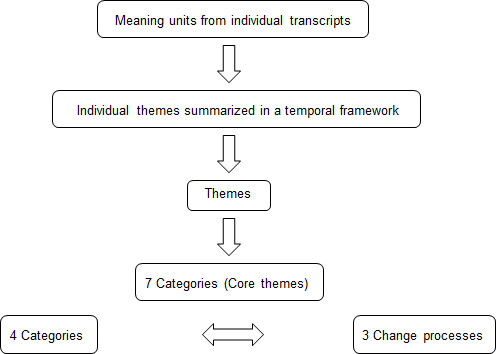
BACKGROUND: Internet-based self-help treatment with minimal therapist contact has been shown to have an effect in treating various conditions. The objective of this study was to explore participants' views of Internet administrated guided self-help treatment for depression. METHODS: In-depth interviews were conducted with 12 strategically selected participants and qualitative methods with components of both thematic analysis and grounded theory were used in the analyses. RESULTS: Three distinct change processes relating to how participants worked with the treatment material emerged which were categorized as (a) Readers, (b) Strivers, and (c) Doers. These processes dealt with attitudes towards treatment, views on motivational aspects of the treatment, and perceptions of consequences of the treatment. CONCLUSIONS: We conclude that the findings correspond with existing theoretical models of face-to-face psychotherapy within qualitative process research. Persons who take responsibility for the treatment and also attribute success to themselves appear to benefit more. Motivation is a crucial aspect of guided self-help in the treatment of depression.
Overview
The claims and statistics of this paper haven’t been checked yet.
Run the check — free, no account needed. It reads the open-access text and checks the sources it cites.
Integrity signals
Registry
Cites
Statistics
Figures
Verification
Claims the paper makes
The claims and statistics of this paper haven’t been checked yet.
Run the check — free, no account needed. It reads the open-access text and checks the sources it cites.
Claims other papers make about this one
Each is checked against this paper’s own text: does it say what the citing paper says it does?
The source backs part of the claim, not all of it — or backs it for a different population, condition or comparison.
In the citing paper
“Another limitation of Internet-based treatments for psychological disorders, delivered via computers, is that they tend to be text-based, often reaching close to 200 pages of reading ([Bendelin et al. 2011]).”
From Development and initial evaluation of a smartphone application based on acceptance and commitment therapy (2012) · cites this paper as Bendelin et al. 2011
Experimental — accuracy not yet measuredThe cited source says what the claim attributes to it.
In the citing paper
“These findings align with previous ICBT studies for adolescent and adult participants, where many seem to find the treatment material relevant and informative (Bendelin et al., 2011; Berg et al., 2020a; Lenhard et al., 2016).”
From Investigating the potential of a novel internet-based cognitive behavioural intervention for Dari and Farsi speaking refugee youth: A feasibility study (2022) · cites this paper as Bendelin et al., 2011
The cited source says what the claim attributes to it.
In the citing paper
“This might correspond with Bendelin et al.'s (2011) suggestion that patients actively participating in internet‐based treatment and exercises tend to achieve better outcomes.”
From Internet‐Based Acceptance and Commitment Therapy With Interoceptive Exposure for Panic Disorder: A Randomized Controlled Trial and Working Alliance Analysis. (2026) · cites this paper as Bendelin et al.'s (2011)
The check wasn’t confident either way, so it gives no verdict — never disputed.
In the citing paper
“The current study also meets the needs outlined in previous eHealth studies of having varied activities, a combination of audio, video, and text information, and being shorter in length (Bendelin et al., 2011).”
From ACT2COPE: A pilot randomised trial of a brief online acceptance and commitment therapy intervention for people living with chronic health conditions during the COVID-19 pandemic (2023) · cites this paper as Bendelin et al., 2011
Experimental — accuracy not yet measuredIn the citing paper
“Studies on the experiences of patients with online therapy also show that personal feedback and support are perceived as positive among patients, to optimally use the program and to keep them motivated [12-14].”
Self-check
Percentages, sums and reported differences re-computed from the paper’s own numbers.
The self-check needs the paper’s full text.
Citations
Cites
Using thematic analysis in psychology
Braun, V., & Clarke, V. (2006) · Qualitative Research in Psychology · doi:10.1191/1478088706qp063oa · Cited by 194,414
Wagner, H. R., Glaser, B. G., & Strauss, A. L. (1968) · Social Forces · doi:10.2307/2575405 · Cited by 46,525
The Discovery of Grounded Theory: Strategies for Qualitative Research
Glaser, B. G., & Strauss, A. L. (2017) · Aldine (Routledge reprint) · doi:10.4324/9780203793206 · Cited by 25,789
An Introduction to Qualitative Research
Flick, U. (2023) · SAGE Publications Ltd eBooks · doi:10.4135/9781036231712 · Cited by 9,550
Language and meaning: Data collection in qualitative research.
Polkinghorne, D. E. (2005) · Journal of Counseling Psychology · doi:10.1037/0022-0167.52.2.137 · Cited by 2,313
Dilemmas in qualitative health research
Yardley, L. (2000) · Psychology & Health · doi:10.1080/08870440008400302 · Cited by 2,310
Internet-based cognitive behaviour therapy for symptoms of depression and anxiety: A meta-analysis
SPEK, V., CUIJPERS, P., NYKLÍČEK, I., RIPER, H., KEYZER, J., & POP, V. (2007) · Psychological Medicine · doi:10.1017/s0033291706008944 · Cited by 1,586
Rennie, D. L. (1998) · Theory & Psychology · doi:10.1177/0959354398081006 · Cited by 1,449
Guy, W. L. (2025) · Springer Reference Medizin · doi:10.1007/978-3-662-65186-5_300379 · Cited by 1,441
Internet-Based and Other Computerized Psychological Treatments for Adult Depression: A Meta-Analysis
Andersson, G., & Cuijpers, P. (2009) · Cognitive Behaviour Therapy · doi:10.1080/16506070903318960 · Cited by 1,368
Self-citation
Research works printed but not linked: 1
- Beck AT, Steer RA, Brown GK: Manual for the Beck Depression Inventory-II. 1996, San Antonio, TX: Psychological Corporation
Cited by
Sorted by citations
Internet-delivered psychological treatments: from innovation to implementation
Andersson, G., Titov, N., Dear, B. F., Rozental, A., & Carlbring, P. (2019) · World Psychiatry · doi:10.1002/wps.20610 · Cited by 750
Self-citationInternet-Delivered Psychological Treatments
Andersson, G. (2016) · Annual Review of Clinical Psychology · doi:10.1146/annurev-clinpsy-021815-093006 · Cited by 595
Self-citationvan Ballegooijen, W., Cuijpers, P., van Straten, A., Karyotaki, E., Andersson, G., Smit, J. H., & Riper, H. (2014) · PLoS ONE · doi:10.1371/journal.pone.0100674 · Cited by 409
“Another qualitative study on guided iCBT pointed out that there may be subgroups who only read the instructions provided in the treatment without following them [56], which could indicate that adherence does not always equal compliance with the treatment protocol.”
BackgroundSelf-citationMixing Online and Face-to-Face Therapy: How to Benefit From Blended Care in Mental Health Care
Wentzel, J., van der Vaart, R., Bohlmeijer, E. T., & van Gemert-Pijnen, J. E. W. C. (2016) · JMIR Mental Health · doi:10.2196/mental.4534 · Cited by 371
“On a personal level, motivation and willingness to complete online therapy [17-20], trust in and credibility of the therapy [17,20-22], and need for support [17] during therapy all contribute to successful blended treatment.”
Andersson, G., Carlbring, P., Titov, N., & Lindefors, N. (2019) · The Canadian Journal of Psychiatry · doi:10.1177/0706743719839381 · Cited by 324
Self-citation
Metadata
- Authors
- Bendelin, N., Hesser, H., Dahl, J., Carlbring, P., Nelson, K. Z., & Andersson, G.
- Affiliations
- Linköping University (SE)
- Umeå University (SE)
- Corresponding author
- Andersson, Gerhard
- Venue
- BMC Psychiatry
- Published
- 2011-06-30
- Volume
- 11
- Issue
- 1
- Pages
- 107-107
- ISSN
- 1471-244X (ISSN-L)
- PMC
- PMC3142491
- OpenAlex
- W2146982643
- Cited by
- 173
- References
- 43
- Citations by year
- 2026: 3 · 2025: 7 · 2024: 10 · 2023: 9 · 2022: 16 · 2021: 10 · 2020: 18 · 2019: 12 · 2018: 11 · 2017: 12 · 2016: 12 · 2015: 21 · 2014: 15 · 2013: 9 · 2012: 8
- FWCI
- 13.62
- Type
- journal article
- Language
- en
- Open access
- gold
- doi.org
- Licence
- Locations
- BMC Psychiatry (publishedVersion, cc-by)
- Europe PMC (PubMed Central) (publishedVersion, cc-by)
- PubMed Central (publishedVersion, cc-by)
- PubMed (publishedVersion)
- DiVA (Linkoping University) (submittedVersion, other-oa)
- DiVA at Umeå University (Umeå University) (submittedVersion, other-oa)
- DOAJ (DOAJ: Directory of Open Access Journals) (submittedVersion)
- Funders
- Vetenskapsrådet
- Topics
- Social Sciences › Psychology › Applied Psychology › Digital Mental Health Interventions
- Social Sciences › Psychology › Experimental and Cognitive Psychology › Anxiety, Depression, Psychometrics, Treatment, Cognitive Processes
- Health Sciences › Medicine › Psychiatry and Mental health › Mental Health Treatment and Access
- Keywords
- depression, online therapy, guided self-help, cognitive behavioral therapy, patient experience, treatment motivation, change processes, personal responsibility, therapeutic process
- MeSH terms
- Adult, Attitude to Health, Depression, Female, Humans, Male, Middle Aged, Self Care, Therapy, Computer-Assisted, Cognitive Behavioral Therapy, Internet
About these checks
Registry, retraction, Cites and statistics results are computed, not judged, with one exception: a printed reference that no index lists is read once by a model before it counts as a citation error. Claims are extracted by a model and kept only when their quote appears verbatim in the text; each cited source is then checked, with a model’s help, for whether it says what the claim relies on. Those verdicts can be wrong — read the claim’s quote and the cited source before relying on one.
Statistics and arithmetic are recomputed, not judged.
Confidence bands are shown only for fields calibrated on our annotated test set. None is calibrated yet, so no band is shown.
What counts as a claim ›How we measure confidence ›How we check this ›
Are you an author, or do you see a problem with this page? Request a review
