

Glucocorticoid receptor mRNA and protein isoform alterations in the orbitofrontal cortex in schizophrenia and bipolar disorder
Open accessThe DOI matches its Crossref record; 75 of the 75 references it cites were found in a registry or an index.
Abstract
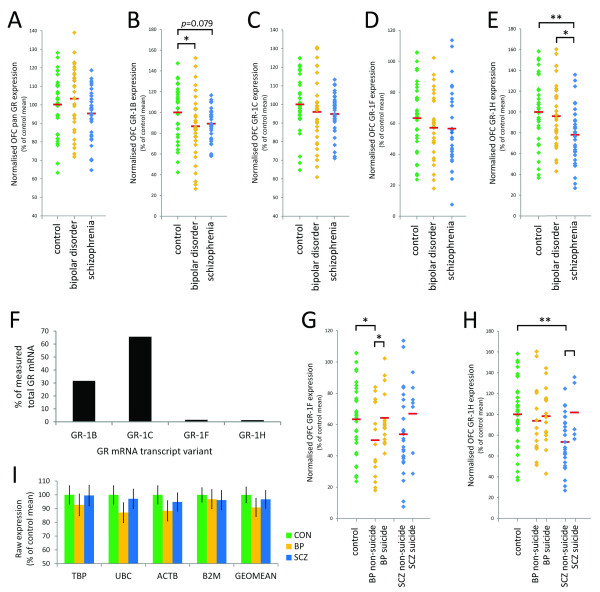
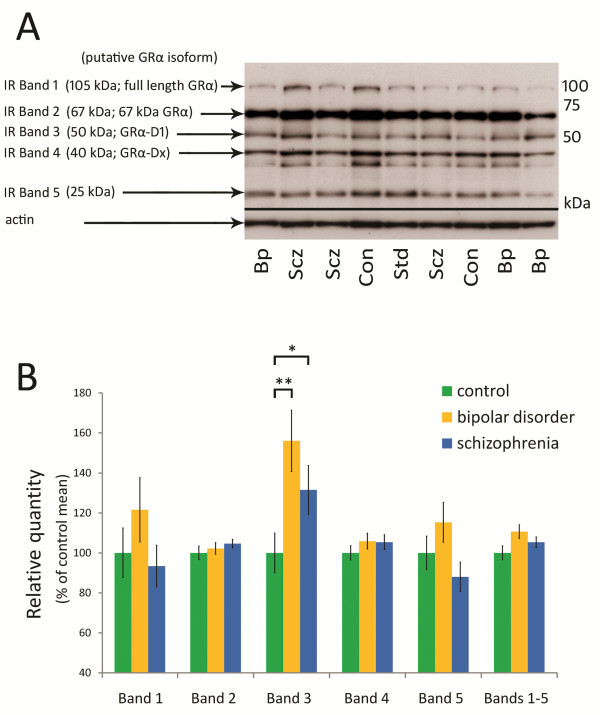
BACKGROUND: The orbitofrontal cortex (OFC) may play a role in the pathogenesis of psychiatric illnesses such as bipolar disorder and schizophrenia, in which hypothalamic-pituitary-adrenal (HPA) axis abnormalities are observed and stress has been implicated. A critical component of the HPA axis which mediates cellular stress responses in the OFC, and has been implicated in psychiatric illness, is the glucocorticoid receptor (GR). METHODS: In the lateral OFC, we employed quantitative real-time PCR and western blotting to investigate GR mRNA and protein expression in 34 bipolar disorder cases, 35 schizophrenia cases and 35 controls. Genotype data for eleven GR gene (NR3C1) polymorphisms was also used to explore possible effects of NR3C1 sequence variation on GR mRNA and protein expression in the lateral OFC. RESULTS: We found no diagnostic differences in pan GR, GR-1C or GR-1F mRNA expression. However, the GR-1B mRNA transcript variant was decreased (14.3%) in bipolar disorder cases relative to controls (p < 0.05), while GR-1H mRNA was decreased (22.0%) in schizophrenia cases relative to controls (p < 0.005). By western blotting, there were significant increases in abundance of a truncated GRα isoform, putative GRα-D1, in bipolar disorder (56.1%, p < 0.005) and schizophrenia (31.5% p < 0.05). Using genotype data for eleven NR3C1 polymorphisms, we found no evidence of effects of NR3C1 genotype on GR mRNA or GRα protein expression in the OFC. CONCLUSIONS: These findings reveal selective abnormalities of GR mRNA expression in the lateral OFC in psychiatric illness, which are more specific and may be less influenced by NR3C1 genotype than those of the dorsolateral prefrontal cortex reported previously. Our results suggest that the GRα-D1 protein isoform may be up-regulated widely across the frontal cortex in psychiatric illness.
Overview
The claims and statistics of this paper haven’t been checked yet.
Free: it reads the open-access text and checks the first 5 claims that cite a source we can check. Create a free account to check every claim.
Integrity signals
Registry
Cites
Statistics
Figures
Verification
Claims the paper makes
The claims and statistics of this paper haven’t been checked yet.
Free: it reads the open-access text and checks the first 5 claims that cite a source we can check. Create a free account to check every claim.
Claims other papers make about this one
Each is checked against this paper’s own text: does it say what the citing paper says it does?
In the citing paper
“Moreover, the relative levels of the GRα subtypes expressed in the human brain were found to change during development and the aging process69, 70.”
From Corticosteroids (2016) · cites this paper as [70]
Self-check
Percentages, sums and reported differences re-computed from the paper’s own numbers.
The self-check needs the paper’s full text.
Citations
Cites
Analysis of Relative Gene Expression Data Using Real-Time Quantitative PCR and the 2−ΔΔCT Method
Livak, K. J., & Schmittgen, T. D. (2001) · Methods · doi:10.1006/meth.2001.1262 · Cited by 180,860 · cited 1×
“To estimate the relative abundances of each GR mRNA variant within each individual, relative amounts of each transcript were calculated by the 2 method [45], using the ACTB housekeeper as internal control gene and pan GR mRNA as the calibrator.”
MethodPLINK: a tool set for whole-genome association and population-based linkage analyses.
Purcell, S., Neale, B., Todd-Brown, K., Thomas, L., Ferreira, M. A. R., Bender, D., Maller, J., Sklar, P., de Bakker, P. I. W., Daly, M. J., et al. (2007) · The American Journal of Human Genetics · doi:10.1086/519795 · Cited by 34,089 · cited 1×
“edu/purcell/plink) [47] was used for HardyWeinberg equilibrium testing.”
MethodThe reward circuit: linking primate anatomy and human imaging
Haber, S. N., & Knutson, B. (2010) · Neuropsychopharmacology · doi:10.1038/npp.2009.129 · Cited by 3,718 · cited 2×
“Since the OFC is an integral component of the brain’s reward circuitry [2], and is involved in integrating sensory information [4,6], it is possible that abnormal GR signalling may impact these cognitive functions, particularly during the experience of stress.”
BackgroundOngur, D. (2000) · Cerebral Cortex · doi:10.1093/cercor/10.3.206 · Cited by 2,627 · cited 8×
“Öngür D, Price JL: The organization of networks within the orbital and medial prefrontal cortex of rats, monkeys and humans.”
MethodInfluentialMapping the Onset of Psychosis: The Comprehensive Assessment of At-Risk Mental States
Yung, A. R., Yung, A. R., Pan Yuen, H., Mcgorry, P. D., Phillips, L. J., Kelly, D., Dell'olio, M., Francey, S. M., Cosgrave, E. M., Killackey, E., et al. (2005) · Australian & New Zealand Journal of Psychiatry · doi:10.1080/j.1440-1614.2005.01714.x · Cited by 2,196 · cited 1×
“A number of retrospective and prospective epidemiological studies have demonstrated that early life stress increases the risk of psychosis later in life [16-20], while stress later in life can impact the course of psychotic illness [21,22].”
BackgroundThe human orbitofrontal cortex: linking reward to hedonic experience
Kringelbach, M. L. (2005) · Nature Reviews Neuroscience · doi:10.1038/nrn1747 · Cited by 2,180 · cited 3×
“It integrates multimodal sensory information and is involved in reward encoding and the evaluation of punishment [4,7].”
BackgroundLichtenstein, P., Yip, B. H., Björk, C., Pawitan, Y., Cannon, T. D., Sullivan, P. F., & Hultman, C. M. (2009) · The Lancet · doi:10.1016/s0140-6736(09)60072-6 · Cited by 2,125
Neurocircuitry of Mood Disorders
Price, J. L., & Drevets, W. C. (2010) · Neuropsychopharmacology · doi:10.1038/npp.2009.104 · Cited by 1,606 · cited 6×
“It integrates multimodal sensory information and is involved in reward encoding and the evaluation of punishment [4,7].”
BackgroundInfluentialRead, J., van Os, J., Morrison, A. P., & Ross, C. A. (2005) · Acta Psychiatrica Scandinavica · doi:10.1111/j.1600-0447.2005.00634.x · Cited by 1,534 · cited 1×
“A number of retrospective and prospective epidemiological studies have demonstrated that early life stress increases the risk of psychosis later in life [16-20], while stress later in life can impact the course of psychotic illness [21,22].”
BackgroundThe stressed synapse: the impact of stress and glucocorticoids on glutamate transmission
Popoli, M., Yan, Z., McEwen, B. S., & Sanacora, G. (2012) · Nature Reviews Neuroscience · doi:10.1038/nrn3138 · Cited by 1,393 · cited 1×
“regions, can impact glutamatergic and GABAergic neurotransmitter signalling [67-72], and in excess can cause neuronal loss and impair brain function [73-75].”
Background
Cited by
The biology of the glucocorticoid receptor: New signaling mechanisms in health and disease
Oakley, R. H., & Cidlowski, J. A. (2013) · Journal of Allergy and Clinical Immunology · doi:10.1016/j.jaci.2013.09.007 · Cited by 1,068
“Moreover, a selective increase in GRα-D was measured in specific regions of the brain in patients with schizophrenia and bipolar disorder (92, 93).”
BackgroundRamamoorthy, S., & Cidlowski, J. A. (2016) · Rheumatic Disease Clinics of North America · doi:10.1016/j.rdc.2015.08.002 · Cited by 692
The HPA axis in bipolar disorder: Systematic review and meta-analysis
Belvederi Murri, M., Prestia, D., Mondelli, V., Pariante, C., Patti, S., Olivieri, B., Arzani, C., Masotti, M., Respino, M., Antonioli, M., et al. (2016) · Psychoneuroendocrinology · doi:10.1016/j.psyneuen.2015.10.014 · Cited by 391
Comprehensive Overview of the Structure and Regulation of the Glucocorticoid Receptor
Vandevyver, S., Dejager, L., & Libert, C. (2014) · Endocrine Reviews · doi:10.1210/er.2014-1010 · Cited by 265
Morning cortisol levels in schizophrenia and bipolar disorder: a meta-analysis
Girshkin, L., Matheson, S. L., Shepherd, A. M., & Green, M. J. (2014) · Psychoneuroendocrinology · doi:10.1016/j.psyneuen.2014.07.013 · Cited by 215
Comer, A. L., Carrier, M., Tremblay, M.-È., & Cruz-Martín, A. (2020) · Frontiers in Cellular Neuroscience · doi:10.3389/fncel.2020.00274 · Cited by 205
“…factor, C: complement cascade, BBB: blood brain barrier. involving the immune and neuroendocrine systems (Sudo et al., 2004; Sampson et al., 2016; Singh et al., 2016) or through direct secretion by gut microbes of neurotransmitters (Yano et al., 2015) and metabolites (De Vadder et al.,…”
BackgroundThe Glucocorticoid Receptor: Isoforms, Functions, and Contribution to Glucocorticoid Sensitivity
Lockett, J., Inder, W. J., & Clifton, V. L. (2024) · Endocrine Reviews · doi:10.1210/endrev/bnae008 · Cited by 135
Distribution of the glucocorticoid receptor in the human amygdala; changes in mood disorder patients
Wang, Q., Verweij, E. W. E., Krugers, H. J., Joëls, M., Swaab, D. F., & Lucassen, P. J. (2013) · Brain Structure and Function · doi:10.1007/s00429-013-0589-4 · Cited by 124
Fung, S. J., Fillman, S. G., Webster, M. J., & Shannon Weickert, C. (2014) · Schizophrenia Research · doi:10.1016/j.schres.2014.02.021 · Cited by 93
“Our study adds to a growing body of literature suggesting that the molecular neuropathologies of schizophrenia and bipolar disorder display substantial overlap, including that much interneuron pathology is shared between the disorders and may be conserved across distinct frontal brain regions (e.g. Thompson et al., 20…”
Self-citationSinclair, D., Fillman, S. G., Webster, M. J., & Weickert, C. S. (2013) · Scientific Reports · doi:10.1038/srep03539 · Cited by 102
Self-citationKasote, D. M., Hegde, M. V., & Katyare, S. S. (2013) · BioFactors · doi:10.1002/biof.1093 · Cited by 82
“Alterations in GR messenger RNA (mRNA) expression and protein isoform have been reported in Schizophrenia (SZ) and bipolar disorder (BD) [60,61].”
BackgroundDarby, M. M., Yolken, R. H., & Sabunciyan, S. (2016) · Translational Psychiatry · doi:10.1038/tp.2016.173 · Cited by 73
Neuroimmune transcriptome changes in patient brains of psychiatric and neurological disorders
Chen, Y., Dai, R., Tang, L., Mikhailova, T., Liang, Q., Li, M., Zhou, J., Kopp, R. F., Weickert, C. S., Chen, C., et al. (2022) · Molecular Psychiatry · doi:10.1038/s41380-022-01854-7 · Cited by 80
Self-citationDNA-methylation gene network dysregulation in peripheral blood lymphocytes of schizophrenia patients
Auta, J., Smith, R. C., Dong, E., Tueting, P., Sershen, H., Boules, S., Lajtha, A., Davis, J., & Guidotti, A. (2013) · Schizophrenia Research · doi:10.1016/j.schres.2013.07.030 · Cited by 68
“…processes (Veldic et al., 2004; Ruzicka et al., 2005; Gavin et al., 2012, Dong et al., 2012; Lewis et al., 2005; Roth et al., 2009; Sinclair et al., 2011, 2012; Zhang et al. 2013; Guidotti et al. 2012; Provencal et al. 2012; McGowan et al., 2009; Labonte et al., 2012; Ma et al.,…”
BackgroundArnett, M. G., Pan, M. S., Doak, W., Cyr, P., Muglia, L. M., & Muglia, L. J. (2015) · Translational Psychiatry · doi:10.1038/tp.2015.35 · Cited by 60
Glucocorticoid receptor gene expression and promoter CpG modifications throughout the human brain
Cao-Lei, L., Suwansirikul, S., Jutavijittum, P., Mériaux, S. B., Turner, J. D., & Muller, C. P. (2013) · Journal of Psychiatric Research · doi:10.1016/j.jpsychires.2013.07.022 · Cited by 46
“Recently, it was reported that the expression of exons 1B and 1C was decreased in the dorsolateral prefrontal cortex in both schizophrenia and bipolar disorder patients (Sinclair et al., 2012).”
BackgroundCorley, S., Tsai, S.-Y., Wilkins, M. R., & Weickert, C. S. (2016) · PLoS ONE · doi:10.1371/journal.pone.0166944 · Cited by 41
Self-citationOakley, R. H., Ramamoorthy, S., Foley, J. F., Busada, J. T., Lu, N. Z., & Cidlowski, J. A. (2018) · The FASEB Journal · doi:10.1096/fj.201701153r · Cited by 37
Lopes, R., Soares, R. A., Coelho, R. C., & Figueiredo‐Braga, M. (2015) · Life Sciences · doi:10.1016/j.lfs.2015.02.010 · Cited by 38
Xu, C., Ma, X.-M., Chen, H.-B., Zhou, M.-H., Qiao, H., & An, S.-C. (2016) · Neuropharmacology · doi:10.1016/j.neuropharm.2016.02.020 · Cited by 34
Rizavi, H. S., Khan, O. S., Zhang, H., Bhaumik, R., Grayson, D. R., & Pandey, G. N. (2023) · Translational Psychiatry · doi:10.1038/s41398-023-02345-1 · Cited by 34
“There is also a strong positive correlation between %5hmC of R2 and mRNA of GR-1B (r= 0.46, p= 0.02) and between %5hmC of R4 and mRNA of GR-1F (r= 0.41, p= 0.02).”
ResultInfluentialHirakawa, H., Akiyoshi, J., Muronaga, M., Tanaka, Y., Ishitobi, Y., Inoue, A., Oshita, H., Aizawa, S., Masuda, K., Higuma, H., et al. (2016) · International Journal of Psychiatry in Clinical Practice · doi:10.3109/13651501.2016.1144772 · Cited by 34
Kaul, D., Smith, C. C., Stevens, J., Fröhlich, A. S., Binder, E. B., Mechawar, N., Schwab, S. G., & Matosin, N. (2020) · Neurobiology of Stress · doi:10.1016/j.ynstr.2020.100270 · Cited by 26
Weissleder, C., Webster, M. J., Barry, G., & Weickert, C. S. (2020) · Schizophrenia Bulletin · doi:10.1093/schbul/sbaa159 · Cited by 31
Self-citationChu, W., Wei, W., Han, H., Gao, Y. H., Liu, K., Tian, Y., Jiang, Z., Zhang, L., & Chen, J. (2017) · Scientific Reports · doi:10.1038/s41598-017-00615-9 · Cited by 27
Scott, M. R., & Meador‐Woodruff, J. H. (2019) · Molecular Psychiatry · doi:10.1038/s41380-019-0359-7 · Cited by 27
Williams, S., & Ghosh, C. (2019) · Drug Discovery Today · doi:10.1016/j.drudis.2019.09.009 · Cited by 26
“Therefore, GR dysregulation or hyperactivity can have a notable influence on HPA dysfunction [65,82–84] and contribute to mood disorders [3,76,85,86] or abnormal responses to chemical or somatic stimulation [83,87,88].”
BackgroundYoung, A. H. (2014) · Harvard Review of Psychiatry · doi:10.1097/hrp.0000000000000020 · Cited by 25
Neural - hormonal responses to negative affective stimuli: Impact of dysphoric mood and sex
Marečková, K., Holsen, L. M., Admon, R., Whitfield, S., Seidman, L. J., Buka, S. L., Klibanski, A., & Goldstein, J. M. (2017) · Journal of Affective Disorders · doi:10.1016/j.jad.2017.06.050 · Cited by 25
Chen, X., Feng, L., Cai, B., Chen, G., & Chen, G. (2017) · PubMed Central · Cited by 24
Meiklejohn, H., Mostaid, M. S., Luza, S., Mancuso, S. G., Kang, D., Atherton, S., Rothmond, D. A., Weickert, C. S., Opazo, C., Pantelis, C., et al. (2019) · Journal of Psychiatric Research · doi:10.1016/j.jpsychires.2019.03.005 · Cited by 21
Self-citationAssociation between OPCRIT dimensions and polymorphisms of HPA axis genes in bipolar disorder
Leszczyńska-Rodziewicz, A., Maciukiewicz, M., Szczepankiewicz, A., Pogłodziński, A., & Hauser, J. (2013) · Journal of Affective Disorders · doi:10.1016/j.jad.2013.08.012 · Cited by 22
“It has been reported that rs6191 variant is associated with depressive symptoms in the elderly in co-existence with childhood adversity (Sinclair et al., 2012).”
BackgroundSimões, S. N., Martins, D., Pereira, C. A. D. B., Hashimoto, R. F., & Brentani, H. (2015) · BMC Bioinformatics · doi:10.1186/1471-2105-16-s19-s9 · Cited by 20
“) are strongly related to schizophrenia [46-50].”
Role of microRNAs and long non‑coding RNAs in glucocorticoid signaling (Review)
Pierouli, K., Papageorgiou, L., Mitsis, Τ., Papakonstantinou, E., Diakou, I., Leptidis, S., Sigala, M., Dragoumani, K., Spandidos, D. A., Bacopoulou, F., et al. (2022) · International Journal of Molecular Medicine · doi:10.3892/ijmm.2022.5203 · Cited by 19
“Moreover, the increased expression of a truncated GR protein isoform has been reproducibly demonstrated in the prefrontal cortex of patients with schizophrenia and bipolar disorder (72,73).”
Kennedy, C. L. M., Carter, S. D., Mifsud, K. R., & Reul, J. M. H. M. (2019) · Journal of Neuroendocrinology · doi:10.1111/jne.12820 · Cited by 19
“be strongly linked to a number of neuropsychiatric disorders such as major depression, anxiety-related disorders, post-traumatic stress disorder (PTSD) and schizophrenia [4-7].”
BackgroundJi, E., Weickert, C. S., Purves-Tyson, T. D., White, C., Handelsman, D. J., Desai, R., O׳Donnell, M., Liu, D., Galletly, C. A., Lenroot, R., et al. (2020) · Psychoneuroendocrinology · doi:10.1016/j.psyneuen.2020.104916 · Cited by 18
Self-citationFKBP5 Messenger RNA Increases After Adolescence in Human Dorsolateral Prefrontal Cortex
Weickert, C. S., Webster, M. J., Boerrigter, D., & Sinclair, D. (2015) · Biological Psychiatry · doi:10.1016/j.biopsych.2015.11.005 · Cited by 17
Self-citationChildhood maltreatment and HPA axis gene expression in bipolar disorders: A gene network analysis
Laroche, D. G., Curis, E., Bellivier, F., Nepost, C., Courtin, C., Étain, B., & Marie-Claire, C. (2020) · Psychoneuroendocrinology · doi:10.1016/j.psyneuen.2020.104753 · Cited by 15
Poppa, T., Droutman, V., Amaro, H. D. L. A., Black, D. S., Arnaudova, I., & Monterosso, J. R. (2019) · NeuroImage Clinical · doi:10.1016/j.nicl.2019.101973 · Cited by 14
Ji, W., Li, G., Hu, Y., Zhang, W., Wang, J., Jiang, F., Zhang, Y., Wu, F., Wei, X., Li, Y., et al. (2024) · Biological Psychiatry Cognitive Neuroscience and Neuroimaging · doi:10.1016/j.bpsc.2024.02.012 · Cited by 11
Nery, T. G. M., da Silva, E. M. G., Tavares, R., & Passetti, F. (2018) · Journal of Molecular Neuroscience · doi:10.1007/s12031-018-1220-1 · Cited by 11
Yoshino, Y., Kumon, H., Shimokawa, T., Yano, H., Ochi, S., Funahashi, Y., Iga, J., Matsuda, S., Tanaka, J., & Ueno, S. (2022) · The International Journal of Neuropsychopharmacology · doi:10.1093/ijnp/pyac044 · Cited by 10
Weickert, C. S., Rothmond, D. A., & Purves-Tyson, T. D. (2018) · Handbook of clinical neurology · doi:10.1016/b978-0-444-63639-3.00016-5 · Cited by 9
Self-citationGrasso, E. M., Majumdar, A. K., Wrabl, J. O., Frueh, D. P., & Hilser, V. J. (2021) · Biophysical Journal · doi:10.1016/j.bpj.2021.04.017 · Cited by 6
Shao, S., Wang, Y., Zhao, Y., Xu, Y., Wang, T., Du, K., Bao, S., Wang, X., & Zhang, L. (2022) · Journal of Otolaryngology - Head and Neck Surgery · doi:10.1186/s40463-022-00561-1 · Cited by 6
“also found that patients with schizophrenia and bipolar disorder have selective increases in GRα-D isoform expression in certain brain regions [14, 36].”
BackgroundRole of corticosteroids in the antidepressant response
Pierscionek, T. J., Adekunte, O., Watson, S., Ferrier, I. N., & Alabi, A. (2014) · ChronoPhysiology and Therapy · doi:10.2147/cpt.s67272 · Cited by 6
“Selective abnormalities of GR mRNA expression in the orbitofrontal cortex and alterations in protein isoforms have been noted in a range of psychiatric conditions.(50) Post mortem studies of depressed patients who committed suicide have also shown a reduction in CRF receptor sites in the cerebral cortex.”
Adžić, M., Glavonic, E., Nesic, M. J., Milosavljevic, M., Mihaljevic, M. M., Petrovic, Z., Pavlović, Z., Brkic, Z., Francija, E., Soldatović, I., et al. (2018) · Progress in Neuro-Psychopharmacology and Biological Psychiatry · doi:10.1016/j.pnpbp.2018.12.011 · Cited by 5
“Our preliminary data obtained in PBMC of psychotic patients indicated that specific GRα isoform predicted SCH diagnosis as it was reported for that GRα isoform in the brain (Sinclair et al., 2012).”
Zhou, R., Zhang, T., & Sun, B. (2025) · International Journal of Molecular Sciences · doi:10.3390/ijms26052227 · Cited by 2
“…sex hormone-related TFs have been extensively studied in the context of brain function, with the majority, including ATF4 [43–45], FOXO1 [46], FOXP1 [47,48], NR3C1 [49–52], PBX1 [53], POU2F1 [54], SREBF2 [55–57], and THRB [58], previously implicated in cellular dysregulations associated with SCZ.”
Simões, S. N. (2015) · Digital Library of Theses and Dissertations (Universidade de São Paulo) · doi:10.11606/t.95.2015.tde-17112015-172846 · Cited by 2
Glucocorticoid receptor activity in triple negative breast cancer
Noureddine, L. M. (2022) · theses.fr (ABES) · doi:10.70675/13ab50cfz7edbz4a44z918aza657b9614a4d · Cited by 1
The neuroendocrinology of stress in the pathophysiology of bipolar disorders
Young, A. H., & Colasanti, A. (2016) · Cambridge University Press eBooks · doi:10.1017/cbo9781107477278.009
Neuroimmune Regulation in Health and Disease
Berczi, I. (2016) · Elsevier eBooks · doi:10.1016/b978-0-12-801770-8.00001-x
Stress and psychosis: Cortisol levels in association with clinical, cognitive, and genetic variation
Girshkin, L. (2017) · UNSWorks (University of New South Wales, Sydney, Australia) · doi:10.26190/unsworks/3560
Ji, E. (2016) · UNSWorks (University of New South Wales, Sydney, Australia) · doi:10.26190/unsworks/3213
Neuroinflammation, the blood-brain barrier and immune cell trafficking in schizophrenia
Cai, H. (2019) · UNSWorks (University of New South Wales, Sydney, Australia) · doi:10.26190/unsworks/3854
邵姗, Wang, Y., Zhao, Y., Xu, Y., Wang, T., Du, K., Bao, S., Wang, X., & Zhang, L. (2022) · Figshare · doi:10.6084/m9.figshare.20056347
Oakley, R. H., Sueyoshi, T., Ramamoorthy, S., Nikolova, V. D., Goulding, D. R., LI, J., Ray, M. K., Moy, S. S., & Cidlowski, J. A. (2026) · The FASEB Journal · doi:10.1096/fj.202601316r
Metadata
- Authors
- Sinclair, D., Webster, M. J., Fullerton, J. M., & Weickert, C. S.
- Affiliations
- UNSW Sydney (AU)
- Stanley Medical Research Institute (US)
- Corresponding author
- Sinclair, Duncan
- Venue
- BMC Psychiatry
- Published
- 2012-07-20
- Volume
- 12
- Issue
- 1
- Pages
- 84-84
- ISSN
- 1471-244X (ISSN-L)
- PMC
- PMC3496870
- OpenAlex
- W2083472062
- Cited by
- 55
- References
- 75
- Citations by year
- 2026: 1 · 2025: 1 · 2024: 2 · 2023: 2 · 2022: 6 · 2021: 1 · 2020: 5 · 2019: 5 · 2018: 4 · 2017: 3 · 2016: 6 · 2015: 7 · 2014: 5 · 2013: 7
- FWCI
- 2.52
- Type
- journal article
- Language
- en
- Open access
- gold
- doi.org
- Licence
- Locations
- BMC Psychiatry (publishedVersion, cc-by)
- Europe PMC (PubMed Central) (publishedVersion, cc-by)
- PubMed Central (publishedVersion, cc-by)
- PubMed (publishedVersion)
- UNSWorks (UNSW Sydney) (submittedVersion, cc-by-nc-nd)
- DOAJ (DOAJ: Directory of Open Access Journals) (submittedVersion)
- Figshare (submittedVersion)
- Funders
- Stanley Medical Research Institute
- Neuroscience Research Australia
- University of New South Wales
- NSW Ministry of Health
- Macquarie Group Foundation
- Topics
- Life Sciences › Neuroscience › Behavioral Neuroscience › Stress Responses and Cortisol
- Health Sciences › Medicine › Psychiatry and Mental health › Schizophrenia research and treatment
- Health Sciences › Medicine › Psychiatry and Mental health › Bipolar Disorder and Treatment
- Keywords
- glucocorticoid receptor, NR3C1, orbitofrontal cortex, schizophrenia, bipolar disorder, splice variants, hypothalamic-pituitary-adrenal axis, stress response, gene expression
- MeSH terms
- Adult, Bipolar Disorder, Female, Frontal Lobe, Genotype, Humans, Male, Middle Aged, Receptors, Glucocorticoid, RNA, Messenger, Schizophrenia, Up-Regulation, Genetic Predisposition to Disease, Protein Isoforms, Polymorphism, Single Nucleotide
About these checks
Registry, retraction, Cites and statistics results are computed, not judged, with one exception: a printed reference that no index lists is read once by a model before it counts as a citation error. Claims are extracted by a model and kept only when their quote appears verbatim in the text; each cited source is then checked, with a model’s help, for whether it says what the claim relies on. Those verdicts can be wrong — read the claim’s quote and the cited source before relying on one.
Statistics and arithmetic are recomputed, not judged.
Confidence bands are shown only for fields calibrated on our annotated test set. None is calibrated yet, so no band is shown.
What counts as a claim ›How we measure confidence ›How we check this ›
Are you an author, or do you see a problem with this page? Request a review
Data sources
Bibliographic data: Semantic Scholar, OpenAlex, Crossref.
Contains information from the Semantic Scholar Academic Graph Datasets, made available under the ODC Attribution License (ODC-BY 1.0).
Semantic Scholar’s data is described in: Kinney, R., et al. (2023). The Semantic Scholar Open Data Platform. arXiv:2301.10140.
