

The DOI matches its Crossref record; 42 of the 42 references it cites were found in a registry or an index.
Prognostic significance of functional somatic symptoms in adolescence: a 15-year community-based follow-up study of adolescents with depression compared with healthy peers
Open accessAbstract
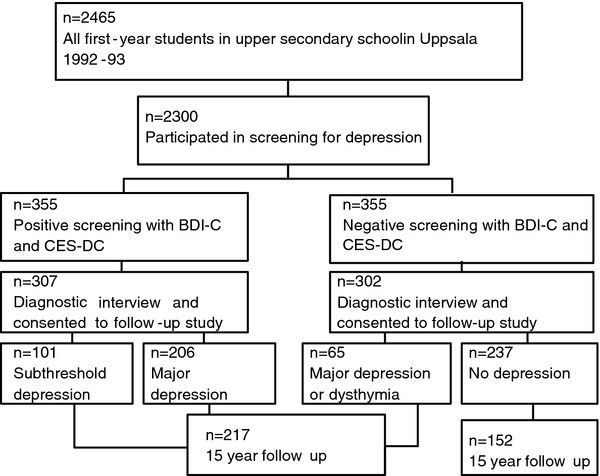
BACKGROUND: There is a lack of population-based long-term longitudinal research on mental health status and functional physical/somatic symptoms. Little is known about the long-term mental health outcomes associated with somatic symptoms or the temporal relationship between depression and such symptoms. This 15-year study followed up adolescents with depression and matched controls, screened from a population-based sample, who reported different numbers of somatic symptoms. METHODS: The total population of 16-17-year-olds in Uppsala, Sweden, was screened for depression in 1991-1993. Adolescents who screened positive and an equal number of healthy controls took part in a semi-structured diagnostic interview. In addition, 21 different self-rated somatic symptoms were assessed. Sixty-four percent of those adolescents participated in a follow-up structured interview 15 years later. RESULTS: Somatic symptoms in adolescence predicted depression and other adult mental disorders regardless of the presence of adolescent depression. In adolescents with depression, the number of functional somatic symptoms predicted, in a dose response relationship, suicidal behavior, bipolar episodes, and psychotic episodes as well as chronic and recurrent depression. Contrary to expectations, the somatic symptoms of abdominal pain and perspiration without exertion better predicted depression than all DSM-IV depressive symptoms. Abdominal pain persisted as an independent strong predictor of depression and anxiety, even after controlling for other important confounders. CONCLUSIONS: Somatic symptoms in adolescence can predict severe adult mental health disorders. The number of somatic symptoms concurrent with adolescent depression is, in a stepwise manner, linked to suicidal attempts, bipolar disorders, psychotic disorders, and recurrent and chronic depression. These findings can be useful in developing treatment guidelines for patients with somatic symptoms.
Overview
The claims and statistics of this paper haven’t been checked yet.
Run the check — free, no account needed. It reads the open-access text and checks the sources it cites.
Integrity signals
Registry
Cites
Statistics
Figures
Verification
Claims the paper makes
The claims and statistics of this paper haven’t been checked yet.
Run the check — free, no account needed. It reads the open-access text and checks the sources it cites.
Claims other papers make about this one
Each is checked against this paper’s own text: does it say what the citing paper says it does?
The source backs part of the claim, not all of it — or backs it for a different population, condition or comparison.
In the citing paper
“Frequently, symptoms sustain into adulthood, carrying a significant risk of long-term impairment, reduced probability of obtaining a higher education and a high use of health care costs [9–13].”
From Feasibility of group-based acceptance and commitment therapy for adolescents (AHEAD) with multiple functional somatic syndromes: A pilot study (2020) · cites this paper as [13]
Experimental — accuracy not yet measured
Self-check
Percentages, sums and reported differences re-computed from the paper’s own numbers.
The self-check needs the paper’s full text.
Citations
Cites
An inventory for measuring depression
BECK, A. T. (1961) · Archives of General Psychiatry · doi:10.1001/archpsyc.1961.01710120031004 · Cited by 38,032
(1998) · The Journal of Clinical Psychiatry · Cited by 19,139
(1998) · PubMed · Cited by 10,216
The mini international neuropsychiatric interview
Lecrubier, Y., Sheehan, D. V., Hergueta, T., & Weiller, E. (1998) · European Psychiatry · doi:10.1016/s0924-9338(99)80239-9 · Cited by 5,899
Coddington, R. D. (1972) · Journal of Psychosomatic Research · doi:10.1016/0022-3999(72)90045-1 · Cited by 949
Monoamine Metabolites in CSF and Suicidal Behavior
Träskman, L. (1981) · Archives of General Psychiatry · doi:10.1001/archpsyc.1981.01780310031002 · Cited by 692
Using Chronic Pain to Predict Depressive Morbidity in the General Population
Ohayon, M. M., & Schatzberg, A. F. (2003) · Archives of General Psychiatry · doi:10.1001/archpsyc.60.1.39 · Cited by 617
Somatization and the recognition of depression and anxiety in primary care
Kirmayer, L. J., Robbins, J. M., Dworkind, M., & Yaffe⃰, M. J. (1993) · American Journal of Psychiatry · doi:10.1176/ajp.150.5.734 · Cited by 601
The significance of life events as etiologic factors in the diseases of children
Coddington, R. D. (1972) · Journal of Psychosomatic Research · doi:10.1016/0022-3999(72)90018-9 · Cited by 593
Natural Course of Adolescent Major Depressive Disorder: I. Continuity Into Young Adulthood
Lewinsohn, P. M., Rohde, P., Klein, D. N., & Seeley, J. R. (1999) · Journal of the American Academy of Child & Adolescent Psychiatry · doi:10.1097/00004583-199901000-00020 · Cited by 527
Cited by
Sorted by citations
Risk factors for suicidal thoughts and behaviors: A meta-analysis of 50 years of research
Franklin, J. C., Ribeiro, J. D., Fox, K. R., Bentley, K. H., Kleiman, E. M., Huang, X., Musacchio, K. M., Jaroszewski, A. C., Chang, B. P., & Nock, M. K. (2017) · Psychological Bulletin · doi:10.1037/bul0000084 · Cited by 3,784
How to assess common somatic symptoms in large-scale studies: A systematic review of questionnaires
Zijlema, W. L., Stolk, R. P., Löwe, B., Rief, W., White, P. D., & Rosmalen, J. G. M. (2013) · Journal of Psychosomatic Research · doi:10.1016/j.jpsychores.2013.03.093 · Cited by 280
Chronic Pain and Suicide: Understanding the Association
Hooley, J. M., Franklin, J. C., & Nock, M. K. (2014) · Current Pain and Headache Reports · doi:10.1007/s11916-014-0435-2 · Cited by 150
The risk of suicide mortality in chronic pain patients
Hassett, A. L., Aquino, J. K., & Ilgen, M. A. (2014) · Current Pain and Headache Reports · doi:10.1007/s11916-014-0436-1 · Cited by 140
Brain functional alterations in MDD patients with somatic symptoms: A resting-state fMRI study
Liu, P., Tu, H., Zhang, A., Yang, C., Liu, Z., Lei, L., Wu, P., Sun, N., & Zhang, K. (2021) · Journal of Affective Disorders · doi:10.1016/j.jad.2021.08.143 · Cited by 112
Metadata
- Authors
- Bohman, H., Jonsson, U., Päären, A., von Knorring, L., Olsson, G., & von Knorring, A.-L.
- Affiliations
- Uppsala University (SE)
- Corresponding author
- Bohman, Hannes
- ORCID
- Bohman, Hannes
- Venue
- BMC Psychiatry
- Published
- 2012-07-27
- Volume
- 12
- Issue
- 1
- Pages
- 90-90
- ISSN
- 1471-244X (ISSN-L)
- PMC
- PMC3439696
- OpenAlex
- W2122939734
- Cited by
- 126
- References
- 42
- Citations by year
- 2026: 10 · 2025: 9 · 2024: 7 · 2023: 8 · 2022: 9 · 2021: 7 · 2020: 10 · 2019: 8 · 2018: 12 · 2017: 4 · 2016: 14 · 2015: 5 · 2014: 17 · 2013: 5 · 2012: 1
- FWCI
- 6.40
- Type
- journal article
- Language
- en
- Open access
- gold
- doi.org
- Licence
- Locations
- BMC Psychiatry (publishedVersion, cc-by)
- PubMed Central (publishedVersion, cc-by)
- PubMed (publishedVersion)
- Uppsala University Publications (Uppsala University) (submittedVersion, other-oa)
- DOAJ (DOAJ: Directory of Open Access Journals) (submittedVersion)
- Funders
- Forskningsrådet för Arbetsliv och Socialvetenskap
- Topics
- Health Sciences › Medicine › Psychiatry and Mental health › Psychosomatic Disorders and Their Treatments
- Social Sciences › Psychology › Clinical Psychology › Child and Adolescent Psychosocial and Emotional Development
- Social Sciences › Psychology › Experimental and Cognitive Psychology › Anxiety, Depression, Psychometrics, Treatment, Cognitive Processes
- Keywords
- functional somatic symptoms, adolescent depression, long-term mental health outcomes, abdominal pain, suicidal behavior, bipolar disorder, psychosis, chronic depression, anxiety, dose-response relationship, prognostic factors, community-based follow-up
- MeSH terms
- Adolescent, Adult, Bipolar Disorder, Depression, Depressive Disorder, Female, Follow-Up Studies, Humans, Male, Mental Health, Predictive Value of Tests, Prognosis, Psychotic Disorders, Recurrence, Suicide, Attempted, Sweating, Abdominal Pain
About these checks
Registry, retraction, Cites and statistics results are computed, not judged, with one exception: a printed reference that no index lists is read once by a model before it counts as a citation error. Claims are extracted by a model and kept only when their quote appears verbatim in the text; each cited source is then checked, with a model’s help, for whether it says what the claim relies on. Those verdicts can be wrong — read the claim’s quote and the cited source before relying on one.
Statistics and arithmetic are recomputed, not judged.
Confidence bands are shown only for fields calibrated on our annotated test set. None is calibrated yet, so no band is shown.
What counts as a claim ›How we measure confidence ›How we check this ›
Are you an author, or do you see a problem with this page? Request a review
