

The DOI matches its Crossref record; 64 of the 66 references it cites were found in a registry or an index.
Guidelines for the use and management of long-acting injectable antipsychotics in serious mental illness
Open accessAbstract
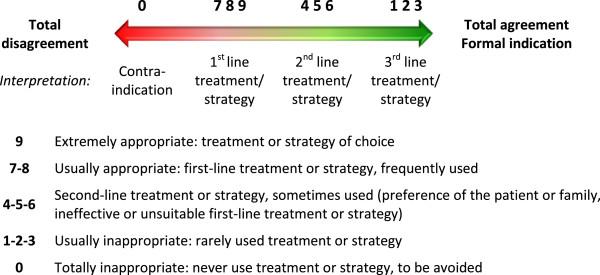
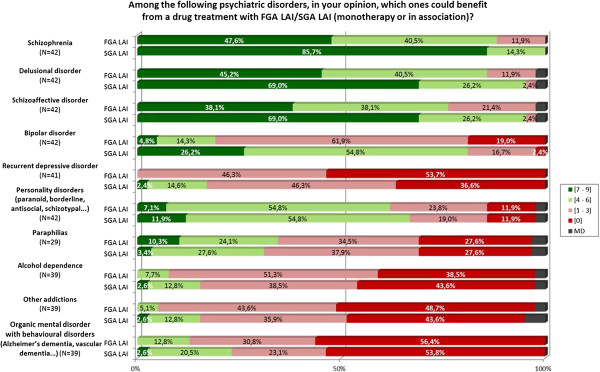
Background: Long-acting injectable (LAI) formulations are not widely used in routine practice even though they offer advantages in terms of relapse prevention. As part of a process to improve the quality of care, the French Association for Biological Psychiatry and Neuropsychopharmacology (AFPBN) elaborated guidelines for the use and management of antipsychotic depots in clinical practice. Methods: Based on a literature review, a written survey was prepared that asked about 539 options in 32 specific clinical situations concerning 3 fields: target-population, prescription and use, and specific populations. We contacted 53 national experts, 42 of whom (79%) completed the survey. The options were scored using a 9-point scale derived from the Rand Corporation and the University of California in the USA. According to the answers, a categorical rank (first-line/preferred choice, second-line/alternate choice, third-line/usually inappropriate) was assigned to each option. The first-line option was defined as a strategy rated as 7–9 (extremely appropriate) by at least 50% of the experts. The following results summarize the key recommendations from the guidelines after data analysis and interpretation of the results of the survey by the scientific committee. Results: LAI antipsychotics are indicated in patients with schizophrenia, schizoaffective disorder, delusional disorder and bipolar disorder. LAI second-generation antipsychotics are recommended as maintenance treatment after the first episode of schizophrenia. LAI first-generation antipsychotics are not recommended in the early course of schizophrenia and are not usually appropriate in bipolar disorder. LAI antipsychotics have long been viewed as a treatment that should only be used for a small subgroup of patients with non-compliance, frequent relapses or who pose a risk to others. The panel considers that LAI antipsychotics should be considered and systematically proposed to any patients for whom maintenance antipsychotic treatment is indicated. Recommendations for medication management when switching oral antipsychotics to LAI antipsychotics are proposed. Recommendations are also given for the use of LAI in specific populations. Conclusion: In an evidence-based clinical approach, psychiatrists, through shared decision-making, should be systematically offering to most patients that require long-term antipsychotic treatment an LAI antipsychotic as a first-line treatment.
Overview
The claims and statistics of this paper haven’t been checked yet.
Run the check — free, no account needed. It reads the open-access text and checks the sources it cites.
Integrity signals
Registry
Cites
Statistics
Figures
Verification
Claims the paper makes
The claims and statistics of this paper haven’t been checked yet.
Run the check — free, no account needed. It reads the open-access text and checks the sources it cites.
Claims other papers make about this one
Each is checked against this paper’s own text: does it say what the citing paper says it does?
In the citing paper
“The current and future increasing availability of LAIs will enrich the choice for the clinicians who intend to use a long-acting formulation [67].”
From The role of shared decision-making in improving adherence to pharmacological treatments in patients with schizophrenia: A clinical review (2020) · cites this paper as [67]
Self-check
Percentages, sums and reported differences re-computed from the paper’s own numbers.
The self-check needs the paper’s full text.
Citations
Cites
Second-generation versus first-generation antipsychotic drugs for schizophrenia: a meta-analysis
Leucht, S., Corves, C., Arbter, D., Engel, R. R., Li, C., & Davis, J. M. (2009) · The Lancet · doi:10.1016/s0140-6736(08)61764-x · Cited by 1,930 · cited 2×
“Some individual oral SGA (amisulpride, clozapine, olanzapine, risperidone) were better in overall efficacy in patients with schizophrenia than oral FGA [17].”
BackgroundLacro, J. P., Dunn, L. B., Dolder, C. R., Leckband, S. G., & Jeste, D. V. (2002) · The Journal of Clinical Psychiatry · doi:10.4088/jcp.v63n1007 · Cited by 1,383 · cited 1×
“For example, the majority of patients with schizophrenia (84%) discontinue their index antipsychotic during the follow-up period [2] and in the long-term perspective, 40 to 50% seem to be noncompliant [3], with no real difference in terms of adherence between first-generation antipsychotics (FGA) and second-generation…”
BackgroundGoodwin, G., Haddad, P. M., Ferrier, I. N., Aronson, J., Barnes, T., Cipriani, A., Coghill, D., Fazel, S., Geddes, J. R., Grunze, H., et al. (2016) · Journal of Psychopharmacology · doi:10.1177/0269881116636545 · Cited by 1,350
Yatham, L. N., Kennedy, S. H., Parikh, S. V., Schaffer, A., Beaulieu, S., Alda, M., O’Donovan, C., MacQUEEN, G. M., McIntyre, R. S., Sharma, V., et al. (2012) · Bipolar Disorders · doi:10.1111/bdi.12025 · Cited by 1,230
The 2009 Schizophrenia PORT Psychopharmacological Treatment Recommendations and Summary Statements
Buchanan, R. W., Kreyenbuhl, J. A., Kelly, D. L., Noel, J. M., Boggs, D. L., Fischer, B. A., Himelhoch, S. S., Fang, B., Peterson, E. L., Aquino, P. R., et al. (2009) · Schizophrenia Bulletin · doi:10.1093/schbul/sbp116 · Cited by 919 · cited 2×
“With regards to non-adherence, most of the guidelines and algorithms (except PORT 2009) state that depot antipsychotics are an effective approach [8-10], with some guidelines actually recommending that switching the antipsychotic formulation from oral to depot should be considered in maintenance treatment [11].”
BackgroundRummel‐Kluge, C., Komossa, K., Schwarz, S., Hunger, H., Schmid, F., Lobos, C. A., Kissling, W., Davis, J. M., & Leucht, S. (2010) · Schizophrenia Research · doi:10.1016/j.schres.2010.07.012 · Cited by 698 · cited 1×
“Oral SGA induced fewer extrapyramidal side effects than oral FGA but some SGA induced more weight gain or metabolic side effects than oral FGA [41,42].”
BackgroundVelligan, D. I., Weiden, P. J., Sajatovic, M., Scott, J. L., Carpenter, D., Ross, R., & Docherty, J. P. (2009) · PubMed · Cited by 625
Weiden, P. J., Kozma, C., Grogg, A., & Locklear, J. (2004) · Psychiatric Services · doi:10.1176/appi.ps.55.8.886 · Cited by 621 · cited 1×
“81 in patients with schizophrenia [37].”
Barnes, T. R. E., Drake, R., Paton, C., Cooper, S. J., Deakin, J. F. W., Ferrier, I. N., Gregory, C. J., Haddad, P. M., Howes, O. D., Jones, I. R., et al. (2019) · Journal of Psychopharmacology · doi:10.1177/0269881119889296 · Cited by 615
Leucht, S., Komossa, K., Rummel‐Kluge, C., Corves, C., Hunger, H., Schmid, F., Lobos, C. A., Schwarz, S., & Davis, J. M. (2008) · American Journal of Psychiatry · doi:10.1176/appi.ajp.2008.08030368 · Cited by 499 · cited 1×
“and tolerability (especially for SGA) [17,18].”
Research works printed but not linked: 3
- Schizophrenia: Core interventions in the treatment and management of schizophrenia in primary and secondary care (update). [http://www.ncbi.nlm.nih.gov/pubmed/20704054]
- Llorca PM, Courtet P, Martin P, Abbar M, Gay C, Meynard JA, Bayle F, Hamon M, Lancon C, Thibaut F, Thomas P, Lancrenon S, Guillaume S, Samalin L: Screening and management of bipolar disorders: methodology. Encephale. 2010, 36 (Suppl 4): S76-S85.
- NICE: National Institute for Health and Clinical Excellence: The management of bipolar disorder in adults, children and adolescents, in primary and secondary care. 2006, Alden Press UK. edn. London: The British Psychological Society and the Royal College of Psychiatrists
Cited by
Sorted by citations
Goodwin, G., Haddad, P. M., Ferrier, I. N., Aronson, J., Barnes, T., Cipriani, A., Coghill, D., Fazel, S., Geddes, J. R., Grunze, H., et al. (2016) · Journal of Psychopharmacology · doi:10.1177/0269881116636545 · Cited by 1,350
“When switching from an oral drug to an LAI form, it is good practice to start with the oral antipsychotic for the length of time required to establish the effective, best tolerated dose before switching to the LAI form (Llorca et al., 2013).”
The role of long-acting injectable antipsychotics in schizophrenia: a critical appraisal
Brissos, S., Veguilla, M. R., Taylor, D., & Balanzá-Martinez, V. (2014) · Therapeutic Advances in Psychopharmacology · doi:10.1177/2045125314540297 · Cited by 297
Greene, M., Yan, T., Chang, E. Y., Hartry, A., Touya, M., & Broder, M. S. (2017) · Journal of Medical Economics · doi:10.1080/13696998.2017.1379412 · Cited by 200
Recent advances in long-acting drug delivery systems for anticancer drug
Pacheco, C., Baião, A., Ding, T., Cui, W., & Sarmento, B. F. C. C. (2023) · Advanced Drug Delivery Reviews · doi:10.1016/j.addr.2023.114724 · Cited by 203
Correll, C. U., Martin, A. L., Patel, C. A., Benson, C. J., Goulding, R., Sliwa, J. K., Joshi, K., Schiller, E., & Kim, E. (2022) · Schizophrenia · doi:10.1038/s41537-021-00192-x · Cited by 168
Metadata
- Authors
- Llorca, P. M., Abbar, M., Courtet, P., Guillaume, S., Lancrenon, S., & Samalin, L.
- Affiliations
- Centre Hospitalier Universitaire de Nîmes (FR)
- Inserm (FR)
- Centre Hospitalier Universitaire de Clermont-Ferrand (FR)
- Corresponding author
- Samalin, Ludovic
- Venue
- BMC Psychiatry
- Published
- 2013-12
- Volume
- 13
- Issue
- 1
- Pages
- 340-340
- ISSN
- 1471-244X (ISSN-L)
- PMC
- PMC3898013
- OpenAlex
- W1982746840
- Cited by
- 188
- References
- 66
- Citations by year
- 2026: 12 · 2025: 12 · 2024: 14 · 2023: 14 · 2022: 24 · 2021: 16 · 2020: 10 · 2019: 18 · 2018: 11 · 2017: 17 · 2016: 20 · 2015: 12 · 2014: 8
- FWCI
- 9.48
- Type
- journal article
- Language
- en
- Open access
- gold
- doi.org
- Licence
- Locations
- BMC Psychiatry (publishedVersion, cc-by)
- Europe PMC (PubMed Central) (publishedVersion, cc-by)
- PubMed Central (publishedVersion, cc-by)
- PubMed (publishedVersion)
- HAL (submittedVersion, other-oa)
- Topics
- Health Sciences › Medicine › Psychiatry and Mental health › Schizophrenia research and treatment
- Social Sciences › Psychology › Clinical Psychology › Psychiatric care and mental health services
- Health Sciences › Medicine › Pharmacology (medical) › Treatment of Major Depression
- Keywords
- long-acting injectable antipsychotics, severe mental illness, schizophrenia, bipolar disorder, schizoaffective disorder, delusional disorder, long-term antipsychotic treatment, relapse prevention, medication adherence, medication management, atypical antipsychotics, typical antipsychotics, shared decision-making
- MeSH terms
- Adult, Aged, Attitude of Health Personnel, Mental Disorders, Delayed-Action Preparations, Female, Humans, Injections, Intramuscular, Male, Middle Aged, Practice Patterns, Physicians', Schizophrenia, Severity of Illness Index, Antipsychotic Agents, United States, Practice Guidelines as Topic
About these checks
Registry, retraction, Cites and statistics results are computed, not judged, with one exception: a printed reference that no index lists is read once by a model before it counts as a citation error. Claims are extracted by a model and kept only when their quote appears verbatim in the text; each cited source is then checked, with a model’s help, for whether it says what the claim relies on. Those verdicts can be wrong — read the claim’s quote and the cited source before relying on one.
Statistics and arithmetic are recomputed, not judged.
Confidence bands are shown only for fields calibrated on our annotated test set. None is calibrated yet, so no band is shown.
What counts as a claim ›How we measure confidence ›How we check this ›
Are you an author, or do you see a problem with this page? Request a review
