

Uptake and adherence of a self-directed internet-based mental health intervention with tailored e-mail reminders in senior high schools in Norway
Open accessThe DOI matches its Crossref record; 67 of the 68 references it cites were found in a registry or an index.
Abstract
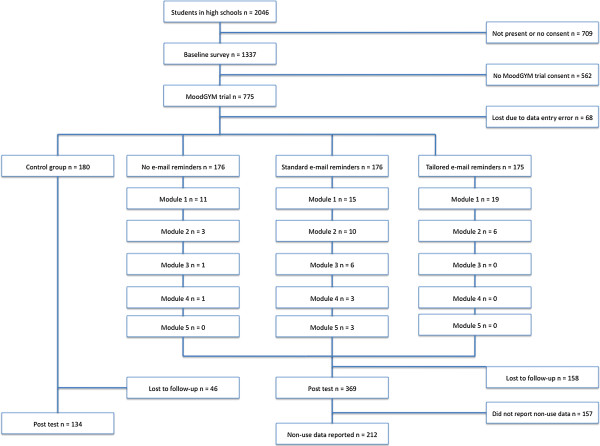
BACKGROUND: Internet-based cognitive behavioural therapy (ICBT) is a promising approach to the prevention and reduction of depressive symptoms among adolescents. This study aimed to evaluate the feasibility and efficacy of disseminating a self-directed internet-based mental health intervention (MoodGYM) in senior high schools. It also sought to investigate possible effects of tailored and weekly e-mail reminders on initial uptake and adherence to the intervention. METHOD: A baseline survey was conducted in four senior high schools in two Norwegian municipalities (n = 1337). 52.8% (707/1337) of the students consented to further participation in the trial and were randomly allocated to one of three MoodGYM intervention groups (tailored weekly e-mail reminder (n = 175), standardized weekly e-mail reminder (n = 176 ) or no e-mail reminder (n = 175)) or a waitlist control group (n = 180). We tested for effects of the intervention on depression and self-esteem using multivariate analysis of variance, effects of tailored e-mail and self-reported current need of help on initial uptake of the intervention using logistic regression and the effect of weekly e-mails on adherence using ordinal regression. RESULTS: There was substantial non-participation from the intervention, with only 8.5% (45/527) participants logging on to MoodGYM, and few proceeding beyond the first part of the programme. No significant effect on depression or self-esteem was found among the sample as a whole or among participants with elevated depression scores at baseline. Having a higher average grade in senior high school predicted initial uptake of the intervention, but tailored e-mail and self-reported current need of help did not. Weekly e-mail prompts did not predict adherence. The main reasons for non-use reported were lack of time/forgetting about it and doubt about the usefulness of the program. CONCLUSION: Overall, disseminating a self-directed internet-based intervention to a school population proved difficult despite steps taken to reduce barriers in terms of tailoring feedback and dispatching weekly e-mail reminders. Providing mental health interventions within the school environment is likely to ensure better uptake among senior high school students, but there is a need to effectively communicate that such programmes can be helpful. TRIAL REGISTRATION: The trial was registered retrospectively as ACTRN12612001106820.
Overview
The claims and statistics of this paper haven’t been checked yet.
Free: it reads the open-access text and checks the first 5 claims that cite a source we can check. Create a free account to check every claim.
Integrity signals
Registry
Cites
Statistics
Figures
Verification
Claims the paper makes
The claims and statistics of this paper haven’t been checked yet.
Free: it reads the open-access text and checks the first 5 claims that cite a source we can check. Create a free account to check every claim.
Claims other papers make about this one
Each is checked against this paper’s own text: does it say what the citing paper says it does?
The source backs part of the claim, not all of it — or backs it for a different population, condition or comparison.
In the citing paper
“Self-help interventions including bibliotherapy99 and computerized therapy100 have shown a moderate positive effect size when compared to control groups although they are generally less effective than face to face therapies.101”
From Rapid Systematic Review: The Impact of Social Isolation and Loneliness on the Mental Health of Children and Adolescents in the Context of COVID-19 (2020) · cites this paper as [100]
Experimental — accuracy not yet measured
Self-check
Percentages, sums and reported differences re-computed from the paper’s own numbers.
The self-check needs the paper’s full text.
Citations
Cites
The CES-D Scale: A Self-Report Depression Scale for Research in the General Population
Radloff, L. S. (1977) · Applied Psychological Measurement · doi:10.1177/014662167700100306 · Cited by 53,267
Society and the Adolescent Self-Image
Rosenberg, M. (1965) · doi:10.1515/9781400876136 · Cited by 30,126
Gulliver, A., Griffiths, K. M., & Christensen, H. (2010) · BMC Psychiatry · doi:10.1186/1471-244x-10-113 · Cited by 3,292 · cited 1×
“Several barriers to help-seeking for common mental health problems have been identified [7-9].”
BackgroundSelf-citationEysenbach, G. (2005) · Journal of Medical Internet Research · doi:10.2196/jmir.7.1.e11 · Cited by 2,524 · cited 1×
“An issue considered as a barrier to the implementation of Internet interventions in general, is the poor adherence associated with open access websites compared to monitored settings such as randomized controlled trials [33,34].”
BackgroundHankin, B. L., Abramson, L. Y., Moffitt, T. E., Silva, P. A., McGee, R., & Angell, K. E. (1998) · Journal of Abnormal Psychology · doi:10.1037/0021-843x.107.1.128 · Cited by 2,333 · cited 1×
“Females were also more likely to volunteer for the trial group, possibly because young women report higher levels of depressive symptoms than men, a finding in line with the literature on gender differences in depression [60].”
ResultDoes low self-esteem predict depression and anxiety? A meta-analysis of longitudinal studies.
Sowislo, J. F., & Orth, U. (2013) · Psychological Bulletin · doi:10.1037/a0028931 · Cited by 2,123 · cited 1×
“The cognitive vulnerability model of depression proposes that low self-esteem increases risk of depression, and has received empirical support [31,32].”
BackgroundThe use of the Center for Epidemiologic Studies Depression Scale in adolescents and young adults
Radloff, L. S. (1991) · Journal of Youth and Adolescence · doi:10.1007/bf01537606 · Cited by 1,997 · cited 1×
“However, due to developmental factors in adolescent samples the CES-D score may be inflated [48].”
BackgroundInternet-based cognitive behaviour therapy for symptoms of depression and anxiety: A meta-analysis
SPEK, V., CUIJPERS, P., NYKLÍČEK, I., RIPER, H., KEYZER, J., & POP, V. (2007) · Psychological Medicine · doi:10.1017/s0033291706008944 · Cited by 1,586 · cited 1×
“The positive effect of internet-based cognitive behavioural therapy (ICBT) on depression among adults has been documented in randomized controlled trials [10-14] and community populations [15,16].”
BackgroundWhen and how do young people seek professional help for mental health problems?
Rickwood, D. J., Deane, F. P., & Wilson, C. J. (2007) · Medical Journal of Australia · doi:10.5694/j.1326-5377.2007.tb01334.x · Cited by 1,195
Mood disorders in children and adolescents: an epidemiologic perspective
Kessler, R. C., Avenevoli, S., & Ries Merikangas, K. (2001) · Biological Psychiatry · doi:10.1016/s0006-3223(01)01129-5 · Cited by 1,181 · cited 1×
“Background Depression among adolescents has been recognized as a significant mental health problem, with point prevalence estimates varying between 1% and 6% [1,2].”
Background
Research works printed but not linked: 4
- Groves C Griffiths K Christensen H Working out MoodGYM: A user's guide 2003 Canberra: Centre for Mental Health Research
- Clausen S Aldring og depressive symptomer: en epidemiologisk studie J Norwegian Psychol Assoc 2005 42 9 779
- Røysamb E Schwarzer R Jerusalem M Norwegian Version of the General Perceived Self-Efficacy Scale 1998 Retrieved May 24, 2009, from http://userpage.fu-berlin.de/~health/norway.htm
- von Soest T Rosenbergs selvfølelsesskala: validering av en norsk oversettelse J Norwegian Psychol Assoc 2005 42 3 226 228
Cited by
Items 101–150 of 150
Mehrotra, S., Sudhir, P. M., R., S. K. C., Thirthalli, J., Rao, G. N., Srikanth, T. K., & Gandotra, A. (2017) · International Journal of Community Medicine and Public Health · doi:10.18203/2394-6040.ijcmph20173618 · Cited by 6
Nordgreen, T., Nordby, E. S., Myklebost, S. B., Flobak, E., & Kahlon, S. (2021) · Frontiers in Psychology · doi:10.3389/fpsyg.2021.705383 · Cited by 6
Internet-based interventions to support recovery in youth: A systematic review
Dallinger, V. C., Krishnamoorthy, G., Burton, L. J., du Plessis, C., Pillai‐Sasidharan, A., & Ayres, A. C. (2022) · Digital Health · doi:10.1177/20552076221129094 · Cited by 9
“Six of the studies reviewed included outcome measures that were associated with the process of empowerment.(24,33,34,36,37,41) These measures assessed outcomes for self-efficacy and self-esteem andwhile theywere different constructs of empowerment, both were considered elements of empowerment.”
BackgroundMethodInfluentialSieverink, F. (2017) · doi:10.3990/1.9789036544177 · Cited by 8
Alqahtani, F., & Orji, R. (2025) · Human Behavior and Emerging Technologies · doi:10.1155/hbe2/8111089 · Cited by 14
Rodrigues, T. C., Reijnders, T., Breeman, L. D., Janssen, V. R., Kraaijenhagen, R. A., Atsma, D. E., & Evers, A. W. M. (2024) · JMIR Formative Research · doi:10.2196/38803 · Cited by 7
“Although previous studies show a relatively low uptake and use intention of self-help eHealth interventions [11-13], we did not find differences in use intentions between the self-help and human-supported interventions.”
Lee, C., Bazan, M., Wong, J., Yoshida, T., Jantarabenjakul, W., Lin, S., & Papatheodorou, S. (2024) · Journal of Telemedicine and Telecare · doi:10.1177/1357633x241273032 · Cited by 4
“36 With a similar target population, one systematic review found nonsigni fi cant differences between mobile applications and controls for depression improvement (Cohen ’ s d = 0.09, p = 0.69) as measured by the Depression, Anxiety, and Stress Scale, 34 other studies came to the same conclusion.”
InfluentialAustralian University Students’ Perceptions of Mental Illness: A Qualitative Study
Perre, N. M., Wilson, N. J., Smith‐Merry, J., & Murphy, G. (2016) · DOAJ (DOAJ: Directory of Open Access Journals) · Cited by 9
Lin, J., Wurst, R., Paganini, S., Hohberg, V., Kinkel, S., Göhner, W., Ramsenthaler, C., & Fuchs, R. (2020) · Trials · doi:10.1186/s13063-020-04438-4 · Cited by 6
Electronic interventions for depression in adolescents: hot idea or hot air?
Bruce, V., & Kutcher, S. (2016) · South African Journal of Psychology · doi:10.1177/0081246316631434 · Cited by 6
Amarti, K., Schulte, M. H. J., Kleiboer, A. M., van Genugten, C., Oudega, M. L., Sonnenberg, C., Gonçalves, G., Rocha, A., & Riper, H. M. (2022) · JMIR Research Protocols · doi:10.2196/41445 · Cited by 9
“Uptake refers to the degree to which a participant engages with the content of the intervention by using or not using [57] the intervention, in this case the Moodbuster 2.0 iCBT or blended CBT.”
InfluentialBjornstad, G. J., Sonthalia, S., Rouse, B., Freeman, L., Hessami, N., Dunne, J. H., & Axford, N. (2024) · Campbell Systematic Reviews · doi:10.1002/cl2.1376 · Cited by 8
Telepsychiatry and Digital Mental Health Care in Child and Adolescent Psychiatry
Malhotra, S., & Shah, R. (2018) · Elsevier eBooks · doi:10.1016/b978-0-12-815310-9.00011-3 · Cited by 6
Hosseini, B., Tremblay, C. L., Longo, C., Golchi, S., White, J. H., Quach, C., Ste‐Marie, L., Platt, R. W., & Ducharme, F. M. (2022) · Research Square · doi:10.21203/rs.3.rs-1588325/v1 · Cited by 3
McDougal, E., Sheikh, A., de Lima, E. S., Lereya, S. T., Edbrooke-Childs, J. H., Deighton, J., Hobbs, T., Fonagy, P., & Thompson, A. (2025) · Journal of Community Psychology · doi:10.1002/jcop.70037 · Cited by 4
Böke, B. N., Mettler, J., Bastien, L., Cho, S., & Heath, N. L. (2026) · JMIR Mental Health · doi:10.2196/74205 · Cited by 3
“First, they have the potential to reach those who may not access face-to-face services, who may not meet clinical criteria for specialized treatments, or are on waitlists for services, thus broadening access to evidence-based strategies and supports [30,35,37,38].”
InfluentialJackson, H. M., Farrer, L. M., Werner‐Seidler, A., Perry, Y., Christensen, H. M., Ohan, J. L., Calear, A. L., & Batterham, P. J. (2023) · Journal of Mood and Anxiety Disorders · doi:10.1016/j.xjmad.2023.100027 · Cited by 6
“Some studies have shown that greater program usage was predicted by living in a rural location, lower year level, higher pre-intervention depression, lower pre-intervention anxiety, and higher self-esteem [12], [18], [19], [20].”
Pathrose, S. P., Wells, J., Patterson, P., Mcdonald, F., Everett, B., Ussher, J. M., Salamonson, Y., Biegel, G. M., Tho, N. D., & Ramjan, L. M. (2023) · Collegian Journal of the Royal College of Nursing Australia · doi:10.1016/j.colegn.2023.11.005 · Cited by 3
Implications of cognitive impairments on functional outcomes in major depressive disorder
Greer, T. L., & Hatt, C. R. (2015) · Cambridge University Press eBooks · doi:10.1017/cbo9781139860567.011 · Cited by 3
Perry, Y., Calear, A. L., Mackinnon, A. J., Batterham, P. J., Licinio, J., King, C., Thomsen, N., Scott, J. L., Donker, T., Merry, S., et al. (2020) · Open Access Victoria University of Wellington | Te Herenga Waka (Figshare) · doi:10.26686/wgtn.12331289.v2 · Cited by 2
Vangberg, H. C. B. (2013) · NVA (Nasjonalt vitenarkiv) · Cited by 2
Self-citationDealing with Diversity in Digital Psychological Interventions for Young People: A Structured Review
Jahedi, F., Henman, P. W. F., & Ryan, J. C. (2024) · ACI Open · doi:10.1055/s-0044-1788563 · Cited by 2
Cohen, K. A., Bruns, E. J., Lyon, A. R., Raviv, T., Becker, S., & Schleider, J. L. (2025) · Implementation Science Communications · doi:10.1186/s43058-025-00742-9 · Cited by 2
“Lack of time was one of the most commonly endorsed reasons to explain nonuse [18].”
Khan, K., Babbage, C. M., Sprange, K., Hall, C. L., Parker, A., Greenhalgh, C., Jeffery, M., Lucassen, M. F. G., Merry, S., Prasad, V., et al. (2025) · BMJ Open · doi:10.1136/bmjopen-2024-092483 · Cited by 1
“16 However, it is widely known that a commonly purported facilitator that improves engagement and adherence with DHIs is human support.”
Smith, M. H., Longmuir, P. E., Robb, M., Norris, M. L., DiGasparro, M., Laurie, K., Baechler, N., McBrearty, N., Courtney, K., Cooligan, F., et al. (2026) · Children · doi:10.3390/children13020163 · Cited by 2
The need for care integration across hospital services for adults with sickle cell disease
Benenson, I., Jadotte, Y. T., & Holly, C. M. (2018) · Journal of Integrated Care · doi:10.1108/jica-03-2018-0022 · Cited by 1
Perry, Y., Calear, A. L., Mackinnon, A. J., Batterham, P. J., Licinio, J., King, C., Thomsen, N., Scott, J. L., Donker, T., Merry, S., et al. (2020) · doi:10.26686/wgtn.12331289 · Cited by 1
Chillemi, K. (2015) · Figshare · doi:10.25916/sut.26271118 · Cited by 1
Bordelon, A. E. (2018) · Louisiana State University · doi:10.31390/gradschool_dissertations.4607
Robinson, O. C., Sebah, I., & Avram, A. A. (2021) · Advances in psychology, mental health, and behavioral studies (APMHBS) book series · doi:10.4018/978-1-7998-7991-6.ch003 · Cited by 1
Cuestionario pop [a] Carlos Iglesias: "'Un franco, 14 pesetas' es la 'peli' que más veces he visto"
Crespo, I. (2011) · Cinemanía · Cited by 1
Using peer support to strengthen mental health during the COVID-19 pandemic: a review (Preprint)Preprint
Suresh, R., Alam, A., & Karkossa, Z. (2021) · doi:10.2196/preprints.30585
Li, S. H., Achilles, M. R., Werner‐Seidler, A., Beames, J. R., Subotic-Kerry, M., & O’Dea, B. (2022) · doi:10.2196/preprints.37640
Factors Affecting School-Based Mental Health in Adolescents: Scoping Review
Dumar, B., Windarwati, H. D., & Yuliatun, L. (2023) · Jurnal Aisyah Jurnal Ilmu Kesehatan · doi:10.30604/jika.v8i1.1534 · Cited by 3
Brief School-Based Interventions Targeting Student Mental Health or Wellbeing: A Systematic ReviewPreprint
Cohen, K. A., Ito, S., Ahuvia, I. L., Yang, Y., Zhang, Y., Renshaw, T. L., Larson, M. F., Cook, C. R., Hill, S., Liao, J., et al. (2023) · doi:10.31234/osf.io/xemjn
Njiru, H. N., Gitahi, M., & Njogu, E. (2024) · Epidemiology and Public Health · doi:10.52768/epidemiolpublichealth/1042
Daniel, S., Volcko, L., Bassi, E. M., Hews‐Girard, J., Bright, K. S., Barker, M., Norman, L., Pintson, K., Henry, G., Soufi, S., et al. (2024) · doi:10.2196/preprints.69907
Ozmen, S., Amarnath, A., de Wit, L. M., van Klaveren, C., Cuijpers, P. J., van Straten, A., & Struijs, S. Y. (2025) · doi:10.2196/preprints.72896
Böke, B. N., Mettler, J., Bastien, L., Cho, S., & Heath, N. L. (2025) · doi:10.2196/preprints.74205
Auyeung, L., Tsang, E. Z., & Mak, W. W. S. (2025) · Computers in Human Behavior Reports · doi:10.1016/j.chbr.2025.100695 · Cited by 6
Feasibility of a Guided Web-Based Procrastination Intervention for College Students: Open Trial
Ozmen, S., Amarnath, A., de Wit, L. M., van Klaveren, C., Cuijpers, P. J., van Straten, A., & Struijs, S. Y. (2025) · JMIR Formative Research · doi:10.2196/72896 · Cited by 3
Mindfulness and Trading DecisionsPreprint
Ding, Z., Ghanma, D., Varotto, S., & Vogt, J. (2025) · SSRN Electronic Journal · doi:10.2139/ssrn.5406664
Hosseini, B., Tremblay, C. L., Longo, C., Glochi, S., White, J. H., Quach, C., Ste‐Marie, L., Platt, R. W., & Ducharme, F. M. (2023) · Figshare · doi:10.6084/m9.figshare.22611770
Hosseini, B., Tremblay, C. L., Longo, C., Glochi, S., White, J. H., Quach, C., Ste‐Marie, L., Platt, R. W., & Ducharme, F. M. (2023) · Figshare · doi:10.6084/m9.figshare.22611767
Khan, K., Hall, C. L., Babbage, C. M., Dodzo, S., Greenhalgh, C., Lucassen, M., Merry, S., Sayal, K. S., Sprange, K., Stasiak, K., et al. (2024) · Figshare · doi:10.6084/m9.figshare.26697908
Amarti, K., Schulte, M. H. J., Kleiboer, A. M., van Genugten, C., Oudega, M. L., Rocha, A., & Riper, H. M. (2026) · JMIR Formative Research · doi:10.2196/83316
Kang‐Yi, C. D., Chao, B., Ilyas, R., Arthurs, C., Eissenstat, S. J., & Gao, N. (2026) · Mental Health Science · doi:10.1002/mhs2.70046 · Cited by 1
Preferences for e-Mental Health Interventions in Germany: A Discrete Choice ExperimentPreprint
Himmler, S., & Phillips, E. A. (2021) · OSF Preprints (OSF Preprints)
Dabrowski, A., Mackley, G., Fernando, C., Rahim, H. A., & Siena, J. A. (2026) · Frontiers in Education · doi:10.3389/feduc.2026.1812649
School-based digital mental health interventions: A scoping review
Santosh-Thomas, S., Aggarwal, A., Chandler, T., Dremann, S., Phillips, S., Lopez, E., Weist, M. D., & Daly, B. P. (2026) · Journal of Child and Adolescent Mental Health · doi:10.2989/17280583.2026.2721998
Metadata
- Authors
- Lillevoll, K. R., Vangberg, H. C. B., Griffiths, K. M., Waterloo, K., & Eisemann, M. R.
- Affiliations
- UiT The Arctic University of Norway (NO)
- Australian National University (AU)
- Corresponding author
- Lillevoll, Kjersti R
- ORCID
- Venue
- BMC Psychiatry
- Published
- 2014-01-21
- Volume
- 14
- Issue
- 1
- Pages
- 14-14
- ISSN
- 1471-244X (ISSN-L)
- PMC
- PMC3901754
- OpenAlex
- W2149083723
- Cited by
- 150
- References
- 68
- Citations by year
- 2026: 5 · 2025: 12 · 2024: 13 · 2023: 13 · 2022: 16 · 2021: 15 · 2020: 14 · 2019: 10 · 2018: 10 · 2017: 14 · 2016: 14 · 2015: 12
- FWCI
- 20.64
- Type
- journal article
- Language
- en
- Open access
- gold
- doi.org
- Licence
- Locations
- BMC Psychiatry (publishedVersion, cc-by)
- Europe PMC (PubMed Central) (publishedVersion, cc-by)
- PubMed Central (publishedVersion, cc-by)
- PubMed (publishedVersion)
- NORA - Norwegian Open Research Archives (submittedVersion, other-oa)
- ANU Open Research (Australian National University) (submittedVersion, cc-by)
- Funders
- Universitetet i Tromsø
- Topics
- Social Sciences › Psychology › Applied Psychology › Digital Mental Health Interventions
- Social Sciences › Psychology › Experimental and Cognitive Psychology › Anxiety, Depression, Psychometrics, Treatment, Cognitive Processes
- Health Sciences › Medicine › Psychiatry and Mental health › Mental Health Treatment and Access
- Keywords
- internet-based cognitive behavioral therapy, MoodGYM, adolescent depression, self-guided intervention, email reminders, intervention uptake, intervention adherence, school-based mental health programs, high school students, self-esteem, personalized feedback
- MeSH terms
- Adolescent, Depressive Disorder, Female, Humans, Male, Norway, Patient Compliance, Schools, Self Care, Cognitive Behavioral Therapy, Reminder Systems, Self Efficacy, Internet, Electronic Mail, Young Adult
About these checks
Registry, retraction, Cites and statistics results are computed, not judged, with one exception: a printed reference that no index lists is read once by a model before it counts as a citation error. Claims are extracted by a model and kept only when their quote appears verbatim in the text; each cited source is then checked, with a model’s help, for whether it says what the claim relies on. Those verdicts can be wrong — read the claim’s quote and the cited source before relying on one.
Statistics and arithmetic are recomputed, not judged.
Confidence bands are shown only for fields calibrated on our annotated test set. None is calibrated yet, so no band is shown.
What counts as a claim ›How we measure confidence ›How we check this ›
Are you an author, or do you see a problem with this page? Request a review
Data sources
Bibliographic data: Semantic Scholar, OpenAlex, Crossref.
Contains information from the Semantic Scholar Academic Graph Datasets, made available under the ODC Attribution License (ODC-BY 1.0).
Semantic Scholar’s data is described in: Kinney, R., et al. (2023). The Semantic Scholar Open Data Platform. arXiv:2301.10140.
