

Uptake and adherence of a self-directed internet-based mental health intervention with tailored e-mail reminders in senior high schools in Norway
Open accessThe DOI matches its Crossref record; 66 of the 68 references it cites were found in a registry or an index.
Abstract
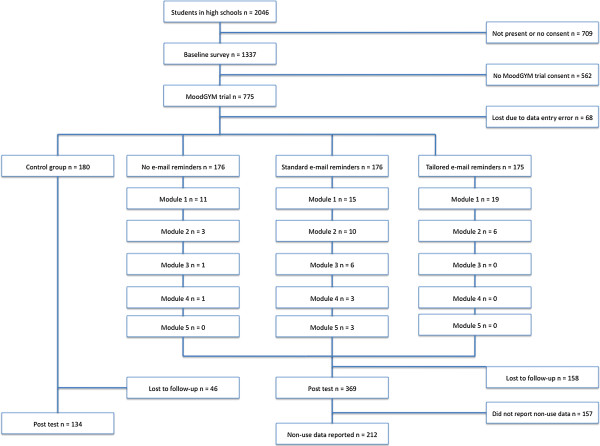
BACKGROUND: Internet-based cognitive behavioural therapy (ICBT) is a promising approach to the prevention and reduction of depressive symptoms among adolescents. This study aimed to evaluate the feasibility and efficacy of disseminating a self-directed internet-based mental health intervention (MoodGYM) in senior high schools. It also sought to investigate possible effects of tailored and weekly e-mail reminders on initial uptake and adherence to the intervention. METHOD: A baseline survey was conducted in four senior high schools in two Norwegian municipalities (n = 1337). 52.8% (707/1337) of the students consented to further participation in the trial and were randomly allocated to one of three MoodGYM intervention groups (tailored weekly e-mail reminder (n = 175), standardized weekly e-mail reminder (n = 176 ) or no e-mail reminder (n = 175)) or a waitlist control group (n = 180). We tested for effects of the intervention on depression and self-esteem using multivariate analysis of variance, effects of tailored e-mail and self-reported current need of help on initial uptake of the intervention using logistic regression and the effect of weekly e-mails on adherence using ordinal regression. RESULTS: There was substantial non-participation from the intervention, with only 8.5% (45/527) participants logging on to MoodGYM, and few proceeding beyond the first part of the programme. No significant effect on depression or self-esteem was found among the sample as a whole or among participants with elevated depression scores at baseline. Having a higher average grade in senior high school predicted initial uptake of the intervention, but tailored e-mail and self-reported current need of help did not. Weekly e-mail prompts did not predict adherence. The main reasons for non-use reported were lack of time/forgetting about it and doubt about the usefulness of the program. CONCLUSION: Overall, disseminating a self-directed internet-based intervention to a school population proved difficult despite steps taken to reduce barriers in terms of tailoring feedback and dispatching weekly e-mail reminders. Providing mental health interventions within the school environment is likely to ensure better uptake among senior high school students, but there is a need to effectively communicate that such programmes can be helpful. TRIAL REGISTRATION: The trial was registered retrospectively as ACTRN12612001106820.
Overview
The claims and statistics of this paper haven’t been checked yet.
Free: it reads the open-access text and checks the first 5 claims that cite a source we can check. Create a free account to check every claim.
Integrity signals
Registry
Cites
Statistics
Figures
Verification
Claims the paper makes
The claims and statistics of this paper haven’t been checked yet.
Free: it reads the open-access text and checks the first 5 claims that cite a source we can check. Create a free account to check every claim.
Claims other papers make about this one
Each is checked against this paper’s own text: does it say what the citing paper says it does?
The source backs part of the claim, not all of it — or backs it for a different population, condition or comparison.
In the citing paper
“Self-help interventions including bibliotherapy99 and computerized therapy100 have shown a moderate positive effect size when compared to control groups although they are generally less effective than face to face therapies.101”
From Rapid Systematic Review: The Impact of Social Isolation and Loneliness on the Mental Health of Children and Adolescents in the Context of COVID-19 (2020) · cites this paper as [100]
Experimental — accuracy not yet measured
Self-check
Percentages, sums and reported differences re-computed from the paper’s own numbers.
The self-check needs the paper’s full text.
Citations
Cites
The CES-D Scale: A Self-Report Depression Scale for Research in the General Population
Radloff, L. S. (1977) · Applied Psychological Measurement · doi:10.1177/014662167700100306 · Cited by 53,267
Society and the Adolescent Self-Image
Rosenberg, M. (1965) · doi:10.1515/9781400876136 · Cited by 30,126
Gulliver, A., Griffiths, K. M., & Christensen, H. (2010) · BMC Psychiatry · doi:10.1186/1471-244x-10-113 · Cited by 3,292 · cited 1×
“Several barriers to help-seeking for common mental health problems have been identified [7-9].”
BackgroundSelf-citationEysenbach, G. (2005) · Journal of Medical Internet Research · doi:10.2196/jmir.7.1.e11 · Cited by 2,524 · cited 1×
“An issue considered as a barrier to the implementation of Internet interventions in general, is the poor adherence associated with open access websites compared to monitored settings such as randomized controlled trials [33,34].”
BackgroundHankin, B. L., Abramson, L. Y., Moffitt, T. E., Silva, P. A., McGee, R., & Angell, K. E. (1998) · Journal of Abnormal Psychology · doi:10.1037/0021-843x.107.1.128 · Cited by 2,333 · cited 1×
“Females were also more likely to volunteer for the trial group, possibly because young women report higher levels of depressive symptoms than men, a finding in line with the literature on gender differences in depression [60].”
ResultDoes low self-esteem predict depression and anxiety? A meta-analysis of longitudinal studies.
Sowislo, J. F., & Orth, U. (2013) · Psychological Bulletin · doi:10.1037/a0028931 · Cited by 2,123 · cited 1×
“The cognitive vulnerability model of depression proposes that low self-esteem increases risk of depression, and has received empirical support [31,32].”
BackgroundThe use of the Center for Epidemiologic Studies Depression Scale in adolescents and young adults
Radloff, L. S. (1991) · Journal of Youth and Adolescence · doi:10.1007/bf01537606 · Cited by 1,997 · cited 1×
“However, due to developmental factors in adolescent samples the CES-D score may be inflated [48].”
BackgroundInternet-based cognitive behaviour therapy for symptoms of depression and anxiety: A meta-analysis
SPEK, V., CUIJPERS, P., NYKLÍČEK, I., RIPER, H., KEYZER, J., & POP, V. (2007) · Psychological Medicine · doi:10.1017/s0033291706008944 · Cited by 1,586 · cited 1×
“The positive effect of internet-based cognitive behavioural therapy (ICBT) on depression among adults has been documented in randomized controlled trials [10-14] and community populations [15,16].”
BackgroundWhen and how do young people seek professional help for mental health problems?
Rickwood, D. J., Deane, F. P., & Wilson, C. J. (2007) · Medical Journal of Australia · doi:10.5694/j.1326-5377.2007.tb01334.x · Cited by 1,195
Mood disorders in children and adolescents: an epidemiologic perspective
Kessler, R. C., Avenevoli, S., & Ries Merikangas, K. (2001) · Biological Psychiatry · doi:10.1016/s0006-3223(01)01129-5 · Cited by 1,181 · cited 1×
“Background Depression among adolescents has been recognized as a significant mental health problem, with point prevalence estimates varying between 1% and 6% [1,2].”
BackgroundAdherence in Internet Interventions for Anxiety and Depression
Christensen, H., Griffiths, K. M., & Farrer, L. (2009) · Journal of Medical Internet Research · doi:10.2196/jmir.1194 · Cited by 1,133 · cited 1×
“An issue considered as a barrier to the implementation of Internet interventions in general, is the poor adherence associated with open access websites compared to monitored settings such as randomized controlled trials [33,34].”
BackgroundSelf-citationMajor depressive disorder in older adolescents
Lewinsohn, P. M., Rohde, P., & Seeley, J. R. (1998) · Clinical Psychology Review · doi:10.1016/s0272-7358(98)00010-5 · Cited by 1,078 · cited 1×
“Background Depression among adolescents has been recognized as a significant mental health problem, with point prevalence estimates varying between 1% and 6% [1,2].”
BackgroundDelivering interventions for depression by using the internet: randomised controlled trial
Christensen, H. (2004) · BMJ · doi:10.1136/bmj.37945.566632.ee · Cited by 928 · cited 1×
“The positive effect of internet-based cognitive behavioural therapy (ICBT) on depression among adults has been documented in randomized controlled trials [10-14] and community populations [15,16].”
BackgroundScreening for Adolescent Depression: A Comparison of Depression Scales
ROBERTS, R. E., LEWINSOHN, P. M., & SEELEY, J. R. (1991) · Journal of the American Academy of Child & Adolescent Psychiatry · doi:10.1097/00004583-199101000-00009 · Cited by 850
Major Depression in Community Adolescents: Age at Onset, Episode Duration, and Time to Recurrence
LEWINSOHN, P. M., CLARKE, G. N., SEELEY, J. R., & ROHDE, P. (1994) · Journal of the American Academy of Child & Adolescent Psychiatry · doi:10.1097/00004583-199407000-00006 · Cited by 836 · cited 1×
“The recurrent nature of depression points to the importance of prevention and early intervention among this group [3].”
BackgroundInternet-based self-help for depression: randomised controlled trial
Andersson, G., Bergström, J., Holländare, F., Carlbring, P., Kaldo, V., & Ekselius, L. (2005) · British Journal of Psychiatry · doi:10.1192/bjp.187.5.456 · Cited by 529 · cited 1×
“The positive effect of internet-based cognitive behavioural therapy (ICBT) on depression among adults has been documented in randomized controlled trials [10-14] and community populations [15,16].”
BackgroundBrouwer, W., Kroeze, W., Crutzen, R., de Nooijer, J., de Vries, N. K., Brug, J., & Oenema, A. (2011) · Journal of Medical Internet Research · doi:10.2196/jmir.1639 · Cited by 455 · cited 1×
“Overall, findings suggest that adding reminders encourages sustained usage of intervention web sites [38-42].”
BackgroundBerger, T., Hämmerli, K., Gubser, N., Andersson, G., & Caspar, F. (2011) · Cognitive Behaviour Therapy · doi:10.1080/16506073.2011.616531 · Cited by 383 · cited 1×
“Although ICBT with therapist support shows larger effect sizes, fully automated, unguided interventions are effective in reducing depressive symptoms [17].”
BackgroundClarke, G., Eubanks, D., Reid, E., Kelleher, C., O'Connor, E., DeBar, L. L., Lynch, F., Nunley, S., & Gullion, C. (2005) · Journal of Medical Internet Research · doi:10.2196/jmir.7.2.e16 · Cited by 372 · cited 1×
“Overall, findings suggest that adding reminders encourages sustained usage of intervention web sites [38-42].”
BackgroundSystematic review of school-based prevention and early intervention programs for depression
Calear, A. L., & Christensen, H. (2010) · Journal of Adolescence · doi:10.1016/j.adolescence.2009.07.004 · Cited by 365 · cited 1×
“The evidence for effectiveness of computerized or internet-based CBT for adolescents and young adults is emerging, with a number of studies reporting that such interventions are effective in preventing or reducing depressive symptoms in adolescents and young adults [19-22] and in schools in particular [23-25].”
BackgroundCalear, A. L., Christensen, H., Mackinnon, A., Griffiths, K. M., & O'Kearney, R. (2009) · Journal of Consulting and Clinical Psychology · doi:10.1037/a0017391 · Cited by 327 · cited 6×
“6% have been variable ranging from small in a universal sample of students in schools [24] to large in an adult telecounselling environment [11].”
BackgroundMethodResultInfluentialSelf-citationPerceived self-efficacy in health behaviour research: Conceptualisation, measurement and correlates
Leganger, A., Kraft, P., & R⊘ysamb, E. (2000) · Psychology & Health · doi:10.1080/08870440008400288 · Cited by 308 · cited 1×
“The psychometric properties of the Norwegian version of this scale has been found satisfactory [54].”
MethodPsychological and educational interventions for preventing depression in children and adolescents
Merry, S. N., Hetrick, S. E., Cox, G. R., Brudevold-Iversen, T., Bir, J. J., & McDowell, H. (2011) · Cochrane Database of Systematic Reviews · doi:10.1002/14651858.cd003380.pub3 · Cited by 305
2. THE MEASUREMENT OF SELF-ESTEEM
(1965) · Society and the Adolescent Self-Image · doi:10.1515/9781400876136-003 · Cited by 275
Richardson, T., Stallard, P., & Velleman, S. (2010) · Clinical Child and Family Psychology Review · doi:10.1007/s10567-010-0069-9 · Cited by 272 · cited 1×
“The evidence for effectiveness of computerized or internet-based CBT for adolescents and young adults is emerging, with a number of studies reporting that such interventions are effective in preventing or reducing depressive symptoms in adolescents and young adults [19-22] and in schools in particular [23-25].”
BackgroundJohansson, R., Sjöberg, E., Sjögren, M., Johnsson, E., Carlbring, P., Andersson, T., Rousseau, A., & Andersson, G. (2012) · PLoS ONE · doi:10.1371/journal.pone.0036905 · Cited by 268 · cited 1×
“Tailoring interventions or feedback are already utilized in life style or health related interventions [2527] and are emerging within the field of depression [28].”
BackgroundStrecher, V., McClure, J., Alexander, G., Chakraborty, B., Nair, V., Konkel, J., Greene, S., Couper, M., Carlier, C., Wiese, C., et al. (2008) · Journal of Medical Internet Research · doi:10.2196/jmir.1002 · Cited by 264 · cited 1×
“Tailoring interventions or feedback are already utilized in life style or health related interventions [27-29] and are emerging within the field of depression [30].”
BackgroundInternet-Based Treatment for Adults with Depressive Symptoms: Randomized Controlled Trial
Warmerdam, L., van Straten, A., Twisk, J., Riper, H., & Cuijpers, P. (2008) · Journal of Medical Internet Research · doi:10.2196/jmir.1094 · Cited by 255 · cited 1×
“The positive effect of internet-based cognitive behavioural therapy (ICBT) on depression among adults has been documented in randomized controlled trials [10-14] and community populations [15,16].”
Essau, C. A. (2005) · Depression and Anxiety · doi:10.1002/da.20115 · Cited by 249
Christensen, H., Griffiths, K. M., Korten, A. E., Brittliffe, K., & Groves, C. (2004) · Journal of Medical Internet Research · doi:10.2196/jmir.6.4.e46 · Cited by 240
Self-citationZachrisson, H. D., Rödje, K., & Mykletun, A. (2006) · BMC Public Health · doi:10.1186/1471-2458-6-34 · Cited by 230 · cited 1×
“The majority of adolescents suffering from depression remain untreated [4-6].”
BackgroundVan Voorhees, B. W., Fogel, J., Reinecke, M. A., Gladstone, T., Stuart, S., Gollan, J., Bradford, N., Domanico, R., Fagan, B., Ross, R., et al. (2009) · Journal of Developmental & Behavioral Pediatrics · doi:10.1097/dbp.0b013e3181966c2a · Cited by 197 · cited 1×
“The evidence for effectiveness of computerized or internet-based CBT for adolescents and young adults is emerging, with a number of studies reporting that such interventions are effective in preventing or reducing depressive symptoms in adolescents and young adults [19-22] and in schools in particular [23-25].”
BackgroundO'Kearney, R., Gibson, M., Christensen, H., & Griffiths, K. M. (2006) · Cognitive Behaviour Therapy · doi:10.1080/16506070500303456 · Cited by 183 · cited 1×
“Previous research has provided early support for the effectiveness of MoodGYM in reducing depression [24,61] but effects”
ResultSelf-citationO'Kearney, R., Kang, K., Christensen, H., & Griffiths, K. (2009) · Depression and Anxiety · doi:10.1002/da.20507 · Cited by 179 · cited 2×
“In a monitored environment, there is less drop-out [23,37].”
BackgroundSelf-citationvan Tuijl, L. A., de Jong, P. J., Sportel, B. E., de Hullu, E., & Nauta, M. H. (2013) · Journal of Behavior Therapy and Experimental Psychiatry · doi:10.1016/j.jbtep.2013.09.007 · Cited by 176 · cited 1×
“The cognitive vulnerability model of depression proposes that low self-esteem increases risk of depression, and has received empirical support [31,32].”
BackgroundNijland, N., van Gemert-Pijnen, J. E., Kelders, S. M., Brandenburg, B. J., & Seydel, E. R. (2011) · Journal of Medical Internet Research · doi:10.2196/jmir.1603 · Cited by 175 · cited 1×
“The use of "push" factors or reminders has been recommended by several researchers [20,35-37].”
BackgroundDepression and smoking during pregnancy
Zhu, S., & Valbø, A. (2002) · Addictive Behaviors · doi:10.1016/s0306-4603(01)00199-x · Cited by 159
Lintvedt, O. K., Griffiths, K. M., Sørensen, K., Østvik, A. R., Wang, C. E. A., Eisemann, M., & Waterloo, K. (2013) · Clinical Psychology & Psychotherapy · doi:10.1002/cpp.770 · Cited by 157 · cited 2×
“The use of "push" factors or reminders has been recommended by several researchers [20,35-37].”
BackgroundSelf-citationPowell, J., Hamborg, T., Stallard, N., Burls, A., McSorley, J., Bennett, K., Griffiths, K. M., & Christensen, H. (2012) · Journal of Medical Internet Research · doi:10.2196/jmir.2240 · Cited by 156 · cited 3×
“Furthermore, programs aiming to enhance skills on the individual level, such as promoting healthy cognitive and behavioural patterns, may be one means of preventing depression also in currently non-depressed persons [16,18].”
BackgroundSelf-citationNeil, A. L., Batterham, P., Christensen, H., Bennett, K., & Griffiths, K. M. (2009) · Journal of Medical Internet Research · doi:10.2196/jmir.1050 · Cited by 152 · cited 3×
“In a monitored environment, there is less drop-out [23,37].”
BackgroundResultSelf-citationTram, J. M., & Cole, D. A. (2000) · Journal of Abnormal Psychology · doi:10.1037//0021-843x.109.4.753 · Cited by 142 · cited 1×
“These variables were selected based on their interrelatedness and relevance to help-seeking behaviors [57-59].”
BackgroundFarrer, L., Christensen, H., Griffiths, K. M., & Mackinnon, A. (2011) · PLoS ONE · doi:10.1371/journal.pone.0028099 · Cited by 140 · cited 2×
“The positive effect of internet-based cognitive behavioural therapy (ICBT) on depression among adults has been documented in randomized controlled trials [10-14] and community populations [15,16].”
BackgroundSelf-citationThe relationship between self-efficacy and depression in adolescents.
Ehrenberg, M. F., Cox, D. N., & Koopman, R. (1991) · PubMed · Cited by 136
Merry, S. N., Hetrick, S. E., Cox, G. R., Brudevold‐Iversen, T., Bir, J. J., & McDowell, H. (2012) · Evidence-Based Child Health: A Cochrane Review Journal · doi:10.1002/ebch.1867 · Cited by 131
The Use of Computerized Self-Help Packages to Treat Adolescent Depression and Anxiety
Sethi, S., Campbell, A. J., & Ellis, L. A. (2010) · Journal of Technology in Human Services · doi:10.1080/15228835.2010.508317 · Cited by 129 · cited 1×
“The evidence for effectiveness of computerized or internet-based CBT for adolescents and young adults is emerging, with a number of studies reporting that such interventions are effective in preventing or reducing depressive symptoms in adolescents and young adults [19-22] and in schools in particular [23-25].”
BackgroundDesign and Implementation of an Interactive Website to Support Long-Term Maintenance of Weight Loss
Stevens, V. J., Funk, K. L., Brantley, P. J., Erlinger, T. P., Myers, V. H., Champagne, C. M., Bauck, A., Samuel-Hodge, C. D., & Hollis, J. F. (2008) · Journal of Medical Internet Research · doi:10.2196/jmir.931 · Cited by 124 · cited 2×
“Overall, findings suggest that adding reminders encourages sustained usage of intervention web sites [38-42].”
BackgroundResultYoung people, social support and help-seeking
Barker, Olukoya, & Aggleton (2005) · International Journal of Adolescent Medicine and Health · doi:10.1515/ijamh.2005.17.4.315 · Cited by 123 · cited 2×
“The latter might not only include symptom level but also other factors associated with help-seeking behaviours [9].”
BackgroundRandomized Controlled Trial of Web-Based Treatment of Social Phobia Without Clinician Guidance
Titov, N., Andrews, G., Choi, I., Schwencke, G., & Johnston, L. (2009) · Australian & New Zealand Journal of Psychiatry · doi:10.1080/00048670903179160 · Cited by 117 · cited 2×
“Overall, findings suggest that adding reminders encourages sustained usage of intervention web sites [38-42].”
BackgroundThe measurement of self-esteem, Society and the adolescent self-image
Rosenberg, M. (1965) · Medical Entomology and Zoology · Cited by 108
Predictors of Service Use for Mental Health Problems Among British Schoolchildren
Ford, T., Hamilton, H., Meltzer, H., & Goodman, R. (2008) · Child and Adolescent Mental Health · doi:10.1111/j.1475-3588.2007.00449.x · Cited by 103 · cited 1×
“The majority of adolescents suffering from depression remain untreated [4-6].”
BackgroundEffectiveness of Web-based Psychological Interventions for Depression: A Meta-analysis
Cowpertwait, L., & Clarke, D. (2013) · International Journal of Mental Health and Addiction · doi:10.1007/s11469-012-9416-z · Cited by 101 · cited 1×
“However, the results are not unambiguous [43,44].”
Van Voorhees, B. W., Fogel, J., Houston, T. K., Cooper, L. A., Wang, N.-Y., & Ford, D. E. (2006) · Social Psychiatry and Psychiatric Epidemiology · doi:10.1007/s00127-006-0091-x · Cited by 101 · cited 1×
“Previous research has shown that beliefs about treatment are significant predictors of perceived need for treatment [63], and also of adherence to an internet-based depression prevention intervention [64].”
BackgroundComparing Two Web-Based Smoking Cessation Programs: Randomized Controlled Trial
McKay, H. G., Danaher, B. G., Seeley, J. R., Lichtenstein, E., & Gau, J. M. (2008) · Journal of Medical Internet Research · doi:10.2196/jmir.993 · Cited by 99 · cited 1×
“The use of "push" factors or reminders has been recommended by several researchers [20,35-37].”
BackgroundWanner, M., Martin-Diener, E., Bauer, G., Braun-Fahrländer, C., & Martin, B. W. (2010) · Journal of Medical Internet Research · doi:10.2196/jmir.1361 · Cited by 95 · cited 1×
“However, the results are not unambiguous [43,44].”
Pössel, P., Baldus, C., Horn, A. B., Groen, G., & Hautzinger, M. (2005) · Journal of Child Psychology and Psychiatry · doi:10.1111/j.1469-7610.2004.00395.x · Cited by 93 · cited 1×
“These variables were selected based on their interrelatedness and relevance to help-seeking behaviors [57-59].”
BackgroundOnline Health Promotion, Early Identification of Difficulties, and Help Seeking in Young People
SANTOR, D. A., POULIN, C., LeBLANC, J. C., & KUSUMAKAR, V. (2007) · Journal of the American Academy of Child & Adolescent Psychiatry · doi:10.1097/01.chi.0000242247.45915.ee · Cited by 93 · cited 1×
“It has been reported that frequency of access of an online health promotion web site (YooMagazine) that focused on mental health literacy, early detection of difficulties and helpseeking was associated with greater off-line help-seeking behaviours in an adolescent sample [65].”
BackgroundAdolescent's preferred modes of delivery for mental health services
Bradford, S., & Rickwood, D. (2014) · Child and Adolescent Mental Health · doi:10.1111/camh.12002 · Cited by 83 · cited 1×
“Recent research indicates that online interventions were the preferred mode of delivery of mental health services in only 16% of a sample of Australian adolescents [62].”
BackgroundRobroek, S. J., Lindeboom, D. E., & Burdorf, A. (2012) · Journal of Medical Internet Research · doi:10.2196/jmir.1788 · Cited by 79 · cited 2×
“Overall, findings suggest that adding reminders encourages sustained usage of intervention web sites [38-42].”
BackgroundResultChristensen, H., Reynolds, J., & Griffiths, K. M. (2011) · Early Intervention in Psychiatry · doi:10.1111/j.1751-7893.2010.00242.x · Cited by 76 · cited 1×
“It has been proposed that providing feedback about an individual’s level of depression and anxiety might facilitate engagement with e-health applications [26].”
BackgroundSelf-citationHansen, A. W., Grønbæk, M., Helge, J. W., Severin, M., Curtis, T., & Tolstrup, J. S. (2012) · Journal of Medical Internet Research · doi:10.2196/jmir.2109 · Cited by 65 · cited 1×
“Tailoring interventions or feedback are already utilized in life style or health related interventions [27-29] and are emerging within the field of depression [30].”
BackgroundStallard, P., & Buck, R. (2013) · British Journal of Psychiatry · doi:10.1192/bjp.bp.112.119172 · Cited by 53 · cited 1×
“This mode of delivery attracted more users than did the current selfdirected intervention completed outside school hours, and retention was superior [24,66,67].”
BackgroundBattista, S. R., Pencer, A. H., McGonnell, M., Durdle, H., & Stewart, S. H. (2012) · International Journal of Mental Health and Addiction · doi:10.1007/s11469-012-9395-0 · Cited by 33
Wong, P. W. C., Fu, K.-W., Chan, K. Y. K., Chan, W. S. C., Liu, P. M. Y., Law, Y.-W., & Yip, P. S. F. (2012) · Journal of Affective Disorders · doi:10.1016/j.jad.2012.03.050 · Cited by 33
Forebygging av depresjon med hovedvekt på individrettede metoder
Dalgard, O. S., & Bøen, H. (2008) · NORA - Norwegian Open Research Archives · Cited by 29
The Need for Web-Based Cognitive Behavior Therapy Among University Students
Lintvedt, O. K., S⊘rensen, K., Østvik, A. R., Verplanken, B., & Wang, C. E. (2008) · Journal of Technology in Human Services · doi:10.1080/15228830802096705 · Cited by 26
(2010) · PubMed · Cited by 23
Validation of an Informant-Reported Web-Based Data Collection to Assess Dementia Symptoms
Rockwood, K. J., Zeng, A., Leibman, C., Mucha, L., & Mitnitski, A. (2012) · Journal of Medical Internet Research · doi:10.2196/jmir.1941 · Cited by 15
Vosbergen, S., Laan, E. K., Colkesen, E. B., Niessen, M. A. J., Kraaijenhagen, R. A., Essink‐Bot, M., & Peek, N. B. (2012) · Journal of Medical Internet Research · doi:10.2196/jmir.2067 · Cited by 13 · cited 1×
“Tailoring interventions or feedback are already utilized in life style or health related interventions [27-29] and are emerging within the field of depression [30].”
Background
Research works printed but not linked: 4
- Groves C Griffiths K Christensen H Working out MoodGYM: A user's guide 2003 Canberra: Centre for Mental Health Research
- Clausen S Aldring og depressive symptomer: en epidemiologisk studie J Norwegian Psychol Assoc 2005 42 9 779
- Røysamb E Schwarzer R Jerusalem M Norwegian Version of the General Perceived Self-Efficacy Scale 1998 Retrieved May 24, 2009, from http://userpage.fu-berlin.de/~health/norway.htm
- von Soest T Rosenbergs selvfølelsesskala: validering av en norsk oversettelse J Norwegian Psychol Assoc 2005 42 3 226 228
Cited by
Loades, M. E., Chatburn, E., Higson-Sweeney, N., Reynolds, S., Shafran, R., Brigden, A., Linney, C., McManus, M. N., Borwick, C., & Crawley, E. (2020) · Journal of the American Academy of Child & Adolescent Psychiatry · doi:10.1016/j.jaac.2020.05.009 · Cited by 2,906
Hollis, C., Falconer, C. J., Martin, J. L., Whittington, C., Stockton, S., Glazebrook, C., & Davies, E. B. (2017) · Journal of Child Psychology and Psychiatry · doi:10.1111/jcpp.12663 · Cited by 846
“DHIs most frequently cited were MoodGym, BRAVE-Online, Project CATCH-IT, Master Your Mood Online (Grip Op Je Dip) and MobileType.”
BackgroundMethodInfluentialLehtimaki, S., Martic, J., Wahl, B., Foster, K. T., & Schwalbe, N. (2021) · JMIR Mental Health · doi:10.2196/25847 · Cited by 488
“Similar to our findings, studies have reported low adherence and high dropout rates in adolescents and young people using digital mental health interventions [58-60], although there are also contrasting data with high levels of acceptability and usability [47], including from low- and middle-income countries [61-63].”
ResultLiverpool, S., Mota, C. P., Sales, C. M. D., Čuš, A., Carletto, S., Hancheva, C., Sousa, S., Cerón, S. C., Moreno-Peral, P., Pietrabissa, G., et al. (2020) · Journal of Medical Internet Research · doi:10.2196/16317 · Cited by 408
Garrido, S., Millington, C., Cheers, D., Boydell, K., Schubert, E., Meade, T., & Nguyen, Q. V. (2019) · Frontiers in Psychiatry · doi:10.3389/fpsyt.2019.00759 · Cited by 400
“They were categorised as Low interaction (L) (43, 49, 53) if they had some limited interaction such as regular emails, text messages, or optional opportunities to contact a therapist, or No interaction (N) (52, 54, 56, 59, 74) if they did not involve any”
BackgroundInfluential
Metadata
- Authors
- Lillevoll, K. R., Vangberg, H. C. B., Griffiths, K. M., Waterloo, K., & Eisemann, M. R.
- Affiliations
- UiT The Arctic University of Norway (NO)
- Australian National University (AU)
- Corresponding author
- Lillevoll, Kjersti R
- ORCID
- Venue
- BMC Psychiatry
- Published
- 2014-01-21
- Volume
- 14
- Issue
- 1
- Pages
- 14-14
- ISSN
- 1471-244X (ISSN-L)
- PMC
- PMC3901754
- OpenAlex
- W2149083723
- Cited by
- 150
- References
- 68
- Citations by year
- 2026: 5 · 2025: 12 · 2024: 13 · 2023: 13 · 2022: 16 · 2021: 15 · 2020: 14 · 2019: 10 · 2018: 10 · 2017: 14 · 2016: 14 · 2015: 12
- FWCI
- 20.64
- Type
- journal article
- Language
- en
- Open access
- gold
- doi.org
- Licence
- Locations
- BMC Psychiatry (publishedVersion, cc-by)
- Europe PMC (PubMed Central) (publishedVersion, cc-by)
- PubMed Central (publishedVersion, cc-by)
- PubMed (publishedVersion)
- NORA - Norwegian Open Research Archives (submittedVersion, other-oa)
- ANU Open Research (Australian National University) (submittedVersion, cc-by)
- Funders
- Universitetet i Tromsø
- Topics
- Social Sciences › Psychology › Applied Psychology › Digital Mental Health Interventions
- Social Sciences › Psychology › Experimental and Cognitive Psychology › Anxiety, Depression, Psychometrics, Treatment, Cognitive Processes
- Health Sciences › Medicine › Psychiatry and Mental health › Mental Health Treatment and Access
- Keywords
- internet-based cognitive behavioral therapy, MoodGYM, adolescent depression, self-guided intervention, email reminders, intervention uptake, intervention adherence, school-based mental health programs, high school students, self-esteem, personalized feedback
- MeSH terms
- Adolescent, Depressive Disorder, Female, Humans, Male, Norway, Patient Compliance, Schools, Self Care, Cognitive Behavioral Therapy, Reminder Systems, Self Efficacy, Internet, Electronic Mail, Young Adult
About these checks
Registry, retraction, Cites and statistics results are computed, not judged, with one exception: a printed reference that no index lists is read once by a model before it counts as a citation error. Claims are extracted by a model and kept only when their quote appears verbatim in the text; each cited source is then checked, with a model’s help, for whether it says what the claim relies on. Those verdicts can be wrong — read the claim’s quote and the cited source before relying on one.
Statistics and arithmetic are recomputed, not judged.
Confidence bands are shown only for fields calibrated on our annotated test set. None is calibrated yet, so no band is shown.
What counts as a claim ›How we measure confidence ›How we check this ›
Are you an author, or do you see a problem with this page? Request a review
Data sources
Bibliographic data: Semantic Scholar, OpenAlex, Crossref.
Contains information from the Semantic Scholar Academic Graph Datasets, made available under the ODC Attribution License (ODC-BY 1.0).
Semantic Scholar’s data is described in: Kinney, R., et al. (2023). The Semantic Scholar Open Data Platform. arXiv:2301.10140.
