

The DOI matches its Crossref record; 54 of the 55 references it cites were found in a registry or an index.
Narrative Exposure Therapy as a treatment for child war survivors with posttraumatic stress disorder: Two case reports and a pilot study in an African refugee settlement
Open accessAbstract
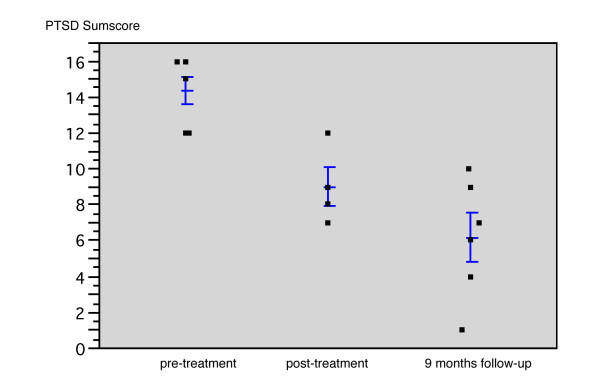
Background: Little data exists on the effectiveness of psychological interventions for children with posttraumatic stress disorder (PTSD) that has resulted from exposure to war or conflict-related violence, especially in non-industrialized countries. We created and evaluated the efficacy of KIDNET, a child-friendly version of Narrative Exposure Therapy (NET), as a short-term treatment for children. Methods: Six Somali children suffering from PTSD aged 12–17 years resident in a refugee settlement in Uganda were treated with four to six individual sessions of KIDNET by expert clinicians. Symptoms of PTSD and depression were assessed pre-treatment, post-treatment and at nine months follow-up using the CIDI Sections K and E. Results: Important symptom reduction was evident immediately after treatment and treatment outcomes were sustained at the 9-month follow-up. All patients completed therapy, reported functioning gains and could be helped to reconstruct their traumatic experiences into a narrative with the use of illustrative material. Conclusions: NET may be safe and effective to treat children with war related PTSD in the setting of refugee settlements in developing countries.
Overview
The claims and statistics of this paper haven’t been checked yet.
Run the check — free, no account needed. It reads the open-access text and checks the sources it cites.
Integrity signals
Registry
Cites
Statistics
Figures
Verification
Claims the paper makes
The claims and statistics of this paper haven’t been checked yet.
Run the check — free, no account needed. It reads the open-access text and checks the sources it cites.
Claims other papers make about this one
Each is checked against this paper’s own text: does it say what the citing paper says it does?
The cited source says what the claim attributes to it.
In the citing paper
“KIDNET, a version of NET adapted for the treatment of children [18], has been tested in a pilot study in an Ugandan refugee camp with Somali refugee children diagnosed with PTSD [19,20] with promising results.”
From Treating children traumatized by war and tsunami: a comparison between exposure therapy and meditation-relaxation in north-east Sri Lanka (2009) · cites this paper as [19]
Self-check
Percentages, sums and reported differences re-computed from the paper’s own numbers.
The self-check needs the paper’s full text.
Citations
Cites
The Hopkins Symptom Checklist (HSCL): A self-report symptom inventory
Derogatis, L. R., Lipman, R. S., Rickels, K., Uhlenhuth, E. H., & Covi, L. (1974) · Behavioral Science · doi:10.1002/bs.3830190102 · Cited by 4,604
Freeman, A. M. (2001) · The Journal of Clinical Psychiatry · doi:10.4088/jcp.v62n1112 · Cited by 1,667
Albeck, J. H. (2001) · American Journal of Psychotherapy · doi:10.1176/appi.psychotherapy.2001.55.2.295 · Cited by 973
A Mental Health Intervention for Schoolchildren Exposed to Violence: A Randomized Controlled Trial
Stein, B. D., Jaycox, L. H., Kataoka, S. H., Wong, M., Tu, W., Elliott, M. N., & Fink, A. (2003) · JAMA · doi:10.1001/jama.290.5.603 · Cited by 751 · cited 1×
“Cognitive-behavioural interventions have been successfully used with school children exposed to violence, after single-incident stressors, after natural disasters as well as to treat sexually abused children [18, 30-33 ].”
MethodNeuner, F., Schauer, M., Klaschik, C., Karunakara, U., & Elbert, T. (2004) · Journal of Consulting and Clinical Psychology · doi:10.1037/0022-006x.72.4.579 · Cited by 644
Self-citationTHE COMPOSITE INTERNATIONAL DIAGNOSTIC INTERVIEW (CIDI)
Robins, L. N. (1994) · IX World Congress of Psychiatry · doi:10.1142/9789814440912_0056 · Cited by 574
(2010) · PsycEXTRA Dataset · doi:10.1037/e673052010-001 · Cited by 475
Treating Sexually Abused Children With Posttraumatic Stress Symptoms: A Randomized Clinical Trial
King, N. J., Tonge, B. J., Mullen, P. E., Myerson, N., Heyne, D. A., Rollings, S., MARTIN, R., & Ollendick, T. H. (2000) · Journal of the American Academy of Child & Adolescent Psychiatry · doi:10.1097/00004583-200011000-00008 · Cited by 458
Trauma in children and adolescents: risk and treatment of psychiatric sequelae
Pine, D. S., & Cohen, J. A. (2002) · Biological Psychiatry · doi:10.1016/s0006-3223(01)01352-x · Cited by 429
Outcome of psychotherapy among early adolescents after trauma
(1997) · American Journal of Psychiatry · doi:10.1176/ajp.154.4.536 · Cited by 381 · cited 1×
“Cognitive-behavioural interventions have been successfully used with school children exposed to violence, after single-incident stressors, after natural disasters as well as to treat sexually abused children [18,30-33].”
Background
Research works printed but not linked: 1
- Foa EB: Posttraumatic Stress Diagnostic Scale (Manual). 1995, Minneapolis, MN, National Computer Systems
Cited by
Sorted by citations
Ehntholt, K. A., & Yule, W. (2006) · Journal of Child Psychology and Psychiatry · doi:10.1111/j.1469-7610.2006.01638.x · Cited by 524
Tyrer, R. A., & Fazel, M. S. (2014) · PLoS ONE · doi:10.1371/journal.pone.0089359 · Cited by 461
The emerging evidence for Narrative Exposure Therapy: A review
Robjant, K., & Fazel, M. (2010) · Clinical Psychology Review · doi:10.1016/j.cpr.2010.07.004 · Cited by 397
Jordans, M. J. D., Komproe, I. H., Tol, W. A., Kohrt, B. A., Luitel, N. P., Macy, R. D., & De Jong, J. T. V. M. (2010) · Journal of Child Psychology and Psychiatry · doi:10.1111/j.1469-7610.2010.02209.x · Cited by 337
Betancourt, T. S., Meyers-Ohki, S. E., Charrow, A. P., & Tol, W. A. (2013) · Harvard Review of Psychiatry · doi:10.1097/hrp.0b013e318283bf8f · Cited by 326
Metadata
- Authors
- Onyut, L. P., Neuner, F., Schauer, E., Ertl, V., Odenwald, M., Schauer, M., & Elbert, T.
- Affiliations
- University of Konstanz (DE)
- Corresponding author
- Neuner, Frank
- Venue
- BMC Psychiatry
- Published
- 2005-02-03
- Volume
- 5
- Issue
- 1
- Pages
- 7-7
- ISSN
- 1471-244X (ISSN-L)
- PMC
- PMC549194
- OpenAlex
- W1844435675
- Cited by
- 177
- References
- 51
- Citations by year
- 2026: 5 · 2025: 10 · 2024: 4 · 2023: 6 · 2022: 17 · 2021: 10 · 2020: 8 · 2019: 11 · 2018: 6 · 2017: 6 · 2016: 1 · 2015: 13 · 2014: 10 · 2013: 15 · 2012: 5
- FWCI
- 7.71
- Type
- journal article
- Language
- en
- Open access
- gold
- doi.org
- Locations
- BMC Psychiatry (publishedVersion, cc-by)
- PubMed Central (publishedVersion, cc-by)
- PubMed (publishedVersion)
- KOPS (University of Konstanz) (submittedVersion, cc-by-nc-nd)
- DOAJ (DOAJ: Directory of Open Access Journals) (submittedVersion)
- PUB – Publications at Bielefeld University (Bielefeld University) (submittedVersion)
- Funders
- Deutsche Forschungsgemeinschaft
- Topics
- Social Sciences › Psychology › Clinical Psychology › Posttraumatic Stress Disorder Research
- Social Sciences › Psychology › Clinical Psychology › Migration, Health and Trauma
- Social Sciences › Psychology › Clinical Psychology › Child Abuse and Trauma
- Keywords
- narrative exposure therapy, post-traumatic stress disorder, Somali refugees, refugee settlement, conflict-related violence, depression, trauma narratives, treatment efficacy, Uganda
- MeSH terms
- Adolescent, Aversive Therapy, Child, Depressive Disorder, Developing Countries, Habituation, Psychophysiologic, Humans, Pilot Projects, Refugees, Somalia, Stress Disorders, Post-Traumatic, Uganda, Warfare, Treatment Outcome, Survivors, Narration, Black People
About these checks
Registry, retraction, Cites and statistics results are computed, not judged, with one exception: a printed reference that no index lists is read once by a model before it counts as a citation error. Claims are extracted by a model and kept only when their quote appears verbatim in the text; each cited source is then checked, with a model’s help, for whether it says what the claim relies on. Those verdicts can be wrong — read the claim’s quote and the cited source before relying on one.
Statistics and arithmetic are recomputed, not judged.
Confidence bands are shown only for fields calibrated on our annotated test set. None is calibrated yet, so no band is shown.
What counts as a claim ›How we measure confidence ›How we check this ›
Are you an author, or do you see a problem with this page? Request a review
