

A controlled trial of the Litebook light-emitting diode (LED) light therapy device for treatment of Seasonal Affective Disorder (SAD)
Open accessThe DOI matches its Crossref record; 33 of the 33 references it cites were found in a registry or an index.
Abstract
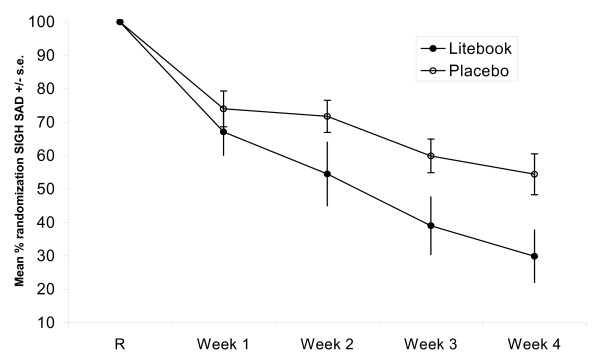
BACKGROUND: Recent research has emphasized that the human circadian rhythm system is differentially sensitive to short wavelength light. Light treatment devices using efficient light-emitting diodes (LEDs) whose output is relatively concentrated in short wavelengths may enable a more convenient effective therapy for Seasonal Affective Disorder (SAD). METHODS: The efficacy of a LED light therapy device in the treatment of SAD was tested in a randomized, double-blind, placebo-controlled, multi-center trial. Participants aged 18 to 65 with SAD (DSM-IV major depression with seasonal pattern) were seen at Baseline and Randomization visits separated by 1 week, and after 1, 2, 3 and 4 weeks of treatment. Hamilton Depression Rating Scale scores (SIGH-SAD) were obtained at each visit. Participants with SIGH-SAD of 20 or greater at Baseline and Randomization visits were randomized to active or control treatment: exposure to the Litebook LED treatment device (The Litebook Company Ltd., Alberta, Canada) which delivers 1,350 lux white light (with spectral emission peaks at 464 nm and 564 nm) at a distance of 20 inches or to an inactivated negative ion generator at a distance of 20 inches, for 30 minutes a day upon awakening and prior to 8 A.M. RESULTS: Of the 26 participants randomized, 23 completed the trial. Mean group SIGH-SAD scores did not differ significantly at randomization. At trial end, the proportions of participants in remission (SIGH-SAD less than 9) were significantly greater (Fisher's exact test), and SIGH-SAD scores, as percent individual score at randomization, were significantly lower (t-test), with active treatment than with control, both in an intent-to-treat analysis and an observed cases analysis. A longitudinal repeated measures ANOVA analysis of SIGH-SAD scores also indicated a significant interaction of time and treatment, showing superiority of the Litebook over the placebo condition. CONCLUSION: The results of this pilot study support the hypothesis that light therapy with the Litebook is an effective treatment for SAD. TRIAL REGISTRATION: Clinicaltrials.gov: NCT00139997.
Overview
The claims and statistics of this paper haven’t been checked yet.
Free: it reads the open-access text and checks the first 5 claims that cite a source we can check. Create a free account to check every claim.
Integrity signals
Registry
Cites
Statistics
Figures
Verification
Claims the paper makes
The claims and statistics of this paper haven’t been checked yet.
Free: it reads the open-access text and checks the first 5 claims that cite a source we can check. Create a free account to check every claim.
Claims other papers make about this one
Each is checked against this paper’s own text: does it say what the citing paper says it does?
The cited source doesn’t support the claim as written.
In the citing paper
“The response rates in the current study between 65% and 76% for remission are relatively high compared to the placebo responses from the placebo-controlled studies, probably too high to be interpreted as placebo effects only, although we can not rule out this possibility.”
From Low-intensity blue-enriched white light (750 lux) and standard bright light (10 000 lux) are equally effective in treating SAD. A randomized controlled study (2011) · cites this paper as [40]
Checked by a reasoning model — may be wrong.
Experimental — accuracy not yet measuredThe cited source says what the claim attributes to it.
In the citing paper
“The few studies testing light therapy in winter depressives using some kind of placebo condition (for example a deactivated negative-ion generator) revealed placebo effects that ranged from 21% to 41% [38-40].”
In the citing paper
“Eleven studies accomplished the double-blind procedure for both patients and raters, effectively avoiding performance bias and detection bias.[23,25–27,29,32,35,36,38–40]”
From Effectiveness of visible light for seasonal affective disorder: A systematic review and network meta-analysis (2025) · cites this paper as [27]
In the citing paper
“Fourteen articles[25–36,38,39] reported the effects of various visible light interventions on SIGH-SAD of patients with SAD.”
From Effectiveness of visible light for seasonal affective disorder: A systematic review and network meta-analysis (2025) · cites this paper as [27]
Self-check
Percentages, sums and reported differences re-computed from the paper’s own numbers.
The self-check needs the paper’s full text.
Citations
Cites
Development of a Rating Scale for Primary Depressive Illness
HAMILTON, M. (1967) · British Journal of Social and Clinical Psychology · doi:10.1111/j.2044-8260.1967.tb00530.x · Cited by 8,410 · cited 2×
“Hamilton Depression Rating Scale scores (SIGH-SAD) were obtained at each visit.”
MethodA self-assessment questionnaire to determine morningness- eveningness in human circadian rhythms
Home, J. K. (1976) · Medical Entomology and Zoology · Cited by 4,783
Structured Clinical Interview for DSM-IV Axis I Disorders
Spitzer, R. L., First, M. B., & Gibbon, M. (1997) · Medical Entomology and Zoology · Cited by 4,096
(1976) · PubMed · Cited by 3,979
Rosenthal, N. E. (1984) · Archives of General Psychiatry · doi:10.1001/archpsyc.1984.01790120076010 · Cited by 2,385
Action Spectrum for Melatonin Regulation in Humans: Evidence for a Novel Circadian Photoreceptor
Brainard, G. C., Hanifin, J. P., Greeson, J. M., Byrne, B., Glickman, G., Gerner, E., & Rollag, M. D. (2001) · The Journal of Neuroscience · doi:10.1523/jneurosci.21-16-06405.2001 · Cited by 1,930 · cited 2×
“For example, melatonin secretion is most powerfully inhibited by light with wavelength in the range 450 – 480 nm [9,11], and melatonin rhythms are best shifted by such wavelengths [10].”
BackgroundCredibility of analogue therapy rationales
Borkovec, T. D., & Nau, S. D. (1972) · Journal of Behavior Therapy and Experimental Psychiatry · doi:10.1016/0005-7916(72)90045-6 · Cited by 1,553 · cited 1×
“After experiencing the assigned device in operation, the participant completed a brief questionnaire about expectations [21].”
MethodThapan, K., Arendt, J., & Skene, D. J. (2001) · The Journal of Physiology · doi:10.1111/j.1469-7793.2001.t01-1-00261.x · Cited by 1,320 · cited 2×
“For example, melatonin secretion is most powerfully inhibited by light with wavelength in the range 450 – 480 nm [9,11], and melatonin rhythms are best shifted by such wavelengths [10].”
BackgroundGolden, R. N., Gaynes, B. N., Ekstrom, R. D., Hamer, R. M., Jacobsen, F. M., Suppes, T., Wisner, K. L., & Nemeroff, C. B. (2005) · American Journal of Psychiatry · doi:10.1176/appi.ajp.162.4.656 · Cited by 896 · cited 1×
“Several meta-analyses have found that light treatment is effective for SAD [6-8].”
BackgroundDocumentation of the Threshold Limit Values and Biological Exposure Indices
Acgih (2001) · Medical Entomology and Zoology · Cited by 845
High Sensitivity of the Human Circadian Melatonin Rhythm to Resetting by Short Wavelength Light
Lockley, S. W., Brainard, G. C., & Czeisler, C. A. (2003) · The Journal of Clinical Endocrinology & Metabolism · doi:10.1210/jc.2003-030570 · Cited by 782 · cited 2×
“For example, melatonin secretion is most powerfully inhibited by light with wavelength in the range 450 – 480 nm [9,11], and melatonin rhythms are best shifted by such wavelengths [10].”
BackgroundLight therapy for Seasonal Affective Disorder A review of efficacy
TERMAN, M. (1989) · Neuropsychopharmacology · doi:10.1016/0893-133x(89)90002-x · Cited by 539 · cited 1×
“Several meta-analyses have found that light treatment is effective for SAD [6-8].”
BackgroundCircadian Time of Morning Light Administration and Therapeutic Response in Winter Depression
Terman, J. S., Terman, M., Lo, E.-S., & Cooper, T. B. (2001) · Archives of General Psychiatry · doi:10.1001/archpsyc.58.1.69 · Cited by 366 · cited 5×
“Studies with other meth- Page 6 of 8 (page number not for citation purposes) odologies, such as that of Murray et al [30], have not observed relationships like those observed by Terman et al [29].”
BackgroundMethodInfluentialBright Light Treatment of Winter Depression: A Placebo-Controlled Trial
Eastman, C. I., Young, M. A., Fogg, L. F., Liu, L., & Meaden, P. M. (1998) · Archives of General Psychiatry · doi:10.1001/archpsyc.55.10.883 · Cited by 347 · cited 4×
“The rate of remission in the active group, 57%, was comparable to the remission rate observed by Eastman et al [4] with 1 hour daily use of a 5,000 lux light box (61%).”
BackgroundMethodResultInfluentialTerman, M., Terman, J. S., & Ross, D. C. (1998) · Archives of General Psychiatry · doi:10.1001/archpsyc.55.10.875 · Cited by 307 · cited 2×
“Participants using the ion generator were instructed to wear a wrist strap connected to the device to maximize the transfer of negative ions, as this intervention has been found to increase expectations regarding efficacy for the device [3].”
BackgroundMethodLight Therapy for Seasonal Affective Disorder with Blue Narrow-Band Light-Emitting Diodes (LEDs)
Glickman, G., Byrne, B., Pineda, C., Hauck, W. W., & Brainard, G. C. (2006) · Biological Psychiatry · doi:10.1016/j.biopsych.2005.07.006 · Cited by 260
Brainard, G. C., Lewy, A. J., Menaker, M., Fredrickson, R. H., Miller, L. S., Weleber, R. G., Cassone, V., & Hudson, D. (1988) · Brain Research · doi:10.1016/0006-8993(88)90820-7 · Cited by 233 · cited 1×
“Second, even dim light can affect the circadian rhythm system and may have some positive therapeutic effect [27].”
BackgroundLam, R. W., Levitt, A. J., Levitan, R. D., Enns, M. W., Morehouse, R., Michalak, E. E., & Tam, E. M. (2006) · American Journal of Psychiatry · doi:10.1176/ajp.2006.163.5.805 · Cited by 232 · cited 2×
“Light therapy was found to be similar in efficacy to treatment with fluoxetine in a large controlled trial [5].”
BackgroundResultSelf-citationSeasonal Affective Disorder: An Overview: REVIEW
Magnusson, A., & Boivin, D. (2003) · Chronobiology International · doi:10.1081/cbi-120019310 · Cited by 196
Self-citationGALLIN, P. F., TERMAN, M., REMÉ, C. E., RAFFERTY, B., TERMAN, J. S., & BURDE, R. M. (1995) · American Journal of Ophthalmology · doi:10.1016/s0002-9394(14)73874-7 · Cited by 134
Canadian Consensus Guidelines for the Treatment of Seasonal Affective Disorder
Lam, R. W. M. (1999) · Cited by 122
Self-citationAj, L., Sack, R. L., Singer, C. M., & Dm, W. (1987) · PubMed · Cited by 108
Light Therapy for Seasonal Affective Disorder
Brett, A. (1998) · Journal watch · doi:10.1056/jw199810230000006 · Cited by 97
Pathophysiological mechanism of seasonal affective disorder
Lee, T. M. C., Blashko, C. A., Janzen, H. L., Paterson, J. G., & Chan, C. C. H. (1997) · Journal of Affective Disorders · doi:10.1016/s0165-0327(97)00076-1 · Cited by 61 · cited 1×
“Several meta-analyses have found that light treatment is effective for SAD [6-8].”
BackgroundMood and behavioral effects of four-week light treatment in winter depressives and controls
Bauer, M. S., Kurtz, J. W., Rubin, L. B., & Marcus, J. G. (1994) · Journal of Psychiatric Research · doi:10.1016/0022-3956(94)90025-6 · Cited by 56 · cited 1×
“Most studies of light therapy for SAD have been 1 or 2 weeks in duration, but gradual onset of response was observed in the 4 week trial by Bauer et al [25], and in the 8 week trial by Lam et al [5].”
BackgroundLam, R. W. M. (2006) · American Journal of Psychiatry · doi:10.1176/appi.ajp.163.5.805 · Cited by 52
Self-citationMurray, G., Michalak, E. E., Levitt, A. J., Levitan, R. D., Enns, M. W., Morehouse, R., & Lam, R. W. (2005) · Chronobiology International · doi:10.1080/07420520500263292 · Cited by 44 · cited 1×
“odologies, such as that of Murray et al [ 30 ], have not observed relationships like those observed by Terman et al [29].”
MethodSelf-citationTreatment of Seasonal Affective Disorder with a High-Output Negative Ionizer
Terman, M., & Terman, J. S. (1995) · The Journal of Alternative and Complementary Medicine · doi:10.1089/acm.1995.1.87 · Cited by 44 · cited 1×
“Since negative ion generators have been reported to be effective in treatment of SAD [14], a "credible placebo" design similar to that of Eastman and colleagues [4], in which an inactivated negative ion generator was used as a "no light" control condition, was employed.”
MethodLewy, A. J., Emens, J., Sack, R. L., Hasler, B. P., & Bernert, R. A. (2003) · Chronobiology International · doi:10.1081/cbi-120024215 · Cited by 40
Some neuroendocrine parameters in bipolar and unipolar depression
Mendlewicz, J., Linkowski, P., & Cauter, E. V. (1979) · Journal of Affective Disorders · doi:10.1016/0165-0327(79)90022-3 · Cited by 15
Wortis, J. (1985) · Biological Psychiatry · doi:10.1016/0006-3223(85)90130-1 · Cited by 4
LEVITT, A. J. (2003) · Chronobiology International · doi:10.1081/cbi-120026504 · Cited by 4
Research works printed but not linked: 3
- Williams JB Link MJ Rosenthal NE Amira L Terman M Structured Interview Guide for the Hamilton Depression Rating Scale – Seasonal Affective Disorder Version (SIGH-SAD) 1994 New York: New York Psychiatric Institute
- APA American Psychiatric Association Diagnostic and Statistical Manual of Mental Disorders 1994 4 Washington: American Psychiatric Press
- American National Standards Institute and Illuminating Engineering Society of North America Recommended Practice for Photobiological Safety for Lamps and Lamp Systems – General Requirements (RP 271) 1996 New York: Illuminating Engineering Society of North America
Cited by
Kennedy, S. H., Lam, R. W., Parikh, S. V., Patten, S. B., & Ravindran, A. V. (2009) · Journal of Affective Disorders · doi:10.1016/j.jad.2009.06.043 · Cited by 525
“Other light devices that have shown efficacy, in small studies, include those using light-emitting diodes (LEDs) (Desan et al., 2007; Glickman et al., 2006).”
BackgroundSelf-citationContemporary Issues in Bioethics.
(1978) · Annals of Internal Medicine · doi:10.7326/0003-4819-89-4-581_1 · Cited by 434
Blue light from light-emitting diodes elicits a dose-dependent suppression of melatonin in humans
West, K. E., Jablonski, M. R., Warfield, B., Cecil, K. S., James, M., Ayers, M. A., Maida, J., Bowen, C., Sliney, D. H., Rollag, M. D., et al. (2011) · Journal of Applied Physiology · doi:10.1152/japplphysiol.01413.2009 · Cited by 333
Lam, R. W., Levitt, A. J., Levitan, R. D., Michalak, E. E., Cheung, A. H., Morehouse, R., Ramasubbu, R., Yatham, L. N., & Tam, E. M. (2016) · JAMA Psychiatry · doi:10.1001/jamapsychiatry.2015.2235 · Cited by 275
“Median (range) 31 (2-728) 24 (2-207) 24 (2-728) 36 (5-270) 38 (2-520)”
Self-citationSamuels, C. H. (2012) · Clinical Journal of Sport Medicine · doi:10.1097/jsm.0b013e31824d2eeb · Cited by 128
Metadata
- Authors
- Desan, P. H., Weinstein, A. J., Michalak, E. E., Tam, E. M., Meesters, Y., Ruiter, M. J., Horn, E., Telner, J., Iskandar, H., Boivin, D. B., & Lam, R. W.
- Affiliations
- Yale University (US)
- University of British Columbia (CA)
- University Medical Center Groningen (NL)
- Royal Ottawa Mental Health Centre (CA)
- Douglas Mental Health University Institute (CA)
- Corresponding author
- Desan, Paul H
- Venue
- BMC Psychiatry
- Published
- 2007-08-07
- Volume
- 7
- Issue
- 1
- Pages
- 38-38
- ISSN
- 1471-244X (ISSN-L)
- PMC
- PMC1971065
- OpenAlex
- W2149243911
- Cited by
- 74
- References
- 32
- Citations by year
- 2025: 6 · 2024: 1 · 2023: 1 · 2022: 5 · 2021: 2 · 2020: 6 · 2019: 5 · 2018: 6 · 2017: 1 · 2016: 4 · 2015: 4 · 2014: 4 · 2013: 4 · 2012: 8
- FWCI
- 1.36
- Type
- journal article
- Language
- en
- Open access
- gold
- doi.org
- Licence
- cc-by
- creativecommons.org/licenses/by/2.0 (tdm)
- Locations
- BMC Psychiatry (publishedVersion, cc-by)
- PubMed Central (publishedVersion, cc-by)
- PubMed (publishedVersion)
- cIRcle (University of British Columbia) (submittedVersion, cc-by)
- DOAJ (DOAJ: Directory of Open Access Journals) (submittedVersion)
- University of Groningen research database (University of Groningen / Centre for Information Technology) (submittedVersion, cc-by)
- University of Groningen research database (University of Groningen / Centre for Information Technology) (submittedVersion, other-oa)
- Open Collections
- Funders
- Michael Smith Health Research BC
- Canadian Institutes of Health Research
- Topics
- Life Sciences › Neuroscience › Endocrine and Autonomic Systems › Circadian rhythm and melatonin
- Life Sciences › Agricultural and Biological Sciences › Plant Science › Light effects on plants
- Health Sciences › Medicine › Pharmacology (medical) › Treatment of Major Depression
- Keywords
- seasonal affective disorder, phototherapy, light-emitting diodes, short-wavelength light, circadian rhythm, depression remission
- MeSH terms
- Adolescent, Adult, Aged, Double-Blind Method, Female, Humans, Male, Middle Aged, Phototherapy, Severity of Illness Index, Seasonal Affective Disorder, Treatment Outcome
About these checks
Registry, retraction, Cites and statistics results are computed, not judged, with one exception: a printed reference that no index lists is read once by a model before it counts as a citation error. Claims are extracted by a model and kept only when their quote appears verbatim in the text; each cited source is then checked, with a model’s help, for whether it says what the claim relies on. Those verdicts can be wrong — read the claim’s quote and the cited source before relying on one.
Statistics and arithmetic are recomputed, not judged.
Confidence bands are shown only for fields calibrated on our annotated test set. None is calibrated yet, so no band is shown.
What counts as a claim ›How we measure confidence ›How we check this ›
Are you an author, or do you see a problem with this page? Request a review
Data sources
Bibliographic data: Semantic Scholar, OpenAlex, Crossref.
Contains information from the Semantic Scholar Academic Graph Datasets, made available under the ODC Attribution License (ODC-BY 1.0).
Semantic Scholar’s data is described in: Kinney, R., et al. (2023). The Semantic Scholar Open Data Platform. arXiv:2301.10140.
