

A controlled trial of the Litebook light-emitting diode (LED) light therapy device for treatment of Seasonal Affective Disorder (SAD)
Open accessThe DOI matches its Crossref record; 33 of the 33 references it cites were found in a registry or an index.
Abstract
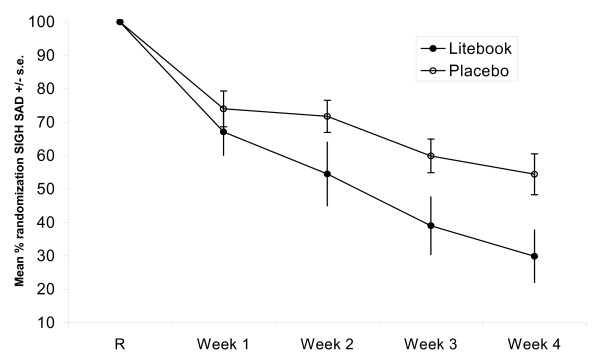
BACKGROUND: Recent research has emphasized that the human circadian rhythm system is differentially sensitive to short wavelength light. Light treatment devices using efficient light-emitting diodes (LEDs) whose output is relatively concentrated in short wavelengths may enable a more convenient effective therapy for Seasonal Affective Disorder (SAD). METHODS: The efficacy of a LED light therapy device in the treatment of SAD was tested in a randomized, double-blind, placebo-controlled, multi-center trial. Participants aged 18 to 65 with SAD (DSM-IV major depression with seasonal pattern) were seen at Baseline and Randomization visits separated by 1 week, and after 1, 2, 3 and 4 weeks of treatment. Hamilton Depression Rating Scale scores (SIGH-SAD) were obtained at each visit. Participants with SIGH-SAD of 20 or greater at Baseline and Randomization visits were randomized to active or control treatment: exposure to the Litebook LED treatment device (The Litebook Company Ltd., Alberta, Canada) which delivers 1,350 lux white light (with spectral emission peaks at 464 nm and 564 nm) at a distance of 20 inches or to an inactivated negative ion generator at a distance of 20 inches, for 30 minutes a day upon awakening and prior to 8 A.M. RESULTS: Of the 26 participants randomized, 23 completed the trial. Mean group SIGH-SAD scores did not differ significantly at randomization. At trial end, the proportions of participants in remission (SIGH-SAD less than 9) were significantly greater (Fisher's exact test), and SIGH-SAD scores, as percent individual score at randomization, were significantly lower (t-test), with active treatment than with control, both in an intent-to-treat analysis and an observed cases analysis. A longitudinal repeated measures ANOVA analysis of SIGH-SAD scores also indicated a significant interaction of time and treatment, showing superiority of the Litebook over the placebo condition. CONCLUSION: The results of this pilot study support the hypothesis that light therapy with the Litebook is an effective treatment for SAD. TRIAL REGISTRATION: Clinicaltrials.gov: NCT00139997.
Overview
The claims and statistics of this paper haven’t been checked yet.
Free: it reads the open-access text and checks the first 5 claims that cite a source we can check. Create a free account to check every claim.
Integrity signals
Registry
Cites
Statistics
Figures
Verification
Claims the paper makes
The claims and statistics of this paper haven’t been checked yet.
Free: it reads the open-access text and checks the first 5 claims that cite a source we can check. Create a free account to check every claim.
Claims other papers make about this one
Each is checked against this paper’s own text: does it say what the citing paper says it does?
The cited source doesn’t support the claim as written.
In the citing paper
“The response rates in the current study between 65% and 76% for remission are relatively high compared to the placebo responses from the placebo-controlled studies, probably too high to be interpreted as placebo effects only, although we can not rule out this possibility.”
From Low-intensity blue-enriched white light (750 lux) and standard bright light (10 000 lux) are equally effective in treating SAD. A randomized controlled study (2011) · cites this paper as [40]
Checked by a reasoning model — may be wrong.
Experimental — accuracy not yet measuredThe cited source says what the claim attributes to it.
In the citing paper
“The few studies testing light therapy in winter depressives using some kind of placebo condition (for example a deactivated negative-ion generator) revealed placebo effects that ranged from 21% to 41% [38-40].”
In the citing paper
“Eleven studies accomplished the double-blind procedure for both patients and raters, effectively avoiding performance bias and detection bias.[23,25–27,29,32,35,36,38–40]”
From Effectiveness of visible light for seasonal affective disorder: A systematic review and network meta-analysis (2025) · cites this paper as [27]
In the citing paper
“Fourteen articles[25–36,38,39] reported the effects of various visible light interventions on SIGH-SAD of patients with SAD.”
From Effectiveness of visible light for seasonal affective disorder: A systematic review and network meta-analysis (2025) · cites this paper as [27]
Self-check
Percentages, sums and reported differences re-computed from the paper’s own numbers.
The self-check needs the paper’s full text.
Citations
Cites
Development of a Rating Scale for Primary Depressive Illness
HAMILTON, M. (1967) · British Journal of Social and Clinical Psychology · doi:10.1111/j.2044-8260.1967.tb00530.x · Cited by 8,410 · cited 2×
“Hamilton Depression Rating Scale scores (SIGH-SAD) were obtained at each visit.”
MethodA self-assessment questionnaire to determine morningness- eveningness in human circadian rhythms
Home, J. K. (1976) · Medical Entomology and Zoology · Cited by 4,783
Structured Clinical Interview for DSM-IV Axis I Disorders
Spitzer, R. L., First, M. B., & Gibbon, M. (1997) · Medical Entomology and Zoology · Cited by 4,096
(1976) · PubMed · Cited by 3,979
Rosenthal, N. E. (1984) · Archives of General Psychiatry · doi:10.1001/archpsyc.1984.01790120076010 · Cited by 2,385
Action Spectrum for Melatonin Regulation in Humans: Evidence for a Novel Circadian Photoreceptor
Brainard, G. C., Hanifin, J. P., Greeson, J. M., Byrne, B., Glickman, G., Gerner, E., & Rollag, M. D. (2001) · The Journal of Neuroscience · doi:10.1523/jneurosci.21-16-06405.2001 · Cited by 1,930 · cited 2×
“For example, melatonin secretion is most powerfully inhibited by light with wavelength in the range 450 – 480 nm [9,11], and melatonin rhythms are best shifted by such wavelengths [10].”
BackgroundCredibility of analogue therapy rationales
Borkovec, T. D., & Nau, S. D. (1972) · Journal of Behavior Therapy and Experimental Psychiatry · doi:10.1016/0005-7916(72)90045-6 · Cited by 1,553 · cited 1×
“After experiencing the assigned device in operation, the participant completed a brief questionnaire about expectations [21].”
MethodThapan, K., Arendt, J., & Skene, D. J. (2001) · The Journal of Physiology · doi:10.1111/j.1469-7793.2001.t01-1-00261.x · Cited by 1,320 · cited 2×
“For example, melatonin secretion is most powerfully inhibited by light with wavelength in the range 450 – 480 nm [9,11], and melatonin rhythms are best shifted by such wavelengths [10].”
BackgroundGolden, R. N., Gaynes, B. N., Ekstrom, R. D., Hamer, R. M., Jacobsen, F. M., Suppes, T., Wisner, K. L., & Nemeroff, C. B. (2005) · American Journal of Psychiatry · doi:10.1176/appi.ajp.162.4.656 · Cited by 896 · cited 1×
“Several meta-analyses have found that light treatment is effective for SAD [6-8].”
BackgroundDocumentation of the Threshold Limit Values and Biological Exposure Indices
Acgih (2001) · Medical Entomology and Zoology · Cited by 845
Research works printed but not linked: 3
- Williams JB Link MJ Rosenthal NE Amira L Terman M Structured Interview Guide for the Hamilton Depression Rating Scale – Seasonal Affective Disorder Version (SIGH-SAD) 1994 New York: New York Psychiatric Institute
- APA American Psychiatric Association Diagnostic and Statistical Manual of Mental Disorders 1994 4 Washington: American Psychiatric Press
- American National Standards Institute and Illuminating Engineering Society of North America Recommended Practice for Photobiological Safety for Lamps and Lamp Systems – General Requirements (RP 271) 1996 New York: Illuminating Engineering Society of North America
Cited by
Kennedy, S. H., Lam, R. W., Parikh, S. V., Patten, S. B., & Ravindran, A. V. (2009) · Journal of Affective Disorders · doi:10.1016/j.jad.2009.06.043 · Cited by 525
“Other light devices that have shown efficacy, in small studies, include those using light-emitting diodes (LEDs) (Desan et al., 2007; Glickman et al., 2006).”
BackgroundSelf-citationContemporary Issues in Bioethics.
(1978) · Annals of Internal Medicine · doi:10.7326/0003-4819-89-4-581_1 · Cited by 434
Blue light from light-emitting diodes elicits a dose-dependent suppression of melatonin in humans
West, K. E., Jablonski, M. R., Warfield, B., Cecil, K. S., James, M., Ayers, M. A., Maida, J., Bowen, C., Sliney, D. H., Rollag, M. D., et al. (2011) · Journal of Applied Physiology · doi:10.1152/japplphysiol.01413.2009 · Cited by 333
Lam, R. W., Levitt, A. J., Levitan, R. D., Michalak, E. E., Cheung, A. H., Morehouse, R., Ramasubbu, R., Yatham, L. N., & Tam, E. M. (2016) · JAMA Psychiatry · doi:10.1001/jamapsychiatry.2015.2235 · Cited by 275
“Median (range) 31 (2-728) 24 (2-207) 24 (2-728) 36 (5-270) 38 (2-520)”
Self-citationSamuels, C. H. (2012) · Clinical Journal of Sport Medicine · doi:10.1097/jsm.0b013e31824d2eeb · Cited by 128
A hybrid power line and visible light communication system for indoor hospital applications
Ding, W., Yang, F. C., Yang, H., Wang, J., Wang, X., Zhang, X., & Song, J. (2015) · Computers in Industry · doi:10.1016/j.compind.2015.01.006 · Cited by 141
Pjrek, E., Friedrich, M.-E., Cambioli, L., Dold, M., Jäger, F., Komorowski, A., Lanzenberger, R., Kasper, S., & Winkler, D. (2020) · Psychotherapy and Psychosomatics · doi:10.1159/000502891 · Cited by 136
Light treatment prevents fatigue in women undergoing chemotherapy for breast cancer
Ancoli-Israel, S., Rissling, M., Neikrug, A., Trofimenko, V., Natarajan, L., Parker, B. A., Lawton, S., Desan, P., & Liu, L. (2012) · Supportive Care in Cancer · doi:10.1007/s00520-011-1203-z · Cited by 119
“The Litebook® utilizes 60 white light-emitting diode (LED) lights with a distribution of energy particularly concentrated in the middle and long wavelengths [32].”
Self-citationContemporary Issues in Bioethics
Clark, P. A. (2012) · InTech eBooks · doi:10.5772/2179 · Cited by 121
Ravindran, A. V., Lam, R. W., Filteau, M. J., Lespérance, F., Kennedy, S. H., Parikh, S. V., & Patten, S. B. (2009) · Journal of Affective Disorders · doi:10.1016/j.jad.2009.06.040 · Cited by 108
Self-citationMeesters, Y., Dekker, V., Schlangen, L. J., Bos, E. H., & Ruiter, M. J. (2011) · BMC Psychiatry · doi:10.1186/1471-244x-11-17 · Cited by 98
“The few studies testing light therapy in winter depressives using some kind of placebo condition (for example a deactivated negative-ion generator) revealed placebo effects that ranged from 21% to 41% [38-40].”
BackgroundSelf-citationSeasonal affective disorder, winter type: current insights and treatment options
Meesters, Y., & Gordijn, M. C. M. (2016) · Psychology Research and Behavior Management · doi:10.2147/prbm.s114906 · Cited by 66
“condition totally unrelated to light, such as a deactivated ion generator.(40) Responses to these “placebo” conditions have”
Self-citationLow-Intensity Laser Irradiation Stimulates Wound Healing in Diabetic Wounded Fibroblast Cells (WS1)
Houreld, N. N., & Abrahamse, H. (2010) · Diabetes Technology & Therapeutics · doi:10.1089/dia.2010.0039 · Cited by 83
Abnormal Hypothalamic Response to Light in Seasonal Affective Disorder
Vandewalle, G., Hébert, M., Beaulieu, C., Richard, L., Daneault, V., Garon, M.-L., Leblanc, J., Grandjean, D., Maquet, P., Schwartz, S., et al. (2011) · Biological Psychiatry · doi:10.1016/j.biopsych.2011.06.022 · Cited by 75
Gordijn, M. C. M., 't Mannetje, D., & Meesters, Y. (2012) · Journal of Affective Disorders · doi:10.1016/j.jad.2011.08.016 · Cited by 63
“The effects in the light condition turned out to be superior to those in the placebo condition (Desan et al., 2007), but it is unclear to what extent the spectral characteristics of the light in this study are responsible for the improvements observed, since no light was given in the control…”
BackgroundSelf-citationThe Effect of Systematic Light Exposure on Sleep in a Mixed Group of Fatigued Cancer Survivors
Wu, L. M., Amidi, A., Valdimarsdottir, H., Ancoli-Israel, S., Liu, L., Winkel, G., Byrne, E. E., Sefair, A. V., Vega, A., Bovbjerg, K., et al. (2018) · Journal of Clinical Sleep Medicine · doi:10.5664/jcsm.6874 · Cited by 59
Menculini, G., Verdolini, N., Murru, A., Pacchiarotti, I., Volpe, U., Cervino, A., Steardo, L., Moretti, P., Vieta, E., & Tortorella, A. (2018) · Journal of Affective Disorders · doi:10.1016/j.jad.2018.08.071 · Cited by 44
The antidepressant effect of light therapy from retinal projections.
Li, X., & Li, X. (2018) · Neuroscience Bulletin · doi:10.1007/s12264-018-0210-1 · Cited by 47
“…peaks at 464 nm and 564 nm White at 1,350 lux 0.5 h/day, before 08:00 am, 4 weeks Proportion of patients in remission significantly greater (SIGHSAD\ 9) Desan et al., 2007 [134] 158 patients with SAD aged 18–65 years, randomized into 6 groups SPX-30 triphos- phor fluorescent lamp (Hughes…”
MethodInfluentialPhotobiomodulation with light-emitting diodes improves sperm motility in men with asthenozoospermia
Frangež, H. B., Frangež, I., Verdenik, I., Janša, V., & Virant‐Klun, I. (2014) · Lasers in Medical Science · doi:10.1007/s10103-014-1653-x · Cited by 45
Song, C., Luchtman, D. W., Kang, Z., Tam, E. M., Yatham, L. N., Su, K., & Lam, R. W. M. (2015) · Journal of Affective Disorders · doi:10.1016/j.jad.2015.06.003 · Cited by 42
“Patients used the light box at home for 30–60 min in the early morning upon awakening, typically between 07:00 and 10:00 (Lam et al., 2006; Desan et al., 2007).”
MethodSelf-citationFrom eminence-based practice to evidence-based practice: a paradigm shift.
Bhandari, M., Zlowodzki, M. P., & Cole, P. A. (2004) · PubMed · Cited by 42
Danilenko, K. V., & Levitan, R. D. (2012) · Handbook of clinical neurology · doi:10.1016/b978-0-444-52002-9.00017-6 · Cited by 42
“…studies support the possibility that blue light accounts for a significant component of the antidepressant effect of light for winter depression (Glickman et al., 2006; Desan et al., 2007; Anderson et al., 2009; Strong et al., 2009), which may reflect the unique activity of the melanopsin system.”
Background“Shedding Light on Light”: A Review on the Effects on Mental Health of Exposure to Optical Radiation
Bertani, D. E., Novellis, A. M. P. D., Farina, R., Latella, E., Meloni, M., Scala, C., Valeo, L., Galeazzi, G. M., & Ferrari, S. (2021) · International Journal of Environmental Research and Public Health · doi:10.3390/ijerph18041670 · Cited by 39
Do, A., Li, V. W., Huang, S., Michalak, E. E., Tam, E. M., Chakrabarty, T., Yatham, L. N., & Lam, R. W. (2022) · The Canadian Journal of Psychiatry · doi:10.1177/07067437221097903 · Cited by 37
Self-citationImpact of light irradiation on preservation and function of mammalian spermatozoa
Yeste, M., Castillo‐Martín, M., Bonet, S., & Rodríguez-Gil, J. E. (2018) · Animal Reproduction Science · doi:10.1016/j.anireprosci.2018.02.004 · Cited by 37
Wang, S., Zhang, Z., Yao, L., Ding, N., Jiang, L., & Wu, Y. (2020) · PLOS ONE · doi:10.1371/journal.pone.0232798 · Cited by 35
An Overview of Seasonal Affective Disorder and its Treatment Options
Howland, R. H. (2009) · The Physician and Sportsmedicine · doi:10.3810/psm.2009.12.1748 · Cited by 36
Meesters, Y., Winthorst, W. H., Duijzer, W. B., & Hommes, V. (2016) · BMC Psychiatry · doi:10.1186/s12888-016-0729-5 · Cited by 37
“The effects of blue-enriched white LED light were found to be superior to placebo (deactivated ion-generator) [32] but similar to the effects of blue light [33].”
BackgroundSelf-citationAdamsson, M., Laike, T., & Morita, T. (2018) · Journal of Circadian Rhythms · doi:10.5334/jcr.153 · Cited by 35
Meesters, Y., Duijzer, W. B., & Hommes, V. (2018) · Journal of Affective Disorders · doi:10.1016/j.jad.2018.01.024 · Cited by 30
Self-citationLED‐backlit computer screens influence our biological clock and keep us more awake
Bues, M., Pross, A., Stefani, O., Frey, S., Anders, D., Späti, J., Wirz‐Justice, A., Mager, R., & Cajochen, C. (2012) · Journal of the Society for Information Display · doi:10.1889/jsid20.5.266 · Cited by 26
Circadian realignment and depressed mood: A systematic review
Wescott, D. L., Hasler, B. P., Foust, J. E., & Roecklein, K. A. (2024) · Sleep Medicine Reviews · doi:10.1016/j.smrv.2024.102022 · Cited by 24
SAD and the Not-So-Single Photoreceptors
Oren, D. A., Koziorowski, M., & Desan, P. H. (2013) · American Journal of Psychiatry · doi:10.1176/appi.ajp.2013.13010111 · Cited by 24
“, the energy distribution of the emitted light was characterized by having amain spectral emission peak at approximately 464 nm but also had a broader, secondary spectral peak near 564 nm (58).”
BackgroundSelf-citationRissling, M. B., Liu, L., Youngstedt, S. D., Trofimenko, V., Natarajan, L., Neikrug, A. B., Jeste, N. D., Parker, B. A., & Ancoli‐Israel, S. (2022) · Frontiers in Neuroscience · doi:10.3389/fnins.2022.815872 · Cited by 23
Jurvelin, H., Takala, T., Nissilä, J., Timonen, M., Rüger, M., Jokelainen, J. J., & Räsänen, P. K. (2014) · BMC Psychiatry · doi:10.1186/s12888-014-0288-6 · Cited by 23
Are short (blue) wavelengths necessary for light treatment of seasonal affective disorder?
Anderson, J. L., St Hilaire, M. A., Auger, R. R., Glod, C. A., Crow, S. J., Rivera, A. N., Fuentes Salgado, S. M., Pullen, S. J., Kaufman, T. K., Selby, A. J., et al. (2016) · Chronobiology International · doi:10.1080/07420528.2016.1207660 · Cited by 22
“Desan et al. (2007) found white LED light superior to placebo negative-ion treatment across a 4-week trial in SAD patients.”
BackgroundXiao, M., Feng, L., Wang, Q., Luan, X., Chen, S., & He, J. (2020) · International Journal of Geriatric Psychiatry · doi:10.1002/gps.5412 · Cited by 22
“Previous studies also support the effectiveness of LEDs in the treatment of seasonal depression.(47) In our study,”
ResultLight, opsins, and life: Mammalian photophysiological functions beyond image perception
Shi, Y., Hu, J., & Xue, T. (2025) · Neuron · doi:10.1016/j.neuron.2025.05.025 · Cited by 17
Crabtree, V. M., LaRosa, K. N., MacArthur, E., Russell, K. M. W., Wang, F., Zhang, H., Pan, H., Brigden, J., Schwartz, L. E., Wilson, M. W., et al. (2020) · Behavioral Sleep Medicine · doi:10.1080/15402002.2020.1797744 · Cited by 15
“This guideline was set a priori, based on previous studies permitting light usage to be reduced to 15 min (Desan et al., 2007), as well as Litebook settings that allow the device to be turned on in 15-min intervals (each participant was instructed to set the Litebook for two intervals).”
BackgroundMethodSustainable Architecture and Human Health: A Case for Effective Circadian Daylighting Metrics
Mukherjee, B., & Boubekri, M. (2025) · Buildings · doi:10.3390/buildings15030315 · Cited by 14
“Desan et al. [34] found that white light exposure (at peaks of 464 nm and 564 nm) of 1350 lux for 30 min before 8 a.m. was significant in reducing depression among 23 adults suffering from SAD.”
High circadian stimulus lighting therapy for depression: Meta-analysis of clinical trials
Zhou, L., Hou, D., Wang, Y., Zhou, S., & Lin, Y. (2022) · Frontiers in Neuroscience · doi:10.3389/fnins.2022.975576 · Cited by 14
“Two studies were at high risk of attrition bias as participants withdrew from the experiment (Glickman et al., 2006; Desan et al., 2007).”
BackgroundMorton, E. E., Michalak, E. E., LEVITT, A. J., Levitan, R. D., Cheung, A., Morehouse, R. L., Ramasubbu, R., Yatham, L. N., Tam, E. M., & Lam, R. W. M. (2020) · The Canadian Journal of Psychiatry · doi:10.1177/0706743720936470 · Cited by 14
Self-citationYang, C., Yang, P., Liang, S., & Wang, T. (2019) · Lighting Research & Technology · doi:10.1177/1477153519884097 · Cited by 12
Mischoulon, D., Pedrelli, P., Wurtman, J. J., Vangel, M. G., & Wurtman, R. J. (2010) · CNS Neuroscience & Therapeutics · doi:10.1111/j.1755-5949.2009.00082.x · Cited by 12
“Research on light therapy, the most popular treatment for SAD, has yielded generally positive results, with up to 53% of patients responding to light therapy [1,14–20].”
BackgroundWu, L. M., Valdimarsdottir, H. B., Amidi, A., Reid, K. J., Ancoli‐Israel, S., Bovbjerg, K., Fox, R. S., Walker, L., Matharu, A., Kaseda, E. T., et al. (2022) · Journal of Biological Rhythms · doi:10.1177/07487304221107833 · Cited by 11
Short wavelength light administered just prior to waking: a pilot study
Grandner, M. A., Kripke, D. F., Elliott, J., & Cole, R. (2013) · Biological Rhythm Research · doi:10.1080/09291016.2011.632578 · Cited by 9
“Since that time, a number of studies have found that narrow-band light with a wavelength of 480+20 nm may be optimal for biologic effect (Lockley et al. 2003; Warman et al. 2003; Herljevic et al. 2004, 2005; Wright et al. 2004; Revell et al. 2005, 2006; Campbell 2006; Glickman et al. 2006; Lockley et al. 2006; Desan e…”
BackgroundIntroduction to Modern Sleep Technology
Chiang, R. P., & Kang, S.-C. (2012) · International series on intelligent systems, control and automation: science and engineering · doi:10.1007/978-94-007-5470-6 · Cited by 9
35 years of light treatment for mental disorders in the Netherlands
Meesters, Y., van Tuinen, E. J. D., & Gordijn, M. C. M. (2023) · Annals of Medicine · doi:10.1080/07853890.2023.2269574 · Cited by 10
“The effects of blue-enriched LED light were also superior to placebo when treating SAD [28].”
BackgroundSelf-citationWan, Y., Ding, J., Fan, M., & Huang, H. (2025) · Medicine · doi:10.1097/md.0000000000043107 · Cited by 7
“[23,25– 27,29,32,35,36,38–40] And the data included in studies was nearly complete, with no reporting bias or other deviation.”
Oldham, C. M., Oldham, M. B., & Desan, P. H. (2019) · Psychiatric Research and Clinical Practice · doi:10.1176/appi.prcp.2019.20180011 · Cited by 7
“Psych Res Clin Pract 1:2, 2019 prcp.psychiatryonline.org 53 shown ef fi cacy for 398-lux narrow-band blue light (19), for 200-lux narrow-band blue light (20), and for 1,350-lux blue-enriched white light (21).”
Self-citationÖmür, A. D. (2022) · Polish Journal of Veterinary Sciences · doi:10.24425/pjvs.2022.141809 · Cited by 7
“Additionally, light application (photobiomodulation) has areas of use in terms of phototherapy (Desan et al. 2007, Saltmarche 2008, Avci et al. 2013, Soares et al. 2021, de Rezende et al. 2022).”
BackgroundLight-emitting diodes and their applications in energy-saving lighting
Moram, M. A. (2011) · Proceedings of the Institution of Civil Engineers - Energy · doi:10.1680/ener.1000004 · Cited by 7
Antidepressant Effect of Blue Light on Depressive Phenotype in Light-Deprived Male Rats
Meng, Q., Jiang, J., Hou, X., Jia, L., Duan, X., Zhou, W., Zhang, Q., Cheng, Z., Wang, S., Xiao, Q., et al. (2020) · Journal of Neuropathology & Experimental Neurology · doi:10.1093/jnen/nlaa143 · Cited by 6
Managing Performance Throughout Periods of Travel
Williams, B., Clarke, R., Aspe, R., Cole, M., & Hughes, J. D. (2017) · Strength and conditioning journal · doi:10.1519/ssc.0000000000000317 · Cited by 6
“Desan, et al., (15) found that the Litebook light-emitting diode light therapy (which uses shortwave blue light) was an effective device for treatment of seasonal affective disorder, which could also be repurposed for extending melatonin suppression.”
Light-Emitting Diodes for Healthcare and Well-being
Gu, Y., Qiu, H., Wang, Y., Huang, N., & Liu, T. C. (2019) · Solid state lighting technology and application series · doi:10.1007/978-3-319-99211-2_13 · Cited by 6
How Light Resets Circadian Clocks
Johnsson, A., Helfrich‐Förster, C., & Engelmann, W. (2014) · Springer eBooks · doi:10.1007/978-1-4939-1468-5_18 · Cited by 6
Lichttherapie: Zum Stand der aktuellen Forschung
Bassa, D., Canazei, M., Hinterhuber, H., & Weiss, E. M. (2013) · Neuropsychiatrie · doi:10.1007/s40211-013-0067-5 · Cited by 5
Stefani, O., Bues, M., Pross, A., Späth, D., Frey, S., Anders, D., Mager, R., & Cajochen, C. (2010) · SID Symposium Digest of Technical Papers · doi:10.1889/1.3499852 · Cited by 5
“Further studies of Desan [8], Glickman [9] and Wright [10] showed the possibility of melatonin suppression with LED light in the blue spectrum.”
BackgroundLe trouble affectif saisonnier
Chneiweiss, L. (2014) · Médecine du Sommeil · doi:10.1016/j.msom.2014.03.002 · Cited by 5
Sleepiness and Fatigue in Patients with Psychiatric Disorders
Hagen, C. C., & Black, J. E. (2008) · Sleep Medicine Clinics · doi:10.1016/j.jsmc.2008.01.013 · Cited by 4
Shedding Light on Seasonal Affective Disorder
Horowitz, S. (2008) · Alternative and Complementary Therapies · doi:10.1089/act.2008.14608 · Cited by 3
H., F. F. P., & Sasi, S. (2025) · Comments on Inorganic Chemistry · doi:10.1080/02603594.2025.2576249 · Cited by 2
Exploring photobiomodulation as a complementary approach for mental health: an integrative review
Cidral‐Filho, F. J., Hewitson, A., Vitorino, V. L., & Donatello, N. N. (2025) · Lasers in Medical Science · doi:10.1007/s10103-025-04738-8 · Cited by 2
“The 468 nm light provided the greatest mental health benefits, suggesting wavelength specificity in the efficacy of PBM.”
InfluentialPlacebo Use in Depression Research: Some Ethical Considerations
Meesters, Y., Martine, J., & Willem, A. (2012) · InTech eBooks · doi:10.5772/35423 · Cited by 2
“…been used, such as imaginary light (Richter et al., 1994), invisible light (Meesters et al., 1997), extra-ocular light (Koorengevel et al., 2001), lowintensity light (Lieverse et al., 2011) or sometimes a placebo totally unrelated to light, such as a deactivated ion generator (Desan et al., 2007).”
BackgroundSelf-citationEffect of Infrared LED Array Stimulation on EEG
Wu, J., Fang, W., Shan, Y.-C., & Chang, Y. (2013) · Biomedical Engineering · doi:10.2316/p.2013.791-042 · Cited by 2
Effects of seasonal factors on brain function: Systematic review and future perspectives
Majumdar, J. K., Rangaprakash, D., & Deshpande, G. (2025) · iScience · doi:10.1016/j.isci.2025.114066 · Cited by 1
dose-dependent suppression of melatonin in humans Blue light from light-emitting diodes elicits a
Ayers, M. A., Maida, J. C., Bowen, C. K., Sliney, D. H., West, E. A., Jablonski, M., Warfield, B., Cecil, K. S., Dick, R., Haim, A., et al. (2015) · Cited by 1
Blue Light Therapy and the Circadian Rhythm: Effect on Southern California High School Students
Hoy, A. (2020) · Journal of Student Research · doi:10.47611/jsrhs.v9i1.1247 · Cited by 1
“LEDs which emit blue light allows the brain to stimulate happiness and digress depression further proving blue light as a remedy (Desan et al. 2007).”
BackgroundManagement of Sleep Disorders: Light Therapy
Mao, W., Lee, H., & Chen, H. (2012) · International series on intelligent systems, control and automation: science and engineering · doi:10.1007/978-94-007-5470-6_8 · Cited by 1
Kaltenboeck, A. (2020) · Oxford University Research Archive (ORA) (University of Oxford) · doi:10.5287/ora-mv070dmrw · Cited by 1
Johnson, J. A. (2013) · Libraries and Cultural Resources (University of Calgary) · doi:10.5072/prism/24954
The Effects Of Fluorescent Versus Led Lighting On Soldiers In Military Shelters
Hawes, B. K. (2014) · eCommons (Cornell University)
(2010) · The Internet Journal of Academic Physician Assistants · doi:10.5580/1907
The Embedded System Integrated ECG Monitoring and Low Energy Led Light Stimulation
Shan, Y.-C., Wu, J., Chen, W., Tseng, S.-M., & Fang, W. (2016) · Universal Journal of Public Health · doi:10.13189/ujph.2016.040504
“Visual stimulation with the irradiation by white LED light (1,350 lux) can improve the seasonal affective disorder (SAD) [8].”
Molecular and Whole Circuit Dynamics of Drosophila Clockwork and Light Integration
Roberts, L. (2016) · eScholarship (California Digital Library)
Der Einfluss von Bright Light auf die Ausdauerleistungsfähigkeit
Forstner, S. (2012) · mediaTUM (Technical University of Munich)
Photostimulation in boar sperm: mid-term effects, mechanism of action and “in-farm” applicability
Blanco‐Prieto, O. (2020) · Tesis Doctorals en Xarxa (Consorci de Serveis Universitaris de Catalunya)
Kaltenboeck, A., Růžičková, T., Breunhölder, V., Zghoul, T., Cowen, P. J., & Harmer, C. J. (2021) · Psychopharmacology · doi:10.1007/s00213-021-06003-6
“Paralleling previous observations (Desan et al. 2007; Eastman et al. 1998; Lam et al. 2016), we found that participants receiving sham negative ion treatment held comparable expectations about treatment effects as those receiving BLT—but only when the direction of the effect was explicitly specified.”
ResultKrause, R., & Stange, R. (2012) · Springer eBooks · doi:10.1007/978-3-642-16939-7_4
Deep Sleep: Creating a Quality Sleep Product Experience for Adult
Cao, M. (2024) · Creativity and Innovation · doi:10.47297/wspciwsp2516-252702.20240802
Rogers, V. E., Mowbray, C., Rahmaty, Z., & Hinds, P. S. (2020) · Figshare · doi:10.25384/sage.13315712
The efficacy of bright light treatment for depressive symptoms
Dabroek, L. (2015) · Leiden Repository (Leiden University)
Potentialisation de la réponse antidépressive par la lumière : étude préclinique
Delcourte, S. (2019) · theses.fr (ABES) · doi:10.70675/7468b6d3zbf12z4888z88afzc63efcc91723
Хронобиологический подход к терапии аффективных расстройств
Симуткин, Г. Г. (2014) · Современная терапия психических расстройств
Metadata
- Authors
- Desan, P. H., Weinstein, A. J., Michalak, E. E., Tam, E. M., Meesters, Y., Ruiter, M. J., Horn, E., Telner, J., Iskandar, H., Boivin, D. B., & Lam, R. W.
- Affiliations
- Yale University (US)
- University of British Columbia (CA)
- University Medical Center Groningen (NL)
- Royal Ottawa Mental Health Centre (CA)
- Douglas Mental Health University Institute (CA)
- Corresponding author
- Desan, Paul H
- Venue
- BMC Psychiatry
- Published
- 2007-08-07
- Volume
- 7
- Issue
- 1
- Pages
- 38-38
- ISSN
- 1471-244X (ISSN-L)
- PMC
- PMC1971065
- OpenAlex
- W2149243911
- Cited by
- 74
- References
- 32
- Citations by year
- 2025: 6 · 2024: 1 · 2023: 1 · 2022: 5 · 2021: 2 · 2020: 6 · 2019: 5 · 2018: 6 · 2017: 1 · 2016: 4 · 2015: 4 · 2014: 4 · 2013: 4 · 2012: 8
- FWCI
- 1.36
- Type
- journal article
- Language
- en
- Open access
- gold
- doi.org
- Licence
- cc-by
- creativecommons.org/licenses/by/2.0 (tdm)
- Locations
- BMC Psychiatry (publishedVersion, cc-by)
- PubMed Central (publishedVersion, cc-by)
- PubMed (publishedVersion)
- cIRcle (University of British Columbia) (submittedVersion, cc-by)
- DOAJ (DOAJ: Directory of Open Access Journals) (submittedVersion)
- University of Groningen research database (University of Groningen / Centre for Information Technology) (submittedVersion, cc-by)
- University of Groningen research database (University of Groningen / Centre for Information Technology) (submittedVersion, other-oa)
- Open Collections
- Funders
- Michael Smith Health Research BC
- Canadian Institutes of Health Research
- Topics
- Life Sciences › Neuroscience › Endocrine and Autonomic Systems › Circadian rhythm and melatonin
- Life Sciences › Agricultural and Biological Sciences › Plant Science › Light effects on plants
- Health Sciences › Medicine › Pharmacology (medical) › Treatment of Major Depression
- Keywords
- seasonal affective disorder, phototherapy, light-emitting diodes, short-wavelength light, circadian rhythm, depression remission
- MeSH terms
- Adolescent, Adult, Aged, Double-Blind Method, Female, Humans, Male, Middle Aged, Phototherapy, Severity of Illness Index, Seasonal Affective Disorder, Treatment Outcome
About these checks
Registry, retraction, Cites and statistics results are computed, not judged, with one exception: a printed reference that no index lists is read once by a model before it counts as a citation error. Claims are extracted by a model and kept only when their quote appears verbatim in the text; each cited source is then checked, with a model’s help, for whether it says what the claim relies on. Those verdicts can be wrong — read the claim’s quote and the cited source before relying on one.
Statistics and arithmetic are recomputed, not judged.
Confidence bands are shown only for fields calibrated on our annotated test set. None is calibrated yet, so no band is shown.
What counts as a claim ›How we measure confidence ›How we check this ›
Are you an author, or do you see a problem with this page? Request a review
Data sources
Bibliographic data: Semantic Scholar, OpenAlex, Crossref.
Contains information from the Semantic Scholar Academic Graph Datasets, made available under the ODC Attribution License (ODC-BY 1.0).
Semantic Scholar’s data is described in: Kinney, R., et al. (2023). The Semantic Scholar Open Data Platform. arXiv:2301.10140.
