

The DOI matches its Crossref record; 60 of the 61 references it cites were found in a registry or an index, and 1 are not checked yet.
A cluster randomised trial of a telephone-based intervention for parents to increase fruit and vegetable consumption in their 3- to 5-year-old children: study protocol
Open accessAbstract
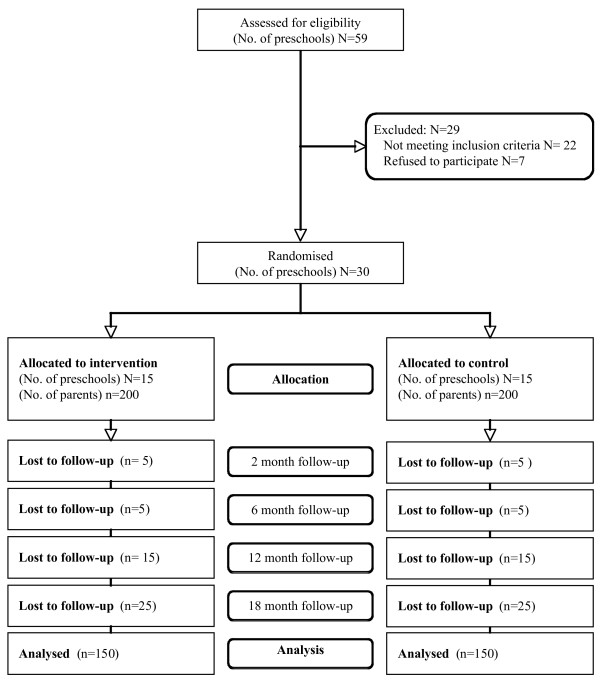
BACKGROUND: Inadequate fruit and vegetable consumption in childhood increases the risk of developing chronic disease. Despite this, a substantial proportion of children in developed nations, including Australia, do not consume sufficient quantities of fruits and vegetables. Parents are influential in the development of dietary habits of young children but often lack the necessary knowledge and skills to promote healthy eating in their children. The aim of this study is to assess the efficacy of a telephone-based intervention for parents to increase the fruit and vegetable consumption of their 3- to 5-year-old children. METHODS/DESIGN: The study, conducted in the Hunter region of New South Wales, Australia, employs a cluster randomised controlled trial design. Two hundred parents from 15 randomly selected preschools will be randomised to receive the intervention, which consists of print resources and four weekly 30-minute telephone support calls delivered by trained telephone interviewers. The calls will assist parents to increase the availability and accessibility of fruit and vegetables in the home, create supportive family eating routines and role-model fruit and vegetable consumption. A further two hundred parents will be randomly allocated to the control group and will receive printed nutrition information only. The primary outcome of the trial will be the change in the child's consumption of fruit and vegetables as measured by the fruit and vegetable subscale of the Children's Dietary Questionnaire. Pre-intervention and post-intervention parent surveys will be administered over the telephone. Baseline surveys will occur one to two weeks prior to intervention delivery, with follow-up data collection calls occurring two, six, 12 and 18 months following baseline data collection. DISCUSSION: If effective, this telephone-based intervention may represent a promising public health strategy to increase fruit and vegetable consumption in childhood and reduce the risk of subsequent chronic disease.
Overview
The claims and statistics of this paper haven’t been checked yet.
Run the check — free, no account needed. It reads the open-access text and checks the sources it cites.
Integrity signals
Registry
Cites
Statistics
Figures
Verification
Claims the paper makes
The claims and statistics of this paper haven’t been checked yet.
Run the check — free, no account needed. It reads the open-access text and checks the sources it cites.
Claims other papers make about this one
Each is checked against this paper’s own text: does it say what the citing paper says it does?
The source backs part of the claim, not all of it — or backs it for a different population, condition or comparison.
In the citing paper
“Previous studies have also surveyed study data collectors to assess the success of blinding strategies [74].”
From Guidance for conducting feasibility and pilot studies for implementation trials (2020) · cites this paper as [74]
Experimental — accuracy not yet measured
Self-check
Percentages, sums and reported differences re-computed from the paper’s own numbers.
The self-check needs the paper’s full text.
Citations
Cites
Bulletin of the World Health Organization
van der Sande, M. A. B., Walraven, G. E. L., Milligan, P. J., BANYA, W. A. S., CEESAY, S. M., Nyan, O. A., & McAdam, K. P. W. J. (2001) · Bulletin of the World Health Organization · Cited by 7,097
The World Health Report 2002 - Reducing Risks, Promoting Healthy Life
Available, N. A. N. (2003) · Education for Health · doi:10.1080/1357628031000116808 · Cited by 6,078
Consort 2010 statement: extension to cluster randomised trials
Campbell, M. K., Piaggio, G., Elbourne, D. R., Altman, D. G., & for the CONSORT Group (2012) · BMJ · doi:10.1136/bmj.e5661 · Cited by 3,510
CONSORT statement: extension to cluster randomised trials
Campbell, M. K., Elbourne, D. R., & Altman, D. G. (2004) · BMJ · doi:10.1136/bmj.328.7441.702 · Cited by 2,557
A taxonomy of behavior change techniques used in interventions
Abraham, C., & Michie, S. (2008) · Health Psychology · doi:10.1037/0278-6133.27.3.379 · Cited by 2,525
Increasing response rates to postal questionnaires: systematic review
Edwards, P. J., Roberts, I., Clarke, M. J., DiGuiseppi, C. G., Pratap, S., Wentz, R., & Kwan, I. (2002) · BMJ · doi:10.1136/bmj.324.7347.1183 · Cited by 1,915
Bulletin of the World Health Organization
Rennie, S., & Behets, F. (2006) · Bulletin of the World Health Organization · doi:10.2471/blt.00.00000 · Cited by 1,602
The 1986 census of population and housing
Cornish, J. K. (1985) · Journal of the Australian Population Association · doi:10.1007/bf03041202 · Cited by 1,410
Rasmussen, M., Krølner, R. F., Klepp, K., Lytle, L., Brug, J., Bere, E. T., & Due, P. (2006) · International Journal of Behavioral Nutrition and Physical Activity · doi:10.1186/1479-5868-3-22 · Cited by 1,096
A stage model of behavioral therapies research: getting started and moving on from stage I.
Rounsaville, B. J., Carroll, K. M., & Onken, L. S. (2001) · Clinical Psychology: Science and Practice · doi:10.1093/clipsy.8.2.133 · Cited by 846
Research works printed but not linked: 10
- Ministry of Health: The Health of New Zealand: Total population. 2004, Wellington: Ministry of Health
- Commonwealth Scientific Industrial Research Organisation (CSIRO), Preventative Health National Research Flagship, The University of South Australia: 2007 Australian National Children's Nutrition and Physical Activity Survey: Main Findings. 2008
- Australian Bureau of Statistics: Australian Social Trends 2001 (4102.0). 2001, Canberra: ABS
- Kellett E, Smith A, Schmerlaib Y: The Australian Guide to Healthy Eating: Background information for consumers. 1998, Adelaide: Children's Health Development Foundation
- Australian Bureau of Statistics: 2006 Census of Population and Housing. 2007, Canberra: ABS
- Australian Bureau of Statistics: Childhood education and care (4402.0). 2009, Canberra: ABS
- Steering Committee for the Review of Government Service Provision: Report on Government Services 2009, Volume 1: Early Childhood, Education and Training; Justice; Emergency Management. 2009, Canberra: Productivity Commission
- Australian Bureau of Statistics: Socio-economic Indexes for Areas (SEIFA) - 2033.0.55.001 - 2006. 2008, Canberra: ABS
- Australian Bureau of Statistics: An introduction to SocioEconomic Indexes for Areas (SEIFA). CAT no 2039.0. 2006, Canberra: ABS
- Centre for Epidemiology and Research: 2008 Report on Adult Health from the New South Wales Population Health Survey. 2009, Sydney: NSW Department of Health
Cited by
Sorted by citations
Items 101–178 of 178
Matheson, F. I., Creatore, M. I., Gozdyra, P., Park, A. L., & Ray, J. G. (2014) · BMJ Open · doi:10.1136/bmjopen-2014-006032 · Cited by 17
Armstrong-Hough, M. J., Ggita, J. M., Ayakaka, I., Dowdy, D. W., Cattamanchi, A., Haberer, J. E., Katamba, A., & Davis, J. L. (2018) · JAIDS Journal of Acquired Immune Deficiency Syndromes · doi:10.1097/qai.0000000000001617 · Cited by 17
Neelakantan, A., DeFries, R., Sterling, E. J., & Naeem, S. (2020) · Regional Environmental Change · doi:10.1007/s10113-020-01589-7 · Cited by 17
Strength in Process: Using Concept Mapping to Inform Community Coalition Development
Miller, J. “., Rhema, S. H., Faul, A. C., D'Ambrosio, J., Yankeelov, P. A., Amer, R., & Clark, R. (2012) · Journal of Community Practice · doi:10.1080/10705422.2012.736074 · Cited by 17
Aurizki, G. E., Efendi, F., & Indarwati, R. (2019) · Working with Older People · doi:10.1108/wwop-08-2019-0020 · Cited by 18
Novotny, R., Li, F., Guerrero, R. T. L., COLEMAN, P. H., Tufa, A. J., Bersamin, A., Deenik, J. L., & Wilkens, L. R. (2017) · BMC Public Health · doi:10.1186/s12889-017-4377-6 · Cited by 16
Berens, E.-M., Ganahl, K., Vogt, D., & Schaeffer, D. (2021) · International Journal of Migration Health and Social Care · doi:10.1108/ijmhsc-09-2019-0078 · Cited by 16
Afolalu, E. F., Spies, E., Bacsó, Á., Clerc, E., Abetz‐Webb, L., Gallot, S., & Chrea, C. (2021) · Harm Reduction Journal · doi:10.1186/s12954-021-00526-z · Cited by 16
Time trends of cause-specific mortality among resettlers in Germany, 1990 through 2009
Kaucher, S., Leier, V., Deckert, A., Holleczek, B., Meisinger, C., Winkler, V. F., & Becher, H. (2017) · European Journal of Epidemiology · doi:10.1007/s10654-017-0240-4 · Cited by 15
Power, J., Schofield, M. J., Farchione, D., PERLESZ, A. J., McNair, R., Brown, R., Pitts, M. K., & Bickerdike, A. J. (2015) · Australian and New Zealand Journal of Family Therapy · doi:10.1002/anzf.1109 · Cited by 15
Harm reduction: Philosophical drivers of conceptual tensions and ways forward
Jiao, S. (2019) · Nursing Inquiry · doi:10.1111/nin.12286 · Cited by 15
Occupational well-being and leadership in a school community
Laine, S., Saaranen, T. K., Ryhänen, E., & Tossavainen, K. (2017) · Health Education · doi:10.1108/he-02-2014-0021 · Cited by 14
The Role of Health in Urban Climate Adaptation: An Analysis of Six U.S. Cities
Shimamoto, M. M., & McCormick, S. (2017) · Weather Climate and Society · doi:10.1175/wcas-d-16-0142.1 · Cited by 15
The burden of alcohol-related morbidity and mortality in Ottawa, Canada
Willmore, J., Marko, T.-L., Taing, D., & Sampasa‐Kanyinga, H. (2017) · PLoS ONE · doi:10.1371/journal.pone.0185457 · Cited by 14
Perinatal depression: Data-driven subtypes derived from life history and mindfulness and personality
Sun, J., Li, J., Zhang, X., Wang, Y., Cao, D., Wang, J., Bai, H., Lin, P., Zhang, H., Sun, Y., et al. (2020) · Journal of Affective Disorders · doi:10.1016/j.jad.2020.07.040 · Cited by 15
Fox‐Harding, C., Tompsett, C., Sanders, R. H., & Cobley, S. P. (2018) · International Journal of Sport and Exercise Psychology · doi:10.1080/1612197x.2018.1519838 · Cited by 14
Building Positive Psychological Resources
Gilbert, E. K., Foulk, T. A., & Bono, J. E. (2017) · Wiley eBooks · doi:10.1002/9781118993811.ch33 · Cited by 15
Etherington, C., Deng, M. X., Boet, S., Johnston, A., Mansour, F., Said, H., Zheng, K., & Sun, L. Y. (2020) · BMJ Open · doi:10.1136/bmjopen-2020-037139 · Cited by 15
Graham, H. M., Hutchinson, J., Law, C., Platt, L., & Wardle, H. (2016) · SSM - Population Health · doi:10.1016/j.ssmph.2016.10.011 · Cited by 13
Hypertension and diabetes management: a policy perspective from Ghana
Owusu, M. F., Basu, A., & Barnett, P. (2018) · Journal of Health Organization and Management · doi:10.1108/jhom-03-2018-0076 · Cited by 14
Implementation Strategies to Improve Knowledge and Adherence to Spinal Cord Injury Guidelines
Wuchner, S. S., Murray, L. L., McLennon, S. M., Ebright, P. R., & Bakas, T. (2016) · Rehabilitation Nursing · doi:10.1002/rnj.304 · Cited by 14
Wright, A., Thurber, K. A., Yap, M., Du, W., Banks, E., Walker, J., Irwin, F., Sanders, W., & Lovett, R. W. (2020) · BMC Medical Research Methodology · doi:10.1186/s12874-020-00970-8 · Cited by 13
Trends in Sickness Certification of Injured Workers by General Practitioners in Victoria, Australia
Ruseckaite, R., Collie, A., Bohensky, M. A., Brijnath, B., Kosny, A. A., & Mazza, D. (2013) · Journal of Occupational Rehabilitation · doi:10.1007/s10926-013-9487-0 · Cited by 12
Hammersley, M. L., Wyse, R., Jones, R. A., Wolfenden, L., Yoong, S. L., Stacey, F. G., Eckermann, S. D., Okely, A. D., Innes‐Hughes, C., Li, V., et al. (2020) · BMC Public Health · doi:10.1186/s12889-020-08526-7 · Cited by 12
Self-citationJoseph, J., & Jaswal, S. (2020) · Ageing International · doi:10.1007/s12126-020-09375-w · Cited by 12
Freeman, A., Kwarteng, A., Febir, L. G., Amenga‐Etego, S., Owusu‐Agyei, S., & Asante, K. P. (2017) · Journal of Pharmaceutical Policy and Practice · doi:10.1186/s40545-017-0103-0 · Cited by 12
Anku, P. J., Amo‐Adjei, J., Doku, D. T., & Kumi-Kyereme, A. (2017) · Global Public Health · doi:10.1080/17441692.2017.1385823 · Cited by 12
Mellifont, D. (2017) · Work · doi:10.3233/wor-172643 · Cited by 12
Shum, L. K., Chan, H., Erdelyi, S., Pei, L. X., & Brubacher, J. R. (2021) · BMJ Open · doi:10.1136/bmjopen-2021-049623 · Cited by 12
Arab women feelings while seeking information during COVID-19 pandemic: applying PMT constructs
Alwreikat, A., Shehata, A. M. K., & Eldakar, M. A. M. (2021) · Online Information Review · doi:10.1108/oir-09-2020-0419 · Cited by 12
The role of HRD in university – community partnership
Osafo, E., & Yawson, R. M. (2019) · European journal of training and development · doi:10.1108/ejtd-12-2018-0119 · Cited by 11
Climate-related migration and population health: social science-oriented dynamic simulation model
Reuveny, R. (2021) · BMC Public Health · doi:10.1186/s12889-020-10120-w · Cited by 12
Voorendonk, E. M., Sanches, S. A., Mojet, M., de Jongh, A., & van Minnen, A. (2021) · Mental health and physical activity · doi:10.1016/j.mhpa.2021.100417 · Cited by 11
Clausen, T., Burr, H., & Borg, V. (2014) · American Journal of Industrial Medicine · doi:10.1002/ajim.22313 · Cited by 11
Lin, C., & Liao, C.-M. (2014) · Public Health · doi:10.1016/j.puhe.2014.09.004 · Cited by 10
Dupuis‐Blanchard, S., Villalón, L., & Alimezelli, H. T. (2014) · Global Health Promotion · doi:10.1177/1757975913512161 · Cited by 10
Hemenway, M., Witkiewitz, K. A., Unrod, M., Brandon, K. O., Brandon, T. H., Wetter, D. W., Sutton, S. K., & Vinci, C. (2020) · Contemporary Clinical Trials · doi:10.1016/j.cct.2020.106218 · Cited by 10
Evolution of educational inequalities in mortality among young adults in an urban setting
Grande, H. D., Deboosere, P., & Vandenheede, H. (2013) · International Journal of Public Health · doi:10.1007/s00038-013-0478-x · Cited by 9
Dsouza, N., Hassrick, E. M., Giordano, K., Friedman, C., Yamasaki, Y., Perez, C., Martínez, O., Carroll‐Scott, A., & Martínez-Donate, A. P. (2021) · Journal of Urban Health · doi:10.1007/s11524-021-00535-0 · Cited by 9
Prevalence and Risk Factors of Sleep Disturbance in Community Dwelling Adults in Korea
Choi, H., Kim, B., & Kim, I.-J. (2013) · Korean Journal of Adult Nursing · doi:10.7475/kjan.2013.25.2.183 · Cited by 9
Choi, R., & Hwang, B.-D. (2016) · 보건교육·건강증진학회지 · doi:10.14367/kjhep.2016.33.2.67 · Cited by 9
Mo, L., Zhou, Y., Gopalakrishnana, G., & Li, X. (2020) · Open Geosciences · doi:10.1515/geo-2020-0110 · Cited by 9
A Cost-Effectiveness-Assessing Model of Vaccination for Varicella and Zoster
Comba, M., Raimundo, S. M., & Venturino, E. (2012) · Mathematical Modelling of Natural Phenomena · doi:10.1051/mmnp/20127306 · Cited by 8
Sadegholvad, S., Yeatman, H. R., Parrish, A., & Worsley, A. (2017) · Nutrients · doi:10.3390/nu9080844 · Cited by 9
Food acculturation experiences of new Iranian skilled migrant mothers in South Australia
Kavian, F., Coveney, J., Matwiejczyk, L., & Mehta, K. (2021) · Nutrition & Dietetics · doi:10.1111/1747-0080.12659 · Cited by 8
Compassion in Spanish-speaking health care: A systematic review
Zaragozá, A. S., Soto-Rubio, A. L., Lacomba‐Trejo, L., Valero‐Moreno, S., & Pérez‐Marín, M. (2021) · Current Psychology · doi:10.1007/s12144-021-01994-z · Cited by 11
Factors influencing prehospital delay time among patients with peripheral arterial occlusive disease
Vasaroangrong, T., Thosingha, O., Riegel, B. J., Ruangsetakit, C., & Viwatwongkasem, C. (2015) · European Journal of Cardiovascular Nursing · doi:10.1177/1474515114567813 · Cited by 8
Mindfulness and Children’s Physical Activity, Diet, Quality of Life, and Weight Status
Clevenger, K. A., Pfeiffer, K. A., Yee, K. E., Triplett, A. N., Florida, J., & Selby, S. (2017) · Mindfulness · doi:10.1007/s12671-017-0765-3 · Cited by 9
Identifying and Classifying Tools for Health Policy Ethics Review: A Systematic Search and Review
Henein, M., & Ells, C. (2021) · Health Care Analysis · doi:10.1007/s10728-020-00422-w · Cited by 7
Equitable Distribution of PEPFAR-Supported HIV/AIDS Services in South Africa
Larson, E., O’Bra, H., Brown, J. W., Goldman, T., Pillay, Y. G., & Klausner, J. D. (2011) · American Journal of Public Health · doi:10.2105/ajph.2011.300242 · Cited by 6
Promoting Sexual Health With SMS Texting Technology
Blackburn, L., & Blatnik, A. (2013) · Nursing for Women s Health · doi:10.1111/1751-486x.12074 · Cited by 5
Jirarattanasopha, V., Witvorapong, N., & Hanvoravongchai, P. (2018) · Journal of Health Research · doi:10.1108/jhr-11-2018-080 · Cited by 5
Horwitz, E. B., Spännäri, J., Langley, J., Jacobs, B., & Osika, W. (2020) · Work · doi:10.3233/wor-203243 · Cited by 6
An innovative emergency transportation scenario for mass casualty incident management
Lin, M., Pan, C.-L., Wen, J., Lee, C.-H., Wu, Z.-P., Chang, C.-F., & Chiu, C.-W. (2021) · Medicine · doi:10.1097/md.0000000000024482 · Cited by 5
Tymula, A. A., & Wang, X. (2020) · Journal of Economic Behavior & Organization · doi:10.1016/j.jebo.2021.05.030 · Cited by 7
Validity and reliability of the South African health promoting schools monitoring questionnaire
Struthers, P., Wegner, L., Koker, P. D., Lerebo, W. T., & Blignaut, R. J. (2016) · Health Promotion International · doi:10.1093/heapro/daw074 · Cited by 4
Psychosocial and cultural interventions for reducing alcohol consumption during lactation
Cassidy, T. M., & Giglia, R. C. (2012) · Cochrane Database of Systematic Reviews · doi:10.1002/14651858.cd009707 · Cited by 4
Implementer resistance to school food policy: unpacking the paradox
Levay, A., Chapman, G. E., & Seed, B. (2018) · British Food Journal · doi:10.1108/bfj-09-2017-0533 · Cited by 3
Tringali, V., & Aldridge, C. (2021) · Physical Activity and Health · doi:10.5334/paah.125 · Cited by 3
Stanley, E. A., Mumford, E. A., Liu, W., Taylor, B. G., & Maitra, P. (2021) · Journal of Police and Criminal Psychology · doi:10.1007/s11896-021-09436-z · Cited by 4
Comparison of the EQ-5D-5L and the EQ-5D-3L using individual patient data from the REFORM trial
Corbacho, B., Keding, A., Chuang, L., Ramos-Goñi, J. M., Joshi, K., Cockayne, S., & Torgerson, D. J. (2021) · F1000Research · doi:10.12688/f1000research.54554.1 · Cited by 2
Handling Tensions in the ‘Everyday Landscape’: Moving beyond the Development—Conservation Conflict?
Hofstad, H. (2014) · Environment and Planning C Government and Policy · doi:10.1068/c1285 · Cited by 2
Lee, S. X. J., Burrows, T. L., Yoong, S. L., & Wyse, R. (2018) · Public Health Nutrition · doi:10.1017/s1368980018001465 · Cited by 2
Self-citationWyse, R., Stacey, F. G., Campbell, L., Yoong, S. L., Lecathelinais, C., Wiggers, J. H., Campbell, K. J., & Wolfenden, L. (2020) · Nutrients · doi:10.3390/nu12123702 · Cited by 2
Self-citationDoes medical certification of workers with injuries influence patterns of health service use?
Ruseckaite, R., Collie, A., Prang, K.-H., Brijnath, B., Kosny, A. A., & Mazza, D. (2016) · Work · doi:10.3233/wor-162312 · Cited by 2
Rich and Well Educated: Are These Requirements Necessary to Claim Healthcare Tax Credits in Italy?
Brenna, E. (2017) · Applied Health Economics and Health Policy · doi:10.1007/s40258-017-0365-3 · Cited by 1
Nguefack, F., Dongmo, R., Kenfack, B., & Socpa, A. (2014) · Journal de Pédiatrie et de Puériculture · doi:10.1016/j.jpp.2014.09.003 · Cited by 1
Types of Smoking Statuses and Associated Factors among Korean Wageworkers
Moon, S. (2016) · Journal of Korean Public Health Nursing · doi:10.5932/jkphn.2016.30.3.495 · Cited by 1
THE SOCIAL REPRESENTATIVENESS OF CABINET MINISTERS IN ISRAEL: ARE THE GAPS CLOSING?
Kenig, O. (2014) · Representation · doi:10.1080/00344893.2014.911773 · Cited by 1
Myrick, J. G. (2019) · Emerald Group Publishing Limited eBooks · doi:10.1108/978-1-78769-967-020191005 · Cited by 1
Examining a migration-based phenomenon of heroin use in an urban drug scene in Sao Paulo, Brazil
Ribeiro, M., Frajzinger, R., Perrenoud, L. O., & Fischer, B. (2021) · International Journal of Migration Health and Social Care · doi:10.1108/ijmhsc-06-2020-0065 · Cited by 1
Kfoury, K. A. E. (2015) · Journal of Infection and Public Health · doi:10.1016/j.jiph.2015.11.014 · Cited by 1
RetractedSáenz, I. D., & Montiu, M. F. (2012) · Nursing (Ed española) · doi:10.1016/s0212-5382(12)70125-5
Additional file 2 of Guidance for conducting feasibility and pilot studies for implementation trials
Pearson, N., Naylor, P.-J., Ashe, M. C., Fernandez, M., Yoong, S. L., & Wolfenden, L. (2020) · Figshare · doi:10.6084/m9.figshare.13173941
Self-citationBarnes, C., Grady, A., Nathan, N., Wolfenden, L., Pond, N., McFayden, T., Ward, D. S., Vaughn, A., & Yoong, S. L. (2020) · Figshare · doi:10.6084/m9.figshare.13167353
Self-citationHammersley, M. L., Wyse, R., Jones, R. A., Wolfenden, L., Yoong, S., Stacey, F. G., Eckermann, S., Okely, A. D., Innes‐Hughes, C., Li, V., et al. (2020) · Figshare · doi:10.6084/m9.figshare.12269645
Self-citationAdditional file 1 of Guidance for conducting feasibility and pilot studies for implementation trials
Pearson, N., Naylor, P.-J., Ashe, M. C., Fernandez, M., Yoong, S. L., & Wolfenden, L. (2020) · Figshare · doi:10.6084/m9.figshare.13173938
Self-citationBarnes, C., Grady, A., Nathan, N., Wolfenden, L., Pond, N., McFayden, T., Ward, D. S., Vaughn, A., & Yoong, S. L. (2020) · Figshare · doi:10.6084/m9.figshare.13167356
Self-citation
Metadata
- Authors
- Wyse, R. J., Wolfenden, L., Campbell, E., Brennan, L., Campbell, K. J., Fletcher, A., Bowman, J., Heard, T. R., & Wiggers, J.
- Affiliations
- University of Newcastle Australia (AU)
- Hunter New England Local Health District (AU)
- Monash University (AU)
- Deakin University (AU)
- Corresponding author
- Wyse, Rebecca J
- ORCID
- Venue
- BMC Public Health
- Published
- 2010-04-28
- Volume
- 10
- Issue
- 1
- Pages
- 216-216
- ISSN
- 1471-2458 (ISSN-L)
- PMC
- PMC2873583
- OpenAlex
- W2123491720
- Cited by
- 178
- References
- 60
- Citations by year
- 2024: 1 · 2021: 28 · 2020: 22 · 2019: 13 · 2018: 13 · 2017: 35 · 2016: 19 · 2015: 13 · 2014: 14 · 2013: 6 · 2012: 10
- FWCI
- 6.07
- Type
- journal article
- Language
- en
- Open access
- gold
- doi.org
- Licence
- Locations
- BMC Public Health (publishedVersion, cc-by)
- Europe PMC (PubMed Central) (publishedVersion, cc-by)
- PubMed Central (publishedVersion, cc-by)
- PubMed (publishedVersion)
- Research Bank (Australian Catholic University) (submittedVersion)
- DOAJ (DOAJ: Directory of Open Access Journals) (submittedVersion)
- Figshare (submittedVersion, cc-by)
- NOVA (University of Newcastle Australia) (submittedVersion)
- Funders
- Hunter Medical Research Institute
- Cancer Institute NSW
- Topics
- Health Sciences › Nursing › Nutrition and Dietetics › Nutrition, Health and Food Behavior
- Health Sciences › Medicine › Public Health, Environmental and Occupational Health › Obesity, Physical Activity, Diet
- Health Sciences › Medicine › Public Health, Environmental and Occupational Health › Food Security and Health in Diverse Populations
- Keywords
- fruit and vegetable intake, preschool children, parental intervention, telephone-delivered intervention, household food availability, parental role modeling, healthy eating promotion, chronic disease prevention
- MeSH terms
- Adult, Child, Preschool, Feeding Behavior, Female, Fruit, Health Education, Health Promotion, Humans, Health Knowledge, Attitudes, Practice, Male, New South Wales, Parents, Social Support, Telephone, Vegetables, Cluster Analysis
About these checks
Registry, retraction, Cites and statistics results are computed, not judged, with one exception: a printed reference that no index lists is read once by a model before it counts as a citation error. Claims are extracted by a model and kept only when their quote appears verbatim in the text; each cited source is then checked, with a model’s help, for whether it says what the claim relies on. Those verdicts can be wrong — read the claim’s quote and the cited source before relying on one.
Statistics and arithmetic are recomputed, not judged.
Confidence bands are shown only for fields calibrated on our annotated test set. None is calibrated yet, so no band is shown.
What counts as a claim ›How we measure confidence ›How we check this ›
Are you an author, or do you see a problem with this page? Request a review
