

The DOI matches its Crossref record; 36 of the 37 references it cites were found in a registry or an index, and 1 are not checked yet.
Problem-solving therapy for depression and common mental disorders in Zimbabwe: piloting a task-shifting primary mental health care intervention in a population with a high prevalence of people living with HIV
Open accessAbstract
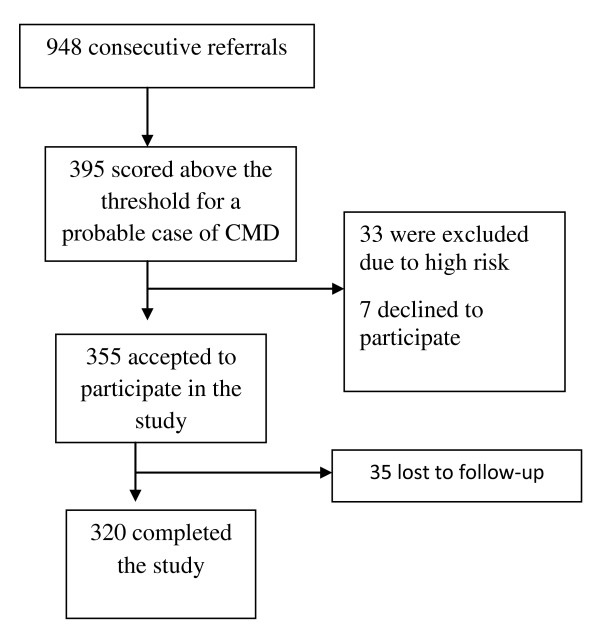
BACKGROUND: There is limited evidence that interventions for depression and other common mental disorders (CMD) can be integrated sustainably into primary health care in Africa. We aimed to pilot a low-cost multi-component 'Friendship Bench Intervention' for CMD, locally adapted from problem-solving therapy and delivered by trained and supervised female lay workers to learn if was feasible and possibly effective as well as how best to implement it on a larger scale. METHOD: We trained lay workers for 8 days in screening and monitoring CMD and in delivering the intervention. Ten lay workers screened consecutive adult attenders who either were referred or self-referred to the Friendship Bench between July and December 2007. Those scoring above the validated cut-point of the Shona Symptom Questionnaire (SSQ) for CMD were potentially eligible. Exclusions were suicide risk or very severe depression. All others were offered 6 sessions of problem-solving therapy (PST) enhanced with a component of activity scheduling. Weekly nurse-led group supervision and monthly supervision from a mental health specialist were provided. Data on SSQ scores at 6 weeks after entering the study were collected by an independent research nurse. Lay workers completed a brief evaluation on their experiences of delivering the intervention. RESULTS: Of 395 potentially eligible, 33 (8%) were excluded due to high risk. Of the 362 left, 2% (7) declined and 10% (35) were lost to follow-up leaving an 88% response rate (n = 320). Over half (n = 166, 52%) had presented with an HIV-related problem. Mean SSQ score fell from 11.3 (sd 1.4) before treatment to 6.5 (sd 2.4) after 3-6 sessions. The drop in SSQ scores was proportional to the number of sessions attended. Nine of the ten lay workers rated themselves as very able to deliver the PST intervention. CONCLUSION: We have found preliminary evidence of a clinically meaningful improvement in CMD associated with locally adapted problem-solving therapy delivered by lay health workers through routine primary health care in an African setting. There is a need to test the effectiveness of this task-shifting mental health intervention in an appropriately powered randomised controlled trial. TRIAL REGISTRATION: ISRCTN: ISRCTN25476759.
Overview
The claims and statistics of this paper haven’t been checked yet.
Run the check — free, no account needed. It reads the open-access text and checks the sources it cites.
Integrity signals
Registry
Cites
Statistics
Figures
Verification
Claims the paper makes
The claims and statistics of this paper haven’t been checked yet.
Run the check — free, no account needed. It reads the open-access text and checks the sources it cites.
Claims other papers make about this one
Each is checked against this paper’s own text: does it say what the citing paper says it does?
In the citing paper
“Bipolar depression' is different from unipolar major depression in several important respects, including treatment needs and prognosis. Ascertaining this history can considerably affect the management plan. 87”
From Time for united action on depression: a Lancet–World Psychiatric Association Commission (2022) · cites this paper as [87]
In the citing paper
“Ascertaining this history can considerably affect the management plan. 87”
From Time for united action on depression: a Lancet–World Psychiatric Association Commission (2022) · cites this paper as [87]
Self-check
Percentages, sums and reported differences re-computed from the paper’s own numbers.
The self-check needs the paper’s full text.
Citations
Cites
Pharmacological interventions for somatoform disorders in adults
Kleinstäuber, M., Witthöft, M., Steffanowski, A., van Marwijk, H., Hiller, W., & Lambert, M. J. (2014) · Cochrane Database of Systematic Reviews · doi:10.1002/14651858.cd010628.pub2 · Cited by 11,369
Disease Control Priorities in Developing Countries
Jamison, D., Mosley, W. H., Measham, A., & Bobadilla, J. L. (1993) · World Bank, Washington, DC eBooks · doi:10.1596/0-1952-0990-7 · Cited by 3,714
Disease control priorities in developing countries
(2006) · Choice Reviews Online · doi:10.5860/choice.44-0343 · Cited by 3,636
Resources for mental health: scarcity, inequity, and inefficiency
Saxena, S., Thornicroft, G., Knapp, M., & Whiteford, H. (2007) · The Lancet · doi:10.1016/s0140-6736(07)61239-2 · Cited by 1,789 · cited 1×
“Mental disorders cause considerable suffering, disability and social exclusion in Africa, and are poorly recognised and undertreated [1,2].”
BackgroundDisease control priorities in developing countries
Frenk, J. M. (2006) · Salud Pública de México · doi:10.1590/s0036-36342006000600011 · Cited by 1,615
Lewin, S. A., Munabi-Babigumira, S. K., Glenton, C., Daniels, K., Bosch‐Capblanch, X., van Wyk, B. E., Odgaard‐Jensen, J., Johansen, M., Aja, G. N., Zwarenstein, M., et al. (2010) · Cochrane Database of Systematic Reviews · doi:10.1002/14651858.cd004015.pub3 · Cited by 1,030
Scale up services for mental disorders: a call for action
(2007) · The Lancet · doi:10.1016/s0140-6736(07)61242-2 · Cited by 835
Group Interpersonal Psychotherapy for Depression in Rural Uganda: A Randomized Controlled Trial
Bolton, P., Bass, J., Neugebauer, R., Verdeli, H., Clougherty, K. F., Wickramaratne, P., Speelman, L., Ndogoni, L., & Weissman, M. (2003) · JAMA · doi:10.1001/jama.289.23.3117 · Cited by 655 · cited 1×
“Mental disorders cause considerable suffering, disability and social exclusion in Africa, and are poorly recognised and undertreated [1,2].”
BackgroundAraya, R., Rojas, G., Fritsch, R., Gaete, J., Rojas, M., Simon, G., & Peters, T. J. (2003) · The Lancet · doi:10.1016/s0140-6736(03)12825-5 · Cited by 450
Self-citationBehavioral activation treatments for depression in adults: A meta-analysis and review.
Mazzucchelli, T., Kane, R., & Rees, C. (2009) · Clinical Psychology: Science and Practice · doi:10.1111/j.1468-2850.2009.01178.x · Cited by 438
Research works printed but not linked: 2
- Tibaijuka AK: Report of the Fact-Finding Mission to Zimbabwe to assess the Scope and Impact of Operation Murambatsvina by the UN Special Envoy on Human Settlements Issues In Zimbabwe. UN Habitat. 2005
- Amani Trust: The Chiweshe Nurse-Counsellor Programme: Trainer's Manual (revised). Harare. 1994
Cited by
Sorted by citations
Time for united action on depression: a Lancet–World Psychiatric Association Commission
Herrman, H., Patel, V., Kieling, C., Berk, M., Buchweitz, C., Cuijpers, P., Furukawa, T. A., Kessler, R. C., Kohrt, B. A., Maj, M., et al. (2022) · The Lancet · doi:10.1016/s0140-6736(21)02141-3 · Cited by 1,104
Self-citationPsychological Treatments for the World: Lessons from Low- and Middle-Income Countries
Singla, D. R., Kohrt, B. A., Murray, L. K., Anand, A., Chorpita, B. F., & Patel, V. (2017) · Annual Review of Clinical Psychology · doi:10.1146/annurev-clinpsy-032816-045217 · Cited by 913
Traumatic stress in the age of COVID-19: A call to close critical gaps and adapt to new realities.
Horesh, D., & Brown, A. D. (2020) · Psychological Trauma: Theory, Research, Practice, and Policy · doi:10.1037/tra0000592 · Cited by 742
Joshi, R., Alim, M., Kengne, A. P., Jan, S., Maulik, P. K., Peiris, D., & Patel, A. A. (2014) · PLoS ONE · doi:10.1371/journal.pone.0103754 · Cited by 589
van Ginneken, N., Tharyan, P., Lewin, S., Rao, G. N., Meera, S., Pian, J., Chandrashekar, S., & Patel, V. (2013) · Cochrane Database of Systematic Reviews · doi:10.1002/14651858.cd009149.pub2 · Cited by 575
Metadata
- Authors
- Chibanda, D., Mesu, P., Kajawu, L., Cowan, F., Araya, R., & Abas, M. A.
- Affiliations
- University of Zimbabwe (ZW)
- Counselling Services Unit (ZW)
- University of Bristol (GB)
- King's College London (GB)
- Corresponding author
- Chibanda, Dixon
- Venue
- BMC Public Health
- Published
- 2011-10-26
- Volume
- 11
- Issue
- 1
- Pages
- 828-828
- ISSN
- 1471-2458 (ISSN-L)
- PMC
- PMC3210104
- OpenAlex
- W1969517414
- Cited by
- 319
- References
- 34
- Citations by year
- 2026: 14 · 2025: 29 · 2024: 21 · 2023: 23 · 2022: 28 · 2021: 53 · 2020: 29 · 2019: 23 · 2018: 16 · 2017: 15 · 2016: 21 · 2015: 16 · 2014: 17 · 2013: 11 · 2012: 3
- FWCI
- 13.49
- Type
- journal article
- Language
- en
- Open access
- gold
- doi.org
- Licence
- Locations
- BMC Public Health (publishedVersion, cc-by)
- Europe PMC (PubMed Central) (publishedVersion, cc-by)
- PubMed Central (publishedVersion, cc-by)
- PubMed (publishedVersion)
- Research Portal (King's College London) (acceptedVersion, cc-by)
- LSHTM Research Online (London School of Hygiene and Tropical Medicine) (acceptedVersion)
- DOAJ (DOAJ: Directory of Open Access Journals) (submittedVersion)
- UCL Discovery (University College London) (submittedVersion)
- Greater South Information System
- Topics
- Health Sciences › Medicine › Psychiatry and Mental health › Mental Health Treatment and Access
- Social Sciences › Psychology › Clinical Psychology › Psychotherapy Techniques and Applications
- Health Sciences › Health Professions › General Health Professions › Health Policy Implementation Science
- Keywords
- problem-solving therapy, common mental disorders, depression, Friendship Bench, task shifting, lay health workers, primary care mental health, HIV, Zimbabwe, activity scheduling, feasibility
- MeSH terms
- Adult, Mental Disorders, Community Health Workers, Depression, Feasibility Studies, Female, Follow-Up Studies, Health Promotion, HIV, Humans, Male, Middle Aged, Personnel Staffing and Scheduling, Pilot Projects, Primary Health Care, Problem Solving, Surveys and Questionnaires, Zimbabwe, Program Evaluation, HIV Infections, Prevalence, Young Adult
About these checks
Registry, retraction, Cites and statistics results are computed, not judged, with one exception: a printed reference that no index lists is read once by a model before it counts as a citation error. Claims are extracted by a model and kept only when their quote appears verbatim in the text; each cited source is then checked, with a model’s help, for whether it says what the claim relies on. Those verdicts can be wrong — read the claim’s quote and the cited source before relying on one.
Statistics and arithmetic are recomputed, not judged.
Confidence bands are shown only for fields calibrated on our annotated test set. None is calibrated yet, so no band is shown.
What counts as a claim ›How we measure confidence ›How we check this ›
Are you an author, or do you see a problem with this page? Request a review
