

Enhanced maternal and child health nurse care for women experiencing intimate partner/family violence: protocol for MOVE, a cluster randomised trial of screening and referral in primary health care
Open accessThe DOI matches its Crossref record; 36 of the 38 references it cites were found in a registry or an index.
Abstract
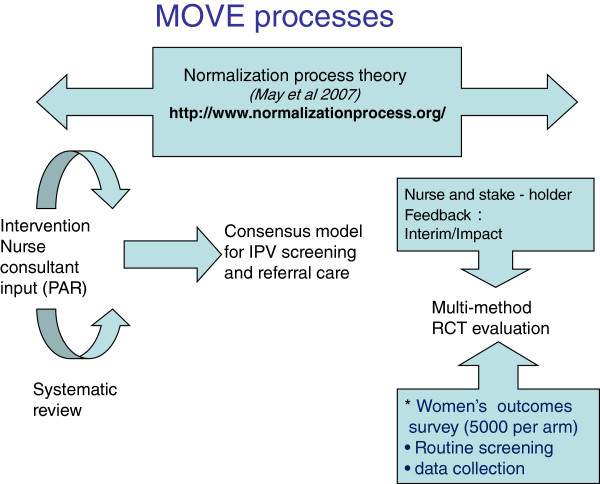
BACKGROUND: Intimate partner violence (IPV) can result in significant harm to women and families and is especially prevalent when women are pregnant or recent mothers. Maternal and child health nurses (MCHN) in Victoria, Australia are community-based nurse/midwives who see over 95% of all mothers with newborns. MCHN are in an ideal position to identify and support women experiencing IPV, or refer them to specialist family violence services. Evidence for IPV screening in primary health care is inconclusive to date. The Victorian government recently required nurses to screen all mothers when babies are four weeks old, offering an opportunity to examine the effectiveness of MCHN IPV screening practices. This protocol describes the development and design of MOVE, a study to examine IPV screening effectiveness and the sustainability of screening practice. METHODS/DESIGN: MOVE is a cluster randomised trial of a good practice model of MCHN IPV screening involving eight maternal and child health nurse teams in Melbourne, Victoria. Normalisation Process Theory (NPT) was incorporated into the design, implementation and evaluation of the MOVE trial to enhance and evaluate sustainability. Using NPT, the development stage combined participatory action research with intervention nurse teams and a systematic review of nurse IPV studies to develop an intervention model incorporating consensus guidelines, clinical pathway and strategies for individual nurses, their teams and family violence services. Following twelve months' implementation, primary outcomes assessed include IPV inquiry, IPV disclosure by women and referral using data from MCHN routine data collection and a survey to all women giving birth in the previous eight months. IPV will be measured using the Composite Abuse Scale. Process and impact evaluation data (online surveys and key stakeholders interviews) will highlight NPT concepts to enhance sustainability of IPV identification and referral. Data will be collected again in two years. DISCUSSION: MOVE will be the first randomised trial to determine IPV screening effectiveness in a community based nurse setting and the first to examine sustainability of an IPV screening intervention. It will further inform the debate about the effectiveness of IPV screening and describe IPV prevalence in a community based post-partum and early infant population. TRIAL REGISTRATION: ACTRN12609000424202.
Overview
The claims and statistics of this paper haven’t been checked yet.
Free: it reads the open-access text and checks the first 5 claims that cite a source we can check. Create a free account to check every claim.
Integrity signals
Registry
Cites
Statistics
Figures
Verification
Claims the paper makes
The claims and statistics of this paper haven’t been checked yet.
Free: it reads the open-access text and checks the first 5 claims that cite a source we can check. Create a free account to check every claim.
Claims other papers make about this one
Each is checked against this paper’s own text: does it say what the citing paper says it does?
In the citing paper
“Women had discretion about whether or how to disclose FV.”
From Implementation, context and complexity (2016) · cites this paper as [81]
In the citing paper
“The context was characterised by multiple layers of operational complexity and emotional turbulence.”
From Implementation, context and complexity (2016) · cites this paper as [81]
In the citing paper
“However, while there were many intervention objects, the mission critical element of the trial was the creation of an interactional space in which women felt safe to disclose FV and the availability of a structured script for action that nurses felt safe to use.”
From Implementation, context and complexity (2016) · cites this paper as [81]
Self-check
Percentages, sums and reported differences re-computed from the paper’s own numbers.
The self-check needs the paper’s full text.
Citations
Cites
Lovibond, P. F., & Lovibond, S. H. (1995) · Behaviour Research and Therapy · doi:10.1016/0005-7967(94)00075-u · Cited by 14,523
The world report on violence and health
Krug, E. G., Mercy, J. A., Dahlberg, L. L., & Zwi, A. B. (2002) · The Lancet · doi:10.1016/s0140-6736(02)11133-0 · Cited by 9,110
(1995) · Cited by 6,909
Health consequences of intimate partner violence
Campbell, J. C. (2002) · The Lancet · doi:10.1016/s0140-6736(02)08336-8 · Cited by 4,055 · cited 1×
“It can commence, continue or escalate in pregnancy and continue into the postpartum period [4] with serious physical and emotional consequences [5,6].”
Hoffman, J. S. (2003) · Injury Prevention · doi:10.1136/ip.9.1.93 · Cited by 1,737
Osman, A., Wong, J. L., Bagge, C. L., Freedenthal, S., Gutierrez, P. M., & Lozano, G. (2012) · Journal of Clinical Psychology · doi:10.1002/jclp.21908 · Cited by 1,064
El informe mundial sobre la violencia y la salud.
Krug, E. G., Mercy, J. A., Dahlberg, L. L., & Zwi, A. B. (2002) · Biomédica · doi:10.7705/biomedica.v22isupp2.1182 · Cited by 1,057
Prevalence of Violence Against Pregnant Women
Gazmararian, J. A. (1996) · JAMA: The Journal of the American Medical Association · doi:10.1001/jama.1996.03530480057041 · Cited by 749 · cited 1×
“Pregnant women and those with infants are especially vulnerable to IPV [2,3].”
Screening for intimate partner violence by health care providersBarriers and interventions
Waalen, J., Goodwin, M. M., Spitz, A. M., Petersen, R., & Saltzman, L. E. (2000) · American Journal of Preventive Medicine · doi:10.1016/s0749-3797(00)00229-4 · Cited by 456
A rational model for assessing and evaluating complex interventions in health care
May, C. (2006) · BMC Health Services Research · doi:10.1186/1472-6963-6-86 · Cited by 447 · cited 1×
“May et al ’ s Normalization Process Theory [35-37] proposes four domains of work which require particular attention in the design, development, implementation and evaluation cycle of health system and health professional behavior change.”
Research works printed but not linked: 6
- McCosker-Howard H Woods AB Roberts G, Hegarty K, Feder G How is intimate partner abuse experienced by childbearing women, in Intimate partner abuse and health professionals: new approaches to domestic violence 2006 London: Churchill Livingstone, Elsevier 111 126
- Smith JL Roberts G, Hegarty K, Feder G The impact of intimate partner violence on children Intimate partner violence and health professionals 2005 London, UK: Elsevier 127 144
- Family Violence Prevention Fund National Consensus Guidelines on Identifying and Responding to Domestic Violence Victimisation in Health Care Settings 2004 San Francisco: Family Violence Prevention Fund 70
- Department of Education and Early Childhood Development (DEECD) Maternal and child health service: Practice Guidelines 2009 Melbourne, Victoria: State Government of Victoria
- Department of Education and Early Childhood Development (DEECD) Maternal and Child Health Service: Key Ages and Stages Framework 2009 Melbourne: State Government of Victoria
- Taft A Hegarty K Feder G Management of the whole family when intimate partner violence is present: guidelines for family clinicians 2006 RACGP: Melbourne
Cited by
Implementation, context and complexity
May, C. R., Johnson, M., & Finch, T. (2016) · Implementation Science · doi:10.1186/s13012-016-0506-3 · Cited by 978
“[66, 67, 81, 82] describe the MOVE trial, a complex intervention study with a bundle of intervention components aimed at identifying and supporting women at risk of, or experiencing, family violence (FV).”
BackgroundScreening women for intimate partner violence in healthcare settings
O'Doherty, L., Hegarty, K., Ramsay, J., Davidson, L. L., Feder, G., & Taft, A. (2015) · Cochrane Database of Systematic Reviews · doi:10.1002/14651858.cd007007.pub3 · Cited by 452
Self-citationInterventions for preventing or reducing domestic violence against pregnant women
Jahanfar, S., Howard, L. M., & Medley, N. (2014) · Cochrane Database of Systematic Reviews · doi:10.1002/14651858.cd009414.pub3 · Cited by 145
Hooker, L., Small, R., Humphreys, C., Hegarty, K., & Taft, A. (2015) · Implementation Science · doi:10.1186/s13012-015-0230-4 · Cited by 132
“The MOVE model was developed through nurse participatory action research and led to implementation of a range of clinical tools and supportive working practices, with the primary aim of increasing screening, safety planning and referral of abused women in MCH nurse care [20].”
BackgroundMethodInfluentialSelf-citationScreening women for intimate partner violence in healthcare settings
Taft, A., O'Doherty, L., Hegarty, K., Ramsay, J., Davidson, L., & Feder, G. (2013) · Cochrane Database of Systematic Reviews · doi:10.1002/14651858.cd007007.pub2 · Cited by 120
Self-citationTaft, A., Hooker, L., Humphreys, C., Hegarty, K. L., Walter, R., Adams, C., Agius, P. A., & Small, R. E. (2015) · BMC Medicine · doi:10.1186/s12916-015-0375-7 · Cited by 100
“We pre-specified the following primary outcomes [20].”
MethodInfluentialSelf-citationBeydoun, H. A., Williams, M., Beydoun, M. A., Eid, S. M., & Zonderman, A. B. (2016) · Journal of Women s Health · doi:10.1089/jwh.2016.5840 · Cited by 84
Hooker, L., Small, R., & Taft, A. (2016) · Journal of Advanced Nursing · doi:10.1111/jan.12851 · Cited by 47
Self-citationHooker, L., Samaraweera, N. Y., Agius, P. A., & Taft, A. (2016) · Midwifery · doi:10.1016/j.midw.2015.12.011 · Cited by 43
Self-citationIdentification and assessment of intimate partner violence in nurse home visitation
Jack, S. M., Ford‐Gilboe, M., Davidov, D. M., & MacMillan, H. L. (2016) · Journal of Clinical Nursing · doi:10.1111/jocn.13392 · Cited by 53
“Other studies have described home visitors' feelings of discomfort when taking focus off of the child to discuss parental concerns (Hebbeler & Gerlach-Downie 2002, Taft et al. 2012).”
Pandey, S. (2016) · International Social Work · doi:10.1177/0020872814537857 · Cited by 34
“Community-based nurse/midwives who regularly see women of reproductive age are in a position to identify and support women experiencing IPV, or refer them to family violence services specialist (Taft et al., 2012).”
BackgroundSelecting outcomes for intimate partner violence intervention trials: Overview and recommendations
O’Doherty, L., MacMillan, H. L., Feder, G. S., Taft, A., Taket, A. R., & Hegarty, K. L. (2014) · Aggression and Violent Behavior · doi:10.1016/j.avb.2014.09.010 · Cited by 26
Self-citationIsangula, K. G., Pallangyo, E., Mbekenga, C., Ndirangu, E. W., & Shumba, C. S. (2022) · BMC Nursing · doi:10.1186/s12912-022-01021-x · Cited by 31
Does intimate partner violence impact on women's initiation and duration of breastfeeding?
James, J. P., Taft, A., Amir, L. H., & Agius, P. A. (2014) · PubMed · Cited by 26
Self-citationIsangula, K. G., Shumba, C. S., Pallangyo, E., Mbekenga, C., & Ndirangu, E. W. (2022) · JMIR Research Protocols · doi:10.2196/37947 · Cited by 23
“In sub-Saharan Africa, nurses and midwives are often respected members of the community and provide advice and evidence-based information on a range of health issues, including care of newborns and young children [2-4].”
BackgroundBridging to Action Requires Mixed Methods, Not Only Randomised Control Trials
Olsen, W. K. (2019) · European Journal of Development Research · doi:10.1057/s41287-019-00201-x · Cited by 22
Broughton, S., Ford‐Gilboe, M., & Varcoe, C. (2022) · Journal of Advanced Nursing · doi:10.1111/jan.15450 · Cited by 22
Isangula, K. G., Pallangyo, E., & Ndirangu, E. W. (2023) · BMC Nursing · doi:10.1186/s12912-023-01472-w · Cited by 18
“In many parts of the world, nurses and mid-wives continue to play a crucial part in the provision of MCH care during pregnancy, delivery and postnatal period [1–4].”
BackgroundBuchanan, C., Kingsley, K., & Everett, R. J. (2021) · International Journal of Environmental Research and Public Health · doi:10.3390/ijerph18116039 · Cited by 16
“For example, this study was completed in only one dental-school specific setting and may therefore not be representative of many graduate and professional healthcare students; however, limited information is available to make these comparisons [41,42].”
BackgroundTaft, A., & Colombini, M. (2017) · BMC Medicine · doi:10.1186/s12916-017-0886-5 · Cited by 14
“Healthcare providers work in complex systems and hierarchies, and specific adjustments may be required within the organisation and management structure to integrate IPV interventions and sustain changes in work practices [13, 14].”
BackgroundSelf-citationDyer, A., & Abildso, C. G. (2018) · Health Education & Behavior · doi:10.1177/1090198118796882 · Cited by 15
“This is congruent with prior research (Jack et al., 2008; Taft et al., 2012).”
BackgroundResultInfluentialLifetime sexual violence and childbirth expectations – A Norwegian population based cohort study
Henriksen, L., Schei, B., & Lukasse, M. (2016) · Midwifery · doi:10.1016/j.midw.2016.02.018 · Cited by 15
“It is shown that exposure to violence during pregnancy has a significant impact on women’s parenting abilities and can compromise their children’s development (Simkin and Klaus, 2004; Taft et al., 2012).”
BackgroundIsangula, K. G., Pallangyo, E., & Ndirangu, E. W. (2023) · Frontiers in Public Health · doi:10.3389/fpubh.2023.1072721 · Cited by 13
“41–50 5(17) 0 8(67) 13(17) 3(30) 0 7(10) 10(33) 6(27) 1(4) 7(15) 2(13) 4(27) 8(80) 14(35)”
Rathnayake, J. C., Pozian, N. M., Carroll, J., & King, J. (2023) · Healthcare · doi:10.3390/healthcare11182486 · Cited by 9
“In addition, the MOVE study was the first RCT to determine the effectiveness of identifying intimate partner violence in a community-based nursing setting [32,52].”
InfluentialPrevenção da violência doméstica: Importância da intervenção do enfermeiro gestor de caso
Carmona, A. P. R., Quaresma, M. D. G. S., & Lucas, P. R. M. B. (2021) · Revista Brasileira em Promoção da saúde · doi:10.5020/18061230.2021.13426 · Cited by 1
Enfermeiro Gestor de Caso na promoção da prevenção da Violência Doméstica – Revisão Integrativa
Carmona, A. P. R., Quaresma, M. D. G., & Lucas, P. R. M. B. (2021) · New Trends in Qualitative Research · doi:10.36367/ntqr.8.2021.106-113 · Cited by 1
DUMITRESCU, E. M., Gheorman, V., Pătraşcu, A., Petrescu, I. O., & Gheorman, V. (2017) · Romanian Journal of Medical Practice · doi:10.37897/rjmp.2017.2.3
Isangula, K. G., Pallangyo, E., Mbekenga, C. K., Ndirangu, E. W., & Shumba, C. S. (2022) · Research Square · doi:10.21203/rs.3.rs-1720154/v1
Sexual Offending in South Asia
Chan, H. C. (2023) · Wiley eBooks · doi:10.1002/9781119853350.ch9
Children in the midst of family violence
Fogden, L., Humphreys, C., & Tsantefski, M. (2023) · Cambridge University Press eBooks · doi:10.1017/9781009218344.011
Self-citationIsangula, K. G., Pallangyo, E. S., Mbekenga, C., Ndirangu-Mugo, E., & Shumba, C. S. (2022) · Figshare · doi:10.6084/m9.figshare.20968082
Isangula, K. G., Pallangyo, E. S., Mbekenga, C., Ndirangu-Mugo, E., & Shumba, C. S. (2022) · Figshare · doi:10.6084/m9.figshare.20968079
Metadata
- Authors
- Taft, A. J., Small, R., Humphreys, C., Hegarty, K., Walter, R., Adams, C., & Agius, P.
- Affiliations
- La Trobe University (AU)
- The University of Melbourne (AU)
- Victoria University (AU)
- Corresponding author
- Taft, Angela J
- Venue
- BMC Public Health
- Published
- 2012-09-20
- Volume
- 12
- Issue
- 1
- Pages
- 811-811
- ISSN
- 1471-2458 (ISSN-L)
- PMC
- PMC3564741
- OpenAlex
- W2146410456
- Semantic Scholar
- 5ecda89f8aa4d98b853a384ebdfed333d39e16ea
- Cited by
- 32
- References
- 37
- Citations by year
- 2023: 5 · 2022: 6 · 2021: 3 · 2019: 1 · 2018: 1 · 2017: 2 · 2016: 5 · 2015: 4 · 2014: 4 · 2013: 1
- FWCI
- 3.28
- Type
- journal article
- Language
- en
- Open access
- gold
- doi.org
- Licence
- cc-by
- creativecommons.org/licenses/by/2.0 (tdm)
- Locations
- BMC Public Health (publishedVersion, cc-by)
- Europe PMC (PubMed Central) (publishedVersion, cc-by)
- PubMed Central (publishedVersion, cc-by)
- PubMed (publishedVersion)
- Victoria University Research Repository (Victoria University) (submittedVersion, cc-by)
- DOAJ (DOAJ: Directory of Open Access Journals) (submittedVersion)
- Figshare (submittedVersion, cc-by)
- Minerva Access (University of Melbourne) (submittedVersion, cc-by)
- La Trobe University (cc-by)
- Funders
- State Government of Victoria
- Australian Research Council
- Topics
- Social Sciences › Health › Intimate Partner and Family Violence
- Health Sciences › Health Professions › General Health Professions › Health Policy Implementation Science
- Health Sciences › Medicine › Obstetrics and Gynecology › Maternal and Perinatal Health Interventions
- Keywords
- intimate partner violence, maternal and child health nurses, IPV screening, screening and referral, primary care, postpartum women, early infancy, Normalisation Process Theory, intervention sustainability, care pathways, Composite Abuse Scale
- MeSH terms
- Adult, Female, Humans, Inservice Training, Mass Screening, Maternal-Child Health Centers, Pregnancy, Primary Health Care, Surveys and Questionnaires, Referral and Consultation, Research Design, Victoria, Cluster Analysis, Women's Health, Domestic Violence, Evidence-Based Practice
About these checks
Registry, retraction, Cites and statistics results are computed, not judged, with one exception: a printed reference that no index lists is read once by a model before it counts as a citation error. Claims are extracted by a model and kept only when their quote appears verbatim in the text; each cited source is then checked, with a model’s help, for whether it says what the claim relies on. Those verdicts can be wrong — read the claim’s quote and the cited source before relying on one.
Statistics and arithmetic are recomputed, not judged.
Confidence bands are shown only for fields calibrated on our annotated test set. None is calibrated yet, so no band is shown.
What counts as a claim ›How we measure confidence ›How we check this ›
Are you an author, or do you see a problem with this page? Request a review
Data sources
Bibliographic data: Semantic Scholar, OpenAlex, Crossref.
Contains information from the Semantic Scholar Academic Graph Datasets, made available under the ODC Attribution License (ODC-BY 1.0).
Semantic Scholar’s data is described in: Kinney, R., et al. (2023). The Semantic Scholar Open Data Platform. arXiv:2301.10140.
