

Implementation, context and complexity
Open accessThe DOI matches its Crossref record; 101 of the 101 references it cites were found in a registry or an index; 30 of the 121 sources its claims cite were checked for support.
Abstract
BACKGROUND: Context is a problem in research on health behaviour change, knowledge translation, practice implementation and health improvement. This is because many intervention and evaluation designs seek to eliminate contextual confounders, when these represent the normal conditions into which interventions must be integrated if they are to be workable in practice. DISCUSSION: We present an ecological model of the ways that participants in implementation and health improvement processes interact with contexts. The paper addresses the problem of context as it affects processes of implementation, scaling up and diffusion of interventions. We extend our earlier work to develop Normalisation Process Theory and show how these processes involve interactions between mechanisms of resource mobilisation, collective action and negotiations with context. These mechanisms are adaptive. They contribute to self-organisation in complex adaptive systems. CONCLUSION: Implementation includes the translational efforts that take healthcare interventions beyond the closed systems of evaluation studies into the open systems of 'real world' contexts. The outcome of these processes depends on interactions and negotiations between their participants and contexts. In these negotiations, the plasticity of intervention components, the degree of participants' discretion over resource mobilisation and actors' contributions, and the elasticity of contexts, all play important parts. Understanding these processes in terms of feedback loops, adaptive mechanisms and the practical compromises that stem from them enables us to see the mechanisms specified by NPT as core elements of self-organisation in complex systems.
Overview
CoChat Summary
TL;DR
This conceptual paper extends Normalisation Process Theory (NPT) to treat implementation contexts as complex adaptive social systems, where outcomes emerge from negotiations among participants, intervention components, and contexts. It argues that intervention plasticity, contextual elasticity, coupling, and normative/relational restructuring shape implementation, scaling up/out, and fidelity.
Key findings
- Implementation contexts are dynamic, emergent, and negotiated rather than fixed backdrops; the paper defines context as “complex adaptive systems that form the dynamic environment(s) in which implementation processes are situated.”
- Outcomes depend on the plasticity of intervention components, participants’ discretion over resource mobilisation and actors’ contributions, the elasticity of contexts, and the extent of normative and relational restructuring.
- The paper proposes six propositions: differences in resource mobilisation/actors’ contributions explain variations over time; normative/relational restructuring explains variations between settings; greater intervention plasticity reduces strain on host contexts; greater contextual elasticity reduces strain on actors; tighter coupling reduces discretion and requires more adaptive work for integration; looser coupling increases discretion and requires more adaptive work for workability.
- Illustrative cases include the MOVE trial, which had positive outcomes and was sustained at 2-year follow-up, and the WISE trial, which failed because a plastic intervention was enacted in an inelastic primary care context.
Methods
- Theoretical/conceptual paper, not an empirical study; it develops and extends NPT by engaging with ideas about complex adaptive systems.
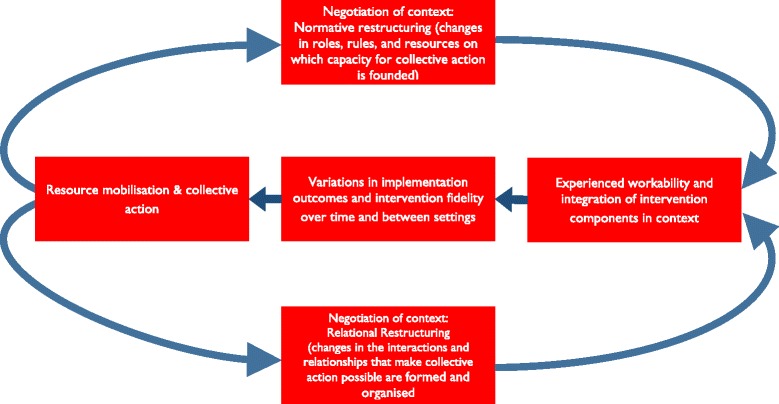
- Uses conceptual definitions in Tables 1 and 2, a figure presenting implementation as feedback loops, and six verifiable propositions; draws on prior literature and process evaluation examples such as MOVE, WISE, and CAREDEM.
- No sample, data collection, or statistical analysis is reported.
Limitations
- The paper states that future work will explore methodological implications, including study design, measurement, and evaluation raised by understanding implementation as non-linear, emergent, and dynamic, and will link micro-/meso-level propositions to macro-level “whole systems” models.
- Evident from the text: the propositions are conceptual and are not empirically tested in this paper.
- Evident from the text: the cited trials are illustrative examples from other studies, not new empirical evidence generated here.
Model-written summary. Check it against the paper before relying on it.
Integrity signals
Registry
Cites
Statistics
Figures
Verification
Claims the paper makes
9 Valid · 5 Not valid · 35 Not checked · 66 Own results and interpretations
Some cited sources support this claim and some don’t — read each source’s verdict below.
In the paper
“This led to a successful intervention.”
§ Implementation, context and complexity > Contexts are negotiated
What the sources say
- Not checked yetcites [57] Kennedy A, Vassilev I, James E, Rogers A. Implementing a social network intervention designed to enhance and diversify support for people with long-term conditions. a qualitative study. Implement Sci. 2016;11(1):1–15.
- Partly supportedcites [84] Blickem C, Kennedy A, Jariwala P, Morris R, Bowen R, Vassilev I, Brooks H, Blakeman T, Rogers A. Aligning everyday life priorities with people’s self-management support networks: an exploration of the work and implementation of a needs-led telephone support system. BMC Health Serv Res. 2014;14(1):262. sourceExperimental — accuracy not yet measured
Our copy does support the 'successful intervention' element: Background > Study aims states 'The BRIGHT trial led to significant improvement in health outcomes' and Results (opening paragraph) concedes 'although the trial resulted in improved patient outcomes'. However, this paper reports those outcome figures only in passing ('These results will be reported in more detail elsewhere') — it is a nested qualitative study of the work of delivering PLANS, not the trial report, and its own findings stress that 'PLANS received a mixed reception', with men particularly resistant and viewing it as an unwanted intrusion in their social life (Discussion). Nothing in our copy makes the causal attribution the citing sentence draws, i.e. that shifting focus to normative/relational restructuring of informal social networks is what produced the success; the paper instead frames normative assumptions as a source of tension ('challenging to normative assumptions about where participants were in life', Results; Conclusions) and describes the emphasis shift as towards personal and community resources rather than as the mechanism of the improved outcomes. (LLM, conf=0.70)
- Disputedcites [85] Reeves D, Blickem C, Vassilev I, Brooks H, Kennedy A, Richardson G. The contribution of social networks to the health and self-management of patients with long-term conditions: a longitudinal study. PloS One. 2014;9:e98340. sourceExperimental — accuracy not yet measured
Our copy of Reeves et al. (2014) is an observational longitudinal study (Methods, Design and Sample Characteristics / Measures of Network Change: baseline face-to-face name-generator interviews plus a 12-month postal follow-up); it designs, delivers and evaluates no intervention, and its Discussion (Summary of Findings) explicitly frames the network-investment benefit as conditional: 'This result clearly needs validation in further studies but if correct, the implication is that considerable health service cost saving could accrue from investing in increasing the illness support people receive from their personal networks.' The paper does re-orientate attention from individual self-management to networks (Introduction; Discussion, Conclusion — 'more meaningfully construed as a collective and networked phenomena'), but it never describes 'normative and relational restructuring' of informal networks, and the same Summary of Findings cautions that network characteristics were largely responding to patient health need ('rally around', positive care law) rather than being deliberately restructured. So the attribution of a resulting 'successful intervention' to this source runs against what our copy states. (LLM, conf=0.68)
Checked by a reasoning model — may be wrong.
- Partly supportedcites [86] Blickem C, Kennedy A, Vassilev I, Morris R, Brooks H, Jariwala P. Linking people with long-term health conditions to healthy community activities: development of patient-Led assessment for network support (PLANS). Health Expect. 2013;16:e48–59. sourceExperimental — accuracy not yet measured
Our copy does support the developmental shift the claim describes: the paper used normalization process theory to guide development of PLANS, orienting it to patients' existing relationships and network support, and the Discussion speaks of 'shifting the emphasis in health provision away from a focus on individuals towards social engagement, well-being and network support' (Discussion). But the paper is a development-and-pilot study only: its strongest outcome statements are pilot acceptability/usability ('There was general support for the PLANS tool'; 'All participants felt that their results were useful and relevant to them', Methods – Piloting the PLANS tool / Box 2), while the Discussion hedges that 'the approach we have developed here may have limitations' and that PLANS 'could also be expected to perform better if [part] of a complex intervention... rather than when used on its own'. No demonstration that the resulting intervention was 'successful' is attributed here; the only patient-outcome evidence in the paper (reduced isolation, increased confidence) is reported from another work it cites (Woodall & South's CHAT social prescribing evaluation, ref. 19, Resources for self-care support: beyond the individual). (LLM, conf=0.70)
plainstates a cause- Asserted: passes — The authors put it forward as true.
- Checkable: passes — It can be checked against evidence.
- Load-bearing: passes — The paper’s conclusions depend on it.
- Based: passes — The paper gives a reason why it holds.
The sources with a verdict support this claim; the rest weren’t checked yet, have no full text we could read, or their verdicts aren’t rated yet.
In the paper
“Changes in the organisation of clinical work in surgery [15, 16], the delivery of telemedicine systems at scale [17, 18] and the scaling out and spread of new health technologies [19, 20], all provide evidence of the role of environmental mechanisms in shaping interventions.”
§ Implementation, context and complexity > Background
What the sources say
- Supportedcites [15] Kellogg KC. Operating room: relational spaces and microinstitutional change in surgery1. Am J Sociol. 2009;115(3):657–711. source
The Introduction describes how a new regulation prompted two teaching hospitals to introduce programs intended to change surgical residents’ work practices. It reports that practice changed at one hospital but not the other; the paper attributes that difference to relational spaces and interactions within the hospitals. This supports the surgery-related example of how context shapes change, without attributing the telemedicine or technology-spread examples to this source. Page numbers are unavailable in our copy. (LLM, conf=0.88)
- Not checked yetcites [16] Kellogg KC, Breen E, Ferzoco SJ, Zinner MJ, Ashley SW. Resistance to change in surgical residency: an ethnographic study of work hours reform. J Am Coll Surg. 2006;202(4):630–6. source
- Supportedcites [17] Sanders C, Rogers A, Bowen R, Bower P, Hirani S, Cartwright M, Fitzpatrick R, Knapp M, Barlow J, Hendy J. Exploring barriers to participation and adoption of telehealth and telecare within the whole system demonstrator trial: a qualitative study. BMC Health Serv Res. 2012;12(1):220. source
The Participants and methods section describes the Whole System Demonstrator trial across three sites, with participating Primary Care Trusts and Local Authorities. The Discussion explicitly says that service changes and existing provider relationships highlight the importance of organizational context for adopting telehealth and telecare. This supports the telemedicine-delivery and environmental-context portion of the citing sentence; the surgery and spread examples are separately cited. (LLM, conf=0.87)
- Supportedcites [18] Agbakoba R, McGee-Lennon M, Bouamrane M-M, Watson N, Mair FS: Implementation factors affecting the large-scale deployment of digital health and well-being technologies: a qualitative study of the initial phases of the ‘Living-It-Up’ programme. Health Informatics J 2015:1460458215594651. [Epub ahead of print] source
The citation is attached to the scaling and spread of new health technologies, not to the surgery or telemedicine examples. The Introduction describes context and stakeholder collaboration as factors in deployment at scale, while the Results section on cultural shifts in work practices reports that organisational behaviours and ways of working affected the integration of new technologies. These passages support the claim that the implementation environment shapes such interventions. (LLM, conf=0.88)
- Not checked yetcites [19] Burri RV. Doing distinctions: boundary work and symbolic capital in radiology. Soc Stud Sci. 2008;38(1):35–62. source
- Not checked yetcites [20] Cox H, Webster A. Translating biomedical science into clinical practice: molecular diagnostics and the determination of malignancy. Health: 2012;17(4):391-406. source
plainstates a cause- Asserted: passes — The authors put it forward as true.
- Checkable: passes — It can be checked against evidence.
- Load-bearing: passes — The paper’s conclusions depend on it.
- Based: passes — The paper gives a reason why it holds.
- Supported
The cited sources support only part of this claim — read each source’s verdict below.
In the paper
“Attempts to understand the dynamics of implementation and to evaluate their effects are either front-loaded into clinical trials in the form of programme theories that specify their expected mode of operation and outcomes or revealed in retrospective ‘process’ evaluations of activity over time and the effects of this activity on outcomes [1, 2].”
§ Implementation, context and complexity > Background
What the sources say
- Not checked yetcites [1] Hawe P. Lessons from complex interventions to improve health. Annu Rev Public Health. 2015;36:307–23. source
- Partly supportedcites [2] Grant A, Treweek S, Dreischulte T, Foy R, Guthrie B. Process evaluations for cluster-randomised trials of complex interventions: a proposed framework for design and reporting. Trials. 2013;14(1):15. sourceExperimental — accuracy not yet measured
The Theory and Process evaluation purpose sections support using theory to specify expected changes and process evaluations to examine implementation and its relationship to outcomes (page numbers unavailable). But the Background says process evaluations can run parallel to trials or follow them, and Reporting process evaluations treats both pre-specified and post-hoc designs as legitimate. The claim’s characterization of process evaluations as retrospective is therefore too narrow. (LLM, conf=0.88)
plain- Asserted: passes — The authors put it forward as true.
- Checkable: passes — It can be checked against evidence.
- Load-bearing: passes — The paper’s conclusions depend on it.
- Based: passes — The paper gives a reason why it holds.
The sources with a verdict support this claim; the rest weren’t checked yet, have no full text we could read, or their verdicts aren’t rated yet.
In the paper
“Process evaluations by Hooker et al. [66, 67], Kennedy et al. [51, 68], Bamford et al. [69], Clarke et al. [46] Godfrey et al. [70] and Ong et al. [71], all show how complex intervention trials are shaped in this way.”
§ Implementation, context and complexity > Context is a dynamic accomplishment
What the sources say
- Supportedcites [66] Hooker L, Small R, Humphreys C, Hegarty K, Taft A. Applying normalization process theory to understand implementation of a family violence screening and care model in maternal and child health nursing practice: a mixed method process evaluation of a randomised controlled trial. Implement Sci. 2015;10(1):39. source
The Methods identify this as a process evaluation of a cluster randomised trial. The Discussion says implementation depended on social, organisational and environmental context, and the Results table identifies specific barriers and enablers. This supports the claim as it applies to Hooker et al. (LLM, conf=0.93)
- Not checked yetcites [67] Hooker L, Small R, Taft A: Understanding sustained domestic violence identification in maternal and child health nurse care: process evaluation from a 2‐year follow‐up of the MOVE trial. J Adv Nurs 2015 source
- Supportedcites [51] Kennedy A, Rogers A, Chew-Graham C, Blakeman T, Bowen R, Gardner C, Lee V, Morris R, Protheroe J. Implementation of a self-management support approach (WISE) across a health system: a process evaluation explaining what did and did not work for organisations, clinicians and patients. Implement Sci. 2014;9(1):129. source
The Introduction identifies this as a process evaluation alongside a randomised trial of a complex intervention. The Discussion explains that how WISE was interpreted in its particular primary-care context contributed to its failure to become embedded in everyday practice. This supports the claim as applied to Kennedy et al.; it does not assess the other named studies. (LLM, conf=0.93)
- Supportedcites [68] Kennedy A, Rogers A, Bowen R, Lee V, Blakeman T, Gardner C, Morris R, Protheroe J, Chew-Graham C. Implementing, embedding and integrating self-management support tools for people with long-term conditions in primary care nursing: a qualitative study. Int J Nurs Stud. 2014;51(8):1103–13. source
The Introduction identifies this qualitative study as a process evaluation of a randomised trial. The Discussion explains how practice finances, performance targets, nurses’ autonomy and established routines affected whether the intervention’s tools were used—supporting the claim that contextual dynamics shaped the trial’s implementation. (LLM, conf=0.92)
- Supportedcites [69] Bamford C, Poole M, Brittain K, Chew-Graham C, Fox C, Iliffe S, Manthorpe J, Robinson L, team C. Understanding the challenges to implementing case management for people with dementia in primary care in England: a qualitative study using normalization process theory. BMC Health Serv Res. 2014;14(1):549. source
The Background describes CAREDEM’s process evaluation as examining the social and organisational factors affecting implementation of a complex dementia case-management intervention. The Discussion (Implications for practice and future research) reports that existing care systems and organisational upheaval in English primary care helped shape what could be implemented in the feasibility study. (LLM, conf=0.90)
plainstates a cause- Asserted: passes — The authors put it forward as true.
- Checkable: passes — It can be checked against evidence.
- Load-bearing: passes — The paper’s conclusions depend on it.
- Based: passes — The paper gives a reason why it holds.
- Supported
The sources with a verdict support this claim; the rest weren’t checked yet, have no full text we could read, or their verdicts aren’t rated yet.
In the paper
“NPT studies (e.g. [18, 48–52]) have focused on contextual and relational integration [21, 23]—the work that actors do to when they realise and execute interventions in organisational and relational settings.”
§ Implementation, context and complexity > The problem of context
What the sources say
- Supportedcites [18] Agbakoba R, McGee-Lennon M, Bouamrane M-M, Watson N, Mair FS: Implementation factors affecting the large-scale deployment of digital health and well-being technologies: a qualitative study of the initial phases of the ‘Living-It-Up’ programme. Health Informatics J 2015:1460458215594651. [Epub ahead of print] source
The Data analysis and theoretical framework section (page unavailable) says the study used NPT to analyse social processes in implementing and integrating the Living-It-Up programme. The Results section on roles and collective aims describes stakeholders developing relationships across organisational structures. This supports citing the paper as an example of an NPT study of implementation in organisational and relational settings; the separate citations [21, 23] accompany the specific terminology. (LLM, conf=0.88)
- Supportedcites [48] Atkins S, Lewin S, Ringsberg K, Thorson A. Provider experiences of the implementation of a new tuberculosis treatment programme: a qualitative study using the normalisation process model. BMC Health Serv Res. 2011;11(1):275. source
The cited paper is an example of a study using the normalisation process model to examine implementation. Its Methods section describes the model as addressing the work of putting practices into effect, and its Results examine both relational integration and contextual integration in the clinic setting. The separate definition cited to [21, 23] need not be attributed to this paper. (LLM, conf=0.86)
- Supportedcites [49] Bamford C, Heaven B, May C, Moynihan P. Implementing nutrition guidelines for older people in residential care homes: a qualitative study using normalization process theory. Implement Sci. 2012;7(1):106. source
The cited paper is itself an NPT study: its Abstract (Methods) says the care-home findings were mapped to NPT constructs. Its Background describes NPT as focusing on the individual and collective work of making an intervention work. The separate citations [21, 23] appear to support the specific phrase “contextual and relational integration,” rather than this paper. (LLM, conf=0.91)
- Supportedcites [50] Drew S, Judge A, May C, Farmer A, Cooper C, Javaid MK, Gooberman-Hill R. Implementation of secondary fracture prevention services after hip fracture: a qualitative study using extended Normalization Process Theory. Implement Sci. 2015;10(1):57. source
The Background identifies this as a study using extended Normalization Process Theory to examine participants’ collective work implementing healthcare services in complex organizational contexts. The Results (Capacity) describe the cooperative work and relationships involved. This supports its citation as an example of an NPT study; the sentence cites other sources for the specific terminology “contextual and relational integration.” (LLM, conf=0.90)
- Supportedcites [51] Kennedy A, Rogers A, Chew-Graham C, Blakeman T, Bowen R, Gardner C, Lee V, Morris R, Protheroe J. Implementation of a self-management support approach (WISE) across a health system: a process evaluation explaining what did and did not work for organisations, clinicians and patients. Implement Sci. 2014;9(1):129. source
The Methods describe an NPT-based process evaluation across organisational, practice-staff and patient levels. The Introduction’s ‘Process evaluation question’ section defines collective action in terms of the relationships and work needed to put an intervention into practice, matching the claim’s description of this study’s focus. The supplied copy gives no page numbers. (LLM, conf=0.88)
- Supportedcites [52] Franx G, Oud M, de Lange J, Wensing M, Grol R. Implementing a stepped-care approach in primary care: results of a qualitative study. Implement Sci. 2012;7(1):8. source
The paper is an example of an NPT study: Methods > Analysis says the authors used NPT constructs to interpret the implementation of stepped care, and Discussion examines clinicians’ shared understanding, engagement, and organization of care. The specific terminology “contextual and relational integration” is attached to different citations in the citing sentence, not attributed specifically to this paper. (LLM, conf=0.88)
- Not checked yetcites [21] May C. A rational model for assessing and evaluating complex interventions in health care. BMC Health Serv Res. 2006;6(86):1–11.
- Not checked yetcites [23] May C, Finch T. Implementation, embedding, and integration: an outline of normalization process theory. Sociology. 2009;43(3):535–54. source
plain- Asserted: passes — The authors put it forward as true.
- Checkable: passes — It can be checked against evidence.
- Load-bearing: unclear — It is unclear whether the paper’s conclusions depend on it.
- Based: passes — The paper gives a reason why it holds.
- Supported
47 more claims · 2 with their cited sources checked
Create a free account to see all 115 claims and to verify the 91 references still open.
- Probably not a substantial claim. 47
- It may state two separate claims as one. 23
- The quote only partly states this claim. 2
Claims other papers make about this one
Each is checked against this paper’s own text: does it say what the citing paper says it does?
The source backs part of the claim, not all of it — or backs it for a different population, condition or comparison.
In the citing paper
“NPT is a theory of implementation that focuses on what people—both individuals and groups—do rather than what they believe or intend, and it has been built up from studies of practice in many different healthcare systems.”
From Using Normalization Process Theory in feasibility studies and process evaluations of complex healthcare interventions: a systematic review (2018) · cites this paper as [10]
Experimental — accuracy not yet measuredThe cited source says what the claim attributes to it.
In the citing paper
“Normalization Process Theory (NPT) identifies, characterises and explains key mechanisms that promote and inhibit the implementation, embedding and integration of new health techniques, technologies and other complex interventions.”
From Using Normalization Process Theory in feasibility studies and process evaluations of complex healthcare interventions: a systematic review (2018) · cites this paper as [10]
The cited source says what the claim attributes to it.
In the citing paper
“NPT is a theory of implementation that focuses on what people—both individuals and groups—do rather than what they believe or intend, and it has been built up from studies of practice in many different healthcare systems.”
From Using Normalization Process Theory in feasibility studies and process evaluations of complex healthcare interventions: a systematic review (2018) · cites this paper as [10]
The cited source says what the claim attributes to it.
In the citing paper
“In the most recent iteration of the theory—Extended Normalization Process Theory (ENPT) [9, 10]—we pointed to the dynamic role of implementation contexts in the mobilisation and negotiation of implementation processes.”
From Using Normalization Process Theory in feasibility studies and process evaluations of complex healthcare interventions: a systematic review (2018) · cites this paper as [10]
The cited source says what the claim attributes to it.
In the citing paper
“In its most recent iteration, we have shown how the basic mechanisms characterised in NPT function as self-organising mechanisms in complex adaptive social systems [10].”
From Using Normalization Process Theory in feasibility studies and process evaluations of complex healthcare interventions: a systematic review (2018) · cites this paper as [10]
2 more claims about this paper
Create a free account to see every claim other papers make about this one.
Self-check
Percentages, sums and reported differences re-computed from the paper’s own numbers.
Each contradiction between two passages listed here was confirmed by an independent check.
Rated minor: it would not touch a result — a value no result rests on, a p-value that stays on the same side of the significance level, or a conflict that is clerical, resolved elsewhere in the paper, or outside its own findings.
In the paper
§ Implementation, context and complexity > Context is a dynamic accomplishment
“and Ong et al. [71]”
§ Implementation, context and complexity > References
“71. Sanders T, Foster NE, Ong BN. Perceptions of general practitioners towards the use of a new system for treating back pain: a qualitative interview study.”
Citations
Cites
Damschroder, L. J., Aron, D. C., Keith, R. E., Kirsh, S. R., Alexander, J. A., & Lowery, J. C. (2009) · Implementation Science · doi:10.1186/1748-5908-4-50 · Cited by 14,496 · cited 4×
“[35]—raises questions about how to discriminate between factors that are at work far beyond the investigative remit of the researcher.”
BackgroundInfluentialThe Theory of Social and Economic Organization.
Delatour, G. S., Weber, M., Henderson, A. M., & Parsons, T. (1948) · American Sociological Review · doi:10.2307/2086579 · Cited by 11,300
Powers, C. H., & Giddens, A. (1988) · Social Forces · doi:10.2307/2579442 · Cited by 8,828
Diffusion of Innovations in Service Organizations: Systematic Review and Recommendations
GREENHALGH, T., ROBERT, G., MACFARLANE, F., BATE, P., & KYRIAKIDOU, O. (2004) · The Milbank Quarterly · doi:10.1111/j.0887-378x.2004.00325.x · Cited by 7,448 · cited 1×
“[33], Rycroft-Malone et al.”
Gluesing, J. C. (2012) · Leadership in Science and Technology: A Reference Handbook · doi:10.4135/9781412994231.n14 · Cited by 3,210
The challenge of complexity in health care
Plsek, P. E., & Greenhalgh, T. (2001) · BMJ · doi:10.1136/bmj.323.7313.625 · Cited by 2,578
(2009) · The SAGE Glossary of the Social and Behavioral Sciences · doi:10.4135/9781412972024.n747 · Cited by 2,442
Implementing, Embedding, and Integrating Practices: An Outline of Normalization Process Theory
May, C., & Finch, T. (2009) · Sociology · doi:10.1177/0038038509103208 · Cited by 2,115
Self-citationThe dynamic sustainability framework: addressing the paradox of sustainment amid ongoing change
Chambers, D. A., Glasgow, R. E., & Stange, K. C. (2013) · Implementation Science · doi:10.1186/1748-5908-8-117 · Cited by 1,724 · cited 1×
“Elasticity The extent to which contexts can be stretched or compressed in ways that make space for intervention components and allow them to fit [89].”
BackgroundOntologies, socio-technical transitions (to sustainability), and the multi-level perspective
Geels, F. W. (2010) · Research Policy · doi:10.1016/j.respol.2010.01.022 · Cited by 1,718 · cited 1×
“Even so, it is hard to accommodate the complicated and interdependent relationships between different structural elements of ‘whole systems’, or to track the pathways through which different macro-level actors and processes shape implementation contexts at meso- and micro-level [39–41].”
Background
Research works printed but not linked: 2
- MRC. A framework for development and evaluation of complex interventions to improve health. London: Medical Research Council; 2000.
- Harre R. Social being. 2nd ed. Oxford: Blackwell Publishers; 1993.
Cited by
Pfadenhauer, L. M., Gerhardus, A., Mozygemba, K., Lysdahl, K. B., Booth, A., Hofmann, B., Wahlster, P., Polus, S., Burns, J., Brereton, L., et al. (2017) · Implementation Science · doi:10.1186/s13012-017-0552-5 · Cited by 1,016
“tive system, where significant changes at a micro, meso or macro level can become manifest over time [92].”
BackgroundNilsen, P., & Bernhardsson, S. (2019) · BMC Health Services Research · doi:10.1186/s12913-019-4015-3 · Cited by 1,014
Braithwaite, J., Churruca, K., Long, J. C., Ellis, L. A., & Herkes, J. (2018) · BMC Medicine · doi:10.1186/s12916-018-1057-z · Cited by 845
“CASs are distributed in space and behave dynamically across time, with idiosyncratic interactions among agents at the local level determining the context, and the present and future behaviors of the system [24].”
BackgroundMethodMay, C. R., Cummings, A., Girling, M., Bracher, M., Mair, F. S., May, C. M., Murray, E., Myall, M., Rapley, T., & Finch, T. (2018) · Implementation Science · doi:10.1186/s13012-018-0758-1 · Cited by 683
“Underpinning these practical questions is one that is fundamental to the social and behavioural sciences—and especially to behavioural economics, sociology and social psychology—which is how can we best understand the dynamics of human agency under conditions of constraint [10]? The important implication of this quest…”
BackgroundInfluentialSelf-citationImplementation science should give higher priority to health equity
Brownson, R. C., Kumanyika, S. K., Kreuter, M. W., & Haire-Joshu, D. (2021) · Implementation Science · doi:10.1186/s13012-021-01097-0 · Cited by 551
“Often context relates to characteristics of a priority population of focus or the setting within which an EBI is being delivered [50, 51].”
Background
Metadata
- Authors
- May, C. R., Johnson, M., & Finch, T.
- Affiliations
- University Hospital Southampton NHS Foundation Trust (GB)
- Newcastle University (GB)
- Corresponding author
- May, Carl R.
- Venue
- Implementation Science
- Published
- 2016-10-19
- Volume
- 11
- Issue
- 1
- Pages
- 141-141
- ISSN
- 1748-5908 (ISSN-L)
- PMC
- PMC5069794
- OpenAlex
- W2535269105
- Semantic Scholar
- 6473263e7f0252fc52c284ce2b6f5c6d170975f8
- Cited by
- 978
- References
- 101
- Citations by year
- 2026: 85 · 2025: 96 · 2024: 112 · 2023: 108 · 2022: 133 · 2021: 125 · 2020: 150 · 2019: 71 · 2018: 61 · 2017: 34
- FWCI
- 103.70
- Type
- journal article
- Language
- en
- Open access
- gold
- doi.org
- Licence
- Locations
- Implementation Science (publishedVersion, cc-by)
- PubMed Central (publishedVersion, cc-by)
- PubMed (publishedVersion)
- ePrints Soton (University of Southampton) (acceptedVersion)
- Northumbria Research Link (Northumbria University) (acceptedVersion)
- LSHTM Research Online (London School of Hygiene and Tropical Medicine) (acceptedVersion)
- Newcastle University ePrints (Newcastle Univesity) (cc-by)
- Funders
- Economic and Social Research Council (ES-062-23-3274)
- Topics
- Health Sciences › Health Professions › General Health Professions › Health Policy Implementation Science
- Social Sciences › Public Administration › Evaluation and Performance Assessment
- Health Sciences › Medicine › Public Health, Environmental and Occupational Health › Clinical practice guidelines implementation
- Keywords
- Normalisation Process Theory, health behavior change, knowledge translation, practice implementation, scaling up interventions, diffusion of innovations, ecological model, complex adaptive systems, self-organization, resource mobilization, collective action, adaptive mechanisms, feedback loops, health improvement
- MeSH terms
- Delivery of Health Care, Humans, Translational Research, Biomedical
About these checks
Registry, retraction, Cites and statistics results are computed, not judged, with one exception: a printed reference that no index lists is read once by a model before it counts as a citation error. Claims are extracted by a model and kept only when their quote appears verbatim in the text; each cited source is then checked, with a model’s help, for whether it says what the claim relies on. Those verdicts can be wrong — read the claim’s quote and the cited source before relying on one.
The claim verdicts this report counts are experimental: their accuracy is not yet measured.
A language model drew the claims from the paper on 2026-10-07, under version 3 of the claim definition (model deepseek-v4.1-flash, prompt extract-v3).
A second model labelled each claim on 2026-10-07 (model jev-1.13-20260917, definition revision gold-guideline-v0.2).
Cited sources are checked with a language model’s help (qwen3.8-omni-flash and gpt-6-sol).
Statistics and arithmetic are recomputed, not judged.
Confidence bands are shown only for fields calibrated on our annotated test set. None is calibrated yet, so no band is shown.
What counts as a claim ›How we measure confidence ›How we check this ›
Are you an author, or do you see a problem with this page? Request a review
How to cite
Cite CoChat for the checks on this page, and the paper for its own findings.
- This page
- CoChat. (2026). Citation check: Implementation, context and complexity. https://app.cochat.ai/papers/10.1186/s13012-016-0506-3
- The paper
- May, C. R., Johnson, M., & Finch, T. (2016). Implementation, context and complexity. Implementation Science. https://doi.org/10.1186/s13012-016-0506-3
Data sources
Bibliographic data: Semantic Scholar, OpenAlex, Crossref.
Contains information from the Semantic Scholar Academic Graph Datasets, made available under the ODC Attribution License (ODC-BY 1.0).
Semantic Scholar’s data is described in: Kinney, R., et al. (2023). The Semantic Scholar Open Data Platform. arXiv:2301.10140.
