

The DOI matches its Crossref record; 45 of the 45 references it cites were found in a registry or an index.
Attrition and generalizability in longitudinal studies: findings from a 15-year population-based study and a Monte Carlo simulation study
Open accessAbstract
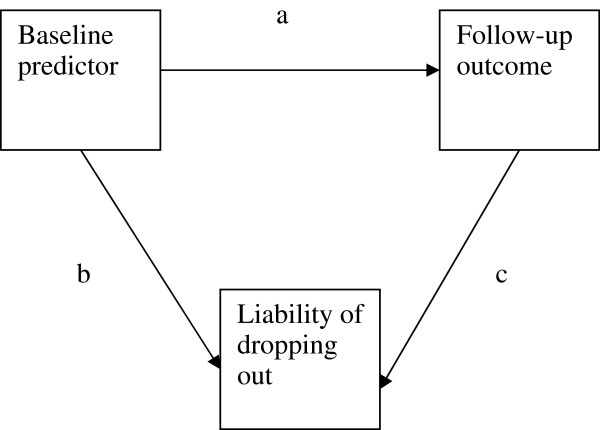
BACKGROUND: Attrition is one of the major methodological problems in longitudinal studies. It can deteriorate generalizability of findings if participants who stay in a study differ from those who drop out. The aim of this study was to examine the degree to which attrition leads to biased estimates of means of variables and associations between them. METHODS: Mothers of 18-month-old children were enrolled in a population-based study in 1993 (N=913) that aimed to examine development in children and their families in the general population. Fifteen years later, 56% of the sample had dropped out. The present study examined predictors of attrition as well as baseline associations between variables among those who stayed and those who dropped out of that study. A Monte Carlo simulation study was also performed. RESULTS: Those who had dropped out of the study over 15 years had lower educational level at baseline than those who stayed, but they did not differ regarding baseline psychological and relationship variables. Baseline correlations were the same among those who stayed and those who later dropped out. The simulation study showed that estimates of means became biased even at low attrition rates and only weak dependency between attrition and follow-up variables. Estimates of associations between variables became biased only when attrition was dependent on both baseline and follow-up variables. Attrition rate did not affect estimates of associations between variables. CONCLUSIONS: Long-term longitudinal studies are valuable for studying associations between risk/protective factors and health outcomes even considering substantial attrition rates.
Overview
The claims and statistics of this paper haven’t been checked yet.
Run the check — free, no account needed. It reads the open-access text and checks the sources it cites.
Integrity signals
Registry
Cites
Statistics
Figures
Verification
Claims the paper makes
The claims and statistics of this paper haven’t been checked yet.
Run the check — free, no account needed. It reads the open-access text and checks the sources it cites.
Claims other papers make about this one
Each is checked against this paper’s own text: does it say what the citing paper says it does?
In the citing paper
“Attrition rates in longitudinal research vary widely [43]”
Self-check
Percentages, sums and reported differences re-computed from the paper’s own numbers.
The self-check needs the paper’s full text.
Citations
Cites
Statistical Power Analysis for the Behavioral Sciences
Muller, K. E., & Cohen, J. (1989) · Technometrics · doi:10.2307/1270020 · Cited by 99,603
Statistical power analysis for the behavioral sciences
Cohen, J. (1990) · Computers Environment and Urban Systems · doi:10.1016/0198-9715(90)90050-4 · Cited by 65,417
Principles and Practice of Structural Equation Modeling
Tabri, N., & Elliott, C. M. (2012) · Canadian Graduate Journal of Sociology and Criminology · doi:10.15353/cgjsc.v1i1.3787 · Cited by 39,094
Statistical power analyses using G∗Power 3.1: tests for correlation and regression analyses
Faul, F., Erdfelder, E., Buchner, A., & Lang, A.-G. (2009) · Behavior Research Methods · doi:10.3758/brm.41.4.1149 · Cited by 37,615
(1998) · Cited by 36,049
Missing data: our view of the state of the art
Schafer, J. L., & Graham, J. W. (2002) · Psychological Methods · doi:10.1037/1082-989x.7.2.147 · Cited by 11,638
What's wrong with Bonferroni adjustments
Perneger, T. V. (1998) · BMJ · doi:10.1136/bmj.316.7139.1236 · Cited by 5,900
Temperament: Early Developing Personality Traits
Buss, A. H., & Plomin, R. J. (1984) · Research Portal (King's College London) · Cited by 2,164
Caspi, A. (1996) · Archives of General Psychiatry · doi:10.1001/archpsyc.1996.01830110071009 · Cited by 1,159
Self‐selection and bias in a large prospective pregnancy cohort in Norway
Nilsen, R. M., Vollset, S. E., Gjessing, H. K., Skjærven, R., Klungsøyr, K., Schreuder, P., Alsaker, E. R., Haug, K., Daltveit, A. K., & Magnus, P. M. (2009) · Paediatric and Perinatal Epidemiology · doi:10.1111/j.1365-3016.2009.01062.x · Cited by 836
Research works printed but not linked: 3
- Schaffer RH: Social Development. 1996, Blackwell Plublishers Inc., Oxford
- Muthén LK, Muthén BO: Mplus user’s guide. 2010, Muthén & Muthén, Los Angeles, 6
- Hesbacher PT, Rickels K, Morris RJ, Newman H, Rosenfeld H: Psychiatric illness in family practice. J Clin Psychiatry. 1980, 41: 6-10.
Cited by
Sorted by citations
Retention strategies in longitudinal cohort studies: a systematic review and meta-analysis
Theme, T. S. L. S., Teague, S. J., Youssef, G. J., Macdonald, J. A., Sciberras, E., Shatte, A. B. R., Fuller‐Tyszkiewicz, M., Greenwood, C. J., McIntosh, J. E., Olsson, C. A., et al. (2018) · BMC Medical Research Methodology · doi:10.1186/s12874-018-0586-7 · Cited by 483
Keith, M. G., Tay, L., & Harms, P. D. (2017) · Frontiers in Psychology · doi:10.3389/fpsyg.2017.01359 · Cited by 319
Asikainen, H., & Gijbels, D. (2017) · Educational Psychology Review · doi:10.1007/s10648-017-9406-6 · Cited by 290
Basso, J. C., McHale, A., Ende, V., Oberlin, D. J., & Suzuki, W. A. (2019) · Behavioural Brain Research · doi:10.1016/j.bbr.2018.08.023 · Cited by 255
Ross, L. A., McSherry, W., Giske, T., van Leeuwen, R., Schep‐Akkerman, A., Koslander, T., Hall, J., Steenfeldt, V. Ø., & Jarvis, P. (2018) · Nurse Education Today · doi:10.1016/j.nedt.2018.05.002 · Cited by 224
Metadata
- Authors
- Gustavson, K., von Soest, T., Karevold, E., & Røysamb, E.
- Affiliations
- Norwegian Institute of Public Health (NO)
- Corresponding author
- Gustavson, Kristin
- Venue
- BMC Public Health
- Published
- 2012-10-29
- Volume
- 12
- Issue
- 1
- Pages
- 918-918
- ISSN
- 1471-2458 (ISSN-L)
- PMC
- PMC3503744
- OpenAlex
- W1995178720
- Cited by
- 679
- References
- 45
- Citations by year
- 2026: 68 · 2025: 84 · 2024: 79 · 2023: 61 · 2022: 75 · 2021: 55 · 2020: 55 · 2019: 36 · 2018: 46 · 2017: 38 · 2016: 20 · 2015: 30 · 2014: 15 · 2013: 11 · 2012: 4
- FWCI
- 18.31
- Type
- journal article
- Language
- en
- Open access
- gold
- doi.org
- Licence
- Locations
- BMC Public Health (publishedVersion, cc-by)
- PubMed Central (publishedVersion, cc-by)
- PubMed (publishedVersion)
- DOAJ (DOAJ: Directory of Open Access Journals) (submittedVersion)
- NORA - Norwegian Open Research Archives (submittedVersion, cc-by)
- Funders
- Norges Forskningsråd
- Topics
- Physical Sciences › Mathematics › Statistics and Probability › Statistical Methods and Bayesian Inference
- Social Sciences › Sociology and Political Science › Survey Methodology and Nonresponse
- Physical Sciences › Mathematics › Statistics and Probability › Statistical Methods in Epidemiology
- Keywords
- attrition, longitudinal study, generalizability, selection bias, dropout, educational attainment, child development, mothers, Monte Carlo simulation
- MeSH terms
- Adult, Computer Simulation, Female, Follow-Up Studies, Humans, Longitudinal Studies, Monte Carlo Method, Mothers, Patient Dropouts, Risk Factors, Time Factors, Bias
About these checks
Registry, retraction, Cites and statistics results are computed, not judged, with one exception: a printed reference that no index lists is read once by a model before it counts as a citation error. Claims are extracted by a model and kept only when their quote appears verbatim in the text; each cited source is then checked, with a model’s help, for whether it says what the claim relies on. Those verdicts can be wrong — read the claim’s quote and the cited source before relying on one.
Statistics and arithmetic are recomputed, not judged.
Confidence bands are shown only for fields calibrated on our annotated test set. None is calibrated yet, so no band is shown.
What counts as a claim ›How we measure confidence ›How we check this ›
Are you an author, or do you see a problem with this page? Request a review
