

Impact of social integration on metabolic functions: evidence from a nationally representative longitudinal study of US older adults
Open accessThe DOI matches its Crossref record; 47 of the 47 references it cites were found in a registry or an index.
Abstract
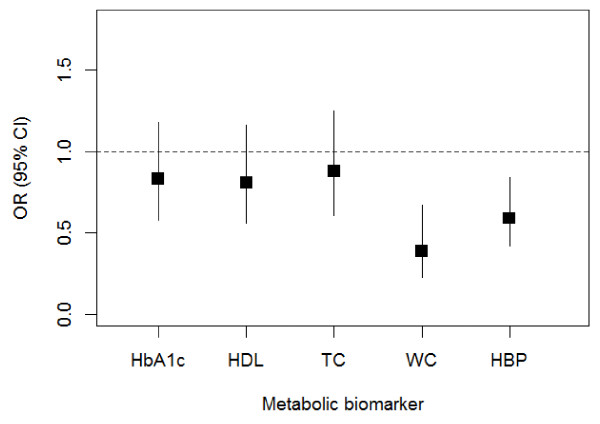
BACKGROUND: Metabolic functions may operate as important biophysiological mechanisms through which social relationships affect health. It is unclear how social embeddedness or the lack thereof is related to risk of metabolic dysregulation. To fill this gap we tested the effects of social integration on metabolic functions over time in a nationally representative sample of older adults in the United States and examined population heterogeneity in the effects. METHODS: Using longitudinal data from 4,323 adults aged over 50 years in the Health and Retirement Study and latent growth curve models, we estimated the trajectories of social integration spanning five waves, 1998-2006, in relation to biomarkers of energy metabolism in 2006. We assessed social integration using a summary index of the number of social ties across five domains. We examined six biomarkers, including total cholesterol, high-density lipoprotein cholesterol, glycosylated hemoglobin, waist circumference, and systolic and diastolic blood pressure, and the summary index of the overall burden of metabolic dysregulation. RESULTS: High social integration predicted significantly lower risks of both individual and overall metabolic dysregulation. Specifically, adjusting for age, sex, race, and body mass index, having four to five social ties reduced the risks of abdominal obesity by 61% (odds ratio [OR] [95% confidence interval {CI}] = 0.39 [0.23, 0.67], p = .007), hypertension by 41% (OR [95% CI] = 0.59 [0.42, 0.84], p = .021), and the overall metabolic dysregulation by 46% (OR [95% CI] = 0.54 [0.40, 0.72], p < .001). The OR for the overall burden remained significant when adjusting for social, behavioral, and illness factors. In addition, stably high social integration had more potent metabolic impacts over time than changes therein. Such effects were consistent across subpopulations and more salient for the younger old (those under age 65), males, whites, and the socioeconomically disadvantaged. CONCLUSIONS: This study addressed important challenges in previous research linking social integration to metabolic health by clarifying the nature and direction of the relationship as it applies to different objectively measured markers and population subgroups. It suggests additional psychosocial and biological pathways to consider in future research on the contributions of social deficits to disease etiology and old-age mortality.
Overview
The claims and statistics of this paper haven’t been checked yet.
Free: it reads the open-access text and checks the first 5 claims that cite a source we can check. Create a free account to check every claim.
Integrity signals
Registry
Cites
Statistics
Figures
Verification
Claims the paper makes
The claims and statistics of this paper haven’t been checked yet.
Free: it reads the open-access text and checks the first 5 claims that cite a source we can check. Create a free account to check every claim.
Claims other papers make about this one
Each is checked against this paper’s own text: does it say what the citing paper says it does?
In the citing paper
“Previous nonexperimental studies using observational data from human subjects tentatively support this proposition by documenting associations between social relationship measures such as social integration and support with biomarkers of inflammation (5,8,18), metabolic syndrome (18,19), and cumulative dysregulation indicated by allostatic load (20).”
From Social relationships and physiological determinants of longevity across the human life span (2016) · cites this paper as [19]
Self-check
Percentages, sums and reported differences re-computed from the paper’s own numbers.
The self-check needs the paper’s full text.
Citations
Cites
Grundy, S. M., Bilheimer, D. W., Chait, A., Clark, L. T., Denke, M. A., Havel, R. J., Hazzard, W. R., Hulley, S. B., Hunninghake, D. B., Kreisberg, R. A., et al. (1993) · JAMA · doi:10.1001/jama.269.23.3015 · Cited by 27,947
Alberti, K. G. M. M., Eckel, R. H., Grundy, S. M., Zimmet, P. Z., Cleeman, J. I., Donato, K. A., Fruchart, J.-C., James, W. P. T., Loria, C. M., & Smith, S. C. (2009) · Circulation · doi:10.1161/circulationaha.109.192644 · Cited by 14,860
Social Relationships and Mortality Risk: A Meta-analytic Review
Holt-Lunstad, J., Smith, T. B., & Layton, J. B. (2010) · PLoS Medicine · doi:10.1371/journal.pmed.1000316 · Cited by 7,272 · cited 1×
“Meta-analyses also suggest that the magnitude of such associations is comparable with that of smoking cessation and exceeds those of many other known risk factors of mortality, such as obesity or physical inactivity [11].”
ResultSocial Relationships and Health
House, J. S., Landis, K. R., & Umberson, D. (1988) · Science · doi:10.1126/science.3399889 · Cited by 7,073 · cited 1×
“Background It has long been believed that the degree to which an individual is embedded in social relations is influential for his or her health and well-being [1-3].”
BackgroundSocial support as a moderator of life stress
Cobb, S. (1976) · Psychosomatic Medicine · doi:10.1097/00006842-197609000-00003 · Cited by 6,936
Ford, E. S., Giles, W. H., & Dietz, W. H. (2002) · JAMA · doi:10.1001/jama.287.3.356 · Cited by 6,698
BERKMAN, L. F., & SYME, S. L. (1979) · American Journal of Epidemiology · doi:10.1093/oxfordjournals.aje.a112674 · Cited by 5,341 · cited 1×
“Background It has long been believed that the degree to which an individual is embedded in social relations is influential for his or her health and well-being [1-3].”
BackgroundFrom social integration to health: durkheim in the new millennium
Berkman, L. F., Glass, T., Brissette, I., & Seeman, T. E. (2000) · Social Science & Medicine · doi:10.1016/s0277-9536(00)00065-4 · Cited by 4,821
Biobehavioral responses to stress in females: Tend-and-befriend, not fight-or-flight.
Taylor, S. E., Klein, L. C., Lewis, B. P., Gruenewald, T. L., Gurung, R. A. R., & Updegraff, J. A. (2000) · Psychological Review · doi:10.1037/0033-295x.107.3.411 · Cited by 3,308 · cited 1×
“The larger residual effect of social integration for males, after the adjustment of an array of social and behavioral factors, is consistent with a previous study that found greater male inflammatory response to social isolation in US adults [14] and may reflect sex-specific stress reactivity patterns that evolved as…”
ResultUchino, B. N., Cacioppo, J. T., & Kiecolt-Glaser, J. K. (1996) · Psychological Bulletin · doi:10.1037/0033-2909.119.3.488 · Cited by 2,727 · cited 1×
“Social isolation, or the lack of social integration and support, has been increasingly related to physiological functioning in general [12] and metabolic disorders in particular, including higher blood pressure (BP) [20], higher waist to hip ratio [21], glucose intolerance [22], lipid abnormalities, and higher prevale…”
Background
Research works printed but not linked: 2
- Crimmins E Faul J Kim JK Guyer H Langa K Ofstedal MB HRS documentation report: documentation of biomarkers in the 2006 and 2008 health and retirement study 2013
- Hobbs F Stoops N Demographic trends in the 20th century 2002 Washington, DC: U.S. Government Printing Office
Cited by
Social relationships and physiological determinants of longevity across the human life span
Yang, Y. C., Boen, C., Gerken, K., Li, T., Schorpp, K., & Harris, K. M. (2016) · Proceedings of the National Academy of Sciences · doi:10.1073/pnas.1511085112 · Cited by 751
Self-citationShiovitz‐Ezra, S., & Parag, O. (2018) · Aging & Mental Health · doi:10.1080/13607863.2018.1488942 · Cited by 246
Psychosocial Risk Factors for Hypertension: an Update of the Literature
Cuffee, Y., Ogedegbe, C., Williams, N. J., Ogedegbe, G., & Schoenthaler, A. (2014) · Current Hypertension Reports · doi:10.1007/s11906-014-0483-3 · Cited by 182
“A high level of social integration, defined as having four to five social ties across five domains of social activities (marital status; contact with parents, children, and neighbors; and volunteer activities) was associated with a 41 % decreased odds of developing elevated BP among participants in the Health and Reti…”
Gender and Social Isolation across the Life Course
Umberson, D., Lin, Z., & Cha, H. (2022) · Journal of Health and Social Behavior · doi:10.1177/00221465221109634 · Cited by 164
Religious and Spiritual Coping and Risk of Incident Hypertension in the Black Women's Health Study
Cozier, Y. C., Yu, J., Wise, L. A., VanderWeele, T. J., Balboni, T. A., Argentieri, M. A., Rosenberg, L. A., Palmer, J. R., & Shields, A. E. (2018) · Annals of Behavioral Medicine · doi:10.1093/abm/kay001 · Cited by 130
Kadambi, S., Soto-Perez-de-Celis, E., Garg, T., Loh, K. P., Krok-Schoen, J. L., Battisti, N. M. L., Moffat, G. T., Gil-Jr, L. A., Mohile, S., & Hsu, T. (2020) · Journal of Geriatric Oncology · doi:10.1016/j.jgo.2019.09.005 · Cited by 123
Volunteering and Cardiovascular Disease Risk: Does Helping Others Get “Under the Skin?”
Burr, J. A., Han, S. H., & Tavares, J. L. (2015) · The Gerontologist · doi:10.1093/geront/gnv032 · Cited by 110
Long-term exposure to greenspace and metabolic syndrome: A Whitehall II study
de Keijzer, C., Basagaña, X., Tonne, C. C., Valentín, A., Alonso, J., Antó, J. M., Nieuwenhuijsen, M. J., Kivimäki, M., Singh‐Manoux, A., Sunyer, J., et al. (2019) · Environmental Pollution · doi:10.1016/j.envpol.2019.113231 · Cited by 107
Social Isolation: An Unequally Distributed Health Hazard
Umberson, D., & Donnelly, R. (2023) · Annual Review of Sociology · doi:10.1146/annurev-soc-031021-012001 · Cited by 99
The physiological impacts of wealth shocks in late life: Evidence from the Great Recession
Boen, C., & Yang, Y. C. (2015) · Social Science & Medicine · doi:10.1016/j.socscimed.2015.12.029 · Cited by 92
Self-citationExamining the Role of Psychosocial Stressors in Hypertension
Marwaha, K. (2022) · Journal of Preventive Medicine and Public Health · doi:10.3961/jpmph.21.266 · Cited by 89
Nakagomi, A., Yasufuku, Y., Ueno, T., & Kondo, K. (2022) · Hypertension Research · doi:10.1038/s41440-022-00972-7 · Cited by 82
Santini, Z. I., Koyanagi, A., Tyrovolas, S., Haro, J. M., Fiori, K. L., Uwakwa, R., Thiyagarajan, J. A., Webber, M., Prince, M. J., & Prina, M. A. (2015) · Social Science & Medicine · doi:10.1016/j.socscimed.2015.10.061 · Cited by 80
Yang, Y. C., Gerken, K., Schorpp, K., Boen, C., & Harris, K. M. (2017) · Biodemography and Social Biology · doi:10.1080/19485565.2017.1279536 · Cited by 69
Self-citationCundiff, J. M., & Matthews, K. A. (2018) · Psychological Science · doi:10.1177/0956797617746510 · Cited by 70
Social Relationships, Inflammation, and Cancer Survival
Boen, C., Barrow, D. A., Bensen, J. T., Farnan, L., Gerstel, A., Hendrix, L. H., & Yang, Y. C. (2018) · Cancer Epidemiology Biomarkers & Prevention · doi:10.1158/1055-9965.epi-17-0836 · Cited by 71
Self-citationAung, M. N., Moolphate, S., Aung, T. N. N., Kantonyoo, C., Khamchai, S., & Wannakrairot, P. (2016) · Clinical Interventions in Aging · doi:10.2147/cia.s108974 · Cited by 67
The Prospective Association of Social Integration With Life Span and Exceptional Longevity in Women
Trudel‐Fitzgerald, C., Zevon, E. S., Kawachi, I. I., Tucker‐Seeley, R. D., Grodstein, F., & Kubzansky, L. D. (2019) · The Journals of Gerontology Series B · doi:10.1093/geronb/gbz116 · Cited by 64
Kraav, S.-L., Awoyemi, O., Junttila, N., Vornanen, R., Kauhanen, J., Toikko, T., Lehto, S. M., Hantunen, S., & Tolmunen, T. (2021) · Aging & Mental Health · doi:10.1080/13607863.2020.1830945 · Cited by 56
Węziak‐Białowolska, D., Białowolski, P., Lee, M. T., Chen, Y., VanderWeele, T. J., & McNeely, E. (2022) · International Journal of Public Health · doi:10.3389/ijph.2022.1604710 · Cited by 47
Loneliness as a risk factor for metabolic syndrome: results from the HUNT study
Henriksen, R. E., Nilsen, R. M., & Strandberg, R. B. (2019) · Journal of Epidemiology & Community Health · doi:10.1136/jech-2019-212335 · Cited by 45
Holt‐Lunstad, J. (2023) · Policy Insights from the Behavioral and Brain Sciences · doi:10.1177/23727322221150204 · Cited by 41
La soledad y el aislamiento social en las personas mayores
Vicente-Arruebarrena, A., & Cabaco, A. S. (2021) · Stvdia zamorensia · doi:10.5944/studiazamo.vol.19.2020.29363 · Cited by 34
Busch, E. L., Whitsel, E. A., Kroenke, C. H., & Yang, Y. C. (2018) · The Breast · doi:10.1016/j.breast.2018.03.013 · Cited by 27
Self-citationChild, S. T., & Albert, M. A. (2018) · Current Cardiovascular Risk Reports · doi:10.1007/s12170-018-0594-5 · Cited by 25
Hosseini, Z., Veenstra, G., Khan, N. A., & Conklin, A. (2020) · Journal of Hypertension · doi:10.1097/hjh.0000000000002688 · Cited by 25
Donnelly, R., Lin, Z., & Umberson, D. (2023) · Social Forces · doi:10.1093/sf/soad027 · Cited by 23
Challa, S. R., Fornal, C. A., Wang, B. C., Boyineni, J., DeVera, R. E., Unnam, P., Song, Y., Soares, M. B., Malchenko, S., Gyarmati, P., et al. (2023) · Chronic Stress · doi:10.1177/24705470231207010 · Cited by 19
Abreu, T. C., Mackenbach, J. D., Heuvelman, F., Schoonmade, L. J., & Beulens, J. W. J. (2023) · SSM - Population Health · doi:10.1016/j.ssmph.2023.101559 · Cited by 16
Shartle, K., Yang, Y. C., Richman, L. S., Belsky, D. W., Aiello, A. E., & Harris, K. M. (2022) · Journal of Aging and Health · doi:10.1177/08982643221087807 · Cited by 15
Self-citationEffects of loneliness and social isolation on mortality and morbidity in middle-aged men
Kraav, S. (2022) · UEF eRepo (University of Eastern Finland) · Cited by 16
Social Connectivity During the COVID-19 Pandemic: Disparities among Medicare Beneficiaries
Jacobs, M., & Ellis, C. (2021) · Journal of Primary Care & Community Health · doi:10.1177/21501327211030135 · Cited by 14
Parker, M., Self‐Brown, S., Rahimi, A., & Fang, X. (2024) · Journal of the American Heart Association · doi:10.1161/jaha.123.030403 · Cited by 13
DelOlmo-Romero, S., Correa‐Rodríguez, M., Sánchez-Martínez, M.-C., Gil-Gutiérrez, R., Ortego‐Centeno, N., & Rueda‐Medina, B. (2023) · Clinical Nursing Research · doi:10.1177/10547738231184935 · Cited by 10
Optimizing Care Across the Continuum for Older Adults with Lung Cancer: A Review
Thompson, L. L., Florissi, C., Yoon, J., Singh, A., & Saraf, A. (2024) · Cancers · doi:10.3390/cancers16223800 · Cited by 9
Preliminary insights into associations between C-reactive protein and social network dynamics
Kornienko, O., Riis, J. L., Davila, M., White, N. S., & Garner, P. W. (2022) · Psychoneuroendocrinology · doi:10.1016/j.psyneuen.2022.105690 · Cited by 9
Hosseini, Z., Safari, A., Khan, N. A., Veenstra, G., & Conklin, A. (2021) · CJC Open · doi:10.1016/j.cjco.2021.09.016 · Cited by 8
Kwon, K. Y., & Kim, J. (2025) · Social Science & Medicine · doi:10.1016/j.socscimed.2025.118874 · Cited by 7
Child, S. T. (2016) · Scholar Commons (University of South Carolina) · Cited by 6
Hosseini, Z., Safari, A., Khan, N. A., Veenstra, G., & Conklin, A. (2021) · Public Health Nutrition · doi:10.1017/s1368980021003724 · Cited by 6
Schoenthaler, A., & Rosenthal, D. M. (2018) · Updates in hypertension and cardiovascular protection · doi:10.1007/978-3-319-59918-2_19 · Cited by 6
Boen, C., & Yang, Y. C. (2018) · Elsevier eBooks · doi:10.1016/b978-0-12-811279-3.00025-2 · Cited by 6
Self-citationThe impact of social networks and social support on mental disorders and mortality
Santini, Z. I. (2016) · Dipòsit Digital de la Universitat de Barcelona (Universitat de Barcelona) · doi:10.13140/rg.2.2.17298.25282 · Cited by 6
Associations between adolescent perceived loneliness and hair cortisol concentration
Anderson, A. M., Sherman, J. P., Fitzpatrick, M. M., Browning, C. R., Kertes, D. A., Mackos, A. R., Pickler, R. H., Smith, L., & Ford, J. L. (2024) · Psychoneuroendocrinology · doi:10.1016/j.psyneuen.2024.107184 · Cited by 5
Health Inequalities—An Embodiment of Caste-Based Inequalities
Ghodajkar, P., & Choudhary, K. K. (2022) · Springer eBooks · doi:10.1007/978-981-19-3128-4_21 · Cited by 5
Bala, C. G., Rusu, A., Fronea, O. F. G., Benedek, T., Pop, C., Vijiiac, A. E., Stănciulescu, D., Dărăbanțiu, D., Román, G., & Dorobanţu, M. (2023) · International Journal of Environmental Research and Public Health · doi:10.3390/ijerph20031736 · Cited by 5
Raza, A., Kaleem, M., Shaikh, M. A. A., Mansoor, F., Ansab, M., Turkmani, M. M., & Khan, U. (2025) · Journal of Clinical Hypertension · doi:10.1111/jch.70064 · Cited by 5
Social integration after moving to a new city predicts lower systolic blood pressure
Roddick, C. M., Christie, C. D., Madden, K. M., & Chen, F. S. (2021) · Psychophysiology · doi:10.1111/psyp.13924 · Cited by 4
Social Isolation and Population Density: Racial and Ethnic Differences Among Older Adults
You, E., Nicholson, N. R., Jacobson, S., Poghosyan, H., Feinn, R., & Charlotte, L. R. (2024) · INQUIRY The Journal of Health Care Organization Provision and Financing · doi:10.1177/00469580241273127 · Cited by 4
Baek, S., Won, J.-U., Lee, Y. M., & Yoon, J. H. (2024) · Public Health · doi:10.1016/j.puhe.2024.04.034 · Cited by 4
Conklin, A., & Guo, P. N. (2024) · Reviews in Cardiovascular Medicine · doi:10.31083/j.rcm2511424 · Cited by 4
Social Integration, Self-Rated Health . . . and Genes?
Das, A. (2019) · Journal of Aging and Health · doi:10.1177/0898264319831513 · Cited by 4
The Social Dimension of Older Ages
Cordella, M., & Poiani, A. (2021) · International perspectives on aging · doi:10.1007/978-3-030-60071-6_6 · Cited by 4
Bapolisi, A. M., Maurage, P., Georges, C. M. G., Petit, G., Balola, M., Cikomola, C., Rimé, B., Philippot, P., Persu, A., & de Timary, P. (2023) · Psychosomatic Medicine · doi:10.1097/psy.0000000000001225 · Cited by 3
Knauft, K. M., Zilioli, S., Tarraf, W., Rorai, V., Perry, T. E., & Lichtenberg, P. A. (2023) · Aging & Mental Health · doi:10.1080/13607863.2023.2282682 · Cited by 2
SOCIAL ISOLATION ACROSS THE ADULT LIFE SPAN: VARIATIONS BY GENDER
Shartle, K. (2023) · Carolina Digital Repository (University of North Carolina at Chapel Hill) · doi:10.17615/qma8-gr34 · Cited by 2
Teyton, A., Nukavarapu, N., Letellier, N., Sears, D. D., Yang, J., Jankowska, M. M., & Benmarhnia, T. (2024) · Environmental Epidemiology · doi:10.1097/ee9.0000000000000326 · Cited by 1
Tret’yakova, L. V., Kvichansky, A. A., Moiseeva, Y. V., Ovchinnikova, V. O., Mamedova, D. I., Nedogreeva, O. A., Лазарева, Н. А., Onufriev, M. V., Gulyaeva, N. V., & Stepanichev, M. Y. (2024) · Journal of Evolutionary Biochemistry and Physiology · doi:10.1134/s0022093024070135 · Cited by 1
Delgado‐Ron, J. A., Orpana, H., Roddick, C. M., Mulligan, K., Pinel, E. C., Helm, P. J., Oliffe, J. L., Coplan, R. J., Benoit, C., Joordens, S., et al. (2026) · SSM - Population Health · doi:10.1016/j.ssmph.2026.101970 · Cited by 1
Når vi alle skal ha livets innspurt hjemme
Bjelland, A. S. H., & Henriksen, R. E. (2019) · Plan · doi:10.18261/issn1504-3045-2019-01-06 · Cited by 2
Wiernik, E. (2016) · theses.fr (ABES) · doi:10.70675/7b5ef2a2z020dz4d24z8044ze1dac2c0b8d0 · Cited by 1
Boen, C. (2017) · Carolina Digital Repository (University of North Carolina at Chapel Hill) · doi:10.17615/r3aj-8827 · Cited by 1
Long-term exposure to greenspace and healthy ageing
Keijzer, D., & Carmen (2019) · Repositori digital de la UPF (Universitat Pompeu Fabra) · Cited by 1
Obesity and Weight Gain in Older People
Valencia, W. M., & Sood, R. (2016) · Springer eBooks · doi:10.1007/978-981-287-080-3_350-1 · Cited by 1
Aldosterone—an Intermediate Factor Linking Psychosocial Stress to Essential Hypertension
Gideon, A. (2024) · KOPS (University of Konstanz) · Cited by 1
Social and Psychological Factors in Cancer and Longevity
Zevon, E. S. (2018) · Digital Access to Scholarship at Harvard (DASH) (Harvard University)
Effect of stress on the development of arterial hypertension
Knyazkova, І. І., Kuzmіnova, N. V., Osovska, N. Y., Богун, М. В., & Vernygorodskyi, S. V. (2016) · Likarska sprava · doi:10.31640/ls-2016(5-6)07
Nobleza, C. O., & Kumar, M. A. (2025) · Current Treatment Options in Neurology · doi:10.1007/s11940-025-00855-5
The relation of social support and blood pressure: Psychological and demographic moderators
Faulkner, L. M. D. (2018) · Maryland Shared Open Access Repository (USMAI Consortium) · doi:10.13016/m2pi99-bly6
Cramm, J. (2024) · eScholarship (California Digital Library)
Zulkefli, N. S. (2016) · Universiti Putra Malaysia Institutional Repository (Universiti Putra Malaysia)
Social Isolation Typologies Among Older Adults: The Intersection of Gender and Sexual Identity
Song, H., & Zhao, Y. (2026) · Research on Aging · doi:10.1177/01640275261435533
Social Physiology: Human homeostasis is more efficient in social proximity
Masalha, M., Cohen, M. T., Aloni, M., Toledo, E., Stahl, E., Shachar, D., Eliav, O., Fuchs, S., & Atzil, S. (2026) · Science Advances · doi:10.1126/sciadv.aeg4937 · Cited by 1
Zafar, M. U., Sher, F., Laraib, Zafar, M. U., & Laraib (2025) · Sociology & Cultural Research Review
Social Determinants of Hypertension: A Focus on Low- and Middle-Income Countries
Haddiya, I., Korbel, Z., Ramdani, S., & Haddiya, E. (2026) · Social medicine · doi:10.71164/socialmedicine.v19i3.2026.1967
Obesity and Weight Gain in Older People
Valencia, W. M., & Sood, R. (2017) · Springer eBooks · doi:10.1007/978-981-287-082-7_350
Du signal nerveux à la réponse hormonale
Colonnese, A., & Panzironi, R. (2026) · doi:10.68559/lsh.libro.23.fr
Mouvement et alternance entre travail et récupération
Colonnese, A., & Panzironi, R. (2026) · doi:10.68559/lsh.libro.19.fr
Melatonin und die Koordination biologischer Rhythmen
Colonnese, A., & Panzironi, R. (2026) · doi:10.68559/lsh.libro.28.de
Glycemia and insulin in the meal response
Colonnese, A., & Panzironi, R. (2026) · doi:10.68559/lsh.libro.2
Variabilité glycémique et altérations précédant le diabète
Colonnese, A., & Panzironi, R. (2026) · doi:10.68559/lsh.libro.3.fr
Oméga-3 et composition des membranes cellulaires
Colonnese, A., & Panzironi, R. (2026) · doi:10.68559/lsh.libro.27.fr
Les défenses immunitaires et leur équilibre métabolique
Colonnese, A., & Panzironi, R. (2026) · doi:10.68559/lsh.libro.6.fr
Alimentazione e cambiamenti delle nostre abitudini
Colonnese, A., & Panzironi, R. (2026) · doi:10.68559/lsh.libro.1.it
Colonnese, A., & Panzironi, R. (2026) · doi:10.68559/lsh.libro.34
Colonnese, A., & Panzironi, R. (2026) · doi:10.68559/lsh.libro.32.fr
Colonnese, A., & Panzironi, R. (2026) · doi:10.68559/lsh.libro.34.es
Omega 3 y composición de las membranas celulares
Colonnese, A., & Panzironi, R. (2026) · doi:10.68559/lsh.libro.27.es
Rauchen und die Mechanismen der Abhängigkeit
Colonnese, A., & Panzironi, R. (2026) · doi:10.68559/lsh.libro.20.de
Las defensas inmunitarias y su equilibrio metabólico
Colonnese, A., & Panzironi, R. (2026) · doi:10.68559/lsh.libro.6.es
Movimento e alternanza tra lavoro e recupero
Colonnese, A., & Panzironi, R. (2026) · doi:10.68559/lsh.libro.19.it
Omega-3 and cell membrane composition
Colonnese, A., & Panzironi, R. (2026) · doi:10.68559/lsh.libro.27
Colonnese, A., & Panzironi, R. (2026) · doi:10.68559/lsh.libro.33.fr
Glucemia e insulina en la respuesta a la comida
Colonnese, A., & Panzironi, R. (2026) · doi:10.68559/lsh.libro.2.es
Typ-2-Diabetes und fortschreitende Stoffwechselverschlechterung
Colonnese, A., & Panzironi, R. (2026) · doi:10.68559/lsh.libro.14.de
Metadata
- Authors
- Yang, Y. C., Li, T., & Ji, Y.
- Affiliations
- UNC Lineberger Comprehensive Cancer Center (US)
- Renmin University of China (CN)
- University of North Carolina at Chapel Hill (US)
- Corresponding author
- Yang, Yang Claire
- Venue
- BMC Public Health
- Published
- 2013-12
- Volume
- 13
- Issue
- 1
- Pages
- 1210-1210
- ISSN
- 1471-2458 (ISSN-L)
- PMC
- PMC3923581
- OpenAlex
- W2172279151
- Semantic Scholar
- cd2d5479a7c574549878da013f87b5160acc5c24
- Cited by
- 68
- References
- 46
- Citations by year
- 2026: 4 · 2025: 3 · 2024: 8 · 2023: 9 · 2022: 7 · 2021: 6 · 2020: 2 · 2019: 7 · 2018: 9 · 2017: 3 · 2016: 4 · 2015: 3 · 2014: 1
- FWCI
- 3.04
- Type
- journal article
- Language
- en
- Open access
- gold
- doi.org
- Licence
- Locations
- BMC Public Health (publishedVersion, cc-by)
- Europe PMC (PubMed Central) (publishedVersion, cc-by)
- PubMed Central (publishedVersion, cc-by)
- PubMed (publishedVersion)
- Carolina Digital Repository (University of North Carolina at Chapel Hill) (submittedVersion)
- UNC Libraries
- Funders
- National Institutes of Health (2r24hd050924-06)
- University of North Carolina at Chapel Hill (R24 HD050924)
- National Institute on Aging (K01AG036745)
- Lineberger Comprehensive Cancer Center, University of North Carolina at Chapel Hill
- Eunice Kennedy Shriver National Institute of Child Health and Human Development (R24 HD-050924)
- Carolina Population Center, University of North Carolina at Chapel Hill (R24HD050924, HD050924)
- Topics
- Social Sciences › Health › Health disparities and outcomes
- Health Sciences › Medicine › Endocrinology, Diabetes and Metabolism › Diabetes, Cardiovascular Risks, and Lipoproteins
- Health Sciences › Medicine › Endocrinology, Diabetes and Metabolism › Adipokines, Inflammation, and Metabolic Diseases
- Keywords
- social integration, social ties, metabolic dysfunction, older adults, abdominal obesity, hypertension, social embeddedness, population heterogeneity, social relationships and health, socioeconomic deprivation, Health and Retirement Study, latent growth curve models, young-old, sex differences, racial differences, cholesterol, HbA1c, waist circumference, blood pressure
- MeSH terms
- Aged, Blood Pressure, Cholesterol, Energy Metabolism, Female, Glycated Hemoglobin, Humans, Interpersonal Relations, Cholesterol, HDL, Longitudinal Studies, Male, Metabolic Diseases, Middle Aged, Risk Factors, United States, Biomarkers, Risk Assessment, Waist Circumference
About these checks
Registry, retraction, Cites and statistics results are computed, not judged, with one exception: a printed reference that no index lists is read once by a model before it counts as a citation error. Claims are extracted by a model and kept only when their quote appears verbatim in the text; each cited source is then checked, with a model’s help, for whether it says what the claim relies on. Those verdicts can be wrong — read the claim’s quote and the cited source before relying on one.
Statistics and arithmetic are recomputed, not judged.
Confidence bands are shown only for fields calibrated on our annotated test set. None is calibrated yet, so no band is shown.
What counts as a claim ›How we measure confidence ›How we check this ›
Are you an author, or do you see a problem with this page? Request a review
Data sources
Bibliographic data: Semantic Scholar, OpenAlex, Crossref.
Contains information from the Semantic Scholar Academic Graph Datasets, made available under the ODC Attribution License (ODC-BY 1.0).
Semantic Scholar’s data is described in: Kinney, R., et al. (2023). The Semantic Scholar Open Data Platform. arXiv:2301.10140.
