

Giving voice to food insecurity in a remote indigenous community in subarctic Ontario, Canada: traditional ways, ways to cope, ways forward
Open accessThe DOI matches its Crossref record; 67 of the 69 references it cites were found in a registry or an index.
Abstract
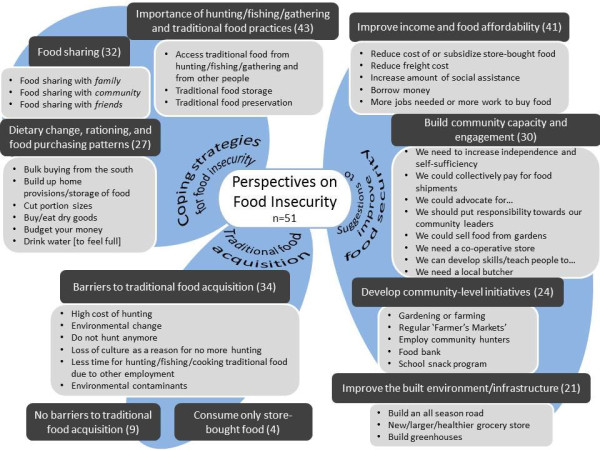
BACKGROUND: Food insecurity is a serious public health issue for Aboriginal people (First Nations [FN], Métis, and Inuit) living in Canada. Food security challenges faced by FN people are unique, especially for those living in remote and isolated communities. Conceptualizations of food insecurity by FN people are poorly understood. The purpose of this study was to explore the perceptions of food insecurity by FN adults living in a remote, on-reserve community in northern Ontario known to have a high prevalence of moderate to severe food insecurity. METHODS: A trained community research assistant conducted semi-directed interviews, and one adult from each household in the community was invited to participate. Questions addressed traditional food, coping strategies, and suggestions to improve community food security and were informed by the literature and a community advisory committee. Thematic data analyses were carried out and followed an inductive, data-driven approach. RESULTS: Fifty-one individuals participated, representing 67% of eligible households. The thematic analysis revealed that food sharing, especially with family, was regarded as one of the most significant ways to adapt to food shortages. The majority of participants reported consuming traditional food (wild meats) and suggested that hunting, preserving and storing traditional food has remained very important. However, numerous barriers to traditional food acquisition were mentioned. Other coping strategies included dietary change, rationing and changing food purchasing patterns. In order to improve access to healthy foods, improving income and food affordability, building community capacity and engagement, and community-level initiatives were suggested. CONCLUSIONS: Findings point to the continued importance of traditional food acquisition and food sharing, as well as community solutions for food systems change. These data highlight that traditional and store-bought food are both part of the strategies and solutions participants suggested for coping with food insecurity. Public health policies to improve food security for FN populations are urgently needed.
Overview
The claims and statistics of this paper haven’t been checked yet.
Free: it reads the open-access text and checks the first 5 claims that cite a source we can check. Create a free account to check every claim.
Integrity signals
Registry
Cites
Statistics
Figures
Verification
Claims the paper makes
The claims and statistics of this paper haven’t been checked yet.
Free: it reads the open-access text and checks the first 5 claims that cite a source we can check. Create a free account to check every claim.
Claims other papers make about this one
Each is checked against this paper’s own text: does it say what the citing paper says it does?
The source backs part of the claim, not all of it — or backs it for a different population, condition or comparison.
In the citing paper
“Successful implementation of such endeavors has valued community engagement and centred Indigenous perspectives and strengths in program planning [1–9].”
From Scale up of the learning circles: a participatory action approach to support local food systems in four diverse First Nations school communities within Canada (2024) · cites this paper as [8]
Experimental — accuracy not yet measured
Self-check
Percentages, sums and reported differences re-computed from the paper’s own numbers.
The self-check needs the paper’s full text.
Citations
Cites
Using thematic analysis in psychology
Braun, V., & Clarke, V. (2006) · Qualitative Research in Psychology · doi:10.1191/1478088706qp063oa · Cited by 194,414 · cited 1×
“Subsequently, data were organized into groups, and “themes” [37] were identified within a subsample of data from ten randomly selected interviews.”
Method(1998) · Sage eBooks · Cited by 38,631
(2006) · Cited by 18,730
(1998) · Cited by 13,501
Handbook of qualitative research
Griffin, T. F. (1999) · Psychology and Marketing · doi:10.1002/(sici)1520-6793(199907)16:4<371::aid-mar7>3.0.co;2-k · Cited by 9,037
Basics of Qualitative Research: Techniques and Procedures for Developing Grounded Theory
Wuetherick, B. (2010) · Canadian Journal of University Continuing Education · doi:10.21225/d5g01t · Cited by 8,311
Constructing grounded theory. A practical guide through qualitative analysis
Brink, E., Dellve, L., Hallberg, U., Abrahamsson, K. H., Klingberg, G., & Wentz, K. (2006) · International Journal of Qualitative Studies on Health and Well-being · doi:10.3402/qhw.v1i3.4932 · Cited by 6,862
Analyzing Social Settings: A Guide To Qualitative Observation And Analysis
Lofland, J., & , J. (1971) · Works - Scholarship, Research, & Creative Expression (Swarthmore College) · Cited by 5,634
Enhancing the quality and credibility of qualitative analysis.
(1999) · PubMed Central · Cited by 4,133
Utilization-Focused Evaluation: The New Century Text. Edition 3.
Patton, M. Q. (1997) · Cited by 1,684
Utilization-focused evaluation : the new century text
Patton, M. Q. (1997) · Cited by 1,469
Reliability in Coding Open-Ended Data: Lessons Learned from HIV Behavioral Research
Hruschka, D. J., Schwartz, D., St.John, D. C., Picone-Decaro, E., Jenkins, R. A., & Carey, J. W. (2004) · Field Methods · doi:10.1177/1525822x04266540 · Cited by 829
Dietary Change and Traditional Food Systems of Indigenous Peoples
Kuhnlein, H. V., & Receveur, O. (1996) · Annual Review of Nutrition · doi:10.1146/annurev.nu.16.070196.002221 · Cited by 595 · cited 3×
“Aboriginal food systems are primarily characterized by two avenues of food provision: the harvesting, sharing and consumption of traditional (or country) foods and the purchasing and consumption of market (or commercial or store-bought) foods [11,12].”
BackgroundEconomic Determinants and Dietary Consequences of Food Insecurity in the United States
Rose, D. (1999) · The Journal of Nutrition · doi:10.1093/jn/129.2.517s · Cited by 567
Dietary Change and Traditional Food Systems of Indigenous Peoples
Kuhnlein, H. V. (1996) · Annual Review of Nutrition · doi:10.1146/annurev.nutr.16.1.417 · Cited by 383
Conceptualizing Food Security for Aboriginal People in Canada
Power, E. M. (2008) · Canadian Journal of Public Health · doi:10.1007/bf03405452 · Cited by 358 · cited 6×
“The knowledge gained can help to tailor food security programs and policies to the unique needs of these communities and population [1,5].”
BackgroundInfluentialCriminological Research: Understanding Qualitative Methods
Wincup, E. (2017) · SAGE Publications Ltd eBooks · doi:10.4135/9781473982802 · Cited by 354
Climate Change, Health, and Vulnerability in Canadian Northern Aboriginal Communities
Furgal, C., & Seguin, J. (2006) · Environmental Health Perspectives · doi:10.1289/ehp.8433 · Cited by 322 · cited 1×
“Similar to findings from this study, the high cost of hunting and environmental change have been cited as barriers to traditional food acquisition and affecting food security for Aboriginal people living in Canada’s north [15,19,48-53].”
ResultFood insecurity in Canadian households.
Che, J., & Chen, J. (2001) · PubMed · Cited by 311
Ford, J. D. (2009) · Regional Environmental Change · doi:10.1007/s10113-008-0060-x · Cited by 262
Alternative food-security indicators: revisiting the frequency and severity of `coping strategies'
Maxwell, D., Ahiadeke, C., Levin, C., Armar-Klemesu, M., Zakariah, S., & Lamptey, G. M. (1999) · Food Policy · doi:10.1016/s0306-9192(99)00051-2 · Cited by 260 · cited 2×
“Less severe forms of food rationing include cutting portion sizes to more severe behaviours such as skipping meals completely [67,71].”
BackgroundKaplan, H., & Gurven, M. (2005) · Moral Sentiments and Material Interests · doi:10.7551/mitpress/4771.003.0007 · Cited by 250
The Prevalence of Food Insecurity Is High and the Diet Quality Poor in Inuit Communities3
Huet, C., Rosol, R., & Egeland, G. M. (2012) · The Journal of Nutrition · doi:10.3945/jn.111.149278 · Cited by 216 · cited 1×
“While numerous food system studies have been published on Inuit people living in the Canadian Arctic in recent years [7,14-23], there are still few food system studies with on-reserve FN communities [12].”
BackgroundFood security in Nunavut, Canada: barriers and recommendations.
Chan, H. M., Fediuk, K., Hamilton, S., Rostas, L., Caughey, A., Kuhnlein, H., Egeland, G., & Loring, E. (2006) · International Journal of Circumpolar Health · doi:10.3402/ijch.v65i5.18132 · Cited by 205 · cited 4×
“This important part of Aboriginal culture and traditions has been documented widely in the literature [6,15,19,55,62-66] including food sharing by the James Bay Cree [57,58].”
BackgroundResultInfluentialWillows, N. D., Veugelers, P., Raine, K., & Kuhle, S. (2009) · Public Health Nutrition · doi:10.1017/s1368980008004345 · Cited by 197 · cited 4×
“Lead authors in this field [1,2,5] have recommended qualitative studies to better understand the food security situation for FN people.”
BackgroundInfluentialTraditional food attributes must be included in studies of food security in the Canadian Arctic
Lambden, J., Receveur, O., & Kuhnlein, H. V. (2007) · International Journal of Circumpolar Health · doi:10.3402/ijch.v66i4.18272 · Cited by 188 · cited 1×
“Lambden and colleagues [30] concluded that traditional food attributes must be included in studies of food security in the Arctic.”
BackgroundNoaks, L., & Wincup, E. (2004) · SAGE Publications Ltd eBooks · doi:10.4135/9781849208789 · Cited by 185 · cited 1×
“listening during interviews [32].”
Food Insecurity among Inuit Women Exacerbated by Socio-economic Stresses and Climate Change
Beaumier, M. C., & Ford, J. D. (2010) · Canadian Journal of Public Health · doi:10.1007/bf03404373 · Cited by 183 · cited 4×
“As northern and remote populations in Canada are continuing to be exposed to external stressors, such as environmental change; they become increasingly reliant on coping mechanisms to maintain food access [14,19].”
BackgroundResultInfluentialA Critical Examination of Community-Based Responses to Household Food Insecurity in Canada
Tarasuk, V. (2001) · Health Education & Behavior · doi:10.1177/109019810102800408 · Cited by 181
Egeland, G. M., Johnson-Down, L., Cao, Z. R., Sheikh, N., & Weiler, H. (2011) · The Journal of Nutrition · doi:10.3945/jn.111.139006 · Cited by 179 · cited 2×
“The importance of traditional food for northern populations has been well documented [18,52,53].”
BackgroundHousehold food insecurity and coping strategies in a poor rural community in Malaysia
Shariff, Z. M., & Khor, G. L. (2008) · Nutrition Research and Practice · doi:10.4162/nrp.2008.2.1.26 · Cited by 174 · cited 1×
“Dietary change, such as consuming less expensive food like rice and pasta, and rationing of food intake are coping mechanisms for food insecurity that emerged from the current interviews and are commonly cited in the literature [67-70].”
BackgroundWillows, N. D. (2019) · PubMed · doi:10.7939/r3-pr1k-nq24 · Cited by 173
Guyot, M., Dickson, C., Paci, C., Furgal, C. M., & Chan, H. M. (2006) · International Journal of Circumpolar Health · doi:10.3402/ijch.v65i5.18135 · Cited by 162 · cited 1×
“Similar to findings from this study, the high cost of hunting and environmental change have been cited as barriers to traditional food acquisition and affecting food security for Aboriginal people living in Canada’s north [15,19,48-53].”
ResultFood insecurity among Inuit preschoolers: Nunavut Inuit Child Health Survey, 2007-2008
Egeland, G. M., Pacey, A., Cao, Z., & Sobol, I. (2010) · Canadian Medical Association Journal · doi:10.1503/cmaj.091297 · Cited by 162 · cited 1×
“While numerous food system studies have been published on Inuit people living in the Canadian Arctic in recent years [7,14-23], there are still few food system studies with on-reserve FN communities [12].”
BackgroundHall, A. L., & Rist, R. C. (1999) · Psychology & Marketing · doi:10.1002/(sici)1520-6793(199907)16:4<291::aid-mar2>3.0.co;2-# · Cited by 136
Traditional and market food access in Arctic Canada is affected by economic factors
Lambden, J., Receveur, O., Marshall, J., & Kuhnlein, H. (2006) · International Journal of Circumpolar Health · doi:10.3402/ijch.v65i4.18117 · Cited by 132 · cited 2×
“, [15,22,31]); 2) During subsequent drafts, questions were reviewed to ensure they were more understandable, culturally appropriate and relevant to the food security issues in FN communities based on consultation with and input from members of the CAC (n = 3) and the investigators’ (n = 3) personal experiences with th…”
BackgroundEvidence-based strategies to build community food security
McCullum, C., Desjardins, E., Kraak, V. I., Ladipo, P., & Costello, H. E. (2005) · Journal of the American Dietetic Association · doi:10.1016/j.jada.2004.12.015 · Cited by 132 · cited 1×
“To determine the consistency of judgment of the coders and to establish inter-rater reliability [41,42], the codes for the themes and subthemes were confirmed by a second independent analyst who had documented expertise with qualitative methods and analysis and expertise on the topic of food security [43,44].”
MethodSelf-citationThe Journey Between Western and Indigenous Research Paradigms
Getty, G. A. (2010) · Journal of Transcultural Nursing · doi:10.1177/1043659609349062 · Cited by 116 · cited 3×
“The theoretical framework for the larger project was based on systems thinking and a critical social theory perspective [29].”
BackgroundInfluentialFORD, J. D., & BEAUMIER, M. (2011) · The Geographical Journal · doi:10.1111/j.1475-4959.2010.00374.x · Cited by 113 · cited 6×
“This important part of Aboriginal culture and traditions has been documented widely in the literature [6,15,19,55,62-66] including food sharing by the James Bay Cree [57,58].”
BackgroundResultInfluentialSkinner, K., Hanning, R., & Tsuji, L. (2006) · International Journal of Circumpolar Health · doi:10.3402/ijch.v65i2.18095 · Cited by 98 · cited 3×
“Fort Albany First Nation was an ideal location for this project for a number of reasons: we have established a community advisory committee with broad community representation; have good rapport with the community and school as we have been working on school programs for healthy eating and physical activity for many y…”
BackgroundMethodResultSelf-citationCommunity Food Security Assessment Toolkit
Cohen, B. R. (2002) · RePEc: Research Papers in Economics · doi:10.22004/ag.econ.347663 · Cited by 93
Lardeau, M., Healey, G., & Ford, J. D. (2011) · Rural and Remote Health · doi:10.22605/rrh1680 · Cited by 89
Berkes, F., George, P. J., Preston, R. J., Hughes, A., Turner, J., & Cummins, B. D. (1994) · ARCTIC · doi:10.14430/arctic1308 · Cited by 83
(2005) · Canadian Journal of Dietetic Practice and Research · doi:10.3148/66.1.2005.43 · Cited by 80
Rosol, R., Huët, C., Wood, M., Lennie, C., Osborne, G., & Egeland, G. M. (2011) · International Journal of Circumpolar Health · doi:10.3402/ijch.v70i5.17862 · Cited by 77
Skinner, K., Hanning, R. M., & Tsuji, L. J. (2014) · Public Health Nutrition · doi:10.1017/s1368980013001705 · Cited by 64
Self-citationThompson, S., Kamal, A. G., Ballard, M., Beardy, B., Islam, D., Lozeznik, V., & wong, K. (2011) · Journal of Aboriginal Economic Development · doi:10.29173/jaed301 · Cited by 62
Ford, J. D., Lardeau, M., & Vanderbilt, W. (2012) · BMC Public Health · doi:10.1186/1471-2458-12-464 · Cited by 60
Schuster, R. C., Wein, E. E., Dickson, C., & Chan, H. M. (2011) · International Journal of Circumpolar Health · doi:10.3402/ijch.v70i3.17833 · Cited by 59
Nancarrow, T., & Chan, L. (2010) · Rural and Remote Health · doi:10.22605/rrh1370 · Cited by 59
Thompson, S., Kamal, A. G., Alam, M. A., & Wiebe, J. (2012) · Canadian journal of nonprofit and social economy research · doi:10.22230/cjnser.2012v3n2a121 · Cited by 56
Norhasmah, S., Zalilah, M. S., Nasir, M. T. M., Kandiah, M., & Asnarulkhadi, A. S. (2010) · PubMed · Cited by 53
Skinner, K. A., Hanning, R. M., Metatawabin, J., Martin, I., & Tsuji, L. J. S. (2012) · Rural and Remote Health · doi:10.22605/rrh2122 · Cited by 52
Self-citationTsuji, L. J. S., Manson, H. R., Wainman, B. C., VanSpronsen, E., Shecapio-Blacksmith, J., & Rabbitskin, T. (2006) · Environmental Monitoring and Assessment · doi:10.1007/s10661-006-9280-z · Cited by 49 · cited 3×
“This important part of Aboriginal culture and traditions has been documented widely in the literature [6,15,19,55,62-66] including food sharing by the James Bay Cree [57,58].”
BackgroundSelf-citationKirby, A. M., Lévesque, L., Wabano, V., & Robertson-Wilson, J. (2007) · International Journal of Behavioral Nutrition and Physical Activity · doi:10.1186/1479-5868-4-63 · Cited by 47
Lemelin, H., Matthews, D., Mattina, C., McIntyre, N., Johnston, M., Koster, R., & Peawanuck, W. F. N. A. (2010) · Rural and Remote Health · doi:10.22605/rrh1333 · Cited by 45
Sustainable food security in the Arctic : state of knowledge
Duhaime, G. (2002) · Medical Entomology and Zoology · Cited by 44
Lead Shot Contamination in Edible Portions of Game Birds and Its Dietary Implications
Tsuji, L. J. S., Nieboer, E., Karagatzides, J. D., Hanning, R. M., & Katapatuk, B. (1999) · Ecosystem Health · doi:10.1046/j.1526-0992.1999.09929.x · Cited by 41
Self-citationSkinner, K. A., Hanning, R. M., Sutherland, C., Edwards-Wheesk, R., & Tsuji, L. J. S. (2012) · American Journal of Health Promotion · doi:10.4278/ajhp.061019136 · Cited by 40 · cited 3×
“Fort Albany First Nation was an ideal location for this project for a number of reasons: we have established a community advisory committee with broad community representation; have good rapport with the community and school as we have been working on school programs for healthy eating and physical activity for many y…”
BackgroundResultSelf-citationGates, A., Hanning, R. M., Gates, M., Skinner, K. A., Martin, I., & Tsuji, L. J. S. (2012) · International Journal of Environmental Research and Public Health · doi:10.3390/ijerph9041379 · Cited by 39
Self-citationFrom subsistence to commercial fishing in Northern Canada: The experience of an Inuk entrepreneur
Gombay, N. (2006) · British Food Journal · doi:10.1108/00070700610676343 · Cited by 37
The Changing Landscape of Arctic Traditional Food
Lougheed, T. (2010) · Environmental Health Perspectives · doi:10.1289/ehp.118-a386 · Cited by 31 · cited 1×
“Similar to findings from this study, the high cost of hunting and environmental change have been cited as barriers to traditional food acquisition and affecting food security for Aboriginal people living in Canada’s north [15,19,48-53].”
ResultAnxiety about food supply in cree women with infants in Quebec
Willows, N. D., Iserhoff, R., Napash, L., Leclerc, L., & Verrall, T. (2005) · International Journal of Circumpolar Health · doi:10.3402/ijch.v64i1.17954 · Cited by 25 · cited 1×
“Regardless of evidence that food insecurity is prevalent in Aboriginal communities, little information is known about the characteristics of the individuals or households experiencing this problem [13].”
BackgroundVulnerability and Adaptive Capacity in Arctic Communities
Sydneysmith, R., Andrachuk, M., Smit, B. E., & Hovelsrud, G. K. (2010) · Springer series on environmental management · doi:10.1007/978-3-642-12194-4_7 · Cited by 18
Robidoux, M. A., Haman, F., & Sethna, C. (2009) · Biodemography and Social Biology · doi:10.1080/19485560903054630 · Cited by 18 · cited 1×
“This important part of Aboriginal culture and traditions has been documented widely in the literature [6,15,19,55,62-66] including food sharing by the James Bay Cree [57,58].”
BackgroundDesjardins, E. (2010) · Scholars Commons (Wilfrid Laurier University) · Cited by 8
Self-citationSpiegelaar, N. (2011) · UWSpace (University of Waterloo) · Cited by 5
Research works printed but not linked: 22
- Health Canada: Canadian Community Health Survey, Cycle 2.2, Nutrition Income-related household food security in Canada 2004 [ http://www.hc-sc.gc.ca/fn-an/alt_formats/hpfb-dgpsa/pdf/surveill/income_food_sec-sec_alim_e.pdf] 2007
- The First Nations Information Governance Centre First Nations Regional Health Survey (RHS) Phase 2 (2008/10) National Report on Adults, Youth and Children Living in First Nations Communities 2012 Ottawa: The First Nations Information Governance Centre
- Agriculture and Agri-Food Canada Canada’s fourth progress report on food security 2006 [ http://www.agr.gc.ca/misb/fsec-seca/pdf/report-rapport_4_e.pdf]23662347
- Dietitians of Canada Community food security: position of Dietitians of Canada 2007 [ http://www.dietitians.ca/Downloadable-Content/Public/cfs-position-paper.aspx]
- Power E Food security for First Nations and Inuit in Canada background paper 2007 Health Canada: Prepared for the First Nations and Inuit Health Branch
- Lincoln YS Guba EG Naturalistic Inquiry 1985 Newbury Park: Sage Publications
- Statistics Canada Concept: census family 2012 Ottawa: Statistics Canada [ http://www.statcan.gc.ca/concepts/definitions/cfamily-rfamille-eng.htm]
- Delormier T Traditional food of the James Bay Cree of Quebec 1993 Ottawa, ON: Final Report to Health and Welfare Canada
- Tsuji LJS Mandatory use of non-toxic shotshell for harvesting of migratory game birds in Canada: cultural and economic concerns Can J Native Stud 1998 18 19 36
- Tsuji LJS Nieboer E A question of sustainability in Cree harvesting practices: the seasons, technological and cultural changes in the western James Bay region of northern Ontario, Canada Can J Native Stud 1999 19 169 192
- Tsuji LJS Edwards E Ashamock M Stephens A Hunter J Edwards R Edwards G Martin ID LeBlanc A Dumas P Spring-harvested game birds from the western James Region of northern Ontario, Canada: organochlorine concentrations in breast tissues 2006 Ottawa, ON: Health Canada Report
- LeBlanc J Veeraraghavan G Food program a hit in Fort Albany 2012 Spring: In The NAN Advocate
- Socha T Zahaf M Chambers L Abraham R Fiddler T Food security in a northern First Nations community: an exploratory study on food availability and accessibility J Aboriginal Health 2012 8 5 14
- Maxwell D Caldwell R The coping strategies index: field methods manual 2008 2 [ http://documents.wfp.org/stellent/groups/public/documents/manual_guide_proced/wfp211058.pdf]
- Tarasuk V Discussion paper on household and individual food insecurity 2001 Health Canada [ http://www.hc-sc.gc.ca/fn-an/nutrition/pol/food_sec_entire-sec_aliments_entier-eng.php]
- McIntyre L Food security: more than a determinant of health 2003 Policy Options [ http://www.irpp.org/po/archive/mar03/mcintyre.pdf]
- LeBlanc J Get Growing program Nishnawbe Aski Nation Annual Report 2011–2012 2012 Thunder Bay, ON: Nishnawbe Aski Nation
- Government of Nunavut A consultation-based review of the harvester support programs of the Government of Nunavut and Nunavut Tunngavik Inc 2008 [ http://www.tunngavik.com/documents/publications/2008-08-11-Review-of-Harvester-Support-Programs-Final-Report-ENG.pdf]
- No author An Act respecting the support program for Inuit beneficiaries of the James Bay and Northern Québec agreement for their hunting, fishing and trapping activities, RSQ, c P-30.2 2006 [ http://canlii.ca/t/hbqv]
- Food Secure Canada Preliminary program for Powering up Food for the Future: Food Secure Canada’s 7th National Assembly 2012 [ http://foodsecurecanada.org/sites/foodsecurecanada.org/files/FSC-EdmontonProgram-web.pdf]
- Food Secure Canada Conference ‘PoweringUP-Food for the Future!’ 2012 [ http://storify.com/milzofsmilz/pwrup2012-food-secure-canada-conference-poweringu]
- Food Secure Canada Resetting the table: a people’s food policy for Canada 2011 [ http://foodsecurecanada.org/sites/foodsecurecanada.org/files/FSC-resetting2012-8half11-lowres-EN.pdf]12455339
Cited by
Food sovereignty, food security and health equity: a meta-narrative mapping exercise
Weiler, A. M., Hergesheimer, C., Brisbois, B., Wittman, H., Yassi, A., & Spiegel, J. M. (2015) · Health Policy and Planning · doi:10.1093/heapol/czu109 · Cited by 194
“Throughout the eight pathways, in addition, articles underscore how social determinants such as gender, racialization, indigeneity, poverty, citizenship and HIV status tend to exacerbate or qualitatively alter people’s experience of health inequities in the food system (e.g. Akinboade 2008; MetallinosKatsaras et al. 2…”
BackgroundRetail food environments research in Canada: A scoping review
Minaker, L. M., Shuh, A., Olstad, D. L., Engler‐Stringer, R., Black, J., & Mah, C. L. (2016) · Canadian Journal of Public Health · doi:10.17269/cjph.107.5344 · Cited by 153
Shafiee, M., Keshavarz, P., Lane, G. L., Pahwa, P., Szafron, M., Jennings, D., & Vatanparast, H. (2022) · Advances in Nutrition · doi:10.1093/advances/nmac081 · Cited by 109
Conducting Interviews During the COVID-19 Pandemic and Beyond
Self, B. (2021) · Forum qualitative Sozialforschung · doi:10.17169/fqs-22.3.3741 · Cited by 105
“Semi-structured interviews in general have been presented as a way of empowering participants by providing a platform for their voices to be heard (SKINNER, HANNING, DESJARDINS & TSUJI, 2013).”
Batal, M., Chan, H. M., Fediuk, K., Ing, A., Berti, P. R., Mercille, G., Sadik, T., & Johnson‐Down, L. (2021) · Canadian Journal of Public Health · doi:10.17269/s41997-021-00491-x · Cited by 103
Metadata
- Authors
- Skinner, K., Hanning, R. M., Desjardins, E., & Tsuji, L. J.
- Affiliations
- University of Waterloo (CA)
- Corresponding author
- Skinner, Kelly
- Venue
- BMC Public Health
- Published
- 2013-05-02
- Volume
- 13
- Issue
- 1
- Pages
- 427-427
- ISSN
- 1471-2458 (ISSN-L)
- PMC
- PMC3651721
- OpenAlex
- W2071579347
- Cited by
- 135
- References
- 69
- Citations by year
- 2026: 6 · 2025: 8 · 2024: 17 · 2023: 16 · 2022: 11 · 2021: 22 · 2020: 13 · 2019: 8 · 2018: 9 · 2017: 2 · 2016: 10 · 2015: 3 · 2014: 8 · 2013: 1
- FWCI
- 13.21
- Type
- journal article
- Language
- en
- Open access
- gold
- doi.org
- Licence
- Locations
- BMC Public Health (publishedVersion, cc-by)
- Europe PMC (PubMed Central) (publishedVersion, cc-by)
- PubMed Central (publishedVersion, cc-by)
- PubMed (publishedVersion)
- Funders
- Canadian Foundation for Dietetic Research
- Canadian Institutes of Health Research
- Topics
- Health Sciences › Medicine › Public Health, Environmental and Occupational Health › Food Security and Health in Diverse Populations
- Social Sciences › Health › Indigenous Health, Education, and Rights
- Social Sciences › Anthropology › Indigenous Studies and Ecology
- Keywords
- food insecurity, First Nations, remote Indigenous communities, traditional food, food sharing, coping strategies, food affordability, food system transformation
- MeSH terms
- Adult, Arctic Regions, Diet, Inuit, Female, Food Supply, Humans, Interviews as Topic, Male, Middle Aged, Ontario, Residence Characteristics, Rural Population, Socioeconomic Factors, Resource Allocation, Population Groups, Resilience, Psychological, Young Adult
About these checks
Registry, retraction, Cites and statistics results are computed, not judged, with one exception: a printed reference that no index lists is read once by a model before it counts as a citation error. Claims are extracted by a model and kept only when their quote appears verbatim in the text; each cited source is then checked, with a model’s help, for whether it says what the claim relies on. Those verdicts can be wrong — read the claim’s quote and the cited source before relying on one.
Statistics and arithmetic are recomputed, not judged.
Confidence bands are shown only for fields calibrated on our annotated test set. None is calibrated yet, so no band is shown.
What counts as a claim ›How we measure confidence ›How we check this ›
Are you an author, or do you see a problem with this page? Request a review
Data sources
Bibliographic data: Semantic Scholar, OpenAlex, Crossref.
Contains information from the Semantic Scholar Academic Graph Datasets, made available under the ODC Attribution License (ODC-BY 1.0).
Semantic Scholar’s data is described in: Kinney, R., et al. (2023). The Semantic Scholar Open Data Platform. arXiv:2301.10140.
