

Giving voice to food insecurity in a remote indigenous community in subarctic Ontario, Canada: traditional ways, ways to cope, ways forward
Open accessThe DOI matches its Crossref record; 67 of the 69 references it cites were found in a registry or an index.
Abstract
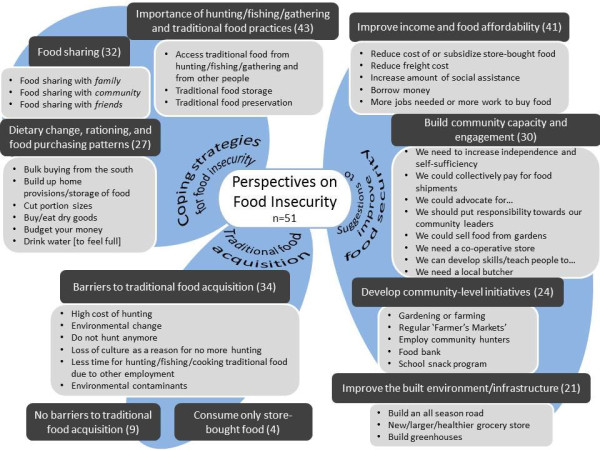
BACKGROUND: Food insecurity is a serious public health issue for Aboriginal people (First Nations [FN], Métis, and Inuit) living in Canada. Food security challenges faced by FN people are unique, especially for those living in remote and isolated communities. Conceptualizations of food insecurity by FN people are poorly understood. The purpose of this study was to explore the perceptions of food insecurity by FN adults living in a remote, on-reserve community in northern Ontario known to have a high prevalence of moderate to severe food insecurity. METHODS: A trained community research assistant conducted semi-directed interviews, and one adult from each household in the community was invited to participate. Questions addressed traditional food, coping strategies, and suggestions to improve community food security and were informed by the literature and a community advisory committee. Thematic data analyses were carried out and followed an inductive, data-driven approach. RESULTS: Fifty-one individuals participated, representing 67% of eligible households. The thematic analysis revealed that food sharing, especially with family, was regarded as one of the most significant ways to adapt to food shortages. The majority of participants reported consuming traditional food (wild meats) and suggested that hunting, preserving and storing traditional food has remained very important. However, numerous barriers to traditional food acquisition were mentioned. Other coping strategies included dietary change, rationing and changing food purchasing patterns. In order to improve access to healthy foods, improving income and food affordability, building community capacity and engagement, and community-level initiatives were suggested. CONCLUSIONS: Findings point to the continued importance of traditional food acquisition and food sharing, as well as community solutions for food systems change. These data highlight that traditional and store-bought food are both part of the strategies and solutions participants suggested for coping with food insecurity. Public health policies to improve food security for FN populations are urgently needed.
Overview
The claims and statistics of this paper haven’t been checked yet.
Free: it reads the open-access text and checks the first 5 claims that cite a source we can check. Create a free account to check every claim.
Integrity signals
Registry
Cites
Statistics
Figures
Verification
Claims the paper makes
The claims and statistics of this paper haven’t been checked yet.
Free: it reads the open-access text and checks the first 5 claims that cite a source we can check. Create a free account to check every claim.
Claims other papers make about this one
Each is checked against this paper’s own text: does it say what the citing paper says it does?
The source backs part of the claim, not all of it — or backs it for a different population, condition or comparison.
In the citing paper
“Successful implementation of such endeavors has valued community engagement and centred Indigenous perspectives and strengths in program planning [1–9].”
From Scale up of the learning circles: a participatory action approach to support local food systems in four diverse First Nations school communities within Canada (2024) · cites this paper as [8]
Experimental — accuracy not yet measured
Self-check
Percentages, sums and reported differences re-computed from the paper’s own numbers.
The self-check needs the paper’s full text.
Citations
Cites
Using thematic analysis in psychology
Braun, V., & Clarke, V. (2006) · Qualitative Research in Psychology · doi:10.1191/1478088706qp063oa · Cited by 194,414 · cited 1×
“Subsequently, data were organized into groups, and “themes” [37] were identified within a subsample of data from ten randomly selected interviews.”
Method(1998) · Sage eBooks · Cited by 38,631
(2006) · Cited by 18,730
(1998) · Cited by 13,501
Handbook of qualitative research
Griffin, T. F. (1999) · Psychology and Marketing · doi:10.1002/(sici)1520-6793(199907)16:4<371::aid-mar7>3.0.co;2-k · Cited by 9,037
Basics of Qualitative Research: Techniques and Procedures for Developing Grounded Theory
Wuetherick, B. (2010) · Canadian Journal of University Continuing Education · doi:10.21225/d5g01t · Cited by 8,311
Constructing grounded theory. A practical guide through qualitative analysis
Brink, E., Dellve, L., Hallberg, U., Abrahamsson, K. H., Klingberg, G., & Wentz, K. (2006) · International Journal of Qualitative Studies on Health and Well-being · doi:10.3402/qhw.v1i3.4932 · Cited by 6,862
Analyzing Social Settings: A Guide To Qualitative Observation And Analysis
Lofland, J., & , J. (1971) · Works - Scholarship, Research, & Creative Expression (Swarthmore College) · Cited by 5,634
Enhancing the quality and credibility of qualitative analysis.
(1999) · PubMed Central · Cited by 4,133
Utilization-Focused Evaluation: The New Century Text. Edition 3.
Patton, M. Q. (1997) · Cited by 1,684
Research works printed but not linked: 22
- Health Canada: Canadian Community Health Survey, Cycle 2.2, Nutrition Income-related household food security in Canada 2004 [ http://www.hc-sc.gc.ca/fn-an/alt_formats/hpfb-dgpsa/pdf/surveill/income_food_sec-sec_alim_e.pdf] 2007
- The First Nations Information Governance Centre First Nations Regional Health Survey (RHS) Phase 2 (2008/10) National Report on Adults, Youth and Children Living in First Nations Communities 2012 Ottawa: The First Nations Information Governance Centre
- Agriculture and Agri-Food Canada Canada’s fourth progress report on food security 2006 [ http://www.agr.gc.ca/misb/fsec-seca/pdf/report-rapport_4_e.pdf]23662347
- Dietitians of Canada Community food security: position of Dietitians of Canada 2007 [ http://www.dietitians.ca/Downloadable-Content/Public/cfs-position-paper.aspx]
- Power E Food security for First Nations and Inuit in Canada background paper 2007 Health Canada: Prepared for the First Nations and Inuit Health Branch
- Lincoln YS Guba EG Naturalistic Inquiry 1985 Newbury Park: Sage Publications
- Statistics Canada Concept: census family 2012 Ottawa: Statistics Canada [ http://www.statcan.gc.ca/concepts/definitions/cfamily-rfamille-eng.htm]
- Delormier T Traditional food of the James Bay Cree of Quebec 1993 Ottawa, ON: Final Report to Health and Welfare Canada
- Tsuji LJS Mandatory use of non-toxic shotshell for harvesting of migratory game birds in Canada: cultural and economic concerns Can J Native Stud 1998 18 19 36
- Tsuji LJS Nieboer E A question of sustainability in Cree harvesting practices: the seasons, technological and cultural changes in the western James Bay region of northern Ontario, Canada Can J Native Stud 1999 19 169 192
- Tsuji LJS Edwards E Ashamock M Stephens A Hunter J Edwards R Edwards G Martin ID LeBlanc A Dumas P Spring-harvested game birds from the western James Region of northern Ontario, Canada: organochlorine concentrations in breast tissues 2006 Ottawa, ON: Health Canada Report
- LeBlanc J Veeraraghavan G Food program a hit in Fort Albany 2012 Spring: In The NAN Advocate
- Socha T Zahaf M Chambers L Abraham R Fiddler T Food security in a northern First Nations community: an exploratory study on food availability and accessibility J Aboriginal Health 2012 8 5 14
- Maxwell D Caldwell R The coping strategies index: field methods manual 2008 2 [ http://documents.wfp.org/stellent/groups/public/documents/manual_guide_proced/wfp211058.pdf]
- Tarasuk V Discussion paper on household and individual food insecurity 2001 Health Canada [ http://www.hc-sc.gc.ca/fn-an/nutrition/pol/food_sec_entire-sec_aliments_entier-eng.php]
- McIntyre L Food security: more than a determinant of health 2003 Policy Options [ http://www.irpp.org/po/archive/mar03/mcintyre.pdf]
- LeBlanc J Get Growing program Nishnawbe Aski Nation Annual Report 2011–2012 2012 Thunder Bay, ON: Nishnawbe Aski Nation
- Government of Nunavut A consultation-based review of the harvester support programs of the Government of Nunavut and Nunavut Tunngavik Inc 2008 [ http://www.tunngavik.com/documents/publications/2008-08-11-Review-of-Harvester-Support-Programs-Final-Report-ENG.pdf]
- No author An Act respecting the support program for Inuit beneficiaries of the James Bay and Northern Québec agreement for their hunting, fishing and trapping activities, RSQ, c P-30.2 2006 [ http://canlii.ca/t/hbqv]
- Food Secure Canada Preliminary program for Powering up Food for the Future: Food Secure Canada’s 7th National Assembly 2012 [ http://foodsecurecanada.org/sites/foodsecurecanada.org/files/FSC-EdmontonProgram-web.pdf]
- Food Secure Canada Conference ‘PoweringUP-Food for the Future!’ 2012 [ http://storify.com/milzofsmilz/pwrup2012-food-secure-canada-conference-poweringu]
- Food Secure Canada Resetting the table: a people’s food policy for Canada 2011 [ http://foodsecurecanada.org/sites/foodsecurecanada.org/files/FSC-resetting2012-8half11-lowres-EN.pdf]12455339
Cited by
Food sovereignty, food security and health equity: a meta-narrative mapping exercise
Weiler, A. M., Hergesheimer, C., Brisbois, B., Wittman, H., Yassi, A., & Spiegel, J. M. (2015) · Health Policy and Planning · doi:10.1093/heapol/czu109 · Cited by 194
“Throughout the eight pathways, in addition, articles underscore how social determinants such as gender, racialization, indigeneity, poverty, citizenship and HIV status tend to exacerbate or qualitatively alter people’s experience of health inequities in the food system (e.g. Akinboade 2008; MetallinosKatsaras et al. 2…”
BackgroundRetail food environments research in Canada: A scoping review
Minaker, L. M., Shuh, A., Olstad, D. L., Engler‐Stringer, R., Black, J., & Mah, C. L. (2016) · Canadian Journal of Public Health · doi:10.17269/cjph.107.5344 · Cited by 153
Shafiee, M., Keshavarz, P., Lane, G. L., Pahwa, P., Szafron, M., Jennings, D., & Vatanparast, H. (2022) · Advances in Nutrition · doi:10.1093/advances/nmac081 · Cited by 109
Conducting Interviews During the COVID-19 Pandemic and Beyond
Self, B. (2021) · Forum qualitative Sozialforschung · doi:10.17169/fqs-22.3.3741 · Cited by 105
“Semi-structured interviews in general have been presented as a way of empowering participants by providing a platform for their voices to be heard (SKINNER, HANNING, DESJARDINS & TSUJI, 2013).”
Batal, M., Chan, H. M., Fediuk, K., Ing, A., Berti, P. R., Mercille, G., Sadik, T., & Johnson‐Down, L. (2021) · Canadian Journal of Public Health · doi:10.17269/s41997-021-00491-x · Cited by 103
Soma, T., & Nuckchady, B. (2021) · Frontiers in Communication · doi:10.3389/fcomm.2021.762201 · Cited by 102
“Concerns around inequity in the food system are addressed in the various works of social scientists ranging from the lack of justice in migrant labour (Weiler et al., 2017), to inequities in food access for Indigenous peoples (Skinner et al., 2013) and more.”
BackgroundSowerwine, J., Mucioki, M., Sarna‐Wojcicki, D., & Hillman, L. (2019) · Food Security · doi:10.1007/s12571-019-00925-y · Cited by 89
“On the other hand, qualitative and mixedmethods studies focus more on the history of colonialism and its legacy on native food systems as well as coping strategies for food insecurity (Skinner et al. 2013), experiences of food insecurity (Ford and Beaumier 2011), barriers to native food access and consumption (Cidero…”
InfluentialSkinner, K. A., Pratley, E., & Burnett, K. (2016) · Societies · doi:10.3390/soc6020007 · Cited by 81
“Indigenous food security in remote, rural, and on-reserve populations has been well studied in Canada, the United States, and Australia [1–7].”
BackgroundSelf-citationDomingo, A., Charles, K.-A., Jacobs, M., Brooker, D., & Hanning, R. M. (2021) · International Journal of Environmental Research and Public Health · doi:10.3390/ijerph18094404 · Cited by 82
Self-citationSustainable Food System Assessment: Lessons from Global Practice
Blay-Palmer, A., Conaré, D., Meter, K., Battista, A. D., & Johnston, C. (2019) · Routledge eBooks · doi:10.4324/9780429439896 · Cited by 74
Enhancing Māori food security using traditional kai
McKerchar, C., Bowers, S., Heta, C., Signal, L. N., & Matoe, L. (2014) · Global Health Promotion · doi:10.1177/1757975914543573 · Cited by 72
“Traditional food acquisition and food sharing continue to be important to indigenous communities (72,73).”
BackgroundGenuis, S. K., Willows, N. D., Nation, A. F., & Jardine, C. G. (2014) · Child Care Health and Development · doi:10.1111/cch.12182 · Cited by 64
“2012), food security and body weights are sensitive topics for discussion and investigation in both Indigenous and other communities (Coates et al. 2006; Walker et al. 2007; Skinner et al. 2013).”
BackgroundFrom landscape practices to ecosystem services: Landscape valuation in Indigenous contexts
Bélisle, A. C., Wapachee, A., & Asselin, H. (2020) · Ecological Economics · doi:10.1016/j.ecolecon.2020.106858 · Cited by 62
What Is Wellbeing, and What Is Important for Wellbeing? Indigenous Voices from across Canada
Tsuji, S. R. J., Zuk, A. M., Solomon, A., Edwards-Wheesk, R., Ahmed, F., & Tsuji, L. J. S. (2023) · International Journal of Environmental Research and Public Health · doi:10.3390/ijerph20176656 · Cited by 60
Self-citationLâm, S., Dodd, W., Skinner, K. A., Papadopoulos, A., Zivot, C., Ford, J. D., Garcia, P. J., & Harper, S. L. (2019) · Environmental Research Letters · doi:10.1088/1748-9326/ab13e4 · Cited by 57
Self-citationConducting Interviews during the COVID-19 Pandemic and Beyond
Self, B. (2021) · Inter · doi:10.19181/inter.2021.13.4.1 · Cited by 56
Majowicz, S. E., Meyer, S. B., Kirkpatrick, S. I., Graham, J. L., Shaikh, A., Elliott, S. J., Minaker, L. M., Scott, S., & Laird, B. D. (2016) · BMC Public Health · doi:10.1186/s12889-016-3142-6 · Cited by 51
“Dietary contaminants (none) Traditional foods and diet [123, 138, 147]”
BackgroundBarbeau, C. D., Oelbermann, M., Karagatzides, J. D., & Tsuji, L. J. S. (2015) · Sustainability · doi:10.3390/su7055664 · Cited by 48
Self-citationSupporting food security for Indigenous families through the restoration of Indigenous foodways
Richmond, C. A. M., Kerr, R. B., Neufeld, H. T., Steckley, M., Wilson, K., & Dokis, B. (2021) · Canadian Geographies / Géographies canadiennes · doi:10.1111/cag.12677 · Cited by 49
The Retail Food Sector and Indigenous Peoples in High-Income Countries: A Systematic Scoping Review
Kenny, T., Little, M., Lemieux, T., Griffin, P. J., Wesche, S. D., Ota, Y., Batal, M., Chan, H. M., & Lemire, M. (2020) · International Journal of Environmental Research and Public Health · doi:10.3390/ijerph17238818 · Cited by 46
“, direct exchanges between northern fishers and southern farmers [148], bulk ordering for community [70,142], and sourcing food from local producers [161,202], there are considerable challenges to practical implementation.”
Organ, J. F., Castleden, H. E., Furgal, C. M., Sheldon, T., & Hart, C. (2014) · Health & Place · doi:10.1016/j.healthplace.2014.09.012 · Cited by 53
Impacts of place and social spaces on traditional food systems in southwestern Ontario
Neufeld, H. T., & Richmond, C. A. M. (2017) · International Journal of Indigenous Health · doi:10.18357/ijih112201716903 · Cited by 44
Jernigan, V. B. B., Williams, M., Wetherill, M., Taniguchi, T., Jacob, T., Cannady, T., Grammar, M., Standridge, J., Fox, J., Wiley, A., et al. (2018) · Preventive Medicine Reports · doi:10.1016/j.pmedr.2018.06.012 · Cited by 41
Piaskoski, A., Reilly, K. C., & Gilliland, J. (2020) · Family & Community Health · doi:10.1097/fch.0000000000000273 · Cited by 41
Haynes, E., Bhagtani, D., Iese, V., Brown, C. R., Fesaitu, J., Hambleton, I. R., Badrie, N., Kroll, F., Guell, C., Brugulat-Panés, A., et al. (2020) · Nutrients · doi:10.3390/nu12113350 · Cited by 41
Tsuji, L. J. S., Tsuji, S. R. J., Zuk, A. M., Davey, R., & Liberda, E. N. (2020) · International Journal of Environmental Research and Public Health · doi:10.3390/ijerph17218113 · Cited by 40
“It then follows that any type of potential food insecurity intervention should ideally incorporate the activity of sharing within its framework [16].”
BackgroundSelf-citationSkinner, K. A., Hanning, R. M., Sutherland, C., Edwards-Wheesk, R., & Tsuji, L. J. S. (2012) · American Journal of Health Promotion · doi:10.4278/ajhp.061019136 · Cited by 40
Self-citationWillows, N. D., Johnson‐Down, L., Moubarac, J., Lucas, M., Robinson, E., & Batal, M. (2018) · International Journal of Circumpolar Health · doi:10.1080/22423982.2018.1536251 · Cited by 39
Hoop House Gardening in the Wapekeka First Nation as an Extension of Land-Based Food Practices
Thompson, H. A., Mason, C. W., & Robidoux, M. A. (2018) · ARCTIC · doi:10.14430/arctic4746 · Cited by 38
“…al., 2009); the high cost and low availability of quality, healthy market food (Power, 2008; Ford, 2009; Socha et al., 2012); the lack of government support for nutritious food programs (Skinner et al., 2013); the loss of traditional knowledge; and reduced access to traditional lands (Power, 2008).”
BackgroundSpring, A., Carter, B., & Blay-Palmer, A. (2018) · Canadian Food Studies / La Revue canadienne des études sur l'alimentation · doi:10.15353/cfs-rcea.v5i2.199 · Cited by 36
“, 2013), including Indigenous communities (Skinner et al., 2013; Stroink & Nelson, 2013).”
MethodTrott, N., & Mulrennan, M. E. (2024) · Societies · doi:10.3390/soc14030034 · Cited by 36
“Despite this, Skinner et al. [60] documented the prevalence and persistence of food sharing in Fort Albany First Nation, affirming its enduring role as a critical adaptation strategy to address food shortages, contrary to trends observed elsewhere.”
BackgroundResultInfluentialRetail food environments, shopping experiences, First Nations and the provincial Norths
Burnett, K., Skinner, K. A., Hay, T., LeBlanc, J., & Chambers, L. A. (2017) · Health Promotion and Chronic Disease Prevention in Canada · doi:10.24095/hpcdp.37.10.03 · Cited by 36
“Kristin Burnett, PhD (1); Kelly Skinner, PhD (2); Travis Hay, MA (3); Joseph LeBlanc, PhD (4); Lori Chambers, PhD (5)”
BackgroundSelf-citationTam, B. Y., Findlay, L., & Kohen, D. (2014) · Societies · doi:10.3390/soc4030463 · Cited by 36
“In Fort Albany, Ontario, Canada, a community greenhouse and school snack programs were recently implemented to supplement the diet of First Nation community members and children [36].”
Thomsen, J. M., Lendelvo, S., Coe, K., & Rispel, M. (2021) · Journal of Sustainable Tourism · doi:10.1080/09669582.2021.1874394 · Cited by 35
“to continue hunting practices (LaRocco, 2020; Mead et al., 2010; Skinner et al., 2013), and this”
BackgroundReccord, C., Power, N., Hatfield, K. M., Karaivanov, Y., Mulay, S., Wilson, M., & Pollock, N. J. (2021) · The Canadian Journal of Psychiatry · doi:10.1177/0706743721990315 · Cited by 35
Wesche, S. D., O'Hare-Gordon, M. A. F., Robidoux, M. A., & Mason, C. W. (2016) · Canadian Food Studies / La Revue canadienne des études sur l'alimentation · doi:10.15353/cfs-rcea.v3i2.161 · Cited by 33
Identifying problems that female soldiers experience with current-issue body armour
Coltman, C. E., Brisbine, B. R., Molloy, R. H., Ball, N. B., Spratford, W., & Steele, J. R. (2021) · Applied Ergonomics · doi:10.1016/j.apergo.2021.103384 · Cited by 30
Loukes, K. A., Ferreira, C., Gaudet, J. C., & Robidoux, M. A. (2021) · Food and Foodways · doi:10.1080/07409710.2021.1901385 · Cited by 29
“…(e.g.., canned moose, pemmican, plates of food) and pelts was more socially acceptable than the sale of unprocessed wild game.6 The importance of sharing traditional food as a cultural expectation as well as an adaptation to food insecurity has been previously documented (Skinner et al. 2013).”
BackgroundMarquina-Márquez, A., Vírchez, J., & Ruíz-Callado, R. (2016) · Polar Geography · doi:10.1080/1088937x.2016.1155673 · Cited by 29
“Mental health problems in Indigenous reserves are considered the result of the historic trauma caused by colonization (Pearce et al. 2015; Reading & Wein 2014; Skinner et al. 2013; Brown et al. 2012; Martin 2012; Lavalle & Poole 2010; Kirmayer & Vlaskakis 2008).”
BackgroundFuture Food System Research Priorities: A Sustainable Food Systems Perspective from Ontario, Canada
Blay‐Palmer, A., Knežević, I., Andrée, P., Ballamingie, P., Landman, K., Mount, P., Nelson, C., Nelson, E., Stahlbrand, L., Stroink, M. L., et al. (2013) · Journal of Agriculture Food Systems and Community Development · doi:10.5304/jafscd.2013.034.029 · Cited by 28
Self-citationExploring the environmental determinants of food choice among Haudenosaunee female youth
Hanemaayer, R., Neufeld, H. T., Anderson, K. M., Haines, J., Gordon, K. L., Lickers, K. R. L., Xavier, A. L., Peach, L., & Peeters, M. (2022) · BMC Public Health · doi:10.1186/s12889-022-13434-z · Cited by 27
“In more rural and remote Indigenous communities where market foods are less available, the ecological environment has been described as a more important determinant of food choice [25, 26].”
BackgroundCultural Ecology and Environmental Education: Lesson Learned from Baduy Indigenous Community
Waluya, B., Malihah, E., Ruhimat, M., & Wiyanarti, E. (2023) · Indonesian Journal of Geography · doi:10.22146/ijg.77203 · Cited by 26
Booth, S., Deen, C., Thompson, K., Kleve, S., Chan, E., McCarthy, L., Kraft, E., Fredericks, B. L., Brimblecombe, J. K., & Ferguson, M. (2023) · Social Science & Medicine · doi:10.1016/j.socscimed.2023.115726 · Cited by 25
Ross, P., & Mason, C. W. (2020) · ARCTIC · doi:10.14430/arctic71082 · Cited by 25
“It cannot be overlooked that a key factor in determining overall food security is income (Skinner et al., 2013; Chen and Natcher, 2019).”
BackgroundParker, B., Burnett, K., Hay, T., & Skinner, K. A. (2018) · Journal of Hunger & Environmental Nutrition · doi:10.1080/19320248.2018.1537867 · Cited by 24
Self-citationBatal, M., Chan, H. M., Ing, A., Fediuk, K., Berti, P. R., Sadik, T., & Johnson‐Down, L. (2021) · Canadian Journal of Public Health · doi:10.17269/s41997-021-00490-y · Cited by 24
“Despite this, it is difficult to control for underestimation or overestimation of some foods as a result of social desirability (i.e., perceived benefits of TF) or anthropometry (reported lower intakes with obesity) (Skinner et al. 2013).”
BackgroundGates, A., Hanning, R. M., Gates, M., & Tsuji, L. J. S. (2016) · Journal of Hunger & Environmental Nutrition · doi:10.1080/19320248.2016.1157552 · Cited by 22
“The benefits of any harvest sharing program will be reliant on the success of the seasonal hunt, which can vary year to year and is not predictable.(50) The findings of this study thus cannot be generalized to different years, seasons, or species of traditional game meats.”
BackgroundSelf-citationLaw, L. S., Sulaiman, N., Gan, W. Y., & Taib, M. N. M. (2018) · Public Health Nutrition · doi:10.1017/s136898001800160x · Cited by 23
“These strategies were quite common for the OA, but they did not seem to share the practice of food storage((31)).”
BackgroundAn empirical assessment of food security on First Nations in Canada
Deaton, B. J., Scholz, A., & Lipka, B. (2019) · Canadian Journal of Agricultural Economics/Revue canadienne d agroeconomie · doi:10.1111/cjag.12208 · Cited by 22
Soares, G. H., Mota, J. M. S., Mialhe, F. L., Biazevic, M. G. H., de Araújo, M. E., & Michel‐Crosato, E. (2021) · Ciência & Saúde Coletiva · doi:10.1590/1413-81232021264.06472019 · Cited by 22
McClain, A. C., Dickin, K. L., & Dollahite, J. (2018) · Appetite · doi:10.1016/j.appet.2018.09.014 · Cited by 21
Challenges in assessing food environments in northern and remote communities in Canada
Skinner, K. A., Burnett, K., Williams, P. L., Martin, D. H., Stothart, C. I., LeBlanc, J., Veeraraghavan, G., & Sheedy, A. (2016) · Canadian Journal of Public Health · doi:10.17269/cjph.107.5324 · Cited by 21
Self-citationShukla, S., Alfaro, J., Cochrane, C., Garson, C., Mason, G., Dyck, J., Beudin-Reimer, B., & Barkman, J. (2019) · Canadian Food Studies / La Revue canadienne des études sur l alimentation · doi:10.15353/cfs-rcea.v6i2.218 · Cited by 20
Gan, W. Y., Sulaiman, N., Law, L. S., Zalbahar, N., Fuzi, S. F. A., & Wilkes, M. (2020) · International Journal of Environmental Research and Public Health · doi:10.3390/ijerph17010348 · Cited by 20
“As such, coping strategies practiced by indigenous people experiencing household food insecurity have been highly cultural oriented, with an emphasis given to traditional food practices in hunting, fishing, and gathering, as well as food sharing, which are unique and representative of the belief and value of the indig…”
BackgroundPrieto, M. R., Ratelle, M., Laird, B. D., & Skinner, K. A. (2022) · Nutrients · doi:10.3390/nu14020378 · Cited by 20
“Likewise, the introduction of the wage system, a colonial influence, has decreased the time and energy available for traditional food acquisition [8,22].”
BackgroundSelf-citationWelch, J. R., & Coimbra, C. Ε. A. (2022) · PLoS ONE · doi:10.1371/journal.pone.0264525 · Cited by 19
“Our findings are similar to those described for the Inuit in Nunavut, Canada, according to whom “food security could be gained through increased economic support for local community hunts, freezers and education programs, as well as better access to cheaper and higher quality market food” [54].”
BackgroundInfluentialFood programs in Indigenous communities within northern Canada: A scoping review
Prieto, M. R., Sallans, A., Ostertag, S., Wesche, S. D., Kenny, T., & Skinner, K. A. (2023) · Canadian Geographies / Géographies canadiennes · doi:10.1111/cag.12872 · Cited by 19
Self-citationAhmed, F., Liberda, E. N., Solomon, A., Davey, R., Sutherland, B., & Tsuji, L. J. S. (2023) · International Journal of Environmental Research and Public Health · doi:10.3390/ijerph20043686 · Cited by 19
“This disruption has contributed to the growing issue of food insecurity amongst Indigenous peoples in Canada [3,4,10].”
BackgroundInfluentialSelf-citationHuman exposure to soil contaminants in subarctic Ontario, Canada
Reyes, E. S., Liberda, E. N., & Tsuji, L. J. S. (2015) · International Journal of Circumpolar Health · doi:10.3402/ijch.v74.27357 · Cited by 19
“Indeed, remote Aboriginal people face unique food security issues related to the high cost of market food, as this type of food is typically flown in (4,5), and the high cost associated with hunting and fishing, such as cost of fuel to travel to hunting sites and financial expenses of owning hunting equipment (6,7).”
BackgroundSelf-citationA Conceptual Framework for Food Sharing as Collaborative Consumption
Octavia, D., Nasution, R. A., & Yudoko, G. (2022) · Foods · doi:10.3390/foods11101422 · Cited by 19
Seeking common ground for food system transformation
Blay‐Palmer, A., Knežević, I., & Spring, A. (2014) · Dialogues in Human Geography · doi:10.1177/2043820614537154 · Cited by 18
“This is particularly the case in the context of aboriginal communities including those in northern Canada who rely on hunting for the majority of their protein and where sharing moderates food insecurity (Collings et al., 1998; Skinner et al., 2013; Thompson and Emmanuel, 2012).”
BackgroundSkinner, K., Hanning, R., Metatawabin, J., & Tsuji, L. (2014) · Rural and Remote Health · doi:10.22605/rrh2545 · Cited by 17
Self-citationClimate Change and Food Systems Research: Current Trends and Future Directions
Nelson, M., Zak, K., Davine, T., & Pau, S. (2016) · Geography Compass · doi:10.1111/gec3.12281 · Cited by 17
Tsuji, L. J. S., Wilton, M. J., Spiegelaar, N., Oelbermann, M., Barbeau, C. D., Solomon, A., Tsuji, C. J. D., Liberda, E. N., Meldrum, R. J., & Karagatzides, J. D. (2019) · Springer eBooks · doi:10.1007/978-3-319-77878-5_20 · Cited by 17
Self-citationThe association between household food insecurity and healthcare costs among Canadian children
Clemens, K. K., Le, B., Anderson, K. K., Comeau, J., Tarasuk, V. S., & Shariff, S. Z. (2023) · Canadian Journal of Public Health · doi:10.17269/s41997-023-00812-2 · Cited by 16
“Also, the CCHS does not include First Nations individuals living on reserve, a population particularly susceptible to food insecurity (Skinner et al., 2013).”
Boreal Agriculture Cannot Be Sustainable Without Food Sovereignty
Keske, C. M. H. (2021) · Frontiers in Sustainable Food Systems · doi:10.3389/fsufs.2021.673675 · Cited by 16
“They produced critical agricultural commodities like dairy, and they self-provisioned by harvesting local plants and wild game, defined by Indigenous communities as “country foods” or “traditional foods” (Skinner et al., 2013).”
BackgroundGoettke, E., & Reynolds, J. (2019) · International Journal of Circumpolar Health · doi:10.1080/22423982.2019.1648969 · Cited by 15
“Over 150 years of oppressive Canadian policy have resulted in significant changes to Indigenous ways of life, including traditional food-gathering practices, and health [5,6].”
BackgroundShafiee, M., Al-Bazz, S., Lane, G. L., Szafron, M., & Vatanparast, H. (2024) · Nutrients · doi:10.3390/nu16132006 · Cited by 14
“Government-imposed policies and resulting practices have led to substantial alterations to Indigenous life, notably affecting traditional food-gathering practices and overall health [7,11].”
BackgroundFood Transition and Oral Health in Two Brazilian Indigenous Peoples: A Grounded Theory Model
Soares, G. H., Carrer, F. C. D. A., Biazevic, M. G. H., & Michel‐Crosato, E. (2019) · Journal of Health Care for the Poor and Underserved · doi:10.1353/hpu.2019.0072 · Cited by 14
“1,6 Similarly to the Guarani group observed in this study, a Guarani community from São Paulo described the maintenance of traditional crops in combination with industrialized products for supplemental purposes.”
The Northern Corridor, Food Insecurity and the Resource Curse for Indigenous Communities in Canada
Thompson, S., Hill, S., Salles, A., Ahmed, T., Adegun, A., & Nwankwo, U. M. (2023) · The School of Public Policy Publications · doi:10.55016/ojs/sppp.v16i1.76032 · Cited by 14
“Many northern communities in Canada are accessible only by airplane, boat and barge, and by winter roads only after freeze-up (Skinner et al. 2013).”
BackgroundYoung, L., Shukla, S., & Wilson, T. (2024) · Frontiers in Sustainable Food Systems · doi:10.3389/fsufs.2024.1321231 · Cited by 13
Ross, P., & Mason, C. W. (2020) · Canadian Food Studies / La Revue canadienne des études sur l alimentation · doi:10.15353/cfs-rcea.v7i1.373 · Cited by 13
“24 change and harvesting practices (Robidoux & Mason, 2017; Skinner et al., 2013).”
BackgroundInfluentialBatal, M., Chan, H. M., Ing, A., Fediuk, K., Berti, P. R., Sadik, T., & Johnson‐Down, L. (2021) · Canadian Journal of Public Health · doi:10.17269/s41997-021-00489-5 · Cited by 13
“…open-ended method that may help overcome the danger of underestimation in food intake (Food and Agriculture Organization 2015; Raper et al. 2004; Skinner et al. 2013), and recalls have been used in other large nutrition studies of diet in Canada for assessing diet quality (Garriguet 2009;…”
BackgroundMethodSkinner, K. A. (2013) · UWSpace (University of Waterloo) · Cited by 14
Self-citationKolahdooz, F., Jang, S. L., Deck, S., Ilkiw, D., Omoro, G., Rautio, A., Pirkola, S. P., Møller, H., Ferguson, G., Evengård, B., et al. (2024) · International Journal of Environmental Research and Public Health · doi:10.3390/ijerph22010001 · Cited by 12
How Canadians Communicate VI: Food Promotion, Consumption, and Controversy
Elliott (2016) · Athabasca University Press eBooks · doi:10.15215/aupress/9781771990257.01 · Cited by 12
Ahmed, F., Liberda, E. N., Soloman, A., Davey, R., Sutherland, B., & Tsuji, L. J. S. (2023) · International Journal of Circumpolar Health · doi:10.1080/22423982.2023.2252595 · Cited by 11
Self-citationRobidoux, M. A., Winnepetonga, D., Santosa, S., & Haman, F. (2021) · Applied Physiology, Nutrition, and Metabolism · doi:10.1139/apnm-2020-0951 · Cited by 10
Mobetty, F., Batal, M., Levacher, V., Sebai, I., & Mercille, G. (2024) · International Journal of Circumpolar Health · doi:10.1080/22423982.2024.2438428 · Cited by 10
“This implies that traditional and store-bought foods can both be part of the strategies and solutions [48,64,106].”
Tursunova, Z., Ramraj, C., Fulford, S., Cyr, M., & Thompson, S. (2021) · Canadian Journal of Urban Research · doi:10.36939/cjur/vol29no2/art296 · Cited by 10
Traditional food security and food sovereignty in the coastal region of South-Central Alaska
Nyholm, J., Walch, A. K., & Redmond, L. C. (2024) · International Journal of Circumpolar Health · doi:10.1080/22423982.2024.2359161 · Cited by 9
Indigenous Grassroots and Family-Run Land-Based Healing in Northern Ontario
Sommerfeld, J., Danto, D., & Walsh, R. (2021) · International Journal of Mental Health and Addiction · doi:10.1007/s11469-021-00496-0 · Cited by 9
Climate Change and the proposed Canadian Northern Corridor
Fawcett, D., Pearce, T. D., & Ford, J. D. (2020) · The School of Public Policy Publications · doi:10.55016/ojs/sppp.v13i1.69570 · Cited by 9
Indigenous Food Insecurity in Canada: An Analysis Using the 2012 Aboriginal Peoples Survey
Subnath, M. (2017) · Scholarship@Western (Western University) · Cited by 9
Carcerality and the elimination of Indigenous people in Canada
Barker, A. J. (2024) · Canadian Geographies / Géographies canadiennes · doi:10.1111/cag.12962 · Cited by 8
Barriers and supports to traditional food access in Mi’kma’ki (Nova Scotia)
Grann, A., Carlsson, L., & Mansfield-Brown, K. (2023) · Canadian Food Studies / La Revue canadienne des études sur l alimentation · doi:10.15353/cfs-rcea.v10i1.571 · Cited by 8
Judge, C., Spring, A., & Skinner, K. A. (2022) · Frontiers in Communication · doi:10.3389/fcomm.2022.780391 · Cited by 8
Self-citationHunting can increase physical activity of Indigenous peoples in Canada: pixem re yecwme'nstut
Paul, S., Haynes, E. M. K., Rush, K. L., Hiwi, B. T., Jakobi, J. M., & Robbins, F. (2024) · Applied Physiology, Nutrition, and Metabolism · doi:10.1139/apnm-2023-0095 · Cited by 7
Al‐Hamad, A., MacNevin, S., & Daher‐Nashif, S. (2022) · Journal of Nutritional Science · doi:10.1017/jns.2022.28 · Cited by 7
“of the literature showed that it supports a sample size of fifteen to twenty participants to conduct photovoice projects((19,20,22,24)).”
BackgroundNutritional social work: What it is and why it matters
Dylan, A., & Cammaert, J. (2021) · Journal of Social Work · doi:10.1177/14680173211008367 · Cited by 7
“Amongst Indigenous Peoples both on- and off-reserve, the issue of food insecurity is considerable (see, e.g., Egeland et al., 2010; Ford, 2012; Power, 2008; Rosol et al., 2011; Rudolph & McLachlan, 2012; Skinner et al., 2013).”
BackgroundKaragatzides, J. D., Wilton, M. J., & Tsuji, L. J. S. (2021) · Sustainability · doi:10.3390/su13158185 · Cited by 7
“Potato and bush bean were chosen for our study as the far-north remote community wanted to grow fruits and vegetables locally under ambient conditions and be less reliant on imported produce [12,13].”
BackgroundSelf-citationWilkes, J., & Perttula, C. (2022) · Frontiers in Communication · doi:10.3389/fcomm.2022.793092 · Cited by 7
Debortoli, N. S., Pearce, T. D., & Ford, J. D. (2023) · The School of Public Policy Publications · doi:10.55016/ojs/sppp.v16i1.74925 · Cited by 7
“Declining access and availability of wildlife species have been observed to be compromising food security, especially for Indigenous populations whose food systems are closely linked to traditional foods (Wesche et al. 2010; Hlimi et al. 2012; Skinner et al. 2013; Kenny et al. 2018; Lam et al. 2019).”
BackgroundSpring, A. (2018) · Scholars Commons (Wilfrid Laurier University) · Cited by 7
Reyes, E. S. (2016) · UWSpace (University of Waterloo) · Cited by 7
Domingo, A., Yessis, J., Zupko, B., McEachern, L. W., Valaitis, R., Skinner, K., & Hanning, R. M. (2024) · BMC Public Health · doi:10.1186/s12889-024-19391-z · Cited by 6
“Such considerations of settler-colonial relations and how they have disrupted Indigenous food systems including connections to the land has been emphasized as important for addressing food security [1, 3, 7, 8].”
BackgroundSelf-citationDehsorkhi, B. G., Afif, K., & Doyon, M. (2026) · International Journal of Environmental Research and Public Health · doi:10.3390/ijerph23010118 · Cited by 6
Ratelle, M., Skinner, K. A., Prieto, M. R., & Laird, B. D. (2023) · Current Developments in Nutrition · doi:10.1016/j.cdnut.2023.100055 · Cited by 6
“TF/CF access has been associated with improved food security [18,53].”
BackgroundMethodSelf-citationSebai, I., Ing, A., Nardocci, M., Fediuk, K., Sadik, T., Chan, H. M., & Batal, M. (2024) · Applied Physiology, Nutrition, and Metabolism · doi:10.1139/apnm-2024-0220 · Cited by 6
Slack, C., Donnelly, T., Wesche, S. D., & Kenny, T. (2025) · International Journal of Circumpolar Health · doi:10.1080/22423982.2025.2497594 · Cited by 6
Metadata
- Authors
- Skinner, K., Hanning, R. M., Desjardins, E., & Tsuji, L. J.
- Affiliations
- University of Waterloo (CA)
- Corresponding author
- Skinner, Kelly
- Venue
- BMC Public Health
- Published
- 2013-05-02
- Volume
- 13
- Issue
- 1
- Pages
- 427-427
- ISSN
- 1471-2458 (ISSN-L)
- PMC
- PMC3651721
- OpenAlex
- W2071579347
- Cited by
- 135
- References
- 69
- Citations by year
- 2026: 6 · 2025: 8 · 2024: 17 · 2023: 16 · 2022: 11 · 2021: 22 · 2020: 13 · 2019: 8 · 2018: 9 · 2017: 2 · 2016: 10 · 2015: 3 · 2014: 8 · 2013: 1
- FWCI
- 13.21
- Type
- journal article
- Language
- en
- Open access
- gold
- doi.org
- Licence
- Locations
- BMC Public Health (publishedVersion, cc-by)
- Europe PMC (PubMed Central) (publishedVersion, cc-by)
- PubMed Central (publishedVersion, cc-by)
- PubMed (publishedVersion)
- Funders
- Canadian Foundation for Dietetic Research
- Canadian Institutes of Health Research
- Topics
- Health Sciences › Medicine › Public Health, Environmental and Occupational Health › Food Security and Health in Diverse Populations
- Social Sciences › Health › Indigenous Health, Education, and Rights
- Social Sciences › Anthropology › Indigenous Studies and Ecology
- Keywords
- food insecurity, First Nations, remote Indigenous communities, traditional food, food sharing, coping strategies, food affordability, food system transformation
- MeSH terms
- Adult, Arctic Regions, Diet, Inuit, Female, Food Supply, Humans, Interviews as Topic, Male, Middle Aged, Ontario, Residence Characteristics, Rural Population, Socioeconomic Factors, Resource Allocation, Population Groups, Resilience, Psychological, Young Adult
About these checks
Registry, retraction, Cites and statistics results are computed, not judged, with one exception: a printed reference that no index lists is read once by a model before it counts as a citation error. Claims are extracted by a model and kept only when their quote appears verbatim in the text; each cited source is then checked, with a model’s help, for whether it says what the claim relies on. Those verdicts can be wrong — read the claim’s quote and the cited source before relying on one.
Statistics and arithmetic are recomputed, not judged.
Confidence bands are shown only for fields calibrated on our annotated test set. None is calibrated yet, so no band is shown.
What counts as a claim ›How we measure confidence ›How we check this ›
Are you an author, or do you see a problem with this page? Request a review
Data sources
Bibliographic data: Semantic Scholar, OpenAlex, Crossref.
Contains information from the Semantic Scholar Academic Graph Datasets, made available under the ODC Attribution License (ODC-BY 1.0).
Semantic Scholar’s data is described in: Kinney, R., et al. (2023). The Semantic Scholar Open Data Platform. arXiv:2301.10140.
