

The DOI matches its Crossref record; 66 of the 67 references it cites were found in a registry or an index.
Do low-income neighbourhoods have the least green space? A cross-sectional study of Australia’s most populous cities
Open accessAbstract
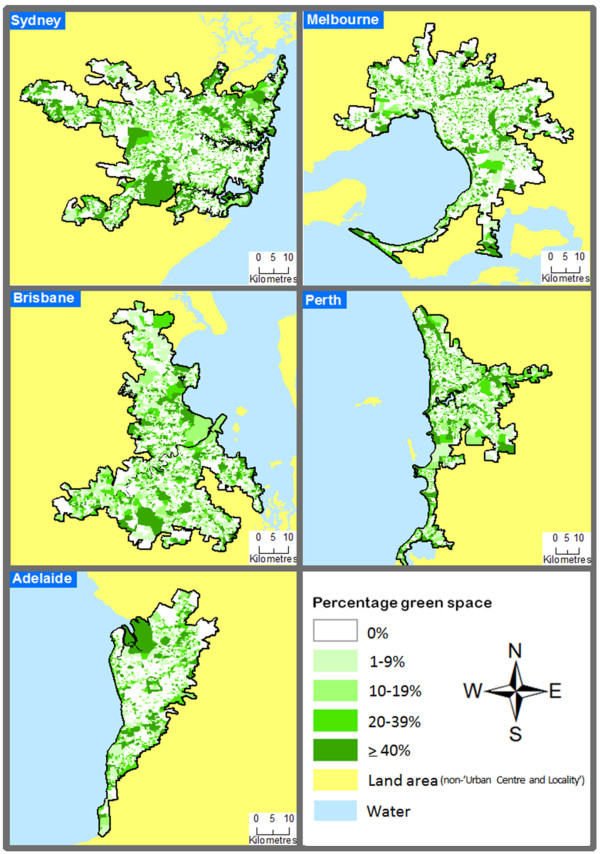
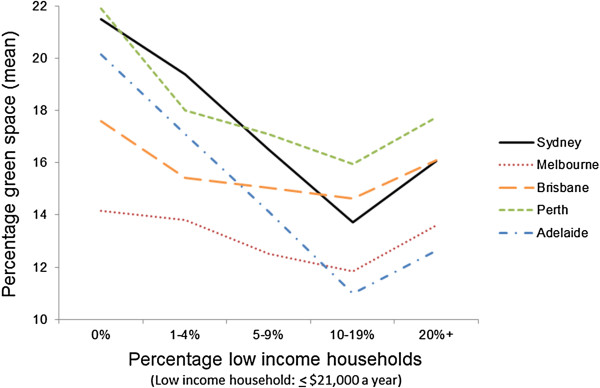
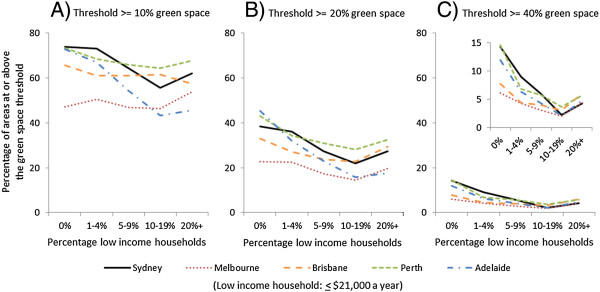
BACKGROUND: An inequitable distribution of parks and other 'green spaces' could exacerbate health inequalities if people on lower incomes, who are already at greater risk of preventable diseases, have poorer access. METHODS: The availability of green space within 1 kilometre of a Statistical Area 1 (SA1) was linked to data from the 2011 Australian census for Sydney (n = 4.6 M residents); Melbourne (n = 4.2 M); Brisbane (n = 2.2 M); Perth (n = 1.8 M); and Adelaide (n = 1.3 M). Socioeconomic circumstances were measured via the percentage population of each SA1 living on < $21,000 per annum. Negative binomial and logit regression models were used to investigate association between the availability of green space in relation to neighbourhood socioeconomic circumstances, adjusting for city and population density. RESULTS: Green space availability was substantively lower in SA1s with a higher percentage of low income residents (e.g. an incidence rate ratio of 0.82 (95% confidence interval (95% CI) 0.75, 0.89) was observed for SA1s containing ≥20% versus 0-1% low income residents). This association varied between cities (p < 0.001). Adelaide reported the least equitable distribution of green space, with approximately 20% greenery in the most affluent areas versus 12% availability in the least affluent. Although Melbourne had a smaller proportion of SA1s in the top quintile of green space availability (13.8%), the distribution of greenery was the most equitable of all the cities, with only a 0.5% difference in the availability of green space between SA1s containing 0-1% low income households versus those with ≥20%. Inequity of access, however, was reported across all cities when using logit regression to examine the availability of at least 20% (odds ratio 0.74, 95% CI 0.59, 0.93) or 40% (0.45, 0.29, 0.69) green space availability in the more disadvantaged versus affluent neighbourhoods. CONCLUSION: Affirmative action on green space planning is required to redress the socioeconomic inequity of access to this important public health resource.
Overview
The claims and statistics of this paper haven’t been checked yet.
Run the check — free, no account needed. It reads the open-access text and checks the sources it cites.
Integrity signals
Registry
Cites
Statistics
Figures
Verification
Claims the paper makes
The claims and statistics of this paper haven’t been checked yet.
Run the check — free, no account needed. It reads the open-access text and checks the sources it cites.
Claims other papers make about this one
Each is checked against this paper’s own text: does it say what the citing paper says it does?
The source backs part of the claim, not all of it — or backs it for a different population, condition or comparison.
In the citing paper
“This may be particularly important for children and adolescents from low socioeconomic backgrounds, who typically engage in greater amounts of ST [48–51] and are also less likely to live in green neighbourhoods [52].”
From Psychological impacts of “screen time” and “green time” for children and adolescents: A systematic scoping review (2020) · cites this paper as [52]
Experimental — accuracy not yet measured
Self-check
Percentages, sums and reported differences re-computed from the paper’s own numbers.
The self-check needs the paper’s full text.
Citations
Cites
Principles of geographical information systems
BURROUGH, P. A., & McDonnell, R. A. (1998) · Cited by 4,082
A Note on Robust Variance Estimation for Cluster‐Correlated Data
Williams, R. L. (2000) · Biometrics · doi:10.1111/j.0006-341x.2000.00645.x · Cited by 2,501
Aesthetic and affective response to natural environment
Ulrich, R. S. (1983) · Behavior and the Natural Environment · doi:10.1007/978-1-4613-3539-9_4 · Cited by 2,241
Tracking restoration in natural and urban field settings
Hartig, T., Evans, G. W., Jamner, L. D., Davis, D. S., & Gärling, T. (2003) · Journal of Environmental Psychology · doi:10.1016/s0272-4944(02)00109-3 · Cited by 2,118
Effect of exposure to natural environment on health inequalities: an observational population study
Mitchell, R., & Popham, F. (2008) · The Lancet · doi:10.1016/s0140-6736(08)61689-x · Cited by 2,099
A systematic review of evidence for the added benefits to health of exposure to natural environments
Bowler, D. E., Buyung-Ali, L. M., Knight, T. M., & Pullin, A. S. (2010) · BMC Public Health · doi:10.1186/1471-2458-10-456 · Cited by 1,993
Green space, urbanity, and health: how strong is the relation?
Maas, J., Verheij, R. A., Groenewegen, P. P., de Vries, S., & Spreeuwenberg, P. (2006) · Journal of Epidemiology and Community Health · doi:10.1136/jech.2005.043125 · Cited by 1,976
The health benefits of urban green spaces: a review of the evidence
Lee, A. C., & Maheswaran, R. (2010) · Journal of Public Health · doi:10.1093/pubmed/fdq068 · Cited by 1,583
Giles‐Corti, B., Broomhall, M. H., Knuiman, M. W., Collins, C. G., Douglas, K., Ng, K., Lange, A., & Donovan, R. J. (2005) · American Journal of Preventive Medicine · doi:10.1016/j.amepre.2004.10.018 · Cited by 1,523
Self-citationThompson Coon, J., Boddy, K., Stein, K., Whear, R., Barton, J., & Depledge, M. H. (2011) · Environmental Science & Technology · doi:10.1021/es102947t · Cited by 1,391
Giles‐Corti, B., & Donovan, R. J. (2002) · Social Science & Medicine · doi:10.1016/s0277-9536(01)00150-2 · Cited by 1,333
Self-citationMorbidity is related to a green living environment
Maas, J., Verheij, R. A., de Vries, S., Spreeuwenberg, P., Schellevis, F. G., & Groenewegen, P. P. (2009) · Journal of Epidemiology and Community Health · doi:10.1136/jech.2008.079038 · Cited by 1,133
The mental and physical health outcomes of green exercise
Pretty, J., Peacock, J., Sellens, M., & Griffin, M. (2005) · International Journal of Environmental Health Research · doi:10.1080/09603120500155963 · Cited by 1,128 · cited 1×
“Some recent studies suggest that these effects on mental health may be closely entwined with active lifestyles [12-17] and have different influences between women and men [18].”
BackgroundFair society, healthy lives: Strategic review of health inequalities in England post-2010
Marmot, M. G., Allen, J., Goldblatt, P., Boyce, T., McNeish, D., Grady, M., & Geddes, I. (2010) · UCL Discovery (University College London) · Cited by 1,036
Creating sense of community: The role of public space
Francis, J., Giles‐Corti, B., Wood, L. J., & Knuiman, M. W. (2012) · Journal of Environmental Psychology · doi:10.1016/j.jenvp.2012.07.002 · Cited by 738
Self-citationRole of physical activity in the relationship between urban green space and health
Richardson, E. A., Pearce, J. R., Mitchell, R., & Kingham, S. (2013) · Public Health · doi:10.1016/j.puhe.2013.01.004 · Cited by 665
Greenspace and obesity: a systematic review of the evidence
Lachowycz, K., & Jones, A. (2011) · Obesity Reviews · doi:10.1111/j.1467-789x.2010.00827.x · Cited by 603
Green Common Spaces and the Social Integration of Inner-City Older Adults
Kweon, B., SULLIVAN, W. C., & Wiley, A. R. (1998) · Environment and Behavior · doi:10.1177/001391659803000605 · Cited by 553
Greenspace, urbanity and health: relationships in England
Mitchell, R., & Popham, F. (2007) · Journal of Epidemiology and Community Health · doi:10.1136/jech.2006.053553 · Cited by 504
Greenspace in urban neighbourhoods and residents' health: adding quality to quantity
van Dillen, S. M. E., de Vries, S., Groenewegen, P., & Spreeuwenberg, P. M. M. (2011) · Journal of Epidemiology & Community Health · doi:10.1136/jech.2009.104695 · Cited by 478
Mitchell, R. (2012) · Social Science & Medicine · doi:10.1016/j.socscimed.2012.04.012 · Cited by 439
Spatial Disparities in the Distribution of Parks and Green Spaces in the USA
Wen, M., Zhang, X., Harris, C. D., Holt, J. B., & Croft, J. B. (2013) · Annals of Behavioral Medicine · doi:10.1007/s12160-012-9426-x · Cited by 413
Maas, J., Verheij, R. A., Spreeuwenberg, P. M. M., & Groenewegen, P. (2008) · BMC Public Health · doi:10.1186/1471-2458-8-206 · Cited by 411
Astell-Burt, T., Mitchell, R., & Hartig, T. (2014) · Journal of Epidemiology and Community Health · doi:10.1136/jech-2013-203767 · Cited by 398
Self-citationEnvironmental influences on psychological restoration
Hartig, T., Böök, A., Garvill, J., Olsson, T., & Gärling, T. (1996) · Scandinavian Journal of Psychology · doi:10.1111/j.1467-9450.1996.tb00670.x · Cited by 387
Francis, J., Wood, L. J., Knuiman, M., & Giles-Corti, B. (2012) · Social Science & Medicine · doi:10.1016/j.socscimed.2012.01.032 · Cited by 382
Self-citationMacIntyre, S. (2007) · International Journal of Behavioral Nutrition and Physical Activity · doi:10.1186/1479-5868-4-32 · Cited by 365
Green space and physical activity: An observational study using Health Survey for England data
Mytton, O. T., Townsend, N. P., Rutter, H., & Foster, C. E. (2012) · Health & Place · doi:10.1016/j.healthplace.2012.06.003 · Cited by 343
The cost of overweight and obesity in Australia
Colagiuri, S., Lee, C., Colagiuri, R., Magliano, D. J., Shaw, J. E., Zimmet, P., & Caterson, I. D. (2010) · The Medical Journal of Australia · doi:10.5694/j.1326-5377.2010.tb03503.x · Cited by 343
Do features of public open spaces vary according to neighbourhood socio-economic status?
Crawford, D. A., Timperio, A. F., Giles‐Corti, B., Ball, K., Hume, C., Roberts, R. J., Andrianopoulos, N., & Salmon, J. (2007) · Health & Place · doi:10.1016/j.healthplace.2007.11.002 · Cited by 338
Self-citationDoes the outdoor environment matter for psychological restoration gained through running?
Bodin, M., & Hartig, T. (2003) · Psychology of sport and exercise · doi:10.1016/s1469-0292(01)00038-3 · Cited by 311
Neighborhood satisfaction, physical and perceived naturalness and openness
Hur, M., Nasar, J. L., & Chun, B. (2009) · Journal of Environmental Psychology · doi:10.1016/j.jenvp.2009.05.005 · Cited by 300
Forests, Trees and Human Health
Nilsson, K., Schipperijn, J., Seeland, K. T., de Vries, S., Hartig, T., Gallis, C., & Sangster, M. (2010) · Springer eBooks · doi:10.1007/978-90-481-9806-1 · Cited by 296
Conway, D. A., Li, C. Q., Wolch, J. R., Kahle, C., & Jerrett, M. (2008) · The Journal of Real Estate Finance and Economics · doi:10.1007/s11146-008-9159-6 · Cited by 289
Astell‐Burt, T., Feng, X., & Kolt, G. S. (2013) · Diabetes Care · doi:10.2337/dc13-1325 · Cited by 243
Self-citationFoster, S. A., Giles‐Corti, B., & Knuiman, M. W. (2010) · Health & Place · doi:10.1016/j.healthplace.2010.07.007 · Cited by 236
Self-citationRichardson, E. A., Pearce, J. R., Mitchell, R., Day, P. L., & Kingham, S. (2010) · BMC Public Health · doi:10.1186/1471-2458-10-240 · Cited by 235
Are socially disadvantaged neighbourhoods deprived of health-related community resources?
Pearce, J. R., Witten, K., Hiscock, R., & Blakely, T. A. (2006) · International Journal of Epidemiology · doi:10.1093/ije/dyl267 · Cited by 235
Astell‐Burt, T., Feng, X., & Kolt, G. S. (2013) · Preventive Medicine · doi:10.1016/j.ypmed.2013.08.017 · Cited by 233
Self-citationGreen space, psychological restoration, and health inequality.
Hartig, T. (2008) · The Lancet · doi:10.1016/s0140-6736(08)61669-4 · Cited by 202
Seaman, P., Jones, R., & Ellaway, A. (2010) · International Journal of Behavioral Nutrition and Physical Activity · doi:10.1186/1479-5868-7-78 · Cited by 196
Green cities and health: a question of scale?
Richardson, E. A., Mitchell, R., Hartig, T., de Vries, S., Astell‐Burt, T., & Frumkin, H. (2011) · Journal of Epidemiology & Community Health · doi:10.1136/jech.2011.137240 · Cited by 193
Self-citationAstell‐Burt, T., Feng, X., & Kolt, G. S. (2013) · British Journal of Sports Medicine · doi:10.1136/bjsports-2012-092006 · Cited by 172
Self-citationRestorative qualities of indoor and outdoor exercise settings as predictors of exercise frequency
Hug, S.-M., Hartig, T., Hansmann, R., Seeland, K. T., & Hornung, R. (2009) · Health & Place · doi:10.1016/j.healthplace.2009.03.002 · Cited by 163
de Jong, K., Albin, M. C., Skärbäck, E., Grahn, P., & Björk, J. (2012) · Health & Place · doi:10.1016/j.healthplace.2012.07.001 · Cited by 160
A comparison of green space indicators for epidemiological research
Mitchell, R., Astell‐Burt, T., & Richardson, E. A. (2011) · Journal of Epidemiology & Community Health · doi:10.1136/jech.2010.119172 · Cited by 157
Self-citationAstell‐Burt, T., Feng, X., & Kolt, G. S. (2013) · BMJ Open · doi:10.1136/bmjopen-2013-003094 · Cited by 156
Self-citationThe cost of diabetes in adults in Australia
Lee, C., Colagiuri, R., Magliano, D. J., Cameron, A. J., Shaw, J. E., Zimmet, P., & Colagiuri, S. (2013) · Diabetes Research and Clinical Practice · doi:10.1016/j.diabres.2012.12.002 · Cited by 146
Sugiyama, T., Giles‐Corti, B., Summers, J., Toit, L. D., Leslie, E. R., & Owen, N. G. (2013) · Preventive Medicine · doi:10.1016/j.ypmed.2013.05.015 · Cited by 145
Self-citationPhysical activity levels and determinants of change in young adults: a longitudinal panel study
Zimmermann-Sloutskis, D., Wanner, M., Zimmermann, E., & Martin, B. W. (2010) · International Journal of Behavioral Nutrition and Physical Activity · doi:10.1186/1479-5868-7-2 · Cited by 133
Greener neighborhoods, slimmer people? Evidence from 246 920 Australians
Astell‐Burt, T., Feng, X., & Kolt, G. S. (2013) · International Journal of Obesity · doi:10.1038/ijo.2013.64 · Cited by 126
Self-citationANALYSIS OF COUNT DATA USING POISSON REGRESSION∗
Lovett, A. A., & Flowerdew, R. (1989) · The Professional Geographer · doi:10.1111/j.0033-0124.1989.00190.x · Cited by 103
Is availability of public open space equitable across areas?
Timperio, A. F., Ball, K., Salmon, J., Roberts, R. J., & Crawford, D. A. (2006) · Health & Place · doi:10.1016/j.healthplace.2006.02.003 · Cited by 101
Cummins, S., & Fagg, J. (2011) · International Journal of Obesity · doi:10.1038/ijo.2011.195 · Cited by 82
Our cities, our future - a national urban policy for a productive, sustainable and liveable future
Albanese, A. (2011) · Commonwealth of Australia eBooks · Cited by 79
Landscape Components, Land Use, and Neighborhood Satisfaction
Kweon, B., Ellis, C. D., Leiva, P. I., & Rogers, G. O. (2010) · Environment and Planning B Planning and Design · doi:10.1068/b35059 · Cited by 77
Forests, Trees and Human Health and Well-being: Introduction
Nilsson, K., Sangster, M., & Konijnendijk, C. C. (2010) · Springer eBooks · doi:10.1007/978-90-481-9806-1_1 · Cited by 66
The Sydney Diabetes Prevention Program: A community-based translational study
Colagiuri, S., Vita, P., Cardona, M., Singh, M. F., Farrell, L., Milat, A., Haas, M. R., & Bauman, A. E. (2010) · BMC Public Health · doi:10.1186/1471-2458-10-328 · Cited by 60
Role of general practitioners in managing age‐related hearing loss
Schneider, J. M., Gopinath, B., McMahon, C. M., Britt, H. C., Harrison, C. M., Usherwood, T. P., Leeder, S., & Mitchell, P. (2010) · The Medical Journal of Australia · doi:10.5694/j.1326-5377.2010.tb03395.x · Cited by 52
Examining Public Open Spaces by Neighborhood-Level Walkability and Deprivation
Badland, H. M., Keam, R., Witten, K., & KEARNS, R. A. (2010) · Journal of Physical Activity and Health · doi:10.1123/jpah.7.6.818 · Cited by 49
Self-citationLovett, A. A., Bentham, C. G., & Flowerdew, R. (1986) · Social Science & Medicine · doi:10.1016/0277-9536(86)90251-0 · Cited by 36
Does geographic access to primary healthcare influence the detection of hepatitis C?
Astell‐Burt, T., Flowerdew, R., Boyle, P. J., & Dillon, J. F. (2011) · Social Science & Medicine · doi:10.1016/j.socscimed.2011.02.015 · Cited by 34
Self-citationCivilizing American Cities: A Selection of Frederick Law Olmsted's "Writings on City Landscapes"
Dotterrer, S., Sutton, S. B., & Olmsted, F. L. (1971) · Journal of Architectural Education (1947-1974) · doi:10.2307/1423802 · Cited by 34
Civilizing American Cities: A Selection of Frederick Law Olmsted's Writings on City Landscapes
Coolidge, D. J., Sutton, S. B., & Olmsted, F. L. (1972) · The New England Quarterly · doi:10.2307/364231 · Cited by 20
Smith, D. M. (2010) · UCL Discovery (University College London) · Cited by 11
Introduction for REAL—Maastricht-MIT Special Issue
Eichholtz, P. M. A., Geltner, D., & Ong, S. E. (2010) · The Journal of Real Estate Finance and Economics · doi:10.1007/s11146-010-9238-3 · Cited by 4
Research works printed but not linked: 8
- The Scottish Government: Good places, better health in Scotland. 2008, The Scottish Government: Edinburgh
- Department of Sustainability and Environment: Victorian Planning Provisions. 2013, Melbourne: Victorian State Government
- Western Australian Planning Commission: Liveable neighbourhoods: a Western Australian Government Sustainable Cities Initiative. 2004, Western Australian Planning Commission: Perth, WA
- Australian Bureau of Statistics: 3218.0 - Regional Population Growth, Australia, 2011: Population estimates and Australia’s new statistical geography. 2012, Canberra: Australian Bureau of Statistics
- Australian Bureau of Statistics: Australian Statistical Geography Standard (ASGS): Volume 4 - Significant Urban Areas, Urban Centres and Localities, Section of State. 2011, Canberra: Australian Bureau of Statistics
- Australian Bureau of Statistics: Australian Statistical Geography Standard (ASGS): Volume 1 - Main Structure and Greater Capital City Statistical Areas. 2011, Canberra:
- Australian Bureau of Statistics: Information paper, Draft Mesh Blocks. 2005, Canberra: Australian Bureau of Statistics
- Pink B: Technical Paper: Socio-Economic Indexes for Areas (SEIFA). 2011, Australian Bureau of Statistics: Canberra
Cited by
Sorted by citations
Exploring pathways linking greenspace to health: theoretical and methodological guidance
Markevych, I., Schoierer, J., Hartig, T., Chudnovsky, A., Hystad, P., Dzhambov, A. M., de Vries, S., Triguero-Mas, M., Brauer, M., Nieuwenhuijsen, M. J., et al. (2017) · Environmental Research · doi:10.1016/j.envres.2017.06.028 · Cited by 2,543
Self-citationTwohig-Bennett, C., & Jones, A. (2018) · Environmental Research · doi:10.1016/j.envres.2018.06.030 · Cited by 1,766
Nature Contact and Human Health: A Research Agenda
Frumkin, H., Bratman, G. N., Breslow, S. J., Cochran, B., Kahn Jr, P. H., Lawler, J. J., Levin, P. S., Tandon, P. S., Varanasi, U., Wolf, K. L., et al. (2017) · Environmental Health Perspectives · doi:10.1289/ehp1663 · Cited by 1,237
A Review of the Health Benefits of Greenness
James, P., Banay, R. F., Hart, J. E., & Laden, F. (2015) · Current Epidemiology Reports · doi:10.1007/s40471-015-0043-7 · Cited by 989
Associations between nature exposure and health: a review of the evidence
Jimenez, M. P., DeVille, N. V., Elliott, E. G., Schiff, J. E., Wilt, G. E., Hart, J. E., & James, P. (2021) · International Journal of Environmental Research and Public Health · doi:10.3390/ijerph18094790 · Cited by 726
Metadata
- Authors
- Astell-Burt, T., Feng, X., Mavoa, S., Badland, H. M., & Giles-Corti, B.
- Affiliations
- Western Sydney University (AU)
- The University of Melbourne (AU)
- Venue
- BMC Public Health
- Published
- 2014-03-31
- Volume
- 14
- Issue
- 1
- Pages
- 292-292
- ISSN
- 1471-2458 (ISSN-L)
- PMC
- PMC4005631
- OpenAlex
- W2149511701
- Cited by
- 351
- References
- 67
- Citations by year
- 2026: 19 · 2025: 42 · 2024: 55 · 2023: 43 · 2022: 40 · 2021: 53 · 2020: 31 · 2019: 19 · 2018: 16 · 2017: 18 · 2016: 8 · 2015: 6 · 2014: 1
- FWCI
- 7.23
- Type
- journal article
- Language
- en
- Open access
- gold
- doi.org
- Licence
- Locations
- BMC Public Health (publishedVersion, cc-by)
- Europe PMC (PubMed Central) (publishedVersion, cc-by)
- PubMed Central (publishedVersion, cc-by)
- PubMed (publishedVersion)
- Minerva Access (University of Melbourne) (submittedVersion, cc-by)
- Research Online (University of Wollongong) (submittedVersion)
- RMIT Research Repository (RMIT University Library) (submittedVersion)
- Figshare (submittedVersion)
- St Andrews Research Repository (St Andrews Research Repository) (submittedVersion, cc-by)
- Funders
- National Heart Foundation of Australia
- National Health and Medical Research Council (1004900)
- Topics
- Social Sciences › Urban Studies › Urban Green Space and Health
- Social Sciences › Sociology and Political Science › Environmental Justice and Health Disparities
- Social Sciences › Health › Health disparities and outcomes
- Keywords
- green spaces, parks, low-income neighbourhoods, green space accessibility, health disparities, urban vegetation, green space planning, Australian cities, population density
- MeSH terms
- Australia, Cities, Cross-Sectional Studies, Environment Design, Plants, Poverty Areas, Residence Characteristics, Socioeconomic Factors, Urban Population, Logistic Models
About these checks
Registry, retraction, Cites and statistics results are computed, not judged, with one exception: a printed reference that no index lists is read once by a model before it counts as a citation error. Claims are extracted by a model and kept only when their quote appears verbatim in the text; each cited source is then checked, with a model’s help, for whether it says what the claim relies on. Those verdicts can be wrong — read the claim’s quote and the cited source before relying on one.
Statistics and arithmetic are recomputed, not judged.
Confidence bands are shown only for fields calibrated on our annotated test set. None is calibrated yet, so no band is shown.
What counts as a claim ›How we measure confidence ›How we check this ›
Are you an author, or do you see a problem with this page? Request a review
