

The DOI matches its Crossref record; 66 of the 67 references it cites were found in a registry or an index.
Do low-income neighbourhoods have the least green space? A cross-sectional study of Australia’s most populous cities
Open accessAbstract
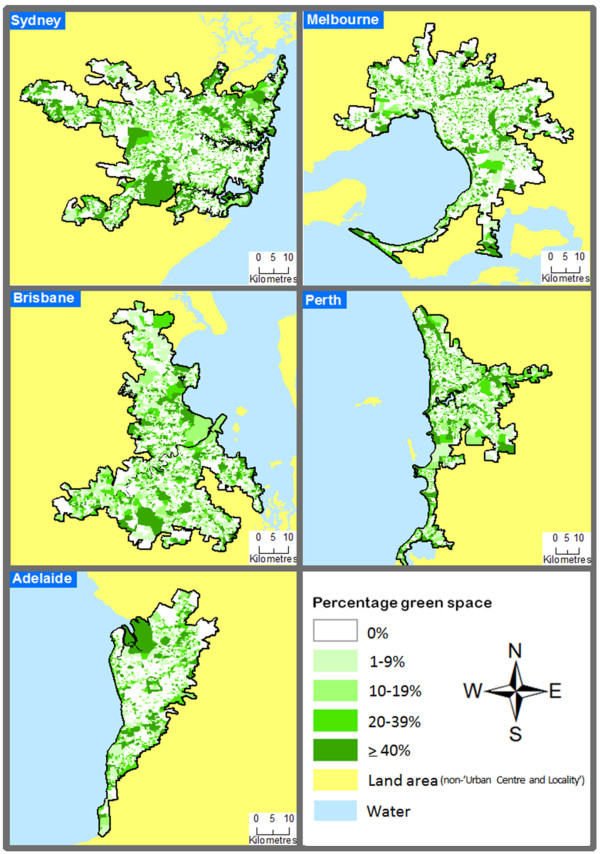
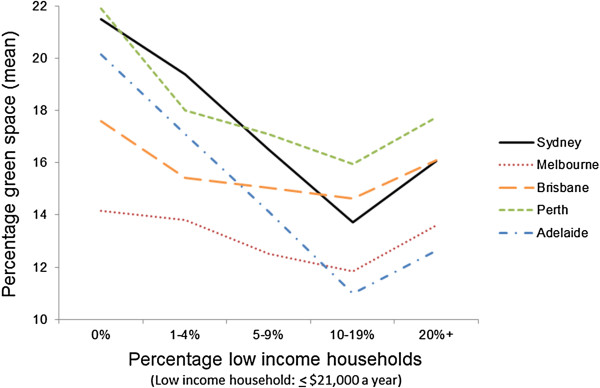
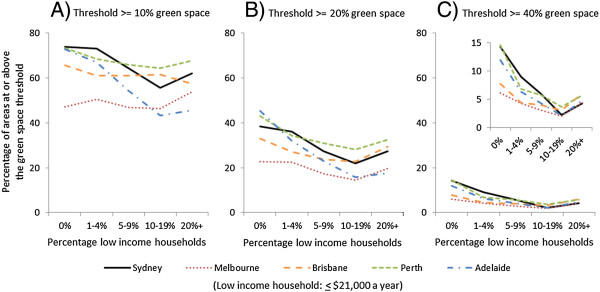
BACKGROUND: An inequitable distribution of parks and other 'green spaces' could exacerbate health inequalities if people on lower incomes, who are already at greater risk of preventable diseases, have poorer access. METHODS: The availability of green space within 1 kilometre of a Statistical Area 1 (SA1) was linked to data from the 2011 Australian census for Sydney (n = 4.6 M residents); Melbourne (n = 4.2 M); Brisbane (n = 2.2 M); Perth (n = 1.8 M); and Adelaide (n = 1.3 M). Socioeconomic circumstances were measured via the percentage population of each SA1 living on < $21,000 per annum. Negative binomial and logit regression models were used to investigate association between the availability of green space in relation to neighbourhood socioeconomic circumstances, adjusting for city and population density. RESULTS: Green space availability was substantively lower in SA1s with a higher percentage of low income residents (e.g. an incidence rate ratio of 0.82 (95% confidence interval (95% CI) 0.75, 0.89) was observed for SA1s containing ≥20% versus 0-1% low income residents). This association varied between cities (p < 0.001). Adelaide reported the least equitable distribution of green space, with approximately 20% greenery in the most affluent areas versus 12% availability in the least affluent. Although Melbourne had a smaller proportion of SA1s in the top quintile of green space availability (13.8%), the distribution of greenery was the most equitable of all the cities, with only a 0.5% difference in the availability of green space between SA1s containing 0-1% low income households versus those with ≥20%. Inequity of access, however, was reported across all cities when using logit regression to examine the availability of at least 20% (odds ratio 0.74, 95% CI 0.59, 0.93) or 40% (0.45, 0.29, 0.69) green space availability in the more disadvantaged versus affluent neighbourhoods. CONCLUSION: Affirmative action on green space planning is required to redress the socioeconomic inequity of access to this important public health resource.
Overview
The claims and statistics of this paper haven’t been checked yet.
Run the check — free, no account needed. It reads the open-access text and checks the sources it cites.
Integrity signals
Registry
Cites
Statistics
Figures
Verification
Claims the paper makes
The claims and statistics of this paper haven’t been checked yet.
Run the check — free, no account needed. It reads the open-access text and checks the sources it cites.
Claims other papers make about this one
Each is checked against this paper’s own text: does it say what the citing paper says it does?
The source backs part of the claim, not all of it — or backs it for a different population, condition or comparison.
In the citing paper
“This may be particularly important for children and adolescents from low socioeconomic backgrounds, who typically engage in greater amounts of ST [48–51] and are also less likely to live in green neighbourhoods [52].”
From Psychological impacts of “screen time” and “green time” for children and adolescents: A systematic scoping review (2020) · cites this paper as [52]
Experimental — accuracy not yet measured
Self-check
Percentages, sums and reported differences re-computed from the paper’s own numbers.
The self-check needs the paper’s full text.
Citations
Cites
Principles of geographical information systems
BURROUGH, P. A., & McDonnell, R. A. (1998) · Cited by 4,082
A Note on Robust Variance Estimation for Cluster‐Correlated Data
Williams, R. L. (2000) · Biometrics · doi:10.1111/j.0006-341x.2000.00645.x · Cited by 2,501
Aesthetic and affective response to natural environment
Ulrich, R. S. (1983) · Behavior and the Natural Environment · doi:10.1007/978-1-4613-3539-9_4 · Cited by 2,241
Tracking restoration in natural and urban field settings
Hartig, T., Evans, G. W., Jamner, L. D., Davis, D. S., & Gärling, T. (2003) · Journal of Environmental Psychology · doi:10.1016/s0272-4944(02)00109-3 · Cited by 2,118
Effect of exposure to natural environment on health inequalities: an observational population study
Mitchell, R., & Popham, F. (2008) · The Lancet · doi:10.1016/s0140-6736(08)61689-x · Cited by 2,099
A systematic review of evidence for the added benefits to health of exposure to natural environments
Bowler, D. E., Buyung-Ali, L. M., Knight, T. M., & Pullin, A. S. (2010) · BMC Public Health · doi:10.1186/1471-2458-10-456 · Cited by 1,993
Green space, urbanity, and health: how strong is the relation?
Maas, J., Verheij, R. A., Groenewegen, P. P., de Vries, S., & Spreeuwenberg, P. (2006) · Journal of Epidemiology and Community Health · doi:10.1136/jech.2005.043125 · Cited by 1,976
The health benefits of urban green spaces: a review of the evidence
Lee, A. C., & Maheswaran, R. (2010) · Journal of Public Health · doi:10.1093/pubmed/fdq068 · Cited by 1,583
Giles‐Corti, B., Broomhall, M. H., Knuiman, M. W., Collins, C. G., Douglas, K., Ng, K., Lange, A., & Donovan, R. J. (2005) · American Journal of Preventive Medicine · doi:10.1016/j.amepre.2004.10.018 · Cited by 1,523
Self-citationThompson Coon, J., Boddy, K., Stein, K., Whear, R., Barton, J., & Depledge, M. H. (2011) · Environmental Science & Technology · doi:10.1021/es102947t · Cited by 1,391
Research works printed but not linked: 8
- The Scottish Government: Good places, better health in Scotland. 2008, The Scottish Government: Edinburgh
- Department of Sustainability and Environment: Victorian Planning Provisions. 2013, Melbourne: Victorian State Government
- Western Australian Planning Commission: Liveable neighbourhoods: a Western Australian Government Sustainable Cities Initiative. 2004, Western Australian Planning Commission: Perth, WA
- Australian Bureau of Statistics: 3218.0 - Regional Population Growth, Australia, 2011: Population estimates and Australia’s new statistical geography. 2012, Canberra: Australian Bureau of Statistics
- Australian Bureau of Statistics: Australian Statistical Geography Standard (ASGS): Volume 4 - Significant Urban Areas, Urban Centres and Localities, Section of State. 2011, Canberra: Australian Bureau of Statistics
- Australian Bureau of Statistics: Australian Statistical Geography Standard (ASGS): Volume 1 - Main Structure and Greater Capital City Statistical Areas. 2011, Canberra:
- Australian Bureau of Statistics: Information paper, Draft Mesh Blocks. 2005, Canberra: Australian Bureau of Statistics
- Pink B: Technical Paper: Socio-Economic Indexes for Areas (SEIFA). 2011, Australian Bureau of Statistics: Canberra
Cited by
Sorted by citations
Exploring pathways linking greenspace to health: theoretical and methodological guidance
Markevych, I., Schoierer, J., Hartig, T., Chudnovsky, A., Hystad, P., Dzhambov, A. M., de Vries, S., Triguero-Mas, M., Brauer, M., Nieuwenhuijsen, M. J., et al. (2017) · Environmental Research · doi:10.1016/j.envres.2017.06.028 · Cited by 2,543
Self-citationTwohig-Bennett, C., & Jones, A. (2018) · Environmental Research · doi:10.1016/j.envres.2018.06.030 · Cited by 1,766
Nature Contact and Human Health: A Research Agenda
Frumkin, H., Bratman, G. N., Breslow, S. J., Cochran, B., Kahn Jr, P. H., Lawler, J. J., Levin, P. S., Tandon, P. S., Varanasi, U., Wolf, K. L., et al. (2017) · Environmental Health Perspectives · doi:10.1289/ehp1663 · Cited by 1,237
A Review of the Health Benefits of Greenness
James, P., Banay, R. F., Hart, J. E., & Laden, F. (2015) · Current Epidemiology Reports · doi:10.1007/s40471-015-0043-7 · Cited by 989
Associations between nature exposure and health: a review of the evidence
Jimenez, M. P., DeVille, N. V., Elliott, E. G., Schiff, J. E., Wilt, G. E., Hart, J. E., & James, P. (2021) · International Journal of Environmental Research and Public Health · doi:10.3390/ijerph18094790 · Cited by 726
Access to urban green space and environmental inequalities in Germany
Wüstemann, H., Kalisch, D., & Kolbe, J. (2017) · Landscape and Urban Planning · doi:10.1016/j.landurbplan.2017.04.002 · Cited by 498
Access to green space, physical activity and mental health: a twin study
Cohen‐Cline, H., Turkheimer, E. N., & Duncan, G. E. (2015) · Journal of Epidemiology & Community Health · doi:10.1136/jech-2014-204667 · Cited by 387
Oswald, T. K., Rumbold, A. R., Kedzior, S. G. E., & Moore, V. M. (2020) · PLoS ONE · doi:10.1371/journal.pone.0237725 · Cited by 367
“This may be particularly important for children and adolescents from low socioeconomic backgrounds, who typically engage in greater amounts of ST [48–51] and are also less likely to live in green neighbourhoods [52].”
BackgroundChen, Y., Yue, W., & Rosa, D. L. (2020) · Landscape and Urban Planning · doi:10.1016/j.landurbplan.2020.103919 · Cited by 366
Hoffimann, E., Barros, H., & Ribeiro, A. I. (2017) · International Journal of Environmental Research and Public Health · doi:10.3390/ijerph14080916 · Cited by 311
Dzhambov, A., Hartig, T., Markevych, I., Tilov, B., & Dimitrova, D. (2018) · Environmental Research · doi:10.1016/j.envres.2017.09.015 · Cited by 303
Dzhambov, A. M., Lercher, P., Browning, M. H. E. M., Stoyanov, D., Petrova, N., Novakov, S. S., & Dimitrova, D. (2020) · Environmental Research · doi:10.1016/j.envres.2020.110420 · Cited by 301
The association between green space and adolescents' mental well-being: a systematic review
Zhang, Y., Mavoa, S., Zhao, J., Raphael, D., & Smith, M. (2020) · International Journal of Environmental Research and Public Health · doi:10.3390/ijerph17186640 · Cited by 240
Self-citationAstell‐Burt, T., Hartig, T., Putra, I. G. N. E., Walsan, R., Dendup, T., & Feng, X. (2022) · The Science of The Total Environment · doi:10.1016/j.scitotenv.2022.157521 · Cited by 232
Self-citationParks and safety: a comparative study of green space access and inequity in five US cities
Williams, T. G., Logan, T. M., Zuo, C. T., Liberman, K., & Guikema, S. D. (2020) · Landscape and Urban Planning · doi:10.1016/j.landurbplan.2020.103841 · Cited by 209
Nature inequity and higher COVID-19 case rates in less-green neighbourhoods in the United States
Spotswood, E. N., Benjamin, M. B., Stoneburner, L., Wheeler, M. M., Beller, E. E., Balk, D. L., McPhearson, T., Kuo, M., & McDonald, R. I. (2021) · Nature Sustainability · doi:10.1038/s41893-021-00781-9 · Cited by 216
Nguyen, P., Astell‐Burt, T., Rahimi‐Ardabili, H., & Feng, X. (2023) · The Lancet Planetary Health · doi:10.1016/s2542-5196(23)00025-6 · Cited by 245
Self-citationMennis, J. L., Mason, M. J., & Ambrus, A. (2018) · Landscape and Urban Planning · doi:10.1016/j.landurbplan.2018.02.008 · Cited by 194
The affective benefits of nature exposure
Bratman, G. N., Olvera‐Alvarez, H. A., & Gross, J. J. (2021) · Social and Personality Psychology Compass · doi:10.1111/spc3.12630 · Cited by 177
Schüle, S. A., Hilz, L. K., Dreger, S., & Bolte, G. (2019) · International Journal of Environmental Research and Public Health · doi:10.3390/ijerph16071216 · Cited by 176
Mears, M., Brindley, P., Maheswaran, R., & Jørgensen, A. (2019) · Geoforum · doi:10.1016/j.geoforum.2019.04.016 · Cited by 161
Eco-gentrification and who benefits from urban green amenities: NYC’s high Line
Jo Black, K., & Richards, M. (2020) · Landscape and Urban Planning · doi:10.1016/j.landurbplan.2020.103900 · Cited by 160
Residential Green Space Quantity and Quality and Child Well-being: A Longitudinal Study
Feng, X., & Astell-Burt, T. (2017) · American Journal of Preventive Medicine · doi:10.1016/j.amepre.2017.06.035 · Cited by 153
Self-citationResearch challenges for cultural ecosystem services and public health in (peri-)urban environments
Chen, X., de Vries, S., Assmuth, T., Dick, J., Hermans, T., Hertel, O., Jensen, A., Jones, L., Kabisch, S., Lanki, T., et al. (2019) · Science of The Total Environment · doi:10.1016/j.scitotenv.2018.09.030 · Cited by 141
Zhang, J., Yu, Z., Cheng, Y., Chen, C., Wan, Y., Zhao, B., & Vejre, H. (2020) · Building and Environment · doi:10.1016/j.buildenv.2020.107170 · Cited by 138
Race, Ethnicity, Income Concentration and 10-Year Change in Urban Greenness in the United States
Casey, J. A., James, P., Cushing, L. J., Jesdale, B. M., & Morello-Frosch, R. A. (2017) · International Journal of Environmental Research and Public Health · doi:10.3390/ijerph14121546 · Cited by 134
Lin, W. C., Chen, Q., Jiang, M., Zhang, X., Liu, Z., Tao, J., Wu, L., Xu, S., Kang, Y., & Zeng, Q. (2019) · Landscape and Urban Planning · doi:10.1016/j.landurbplan.2019.103637 · Cited by 136
Astell‐Burt, T., & Feng, X. (2021) · International Journal of Environmental Research and Public Health · doi:10.3390/ijerph18052757 · Cited by 137
Self-citationSchüle, S. A., Gabriel, K. M. A., & Bolte, G. (2017) · International Journal of Hygiene and Environmental Health · doi:10.1016/j.ijheh.2017.02.006 · Cited by 122
Piccininni, C. R., Michaelson, V. E., Janssen, I., & Pickett, W. (2018) · Preventive Medicine · doi:10.1016/j.ypmed.2018.04.020 · Cited by 128
A spatial analytic approach for classifying greenspace and comparing greenspace social equity
Kimpton, A. (2017) · Applied Geography · doi:10.1016/j.apgeog.2017.03.016 · Cited by 109
Riley, C. B., & Gardiner, M. M. (2020) · PLoS ONE · doi:10.1371/journal.pone.0228499 · Cited by 106
Accessing green space in Melbourne: Measuring inequity and household mobility
Sharifi, F., Nygaard, C. A., Stone, W. M., & Levin, I. (2020) · Landscape and Urban Planning · doi:10.1016/j.landurbplan.2020.104004 · Cited by 109
Wu, J., He, Q., Chen, Y., Lin, J., & Wang, S. (2018) · Environment and Planning B Urban Analytics and City Science · doi:10.1177/2399808318793139 · Cited by 104
Lin, W., Chen, Q., Jiang, M., Tao, J., Liu, Z., Zhang, X., Wu, L., Xu, S., Kang, Y., & Zeng, Q. (2020) · Journal of Urban Health · doi:10.1007/s11524-019-00407-8 · Cited by 108
Mell, I. C., & Whitten, M. (2021) · International Journal of Environmental Research and Public Health · doi:10.3390/ijerph18041527 · Cited by 98
Liveable for whom? Prospects of urban liveability to address health inequities
Badland, H. M., & Pearce, J. R. (2019) · Social Science & Medicine · doi:10.1016/j.socscimed.2019.05.001 · Cited by 103
Self-citationRiley, C. B., Perry, K. I., Ard, K. J., & Gardiner, M. M. (2018) · Sustainability · doi:10.3390/su10072139 · Cited by 97
Jennings, V. L., Floyd, M. F., Shanahan, D. F., Coutts, C., & Sinykin, A. (2017) · Population and Environment · doi:10.1007/s11111-017-0276-0 · Cited by 91
Lopes, H. S., Vidal, D. G., Cherif, N., Silva, L. T., & Remoaldo, P. C. A. (2025) · Journal of Environmental Management · doi:10.1016/j.jenvman.2025.124446 · Cited by 101
Feng, X., & Astell‐Burt, T. (2017) · International Journal of Environmental Research and Public Health · doi:10.3390/ijerph14030235 · Cited by 87
Self-citationLevinger, P., Cerin, E., Milner, C., & Hill, K. (2021) · International Journal of Environmental Health Research · doi:10.1080/09603123.2021.1879739 · Cited by 90
Luque-García, L., Corrales, A., Lertxundi, A., Díaz, S., & Ibarluzea, J. M. (2021) · Environmental Research · doi:10.1016/j.envres.2021.112599 · Cited by 91
Feng, X., & Astell‐Burt, T. (2018) · BMC Psychiatry · doi:10.1186/s12888-018-1926-1 · Cited by 89
Self-citationWu, J., Chen, H., Wang, H., He, Q., & Zhou, K. (2020) · Journal of Cleaner Production · doi:10.1016/j.jclepro.2020.121454 · Cited by 81
Bikomeye, J. C., Namin, S., Anyanwu, C., Rublee, C. S., Ferschinger, J., Leinbach, K., Lindquist, P., Hoppe, A., Hoffman, L., Hegarty, J., et al. (2021) · International Journal of Environmental Research and Public Health · doi:10.3390/ijerph18168420 · Cited by 89
Urban environments and COVID-19 in three Eastern states of the United States
Lee, W., Kim, H., Choi, H. M., Heo, S., Fong, K. C., Yang, J., Park, C., Kim, H., & Bell, M. L. (2021) · The Science of The Total Environment · doi:10.1016/j.scitotenv.2021.146334 · Cited by 80
Biodiversity and human health: A scoping review and examples of underrepresented linkages
Robinson, J. M., Breed, A. C., Camargo, A., Redvers, N., & Breed, M. F. (2024) · Environmental Research · doi:10.1016/j.envres.2024.118115 · Cited by 97
Kimpton, A., Corcoran, J., & Wickes, R. L. (2016) · Journal of Research in Crime and Delinquency · doi:10.1177/0022427816666309 · Cited by 82
Sun, Y., Wang, X., Zhu, J., Chen, L., Jia, Y., Lawrence, J. M., Jiang, L., Xie, X. S., & Wu, J. Y. (2021) · The Science of The Total Environment · doi:10.1016/j.scitotenv.2021.147653 · Cited by 78
Sanders, T., Feng, X., Fahey, P. P., Lonsdale, C., & Astell‐Burt, T. (2015) · International Journal of Obesity · doi:10.1038/ijo.2015.69 · Cited by 77
Self-citationXing, L., Chen, Q., Liu, Y., & He, H. (2023) · Sustainable Cities and Society · doi:10.1016/j.scs.2023.105049 · Cited by 77
Xiao, X., Yang, B., Hu, L., Markevych, I., Bloom, M. S., Dharmage, S. C., Jalaludin, B. B., Knibbs, L. D., Heinrich, J., Morawska, L., et al. (2019) · Environmental Pollution · doi:10.1016/j.envpol.2019.113422 · Cited by 74
Literature Review Reveals a Global Access Inequity to Urban Green Spaces
Sun, Y., Saha, S., Tost, H., Kong, X., & Xu, C. (2022) · Sustainability · doi:10.3390/su14031062 · Cited by 71
Wolff, M., Scheuer, S., & Haase, D. (2020) · Ecological Indicators · doi:10.1016/j.ecolind.2020.106245 · Cited by 69
Xian, Z., Nakaya, T., Liu, K., Zhao, B., Zhang, J., Zhang, J., Lin, Y., & Zhang, J. (2024) · Humanities and Social Sciences Communications · doi:10.1057/s41599-024-02970-1 · Cited by 84
Logan, T. M., Williams, T. G., Nisbet, A., Liberman, K., Zuo, C., & Guikema, S. D. (2017) · Environment and Planning B Urban Analytics and City Science · doi:10.1177/2399808317736528 · Cited by 68
Alderton, A., Villanueva, K., O’Connor, M., Boulangé, C., & Badland, H. M. (2019) · International Journal of Environmental Research and Public Health · doi:10.3390/ijerph16091516 · Cited by 76
Self-citationGreen gentrification or gentrified greening: Metropolitan Melbourne
Sharifi, F., Nygaard, C. A., Stone, W. M., & Levin, I. (2021) · Land Use Policy · doi:10.1016/j.landusepol.2021.105577 · Cited by 70
O’Regan, A. C., & Nyhan, M. (2023) · Environmental Research · doi:10.1016/j.envres.2023.116242 · Cited by 67
Putra, I. G. N. E., Astell‐Burt, T., Cliff, D. P., Vella, S. A., & Feng, X. (2020) · Environmental Research · doi:10.1016/j.envres.2020.110334 · Cited by 65
Self-citationZhang, J. (2022) · Urban forestry & urban greening · doi:10.1016/j.ufug.2022.127811 · Cited by 64
Zijlema, W. L., Stasinska, A., Blake, D., Dirgawati, M., Flicker, L. A., Yeap, B. B., Golledge, J., Hankey, G. J., Nieuwenhuijsen, M. J., & Heyworth, J. S. (2019) · Environment International · doi:10.1016/j.envint.2019.01.075 · Cited by 66
Yang, H., Chen, T., Zeng, Z., & Mi, F. (2022) · Journal of Cleaner Production · doi:10.1016/j.jclepro.2022.134920 · Cited by 70
Green space accessibility in Europe: a comparative study of five major cities
Buckland, M., & Pojani, D. (2022) · European Planning Studies · doi:10.1080/09654313.2022.2088230 · Cited by 62
Acute canopy deficits in global cities exposed by the 3-30-300 benchmark for urban nature
Croeser, T., Sharma, R., Weisser, W. W., & Bekessy, S. A. (2024) · Nature Communications · doi:10.1038/s41467-024-53402-2 · Cited by 71
Relationship between the neighbourhood built environment and early child development
Christian, H. E., Ball, S. J., Zubrick, S. R., Brinkman, S. A., Turrell, G., Boruff, B. J., & Foster, S. A. (2017) · Health & Place · doi:10.1016/j.healthplace.2017.08.010 · Cited by 68
Oswald, T. K., Rumbold, A. R., Kedzior, S. G. E., Kohler, M. J., & Moore, V. (2021) · International Journal of Environmental Research and Public Health · doi:10.3390/ijerph18115630 · Cited by 61
Just What the Doctor Ordered: Using Parks to Improve Children’s Health
Seltenrich, N. (2015) · Environmental Health Perspectives · doi:10.1289/ehp.123-a254 · Cited by 63
Green space quality and adolescent mental health: do personality traits matter?
Feng, X., Astell‐Burt, T., Standl, M., Flexeder, C., Heinrich, J., & Markevych, I. (2021) · Environmental Research · doi:10.1016/j.envres.2021.112591 · Cited by 68
Self-citationMarkevych, I., Feng, X., Astell‐Burt, T., Standl, M., Sugiri, D., Schikowski, T., Koletzko, S., Herberth, G., Bauer, C., Berg, A. V., et al. (2018) · Environmental Pollution · doi:10.1016/j.envpol.2018.10.053 · Cited by 57
Self-citationJuul, V., & Nordbø, E. C. A. (2023) · BMC Public Health · doi:10.1186/s12889-023-15170-4 · Cited by 59
Residents’ Preferences and Perceptions toward Green Open Spaces in an Urban Area
Zhang, L., Cao, H., & Han, R. (2021) · Sustainability · doi:10.3390/su13031558 · Cited by 61
Uhlmann, K., Lin, B., & Ross, H. (2018) · Sustainability · doi:10.3390/su10061844 · Cited by 52
Mears, M., & Brindley, P. (2019) · ISPRS International Journal of Geo-Information · doi:10.3390/ijgi8060286 · Cited by 53
Finding space for nature in cities: the considerable potential of redundant car parking
Croeser, T., Garrard, G. E., Visintin, C., Kirk, H. L., Ossola, A., Furlong, C., Clements, R., Butt, A., Taylor, E. J., & Bekessy, S. A. (2022) · npj Urban Sustainability · doi:10.1038/s42949-022-00073-x · Cited by 52
Enhancing urban nature and place-making in social housing through community gardening
Truong, S., Gray, T. L., & Ward, K. S. (2022) · Urban forestry & urban greening · doi:10.1016/j.ufug.2022.127586 · Cited by 51
Luo, J., Zhai, S., Song, G., He, X., Song, H., Chen, J., Liu, H., & Feng, Y. (2022) · International Journal of Environmental Research and Public Health · doi:10.3390/ijerph19105798 · Cited by 53
Wilding, S. A., Ziauddeen, N., Smith, D. M., Roderick, P. J., Chase, D., & Alwan, N. A. (2020) · BMC Medicine · doi:10.1186/s12916-020-01513-0 · Cited by 50
Walking accessibility to neighbourhood open space in a multi-level urban environment of Hong Kong
Tang, B., Wong, K. K., Tang, K. S., & Wong, S. W. (2020) · Environment and Planning B Urban Analytics and City Science · doi:10.1177/2399808320932575 · Cited by 53
Ethnic inequalities in green space availability: Evidence from Australia
Mushangwe, S., Astell‐Burt, T., Steel, D. G., & Feng, X. (2021) · Urban forestry & urban greening · doi:10.1016/j.ufug.2021.127235 · Cited by 53
Self-citationBoing, A. F., Boing, A. C., Cordes, J., Kim, R., & Subramanian, S. V. (2020) · Proceedings of the National Academy of Sciences · doi:10.1073/pnas.2003719117 · Cited by 48
Green space and cardiovascular health in people with type 2 diabetes
Astell‐Burt, T., Navakatikyan, M., Walsan, R., Davis, W. R., Figtree, G. A., Arnolda, L., & Feng, X. (2021) · Health & Place · doi:10.1016/j.healthplace.2021.102554 · Cited by 51
Self-citationXiao, X., Gao, M. C., Zhou, Y., Xu, S.-L., Knibbs, L. D., Heinrich, J., Dharmage, S. C., Morawska, L., Lin, S., Jalaludin, B. B., et al. (2021) · International Journal of Epidemiology · doi:10.1093/ije/dyab164 · Cited by 47
Zhang, Y., & Luo, F. (2024) · Sustainable Cities and Society · doi:10.1016/j.scs.2024.105784 · Cited by 46
Ageing in Place in Urban Environments
Buffel, T., & Phillipson, C. (2023) · Routledge eBooks · doi:10.4324/9781003229322 · Cited by 53
Gardener Well-Being along Social and Biophysical Landscape Gradients
Egerer, M., Philpott, S. M., Bichier, P., Jha, S., Liere, H., & Lin, B. B. (2018) · Sustainability · doi:10.3390/su10010096 · Cited by 44
Rojas‐Carvajal, M., Sequeira‐Cordero, A., & Brenes, J. C. (2021) · European Journal of Neuroscience · doi:10.1111/ejn.15160 · Cited by 51
O’Regan, A. C., Hunter, R. F., & Nyhan, M. (2021) · Environmental Science & Technology · doi:10.1021/acs.est.1c01326 · Cited by 42
Can Even a Small Amount of Greenery Be Helpful in Reducing Stress? A Systematic Review
Gu, J., Liu, H., & Lu, H. (2022) · International Journal of Environmental Research and Public Health · doi:10.3390/ijerph19169778 · Cited by 41
Moser, A., Panczak, R., Zwahlen, M., Clough‐Gorr, K. M., Spoerri, A., Stuck, A. E., & Egger, M. (2014) · Journal of Epidemiology & Community Health · doi:10.1136/jech-2014-204352 · Cited by 41
Zhang, J., Cheng, Y., & Zhao, B. (2021) · Urban forestry & urban greening · doi:10.1016/j.ufug.2021.127334 · Cited by 41
Navarrete-Hernández, P., & Laffan, K. M. (2023) · Scientific Reports · doi:10.1038/s41598-023-35804-2 · Cited by 46
Jacobs, J., Alston, L. V., Needham, C., Backholer, K., Strugnell, C., Allender, S. E., & Nichols, M. S. (2019) · Obesity Reviews · doi:10.1111/obr.12818 · Cited by 39
Rethinking the distribution of urban green spaces in Mexico City: Lessons from the COVID-19 outbreak
Huerta, C. M. (2022) · Urban forestry & urban greening · doi:10.1016/j.ufug.2022.127525 · Cited by 39
The cooling impact of urban greening: A systematic review of methodologies and data sources
Galalizadeh, S., Morrison‐Saunders, A., Horwitz, P., Silberstein, R. P., & Blake, D. (2023) · Urban forestry & urban greening · doi:10.1016/j.ufug.2023.128157 · Cited by 38
Chen, J., Li, H., Luo, S., Xie, J., Su, D., & Kinoshita, T. (2024) · Urban forestry & urban greening · doi:10.1016/j.ufug.2024.128334 · Cited by 38
Does urban sprawl lessen green space exposure? Evidence from Chinese cities
Chen, Y., Rosa, D. L., & Yue, W. (2025) · Landscape and Urban Planning · doi:10.1016/j.landurbplan.2025.105319 · Cited by 38
Should I stay or should I go? Modelling the fluxes of urban residents to visit green spaces
Luz, A. C., Buijs, M., Aleixo, C., Metelo, I., Grilo, F., Branquinho, C., Santos‐Reis, M., & Pinho, P. (2019) · Urban forestry & urban greening · doi:10.1016/j.ufug.2019.01.009 · Cited by 37
Ecosystem Provisioning Services in Global South Cities
Shackleton, C. M. (2021) · Cities and nature · doi:10.1007/978-3-030-67650-6_8 · Cited by 38
Metadata
- Authors
- Astell-Burt, T., Feng, X., Mavoa, S., Badland, H. M., & Giles-Corti, B.
- Affiliations
- Western Sydney University (AU)
- The University of Melbourne (AU)
- Venue
- BMC Public Health
- Published
- 2014-03-31
- Volume
- 14
- Issue
- 1
- Pages
- 292-292
- ISSN
- 1471-2458 (ISSN-L)
- PMC
- PMC4005631
- OpenAlex
- W2149511701
- Cited by
- 351
- References
- 67
- Citations by year
- 2026: 19 · 2025: 42 · 2024: 55 · 2023: 43 · 2022: 40 · 2021: 53 · 2020: 31 · 2019: 19 · 2018: 16 · 2017: 18 · 2016: 8 · 2015: 6 · 2014: 1
- FWCI
- 7.23
- Type
- journal article
- Language
- en
- Open access
- gold
- doi.org
- Licence
- Locations
- BMC Public Health (publishedVersion, cc-by)
- Europe PMC (PubMed Central) (publishedVersion, cc-by)
- PubMed Central (publishedVersion, cc-by)
- PubMed (publishedVersion)
- Minerva Access (University of Melbourne) (submittedVersion, cc-by)
- Research Online (University of Wollongong) (submittedVersion)
- RMIT Research Repository (RMIT University Library) (submittedVersion)
- Figshare (submittedVersion)
- St Andrews Research Repository (St Andrews Research Repository) (submittedVersion, cc-by)
- Funders
- National Heart Foundation of Australia
- National Health and Medical Research Council (1004900)
- Topics
- Social Sciences › Urban Studies › Urban Green Space and Health
- Social Sciences › Sociology and Political Science › Environmental Justice and Health Disparities
- Social Sciences › Health › Health disparities and outcomes
- Keywords
- green spaces, parks, low-income neighbourhoods, green space accessibility, health disparities, urban vegetation, green space planning, Australian cities, population density
- MeSH terms
- Australia, Cities, Cross-Sectional Studies, Environment Design, Plants, Poverty Areas, Residence Characteristics, Socioeconomic Factors, Urban Population, Logistic Models
About these checks
Registry, retraction, Cites and statistics results are computed, not judged, with one exception: a printed reference that no index lists is read once by a model before it counts as a citation error. Claims are extracted by a model and kept only when their quote appears verbatim in the text; each cited source is then checked, with a model’s help, for whether it says what the claim relies on. Those verdicts can be wrong — read the claim’s quote and the cited source before relying on one.
Statistics and arithmetic are recomputed, not judged.
Confidence bands are shown only for fields calibrated on our annotated test set. None is calibrated yet, so no band is shown.
What counts as a claim ›How we measure confidence ›How we check this ›
Are you an author, or do you see a problem with this page? Request a review
