

The DOI matches its Crossref record; 56 of the 57 references it cites were found in a registry or an index.
A meta-analysis of risk factors for depression in adults and children after natural disasters
Open accessAbstract
BACKGROUND: A number of studies have shown a range of negative psychological symptoms (e.g. depression) after exposure to natural disasters. The aim of this study was to determine risk factors for depression in both children and adults who have survived natural disasters. METHODS: Four electronic databases (PubMed, Embase, Web of Science, and PsychInfo) were used to search for observational studies (case-control, cross-sectional, and cohort studies) about depression following natural disasters. The literature search, study selection, and data extraction were conducted independently by two authors. Thirty-one articles were included in the study, of which twenty included adult participants and eleven included child participants. Summary estimates were obtained using random-effects models. Subgroup analysis, sensitivity analysis, and publication bias tests were performed on the data. RESULTS: The prevalence of depression after natural disasters ranged from 5.8% to 54.0% in adults and from 7.5% to 44.8% in children. We found a number of risk factors for depression after exposure to natural disasters. For adults, the significant predictors were being female ;not married;holding religious beliefs; having poor education; prior trauma; experiencing fear, injury, or bereavement during the disaster; or losing employment or property, suffering house damage as a result of the disaster. For children, the significant predictors were prior trauma; being trapped during the disaster; experiencing injury, fear, or bereavement during the disaster; witnessing injury/death during the disaster; or having poor social support. CONCLUSIONS: The current analysis provides evidence of risk factors for depression in survivors of natural disasters. Further research is necessary to design interventions to improve the mental health of survivors of natural disasters.
Overview
The claims and statistics of this paper haven’t been checked yet.
Run the check — free, no account needed. It reads the open-access text and checks the sources it cites.
Integrity signals
Registry
Cites
Statistics
Figures
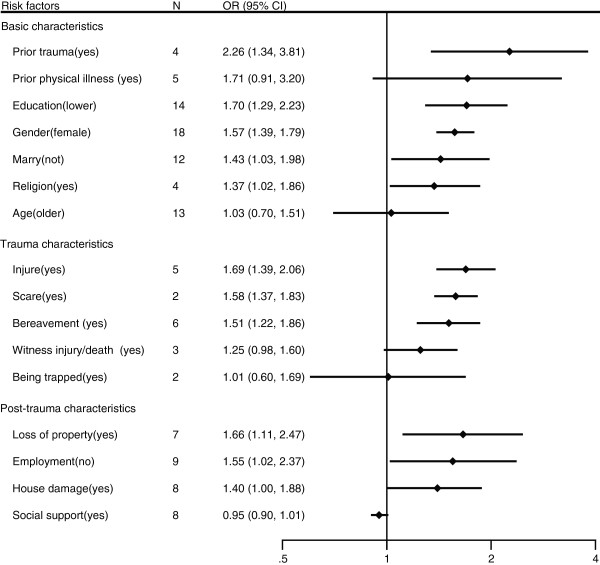
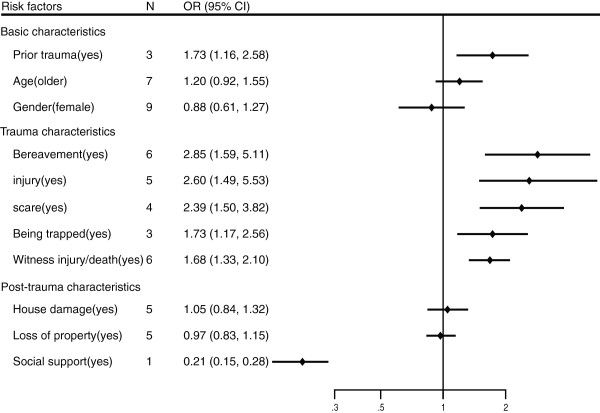
Verification
Claims the paper makes
The claims and statistics of this paper haven’t been checked yet.
Run the check — free, no account needed. It reads the open-access text and checks the sources it cites.
Claims other papers make about this one
Each is checked against this paper’s own text: does it say what the citing paper says it does?
The source backs part of the claim, not all of it — or backs it for a different population, condition or comparison.
In the citing paper
“Depressive episodes are frequently triggered by stressful events, and stress can worsen the clinical course of depression [13,14].”
From Biological Embedding of Early-Life Adversity and a Scoping Review of the Evidence for Intergenerational Epigenetic Transmission of Stress and Trauma in Humans (2023) · cites this paper as [13]
Experimental — accuracy not yet measured
Self-check
Percentages, sums and reported differences re-computed from the paper’s own numbers.
The self-check needs the paper’s full text.
Citations
Cites
Measuring inconsistency in meta-analyses
Higgins, J. P. T., Thompson, S. G., Deeks, J. J., & Altman, D. G. (2003) · BMJ · doi:10.1136/bmj.327.7414.557 · Cited by 63,139
Bias in meta-analysis detected by a simple, graphical test
Egger, M., Smith, G. D., Schneider, M., & Minder, C. (1997) · BMJ · doi:10.1136/bmj.315.7109.629 · Cited by 56,722
Meta-analysis in clinical trials
DerSimonian, R., & Laird, N. (1986) · Controlled Clinical Trials · doi:10.1016/0197-2456(86)90046-2 · Cited by 39,552
Meta-analysis of Observational Studies in Epidemiology<SUBTITLE>A Proposal for Reporting</SUBTITLE>
Stroup, D. F. (2000) · JAMA · doi:10.1001/jama.283.15.2008 · Cited by 20,623
(2014) · Medical Entomology and Zoology · Cited by 17,633
60,000 Disaster Victims Speak: Part I. An Empirical Review of the Empirical Literature, 1981–2001
Norris, F. H., Friedman, M. J., Watson, P. J., Byrne, C. M., Diaz, E., & Kaniasty, K. (2002) · Psychiatry: Interpersonal and Biological Processes · doi:10.1521/psyc.65.3.207.20173 · Cited by 3,128
Steel, Z., Chey, T., Silove, D., Marnane, C., Bryant, R. A., & van Ommeren, M. (2009) · JAMA · doi:10.1001/jama.2009.1132 · Cited by 2,246
Porter, M., & Haslam, N. (2005) · JAMA · doi:10.1001/jama.294.5.602 · Cited by 1,793
Davis, H. S. (1966) · JAMA · doi:10.1001/jama.1966.03100200106038 · Cited by 1,719
Depression and cancer mortality: a meta-analysis
Pinquart, M., & Duberstein, P. R. (2010) · Psychological Medicine · doi:10.1017/s0033291709992285 · Cited by 1,083 · cited 1×
“by mass conflict/displacement, and populations affected by deadly diseases such as cancer and stroke [36-39].”
Background
Research works printed but not linked: 2
- Celiac Disease. Evidence Reports/Technology Assessments, No. 104 (Appendix D). http://www.ncbi.nlm.nih.gov/books/NBK35156,
- Wang T, Han B: Buddhism belief and mental health status of aging survivors in Wenchuan earthquake disaster area. Chin J Gerontol. 2009, 29: 1272-1275.
Cited by
Sorted by citations
Whitmee, S., Haines, A., Beyrer, C., Boltz, F., Capon, A. G., de Souza Dias, B. F., Ezeh, A., Frumkin, H., Gong, P., Head, P., et al. (2015) · The Lancet · doi:10.1016/s0140-6736(15)60901-1 · Cited by 2,998
Review: Mental health impacts of the COVID‐19 pandemic on children and youth – a systematic review
Samji, H., Wu, J., Ladak, A., Vossen, C., Stewart, E., Dove, N., Long, D., & Snell, G. (2022) · Child and Adolescent Mental Health · doi:10.1111/camh.12501 · Cited by 953
Shi, L., Lu, Z.-A., Que, J.-Y., Huang, X.-L., Liu, L., Ran, M.-S., Gong, Y.-M., Yuan, K., Yan, W., Sun, Y.-K., et al. (2020) · JAMA Network Open · doi:10.1001/jamanetworkopen.2020.14053 · Cited by 804
Gruber, J., Prinstein, M. J., Clark, L. A., Rottenberg, J., Abramowitz, J. S., Albano, A. M., Aldao, A., Borelli, J. L., Chung, T., Davila, J., et al. (2021) · American Psychologist · doi:10.1037/amp0000707 · Cited by 697
Tang, B., Deng, Q., Glik, D., Dong, J., & Zhang, L. (2017) · International Journal of Environmental Research and Public Health · doi:10.3390/ijerph14121537 · Cited by 299
Self-citation
Metadata
- Authors
- Tang, B., Liu, X., Liu, Y., Xue, C., & Zhang, L.
- Affiliations
- Second Military Medical University (CN)
- Corresponding author
- Zhang, Lulu
- Venue
- BMC Public Health
- Published
- 2014-06-19
- Volume
- 14
- Issue
- 1
- Pages
- 623-623
- ISSN
- 1471-2458 (ISSN-L)
- PMC
- PMC4077641
- OpenAlex
- W2002469321
- Cited by
- 333
- References
- 57
- Citations by year
- 2026: 22 · 2025: 38 · 2024: 40 · 2023: 25 · 2022: 40 · 2021: 37 · 2020: 37 · 2019: 28 · 2018: 20 · 2017: 22 · 2016: 15 · 2015: 9
- FWCI
- 2.32
- Type
- journal article
- Language
- en
- Open access
- gold
- doi.org
- Licence
- Locations
- BMC Public Health (publishedVersion, cc-by)
- PubMed Central (publishedVersion, cc-by)
- PubMed (publishedVersion)
- Funders
- National Natural Science Foundation of China (91224005, 71303249, 71103194)
- Topics
- Social Sciences › Psychology › Clinical Psychology › Posttraumatic Stress Disorder Research
- Social Sciences › Sociology and Political Science › Disaster Management and Resilience
- Health Sciences › Health Professions › Emergency Medical Services › Disaster Response and Management
- Keywords
- depression, natural disasters, disaster survivors, risk factors, children, adults, psychological trauma, bereavement, social support, gender differences, marital status, religious beliefs, educational attainment, disaster mental health
- MeSH terms
- Adult, Bereavement, Child, Cross-Sectional Studies, Depressive Disorder, Disasters, Female, Humans, Male, Risk Factors, Prevalence, Survivors, Observational Studies as Topic
About these checks
Registry, retraction, Cites and statistics results are computed, not judged, with one exception: a printed reference that no index lists is read once by a model before it counts as a citation error. Claims are extracted by a model and kept only when their quote appears verbatim in the text; each cited source is then checked, with a model’s help, for whether it says what the claim relies on. Those verdicts can be wrong — read the claim’s quote and the cited source before relying on one.
Statistics and arithmetic are recomputed, not judged.
Confidence bands are shown only for fields calibrated on our annotated test set. None is calibrated yet, so no band is shown.
What counts as a claim ›How we measure confidence ›How we check this ›
Are you an author, or do you see a problem with this page? Request a review
