

'Change means sacrificing a good life': perceptions about severity of type 2 diabetes and preventive lifestyles among people afflicted or at high risk of type 2 diabetes in Iganga Uganda
Open accessThe DOI matches its Crossref record; 59 of the 59 references it cites were found in a registry or an index.
Abstract
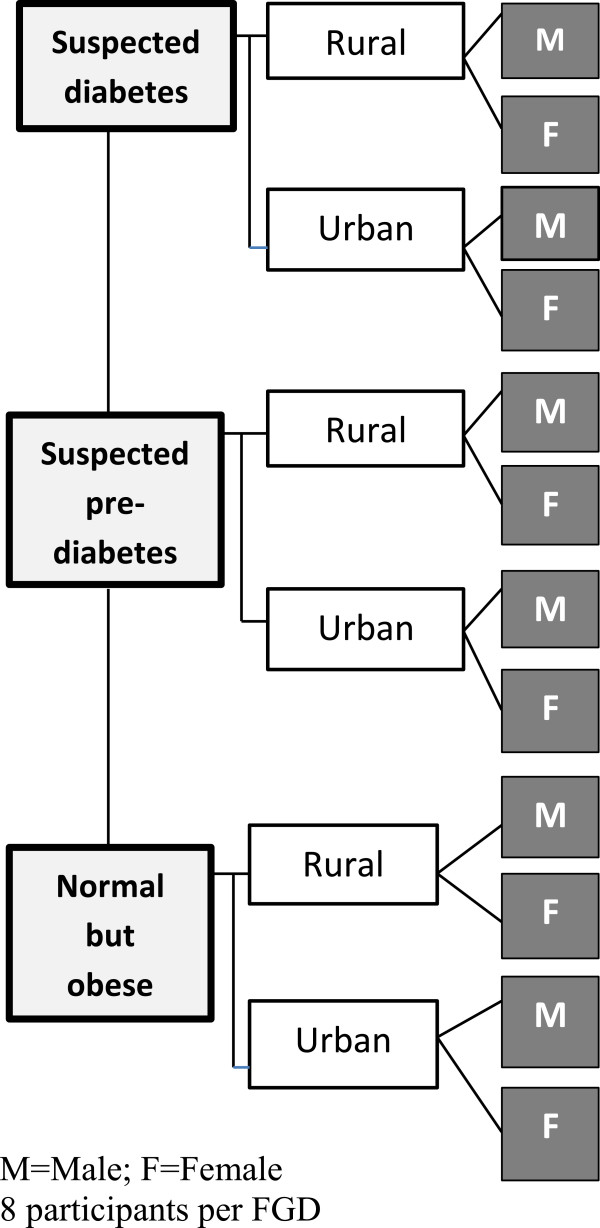
BACKGROUND: Interventions for prevention of type 2 diabetes ought to be acceptable to target communities. We assessed perceptions about type 2 diabetes and lifestyle change among people afflicted or at high risk of this disease in a low income setting in Iganga Uganda. METHODS: Twelve focus group discussions (FGDs) of eight participants each were conducted, balancing rural and peri-urban (near the Municipality) residence and gender. The FGDs involved people with suspected type 2 diabetes (based on fasting plasma glucose (FPG), people with suspected pre-diabetes and obese people with normal FPG. Content analysis was conducted. RESULTS: Diabetes was perceived to be a very severe disease. Its severity was attributed to its incurability and its numerous health effects. Men were also concerned about reduced sexual performance. However, participants' strong concerns about the severity of diabetes were not reflected in their perceptions about the risk factors and lifestyles associated with it. While people with diabetes perceive obesity as 'sickness', those without diabetes perceive it as a sign of 'success'. Although participants are willing to change their diet, they mention numerous barriers including poverty, family size, and access to some foods. Because of their good taste, reduction of high risk foods like sugar and fried food is perceived as 'sacrificing a good life'. Increments in physical activity were said to be feasible, but only in familiar forms like domestic work. An over-arching theme emerged that 'lifestyle changes are viewed as sacrificing a good life'. CONCLUSIONS: Health promotion should target both community norms and individual awareness regarding obesity, physical activity and diet, and should address the notion that obesity and unhealthy foods represent a good life. Health educators should plan with clients on how to overcome barriers and misconceptions to lifestyle change, leveraging the pervasive perception of type 2 diabetes as a severe disease to motivate change.
Overview
The claims and statistics of this paper haven’t been checked yet.
Free: it reads the open-access text and checks the first 5 claims that cite a source we can check. Create a free account to check every claim.
Integrity signals
Registry
Cites
Statistics
Figures
Verification
Claims the paper makes
The claims and statistics of this paper haven’t been checked yet.
Free: it reads the open-access text and checks the first 5 claims that cite a source we can check. Create a free account to check every claim.
Claims other papers make about this one
Each is checked against this paper’s own text: does it say what the citing paper says it does?
The source backs part of the claim, not all of it — or backs it for a different population, condition or comparison.
In the citing paper
“In rural low-income communities of eastern Uganda, poverty and large household sizes constitute prominent food environment barriers for adults living with type 2 diabetes (57). Local subsistence farmers mainly rely on home-grown sweet potatoes as staple food, while animal products such as chicken, fish and eggs are financially unaffordable for most big families (43).”
From Implementation and translation of evidence-based dietary strategies for type 2 diabetes in resource-limited settings: a scoping review based on the CFIR framework (2026) · cites this paper as [57]
Experimental — accuracy not yet measured
Self-check
Percentages, sums and reported differences re-computed from the paper’s own numbers.
The self-check needs the paper’s full text.
Citations
Cites
Graneheim, U. H., & Lundman, B. (2004) · Nurse Education Today · doi:10.1016/j.nedt.2003.10.001 · Cited by 20,772 · cited 4×
“An over-arching descriptive theme was then derived from the themes [34].”
MethodInfluentialCohen, L., Manion, L., & Morrison, K. (2007) · Routledge eBooks · doi:10.4324/9780203029053 · Cited by 20,105
Motivational interviewing: preparing people for change.
Miller, W. R., & Rollnick, S. (2002) · Guilford Press eBooks · Cited by 7,915
Pan, X.-R., Li, G.-W., Hu, Y.-H., Wang, J.-X., Yang, W.-Y., An, Z.-X., Hu, Z.-X., Juan-Lin, Xiao, J.-Z., Cao, H.-B., et al. (1997) · Diabetes Care · doi:10.2337/diacare.20.4.537 · Cited by 4,320
Unwin, N. C. (2006) · Cited by 1,661
Research Methods in Education: An Introduction
Wiersma, W., & Jurs, S. G. (1980) · Cited by 1,459
Toward a theory-based analysis of behavioral maintenance
Rothman, A. J. (2000) · Health Psychology · doi:10.1037/0278-6133.19.suppl1.64 · Cited by 783
Beaglehole, R., Epping-Jordan, J., Patel, V., Chopra, M., Ebrahim, S., Kidd, M., & Haines, A. (2008) · The Lancet · doi:10.1016/s0140-6736(08)61404-x · Cited by 684 · cited 1×
“A major shift in the health systems of low income countries is therefore necessary, to integrate prevention for non-communicable diseases [2,3].”
BackgroundNon-communicable diseases in sub-Saharan Africa: what we know now
Dalal, S., Beunza, J. J., Volmink, J., Adebamowo, C., Bajunirwe, F., Njelekela, M., Mozaffarian, D., Fawzi, W., Willett, W., Adami, H.-O., et al. (2011) · International Journal of Epidemiology · doi:10.1093/ije/dyr050 · Cited by 631
Schellenberg, E. S., Dryden, D. M., Vandermeer, B., Ha, C., & Korownyk, C. (2013) · Annals of Internal Medicine · doi:10.7326/0003-4819-159-8-201310150-00007 · Cited by 520 · cited 2×
“of type 2 diabetes have been known for decades [4-6].”
Background
Research works printed but not linked: 4
- Stuckler D Siegel K Responding to the global challenge of chronic disease, Oxford Univer 2011 1 New York Oxford University Press Inc
- Turyatemba J Iganga-Mayuge DSS at the Helm of Research Makerere University School of Graduate Studies 2011
- Mayega RW Guwatudde D Makumbi F Nakwagala FN Peterson S Tomson G Ostenson CG Diabetes and pre-diabetes among persons aged 35 to 60 years in eastern Uganda: prevalence and associated factors PLoS One 2013 8 8 e72554 10.1371/journal.pone.0072554 23967317 PMC3743823 · DOI
- WHO Geneva W Increasing Physical Activity: A Guide for population level approaches 2007 Geneva WHO
Cited by
Self-management of diabetes in Sub-Saharan Africa: a systematic review
Stephani, V., Opoku, D., & Beran, D. (2018) · BMC Public Health · doi:10.1186/s12889-018-6050-0 · Cited by 172
“regarding the sugar-level of food) [19, 24, 28].”
BackgroundSkoglund, G., Nilsson, B. B., Olsen, C. F., Bergland, A., & Hilde, G. (2022) · BMC Public Health · doi:10.1186/s12889-022-12885-8 · Cited by 137
“challenging [34, 36, 45, 48, 51, 53], describing it as a feeling of sacrificing the good life [45].”
BackgroundInfluentialMusinguzi, G., Anthierens, S., Nuwaha, F., Geertruyden, J. V., Wanyenze, R. K., & Bastiaens, H. (2018) · International Journal of Hypertension · doi:10.1155/2018/8307591 · Cited by 100
“The current health service delivery system has a number of gaps ranging from lack of preventive services for NCDs to lack of essential supplies for managing NCDs [24].”
BackgroundKirunda, B. E., Fadnes, L. T., Wamani, H., den Broeck, J. V., & Tylleskär, T. (2015) · BMC Public Health · doi:10.1186/s12889-015-2506-7 · Cited by 90
“In addition, studies in Africa have reported a social norm of acceptability, or even preference for overweight and obesity particularly among women and it is perceived to be associated with affluence [51–54].”
BackgroundPiloya-Were, T., Sunni, M., Ogle, G. D., & Moran, A. (2016) · Current Opinion in Endocrinology, Diabetes & Obesity · doi:10.1097/med.0000000000000262 · Cited by 38
Mphwanthe, G., Carolan, M., Earnesty, D., & Weatherspoon, L. (2021) · Global Public Health · doi:10.1080/17441692.2020.1805784 · Cited by 35
Ndejjo, R., Musinguzi, G., Nuwaha, F., Wanyenze, R. K., & Bastiaens, H. (2020) · BMC Public Health · doi:10.1186/s12889-020-8188-9 · Cited by 35
“For example, a study in Iganga and Mayuge districts of Uganda reported that communities viewed lifestyle risk factors such as unhealthy diets as indicative of wealth and a high social standing and stated that changing these would tantamount to sacrifice of the ‘good life’ [41].”
BackgroundKiguli, J., Alvesson, H. M., Mayega, R. W., Kasujja, F. X., Muyingo, A., Kirunda, B. E., Kiracho, E. E., Nalwadda, C. K., Naggayi, G., Peterson, S., et al. (2019) · Appetite · doi:10.1016/j.appet.2019.104409 · Cited by 40
Self-citationKirunda, B. E., Wamani, H., Fadnes, L. T., den Broeck, J. V., & Tylleskär, T. (2016) · Journal of Physical Activity and Health · doi:10.1123/jpah.2016-0025 · Cited by 28
Tusubira, A. K., Nalwadda, C. K., Akiteng, A. R., Hsieh, E., Ngaruiya, C., Rabin, T. L., Katahoire, A., Hawley, N. L., Kalyesubula, R., Ssinabulya, I., et al. (2021) · Annals of Global Health · doi:10.5334/aogh.3308 · Cited by 24
Aladeniyi, I., Adeniyi, O. V., Fawole, O. I., Adeolu, M., Goon, D. T., Ajayi, A. I., & Owolabi, E. O. (2017) · South African Family Practice · doi:10.1080/20786190.2017.1333784 · Cited by 21
Ghammari, F., Jalilian, H., Khodayari‐zarnaq, R., & Gholizadeh, M. (2023) · Health Science Reports · doi:10.1002/hsr2.1231 · Cited by 18
“Some patients with diabetes expressed that there was an opportunity cost to lifestyle change.(18) Daily blood glucose monitoring, medication, and lifestyle modifications related to diet, and exercise identified important factors in successful diabetes management.”
BackgroundInfluentialManyara, A. M., Mwaniki, E., Gill, J. M. R., & Gray, C. M. (2024) · Public Health Nutrition · doi:10.1017/s1368980024000752 · Cited by 14
“(cid:129) Association of weight loss with ill health, especially HIV/AIDS in South Africa (24,38,63,92,111,135) and Uganda (91) .”
BackgroundInfluentialGuariguata, L., de Beer, I., Hough, R., Mulongeni, P., Feeley, F. G., & de Wit, T. F. R. (2015) · PLoS ONE · doi:10.1371/journal.pone.0131737 · Cited by 12
“Where there is discordance between self-perceived risk and actual risk, the necessary treatment may be delayed or risk behaviors amplified; a relationship that has been seen in studies of HIV [19,28,29] as well as diabetes[30,31] and hypertension[32] in African populations.”
BackgroundMayega, R. W., Ekirapa, E. K., Kirunda, B. E., Nalwadda, C. K., Aweko, J., Tomson, G. B., Östenson, C., van Olmen, J., Daivadanam, M., & Kiguli, J. (2018) · BMC Public Health · doi:10.1186/s12889-018-6249-0 · Cited by 9
Self-citationBanda, J., Bunn, C., Crampin, A. C., Gill, J. M. R., & Gray, C. M. (2023) · BMJ Open · doi:10.1136/bmjopen-2021-058261 · Cited by 12
“24 This included washing, cooking, walking and cycling in urban areas, and more vigorous activities such as gardening, bush clearing, fetching water, splitting fire-wood and pounding food in rural areas.”
BackgroundJere, J., Ruark, A. H., Bidwell, J. T., Butterfield, R. M., Neilands, T. B., Weiser, S. D., Mulauzi, N., Mkandawire, J., & Conroy, A. A. (2023) · PLoS ONE · doi:10.1371/journal.pone.0296473 · Cited by 10
An assessment of non-communicable disease mortality among adults in Eastern Uganda, 2010–2016
Natukwatsa, D., Wosu, A. C., Ndyomugyenyi, D. B., Waibi, M., & Kajungu, D. (2021) · PLoS ONE · doi:10.1371/journal.pone.0248966 · Cited by 9
“Qualitative studies conducted within the Iganga-Mayuge area also show that myths and misconceptions about NCDs and their metabolic risk factors are commonplace [21].”
BackgroundHeine, M., Badenhorst, M., van Zyl, C., Ghisi, G. L. D. M., Babu, A. S., Buckley, J., Serón, P., Turk-Adawi, K. I., & Derman, W. E. (2021) · International Journal of Environmental Research and Public Health · doi:10.3390/ijerph182211977 · Cited by 8
Tusubira, A. K., Ssinabulya, I., Kalyesubula, R., Nalwadda, C. K., Akiteng, A. R., Ngaruiya, C., Rabin, T. L., Katahoire, A., Armstrong-Hough, M. J., Hsieh, E., et al. (2023) · PLOS Global Public Health · doi:10.1371/journal.pgph.0001777 · Cited by 7
Solomons, N., Kruger, H. S., & Puoane, T. R. (2017) · Health SA Gesondheid · doi:10.1016/j.hsag.2016.11.006 · Cited by 6
“These findings are in line with those reported in previous studies that healthy food is perceived to be costly and that readily available foods in an area influence eating behaviour (Farhamand, Tehrni, Amiri, & Azizi, 2012; Mayega et al., 2014; Muzigaba & Puoane, 2014; Verstraeten et al., 2014).”
ResultOnu, R., & Babatunde, S. (2018) · International Journal of Research in Medical Sciences · doi:10.18203/2320-6012.ijrms20181964 · Cited by 5
Masa, R., & Chowa, G. A. N. (2019) · Food Security · doi:10.1007/s12571-019-00924-z · Cited by 3
“For example, because of good taste, reduction of high risk foods associated with chronic diseases is sometimes considered as B sacrificing a good life ^ (Mayega et al. 2014).”
BackgroundDo People with Type 2 Diabetes Think They are Unhealthy? A Cross-Sectional Study in Celaya, Mexico
Paz-Salinas, K. C., Padilla-Raygoza, N., Sandoval, S. D. C. D., Olvera-Villanueva, G., & Ruiz-Paloalto, M. L. (2015) · Central Asian Journal of Global Health · doi:10.5195/cajgh.2015.207 · Cited by 2
“, reported that only 14% of people with a high intake of fat perceived their diet as unhealthy.(23) In Uganda, obesity is seen as "success" in non diabetic subjects and is desirable among women ("big is better"); weight loss is stigmatized as being sick and associated HIV / AIDS.”
BackgroundInfluentialMusinguzi, N., Stanford, F. C., Boatin, A. A., Orrell, C., Asiimwe, S. B., Siedner, M. J., Haberer, J. E., on behalf of the META team, Bwana, B. M., Amanyire, G., et al. (2021) · International Journal of Obesity · doi:10.1038/s41366-021-00837-y · Cited by 2
“In Uganda, and among black South Africans, obesity has been associated with good health and wealth, while weight loss can be stigmatizing and is often associated with poor health and adversity [11].”
BackgroundJuvinao, D. D., Molina, R. T., Hemingway, B., Acosta, T., & Rod, J. E. (2025) · BMC Public Health · doi:10.1186/s12889-025-25153-2 · Cited by 1
“For instance, qualitative research supports that people with diabetes in low resource settings see obesity as sickness, but people without diabetes perceive it as a sign of success [4].”
InfluentialNdejjo, R., Masengere, P., Nuwaha, F., Ddumba, I., Bastiaens, H., Wanyenze, R. K., & Musinguzi, G. (2021) · Open Research Europe · doi:10.12688/openreseurope.13286.1 · Cited by 6
Mzumara, T., & Banda, O. K. (2024) · Research Square · doi:10.21203/rs.3.rs-4076135/v1 · Cited by 1
Shao, K., Lei, H., Zhu, J., Chen, X., Sina, Y., & Yao, R. (2026) · Frontiers in Public Health · doi:10.3389/fpubh.2026.1870603
Waist Circumference and Metabolic Syndrome: Ugandan Perspectives
Lubogo, D., & Matovu, N. (2025) · Springer eBooks · doi:10.1007/978-3-031-32047-7_93-1
Metadata
- Authors
- Mayega, R. W., Etajak, S., Rutebemberwa, E., Tomson, G., & Kiguli, J.
- Affiliations
- Makerere University (UG)
- Karolinska Institutet (SE)
- Corresponding author
- Mayega, Roy W
- Venue
- BMC Public Health
- Published
- 2014-08-21
- Volume
- 14
- Issue
- 1
- Pages
- 864-864
- ISSN
- 1471-2458 (ISSN-L)
- PMC
- PMC4148963
- OpenAlex
- W2027932614
- Cited by
- 32
- References
- 59
- Citations by year
- 2026: 1 · 2025: 2 · 2024: 2 · 2023: 5 · 2022: 1 · 2021: 5 · 2020: 2 · 2019: 2 · 2018: 4 · 2017: 3 · 2016: 2 · 2015: 3
- FWCI
- 2.15
- Type
- journal article
- Language
- en
- Open access
- gold
- doi.org
- Licence
- Locations
- BMC Public Health (publishedVersion, cc-by)
- Europe PMC (PubMed Central) (publishedVersion, cc-by)
- PubMed Central (publishedVersion, cc-by)
- PubMed (publishedVersion)
- Funders
- Styrelsen för Internationellt Utvecklingssamarbete
- International Development Research Centre
- Karolinska Institutet
- African Population and Health Research Center
- Topics
- Health Sciences › Medicine › Endocrinology, Diabetes and Metabolism › Diabetes Management and Education
- Health Sciences › Medicine › Endocrinology, Diabetes and Metabolism › Diabetes, Cardiovascular Risks, and Lipoproteins
- Health Sciences › Medicine › Public Health, Environmental and Occupational Health › Obesity and Health Practices
- Keywords
- type 2 diabetes, prediabetes, obesity, physical activity, diet, barriers to lifestyle change, community norms, health promotion
- MeSH terms
- Adult, Attitude to Health, Communication Barriers, Diabetes Mellitus, Type 2, Female, Humans, Life Style, Male, Middle Aged, Perception, Poverty, Rural Population, Severity of Illness Index, Uganda, Health Behavior
About these checks
Registry, retraction, Cites and statistics results are computed, not judged, with one exception: a printed reference that no index lists is read once by a model before it counts as a citation error. Claims are extracted by a model and kept only when their quote appears verbatim in the text; each cited source is then checked, with a model’s help, for whether it says what the claim relies on. Those verdicts can be wrong — read the claim’s quote and the cited source before relying on one.
Statistics and arithmetic are recomputed, not judged.
Confidence bands are shown only for fields calibrated on our annotated test set. None is calibrated yet, so no band is shown.
What counts as a claim ›How we measure confidence ›How we check this ›
Are you an author, or do you see a problem with this page? Request a review
Data sources
Bibliographic data: Semantic Scholar, OpenAlex, Crossref.
Contains information from the Semantic Scholar Academic Graph Datasets, made available under the ODC Attribution License (ODC-BY 1.0).
Semantic Scholar’s data is described in: Kinney, R., et al. (2023). The Semantic Scholar Open Data Platform. arXiv:2301.10140.
