

Falls in young, middle-aged and older community dwelling adults: perceived cause, environmental factors and injury
Open accessThe DOI matches its Crossref record; 41 of the 41 references it cites were found in a registry or an index.
Abstract
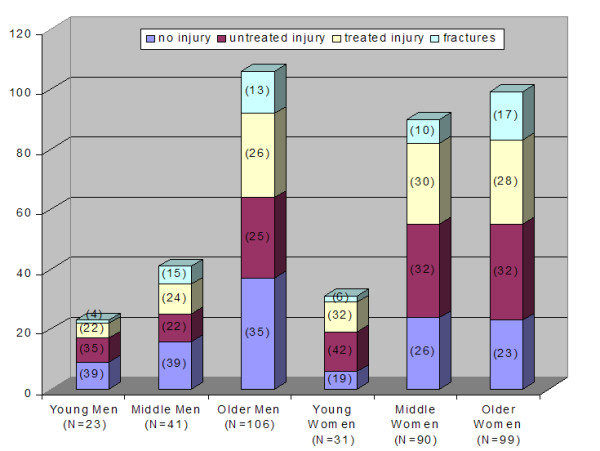
Background: Falls in older people have been characterized extensively in the literature, however little has been reported regarding falls in middle-aged and younger adults. The objective of this paper is to describe the perceived cause, environmental influences and resultant injuries of falls in 1497 young (20–45 years), middle-aged (46–65 years) and older (> 65 years) men and women from the Baltimore Longitudinal Study on Aging. Methods: A descriptive study where participants completed a fall history questionnaire describing the circumstances surrounding falls in the previous two years. Results: The reporting of falls increased with age from 18% in young, to 21% in middle-aged and 35% in older adults, with higher rates in women than men. Ambulation was cited as the cause of the fall most frequently in all gender and age groups. Our population reported a higher percentage of injuries (70.5%) than previous studies. The young group reported injuries most frequently to wrist/hand, knees and ankles; the middle-aged to their knees and the older group to their head and knees. Women reported a higher percentage of injuries in all age groups. Conclusion: This is the first study to compare falls in young, middle and older aged men and women. Significant differences were found between the three age groups with respect to number of falls, activities engaged in prior to falling, perceived causes of the fall and where they fell.
Overview
The claims and statistics of this paper haven’t been checked yet.
Free: it reads the open-access text and checks the first 5 claims that cite a source we can check. Create a free account to check every claim.
Integrity signals
Registry
Cites
Statistics
Figures
Verification
Claims the paper makes
The claims and statistics of this paper haven’t been checked yet.
Free: it reads the open-access text and checks the first 5 claims that cite a source we can check. Create a free account to check every claim.
Self-check
Percentages, sums and reported differences re-computed from the paper’s own numbers.
The self-check needs the paper’s full text.
Citations
Cites
1 retracted
Interventions for preventing falls in elderly people
Gillespie, L. D., Gillespie, W. J., Robertson, M. C., Lamb, S. E., Cumming, R. G., & Rowe, B. H. (2003) · The Cochrane Database of Systematic Reviews · doi:10.1002/14651858.cd000340 · Cited by 1,422
RetractedThe CES-D Scale: A Self-Report Depression Scale for Research in the General Population
Radloff, L. S. (1977) · Applied Psychological Measurement · doi:10.1177/014662167700100306 · Cited by 53,267
Sensitivity and False Alarm Rate of a Fall Sensor in Long-Term Fall Detection in the Elderly
Kangas, M., Korpelainen, R., Vikman, I., Nyberg, L., & Jämsä, T. (2015) · Gerontology · doi:10.1159/000362720 · Cited by 18,909
Risk Factors for Falls among Elderly Persons Living in the Community
Tinetti, M. E., Speechley, M., & Ginter, S. F. (1988) · New England Journal of Medicine · doi:10.1056/nejm198812293192604 · Cited by 6,509 · cited 3×
“Tinetti et al [32] found in a prospective study that 24% of the falls in community dwelling older aged persons resulted in serious injury and 6 percent had fractures.”
BackgroundResultThe cochrane database of systematic reviews
Geddes, J. (1996) · Journal of Psychosomatic Research · doi:10.1016/s0022-3999(96)90063-x · Cited by 5,989
Verbrugge, L. M., & Jette, A. M. (1994) · Social Science & Medicine · doi:10.1016/0277-9536(94)90294-1 · Cited by 3,310 · cited 1×
“In older people, falls are a risk factor for disability and frailty, and exacerbate the disablement process [3,4].”
BackgroundThe Cochrane Database of Systematic Reviews
Handoll, H. H. (2004) · The British Journal of Hand Therapy · doi:10.1177/175899830400900201 · Cited by 1,513
FALLS BY ELDERLY PEOPLE AT HOME: PREVALENCE AND ASSOCIATED FACTORS
BLAKE, A. J., MORGAN, K., BENDALL, M. J., DALLOSSO, H., EBRAHIM, S. B. J., ARIE, T. H. D., FENTEM, P. H., & BASSEY, E. J. (1988) · Age and Ageing · doi:10.1093/ageing/17.6.365 · Cited by 1,261 · cited 1×
“Most older fallers reported tripping as the cause for their fall [18,23], with a large percentage unable to give any reason in a one year retrospective study [24].”
BackgroundCAMPBELL, A. J., BORRIE, M. J., SPEARS, G. F., JACKSON, S. L., BROWN, J. S., & FITZGERALD, J. L. (1990) · Age and Ageing · doi:10.1093/ageing/19.2.136 · Cited by 803 · cited 2×
“Campbell et al [17] found in a prospective study of participants (over 69 years) from a rural setting no gender difference in fall rate; however men were more likely to fall outside and at more intense levels of activity.”
BackgroundResultFactors Associated with Falls in the Elderly: A Community Study
Prudham, D., & Evans, J. G. (1981) · Age and Ageing · doi:10.1093/ageing/10.3.141 · Cited by 803 · cited 2×
“Most older fallers reported tripping as the cause for their fall [18,23], with a large percentage unable to give any reason in a one year retrospective study [24].”
Background
Research works printed but not linked: 2
- 26. Adler-Traines M Falls in the senior population. Physical Therapy Forum 1994 9 14 17
- 38. Metter EJ Yim-Chipless PK Musiol R Talbot LA Balance Training: Preventing Falls in Older Adults The American Journal of Medicine and Sports 2003 5 94 99
Cited by
Comparison of low-complexity fall detection algorithms for body attached accelerometers
Kangas, M., Konttila, A., Lindgren, P., Winblad, I., & Jämsä, T. (2008) · Gait & Posture · doi:10.1016/j.gaitpost.2008.01.003 · Cited by 493
Wrisley, D. M., & Kumar, N. A. (2010) · Physical Therapy · doi:10.2522/ptj.20090069 · Cited by 386
Falls and Fall-Related Injuries among Community-Dwelling Adults in the United States
Verma, S. K., Willetts, J. L., Corns, H. L., Marucci-Wellman, H. R., Lombardi, D. A., & Courtney, T. K. (2016) · PLOS ONE · doi:10.1371/journal.pone.0150939 · Cited by 304
“more falls in the previous two years.[21] In this case, the recall period was twice as long as in the current study, and these proportions are correspondingly about double the values we report.”
ResultGrevendonk, L., Connell, N. J., McCrum, C., Fealy, C. E., Bilet, L., Bruls, Y. M. H., Mevenkamp, J., Schrauwen-Hinderling, V. B., Jörgensen, J. A., Moonen-Kornips, E., et al. (2021) · Nature Communications · doi:10.1038/s41467-021-24956-2 · Cited by 298
Falls and fear of falling: burden, beliefs and behaviours
Boyd, R., & Stevens, J. A. (2009) · Age and Ageing · doi:10.1093/ageing/afp053 · Cited by 290
“Research shows that most fall injuries are minor and only a small percentage result in severe injury [22].”
Background
Metadata
- Authors
- Talbot, L. A., Musiol, R. J., Witham, E. K., & Metter, E. J.
- Affiliations
- Uniformed Services University of the Health Sciences (US)
- Holy Cross Hospital (US)
- Henry M. Jackson Foundation (US)
- National Institutes of Health (US)
- Corresponding author
- Talbot, Laura A
- ORCID
- Talbot, Laura A
- Venue
- BMC Public Health
- Published
- 2005-08-18
- Volume
- 5
- Issue
- 1
- Pages
- 86-86
- ISSN
- 1471-2458 (ISSN-L)
- PMC
- PMC1208908
- OpenAlex
- W2118856586
- Cited by
- 654
- References
- 41
- Citations by year
- 2026: 27 · 2025: 48 · 2024: 54 · 2023: 43 · 2022: 55 · 2021: 57 · 2020: 56 · 2019: 44 · 2018: 37 · 2017: 29 · 2016: 35 · 2015: 28 · 2014: 29 · 2013: 20 · 2012: 20
- FWCI
- 17.37
- Type
- journal article
- Language
- en
- Open access
- gold
- doi.org
- Licence
- Locations
- BMC Public Health (publishedVersion, cc-by)
- PubMed Central (publishedVersion, cc-by)
- PubMed (publishedVersion)
- DOAJ (DOAJ: Directory of Open Access Journals) (submittedVersion, cc-by-sa)
- Funders
- Johns Hopkins University
- National Institutes of Health
- National Institute on Aging
- Topics
- Health Sciences › Health Professions › Physical Therapy, Sports Therapy and Rehabilitation › Balance, Gait, and Falls Prevention
- Health Sciences › Medicine › Public Health, Environmental and Occupational Health › Injury Epidemiology and Prevention
- Health Sciences › Medicine › Surgery › Hip and Femur Fractures
- Keywords
- falls, fall-related injuries, environmental factors, age differences, young adults, middle-aged adults, older adults, ambulation, sex differences, wrist injuries, knee injury, traumatic brain injury, community-dwelling adults
- MeSH terms
- Accidental Falls, Activities of Daily Living, Adult, Aged, Aged, 80 and over, Cross-Sectional Studies, District of Columbia, Female, Humans, Longitudinal Studies, Male, Middle Aged, Surveys and Questionnaires, Wounds and Injuries, Baltimore, Age Distribution, Sex Distribution, Risk Assessment
About these checks
Registry, retraction, Cites and statistics results are computed, not judged, with one exception: a printed reference that no index lists is read once by a model before it counts as a citation error. Claims are extracted by a model and kept only when their quote appears verbatim in the text; each cited source is then checked, with a model’s help, for whether it says what the claim relies on. Those verdicts can be wrong — read the claim’s quote and the cited source before relying on one.
Statistics and arithmetic are recomputed, not judged.
Confidence bands are shown only for fields calibrated on our annotated test set. None is calibrated yet, so no band is shown.
What counts as a claim ›How we measure confidence ›How we check this ›
Are you an author, or do you see a problem with this page? Request a review
Data sources
Bibliographic data: Semantic Scholar, OpenAlex, Crossref.
Contains information from the Semantic Scholar Academic Graph Datasets, made available under the ODC Attribution License (ODC-BY 1.0).
Semantic Scholar’s data is described in: Kinney, R., et al. (2023). The Semantic Scholar Open Data Platform. arXiv:2301.10140.
