

Falls in young, middle-aged and older community dwelling adults: perceived cause, environmental factors and injury
Open accessThe DOI matches its Crossref record; 41 of the 41 references it cites were found in a registry or an index.
Abstract
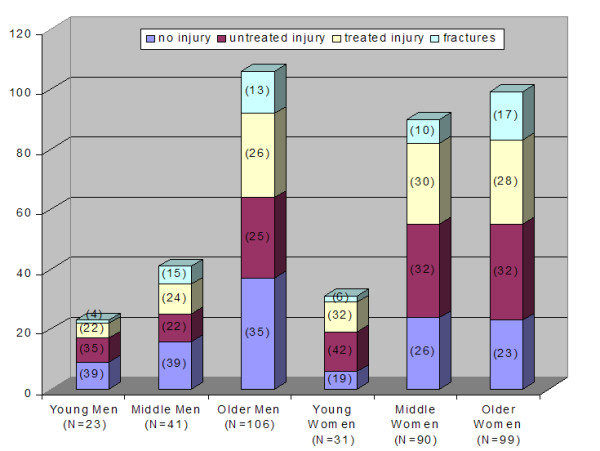
Background: Falls in older people have been characterized extensively in the literature, however little has been reported regarding falls in middle-aged and younger adults. The objective of this paper is to describe the perceived cause, environmental influences and resultant injuries of falls in 1497 young (20–45 years), middle-aged (46–65 years) and older (> 65 years) men and women from the Baltimore Longitudinal Study on Aging. Methods: A descriptive study where participants completed a fall history questionnaire describing the circumstances surrounding falls in the previous two years. Results: The reporting of falls increased with age from 18% in young, to 21% in middle-aged and 35% in older adults, with higher rates in women than men. Ambulation was cited as the cause of the fall most frequently in all gender and age groups. Our population reported a higher percentage of injuries (70.5%) than previous studies. The young group reported injuries most frequently to wrist/hand, knees and ankles; the middle-aged to their knees and the older group to their head and knees. Women reported a higher percentage of injuries in all age groups. Conclusion: This is the first study to compare falls in young, middle and older aged men and women. Significant differences were found between the three age groups with respect to number of falls, activities engaged in prior to falling, perceived causes of the fall and where they fell.
Overview
The claims and statistics of this paper haven’t been checked yet.
Free: it reads the open-access text and checks the first 5 claims that cite a source we can check. Create a free account to check every claim.
Integrity signals
Registry
Cites
Statistics
Figures
Verification
Claims the paper makes
The claims and statistics of this paper haven’t been checked yet.
Free: it reads the open-access text and checks the first 5 claims that cite a source we can check. Create a free account to check every claim.
Claims other papers make about this one
Each is checked against this paper’s own text: does it say what the citing paper says it does?
The check wasn’t confident either way, so it gives no verdict — never disputed.
In the citing paper
“This was a somewhat surprising finding given that muscle size has previously been linked to the presence of mobility deficits and disability in older adults 30–33.”
From Does quadriceps neuromuscular activation capability explain walking speed in older men and women? (2014) · cites this paper as [30]
Experimental — accuracy not yet measured
Self-check
Percentages, sums and reported differences re-computed from the paper’s own numbers.
The self-check needs the paper’s full text.
Citations
Cites
1 retracted
Interventions for preventing falls in elderly people
Gillespie, L. D., Gillespie, W. J., Robertson, M. C., Lamb, S. E., Cumming, R. G., & Rowe, B. H. (2003) · The Cochrane Database of Systematic Reviews · doi:10.1002/14651858.cd000340 · Cited by 1,422
RetractedThe CES-D Scale: A Self-Report Depression Scale for Research in the General Population
Radloff, L. S. (1977) · Applied Psychological Measurement · doi:10.1177/014662167700100306 · Cited by 53,267
Sensitivity and False Alarm Rate of a Fall Sensor in Long-Term Fall Detection in the Elderly
Kangas, M., Korpelainen, R., Vikman, I., Nyberg, L., & Jämsä, T. (2015) · Gerontology · doi:10.1159/000362720 · Cited by 18,909
Risk Factors for Falls among Elderly Persons Living in the Community
Tinetti, M. E., Speechley, M., & Ginter, S. F. (1988) · New England Journal of Medicine · doi:10.1056/nejm198812293192604 · Cited by 6,509 · cited 3×
“Tinetti et al [32] found in a prospective study that 24% of the falls in community dwelling older aged persons resulted in serious injury and 6 percent had fractures.”
BackgroundResultThe cochrane database of systematic reviews
Geddes, J. (1996) · Journal of Psychosomatic Research · doi:10.1016/s0022-3999(96)90063-x · Cited by 5,989
Verbrugge, L. M., & Jette, A. M. (1994) · Social Science & Medicine · doi:10.1016/0277-9536(94)90294-1 · Cited by 3,310 · cited 1×
“In older people, falls are a risk factor for disability and frailty, and exacerbate the disablement process [3,4].”
BackgroundThe Cochrane Database of Systematic Reviews
Handoll, H. H. (2004) · The British Journal of Hand Therapy · doi:10.1177/175899830400900201 · Cited by 1,513
FALLS BY ELDERLY PEOPLE AT HOME: PREVALENCE AND ASSOCIATED FACTORS
BLAKE, A. J., MORGAN, K., BENDALL, M. J., DALLOSSO, H., EBRAHIM, S. B. J., ARIE, T. H. D., FENTEM, P. H., & BASSEY, E. J. (1988) · Age and Ageing · doi:10.1093/ageing/17.6.365 · Cited by 1,261 · cited 1×
“Most older fallers reported tripping as the cause for their fall [18,23], with a large percentage unable to give any reason in a one year retrospective study [24].”
BackgroundCAMPBELL, A. J., BORRIE, M. J., SPEARS, G. F., JACKSON, S. L., BROWN, J. S., & FITZGERALD, J. L. (1990) · Age and Ageing · doi:10.1093/ageing/19.2.136 · Cited by 803 · cited 2×
“Campbell et al [17] found in a prospective study of participants (over 69 years) from a rural setting no gender difference in fall rate; however men were more likely to fall outside and at more intense levels of activity.”
BackgroundResultFactors Associated with Falls in the Elderly: A Community Study
Prudham, D., & Evans, J. G. (1981) · Age and Ageing · doi:10.1093/ageing/10.3.141 · Cited by 803 · cited 2×
“Most older fallers reported tripping as the cause for their fall [18,23], with a large percentage unable to give any reason in a one year retrospective study [24].”
BackgroundGeriatric Falls: Injury Severity Is High and Disproportionate to Mechanism
Sterling, D. A., O???Connor, J. A., & Bonadies, J. (2001) · The Journal of Trauma: Injury, Infection, and Critical Care · doi:10.1097/00005373-200101000-00021 · Cited by 802 · cited 2×
“In a trauma registry study in Connecticut, serious injury was seen in 32% of participants > 65 years of age and only 11% for the younger group [1].”
BackgroundForgetting Falls: The Limited Accuracy of Recall of Falls In the Elderly
Cummings, S. R., Nevitt, M. C., & Kidd, S. (1988) · Journal of the American Geriatrics Society · doi:10.1111/j.1532-5415.1988.tb06155.x · Cited by 780
Falls and Injuries in Frail and Vigorous Community Elderly Persons
Speechley, M., & Tinetti, M. (1991) · Journal of the American Geriatrics Society · doi:10.1111/j.1532-5415.1991.tb05905.x · Cited by 585 · cited 8×
“Tinetti ME, Speechley M, Ginter SH: Risk factors for falls among elderly persons living in the community.”
BackgroundInfluentialA LONGITUDINAL STUDY OF FALLS IN AN ELDERLY POPULATION: I. INCIDENCE AND MORBIDITY
GRYFE, C. I., AMIES, A., & ASHLEY, M. J. (1977) · Age and Ageing · doi:10.1093/ageing/6.4.201 · Cited by 373 · cited 1×
“5%; 275 of 390 fallers) of injuries from their falls than previous prospective [32,33,35] and retrospective studies [20,31].”
ResultInternational Journal of Circumpolar Health
(2011) · International Journal of Circumpolar Health · doi:10.3402/ijch.v70i3.17826 · Cited by 350
Stepping Over Obstacles: Dividing Attention Impairs Performance of Old More Than Young Adults
Chen, H.-C., Schultz, A. B., Ashton-Miller, J. A., Giordani, B., Alexander, N. B., & Guire, K. E. (1996) · The Journals of Gerontology Series A: Biological Sciences and Medical Sciences · doi:10.1093/gerona/51a.3.m116 · Cited by 295 · cited 1×
“As people age, changes in balance, proprioception, muscle strength, attention and vision make compensation to environmental hazards more difficult [25-27].”
BackgroundPopulation-based interventions for the prevention of fall-related injuries in older people
McClure, R. J., Turner, C., Peel, N., Spinks, A., Eakin, E., & Hughes, K. (2005) · Cochrane Database of Systematic Reviews · doi:10.1002/14651858.cd004441.pub2 · Cited by 275
ROSS, C. E., & MIROWSKY, J. (1984) · American Journal of Epidemiology · doi:10.1093/oxfordjournals.aje.a113819 · Cited by 254 · cited 1×
“The Center for Epidemiologic Study Depression (CES-D) Scale, a validated self-report instrument, was used to measure depressive symptoms [11,12].”
MethodPrevention of falls in the elderly
Myers, A. H., Young, Y., & Langlois, J. A. (1996) · Bone · doi:10.1016/8756-3282(95)00384-3 · Cited by 241
Home hazards and falls in the elderly: the role of health and functional status.
Northridge, M. E., Nevitt, M. C., Kelsey, J. L., & Link, B. (1995) · American Journal of Public Health · doi:10.2105/ajph.85.4.509 · Cited by 202 · cited 1×
“Environmental hazards are more likely to precipitate the fall in healthy active older individuals than in their frailer counterparts [21, 28 ].”
BackgroundRisk Factors for Major Injurious Falls among the Home-Dwelling Elderly by Functional Abilities
Koski, K., Luukinen, H., Laippala, P., & Kivelä, S.-L. (1998) · Gerontology · doi:10.1159/000022017 · Cited by 195 · cited 6×
“Koski et al [22] defined a major injury by fractures, joint dislocations, lacerations needing sutures, and intracranial injuries.”
BackgroundResultInfluentialNortheastern Ohio Trauma Study: II. Injury rates by age, sex, and cause.
Fife, D., Barancik, J. I., & Chatterjee, B. F. (1984) · American Journal of Public Health · doi:10.2105/ajph.74.5.473 · Cited by 192 · cited 1×
“In a trauma study, a 6% fall injury rate was found for the frail older people contrasted to a 0.4% rate for 40 year olds [ 34 ].”
ResultInfluentialTALBOT, L. A., METTER, E. J., & FLEG, J. L. (2000) · Medicine & Science in Sports & Exercise · doi:10.1097/00005768-200002000-00024 · Cited by 188 · cited 1×
“Physical activity was based on a self-report of 97 activities performed over the previous 2 years and converted into metabolic equivalents of resting oxygen consumption (MET-minutes) per 24 hours (see Talbot et. al. [ 10 ] for details).”
MethodSelf-citationThal, L. J., Grundman, M., & Golden, R. (1986) · Neurology · doi:10.1212/wnl.36.2.262 · Cited by 161
Niino, N., Tsuzuku, S., Ando, F., & Shimokata, H. (2000) · Journal of Epidemiology · doi:10.2188/jea.10.1sup_90 · Cited by 160 · cited 2×
“5%; 275 of 390 fallers) of injuries from their falls than previous prospective [32,33,35] and retrospective studies [20,31].”
BackgroundResultFried, L. P. (2000) · Epidemiologic Reviews · doi:10.1093/oxfordjournals.epirev.a018031 · Cited by 127
A LONGITUDINAL STUDY OF FALLS IN AN ELDERLY POPULATION II. SOME CIRCUMSTANCES OF FALLING
Ashley, M. J., Gryfe, C. I., & AMIES, A. (1977) · Age and Ageing · doi:10.1093/ageing/6.4.211 · Cited by 126
Review of the Literature on Falls Among the Elderly
Rawsky, E. (1998) · Journal of Nursing Scholarship · doi:10.1111/j.1547-5069.1998.tb01235.x · Cited by 114 · cited 1×
“As people age, changes in balance, proprioception, muscle strength, attention and vision make compensation to environmental hazards more difficult [25-27].”
BackgroundSlipping on ice and snow—elderly women and young men are typical victims
Björnstig, U., Björnstig, J., & Dahlgren, A. (1997) · Accident Analysis & Prevention · doi:10.1016/s0001-4575(96)00074-7 · Cited by 110 · cited 1×
“5 injuries per 1000; older women and young men (20–29 years) had the highest incidence of injury with half being fractures [29].”
BackgroundRate of Falls and the Correlates among Elderly People living in an Urban Community in Japan
Yasumura, S., Haga, H., Nagai, H., Suzuki, T., Amano, H., & Shibata, H. (1994) · Age and Ageing · doi:10.1093/ageing/23.4.323 · Cited by 98 · cited 1×
“Women had a higher percentage of fallers than men regardless of age group consistent with both retrospective [15,16] and prospective studies [17].”
ResultPrognosis of falls in old people at home.
Wild, D., Nayak, U. S., & Isaacs, B. (1981) · Journal of Epidemiology & Community Health · doi:10.1136/jech.35.3.200 · Cited by 85 · cited 1×
“In older fallers [19], the majority of falls occurred while walking on a level surface during ordinary daily activities in the absence of hazardous behavior.”
BackgroundStalenhoef, P. A. (2000) · Family Practice · doi:10.1093/fampra/17.6.490 · Cited by 85 · cited 3×
“In the Netherlands, community dwellers (> 70 years) who fell within one year previous to a postal survey, 8% reported a major injury and 49% had minor injuries [31].”
BackgroundResultCarter, S. E., Campbell, E. M., Sanson‐Fisher, R., & Gillespie, W. J. (2000) · Australian and New Zealand Journal of Public Health · doi:10.1111/j.1467-842x.2000.tb00532.x · Cited by 82 · cited 1×
“Another study of injury in older adults (51% were falls) reported legs (43%) or arms (39%) most frequently occurring [37].”
BackgroundStalenhoef, P. A., Diederiks, J. P. M., de Witte, L., Schiricke, K. H., & Crebolder, H. F. J. M. (1999) · Patient Education and Counseling · doi:10.1016/s0738-3991(98)00071-8 · Cited by 59 · cited 1×
“In older people, falls are a risk factor for disability and frailty, and exacerbate the disablement process [3, 4 ].”
BackgroundFunctional Decline in Independent Elders after Minor Traumatic Injury
Shapiro, M. J., Partridge, R. A., Jenouri, I., Micalone, M., & Gifford, D. R. (2001) · Academic Emergency Medicine · doi:10.1111/j.1553-2712.2001.tb00560.x · Cited by 53 · cited 1×
“The most common injury sites for older (> 65) adults were face (17%), upper extremity (16%), hand/wrist (14%), and head (12%), with lower extremity and ankle/foot less common [36].”
BackgroundWork-Related Injuries in Residential and Drywall Carpentry
Lipscomb, H. J., Dement, J. M., Li, L., Nolan, J. J., & Patterson, D. (2003) · Applied Occupational and Environmental Hygiene · doi:10.1080/10473220301422 · Cited by 47 · cited 1×
“expenses and potential interference with work and family [7,8].”
BackgroundCorrelates of falling during 24 h among elderly Danish community residents
Larsen, E. R., Mosekilde, L., & Foldspang, A. (2004) · Preventive Medicine · doi:10.1016/j.ypmed.2004.02.001 · Cited by 47 · cited 2×
“A Danish study of older adults using a 24-hour recall method found that one specific component of the home environment had a strong association with falls; vinyl or linoleum on the floors [15].”
BackgroundResultYtterstad, B. (1999) · PubMed · Cited by 34
Neck sprain not arising from car accidents: a retrospective study covering 25 years
Versteegen, G. J., Kingma, J., Meijler, W. J., & ten Duis, H. J. (1998) · European Spine Journal · doi:10.1007/s005860050056 · Cited by 30 · cited 1×
“expenses and potential interference with work and family [7,8].”
BackgroundAlcohol consumption and injury in the general population: from a national sample
CHERPITEL, C. J. S. (1994) · Drug and Alcohol Dependence · doi:10.1016/0376-8716(94)90159-7 · Cited by 24 · cited 1×
“This categorization of injury has been used previously [14] and represents the severity of the injury as initially perceived by the participant.”
MethodTideiksaar, R. (1996) · Cited by 6
Research works printed but not linked: 2
- 26. Adler-Traines M Falls in the senior population. Physical Therapy Forum 1994 9 14 17
- 38. Metter EJ Yim-Chipless PK Musiol R Talbot LA Balance Training: Preventing Falls in Older Adults The American Journal of Medicine and Sports 2003 5 94 99
Cited by
Comparison of low-complexity fall detection algorithms for body attached accelerometers
Kangas, M., Konttila, A., Lindgren, P., Winblad, I., & Jämsä, T. (2008) · Gait & Posture · doi:10.1016/j.gaitpost.2008.01.003 · Cited by 493
Wrisley, D. M., & Kumar, N. A. (2010) · Physical Therapy · doi:10.2522/ptj.20090069 · Cited by 386
Falls and Fall-Related Injuries among Community-Dwelling Adults in the United States
Verma, S. K., Willetts, J. L., Corns, H. L., Marucci-Wellman, H. R., Lombardi, D. A., & Courtney, T. K. (2016) · PLOS ONE · doi:10.1371/journal.pone.0150939 · Cited by 304
“more falls in the previous two years.[21] In this case, the recall period was twice as long as in the current study, and these proportions are correspondingly about double the values we report.”
ResultGrevendonk, L., Connell, N. J., McCrum, C., Fealy, C. E., Bilet, L., Bruls, Y. M. H., Mevenkamp, J., Schrauwen-Hinderling, V. B., Jörgensen, J. A., Moonen-Kornips, E., et al. (2021) · Nature Communications · doi:10.1038/s41467-021-24956-2 · Cited by 298
Falls and fear of falling: burden, beliefs and behaviours
Boyd, R., & Stevens, J. A. (2009) · Age and Ageing · doi:10.1093/ageing/afp053 · Cited by 290
“Research shows that most fall injuries are minor and only a small percentage result in severe injury [22].”
Background
Metadata
- Authors
- Talbot, L. A., Musiol, R. J., Witham, E. K., & Metter, E. J.
- Affiliations
- Uniformed Services University of the Health Sciences (US)
- Holy Cross Hospital (US)
- Henry M. Jackson Foundation (US)
- National Institutes of Health (US)
- Corresponding author
- Talbot, Laura A
- ORCID
- Talbot, Laura A
- Venue
- BMC Public Health
- Published
- 2005-08-18
- Volume
- 5
- Issue
- 1
- Pages
- 86-86
- ISSN
- 1471-2458 (ISSN-L)
- PMC
- PMC1208908
- OpenAlex
- W2118856586
- Cited by
- 654
- References
- 41
- Citations by year
- 2026: 27 · 2025: 48 · 2024: 54 · 2023: 43 · 2022: 55 · 2021: 57 · 2020: 56 · 2019: 44 · 2018: 37 · 2017: 29 · 2016: 35 · 2015: 28 · 2014: 29 · 2013: 20 · 2012: 20
- FWCI
- 17.37
- Type
- journal article
- Language
- en
- Open access
- gold
- doi.org
- Licence
- Locations
- BMC Public Health (publishedVersion, cc-by)
- PubMed Central (publishedVersion, cc-by)
- PubMed (publishedVersion)
- DOAJ (DOAJ: Directory of Open Access Journals) (submittedVersion, cc-by-sa)
- Funders
- Johns Hopkins University
- National Institutes of Health
- National Institute on Aging
- Topics
- Health Sciences › Health Professions › Physical Therapy, Sports Therapy and Rehabilitation › Balance, Gait, and Falls Prevention
- Health Sciences › Medicine › Public Health, Environmental and Occupational Health › Injury Epidemiology and Prevention
- Health Sciences › Medicine › Surgery › Hip and Femur Fractures
- Keywords
- falls, fall-related injuries, environmental factors, age differences, young adults, middle-aged adults, older adults, ambulation, sex differences, wrist injuries, knee injury, traumatic brain injury, community-dwelling adults
- MeSH terms
- Accidental Falls, Activities of Daily Living, Adult, Aged, Aged, 80 and over, Cross-Sectional Studies, District of Columbia, Female, Humans, Longitudinal Studies, Male, Middle Aged, Surveys and Questionnaires, Wounds and Injuries, Baltimore, Age Distribution, Sex Distribution, Risk Assessment
About these checks
Registry, retraction, Cites and statistics results are computed, not judged, with one exception: a printed reference that no index lists is read once by a model before it counts as a citation error. Claims are extracted by a model and kept only when their quote appears verbatim in the text; each cited source is then checked, with a model’s help, for whether it says what the claim relies on. Those verdicts can be wrong — read the claim’s quote and the cited source before relying on one.
Statistics and arithmetic are recomputed, not judged.
Confidence bands are shown only for fields calibrated on our annotated test set. None is calibrated yet, so no band is shown.
What counts as a claim ›How we measure confidence ›How we check this ›
Are you an author, or do you see a problem with this page? Request a review
Data sources
Bibliographic data: Semantic Scholar, OpenAlex, Crossref.
Contains information from the Semantic Scholar Academic Graph Datasets, made available under the ODC Attribution License (ODC-BY 1.0).
Semantic Scholar’s data is described in: Kinney, R., et al. (2023). The Semantic Scholar Open Data Platform. arXiv:2301.10140.
